Chasing Ice

This is the memory of the landscape. That landscape is gone. It may never be seen again in the history of civilization.    James Balog

Ice Book CoverHe is a master photographer, an obsessed and possessed artist documenting our dying glaciers.

We sat with a packed audience Tuesday evening at The Little Theatre in Rochester watching Chasing Ice, a documentary about James Balog’s quest, which has become the quest of many others. After the movie, producer/director Jeff Orlowski (thoughtful, intelligent, thoroughly engaging) spoke with the audience via Skype.

Your first stop should be here, to listen to and watch this perfect marriage of music, image and theme: Scarlett Johansson singing “Before My Time”  to a montage of Balog’s magnificent work.

Chasing Ice is playing in selected cities around the country. You can request to host a screening by filling out a form on the Chasing Ice site. Let’s hope that it will be available on Netflix and other venues soon.

While you’re waiting for the documentary, visit the Extreme Ice Survey (art meets science) to see the official trailer, and then stop by the Earth Vision Trust.

Balog has just published Ice: Portraits of Vanishing Glaciers. His other books include Tree: A New Vision of the American Forest; Wildlife Requiem; Anima; and Survivors: A New Vision of Endangered Wildlife.

The filmmakers dedicated Chasing Ice to their children and their children’s children.

So stop by for a listen and a look. It’s the next best thing to seeing the movie.

Next up at Books Can Save a Life

At the moment I’m interested in nature, art, memoir, and fiction all rolled into one, so I’ll be featuring Barry Lopez (Arctic Dreams, Winter Count, About This Life, and “Sliver of Sky,” a recently published essay in Harper’s Magazine); The Voyage of the Narwhal by Andrea Barrett; and When Women Were Birds, by Terry Tempest Williams.

Arcadia, and what’s next

“The monster is peering in the window. The ice caps have melted, the glaciers are nearly gone; the interiors of the continents becoming unlivable, the coasts so storm-battered people are fleeing by the millions. New Orleans and the Florida Keys are being abandoned. The hot land-bound places are being given up for lost; Phoenix and Denver becoming ghost towns. Every day, refugees show up in the city. A family takes shelter in the lee of Bit’s front steps, parents with two small children, silent and watchful.”       from Arcadia, by Lauren Groff

Arcadia book cover

In the novel Arcadia, Bit and his family leave the dying commune they helped establish and move to New York City when Bit is fourteen. As an adult with a teen-age daughter, Bit is a good man who nonetheless feels guilty over what he calls his selfishness: his greatest concern is Grete’s survival in a world rendered dangerously unstable by climate change. No matter what happens, he says to himself and any greater power that may be listening, let Grete survive. That’s something I wonder about too, the kind of world my sons will inherit and the challenges they’ll face.

Reading this novel and Barbara Kingsolver’s Flight Behavior   got me thinking about a symposium on the environment I attended in 2010, sponsored by the Rochester Zen Center. Rochester has many treasures, and the Zen Center is one of them. Founded by Roshi Philip Kapleau in 1966 and now one of the largest organizations devoted to Zen Buddhism in the country, it occupies one of Rochester’s stately old homes off of East Avenue near the George Eastman House.  It has been extensively renovated, and the zendo is a stunning space for meditation.

The symposium, called “Turning Toward the Earth,” centered on the Buddhist response to our environmental crisis. This was an intense and unsettling day, the kind of day that makes you want to take dramatic action, upend your life to make a difference – but just how do you do that? The name of the symposium came from “The Great Turning,” a term coined by Joanna Macy, one of the featured speakers that day. Her stance is explained in an article in the Zen Bow:

“The Great Turning is a concept developed by Buddhist philosopher and activist Joanna Macy to help us understand and engage with the momentous change in worldview that is required of us now, at the close of the modern age. Because our species’ enormous technological power is not matched by our spiritual development we have reached a crisis-point unlike any other in the history of humankind, one in which all other sentient beings and so-called inanimate things are irrevocably caught up.”

In her talk at the symposium, Macy encouraged us to act, regardless of any specific outcomes, no matter how overwhelming the challenges may seem. Author and Zen Buddhist David Loy also spoke. He, too, talked of the need for spiritual transformation on an individual level to save our earth as we know it. A tall order, but he seemed hopeful. Conservation biologist Michael Soule, also a speaker, is largely concerned with the dramatic diminishing of species. He believes humans must change their self-centered nature and overcome their selfishness to solve the the extinction crisis, but he is less hopeful. He wasn’t shy about saying he thinks it is already too late.

If you’d like to know more about the Buddhist response to the environmental crisis, take a look at some of the books authored by Macy and Loy. I have read Macy’s World As Lover, World As Self, and I want to read more of her work.

Buddha

Chasing Ice is a documentary about environmental photographer James Balog, who set up time-lapse cameras across the Arctic to record the melting glaciers. One of the trailers shows an astounding view of a glacier calving – breaking up into an immense iceberg. Once part of a glacier becomes an iceberg, it melts much more quickly.

We’ll be watching the documentary Tuesday evening at the Little Theatre.

Introductory quote from Arcadia, Lauren Groff, Hyperion, New York: 2012. Quote from Zen Bow: “It Goes Along With Everything Else: Mass Extinction and the Great Turning,” Sensei Amala Wrightson, Zen Bow, 23(1), 3 – 8.
Arcadia, an American commune

I was so embarrassed and desperate to fit in. I didn’t tell anyone about the commune.   Rena Mundo Croshere, in the trailer for the documentary, American Commune

Arcadia book coverI’ve been reading Arcadia by Lauren Groff, a novel about a boy named Bit who grows up on a commune in western New York. The fictional story was inspired by The Farm, an intentional community in Tennessee that grew to become the largest commune in America in the 1970s. When I was describing Arcadia to a friend, she mentioned a documentary-in-the-making about The Farm produced by two sisters, Rena Mundo Croshere and Nadine Mundo, who were raised there.

I looked at the trailer, which is tantalizing. I’m looking forward to watching the full documentary, which is slated for release this year. I was especially taken with a moment when Rena Mundo Croshere describes abruptly leaving The Farm after over-population and a police raid caused a mass exodus of families. After a shot of flower children singing on the commune, you see a VW bus driving along a highway, then a TV ad for Barbie make-up, followed by a teenage Rena in her bedroom, with her voice-over saying she wanted to fit in so badly, she didn’t tell anyone about the commune. Moving off The Farm, with its lifestyle built on a vow of poverty, to Los Angeles and mainstream, materialistic America was, she says, like moving to another country.

This notion of hiding one’s true self and background resonates with me because I did something similar by not telling anyone about my mother’s mental illness when I was growing up. I can identify with this leading of a double life, of presenting one face to the public while hiding one’s true self and world of origin. For the same reason, I was drawn to the novel Arcadia, at once curious about what life was like inside a 1970s commune and about how the teenager, Bit, would adjust to living in urban New York after 14 years on a commune. Bit had never once seen the outside world – had never traveled to the “big cities” of Syracuse or Rochester, had never seen bathrooms as we know them with toilets and conventional indoor plumbing, had never been inside a grocery store or to public school.

Groff doesn’t glamorize the communal life but, in her view, completely abandoning the hippie cultural experiment isn’t the answer, either. I had thought Groff’s climax and conclusion would center on Bit’s adjustment to vastly different cultures, but she doesn’t end it there. She takes us into the future, to the year 2018 or so – a world of pandemics, climate change, and food shortages – implying that we need to take another look at these utopian social experiments that were, in many ways, ahead of their time.

In an interview included in the paperback edition of Arcadia, author Lauren Groff says, “In my research, I saw many 1960s counterculture idealists become, over time, obsessed with things like Peak Oil and gold and how to live off-grid, a kind of palpable belief that society is at the brink of failure. They’re not wrong. It’s hard to raise a child these days and not fear doom. This book was my argument with myself for hope.”

More about Arcadia to come in my next post.

Book Giveaway Winner

Lynne Favreau has won my Books Can Save a Life 1st anniversary book giveaway! You can catch her very funny blog here.

Quote by Lauren Groff from “A Conversation with Lauren Groff” in Arcadia, Lauren Groff, Hyperion, New York: 2012.

Quote by Rena Mundo Croshere in the trailer, American Commune, Mundo Films.

First anniversary book giveaway

What one loves in childhood stays in the heart forever.   Mary Jo Putney

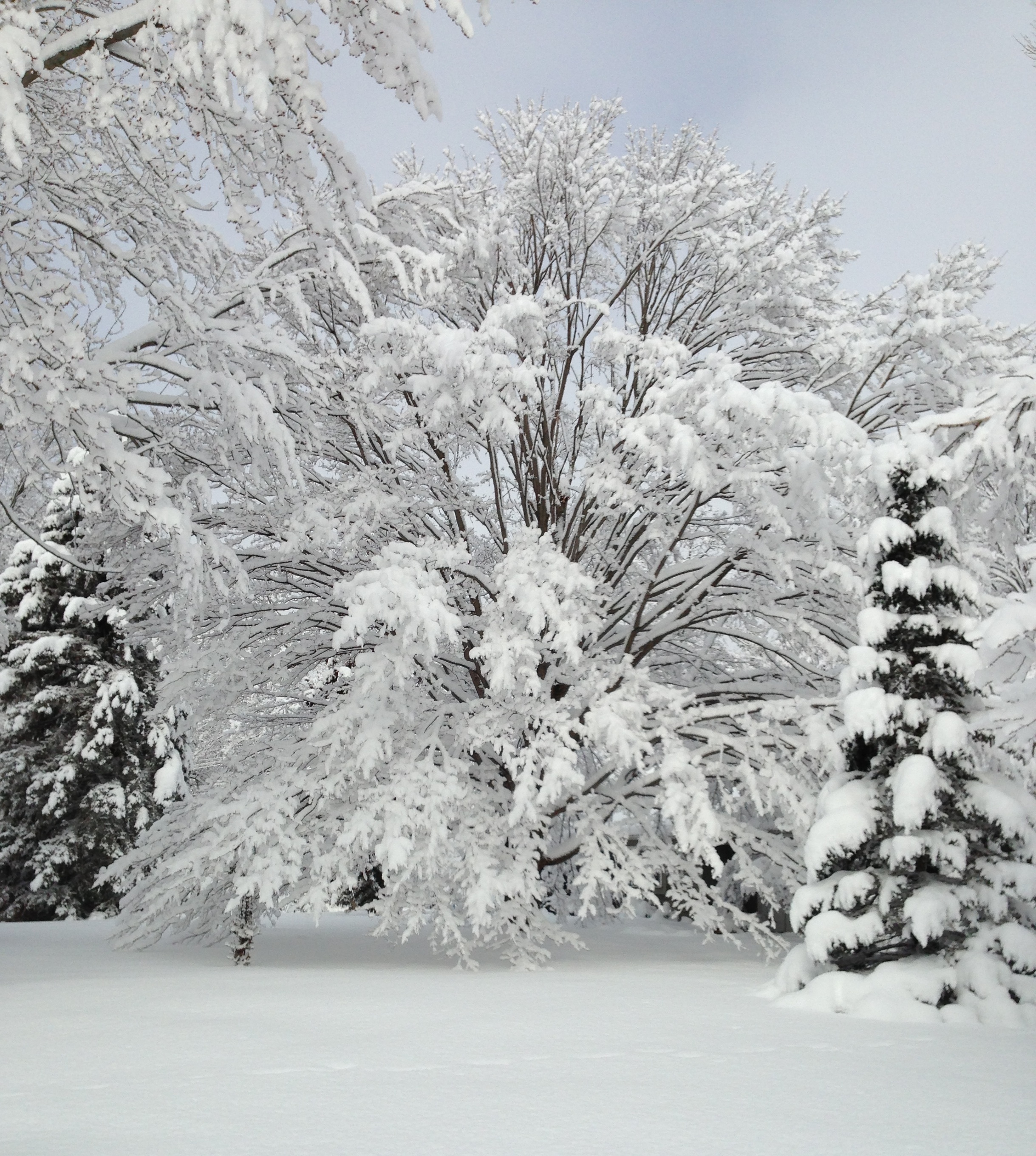
Snow-covered trees
After the storm.


Books Can Save a Life is a year old this month.

I’ve grown so fond of it here and of you who visit and comment. Meeting people from all over and re-connecting with friends and distant family  –  I never expected that.

Not to mention the beautifully conceived and produced blogs about books, writing, food, nature, gardening, travel, creativity, and other topics I’ve discovered, and the artistic geniuses behind them.

Books Can Save a Life is a lot like my backyard retreat, where I sit by our homemade pond after I walk or run. I always look forward to visiting Books to set down my thoughts and see who has stopped by.

To celebrate a year of Books, I’m having a book giveaway. By the end of February, leave a comment about a book you’re reading. a book you want to read, a book that’s becoming a movie, a book memory, or anything at all to do with reading, and I’ll put your name in a hat. (Actually, I use a rice bowl.) If I draw your name I’ll send you the book of your choice. If you can’t decide on a book, I’ll surprise you.

You might have noticed I’ve redecorated, too. I’ve chosen a new design theme in honor of the coming year and to signify a more expansive focus on topics beyond books. There’s so much I want to write about.

But you’ll still find plenty of books here.

Your comments and guest posts are what I absolutely love about this blog. Many of you spoke of books from your childhood that years later still evoke memories of family and loved ones, places you’ve been, and particular times in your lives. I think sometimes the very story or book we need comes along, or  somehow we’re led to find it.

Here are a a few comments from readers of Books this past year. Please keep them coming.

I can’t imagine my room without my personal bookcase, or a world without books. (Giuseppe)

It’s hard to put yourself in their places [The Hunger Games], living their lives and going through what they do daily in their “world,” but that’s what’s so great about books, they take you to different places and times through the amazing imagination of the authors. (Diana)

I find many so called adult novels pretentious. I want a story. I return, often, to what is classified as young adult literature, mostly because these are stories of life. Stories – in the true sense of the word. And, I can’t help but say that, years ago, I was saying to people, “Have you read the Harry Potter book?” And everyone said no. Then came that glorious day on the L in Chicago, traveling home from work, and I saw not one, not two, but six adults reading the book. I wanted to laugh out loud at the thought of those six people entering into another world…. (Donna)

Agatha Christie wrote a story without heroes; to me, that was heroic honesty.  Conversely, the inevitability of justice satisfied me. For all my contempt for two-faced authority, I still relished the idea of wrongdoers punished by divine oversight.  My sense of my own weakness as a child needed that reassurance. (Doug)

Cooking from Moosewood, even with its imperfections, was utopian. Funny how small, utopian practices can make you feel, despite the deepest contradictions, that summer is everlasting and life is good. (Judith)

….even the smallest person can step away from comfort and into challenge, that change is possible on scales small and large, that our efforts and intentions matter. The story reinforced for me that there are things in this world worth protecting–fellowship and love, food and conversation, adventure and courage, songs and stories. These are the things that sustain us when life is difficult, when we are hurt or afraid and have to be so much braver than we feel. (Adrienne)

Snow-covered bench

Enter my book giveaway: Kingsolver’s Flight Behavior

Been traveling for the Thanksgiving holidays and forgot to mention here at Books Can Save a Life that I’m giving away a free copy of Barbara Kingsolver’s Flight Behavior.

Flight Behavior book coverAll you need to do for a chance to win the book is check out my recent post, Now is the time to read Kingsolver’s Flight Behavior, and leave a comment about where you stand on climate change, or if you think a work of fiction such as Kingsolver’s can make a difference one way or the other.

I’m extending the deadline to December 3, when I’ll put the names of all who comment in a hat and draw the lucky winner.

I read an essay the other day in which the author mused that perhaps New York City will no longer exist in a hundred years. Or it will be located in Westchester County.

What do you think?

I welcome all thoughts and opinions (as long as we’re friendly and polite!)

So, comment away, please!

Barbara Kingsolver’s Flight Behavior

Man is born unto trouble as the sparks fly upward, she thought, words from the book of Job, made for a world unraveling into fire and flood.          Barbara Kingsolver, Flight Behavior

Flight Behavior book coverBarbara Kingsolver’s Flight Behavior blindsided me; I didn’t see the end coming, though perhaps I should have. Reading it on the heels of Hurricane Sandy only added to its impact. What incredible timing for this novel to be published just days after a superstorm brought a 13-foot storm surge to New York City.

I once lived in New York, so I found it hard to believe the scenes in the news: water pouring into the 9/11 construction site at the World Trade Center, Bellevue and NYU’s Tisch hospitals in lower Manhattan evacuated, entire neighborhoods destroyed on Staten Island.

Flight Behavior is about climate change and its consequences. If you don’t believe in climate change, you probably won’t like this book. If you do believe in it, you may still find Flight Behavior to be a thinly disguised polemic. I did. Sometimes I had a hard time losing myself in this particular fictional world as I like to do in a good novel.

Nonetheless, I found Flight Behavior to be powerfully and beautifully written. It made me uncomfortable, which is what I think Kingsolver intends for her readers. She loves the earth and respects it as a scientist. (Kingsolver has a degree in biology and worked as a scientist before she began to write fiction.) She wants people to wake up and do something before it is too late.

I couldn’t help thinking of Paul Gilding’s The Great Disruption, one of the most disturbing nonfiction books I’ve ever read on The Great Disruption book coverclimate change. Gilding believes our first priority should be to stop the earth from warming another couple of degrees, and this can be done only with a worldwide, cooperative effort, the likes of which we haven’t seen since World War II. If we don’t do something, Gilding believes disaster will soon be upon us – floods, famines, wars, the end of life as we know it.

He predicts (and hopes) enlightenment will come soon, this decade. People will realize something is wrong, mobilize, and take action.

In Flight Behavior, for a farmer’s wife with two young children, climate change quite suddenly becomes personal. She’s forced to take a stand and brought to a kind of enlightenment. I believe that’s a road we’ll all have to travel.

What do you think about climate change? If you’ve read Flight Behavior or The Great Disruption, please share your thoughts in the comments.

Quote from Flight Behavior, Barbara Kingsolver. HarperCollins Publishers, New York, 2012.

Discovering Argentina

What we did on our fall vacation:

Immersed ourselves in spring.

Each day balmier than the one before, with occasional chilly rain. Crescent moon from another point of view, an unfamiliar family of constellations in the night sky.

In Lelé de Troya’s green room (there are also red, yellow, and blue rooms), Malbec by candlelight, the Beatles, two couples celebrating 25th wedding anniversaries reminiscing about disco dancing in NYC, leisure suits, and long-ago first jobs. Finishing dessert at midnight while the rest of Buenos Aires just gets started.

Talking with many a taxi driver (Claudio, Lila, Juan, and a few more whose names I don’t recall) thanks to one of our foursome’s exuberant Spanish. (Buenas noches! Cómo estás? Yo hablo español pero no comprendo nada. Háblenos de Buenos Aires.) Our drivers are warm, friendly, opinionated, proud of their city but wanting things to be better, eager to speak with us. Trying to follow their rapid-fire Spanish, wishing we understood more.

Japanese Gardens
Jardin Japonés, Buenos Aires

Spanish haiku in the Japanese Gardens, a circle of Spanish-speaking Japanese women deep in conversation under a silk floss tree.

Reading in bed Pico Iyer’s Falling Off the Map: Some Lonely Places of the World, disliking his essay on Argentina in which he contends people here strive for the wealth and sophistication of Europe, but are only pale imitations of it. True for some, perhaps, but I see down-to-earth, hard-working Argentinians and a genuine, vibrant culture that is what it is.

Watching amazing tango dancers, learning the tango was partly invented by Italians who emigrated to La Boca, a working class section of Buenos Aires. Never before realizing the inventiveness and variation possible within the structure of tango.

More reading in bed after a long day walking the city, Lawrence Thornton’s novel, Imagining Argentina. Letting myself imagine, for a moment, what it would be like to have one’s teen-age daughter stolen away to the pampas in the night, never to be seen again. Recalling the crosses and banners of the Mothers of the Plaza de Mayo we’d seen.

Iguazu evenings, drinking Caipirinhas in the secret garden of our bed and breakfast run by a photographer from Calcutta who has spent forty years in Argentina. John cares deeply about local flora and fauna and plans to offer walk-about tours to teach people about the region’s ecology. Meeting Natalie (British), Christina (from Mexico, now British) Helen and Andre (British and South African, respectively, now living in Austria). And some Argentinians from Buenos Aires who say the middle class here is disappearing. Does that sound familiar?

In Iguazu National Park, hundreds, thousands of butterflies: deep purple on brown, art deco, Italian modern. They hitch a ride on our hats, sleeves, shoulders. Clusters of mint green and yellow-winged moths delicate as parchment, scattering like confetti in the wind. Monkeys, coatis, lizards, turtles, toucans.

Garganta del Diablo
Garganta del Diablo

Ending our trip viewing some of the 300 waterfalls in Iguazu. People from all over the world come to this remote place where Argentina, Brazil, and Paraguay meet. Standing before the immense, overwhelming Garganta del Diablo (the Devil’s Throat), welcoming the cool spray after our subtropical hike. Like Andre said one evening after he and Helen braved a boat that takes you as close as you can get to one of the biggest waterfalls, every particle of your body awakens.

You feel totally alive.

Waterfalls at Iguazu

If you’ve been to Argentina or can suggest good books about this beautiful country, please tell us in the comments below.

Zen in Nature

I was interested to read “Finding Zen in a Patch of Nature” in the New York Times today. David Haskell’s new book, The Forest Unseen: A Year’s Watch in Nature sounds wonderful. Plan to add it to my reading list.