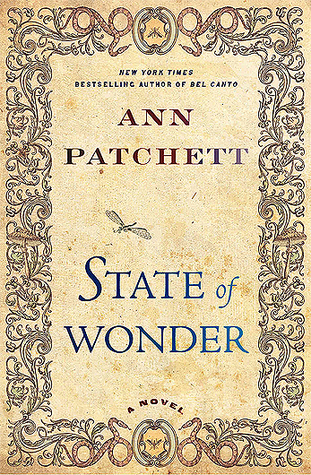
Facing your heart of darkness for love: State of Wonder

StateofWonder.jpg
“She was not terrified that the patient would die or she would lose the baby, she was terrified that she was doing something wrong in the eyes of Dr. Swenson.”


Ann Patchett’s State of Wonder is about a life severely, intentionally curtailed.

Marina Singh is a successful scientist conducting important research at a pharmaceutical company. Only she knows that long ago she’d bailed out of her own life.

When Marina was a chief resident in obstetrics, she performed a complicated delivery that ended badly. There was a lawsuit. Her marriage to a fellow resident dissolved. She wasn’t asked to leave the residency program, but she felt compelled to punish herself and leave on her own.

That way, she never had to face her classmates, or patients, or the brilliant, intimidating Dr. Swenson, again.  Anick Swenson had been the attending physician on call the day of the crisis. All the medical students both revered and feared her.

“She was harder on the women…She would tell them stories of her own days in medical school and how when she came along the men knit their arms together to keep her out. They made a human barricade against her, they kicked at her when she climbed over them, and now all the women were just walking through, no understanding or appreciation for the work that had been done for them.”

Marina never told her mother why she abruptly decided not to become a doctor. She never told her lover, Mr. Fox, who is president of the pharmaceutical company she works for. She never told her close friend and colleague, Anders Eckman, who has just died of fever in the Amazon jungle.

Now, Anders’ wife has begged Marina to find out what she can about Anders’ death and retrieve his body. And Mr. Fox has asked her to check on the progress of a top secret research project being conducted by none other than Dr. Swenson, who makes it a practice of remaining incommunicado.

Marina doesn’t want to set foot in the jungle, and she doesn’t want to see Dr. Swenson. But she goes, because she cares deeply for Anders, who has left behind a wife and three young boys.

Here is the particular nugget of the story I keep coming back to:

“The great, lumbering guilt that slept inside of her at every moment of her life had shifted, stretched.”

Marina has suffered and continues to suffer deeply, even though her suffering is hidden away. She knows what she’s lost. She was a bright, capable young woman who wanted to devote herself to caring for women and helping them bring new life into the world. Yet in the space of a few hours she walked away from it all. She’d spent the greater part of her adult life only half alive, using a fraction of her potential. She seems to be very much alone; she holds the other people in her life at a distance, and she settles for a less than fulfilling relationship with Mr. Fox.

Marina has never gotten over her past. She locked it away in a dark corner of her mind and got on with life. Facing her demons is the psychological story within the story of Marina’s journey into the Amazon jungle. It turns a plot driven novel into something more urgent and real for the reader, even if the reader is only half aware of it.

This fusing of outward adventure and inner journey is what ultimately made it impossible not to follow Marina into the darkness. I revisited some of my own life issues as Marina revisited hers.

I admire Marina, but not all of the decisions she makes as her story unfolds, and that’s as it should be when reading about a character who is real, alive.

The essential story in this book, for me, is the reclaiming of a life. By the end of the story, I was different.  Not in a dramatic way, but nonetheless something had shifted.  A truly great book such as this one stays with me and continues to wield its power. And I can’t begin to measure the impact of many books read over a lifetime.

Some people say the book is in danger of disappearing. But in a recent essay, Timothy Egan writes that people are actually reading more and buying more books. I think we will always hunger for the power of story and the collective wisdom of the great writers and thinkers.

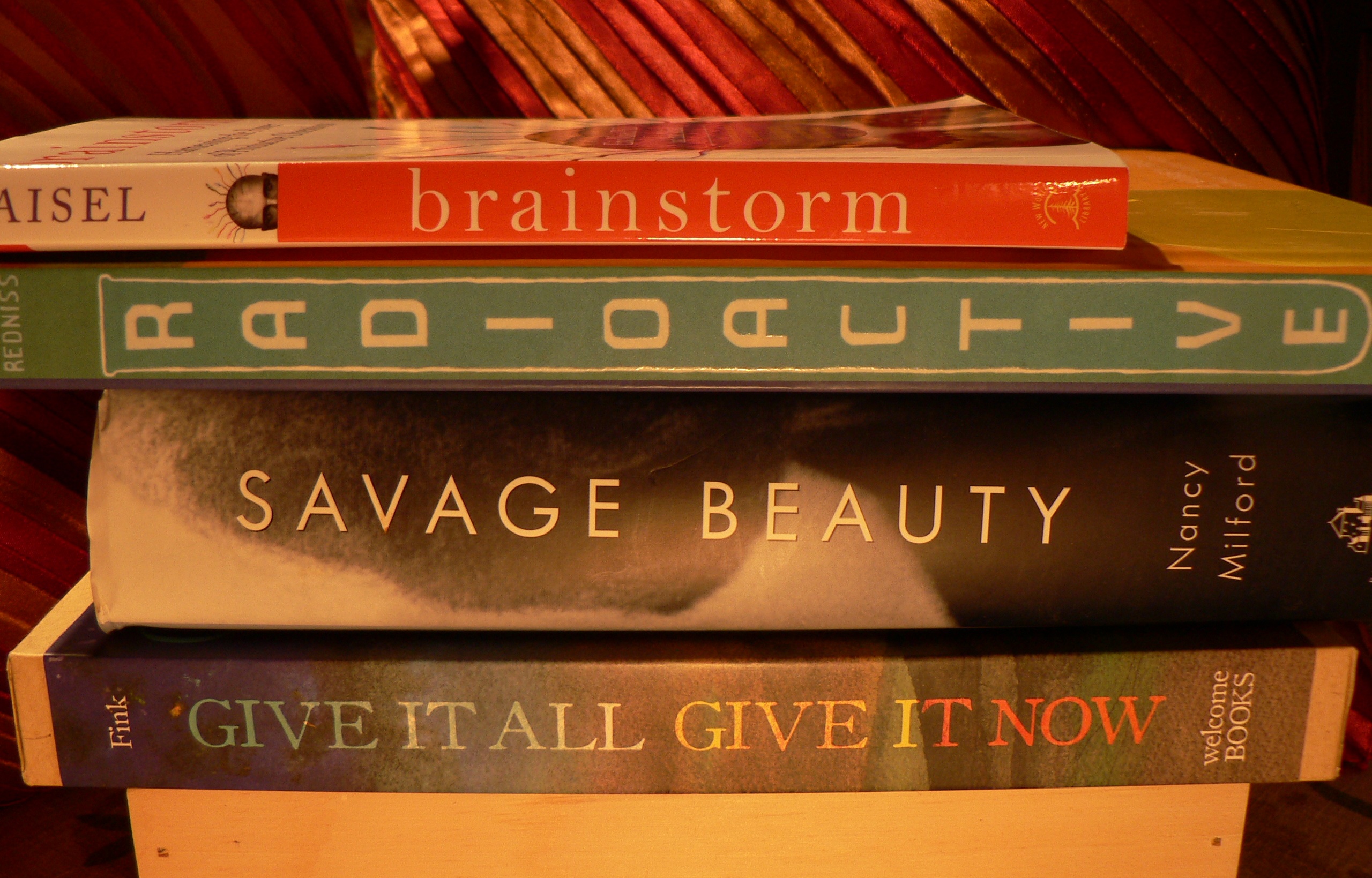


Try some book spine poetry: National Poetry Month

In celebration of National Poetry Month, here is my book spine poetry.

Try it. This small act of creation will bring you to a different place. Send me yours and I’ll post them.

the open road running with the mind of meditation falling off the map the writer's path

________________________________________________________

brainstorm radioactive savage beauty give it all give it now

Why There Should Have Been a Pulitzer Prize for Fiction

There was no Pulitzer Prize for fiction awarded this year because none of the three finalists received a majority vote from the Pulitzer board.

The judges who screened 300 or so books, narrowed the field to three, and submitted their choices to the board were just as surprised as everyone else when the decision was announced.

I think there should have been a fiction Pulitzer winner this year. Here’s why:

  1. Ann Patchett said so.
  2. Authors of books that may have been years in the making shouldn’t be denied the chance to win this prestigious prize just because they published in 2011.
  3. Fiction needs all the support it can get. The book as a form of artistic expression is reinventing itself before our eyes, and some think it may go the way of the dinosaur. This isn’t the time to be stingy with book awards.
  4. The Pulitzer Prize celebrates great storytelling about who we are and how we live in America. The three nominated books, as well as the other contenders, had important and unique things to say about that. Prizes such as the Pulitzer bring more readers to these works.
  5. We reward our sports figures and entertainers lavishly. Our greatest storytellers will never make that kind of money or achieve the fame of baseball players and movie stars, but they do deserve to be rewarded and honored.
  6. Many books published in 2011 were good enough to have been chosen, not just the three nominated; the lack of a prize creates the impression NO books were deemed worthy. I would think this was especially disappointing to the authors of two of the nominated books. (The Pale King was published posthumously.)

One of the disappointed judges said perhaps this will draw readers to three deserving books, rather than just one.

Maybe the Pulitzer board should change the rules so no artist or artistic form suffers when the numbers don’t add up just right.

The three Pulitzer nominees were:

Swamplandia! by Karen Russell

The Pale King, by David Foster Wallace

Train Dreams, by Denis Johnson

There are many fantastic books from 2011 to choose from. Let’s all buy one to show our support for the great writers and the great books.

Blue mushrooms and yellow tree bark – what would you do? State of Wonder

I write with unfortunate news of Dr. Eckman, who died of a fever two nights ago. Given our location, this rain, the petty bureaucracies of government (both this one and your own), and the time sensitive nature of our project, we chose to bury him here in a manner in keeping with his Christian tradition….Despite any setbacks, we persevere.

The letter writer, Dr. Annick Swenson, is a fearless force of nature.

Marina Singh, the protagonist, is not.

Watching the relationship between these two women unfold in Ann Patchett’s State of Wonder was one reason I couldn’t stop turning the pages.

If you’ve read the book or are in the process of reading it, I’d like to know what you think about these two women. Do you like them? Do they change as the story unfolds? For better or for worse?

What do you think about their relationship with men? I found myself comparing Dr. Swenson’s relationship with Dr. Rapp to Marina’s relationship with the men in her life, especially her father and Mr. Fox.

Any thoughts about Marina’s nightmares, induced by taking a drug to prevent malaria?

The conventional roles of mother, father, friend, lover, husband, wife, and child seem to become less strictly defined and more fluid as the story unfolds. What do you think about that?  Consider the Lakashi tribe, too.

What exactly was Easter all about? What do you think of the way Marina, Dr. Swenson, and other characters treated him?

Many of Patchett’s characters must make difficult moral choices. Do you agree with the choices they made? Do any surprise or upset you?

We encounter addicting yellow tree bark, blue mushrooms with hidden power, and lavender moths unlike any other species of moth. What do you make of how the characters responded to these discoveries? What would you do?

Please tell me what you think about any of this in the comments below. There are bound to be disagreements – the more discussion, the better!

What Albert Einstein Said to a Girl
It occurred to me that the books I’ve featured on this blog have so far been about strong, independent women departing from traditional roles.  When I was checking my email subscriptions before I wrote this post, I found this:
Albert Einstein once had a correspondence with a young girl who wanted to be a scientist. She regretted the fact that she was a girl but said she’d grown resigned to it. She hoped Einstein wouldn’t think less of her for being female.
You can read his reply in Brain Pickings, a website about creativity that I like, in a post about women in science.

The letter is from Dear Professor Einstein: Albert Einstein’s Letters To and From Children.

The quote at the beginning of this post is from State of Wonder by Ann Patchett, HarperCollins Books, 2011

Send Me Your Book Stories: Guest Posts Welcome

I’m surprised at how often I’ve read or heard, “This book changed my life,” and “This book saved my life,” since I began writing this blog.

If you have a Books Can Save a Life story, please consider guest posting it here. I’d like to create a virtual scrapbook of stories so we can share our reading journeys and find that next special book to read.

What do I mean by a Books Can Save a Life story? I mean any book that made your life better in a significant way, helped you through a tough time, or guided you through a major life change. Any book that occupies a sacred space in your memory or is intrinsic to your identity.

It could be a picture book, a novel, a memoir, a poem or a book of poems, a biography, a graphic novel, a collection of short stories. Any genre, or no genre at all,  from any time of your life.

On my About Valorie page, I mention a few books that made a difference in my life. Books that helped shape who I am and influenced my path in life. I’ll be writing about other reading moments in future posts.

If you’d like to share a story, send an email to valoriegracehallinan@gmail.com with the subject line: My Book Story. Please include a post of about 500 words or less in the body of the email or an idea/book you’re interested in writing about.

If you’d like, include a short bio and a link to your website or blog, if you have one.

If you prefer to remain anonymous, that’s fine. (Of course, you can always post anonymously in the comments.)

Please keep it simple. I’m looking for a personal experience of value to others that’s honest and from the heart.

Let’s read Ann Patchett’s State of Wonder

A handful of surprises await you in Ann Patchett’s State of Wonder.

Patchett has a way of blindsiding you with plot twists and moral dilemmas that leave you confused, off balance, maybe even a little pissed off. You’re left wondering – would that character really do that? In her situation, what would you do?

Some background: I became a medical librarian as a second career, and an unexpected pleasure has been working with medical students, nursing students, and residents just getting started in their careers.

About half of the medical students I meet are women. Back in the day, a couple of my female college friends became physicians, but they were the exception rather than the rule, and I don’t think most of us had the level of confidence I see in young women today.

I love seeing the amazing energy and commitment of today’s students, yet I know every day they are under an incredible amount of stress. That’s one of the reasons I was drawn to Ann Patchett’s State of Wonder.

It’s about a young obstetrics resident, Marina, who makes a terrible mistake that causes her to abandon medicine. The book picks up years later, when she travels alone into the Amazon jungle to investigate the death of her lab partner and fulfill a mission for the pharmaceutical company she works for.

Her mistake continues to cast a shadow over her life.

State of WonderThe other reason I was drawn to this book is, quite simply, I love everything Ann Patchett writes.  I’ve been a fan ever since Bel Canto.

It was the featured title a few years back in an annual event here, “If All of Rochester Read the Same Book.” Ann visited Rochester for three days and gave readings and talks at local schools and in the community.

When State of Wonder was published, she returned to Rochester and I attended one of her readings. The scene she read featured a terrifying encounter with an anaconda. You could have heard a pin drop.

Ann talked about a trip she took to the Amazon and how she got the idea for the scene, and the book. Turns out she had her own encounter with an anaconda, and she shared a few choice details about that with us. Such as the fact that the serpent smell was so strong, she had to throw away the clothes she’d been wearing.  Every last stitch.

Ann Patchett said she didn’t like the Amazon. It was creepy and she wasn’t going back any time soon.

Which gives you some idea of what Marina is faced with in State of Wonder. Marina is a strong woman (though she doesn’t know it). In a sense, the great mistake of her youth follows her into the jungle and this time she can’t avoid dealing with it.

The neat thing about this book is, you can travel to the Amazon jungle without taking any of the risks, just by slipping inside Marina’s skin.

It’s one hell of a trip.

I’m going to start (re)reading State of Wonder this weekend. Won’t you join me? Please take a couple of weeks to get started and we’ll meet back here the second half of April to talk.