Peter Lake’s New Year

Contradictions, paradoxes, and strong waves of feeling were things that Peter Lake had long before learned to call his own, so he was not surprised to be surprised by the gentleness of Mouquin’s usually boisterous New Year’s Eve….it had been the same when the century had turned, when the celebrants had been unable to celebrate and could only stand in awe of history as it moved its massive weight…like the vault door of a central bank….despite a thousand bottles of champagne and a hundred years of anticipation, Mouquin’s had been as quiet as a church on the Fourth of July. Women had wept, and men had found it hard to hold back the tears. As the clockwork of the millennia moved a notch in front of their eyes, it had taken their thoughts from small things and reminded them of how vulnerable they were to time.     Winter’s Tale, by Mark Helprin

A friend reads this passage every New Year’s Eve.

Sometimes I think I moved upstate from New York City because I was looking for Lake of the Coheeries.

Winter deer
New Year visitors

Quote from Winter’s Tale, Mark Helprin, Harcourt Brace Jovanovich, New York: 1983.

Christmas comfort

For the first course of my Christmas dinner, there must be something hot and inspiring – a cup of what is to me quite the most marvelous and stimulating of soups ever created, a deep carnelian-clear and concentrated fish consommè, an essence of Mediterranean fish and shellfish made aromatic with leeks and tomatoes, fennel stalks, lemon peel, olive oil and white wine.  Elizabeth David, in Elizabeth David’s Christmas

Friday was the winter solstice, a typically cold, gray day in upstate New York. This year, barren of snow and darker than usual in spirit.

The 50-bell carillon in the Rush Rhees Library tower at the University of Rochester rang 26 times, followed by melodies children love: “Mr. Rogers Theme,” “It’s a Small World,” and others. In the medical center chapel that afternoon, we lit candles to brighten the longest night and welcome the lengthening days.

Giant evergreen treesSnow fell that evening. The next morning, in the woodsy part of our backyard, I saw two young white-tailed deer hopping nimbly over a fallen tree.

We need comfort food more than ever this year. On Christmas Eve, I’ll make a feast of four fishes, not quite keeping up with the feast of seven fishes traditionally prepared in seaside Mediterranean villages. Seven for the seven sacraments of the Catholic Church. As for what kinds of fish you’d find on the Christmas Eve table in villages of old, I imagine whatever the fishermen caught that day.

When we travel to Sicily we stay in Scopello, a small village by the sea. We hear the fishing boats heading out before sunrise. Later, we go to the market and look over the fresh catch. One day, on a trip several years ago, our boys were thrilled to see a magnificent six-foot swordfish on display.

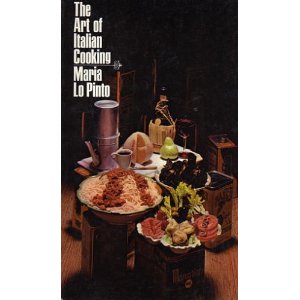
This year, I thumbed through an old paperback cookbook my Sicilian father often consulted, The Art of Italian Cooking by Maria Lo Pinto, to plan our holiday menu. The pages are yellow and I’ve lost the back cover of this edition, which was the 40th printing. First published by Doubleday in 1948, the cookbook was picked up by Bantam in 1955. The Art of Italian Cooking cover

The Christmases of my life seem to fall into distinct phases. Do yours? The holidays of my childhood and adolescence I spent in my family’s floral shop surrounded by poinsettias, piles of fragrant evergreen boughs, and fresh flowers by the dozens.

Then came Christmases in New York. I remember the paper bags filled with warm chestnuts I bought from street vendors, the Salvation Army bells ringing along Fifth Avenue, and the department store window displays: Lord & Taylor, Saks Fifth Avenue, B. Altman, Macy’s. I’d buy a small Christmas tree and bring it home by taxi to my third floor walk-up.

On to upstate New York, and Christmases with my husband and two boys. Decorating the tree, watching the children dressed as angels and sheep in the Christmas pageant, waiting for Santa, leaving cookies and milk for him by the fireplace and a little something for the reindeer. One Christmas morning, the boys discovered a fresh hoof print pressed into the small bowl of oats.

Now, we wait for two young men to come home for the holidays. We have a wonderful time, and the holidays are over way too soon.

If you’d like, leave a Christmas memory in the comments below.

Quote from Elizabeth David’s Christmas, edited by Jill Norman. David R. Godine, Boston: 2008.

Evergreen photo by M. Hallinan

The most important thing

Prayer wheel

For three days I’ve been thinking about the families of the children who died in Newtown, Connecticut.

I’ve been thinking about what it’s like to be a parent.

Our first child was born prematurely on a bright, crisp autumn day. One minute I was lying in bed planning how I’d spend my Sunday, the next my husband and I were racing to the hospital. Our wee one seemed determined to make his appearance on planet earth right then and there on Interstate 90.

A few hours later – after a very short labor – we had a son.

I looked at him sleeping on his tummy in his isolette in the NICU. A scrunched-up bundle in a baby blanket with his little bottom in the air and a head of black Irish/Sicilian hair. Suddenly I knew I would sacrifice anything, even my life, for this new little person. It was like when you look at someone you’ve seen before and realize you’re in love – except it was much, much more than that.  For a moment my ego dissolved. I was no longer the center of my own little universe.

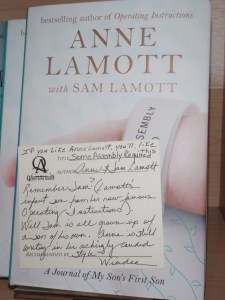
Book cover, Some Assembly Required
As displayed in Queen Anne Books, Seattle

A few years later, when I read Anne Lamott’s words in Operating Instructions, I thought: she has it exactly right. Last week, I came across the same passage again on one of my favorite blogs, and I planned to share the post and add my thoughts. Then Friday happened and Lamott’s words took on a greater urgency for me as I shopped at the market for Christmas cookies and decorations.

Before I got pregnant with Sam, I felt there wasn’t anything that could happen that would utterly destroy me. . . . Now there is something that could happen that I could not survive: I could lose Sam. I look down into his staggeringly lovely little face, and I can hardly breathe sometimes. He is all I have ever wanted, and my heart is so huge with love that I feel like it is about to go off. At the same time, I feel that he has completely ruined my life, because I didn’t used to care all that much.

I think that moments of great joy and great tragedy shock us out of the ordinary and awaken within us a singular intensity of compassion, good will, and love. The boundaries between us and them, between the self and the other, fall away, if only temporarily.

There will be plenty of time later to ask why and bicker and debate the meaning of Newtown and what can be done to stop it from happening again.

The most important thing now is to ride the great wave of love and compassion this tragedy has released into the world – for as long as it lasts –  and take care of our children, 27 heartbroken families, and each other.

Quote: Operating Instructions: A Journal of My Son’s First Year, Anne Lamott. Fawcett Columbine, New York: 1993.

Family cookbooks that become heirlooms

I asked my brother, John, to contribute to my series on favorite family cookbooks. I’ve tasted some of the recipes from the cookbook below, prepared by John. Fabulous, unpretentious Sicilian cooking, the kind we grew up with.
The Sicilian Gentleman's Cookbook book coverI often consult The Sicilian Gentleman’s Cookbook [by Don Baratta] when I want to do some Sicilian cooking. I think cooking becomes very personal, because we all have different tastes. I remember my dad describing different ways to make tomato sauce.  His mom, my grandmother, liked to make simple sauce. You cook down the tomatoes, add spices and, of course, garlic and onion, and you’re done….simple. But my grandfather had to have his sauce strained. Absolutely forbidden to have seeds and skin involved.
To me, The Sicilian Gentleman’s Cookbook is simple cooking. Just the way I imagine peasants cooked in Sicily, because they didn’t have much. They made do with what was available. I usually pull down the book for a quick idea and I go with what we have. Simple. I suggest the artichoke hearts with pasta, which is a family favorite when we get together with friends for Valentine’s Day. I also like the fish stew/soup recipe. It’s really a remarkable meal.
When we were visiting at Thanksgiving, I was browsing through the cookbook and found the Sicilian gentleman’s secret to losing weight: have a bowl of homemade soup every night for dinner. Sounds like a great idea for the long, cold winter nights to come. A hot bowl of homemade soup with a slice of fresh bread and a glass of Malbec or Beaujolais Nouveau, then a good book in front of the fire.
Elizabeth David’s literature of cookery
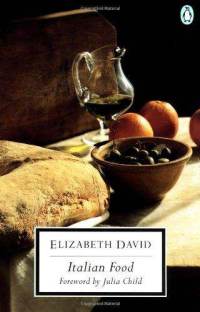
Italian Food book cover
John’s story got me thinking about one of my favorite Italian cookbooks – Elizabeth David’s Italian Food.  The recipes are somewhat antiquated and difficult to re-create, because you can’t always find the proper, authentic ingredients, but they’re mouthwatering all the same. David, who was British, raises food writing to a high art. This is a book you could read and enjoy by a winter fire every evening, without ever making a recipe.
It was difficult to choose an excerpt, the writing is so good, but here are two of my favorites:
It is worth noting that in the dining-cars of trains, where the food is neither notably good nor to everyone’s taste, a dish of uova al burro may always be ordered instead of the set meal and will be brought rapidly and with perfect amiability by the dining-car waiter. So browbeating are the attendants in certain French and English railway dining cars over this question of ordering eggs or sandwiches instead of the dull, expensive, six-course meal provided that I have thought the matter worth mentioning.
She’s talking about a bygone era that sounds wonderful to me. Here is a link to the dining car menus on Amtrak’s long-distance trains – they even serve meals on Christmas Day.
Here is David’s description of a Venetian fish market:
The colours of the peaches, cherries, and apricots, packed in boxes lined with sugar-bag blue paper matching the blue canvas trousers worn by the men unloading the gondolas, are reflected in the rose-red mullet and the orange vongole and cannestrelle which have been prised out of their shells and heaped into baskets….In Venice even ordinary sole and ugly great skate are striped with delicate lilac lights, the sardines shine like newly-minted silver coins, pink Venetian scampi are fat and fresh, infinitely enticing in the early dawn.
I’d like to continue this family cookbook series, so send me the titles of your favorite family cookbooks and I’ll list them here. If you have a story or anecdote about a particular cookbook, please send it along.
Barbara Kingsolver’s Flight Behavior goes to….
Darlene Niman, who owns and operates Out With a Friend, a senior companion service in New York City. She says one of the best books she’s read recently is That Summer in Sicily by Marlena De Blasi.
Quotes from:
Italian Food, Elizabeth David, Penguin Books, New York: 1987.
The Sicilian Gentleman’s Cookbook, 3rd Revised Edition, Don Baratta, Firefly Books, Buffalo: 2002.

Enter my book giveaway: Kingsolver’s Flight Behavior

Been traveling for the Thanksgiving holidays and forgot to mention here at Books Can Save a Life that I’m giving away a free copy of Barbara Kingsolver’s Flight Behavior.

Flight Behavior book coverAll you need to do for a chance to win the book is check out my recent post, Now is the time to read Kingsolver’s Flight Behavior, and leave a comment about where you stand on climate change, or if you think a work of fiction such as Kingsolver’s can make a difference one way or the other.

I’m extending the deadline to December 3, when I’ll put the names of all who comment in a hat and draw the lucky winner.

I read an essay the other day in which the author mused that perhaps New York City will no longer exist in a hundred years. Or it will be located in Westchester County.

What do you think?

I welcome all thoughts and opinions (as long as we’re friendly and polite!)

So, comment away, please!

Barbara Kingsolver’s Flight Behavior

Man is born unto trouble as the sparks fly upward, she thought, words from the book of Job, made for a world unraveling into fire and flood.          Barbara Kingsolver, Flight Behavior

Flight Behavior book coverBarbara Kingsolver’s Flight Behavior blindsided me; I didn’t see the end coming, though perhaps I should have. Reading it on the heels of Hurricane Sandy only added to its impact. What incredible timing for this novel to be published just days after a superstorm brought a 13-foot storm surge to New York City.

I once lived in New York, so I found it hard to believe the scenes in the news: water pouring into the 9/11 construction site at the World Trade Center, Bellevue and NYU’s Tisch hospitals in lower Manhattan evacuated, entire neighborhoods destroyed on Staten Island.

Flight Behavior is about climate change and its consequences. If you don’t believe in climate change, you probably won’t like this book. If you do believe in it, you may still find Flight Behavior to be a thinly disguised polemic. I did. Sometimes I had a hard time losing myself in this particular fictional world as I like to do in a good novel.

Nonetheless, I found Flight Behavior to be powerfully and beautifully written. It made me uncomfortable, which is what I think Kingsolver intends for her readers. She loves the earth and respects it as a scientist. (Kingsolver has a degree in biology and worked as a scientist before she began to write fiction.) She wants people to wake up and do something before it is too late.

I couldn’t help thinking of Paul Gilding’s The Great Disruption, one of the most disturbing nonfiction books I’ve ever read on The Great Disruption book coverclimate change. Gilding believes our first priority should be to stop the earth from warming another couple of degrees, and this can be done only with a worldwide, cooperative effort, the likes of which we haven’t seen since World War II. If we don’t do something, Gilding believes disaster will soon be upon us – floods, famines, wars, the end of life as we know it.

He predicts (and hopes) enlightenment will come soon, this decade. People will realize something is wrong, mobilize, and take action.

In Flight Behavior, for a farmer’s wife with two young children, climate change quite suddenly becomes personal. She’s forced to take a stand and brought to a kind of enlightenment. I believe that’s a road we’ll all have to travel.

What do you think about climate change? If you’ve read Flight Behavior or The Great Disruption, please share your thoughts in the comments.

Quote from Flight Behavior, Barbara Kingsolver. HarperCollins Publishers, New York, 2012.

Wishes in a Japanese garden

Wishes

Remembering spring (just a few weeks ago) in the Jardín Japonés, Buenos Aires. All these wishes placed end to end would make a poem long enough to fill a book.

Every reader has a “My Bookstore”

Just had to tell you about a new book to be released on November 13 by Black Dog & Leventhal Publishers, My Bookstore: Writers Celebrate Their Favorite Places to Browse, Read, and Shop, edited by Ronald Rice with an introduction by Richard Russo.

My Bookstore features essays by 84 authors, including Ann Patchett, Ian Frazier, Chuck Palahniuk, Rick Bragg, and Terry Tempest Williams.

So far, I’ve visited three of the bookstores: Powell’s in Portland, Oregon; Elliot Bay Book Company in Seattle (see my post about Elliot Bay and a few other Washington bookstores); and The Strand in New York City.

Looks like California and New York are well represented, as you might expect. Sorry to see nothing listed for Cleveland (my hometown) or Rochester, NY.  Suggestions, anyone?

I’m adding this book to my holiday wish list.

Oh, and if you have a favorite bookstore, tell us in the comments.

Moosewood Days

Cooking from Moosewood…was utopian.      – J. L. Newton

Moosewood Cookbook Cover
J. L. Newton’s well-used copy of the Moosewood Cookbook by Mollie Katzen

Just hours after I posted a call for stories and anecdotes about treasured family cookbooks, author J. L. Newton sent me a delightful excerpt from her forthcoming memoir, Tasting Home: Coming of Age in the Kitchen.

For me, nothing captures the essence of upstate New York’s lush, Finger Lakes farmland and local, fresh produce like the Moosewood cookbooks and the Moosewood Restaurant. I raised my kids on many a Moosewood recipe. Whenever we camped in Taughannock Falls State Park, we’d look forward to a meal at the restaurant in Ithaca.  Our boys always ordered the macaroni and cheese.

A few years back, during a month-long artist-in-residence stay at the Constance Saltonstall Foundation for the Arts, I enjoyed the home cooking of Judy Barringer, a Moosewood co-founder, who at the time was the Saltonstall chef and cook. Never in my life have I tasted such wonderful vegetarian comfort food. I didn’t know a hamburger made from polenta could taste so good.

So you can see why I was delighted when Judy Newton offered to share Moosewood memories from her “mini-commune” days. Here’s what she had to say:

In the summer of 1985, I was living with three men—-my first husband, Dick, who now had a boyfriend named Ed; my second husband, Max, whom I’d  married with many misgivings the year before; and Nigel, a longtime friend of Max who was doing research in Philadelphia.

A photo shows me sitting with Dick and Max at the table on our deck. Pregnant and wearing striped work overalls, I have long, curly hair. I’m resting my head on my hand and looking pleased, as if paradise had come again.

Dick’s honey-colored mustache droops seductively.  Max has a Jewish Afro and a wide, full beard. Pink flowers float above a green vase in the center of the table, and our plates are full of chicken, rice, and broccoli. It is a plain meal, with few ingredients, which means Max cooked it.

Dick took his recipes from gourment magazines, but Nigel and I had discovered Moosewood Cookbook. On the (separate) nights we cooked that summer, dinner consisted of our garden on a plate.

Excerpt from Tasting Home: Coming of Age in the Kitchen:

I never looked to Moosewood for two-star recipes. Indeed, many of its dishes squeaked by, in our rating system, with only a star above a check, meaning they were fine for everyday meals but not for guests.  “Swiss Cheese and Mushroom Quiche” fell into this category, though it involved a cup and a half of tangy gruyere cheese. My note in the margin said Julia Child’s version was better. Was it the Moosewood crust, partly whole wheat and made with buttermilk instead of water? Was it that Child’s Mastering the Art of French Cooking used heavy cream and nutmeg rather than milk and mustard? Was it that the mushrooms in Moosewood were innocent of shallots and Madeira?

Several Moosewood dishes earned only a check above a star, which translated as “not worth the effort.” We assigned “Vegetarian Chili” (with kidney beans, bulgur, celery, carrots, peppers, and tomatoes) to that category. “Don’t bother,” I wrote in the margin.  Was it the tomato juice? Did I under spice?

Going wrong with Moosewood recipes was a drag because they usually called for a ton of ingredients. It was great when the recipes worked because they allowed you to unload a basket of summer produce (after a good deal of chopping) into a single pot.“Vegetable Stroganoff” called for onions, mushrooms, and six cups of broccoli, carrots, cauliflower, zucchini, peppers, and cherry tomatoes.

“Vegetable Stew” featured potatoes, carrots, celery, eggplant, zucchini, broccoli, mushrooms and tomatoes. Both were tasty dishes in the check/star category.

But “Ode to Chang Kung” with its broccoli, mushrooms, bean sprouts, water chestnuts, bamboo, tofu and sesame seeds (plus cashews, scallions, and chopped green peppers on top) came out weird and bland. Was it the quarter cup of something called “taman?”

“Never again!” Nigel wrote at the top of the recipe.

At other times Moosewood recipes, with their cornucopia of ingredients, demanded additions that seemed designed to remind us of their hippie roots. Why else would “Spinach-Rice Casserole” (which featured brown rice, spinach, onion, garlic, eggs, milk and a cup-and-a-half of cheddar cheese) call for tamari and a quarter cup of sunflower seeds?

Why did “Vegetable Stew,” an otherwise straightforward dish, demand molasses? And why did “Broccoli Noodle Casserole” with its decadent three cups of ricotta, one cup of cheddar, and one cup sour cream even bother with wheat germ sprinkled over the top?

But it didn’t matter. I cooked from Moosewood that summer because I liked the idea of it. The book was produced by a collective, and we were a collective too. The restaurant had no “boss,” and despite Max’s alpha personality, our house had no boss either. We rotated shopping, cooking, and washing dishes, which made me feel heady, and slightly guilty, about having such domestic and culinary leisure.

I was also drawn to the Moosewood philosophy of “convenience and economy” which we certainly got to practice since our ingredients came from our garden outside the kitchen door.

Moosewood celebrated “health, lightness, purity,” a trinity I wanted to pursue, and I liked the homemade quality of the book itself – the hand lettering, the sparkly drawings.

Our favorite recipe, “Spinach–Rice Casserole,” was illustrated with a hairy unicorn encountering a large, strange bird. Hand drawn unicorns called attention to the creativity, love, and labor that, often invisibly, go into making the sweetness of the everyday.

Cooking from Moosewood, even with its imperfections, was utopian. Funny how small, utopian practices can make you feel, despite the deepest contradictions, that summer is everlasting and life is good.

Judith Newton’s memoir, Tasting Home: Coming of Age in the Kitchen, will be published by She Writes Press in February, 2013. Visit her blog at tasting-home.com.

Judith is Professor Emerita in Women and Gender Studies at U.C. Davis. She is the author and co-editor of five works of nonfiction on nineteenth-century British women writers, feminist criticism, women’s history, and men’s  movements. Four of these works will be reprinted as E-Books by Routledge and the University of Michigan Press in the fall of 2012.

More Moosewood

The November/December 2012 issue of Spirituality & Health includes a feature story, “40 Years of Mooosewood.” (Print version only.)  The restaurant is celebrating its 40th anniversary this year.

Do you have a tried and true Moosewood recipe? Tell us in the comments below.

Do You Have a Treasured Family Cookbook?

Between now and the New Year, my readers and I will be sharing our favorite family cookbooks. Please tell us in the comments below about special cookbooks meaningful to you and your family. Or, send your stories and anecdotes to valoriegracehallinan@gmail.com.

Let’s share family cookbooks and food traditions

Antique cooking utensilsIn one of my recent posts, Children’s lit of my ancestry, my Italian cousin wrote about a book traditionally read by Italian families, and I wondered if my father read it when he was growing up.

A friend of mine commented that she’d inherited many of her father’s children’s books, and her grandmother had passed on to her a family Czech cookbook.

That gave me the idea of sharing our best-loved family cookbooks and food traditions as we approach the holiday season. I’ve a few books I’d like to share, and it would be fun to hear from you, too.

Is there a much-loved, well-worn cookbook your mother, father, grandparents or even great-grandparents used? What is special about it or meaningful to you? It could be out of print or a familiar classic. I’d like to share an eclectic mix of titles and traditions.

Maybe you have a story to tell in connection with a particular recipe, meal, holiday, or family memory.

Over the next two months, as we prepare to cook some of our favorite holiday meals, I’d love to hear about cookbooks unique and special to your family. Guest posts about a valued family cookbook or food tradition, or slice-of-life memoir snippets are especially welcome.  Please send cookbook titles, comments, anecdotes, and inquiries about doing a guest post to my email at valoriegracehallinan[at]gmail[dot]com.

Photo from Library of Congress photostream.