What one loves in childhood stays in the heart forever. Mary Jo Putney
After the storm.
Books Can Save a Life is a year old this month.
I’ve grown so fond of it here and of you who visit and comment. Meeting people from all over and re-connecting with friends and distant family – I never expected that.
Not to mention the beautifully conceived and produced blogs about books, writing, food, nature, gardening, travel, creativity, and other topics I’ve discovered, and the artistic geniuses behind them.
Books Can Save a Life is a lot like my backyard retreat, where I sit by our homemade pond after I walk or run. I always look forward to visiting Books to set down my thoughts and see who has stopped by.
To celebrate a year of Books, I’m having a book giveaway. By the end of February, leave a comment about a book you’re reading. a book you want to read, a book that’s becoming a movie, a book memory, or anything at all to do with reading, and I’ll put your name in a hat. (Actually, I use a rice bowl.) If I draw your name I’ll send you the book of your choice. If you can’t decide on a book, I’ll surprise you.
You might have noticed I’ve redecorated, too. I’ve chosen a new design theme in honor of the coming year and to signify a more expansive focus on topics beyond books. There’s so much I want to write about.
But you’ll still find plenty of books here.
Your comments and guest posts are what I absolutely love about this blog. Many of you spoke of books from your childhood that years later still evoke memories of family and loved ones, places you’ve been, and particular times in your lives. I think sometimes the very story or book we need comes along, or somehow we’re led to find it.
Here are a a few comments from readers of Books this past year. Please keep them coming.
I can’t imagine my room without my personal bookcase, or a world without books. (Giuseppe)
It’s hard to put yourself in their places [The Hunger Games], living their lives and going through what they do daily in their “world,” but that’s what’s so great about books, they take you to different places and times through the amazing imagination of the authors. (Diana)
I find many so called adult novels pretentious. I want a story. I return, often, to what is classified as young adult literature, mostly because these are stories of life. Stories – in the true sense of the word. And, I can’t help but say that, years ago, I was saying to people, “Have you read the Harry Potter book?” And everyone said no. Then came that glorious day on the L in Chicago, traveling home from work, and I saw not one, not two, but six adults reading the book. I wanted to laugh out loud at the thought of those six people entering into another world…. (Donna)
Agatha Christie wrote a story without heroes; to me, that was heroic honesty. Conversely, the inevitability of justice satisfied me. For all my contempt for two-faced authority, I still relished the idea of wrongdoers punished by divine oversight. My sense of my own weakness as a child needed that reassurance. (Doug)
Cooking from Moosewood, even with its imperfections, was utopian. Funny how small, utopian practices can make you feel, despite the deepest contradictions, that summer is everlasting and life is good. (Judith)
….even the smallest person can step away from comfort and into challenge, that change is possible on scales small and large, that our efforts and intentions matter. The story reinforced for me that there are things in this world worth protecting–fellowship and love, food and conversation, adventure and courage, songs and stories. These are the things that sustain us when life is difficult, when we are hurt or afraid and have to be so much braver than we feel. (Adrienne)
I like what Deborah has to say about one of her favorite cookbooks, published during World War II, because that was my parents’ era. Whenever I hear about Victory Gardens and rationing, I remember my mother telling me about how you couldn’t buy silk stockings back then, and how she and her siblings had to take turns tending the kitchen garden, and how there were no boys to go out with because they were all fighting overseas.
I think about my father in the Army in Europe, 1943. He missed his mother’s Italian cooking, and one cold November day while exploring Luxembourg he happened upon a tavern where there was an Italian wedding celebration. The family welcomed him with open arms and invited him to dinner the following day. It was my father’s last good meal before he was wounded at Cherbourg a few days later. He ate Army hospital rations for over a year while he recuperated.
Discovering book gems from the past is a pleasure quite different from cracking open a brand new book. I’m looking forward to tracking down a copy of Deborah’s family treasure.
Here’s what she had to say:
One of my favorite cookbooks was passed down to me from my mother: The Lily Wallace New American Cook Book, published in 1941. What I love about it is how it shows a whole different era of cooking “basics”. It has recipes for cooking frogs legs (3 recipes), grouse (3), rabbit (4), squirrel (2), turtle (2), snail (alas, 1) as well as other kinds of game (quail, partridge, venison, woodchuck, and pheasant.) It also has sections on preserving food, including canning, brining, and pickling.
My favorites are sections on: Ration Cooking, Saving Food for Victory, Saving Fuel, and Sugar Ration Cooking. The “Saving Food and Expense for Victory” chapter starts out:
“America may march to victory on its stomach. A nation’s morale and health depend greatly upon food. If the homemaker can do nothing else, she can wage an earnest battle for health and strength for her family in the kitchen, and thus contribute her share to ultimate victory on the military front.”
Another chapter I love is on menu planning, which includes sections on a Plan for a Liberal Diet ($3000 or over income) down to A Plan for a Restricted Diet for Emergency Use ($1000 or less annual income – this one restricts meats mostly–Thursday’s dinner consists of whole-wheat chowder with carrots and potatoes, and bread; Saturday’s dinner consists of Hominy soup, stewed prunes, bread and butter. Yum.)
Deborah has sailed around the world, and she blogs about her journey, and nature, and writing at her beautiful site, Living at the Edge of the Wild. She writes fiction, essays, articles, poems and book reviews. You can read her work at http://www.djbrasket.com/.
Please tell us about your favorite family cookbook in the comments, or share a family cookbook story with us – send me an email at valoriegracehallinan@gmail.com.
Next up: I’ll be celebrating the first-year anniversary of Books Can Save a Life with an “open house” and a book giveaway.
This past fall and early winter there was a perfect storm of top authors publishing new books. I wanted to read a handful of them to see what possesses some of our best creative minds and our popular culture. I wanted to break out of old habits and venture to new places I wouldn’t normally find on my own.
I didn’t get to as many books as I’d planned, but I did read:
This Is How You Lose Her; and a previously published book, The Brief Wondrous Life of Oscar Wao, by Junot Diaz
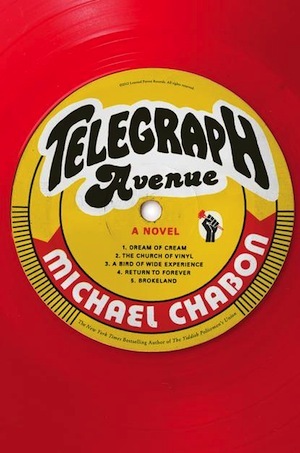
Telegraph Avenue, by Michael Chabon
Sweet Tooth, by Ian McEwan
Most difficult of all was acclimating to the world of Telegraph Avenue. I almost gave up on it. I couldn’t keep Chabon’s characters straight, I was clueless about the endless blaxploitation and 1970s cultural allusions, even though that was my coming-of-age time, and I sometimes struggled with the rich, complex (and masterful) prose. The great librarian Nancy Pearl has a Rule of 50: Stop reading after 50 pages if you don’t like the book, and if you’re over 50 you can subtract your age from 100 and stop there. So I was well within my rights to stop before 50 pages, but I kept going with Telegraph Avenue, and it was worth it.
To me, Telegraph Avenue and Junot Diaz’s books are similar in that I entered completely unfamiliar hearts, minds, and worlds. I’m unlikely to stop by a used record store in Oakland, California any time soon, or meet the kinds of characters (and I mean that in more than one sense of the word) who might hang out there. In Telegraph Avenue, Archy (who is black) and Nat (who is white) are best friends, vinyl record shop business partners, and musicians struggling to make a living in a neighborhood that’s seen better days.
For one reason or another – race, ethnicity, gender, sexual orientation, changing times – the characters in Telegraph Avenue are outsiders or has-beens or both: former blaxploitation and martial arts stars, connoiseurs of soul and jazz and long-forgotten record albums, fine musicians in their own right. Many are regulars at Archy and Nat’s Brokeland Records, which reminded me of the bar in the TV show “Cheers.” I grew to like and care about these characters in large part because of their passion for music and devotion to their art. My godfather was a jazz pianist, and I dated a jazz musician. I remember how both lived and breathed jazz, in the same way Archy, Nat, and others do in Telegraph Avenue. Music shaped their lives, and when they were playing a gig, they had an aura of dignity and charisma others envied.
Yet, both my godfather and the musician I dated played the kind of jazz that was seen by many as antiquated in the 1960s and 70s when music was reinventing itself. There is the same sense of this passing away of art forms in Telegraph Avenue, and of people being rushed headlong into the future while trying to preserve what shouldn’t be lost.
If you’ve read Telegraph Avenue, what did you think? Please comment!
I’d like to give equal time to new, lesser known, and independent authors, so I plan in the coming months to read a sampling of fiction by some of these writers. If you have a book to suggest please do in the comments.
Contradictions, paradoxes, and strong waves of feeling were things that Peter Lake had long before learned to call his own, so he was not surprised to be surprised by the gentleness of Mouquin’s usually boisterous New Year’s Eve….it had been the same when the century had turned, when the celebrants had been unable to celebrate and could only stand in awe of history as it moved its massive weight…like the vault door of a central bank….despite a thousand bottles of champagne and a hundred years of anticipation, Mouquin’s had been as quiet as a church on the Fourth of July. Women had wept, and men had found it hard to hold back the tears. As the clockwork of the millennia moved a notch in front of their eyes, it had taken their thoughts from small things and reminded them of how vulnerable they were to time. Winter’sTale, by Mark Helprin
A friend reads this passage every New Year’s Eve.
Sometimes I think I moved upstate from New York City because I was looking for Lake of the Coheeries.
New Year visitors
Quote from Winter’s Tale, Mark Helprin, Harcourt Brace Jovanovich, New York: 1983.
For the first course of my Christmas dinner, there must be something hot and inspiring – a cup of what is to me quite the most marvelous and stimulating of soups ever created, a deep carnelian-clear and concentrated fish consommè, an essence of Mediterranean fish and shellfish made aromatic with leeks and tomatoes, fennel stalks, lemon peel, olive oil and white wine. Elizabeth David, in Elizabeth David’s Christmas
Friday was the winter solstice, a typically cold, gray day in upstate New York. This year, barren of snow and darker than usual in spirit.
The 50-bell carillon in the Rush Rhees Library tower at the University of Rochester rang 26 times, followed by melodies children love: “Mr. Rogers Theme,” “It’s a Small World,” and others. In the medical center chapel that afternoon, we lit candles to brighten the longest night and welcome the lengthening days.
Snow fell that evening. The next morning, in the woodsy part of our backyard, I saw two young white-tailed deer hopping nimbly over a fallen tree.
We need comfort food more than ever this year. On Christmas Eve, I’ll make a feast of four fishes, not quite keeping up with the feast of seven fishes traditionally prepared in seaside Mediterranean villages. Seven for the seven sacraments of the Catholic Church. As for what kinds of fish you’d find on the Christmas Eve table in villages of old, I imagine whatever the fishermen caught that day.
When we travel to Sicily we stay in Scopello, a small village by the sea. We hear the fishing boats heading out before sunrise. Later, we go to the market and look over the fresh catch. One day, on a trip several years ago, our boys were thrilled to see a magnificent six-foot swordfish on display.
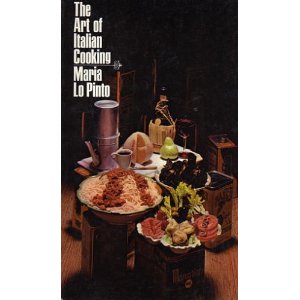
This year, I thumbed through an old paperback cookbook my Sicilian father often consulted, The Art of Italian Cooking by Maria Lo Pinto, to plan our holiday menu. The pages are yellow and I’ve lost the back cover of this edition, which was the 40th printing. First published by Doubleday in 1948, the cookbook was picked up by Bantam in 1955.
The Christmases of my life seem to fall into distinct phases. Do yours? The holidays of my childhood and adolescence I spent in my family’s floral shop surrounded by poinsettias, piles of fragrant evergreen boughs, and fresh flowers by the dozens.
Then came Christmases in New York. I remember the paper bags filled with warm chestnuts I bought from street vendors, the Salvation Army bells ringing along Fifth Avenue, and the department store window displays: Lord & Taylor, Saks Fifth Avenue, B. Altman, Macy’s. I’d buy a small Christmas tree and bring it home by taxi to my third floor walk-up.
On to upstate New York, and Christmases with my husband and two boys. Decorating the tree, watching the children dressed as angels and sheep in the Christmas pageant, waiting for Santa, leaving cookies and milk for him by the fireplace and a little something for the reindeer. One Christmas morning, the boys discovered a fresh hoof print pressed into the small bowl of oats.
Now, we wait for two young men to come home for the holidays. We have a wonderful time, and the holidays are over way too soon.
If you’d like, leave a Christmas memory in the comments below.
Quote from Elizabeth David’s Christmas, edited by Jill Norman. David R. Godine, Boston: 2008.
For three days I’ve been thinking about the families of the children who died in Newtown, Connecticut.
I’ve been thinking about what it’s like to be a parent.
Our first child was born prematurely on a bright, crisp autumn day. One minute I was lying in bed planning how I’d spend my Sunday, the next my husband and I were racing to the hospital. Our wee one seemed determined to make his appearance on planet earth right then and there on Interstate 90.
A few hours later – after a very short labor – we had a son.
I looked at him sleeping on his tummy in his isolette in the NICU. A scrunched-up bundle in a baby blanket with his little bottom in the air and a head of black Irish/Sicilian hair. Suddenly I knew I would sacrifice anything, even my life, for this new little person. It was like when you look at someone you’ve seen before and realize you’re in love – except it was much, much more than that. For a moment my ego dissolved. I was no longer the center of my own little universe.
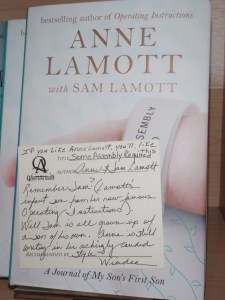
As displayed in Queen Anne Books, Seattle
A few years later, when I read Anne Lamott’s words in Operating Instructions, I thought: she has it exactly right. Last week, I came across the same passage again on one of my favorite blogs, and I planned to share the post and add my thoughts. Then Friday happened and Lamott’s words took on a greater urgency for me as I shopped at the market for Christmas cookies and decorations.
Before I got pregnant with Sam, I felt there wasn’t anything that could happen that would utterly destroy me. . . . Now there is something that could happen that I could not survive: I could lose Sam. I look down into his staggeringly lovely little face, and I can hardly breathe sometimes. He is all I have ever wanted, and my heart is so huge with love that I feel like it is about to go off. At the same time, I feel that he has completely ruined my life, because I didn’t used to care all that much.
I think that moments of great joy and great tragedy shock us out of the ordinary and awaken within us a singular intensity of compassion, good will, and love. The boundaries between us and them, between the self and the other, fall away, if only temporarily.
There will be plenty of time later to ask why and bicker and debate the meaning of Newtown and what can be done to stop it from happening again.
The most important thing now is to ride the great wave of love and compassion this tragedy has released into the world – for as long as it lasts – and take care of our children, 27 heartbroken families, and each other.
Quote: Operating Instructions: A Journal of My Son’s First Year, Anne Lamott. Fawcett Columbine, New York: 1993.
I asked my brother, John, to contribute to my series on favorite family cookbooks. I’ve tasted some of the recipes from the cookbook below, prepared by John. Fabulous, unpretentious Sicilian cooking, the kind we grew up with.
I often consult The Sicilian Gentleman’s Cookbook [by Don Baratta] when I want to do some Sicilian cooking. I think cooking becomes very personal, because we all have different tastes. I remember my dad describing different ways to make tomato sauce. His mom, my grandmother, liked to make simple sauce. You cook down the tomatoes, add spices and, of course, garlic and onion, and you’re done….simple. But my grandfather had to have his sauce strained. Absolutely forbidden to have seeds and skin involved.
To me, TheSicilian Gentleman’s Cookbook is simple cooking. Just the way I imagine peasants cooked in Sicily, because they didn’t have much. They made do with what was available. I usually pull down the book for a quick idea and I go with what we have. Simple. I suggest the artichoke hearts with pasta, which is a family favorite when we get together with friends for Valentine’s Day. I also like the fish stew/soup recipe. It’s really a remarkable meal.
When we were visiting at Thanksgiving, I was browsing through the cookbook and found the Sicilian gentleman’s secret to losing weight: have a bowl of homemade soup every night for dinner. Sounds like a great idea for the long, cold winter nights to come. A hot bowl of homemade soup with a slice of fresh bread and a glass of Malbec or Beaujolais Nouveau, then a good book in front of the fire.
Elizabeth David’s literature of cookery
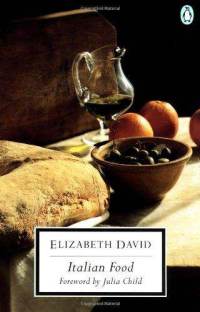
John’s story got me thinking about one of my favorite Italian cookbooks – Elizabeth David’s Italian Food. The recipes are somewhat antiquated and difficult to re-create, because you can’t always find the proper, authentic ingredients, but they’re mouthwatering all the same. David, who was British, raises food writing to a high art. This is a book you could read and enjoy by a winter fire every evening, without ever making a recipe.
It was difficult to choose an excerpt, the writing is so good, but here are two of my favorites:
It is worth noting that in the dining-cars of trains, where the food is neither notably good nor to everyone’s taste, a dish of uova al burro may always be ordered instead of the set meal and will be brought rapidly and with perfect amiability by the dining-car waiter. So browbeating are the attendants in certain French and English railway dining cars over this question of ordering eggs or sandwiches instead of the dull, expensive, six-course meal provided that I have thought the matter worth mentioning.
Here is David’s description of a Venetian fish market:
The colours of the peaches, cherries, and apricots, packed in boxes lined with sugar-bag blue paper matching the blue canvas trousers worn by the men unloading the gondolas, are reflected in the rose-red mullet and the orange vongole and cannestrelle which have been prised out of their shells and heaped into baskets….In Venice even ordinary sole and ugly great skate are striped with delicate lilac lights, the sardines shine like newly-minted silver coins, pink Venetian scampi are fat and fresh, infinitely enticing in the early dawn.
I’d like to continue this family cookbook series, so send me the titles of your favorite family cookbooks and I’ll list them here. If you have a story or anecdote about a particular cookbook, please send it along.
Barbara Kingsolver’s Flight Behavior goes to….
Darlene Niman, who owns and operates Out With a Friend, a senior companion service in New York City. She says one of the best books she’s read recently is That Summer in Sicily by Marlena De Blasi.
Quotes from:
Italian Food, Elizabeth David, Penguin Books, New York: 1987.
The Sicilian Gentleman’s Cookbook, 3rd Revised Edition, Don Baratta, Firefly Books, Buffalo: 2002.
Been traveling for the Thanksgiving holidays and forgot to mention here at Books Can Save a Life that I’m giving away a free copy of Barbara Kingsolver’sFlight Behavior.
All you need to do for a chance to win the book is check out my recent post, Now is the time to read Kingsolver’s Flight Behavior, and leave a comment about where you stand on climate change, or if you think a work of fiction such as Kingsolver’s can make a difference one way or the other.
I’m extending the deadline to December 3, when I’ll put the names of all who comment in a hat and draw the lucky winner.
I read an essay the other day in which the author mused that perhaps New York City will no longer exist in a hundred years. Or it will be located in Westchester County.
What do you think?
I welcome all thoughts and opinions (as long as we’re friendly and polite!)
Man is born unto trouble as the sparks fly upward, she thought, words from the book of Job, made for a world unraveling into fire and flood. Barbara Kingsolver, Flight Behavior
Barbara Kingsolver’sFlight Behaviorblindsided me; I didn’t see the end coming, though perhaps I should have. Reading it on the heels of Hurricane Sandy only added to its impact. What incredible timing for this novel to be published just days after a superstorm brought a 13-foot storm surge to New York City.
I once lived in New York, so I found it hard to believe the scenes in the news: water pouring into the 9/11 construction site at the World Trade Center, Bellevue and NYU’s Tisch hospitals in lower Manhattan evacuated, entire neighborhoods destroyed on Staten Island.
Flight Behavior is about climate change and its consequences. If you don’t believe in climate change, you probably won’t like this book. If you do believe in it, you may still find Flight Behavior to be a thinly disguised polemic. I did. Sometimes I had a hard time losing myself in this particular fictional world as I like to do in a good novel.
Nonetheless, I found Flight Behavior to be powerfully and beautifully written. It made me uncomfortable, which is what I think Kingsolver intends for her readers. She loves the earth and respects it as a scientist. (Kingsolver has a degree in biology and worked as a scientist before she began to write fiction.) She wants people to wake up and do something before it is too late.
I couldn’t help thinking of Paul Gilding’sThe Great Disruption, one of the most disturbing nonfiction books I’ve ever read on climate change. Gilding believes our first priority should be to stop the earth from warming another couple of degrees, and this can be done only with a worldwide, cooperative effort, the likes of which we haven’t seen since World War II. If we don’t do something, Gilding believes disaster will soon be upon us – floods, famines, wars, the end of life as we know it.
He predicts (and hopes) enlightenment will come soon, this decade. People will realize something is wrong, mobilize, and take action.
In Flight Behavior, for a farmer’s wife with two young children, climate change quite suddenly becomes personal. She’s forced to take a stand and brought to a kind of enlightenment. I believe that’s a road we’ll all have to travel.
What do you think about climate change?If you’ve read Flight Behavior or The Great Disruption, please share your thoughts in the comments.
Quote from Flight Behavior, Barbara Kingsolver. HarperCollins Publishers, New York, 2012.
Remembering spring (just a few weeks ago) in the Jardín Japonés, Buenos Aires. All these wishes placed end to end would make a poem long enough to fill a book.







 I often consult