We Are All Completely Beside Ourselves

As part of leaving Bloomington for college and my brand new start, I’d made a careful decision to never ever tell anyone about my sister, Fern. Back in those college days I never spoke of her and seldom thought of her….Though I was only five when she disappeared from my life, I do remember her. I remember her sharply — her smell and touch, scattered images of her face, her ears, her chin, her eyes. Her arms, her feet, her fingers. – We Are All Completely Beside Ourselves, by Karen Joy Fowler.

(I try to avoid spoilers, but there is one here, since I couldn’t write meaningfully about the book otherwise.)
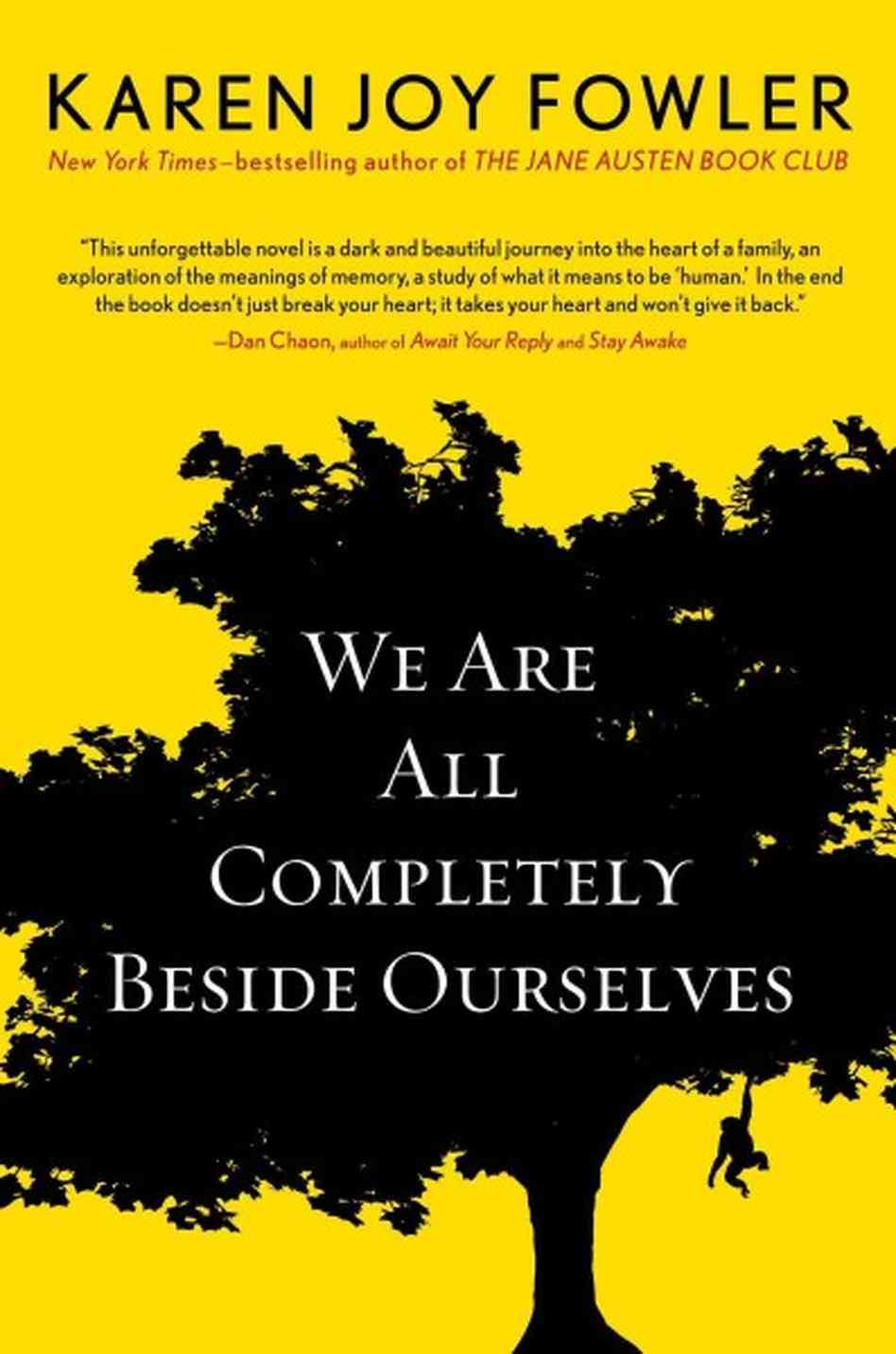
We Are All Completely Beside Ourselves book coverIn Karen Joy Fowler’s novel, We Are All Completely Beside Ourselves, Rosemary Cooke and her twin sister, Fern, do everything together – toddle around in diapers,  share ice cream cones, play in the snow. One morning Rosemary and her brother awaken to find Fern gone, sent away by their parents.

Fern is a chimpanzee.

In the 1970s, a handful of behavioral psychologists thought it would be interesting to raise a chimpanzee as a human child, in adoptive human families. In part, they wanted to see if chimps could learn to communicate by using American Sign Language, thinking that might shed light on human language acquisition.

We Are All Completely Beside Ourselves is a fictional account of one such experiment and the disastrous consequences. No one in the Clarke family comes away unscathed – not Rosemary, not her brother, not her mother or her behavioral psychologist father. And certainly not Fern.

Rosemary is too young to understand the circumstances behind Fern’s banishment, which was mishandled by her parents (no surprise there), and she blocks out much of what happened. This is relatively easy to do, since her shattered mother and father don’t speak of Fern. Rosemary’s brother never forgives his parents for removing their little sister from the family with such confounding callousness; Rosemary wonders if someday she’ll be sent away, too.

When Rosemary enters kindergarten she has to learn to shed her chimp-like mannerisms. Still, the children sense Rosemary is different and call her “the monkey child.”

Friendless, chronically unable to get close to people, never feeling like she fits in, Rosemary must eventually piece together her past and then figure out where to go from there.

I read We Are All Completely Beside Ourselves with a great deal of admiration for Fowler’s storytelling skills, yet also with a kind of dread. I wanted to know why Fern was sent away and what became of her. And yet, I didn’t want to know.

Along the way, I learned some of the history of the use of animals in research. Though there is still much controversy, thanks to the Animal Welfare Act and similar policies, there is now a more enlightened approach to the treatment of animals used in research and testing. Whenever possible, non-animal alternatives are found. One of my medical librarian colleagues specializes in searching the biomedical literature for alternatives to animal testing for research.

The National Institutes of Health announced this summer it will greatly reduce the use of chimpanzees in NIH funded research. Many NIH chimps will be sent to the Federal Sanctuary System in Shreveport, Louisiana.

We Are All Completely Beside Ourselves is an extraordinary story.

THE HUMAN – CHIMP BOND

We Are All Completely Beside Ourselves, by Karen Joy Fowler

Ape House, by Sara Gruen

The Chimps of Fauna Sanctuary, by Andrew Westoll, winner of the Charles Taylor Prize for Literary Nonfiction

In the Shadow of Man, by Jane Goodall

Gorillas in the Mist, by Dian Fossey

Next of Kin, by Roger Fouts


If you’ve read Karen Joy Fowler’s book or any of the above, tell us what you think in the comments.

TransAtlantic inspires a look at our family history

Back from an Oregon vacation and an unforgettable family reunion in Cannon Beach.

Several books traveled with me, of course, including Colum McCann’s TransAtlantic, which we’d chosen for our family reunion book club, and Natalie Goldberg’s newest title, The True Secret of Writing: Connecting Life with Language. I tore through Goldberg’s book, as anyone who is a Goldberg fan will understand, while I mulled over how to frame our TransAtlantic book club discussion.

I didn’t expect to find this serendipitous connection between the two books on page 3 of The True Secret:

The True Secret of Writing book cover“Writing is for everyone, like eating and sleeping….Slaves were forbidden to learn to read or write. Slave owners were afraid to think of these people as human. To read and to write is to be empowered. No shackle can ultimately hold you.

To write is to continue the human lineage. For my grandfather, coming from Russia at seventeen, it was enough to learn the language. Today, it’s our responsibility to further the immigrant dream. To write, to pass on the dream and tell its truth. Get to work. Nothing fancy. Begin with the ordinary.”

Transatlantic book coverReading Goldberg’s words – get to work, nothing fancy, begin with the ordinary – I thought of Colum McCann’s writing, and of Lily Duggan, the fictitious Irish housemaid in TransAtlantic who could not read or write and came penniless to America, whose daughter became an influential journalist and wrote about the first non-stop transatlantic flight, by Alcock and Brown from Newfoundland to Ireland (see this photo of their landing.)

Reading Goldberg’s words – no shackles can ultimately hold you –  I thought of the former slave and abolitionist Frederick Douglass and what he was able to accomplish thanks to his education.

Reading Goldberg’s words – it’s our responsibility to further the immigrant dream –  I decided to ask my husband’s family if they identified with their Irish ancestry. Do they ever think about it, do they find it relevant to their lives, or do they see themselves as thoroughly American? If it’s our responsibility to further the immigrant dream (whether we consider ourselves writers or not), what does that mean and how do we do that?

One branch of my husband’s family came from Drummin Parish, Westport in County Mayo on the west coast of Ireland. They immigrated to America after the English Earl of Aran evicted them and 40 other families from the land where they were tenant farmers. Nearly the entire town came to America, including their local priest, shortly after the Civil War. (Again, I think of TransAtlantic’s Lily Duggan and her deep and involuntary involvement in the Civil War.) They settled in Little Falls, New York, where they may have worked on the enlargement of the Erie Canal. Several of the brothers started a construction and masonry company and built the Beechnut Plant in Canajoharie, locks in the Mohawk River, and many buildings in the Mohawk Valley.

In our discussion, my father-in-law said he thought of himself as American, while his sister identified strongly with her Irish Catholic heritage. I wondered why there was such a difference in the same family. My sister-in-law thought it might be that it had been the man’s responsibility to be successful and earn a good living; to do that he had to shed his ethnicity in the workplace and become “American.” The woman had stayed home, preserving family rituals and traditions, passing on family history, perhaps assimilating more slowly.

Someone said she thought it unusual TransAtlantic’s Lily Duggan was not religious and not raised Catholic, and that led to a discussion of Catholic identity. My mother-in-law, like my husband’s aunt, strongly identified as Irish Catholic, and said when she was growing up being Catholic was more important than being Irish. She told the story of an uncle who wept bitterly when one of his children married a Protestant. Someone else commented that in the New Jersey town where he grew up, there was an Italian Catholic church, an Irish Catholic church, and a Polish Catholic church.

I wanted to know which TransAtlantic characters made the deepest impression. My father-in-law was especially taken with the brilliance, dedication, and integrity of  Senator George Mitchell, who negotiated the peace talks in Northern Ireland. He did some research and found a fascinating interview with Mitchell after he was awarded the Presidential Medal of Freedom. Almost all of us loved Lily, of course. Some of us didn’t know anything about Frederick Douglass and his connection with Ireland, and we’d never heard of Alcock and Brown or their amazing flight.

There were at least four generations at our family reunion. I’m so glad some of us shared the reading of TransAtlantic. I, for one, could have kept our discussion going longer than we had time for.

I don’t think we answered the question of how to further the immigrant dream or whether that is something we’ll even think about, and I don’t know how strongly the younger generation will identify with their Irish heritage. But I do find it fascinating how McCann weaves fiction and nonfiction together to form a narrative arc that extends through time and across generations. It’s much larger than any single life, and yet every individual has a role to play.

I think I see similar through-lines across time in my husband’s family, whether they’re passed down through familial and social influences, or encoded in their DNA, or both: a mechanical and engineering aptitude, keen intelligence, a predilection for risk-taking, an independent spirit, a deep curiosity about the world, and a strong sense of justice. When all of us get together for these reunions that are way too brief, you can see these commonalities.

Have you ever had a book club at your family reunion? If so, what did you read? Tell us about it in the comments.

If you would like to learn more about Natalie Goldberg, her new book, and the true secret of writing (I’m not going to spill the beans), listen to this wonderful 30-minute podcast on Natalie’s website.

Haystack Rock at Cannon Beach
Haystack, Cannon Beach
Cannon Beach and bonfires
Evening bonfires

Traveling orchardist country

Traveling in Oregon’s Hood River Valley, we’ve had marionberry syrup on pancakes at the B & B we’re staying at and huckleberry smoothies at an arts & crafts fair. Peaches, apricots, pears, cherries, strawberries, blueberries and grapes also grow in this land of orchards, vineyards, and farm stands.

I just finished Amanda Coplin’s The Orchardist, set in early 20th century Washington, where an orchardist takes in two pregnant, runaway teenagers. Amanda’s prose is as lush and beautiful as the land she writes about.  The Orchardist is one of the best novels I’ve read in a long time. Amanda is a major new talent, and she’s young, so we can look forward to more of her books.

The Orchardist book cover

We stopped at The Old Trunk Antiques , which has an excellent collection of used and older books. I found a rare edition of Pearl S. Buck’s The Good Earth that had a book jacket with promotional photos from the 1937 movie. (See a previous post on The Good Earth.)

The Old Trunk book and antiques

That was too expensive for me, but I bought Buck’s, Peony, a novel I’m unlikely to encounter in my everyday book browsing. The Old Trunk proprietors are gracious and very knowledgeable about the history of the Hood River area.

Peony book cover

TransAtlantic turns history into story

Transatlantic book cover

Colum McCann loves to spend his days inside the skin of his characters, getting to know them and spinning out their incredible stories. The more unlike McCann they are, the better, he says. He’s a virtuoso, with all the confidence of an Irish storyteller. A stereotype, maybe, but I think there is something to it.

In TransAtlantic, McCann is adept at taking on the voices of historical figures like Frederick Douglass, founder of the civil rights movement in America, Arthur Brown, ace flyer and navigator, and Senator George Mitchell, who negotiated the peace talks in Northern Ireland.  When he was writing the novel, McCann worked closely with Senator Mitchell’s wife to get the details right, but waited until the manuscript was finished before he actually met Mitchell.

My favorite character, though, is the fictitious Irish housemaid, Lily Duggan. In fact, I think Lily is the heart of the novel. She scrapes together enough money to emigrate from desperate famine and British oppression to America – only to find herself tending to endless numbers of soldiers dying because of another brand of oppression in the bloodbath of the Civil War. As my husband, a lover of history, said to me when we were talking about the book, history comes alive through the stories of individual people. (We’re both reading TransAtlantic for an upcoming family reunion – his extended family is of Irish descent.)

McCann writes each chapter from the viewpoint of a different character. He doesn’t write chronologically, but jumps back and forth in time. You have to be willing to go with the flow and accept that you won’t be with any character or confined to a particular time in history for long.

After I got used to that, I began to see what a powerful way this is to tell a story.

I became immersed in each character’s moment in TransAtlantic, thanks to the vivid, sensual writing. For me, McCann’s sweeping view across time and space casts his characters in a generous, compassionate light. Frederick Douglass and Lily Duggan may feel their lives don’t add up to much, but we see what their sacrifices mean to their descendants. Individuals may be forgotten, but their lives can, indeed, have great meaning, and the consequences of one’s actions can reach around the world and through time. We are all connected.

Frederick Douglass
Gravesite of Frederick Douglass, Mt. Hope Cemetery

At the same time, I thought about justice and oppression as I read TransAtlantic, and how various groups – Irish Catholics, blacks, women, and others – fight for the same thing. Sometimes they work together, sometimes they are in competition.

Frederick Douglass is buried in Rochester’s Mt. Hope Cemetery, across from the medical center where I work. In the 1800s, upstate New York was a hotbed of radical abolitionist and women’s suffrage fervor. The civil rights leader Susan B. Anthony lived in Rochester, too, and is buried in Mt. Hope Cemetery. She was friends with Douglass and worked with him on abolitionist and women’s suffrage causes. Yet Anthony and women’s rights activists felt betrayed when black men finally won the right to vote and women did not. Ultimately, Douglass couldn’t hold out for women’s rights. He had to seize the moment when black men in American were given their freedom.

In TransAtlantic, McCann writes of Douglass’s trip to Ireland, where he was surprised to discover the Irish suffered under more deplorable conditions than many American slaves.  Douglass could fight only one fight at a time, and chose not to speak out against Irish Catholic oppression as he associated with British and privileged Irish dignitaries.

I’m looking forward to hearing what others think of TransAtlantic at our family reunion and which of the inseparable stories embedded in the novel they found most affecting: Senator Mitchell, at age 64 changing his infant son’s diaper before he flies to Belfast. Frederick Douglass deciding whether to take the starving Irish baby. Alcock and Brown praying their Vickers Vimy will make it out of the cloud before they crash into the ground. Lily Duggan washing the bodies of the dead young men.

If you’ve read TransAtlantic, please tell us what you think in the comments.

Grave site of Helen Pitts, 2nd wife of Frederick Douglass
Frederick Douglass’s second wife, Helen Pitts, who came from a prominent Rochester family, was white. After her marriage, her family disowned her.

BY COLUM MCCANN:

TransAtlantic

Let the Great World Spin – National Book Award, 2009

Zoli

Dancer

Everything in This Country Must – short film, nominated for Academy Award, 2005

The Side of Brightness

Songdogs

Fishing the Sloe-Black River

Family reunion reading: TransAtlantic

It occurred to me it would be fun if all the book lovers attending our extended family reunion this summer read the same book. Similar to what we do here in Rochester, NY once a year: “If all of Rochester read the same book,” a great project started by librarian Nancy Pearl in Seattle.

At the reunion, we could have an optional, one-time-only gathering to talk about the book.

Wouldn’t it would be interesting, I thought, to read a book that explored my husband’s family’s Irish heritage?

Easier said than done, because we all know what great storytellers the Irish are. When I asked for book suggestions on the family reunion Facebook page, the list got longer and longer.  I hoped no one would suggest James Joyce.

Fortunately, no one did. (Librarian and former book editor that I am, I haven’t read a single book by James Joyce. Like every other avid reader in the universe, I intend to. Someday.)

Angela’s Ashes was on the list, of course. But with all due respect to Frank McCourt, his ship sailed some time ago, and we have to make way for younger authors.

I’m no good at conducting family polls and other administrative tasks, so I made an executive decision. I chose Colum McCann’s TransAtlantic, because it’s hot off the presses, getting lots of attention, and Irish through and through.

Transatlantic book cover

I hope my husband’s family doesn’t mind I made this unilateral call, especially since I don’t have one ounce of Irish blood.

One of the things I most admire about my husband is his unshakeable sense of justice and fairness. I’ve seen this in my in-laws, too. In fact, I’ve seen it in many members of the family I was so fortunate to marry into. This is not just something they give lip service to. In many different ways, they live their beliefs.

Maybe being Irish has something to do with it.

I work directly across the street from Mount Hope Cemetery where former slave and abolitionist Frederick Douglass, a prominent figure in the history of Rochester and our nation, is buried. There is a riveting scene in TransAtlantic that captures the essence of Douglass’s trip to Ireland in 1845.  I hadn’t realized Douglass had traveled to Ireland. That made TransAtlantic, for me, all the more relevant.

Members of our extended family have married or plan to marry into families from Nicaragua, Thailand, Saint Lucia, and other countries I can’t name simply because there are too many relatives to keep track of. (They are, after all, Irish.) If you’ve read my blog, you know I’m fascinated with the idea we may inherit from our ancestors a unique sensibility and way of looking at the world. I’m also intrigued by the wonderful new possibilities that may arise with the union of different cultures, possibilities inherent in the children who will be coming to our reunion.

Upcoming post on Transatlantic

In my next post, thoughts about Colum McCann’s TransAtlantic, as well as his Let the Great World Spin. which won the National Book Award.

Here is a link to an interview with Colum McCann on Charlie Rose.

If you’ve read either of these books, tell us what you think in the comments. Are there books that speak to your own family’s ancestry?  Let us know!

 

IRISH FAMILY REUNION READING

The Sea, by John Banville

Circle of Friends, by Maeve Binchy (and other titles)

My Left Foot, by Christy Brown

Ireland, by Frank Delaney (and other titles)

The Gathering, by Anne Enright

The Wild Colonial Boy, by James Hynes

Angela’s Ashes, by Frank McCourt

‘Tis, by Frank McCourt

Charming Billy, by Alice McDermott

The Mammy; The Granny; The Chisellers, all by Brendan O’Carroll

Trinity, by Leon Uris

Anne said

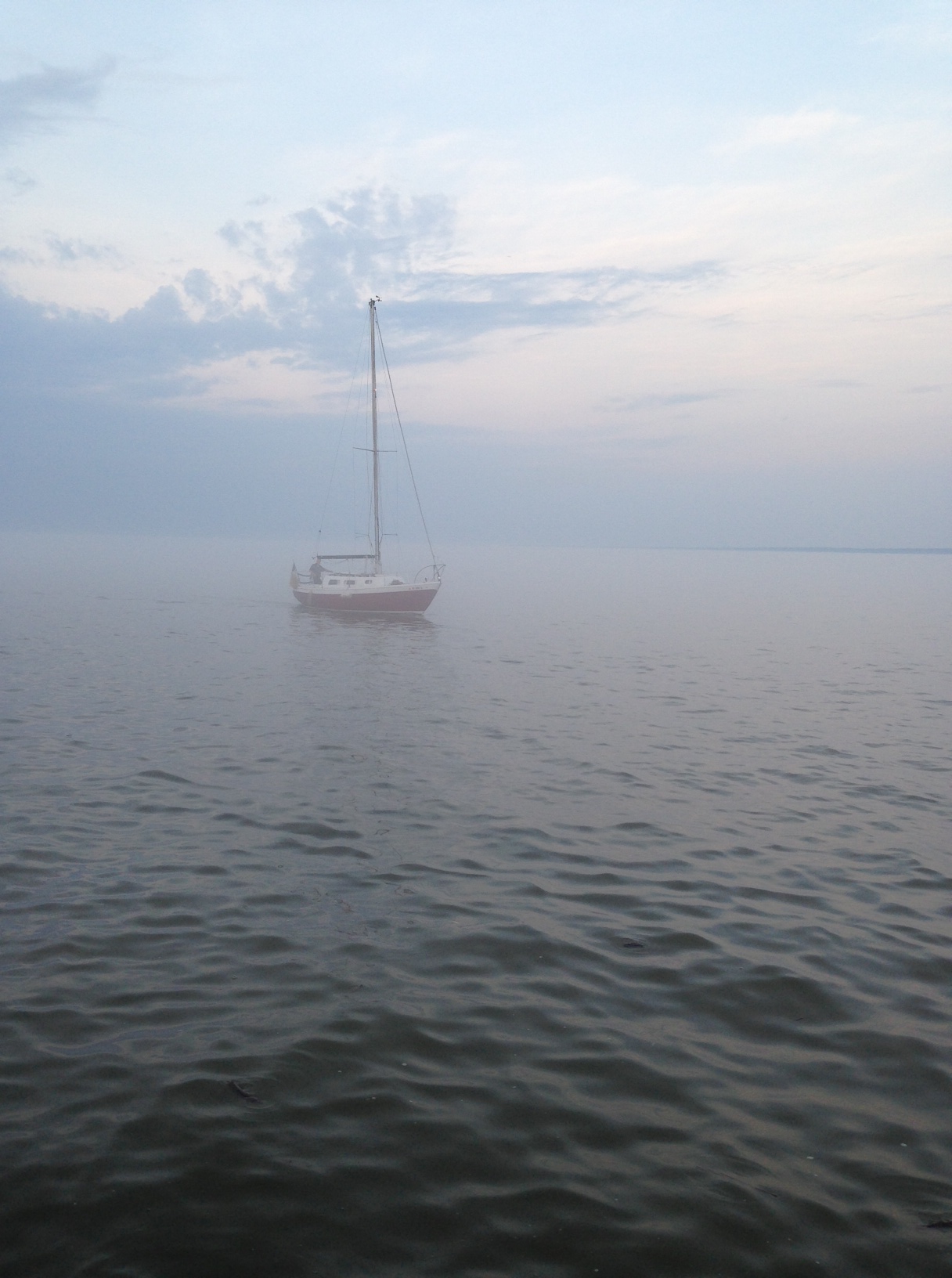
Boat in FogLook at that sea, girls – all silver and shadow and vision of things not seen. We couldn’t enjoy its loveliness any more if we had millions of dollars and ropes of diamonds.

Anne of Green Gables

by Lucy Maude Montgomery

If you want to be lifted up, read Kent Haruf

Benediction book coverShe looked at the two old brothers….

I want you to think about taking this girl in.

They stared at her.

You’re fooling, Harold said.

No, Maggie said. I am not.

They were dumbfounded. They looked at her, regarding her as if she might be dangerous. Then they peered into the palms of their thick callused hands spread out before them on the kitchen table and lastly they looked out the window toward the leafless and stunted elm trees.    

                                                                             Plainsong, by Kent Haruf

Yesterday I finished reading Kent Haruf’s new novel, Benediction, about an elderly hardware store owner, Dad Lewis, dying of cancer.  I realized it was three years to the day since my father passed away from cancer. More than a coincidence, probably. I imagine something unconscious was at play. But I would have read this book eventually, no matter what, because I read everything Haruf writes.

My devotion to Haruf began when I read Plainsong, which he published in 1999. One of Haruf’s critics describes Haruf’s work as “exalted.” If you want to be exalted, get a copy of  Plainsong or Eventide or Benediction and drop into the lives of the folks who live on the dry plains in the fictional town of Holt, Colorado.

Haruf writes about goodhearted people way off the beaten path trying to do the right thing. His prose is entrancing, deceptively simple, powerful. You may begin to be lulled by the humanity Haruf captures on the page, but before you get to feeling incredulous he hits you with some dark reality: bigotry, abuse, cruelty, abandonment, addiction.

I was surprised Haruf said in an interview one of the books that most influenced him as a writer was Ernest Hemingway’s The Sun Also Rises, a novel that underwhelmed me both times I read it. But in Haruf’s plain, spare prose I can see Hemingway’s legacy. And it reinforces my interest in how what we read speaks to us, personally. That’s going to be different for everyone.

Benediction is a beautiful book, but an especially quiet and somber one. If you want to sample a novel by Haruf, I suggest you begin with Plainsong, which has more action and a greater diversity of intriguing characters, followed by Eventide and then Benediction. All are set in Holt, in eastern Colorado. Plainsong and Eventide are companion novels that feature the same cast, while Benediction introduces a new set of characters. I suspect Haruf may continue their stories in a future novel.

In Benediction, an eighty-year-old woman, two sixty-year-old women, and an eight-year-old girl skinny-dip on a hot afternoon in a muddy water trough for cattle. Cool and refreshed, they lie down under a tree in their thin, sleeveless cotton dresses to take a nap. Somehow, Haruf makes this scene riveting. It is emblematic of his writing.

Two of my favorite characters in all of fiction are Plainsong’s rough-hewn cattle ranchers Harold and Raymond McPheron, who take in Victoria Roubideaux, a homeless, pregnant teenager. They are so sweet, and clueless to the point of hilarity. One of the funniest scenes I’ve ever read is their visit to the ob-gyn with Victoria.

As much as I enjoyed Benediction, the McPheron brothers from Plainsong and Eventide will always be in my heart.

Plainsong book coverRaymond, you’re my brother. But you’re getting flat unruly and difficult to abide. And I’ll say one thing more.

What?

This ain’t going to be no goddam Sunday school picnic.

No, it ain’t, Raymond said. But I don’t recall you ever attending Sunday school either.

Quotes from Plainsong, Kent Haruf. Vintage Books, New York: 1999.

BY KENT HARUF:

Plainsong

Eventide

Benediction

The Tie That Binds

Where You Once Belonged

A housekeeper, a professor, a boy, a baseball game

The Professor never really seemed to care whether we figured out the right answer to a problem. He preferred our wild, desperate guesses to silence, and he was even more delighted when those guesses led to new problems that took us beyond the original one. He had a special feeling for what he called the “correct miscalculation,” for he believed that mistakes were often as revealing as the right answers. This gave us confidence even when our best efforts came to nothing.

Paulownia tree
Photo courtesy Coolmitch

The Housekeeper and the Professor by Yoko Ogawa is a quiet story you’ll want to experience just for what it is. A story I don’t want to say a lot about, because too much talking will diminish it.

The Professor is a number theory expert with a traumatic brain injury. He remembers nothing after 1975, with one exception: in the present, his memory lasts exactly 80 minutes.

He rarely leaves his house. He wears scraps of paper pinned to his clothes to remind him of the important things: “My memory lasts only eighty minutes” and “the new housekeeper” (next to a sketch of the housekeeper’s face). He must live in the moment because that is all he has. He is a humble, self-effacing man who loves baseball and the great Japanese pitcher, Yukata Enatsu.

The housekeeper, a single mother, has come to cook the Professor’s meals, clean his small bungalow, and tend to his needs for a few hours every day. Her son has never known his father.

The Professor nicknames the housekeeper’s son “Root” because the top of his head is flat, like the square root symbol. These three lonely people become a self-made family. They find peace and refuge in the daily rituals of preparing and eating a meal, solving a math problem, listening to the radio.

When the Professor isn’t lost in his numbers or helping Root with his math homework, he likes to watch the housekeeper prepare dinner. With great fascination and single-mindedness he observes her stuffing and wrapping dumplings; he’s entirely caught up in the watching. Surprised by the undivided attention the Professor shows her, the housekeeper is given to understand she and her daily tasks are not insignificant.

They attend their first baseball game together. We see the stadium, the lights, the players, the crowds as if for the first time through the eyes of Root, the Professor, and the housekeeper.

The Professor buys Root popcorn, ice cream, and juice only from one particular girl selling food in the stands. “Because she’s the prettiest,” he says.

Another moment: “The ball cracked off the bat and sailed into the midnight blue sky, tracing a graceful parabola. It was whiter than the moon, more beautiful than the stars.”

In her spare prose, Yoko Ogawa never uses the word “love,” but that is what this story is about.

Quotes from The Housekeeper and the Professor, by Yoko Ogawa, Picador, New York, 2009.