Going where time doesn’t exist with M. Wylie Blanchet

“Her voice, forty years after her death, is timeless. In the end, I did not want to get off the boat, or let her go.” Timothy Egan, in his introduction to The Curve of Time: The Classic Memoir of a Woman and Her Children Who Explored the Coastal Waters of the Pacific Northwest, by M. Wylie Blanchet

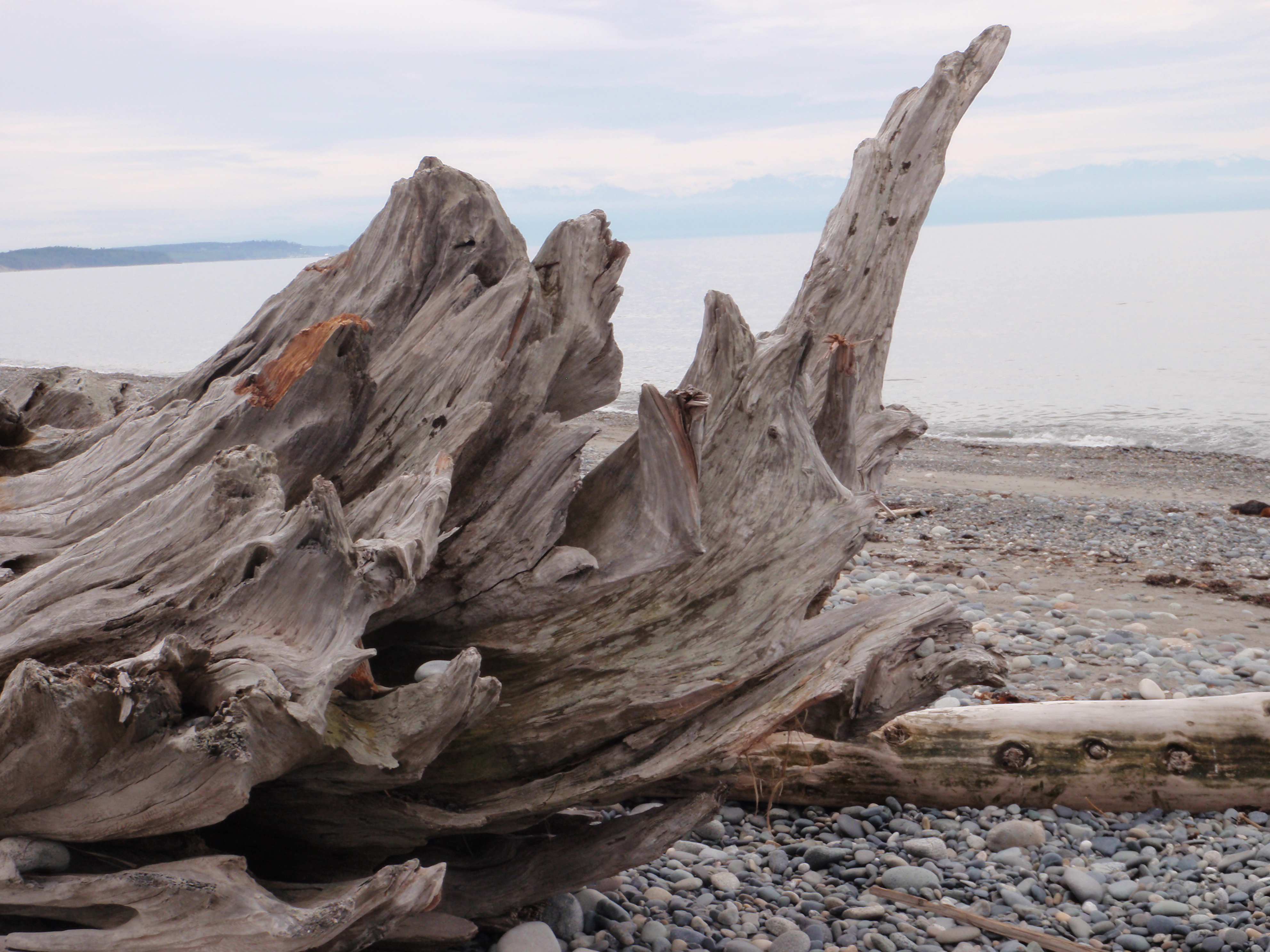
Whidbey IslandIf you want to read this treasure of a memoir you’ll have to do a bit of work. It’s out of print, so I ordered it from a used bookstore listed on Amazon. I love finding small packages on my doorstep from faraway bookstores. Blanchet and her five (FIVE!) children spent many summers on their 25-foot boat, the Caprice, exploring the British Columbia coast. This, after Blanchet’s husband had been lost at sea on the Caprice – only the boat was found. Driftwood
Often, Blanchet followed the route of Captain Vancouver, who explored the waters in 1792. She read a copy of Vancouver’s diary to her children, and they tried to identify landmarks the sea captain had written about.

They followed no particular schedule except for being mindful of tides and weather, stopping when they pleased to explore little islands, hidden coves and beaches, and secluded inlets and bays that often didn’t show up on the map.

“We were very comfortable in the daytime with everything stowed away. The cockpit was covered, and had heavy canvas curtains that fastened down or could be rolled up. There was a folding table whose legs jammed tightly between the two bunks to steady it….We washed our dishes (one plate, one mug each) over the side of the boat; there was a little rope ladder that could be hung over the stern, and we used that when we went swimming.” Whidby Island

Her stories remind me of our many trips over the years rediscovering nature through the eyes of our children. This is the kind of book you’ll want to read aloud with children and grandchildren. Blanchet’s children were amazingly hardy and brave, often finding themselves with their intrepid mother doing things I couldn’t imagine doing with my children: crawling on a log suspended over rapids, exploring Native American burial grounds (in which bodies were “buried” dangling from trees in nets), making their way along a cliff in fog on a slippery, snowy mountaintop.

Few children today will have these kinds of adventures. Much of the wild, pristine country Blanchet wrote about in The Curve of Time has been developed. “I lighted a fire [on the beach] and piled it up with bark…We always carried a rack for broiling fish. Soon they were spluttering and browning over a perfect fire, which I raked over between two flat stones. We built it up with more driftwood…The Northern Lights were edging this way…and that way…across the northern sky – reaching above us – white and elusive, then retreating hurriedly down to the horizon.”

Langley Public Library, Whidby Island All photos were taken on Whidbey Island.

The quotes are from: The Curve of Time: The Classic Memoir of a Woman and Her Children Who Explored the Coastal Waters of the Pacific Northwest, M. Wylie Blanchet, Seal Press, Berkeley, CA, 1968.

__________________________________
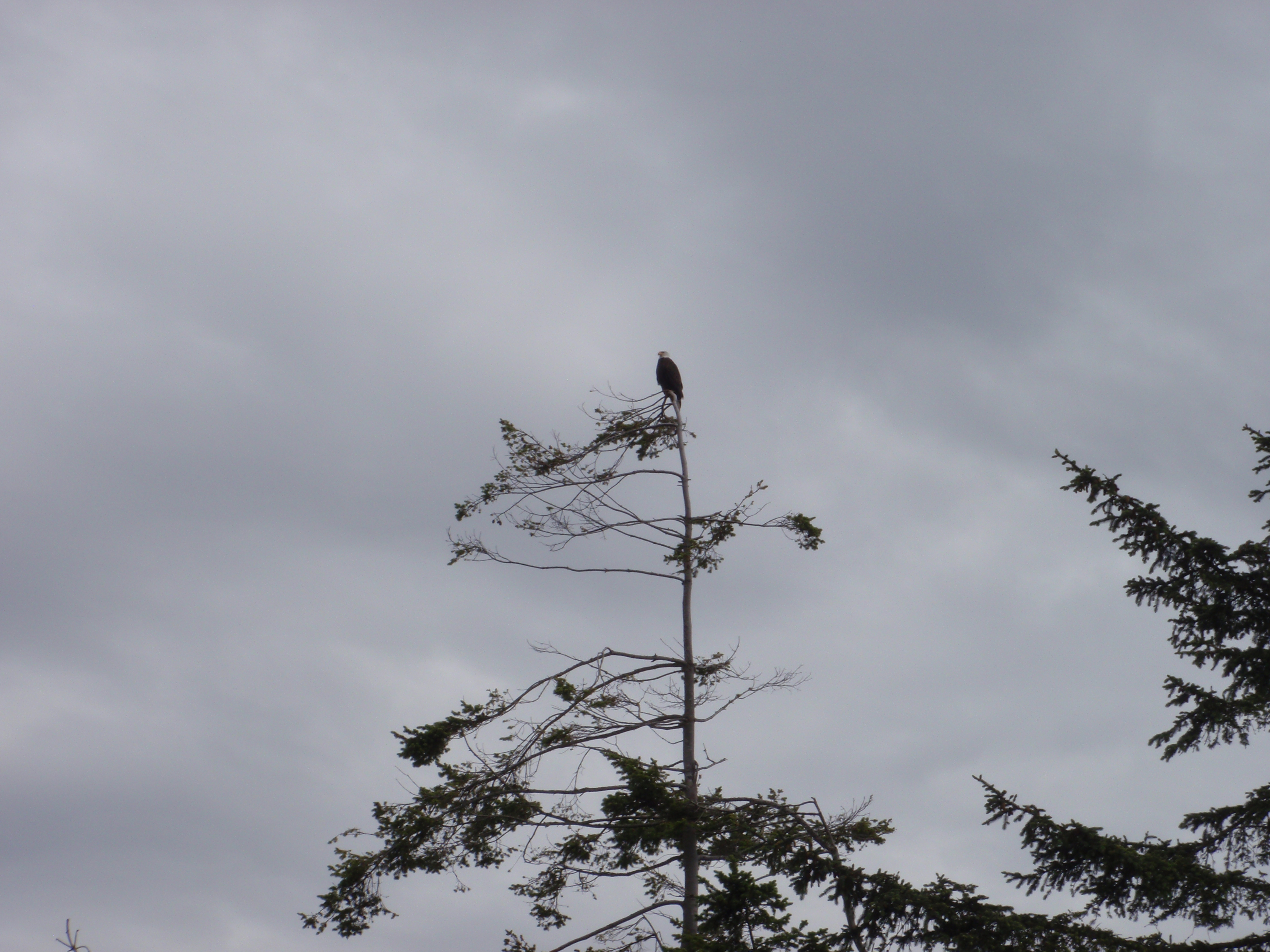
Bald Eagle, Whidby Island

Living on the edge of wilderness

Cascade wildflowersI’ve been keeping company with Ana Maria Spagna’s essay collections, Now Go Home: Wilderness, Belonging, and the Crosscut Saw; and Potluck: Community on the Edge of Wilderness while we’ve been vacationing in the Cascades.

After college, Spagna made a commitment to work on trail crews for the National Park Service in spring, summer, and fall, and to travel during the winter months. Eventually, she settled in Stehekin, Washington, a remote town in the northern Cascades, where she and her partner built their own house. I believe she still works the trail crews several months out of the year.

I tend to romanticize what it would be like to call such a place home. In her essays, Spagna captures the glamour and majesty of living surrounded by natural beauty, but she also writes about the never-ending challenges.

Ana Maria writes about how Republicans and Democrats, liberals and conservatives, tree huggers and loggers, religious fundamentalists and atheists get along (or don’t) in a small community.

There are the forest fires, flash floods, and avalanches. There are the costs incurred to keep residents of these areas safe from natural disasters, costs often borne by taxpayers who live in more populated areas.

It hadn’t occurred to me that precautions to prevent forest fires may cause the buildup of flammable, dense growth that could result in The Big One, a massive fire that destroys everything.

Spagna’s writing is important. She’s a voice from another world, the last bastions of nature, a voice whose wisdom we need to hear.

Here are some of my favorite quotes:

“I visited the Magic Kingdom thirty-seven times before I turned nineteen, and by then I craved something, anything, that would be the antithesis of Disney, the real thing. That’s what I found on the highway: places you can count on, places where in the morning without fail, there will be coffee at the gas station heading out of town….[and] people who….were honest, if quirky, and unexpectedly generous, and they lived an ethic that the land itself, no matter how pretty, can’t teach…..The Golden Rule.”
View from Spirit Lake trail
“These places…wilderness areas, national parks – are supposed to transform us, make us new…..they do not continuously dispense spiritual wowness like a fountain….I stripped myself of everything to be out there–out there!–and the problem with being out there is that then it is not out there anymore. It is more like in here….you can’t be made new at home.”

Quotes are from Now Go Home: Wilderness, Belonging, and the Crosscut Saw, by Ana Maria Spagna, Oregon State University Press, Corvallis, 2004.

Bridal veil falls

Please excuse my language (Blame it on Dear Sugar)

Cheryl Strayed, author of the memoir Wild, is otherwise known as Sugar, the advice columnist for The Rumpus, an online culture and literary magazine.

Cheryl had been writing the column anonymously until this past Valentine’s Day, when she “came out” just as her newly published memoir was rising to the top of the bestseller list.

The Rumpus is a clever, intelligent magazine. I’m a bit too old for it, or it’s a bit young for me, so I’m not a regular reader, nor do I follow Cheryl’s advice column (which is not your ordinary, everyday kind of advice column). But somewhere along the line, I came across a piece of wisdom I liked that Cheryl gave to a struggling young writer who’d sent a letter to Dear Sugar.

This bit of wisdom went viral and the people over at The Rumpus decided to put it on a mug. I ordered the mug and it came in the mail yesterday.

I’ve read all kinds of books about creativity and writing to keep my own writing going and because I’m fascinated by the creative process. A couple of pages on this site are devoted to books about writing and creativity, and I’ll be featuring some of these on Books Can Save a Life as time goes by.

But sometimes just a short, pithy, to-the-point kick in the pants is all I need.

So I’ve got my new mug sitting on my writing desk, ready to be filled with coffee or tea on a moment’s notice.

Write like a m*****f***** mug

I would say this is Cheryl’s approach to writing, to walking, to life.

Wild is to be made into a movie starring Reese Witherspoon.

There is a fabulous interview with Cheryl over at Bookslut, but beware of spoilers. You may want to finish Wild first, before you read it.

Hey, is anyone reading Wild? If so, let us know what you think in the comments below.

I’m heading off to the land of Wild (the Pacific Northwest) later this week to attend a medical librarian conference with some of my colleagues (profoundly intelligent readers, all of them). Then some vacation time with family, where I’ll be reading other books with a Pacific Northwest theme, exploring Seattle (including The Elliott Bay Book Company), and the surrounding terrain. Watch for posts and pictures!

Supermoon and journeys: Cheryl Strayed’s Wild

Moon in my backyard

I write this on the night of the supermoon, high in the sky outside my dining room window.

In her journal, Cheryl Strayed kept a list of the books she burned as she walked the Pacific Crest Trail:  Dubliners by James Joyce; Lolita by Vladimir Nabokov; The Novel by James Michener; The Pacific Crest Trail, Volume 1: California and Volume 2: Oregon and Washington; plus a few more.

Every evening she’d make a campfire, tear out the pages she’d read that day, and feed them to the flames to lighten the load in her over-stuffed pack. I imagine her performing her nightly ritual, the words on paper turning to ash.

Cheryl carried one book the length of her trip: The Dream of a Common Language, by Adrienne Rich.

Reading Wild, I remember this stray fact: In college, I wrote my senior seminar English paper on Adrienne Rich’s Diving Into the Wreck. I’d like to find that old English paper so I can read it after all these years and see what I had to say about Rich’s poetry.

Reading Wild, I remember a vacation in Portland, Oregon to visit family. Our boys were six and nine at the time.

We decided to hike with my sister-in-law and her family along the lower elevations of Mount Hood in search of a waterfall whose name I can’t remember. The map posted at the trail head indicated the hike was a couple of miles. A manageable trip for young children, we thought. The day was hot and sunny, but we walked in the shade of a beautiful pine forest along an easy, well-cleared path.

When Cheryl began walking, her pack was so heavy she couldn’t lift it, and her brand new REI hiking boots were too small.  Along the way, she shed many layers of skin from the pads of her feet and several toenails as well.

She’d walk a week without seeing anyone. She’d go days with a handful of change to her name until she reached a town where a supply pack (mailed by a friend) awaited, with necessities and two ten dollar bills to tide her over for the next couple hundred miles.

The day of our hike we walked. And walked. And walked some more. Until it got to be not so much fun anymore. Until the children were dragging, and the teenage cousin and her friend decided to go on ahead.

One of our boys (who shall remain nameless) grew cranky. The heat was intense and our water was running low. But we figured we were almost to the waterfall, so we kept going.

We walked another half hour, and then in a full meltdown, the thoroughly overheated and tired boy refused to go any further. We’d stopped next to a creek, and my husband took his handkerchief, dipped it in the ice-cold mountain water, and we took turns bathing our faces with it.

My in-laws decided to keep going with their children while we cooled off at the stream. Before long, I was ready to move on. My husband stayed behind with the tired one, cajoling him to take off his shoes and socks and wade in the stream.

Our original group had now split into four groups, which made me uneasy. Walking along holding my son’s hand, I hoped the path wouldn’t split off. What if we went the wrong way and got lost? We saw an older couple approaching as they headed back down the trail.

“Are we close to the waterfall?” I asked.

“You’re getting there. But you’ve a ways to go,” the man said. Not what I wanted to hear.

At the age of 26, with little preparation and no extreme hiking experience, Cheryl decided to hike the Pacific Crest Trail. She was grieving for her mother, who had died in her early forties a month after a cancer diagnosis, and Cheryl had been making a mess of her life ever since. She hoped the trip would save her in some way.

My son and I heard rushing water and felt a million invisible, blessedly cool droplets on our skin before we saw the waterfall. In the clearing ahead, ribbons of spray curved and tumbled down a wall of solid rock, like a bridal veil fluttering in a breeze. Instantly, the temperature dropped ten degrees. We were like parched plants coming back to life after a generous watering.

Everyone had arrived except for my husband and the tired one; they came along a few minutes later. In this peaceful and secluded Shangri La we stretched ourselves out on large, flat rocks and talked as the kids splashed about the stream looking for tadpoles.

Having walked 1100 miles, Cheryl ended her journey at the Bridge of the Gods spanning the Columbia River, which lay between Oregon and Washington.

She’d become a different person, inside and out.

Do good books make you remember, too?

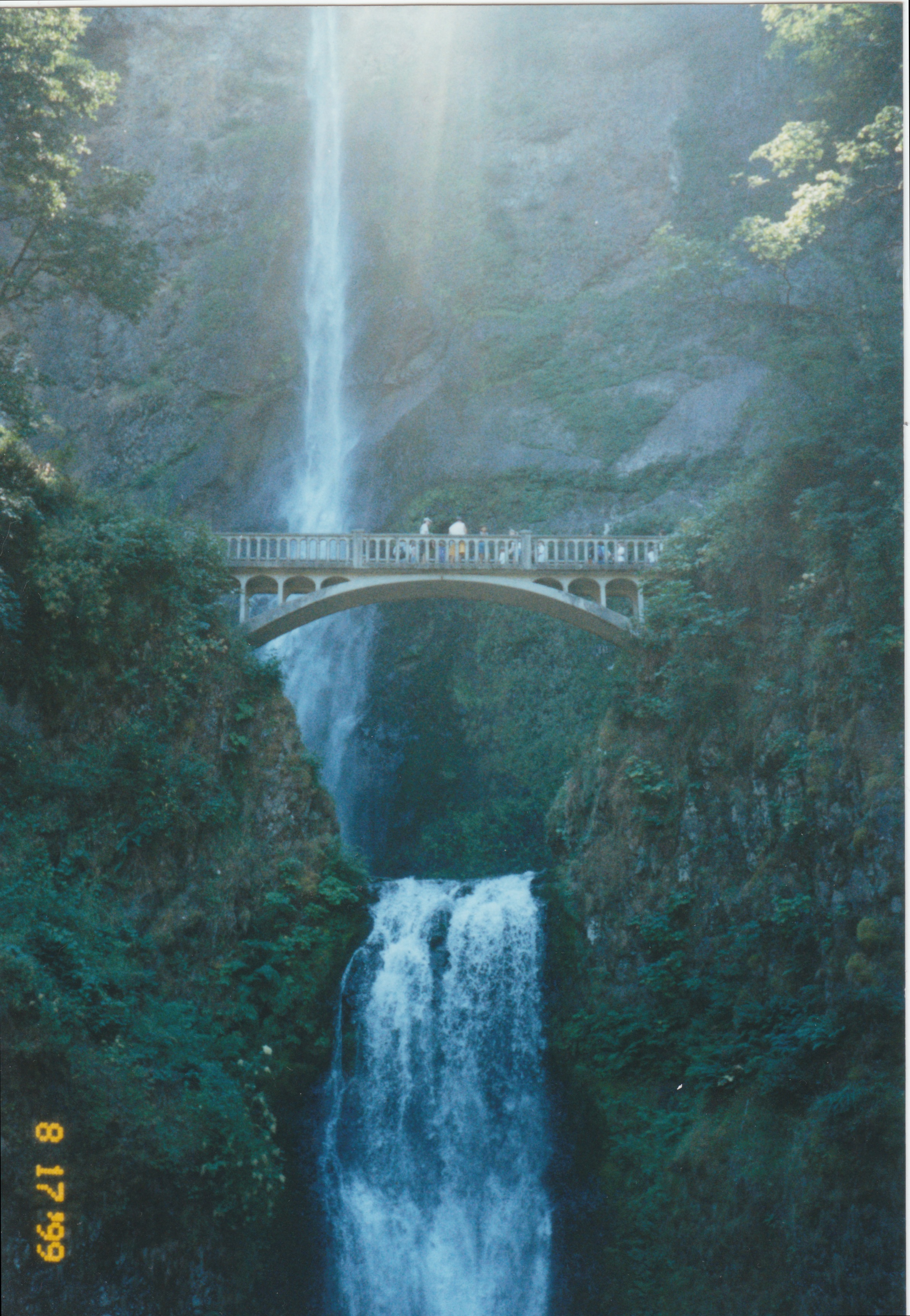
Multnomah Falls, Oregon

With that, I leave you “A Story for Tomorrow,” posted today on Brain Pickings.

Send Me Your Book Stories: Guest Posts Welcome

I’m surprised at how often I’ve read or heard, “This book changed my life,” and “This book saved my life,” since I began writing this blog.

If you have a Books Can Save a Life story, please consider guest posting it here. I’d like to create a virtual scrapbook of stories so we can share our reading journeys and find that next special book to read.

What do I mean by a Books Can Save a Life story? I mean any book that made your life better in a significant way, helped you through a tough time, or guided you through a major life change. Any book that occupies a sacred space in your memory or is intrinsic to your identity.

It could be a picture book, a novel, a memoir, a poem or a book of poems, a biography, a graphic novel, a collection of short stories. Any genre, or no genre at all,  from any time of your life.

On my About Valorie page, I mention a few books that made a difference in my life. Books that helped shape who I am and influenced my path in life. I’ll be writing about other reading moments in future posts.

If you’d like to share a story, send an email to valoriegracehallinan@gmail.com with the subject line: My Book Story. Please include a post of about 500 words or less in the body of the email or an idea/book you’re interested in writing about.

If you’d like, include a short bio and a link to your website or blog, if you have one.

If you prefer to remain anonymous, that’s fine. (Of course, you can always post anonymously in the comments.)

Please keep it simple. I’m looking for a personal experience of value to others that’s honest and from the heart.

Mary Oliver: a girl in the woods reading poetry

Upstream.jpg


“Instructions for living a life: Pay attention. Be astonished. Tell about it.”Mary Oliver


In my hometown near Cleveland, Ohio, there once was a girl who liked to play hooky from school. She’d walk in the woods and read poetry. Back then, my town still had some of its original rural flavor, with creeks, farmland, and forest where neighborhood kids could play for hours. Poetry and nature were the two things in the world the girl loved most.

When she was seventeen, the young woman got in her car and drove to the home of Edna St. Vincent Millay in upstate New York. The poet had died, but her sister, Norma, lived there. The young woman stayed for a time, helping Norma organize Millay’s papers and manuscripts, while she also wrote her own poetry.

Years later, when this same woman from Maple Heights, Ohio won the Pulitzer Prize for poetry in the 1980s, I didn’t pay much attention, even though I’d been an English major in college. I was working in New York City and had left my poetry reading days behind.

It wasn’t until I was in my forties and beginning to do some of my own writing that I thought I’d take a closer look at Mary Oliver, that girl from my hometown, to see what she was all about.

I hadn’t expected to be stunned. I mean, really. Why had I never read her poetry before?

I could describe Mary’s poetry with words like “powerful” and “transcendent” and “life-changing,” but those weak words wouldn’t do her poems justice.  Let’s just say it was exactly the right time for Mary Oliver’s poems to enter my life.  A lot of it had to do with my novice efforts as a creative writer and with believing in myself.

Mary Oliver grew up in a house just around the corner from where I did, though she left home around the time I was born. Our hometown went through especially hard times around 2008. A Cleveland neighborhood nearby was called ground zero in the mortgage disaster.

Some homes were abandoned, some torn down; wildflowers and weeds took over what used to be carefully tended lawns. Much of the wooded areas are now gone, but occasionally people spot deer, usually at dusk. The town has held its own, though; the people who live there have great spirit.

When I go back home to visit, sometimes I think of a girl skipping school, sitting cross-legged under a big, friendly tree in the once nearby woods, reading poetry.

*******************

New and Selected PoemsNew and Selected Poems, by Mary Oliver, published in 1992, includes poems from 1963 – 1991.