Bryce Canyon, sunset. “When we enter the landscape to learn something, we are obligated to pay attention rather than constantly to pose questions. To approach the land as we would a person, by opening an intelligent conversation. And to stay in one place, to make of that one, long observation a fully dilated experience. We will always be rewarded if we give the land credit for more than we imagine, and if we imagine it as being more complex even than language. In these ways we begin to find a home, to sense how to fit a place.” – Barry Lopez, as quoted in Molly Hashimoto’s marvelous Colors of the West: An Artist’s Guide to Nature’s Palette
I found Molly Hashimoto’s luscious book in one of the national park bookstores I browsed on our road trip across the country. It was a great companion as we toured the Southwest, even though I did no painting or sketching – just hiking and exploring.
Molly devotes a chapter to each color: green, blue, gold, red, orange, and violet.
Molly Hashimoto had an epiphany that led to her artistic vision after encountering the work of Thomas Moran:
“This rendezvous with Moran compelled me to reconsider what it meant to be an artist – how to work, where ideas are generated, the purpose of art. I felt that I, too, had to create work in the field, to keep sketchbooks and journals to record my own experiences in the outdoors. Of course, I had a few doubts. After all, this awakening occurred in what I then felt was middle age, and I wondered if it wasn’t just a little late to be undertaking this new project. But enthusiasm won the day. And now I always tell my students it is never too late to start keeping sketchbooks.”
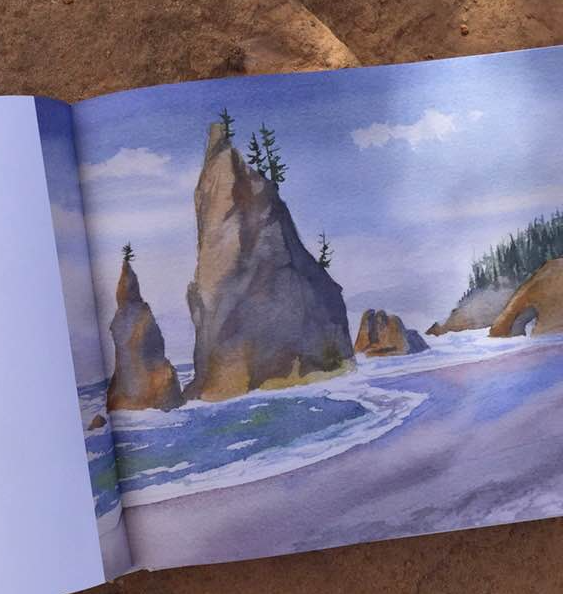
Each national park, and every natural place, has a palette, says Molly Hashimoto. This is Rialto Beach in Olympic National Park. This watercolor painting appears in Molly’s “blue” chapter. “The deeper blue becomes, the more urgently it summons man towards the infinite…” – Wassily Kandinsky
I love Molly’s instructions for palettes of different landscapes:
Skies:
Clear: Use a very weak phthalo blue red shade. The zenith may be a redder, more intense blue, so try adding carbazole violet or cobalt blue to that part of the sky.
Dawn and sunset: Permanent alizarin crimson, hansa yellow, pyrrol orange, perylene red, carbazole violet, phthalo blue red shade, indanthrone blue and quinacridone burnt orange are all colors that may capture the varied shades seen at these hours.
Sea Stacks and Rocks:
Dark rocks seen in silhouette: Use phthalo blue red shade mixed with quinacridone burnt orange and carbazole violet. Or try ultramarine blue plus quinacridone burnt orange plus carbazole violet.
This is Sedona, Arizona and the view just down the street from the home of family members we visited on our cross country road trip. What a stunning palette of colors…..
Molly includes color instructions for trees and forests, rivers, creeks, tarns, and lakes, glaciers and snowfields, cliffs and rocks, summer coastal prairies and meadows, sand, ocean water, and autumn hues.
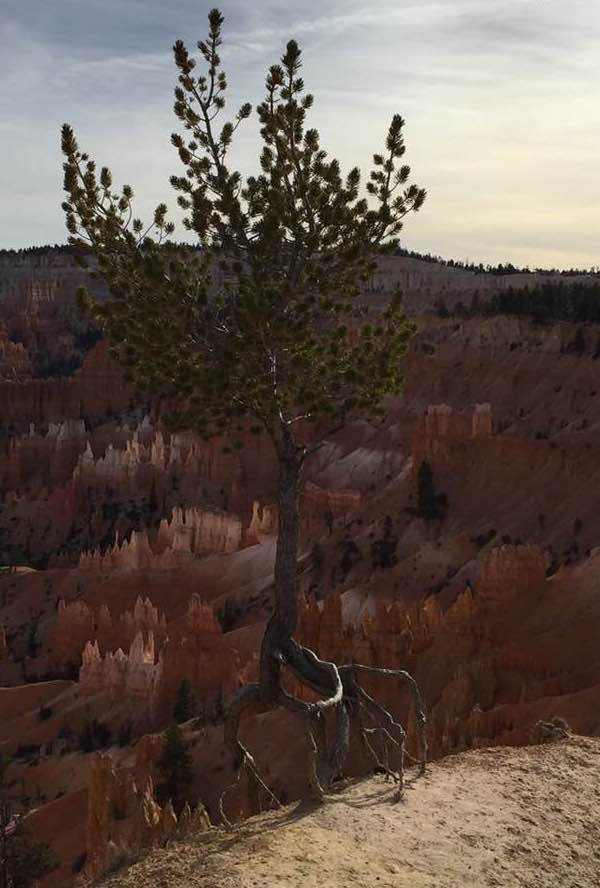
Red Rock Ranger District, Coconino National Forest, Sedona.Grand Canyon South Rim, late afternoon. It has many moods and an infinite number of palettes depending on the time of day, the season, the weather, and a host of other variables.Another view of the Grand Canyon, a different time of day. “Traveling and sketching in the off-season—when children and college students have returned to school and many people are back at work—feels so much more like the earlier artists’ and travelers’ experience of our national parks and monuments. The sense of discovery is keener when there are fewer people. And the visual thrill of brilliant fall colors is augmented by all our senses: the silence, the fragrance of dry leaves, the feeling of the chill morning air. Beyond that, we know that the shorter days mean that winter is coming, so we value these hours even more.” – Molly Hashimoto.(I agree. My husband and I explored these parks and places in November, which turned out to be gloriously warm with many sun-filled days. And not many people.)Bryce Canyon. “Ochres and siennas are colors made from earth compounds tinted with iron oxides and are found in some of the earliest art….” Molly HashimotoWe met an artist and her husband. She was painting with oils.Life on the edge. This is a limber pine (pinus flexilis)The huge fireplace in El Tovar Lodge at the Grand Canyon. In the afternoon, after we’d hiked part of the South Rim, it got chilly and I appreciated this roaring fire. I sat on one of the comfy sofas and read a book.
Do you have a favorite national park? Do you keep a nature journal or sketchbook, or do you paint what you encounter in nature?
These low, red hills fascinated Georgia O’Keeffe. Click on this link to see one of her paintings of this landscape. An O’Keeffe painting recently sold for $45 million.
Detours can be the best parts of a journey.
Our detour to Ghost Ranch Education and Retreat Center in northern New Mexico was a turning point in our trip, and a magical gateway to the American Southwest. I’d mentioned to my husband when we were driving through New Mexico that I wanted to see where Georgia O’Keeffe had lived and painted. Joe looked online and discovered that we could stay at Ghost Ranch.
At more than 20,000 acres, Ghost Ranch is a world-renowned center of paleontology, anthropology, and archeology, rich with fossil quarries that contain some of the most important dinosaur bones ever discovered. Georgia O’Keeffe painted many of her masterpieces here, and more than 100 movies have been filmed at Ghost Ranch (including Indiana Jones and the Kingdom of the Crystal Skull and No Country for Old Men.)
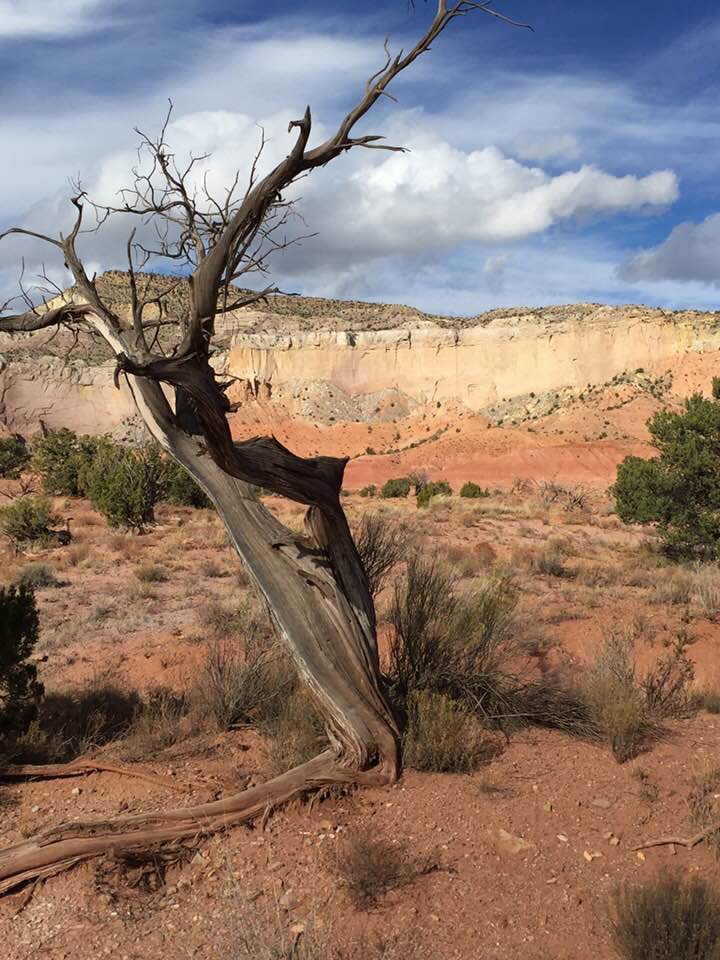
This juniper near O’Keeffe’s home, or one like it, inspired her painting, Gerald’s Tree.
Now owned by the Presbyterian Church, Ghost Ranch attracts thousands of visitors a year who come here for spiritual retreats, art and music classes, yoga, outdoor adventures and trail rides, or as a temporary refuge if you’re passing through, as my husband and I were.
Ghost Ranch is said to be haunted by spirits. It sure felt that way the night Joe and I arrived, in the dark, after driving up, up, and up on a twisting, turning road with many scary drop-offs. The welcome center had closed, and the staff had left our room key. We found our way in the dark and silence to the dorm, a no-frills adobe structure that had been staff quarters on this exclusive retreat for the wealthy in the 1920s and 1930s.
You had to be invited to come to Ghost Ranch. Georgia O’Keeffe was famous by the time she finagled an invitation. Others who came were Charles Lindbergh’s family and the Robert Wood Johnson family, founders of Johnson & Johnson. The R.W. Johnson former home is now the library at Ghost Ranch. The Lindbergh’s wanted a secret, private escape, as this was after their infant son had been kidnapped. Charles flew over Ghost Ranch and developed its first aerial view map.
Cerro Pedernal (flint hill), O’Keeffe’s favorite mountain, which she painted several times. Her ashes are scattered here.
All was darkness as Joe and I made our way to our room, except for the stars. The Milky Way cut a huge swath in the sky.
Ghost Ranch is said to be haunted by the spirits of the nomadic Native Americans that roamed here for thousands of years. Maybe, also, by the restless spirits of the cattle rustler brothers who, back in the day, hid stolen cattle in this box canyon and along the Chama River. Eventually, the two brothers had a falling out and one killed the other. The local townspeople came for the remaining brother and hung him from a tree that still stands on the property.
Ghost Ranch has a herd of sheep descended from those brought by the Spanish hundreds of years ago. Their wool is sent to a local woolen mill.
Our first morning at Ghost Ranch, my husband and I awoke to fluffy clouds that gave way to warm sunshine, which bathed a landscape of unusual rock formations and stunning mountains. The land glowed in hues of vermilion, ochre, gold, cream, and dusty brown.
A typical fireplace. This is in the home of the cattle rustlers who originally inhabited Ghost Ranch land. It is now a museum.
The staff and guides at Ghost Ranch were welcoming and knowledgeable. While Joe hiked up to the cliff chimneys, I took a guided tour of the ranch and a trip into the hillsides, where we saw many features of the terrain that Georgia O’Keeffe painted. Wendy, our tour guide, was an expert on O’Keeffe’s art and life. She had samples of the artist’s paintings that she showed us alongside the actual landscape subjects that so fascinated O’Keeffe. Georgia had her automobile outfitted as a portable studio and painted in the desert all day long. When it got too hot, she rested underneath her car.
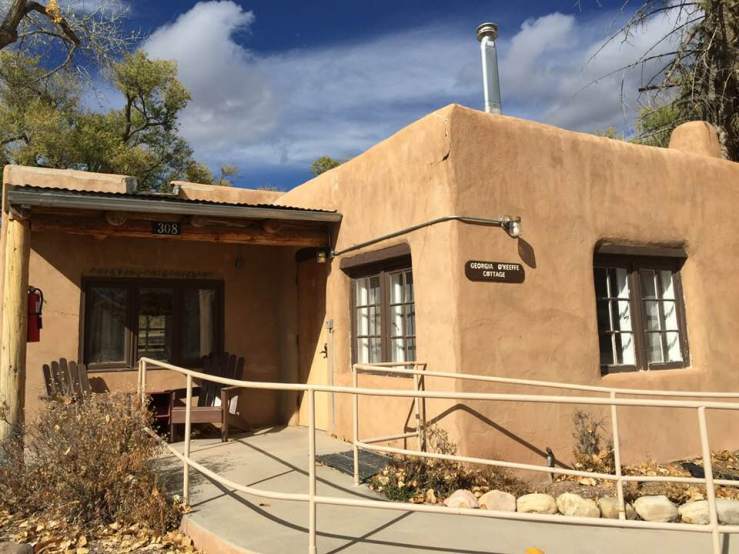
This is the casita that Georgia O’Keeffe lived in her first summer at Ghost Ranch. O’Keeffe’s world famous photographer husband, Alfred Stieglitz, never visited Ghost Ranch during the summers his wife stayed there. He remained in New York, where he was occupied with his career and his mistress. He and Georgia wrote 25,000 pages of letters to each other. Their relationship is a fascinating study of passionate love and how two great artists supported each other in their work.
I also attended a church service in the chapel, where I met a retired chaplain and a minister who were from my home town. The couple had rented out their Cleveland condo and were spending the year living and volunteering at Ghost Ranch.
Joe and I loved the home-cooked meals – breakfast, lunch, and dinner – in the Ghost Ranch dining hall, where you could meet and mingle with other guests who had come to take classes and watch the sun set in the evenings.
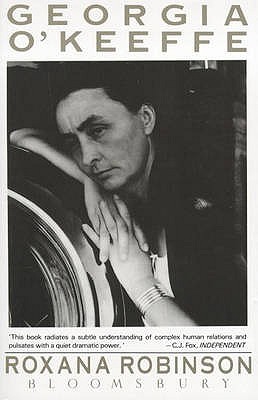
This is an excellent biography of O’Keeffe by Roxana Robinson, a novelist whose fiction has been compared to the work of John Cheever.
We were at Ghost Ranch just short of two days and didn’t have time to explore all its riches.
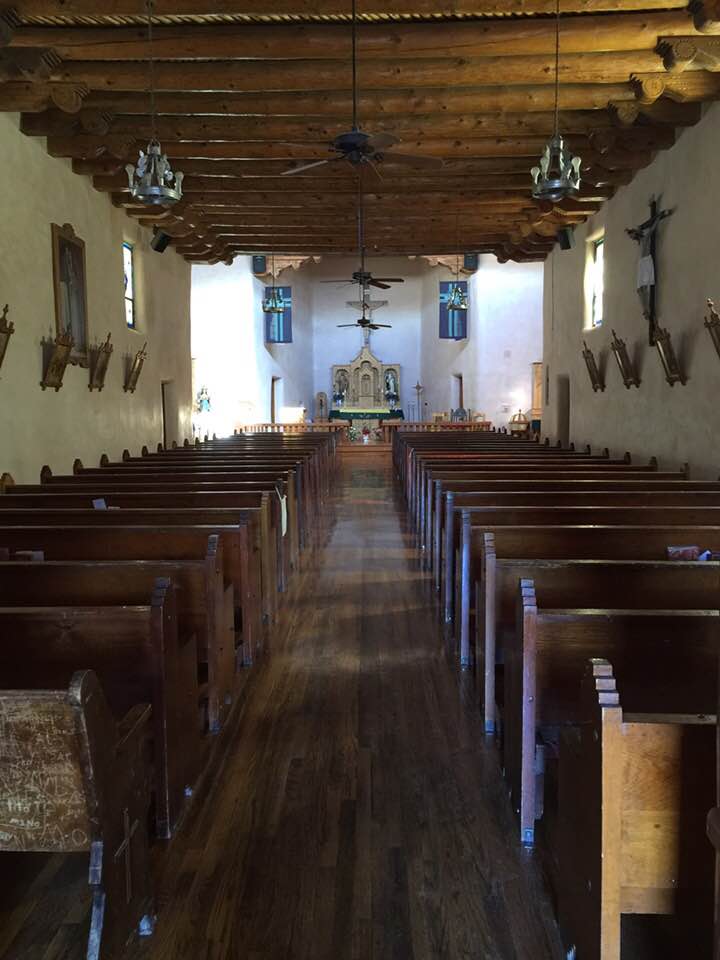
The Catholic church in the nearby town of Abiquiu. O’Keeffe had a home built on Ghost Ranch and then another in Abiquiu, which is now a museum.
“Humboldt talked of ‘mankind’s mischief…which disturbs nature’s order’. There were moments in this life when he was so pessimistic that he painted a bleak future of humankind’s eventual expansion into space, when humans would spread their lethal mix of vice, greed, violence and ignorance across other planets. The human species could turn even those distant stars barren and leave them ‘ravaged’, Humboldt wrote as early as 1801, just as they were already doing with earth….”
I didn’t have the camera or the skills to do justice to the landscape we drove through late one afternoon and into the evening on our cross-country journey. Mile after mile of drilling, fracking, and water pillaging, as far as the eye could see. We found our way into this surreal place unawares, and emerged a few hours later, shaken and sober.
Living in the Finger Lakes region, I’ve been spoiled: citizens came together to successfully outlaw fracking. Scenes such as these are not unfamiliar to me, though. I grew up in Cleveland and saw heavy industry smokestacks often. But I have never seen anything on this scale before. Hundreds of gas flares marked the landscape as if there were some dire emergency – which I believe there is.
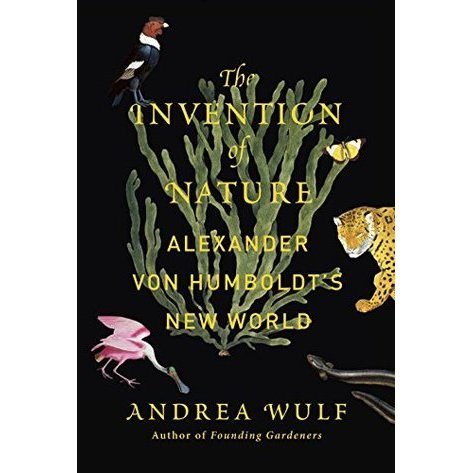
We arrived at our rather desolate, but welcome, motel room and, as timing would have it, that evening I finished reading The Invention of Nature by Andrea Wulf, about a man who, over 200 years ago, predicted that humans would wreak havoc on the environment.
The German scientist and naturalist Alexander von Humboldt has been largely forgotten, even though he was an international “rock star” of his time, and even though many parks, lakes, mountains, towns, and counties in the US are named after him. Andrea Wulf’s biography, published in 2015, has resurrected his legacy and spirit. Her book won the James Wright Award for Nature Writing, the Royal Geographical Society Ness Award, and many others, and it was named a best book of the year by many newspapers and publications.
It’s a wonderful read, especially if you love well written biographies with themes of history, nature, travel, and adventure. Here’s how Humboldt’s story opens:
“They were crawling on hands and knees along a high narrow ridge that was in places only two inches wide. The path, if you could call it that, was layered with sand and loose stones that shifted whenever touched. Down to the left was a steep cliff encrusted with ice that glinted when the sun broke through the thick clouds. The view to the right, with a 1,000-foot drop, wasn’t much better. Here the dark, almost perpendicular walls were covered with rocks that protruded like knife blades.
Alexander Humboldt and his three companions moved in single file, slowly inching forward….It was 23 June 1802, and they were climbing Chimborazo, a beautiful dome-shaped inactive volcano in the Andes that rose to almost 21,000 feet, some 100 miles to the south of Quito in today’s Ecuador.”
As a young man, Humboldt spent five years exploring South America and, later in life, about a year traveling through Siberia. For much of the rest of his years, he conducted research and scientific experiments, lectured, taught, and wrote books about his findings. His books were unlike any seen before, with his discoveries about climate and the natural world. Nearly bankrupting himself, he hired botanical illustrators, naturalists, and researchers to assist him in creating magnificent volumes that were much in demand and translated into many languages.
Humboldt is incredibly important because he concluded that nature was a vast, interconnected global force, and that human impact locally could have ramifications globally.
He had the radical notion that nature did not exist to serve humanity. His work and ideas influenced Charles Darwin, Henry David Thoreau, John Muir, and others. I like that Wulf devotes entire chapters to Darwin, Thoreau, Muir and a few others, so we can see how they carried Humboldt’s ideas forward in understanding nature and climate.
“… [John] Muir experienced the natural world in a new way….he now began to see connections. Everything was important in this grand big tangle of life. There existed no unconnected ‘fragment’, [John] Muir thought. Tiny organisms were as much part of this web as humankind. “Why ought man to value himself as more than an infinitely small unit of the one great unit of creation?’ Muir asked. “The cosmos,’ he said, using Humboldt’s term, would be incomplete without man but also without ‘the smallest transmicroscopic creature.’”
I love this description of Humboldt’s privately sponsored lectures, which women were allowed to attend. (At that time, women could not attend university lectures or meetings of scientific societies.)
“By not charging any entry fee, Humboldt democratized science: his packed audiences ranged from the royal family to coachmen, from students to servants, from scholars to bricklayers – and half of those attending were women.
With his gentle voice Humboldt took his audiences on a journey through the heavens and deep sea, across the earth, up the highest mountains and then back to a tiny fleck of moss on a rock. He talked about poetry and astronomy but also about geology and landscape painting. Meteorology, the history of the earth, volcanoes and the distribution of plants were all part of his lectures. He roamed from fossils to the northern lights, and from magnetism to flora, fauna and the migration of the human race. The lectures were a portrait of a vivid kaleidoscope of correlations that spanned the entire universe.”
Humboldt wrote prolifically. His most influential books are:
Cosmos: Sketch of a Physical Description of the Universe (Five Volumes)
Personal Narrative of Travels to the Equinoctial Regions of the New Continent during the years 1799 – 1804
Views of Nature
“The connection between knowledge, art and poetry, between science and emotions – the ‘deeply-seated bond’, as Humboldt called it – is more important than ever before. Humboldt was driven by a sense of wonder for the natural world – a sense of wonder that might help us today realize that we will protect only what we love.”
A refinery
Our reward for making it through the landscape in these pictures was a full moon rising.
Days later in our journey, we passed by Humboldt Toiyabe National Forest in eastern Nevada.
Coming up next, places and images of great beauty and more luscious books, I promise!
On our road trip across the US (south to Florida, then west to Tucson, Arizona, then north to Portland, Oregon) we spent nearly two weeks visiting family in the St. Petersburg area. Along the way, we stopped in Savannah, Georgia, my first time in that lovely city. An afternoon wasn’t nearly long enough, but we did visit The Book Lady Bookstore on East Liberty Street.
They had a display devoted to the Catholic writer Flannery O’Connor, who lived most of her life in Milledgeville, Georgia, where she raised peacocks and wrote short stories and novels. Her shocking story, “A Good Man Is Hard to Find,” is taught in many high school English classes. If you haven’t read it, it’s well worth your time, I promise you. I’ve never forgotten that story, although I’m not a fan of O’Connor’s novels – her protagonists, obsessed with working out their salvation, are too strange for me.
A Flannery O’Connor display at The Book Lady
But seeing the display called up memories and reminded me how much I enjoyed her collection of letters, The Habit of Being. Many years ago, when I lived in New York City, the assistant rector of the Episcopal church I attended taught a class on Flannery O’Connor. Fleming, our rector, who was from the South, led us in reading her stories and letters, and I was extra thrilled because The New Yorker writer, Joseph Mitchell, a Southerner himself, was in the class, too.
St. Petersburg
There are many things about Florida that I love, but I’m allergic to all the over-development and the acres of generic condos and shopping centers. There is plenty to do near the beautiful St. Pete waterfront though, and when our sons came down we enjoyed some of the shops and restaurants. (They enjoyed the music and night life, too.) We bought red snapper, grouper, and shrimp from a local fish market that had dozens of ice chests overflowing with fresh catches, and our sons did the cooking.
In Florida, I always look hard for bits of nature and local culture, so I was extra happy when we rented a sweet little apartment in a hidden alley in one of the older St. Petersburg neighborhoods. Some of the streets are cobblestone and lined with adorable Old Florida bungalows, many being renovated. Even though most of the windows of our airbnb were painted shut, we had air conditioning, and two large windows in the sleeping porch let in breezes from Tampa Bay two blocks away.
In the yard, I found lots of angel hair fern. We used to add this delicate bit of greenery to the roses we sold by the dozen in my family’s flower shop in Ohio.
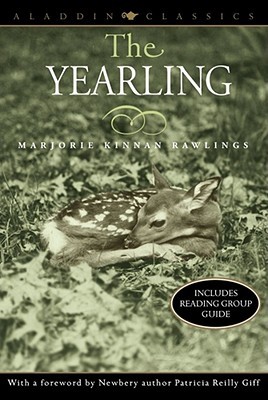
This part of Florida reminds me of one of my favorite books growing up, The Yearling,by Marjorie Kinnan Rawlings. Years later, I discovered, and loved, Marjorie’s memoir, Cross Creek. (There is a Cross Creek Cookery book, too.)
I love angel hair fern.
The ‘burbs
We had many happy visits with extended family in the St. Pete suburbs after we left our airbnb. We walked in the neighborhood every day. It was warm and humid, with occasional light rain that felt wonderful.
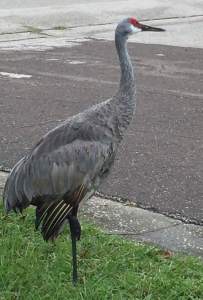
A sandhill crane waits for a busIbis, following their leaderAfter the rainThey grow them big,My sister-in-law has a kitchen garden with herbs and veggies, including plenty of Thai basil.
We passed by this wind sculpture on our walk every day:
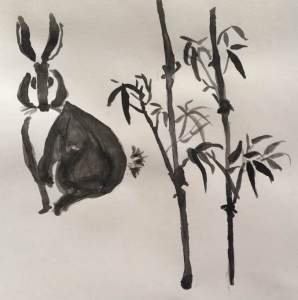
In the evenings, my niece, my sister-in-law and her mother, and I tried Chinese brush painting for the first time. We taught ourselves how to grind the ink, which is pressed into sticks and colorful rectangles, and mix it with water in an ink stone. Then we practiced brush strokes and painted our first, simple pictures. It was fun!
My attempt to paint a chickMy sister-in-law’s mother made a beautiful rabbit and this beautiful bamboo.
The Panhandle
Eventually, it was time to say goodbye to family and move on to the Florida panhandle and points west along our Deep South route. We stayed in Destin, our final visit in Florida, which had a lovely beach that we had almost to ourselves. It was beside a sea turtle breeding ground and state park, and there was a hidden garden teeming with Monarch butterflies.
Destin, Florida. There are military bases in nearby Pensacola, so we heard jets taking off from time to time.In a garden on the beach in Destin, there were hundreds of monarch butterflies.Places to go….Sunrise, Destin, Florida. (Photo by J. Hallinan, who gets up much earlier than I do.)Marjorie Kinnan Rawlings’ classic coming-of-age story, set in backwoods Florida, 1930sHer memoir.Flannery was a great writer of letters.This is what I’ve been reading on the road. It’s wonderful! More about it later…
Coming up: Mobile, Alabama and New Orleans
Traveling, immersing in nature, visiting bookstores. Do these experiences call up memories of books read long ago?
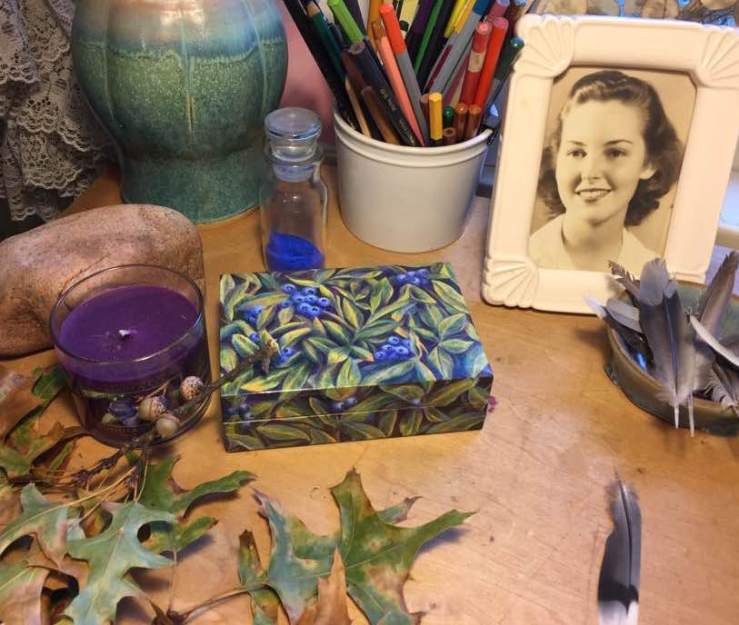
An artist’s work table. The photo is the artist’s mother. The feathers are thought to be sparrow feathers. This past summer, Kathy (my college roommate and an accomplished artist) and her husband nursed and fed a one-legged baby sparrow ejected from its nest, helped her learn to fly, and acclimated her to the suburban “wild.” Kathy said she kept finding feathers in her yard, as if the birds were leaving small tokens of thanksgiving.
My husband and I and Books Can Save a Life have taken to the road!
We’ve left upstate New York, where we’ve lived for over thirty years, and are heading to one of our favorite cities, Portland, Oregon, via St. Petersburg, Florida, where we have family. The place we’ll ultimately call home is still to be determined, but in the meantime, we’re in search of happy adventures and detours.
I’m excited to share with you highlights of our auspicious first stop: Audubon, New Jersey, the home of my good friend and former college roommate, Kathy. She is an artist who specializes in printing, painting, and drawing. Here is a link to her IG site, @blueberry_hills. If you follow her, you’ll be treated to beautiful art along with her thoughts about the creative process and challenges particular to her project of the moment. Back in the day when we were roommates, Kathy was always working on an illustration, a painting, or illuminated calligraphy. Just being around the making of these beautiful pieces awakened my own creative spirit.
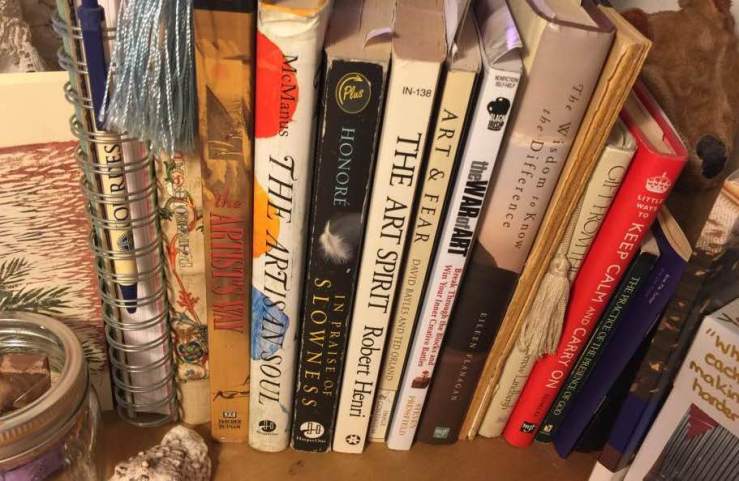
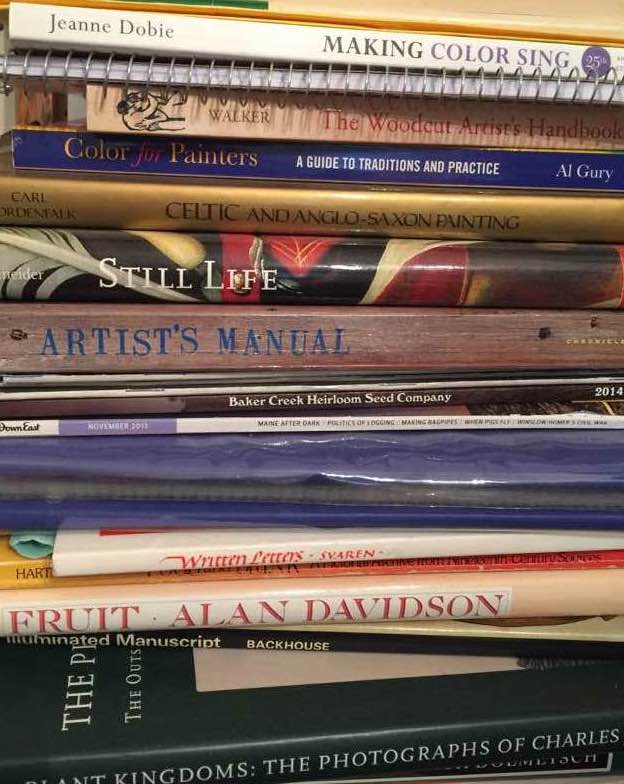
Books nourish an artist’s practice. I see familiar titles here on Kathy’s drawing table, and ones new to me that I look forward to reading.
I’m intrigued by the books and authors that inspire artists. Kathy keeps these close at hand on her drawing table. I’ve read and highly recommend these:
The Artist’s Way by Julia Cameron
Art and Fearby David Bayles and Ted Orland
The War of Art by Steven Pressfield
The Art Spirit by Robert Henri
Gift from the Sea by Anne Morrow Lindbergh
In Praise of Slowness by Carl Honorè
New to me are:
The Artisan Soul by Erwin McManus
The Wisdom to Know the Difference by Eileen Flanagan
Keep Calm and Carry On (The title is based on a British motivational poster from World War II that was never actually used – it was for if and when Britain was invaded; the book is a collection of motivational quotes)
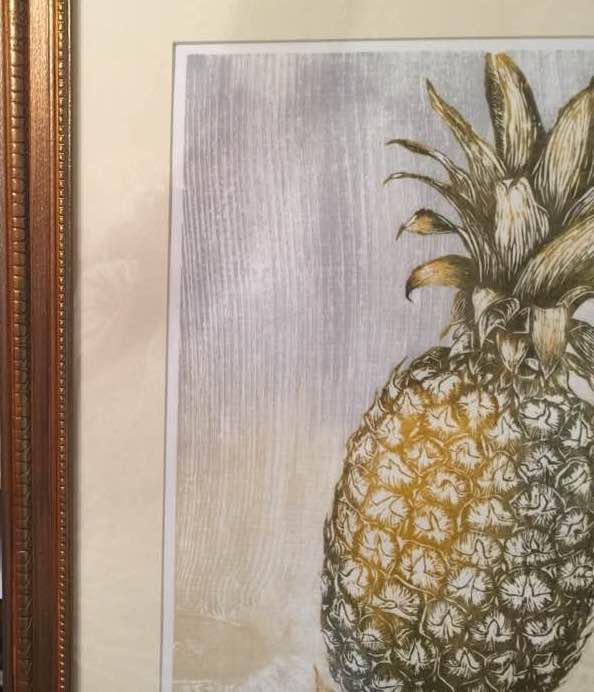
Woodcut, ‘Welcome Home’/’Pineapple’
I decided to call this post “Sparrow, Art, Life” because a few weeks ago I wrote about Birds Art Life: A Year of Observation by Kyo Maclear. It seems to me that Kathy’s work, art and life blend together in a seamless way, and this can be so for the rest of us. Plus, a sparrow happened to come along that changed Kathy’s summer.
Detail of the woodblock Kathy carved to make the pineapple prints. The soft pine woodblock is a work of art, too, and woodblocks are often displayed as such. I deepened the color in this photo somewhat; the piece is beautiful – you can’t help wanting to touch the textured surface.
Kathy and her husband told us the fascinating story of their becoming foster parents to a baby sparrow. She said it was quite something to become so surprisingly intimate with a member of another species. Over the span of four weeks the sparrow, which they named Nestle, bonded with them. Nestle got to feeling quite comfortable snuggling up on Steve’s lap and going to sleep.
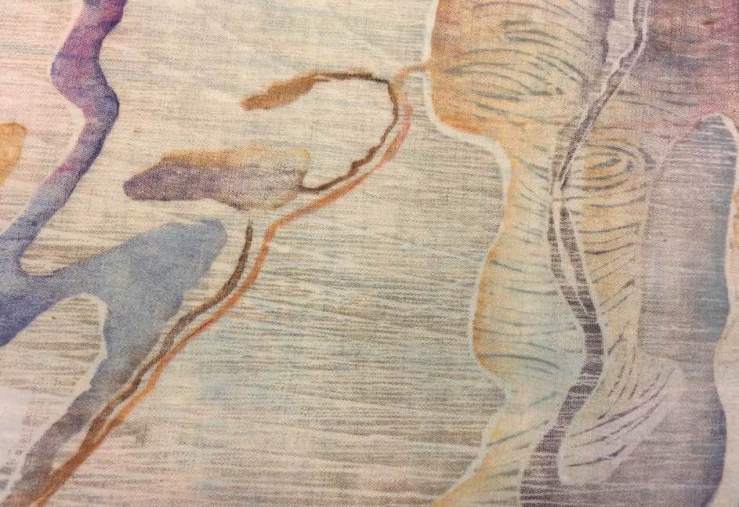
Exploration of wind across water, reflected trees. Woodcut, Akua ink on 400 count cotton sateen (a really nice pillow case). I find this piece and its production intriguing, mysterious, and unpredictable, and Kathy does too. It requires several steps and layerings of ink. Kathy was planning to create another water print the week after I left. She estimated the printing process would take about two days.
Taking care of Nestle, encouraging her to fly, and acclimating her to the wild was intensive, time consuming, and required a bit of research. Kathy and Steve ended up not following much of the advice they found online, but in the end they were successful. The process of letting go was quite moving; at first Nestle returned every evening and wanted to sleep in her cage, but eventually she stopped coming back. Now, occasionally, they spot Nestle in the backyard. I wonder if she remembers her human parents.
Detail, water woodcut
We talked about getting close to nature in this way. Maybe if all of us had opportunities to bond with a creature of another species, we’d have more appreciation for the earth and become more inclined to care for the environment. Kathy said Nestle has inspired a unique art project that she’ll be working on in the coming months. I can’t wait to see it.
I found Kathy and Steve’s story especially timely for me, because I’d just finished writing and producing another audio essay in my “From Where I Stand” series. It features the sounds of encounters with a humpback whale and Adelie penguins from my husband’s recent trip to the Antarctic. I hope to share a link to the audio essay here on Books Can Save a Life soon.
Nestle the sparrow
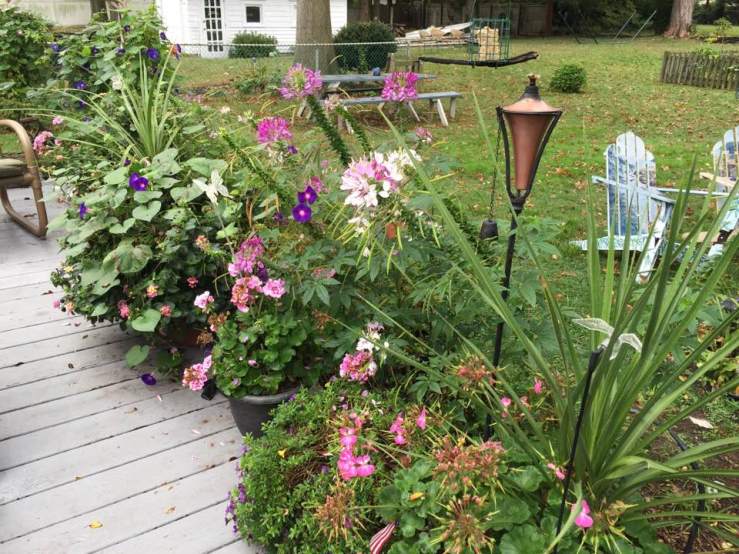
An artist’s garden. Kyo Maclear, in her book Birds Art Life,writes of artists and writers having a side practice, and certainly for Kathy it is gardening. I enjoyed seeing the flowers and meditation space she’s created over the years and hearing about her future garden plans.
Our visit with Kathy and Steve was too short. I loved hanging out in her studio and seeing her other creative spaces, and we could have talked for hours.
Another art studio book stack…..
I’ll write more in a few days from on the road. Do you have especially loved books about art, life and creativity? What are they?
“From 2000 to 2004, five Black young men I grew up with died, all violently, in seemingly unrelated deaths. The first was my brother, Joshua, in October 2000. The second was Ronald in December 2002. The third was C.J. in January 2004. The fourth was Demond in February 2004. The last was Roger in June 2004. That’s a brutal list, in its immediacy and its relentlessness, and it’s a list that silences people. It silenced me for a long time. To say this is difficult is understatement; telling this story is the hardest thing I’ve ever done.
My hope is that learning something about our lives and the lives of the people in my community will mean that….I’ll understand a bit better why this epidemic happened, about how the history of racism and economic inequality and lapsed public and personal responsibility festered and turned sour and spread here. Hopefully, I’ll understand why my brother died while I live, and why I’ve been saddled with this rotten fucking story.” Men We Reaped, by Jesmyn Ward
Our country is going through something.
Last night, Eminem caused the latest sensation when he debuted “The Storm” on the BET Awards.
I just finished reading her beautiful and heartbreaking memoir, Men We Reaped, about the deaths of five young black men in her community. One of them was her 19-year-old brother, Joshua, another was her cousin.
This was an emotionally difficult read, and Ward has spoken of how it was nearly impossible for her to write. Like Salvage the Bones, her memoir opened my eyes to a part of America and a culture that I’m a stranger to. Ward has a powerful connection to her people and her home in rural Mississippi where she still lives, and she’s eloquent when it comes to expressing hard-won insights about both.
She chose an unusual and I think clever structure for her memoir: Moving forward in time from childhood to adulthood, she tells of growing up poor in DeLisle, Mississippi and paints vivid portraits of her nuclear and extended families and community. Ward weaves into this narrative another narrative that moves backward in time, recounting the lives and deaths of five young Black men, beginning with the most recent death and ending with her brother’s death. This chronology builds to an intense climax, and the two narrative strands illuminate and complement each other.
I found Ward’s depictions of her father and mother to be especially psychologically astute, filled with ambiguities and complexities. She blends her disappointment in their failings with love, compassion, and understanding. It’s apparent that she’s done the hard emotional work of coming to terms with her reality, so as the reader I trust her perspective – it has the ring of truth and authenticity. This kind of understanding must be gained before the writing even begins. Insight deepens with the writing, and each successive draft.
I appreciate that Ward is able to show how a person, and a people, can be brainwashed (see the excerpt below) by their history and culture into believing they are worthless. This sabotages lives; sometimes it’s just not possible for people to pull themselves up by their bootstraps. Men We Reaped breaks down barriers by allowing us to see the world through another’s eyes.
If you enjoy memoir, Men We Reaped is a good one. If you want to sample the National Book Award short list for fiction, Ward’s novel, Sing, Unburied, Sing, would be a great choice. I hope to get to it soon.
“We tried to outpace the thing that chased us, that said: You are nothing. We tried to ignore it, but sometimes we caught ourselves repeating what history said, mumbling along, brainwashed: I am nothing. We drank too much, smoked too much, were abusive to ourselves, to each other. We were bewildered. There is a great darkness bearing down on our lives, and no one acknowledges it.”
********
“I thought being unwanted and abandoned and persecuted was the legacy of the poor southern Black woman. But as an adult, I see my mother’s legacy anew. I see how all the burdens she bore, the burdens of her history and identity and of our country’s history and identity, enabled her to manifest her greatest gifts. My mother had the courage to look at four hungry children and find a way to fill them….And my mother’s example teaches me other things: This is how a transplanted people survived a holocaust and slavery. This is how Black people in the South organized to vote under the shadow of terrorism and the noose. This is how human beings sleep and wake and fight and survive.”
Have you read any of Jesmyn Ward’s books? Comments?
“They were constantly chirping, and what they were saying, or what I heard them say, was: Stand up. Look around. Be in the world.”
********
“For me, birding and writing did not feel interchangeable. Birding was the opposite of writing, a welcome and necessary flight from the awkward daily consciousness of making art. It allowed me to exist in a simple continuity, amid a river of birds and people and hours. The stubborn anxiety that filled the rest of my life was calmed for as long as I was standing in the river.”
********
“As long as I can remember I have been drawn to people who have side loves. Maybe because no single job or category has ever worked for me, I am particularly interested in artists who find inspiration alongside their creative practice. It could be a zest for car mechanics or iron welding (Bob Dylan) or for beekeeping (Sylvia Plath). I love the idea that something completely unexpected can be a person’s wellspring or dark inner cavern, that our artistic lives can be so powerfully shaped and lavishly cross-pollinated by what we do in our so-called spare time.” Birds Art Life: A Year of Observation by Kyo Maclear
I just love this little memoir. Writer Kyo Maclear, a novelist, essayist, and children’s book author, was feeling overwhelmed by the illness of her father, caring for her two young boys, keeping up her writing, and all of life’s other demands. She decided to begin a side practice, something to relax her and refresh her writing and creative spirit.
For a year, she accompanied an avid birder who is also a musician and performer in birding adventures around Toronto and wrote about it, along the way finding truths about life and art.
Many artists and writers are dabblers or become accomplished in a side practice that cross pollinates their art and their life. Vladimir Nabokov was a world renowned butterfly expert. Virginia Woolf gardened.
I’m not sure I have a side practice. Certainly nature feeds my writing and inspires me, and I’m experimenting with learning how to paint watercolors because painting is nonverbal, a relief from hours of being in my own head when I write.
For Kyo, birding was a delightful hobby and new passion because it was relatively easy to do. Despite living in an urban environment, Kyo and her birding companion were intrigued and entertained by the wide range of birds they found along the lake front and in streams, parks, vacant lots, parking lots, backyards, and right outside their picture windows.
Each chapter in Birds Art Life is devoted to a month and a theme: Love, Cages, Smallness, Waiting, Knowledge, Faltering, Lulls, Roaming, Regrets, Questions, and Endings.
A few chapter subtitles will give you an idea of Kyo’s thematic reflections:
Smallness: On the satisfactions of small birds and small art and the audacity of aiming tiny in an age of big ambitions
Lulls: On peaceful lulls and terrifying lulls and the general difficulty of being alone and unbusy
In one chapter, Kyo broadens her scope to reflect on climate change and how, day to day, urbanites and suburbanites don’t notice the human-caused environmental disruption and species depletion happening just outside their view.
Many birders have a spark bird, a particular species of bird that ignites their interest and launches them into birding. Likewise, many devoted readers have a spark book, a book they read in childhood that became a portal to a life of passionate reading.
Do you have a spark book? What comes to mind for me is A Wrinkle in Time by Madeleine L’Engle.
This is a hugely satisfying memoir and meditation on life and art that will replenish your spirit. I highly recommend it.
“This is what birds do when they join a swirl of other birds, I thought. They don’t proclaim their individuality or try to make a splash. They dissolve into the group. I wondered if this merging felt so relaxing because it was an antidote to the artist ego, built on an endless need to individuate, to be your own you. In place of exhausting self-assertion, the relief of disappearing into the crowd.”
Do you have a side practice that complements your primary work? Do you have a spark book, or a spark bird, or something specific that sparked your passion in another hobby or practice?
“He would push 10 mg of morphine and 5 mg of the fast-acting sedative drug Versed and go up from there.” – Sheri Fink,Five Days at Memorial: Life and Death in a Storm-Ravaged Hospital
In light of Hurricane Harvey, I’m reposting this from four years ago. Five Days at Memorial is a fabulous work of investigative journalism about one hospital’s desperate decisions in the aftermath of Hurricane Katrina. Much was learned the hard way about emergency preparedness in health care settings during Katrina, which seems to be making a difference as Houston copes with Hurricane Harvey. But with more mega-storms likely in our future, this is something we should all care about. Click on the link below to read my previous post about Five Days at Memorial,a work of nonfiction that has won numerous awards.
“Humans are free. We can commit suicide for the benefit of a Singularity. We can engineer our genes to better support an imaginary hive mind. We can make culture and journalism into second-rate activities and spend centuries remixing the detritus of the 1960s and other eras from before individual creativity went out of fashion.
Or we can believe in ourselves. By chance, it might turn out we are real.”
***
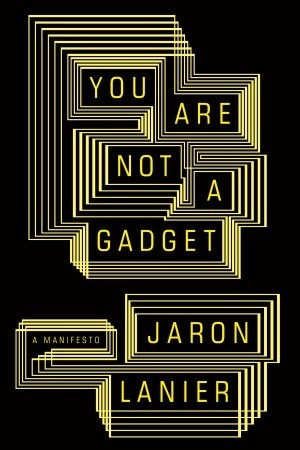
“The words in this book are written for people, not computers. I want to say: You have to be somebody before you can share yourself.” You Are Not a Gadget, byJaron Lanier
A few months ago, I found my way to futurist, virtual reality pioneer, and composer Jaron Lanier and his newest book, Who Owns the Future? I was delighted to read the work of a prominent techie genius (Jaron works for Microsoft) calling for a humanistic information economy. I was so impressed with his message and vision, I sought out his first book, You Are Not a Gadget.
I haven’t had a chance to synthesize my thoughts about You Are Not a Gadget. Before too much time goes by and I forget what I read, I wanted to at least post a few of my favorite quotes from the book, which inspired me as much as Who Owns the Future?
I’ve grown weary of social media and the sameness and superficiality of much of what I see online. I don’t know what to make of or how we can stop the fake news, misinformation, and vitriol that spread like wildfire on the internet and degrade our democracy and culture. You Are Not a Gadgetwas published in 2010 and does not address our current mess, but it is remarkably prescient. I hope that Lanier is writing at this very moment a third book to help save us from ourselves.
Here are some things Lanier has to say in You Are Not a Gadget:
“Web 2.0 designs strongly favor flatness in cultural expression. But I believe that flatness, as applied to human affairs, leads to blandness and meaninglessness.”
********
“If you want to know what’s really going on in a society or ideology, follow the money. If money is flowing to advertising instead of musicians, journalists, and artists, then a society is more concerned with manipulation than truth and beauty. If content is worthless, then people will start to become empty-headed and contentless.
“The combination of hive mind and advertising has resulted in a new kind of social contract. The basic idea of this contract is that authors, journalists, musicians, and artists are encouraged to treat the fruits of their intellects and imaginations as fragments to be given without pay to the hive mind. Reciprocity takes the form of self-promotion. Culture is to become precisely nothing but advertising.”
********
“Anonymous blog comments, vapid video pranks, and lightweight mashups may seem trivial and harmless, but as a whole, this widespread practice of fragmentary, impersonal communication has demeaned interpersonal interaction.
Communication is now often experienced as a superhuman phenomenon that towers above individuals. A new generation has come of age with a reduced expectation of what a person can be, and of who each person might become.”
I highly recommend Jaron Lanier’s books. They will get you thinking about where we seem to be heading and how we might take a more deliberate, ethical path to a humane culture that uses technology wisely while keeping it in its proper place.
This time around, my post is mostly pictures from bookstore stops on our summer vacation in the Pacific Northwest.
The past few years, we’ve been more consciously immersing in nature in our travels, and I’ve been reading and writing about nature, too. Along the way, I’ve become fascinated by watercolor painting and nature journaling, though I can’t say I actually do much painting or journaling.
Very early on, I let a teacher convince me I had no talent for art, and so I’ve avoided these artistic pleasures and pursuits. I’ve since seen the light, and now I have all sorts of intentions and anticipations when it comes to making art. We’ll see.
In the meantime, my desires and my love for beautiful things are reflected in my bookstore adventures.
Browsers Bookshop in Olympia has become a good friend, a favorite stop in my travels since I happened upon it last year. A warm, welcoming staff and an exceptional selection of books.
Browsers Bookshop has many book categories and collections, sprinkled with staff picks. All in all, an outstanding selection of books, with many hidden gems, like the one I found below….
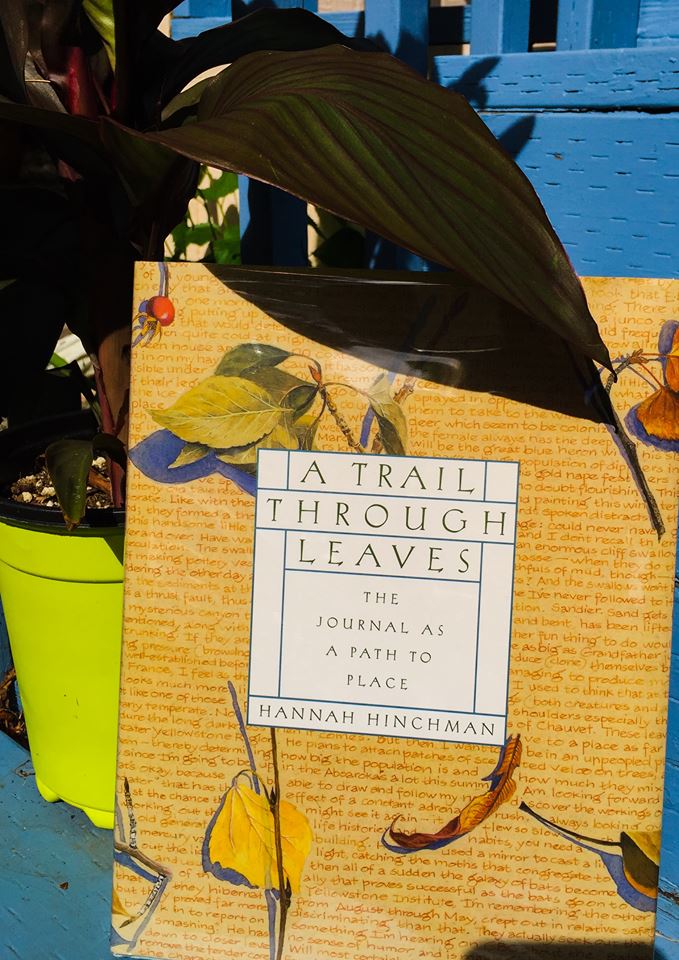
A Trail Through Leaves is extraordinary. Part memoir and part instruction in the daily act of keeping a nature journal, Hannah Hinchman’s writing and illustrations are outstanding. “The journal is a place to decant the stuff of life; reassuringly, none of it is wasted. It remains fresh, still tasting of its source. Transferring experience from the vat of life into the vessel of the journal is a distillation: it sieves, concentrates, and ferments. If after many seasons we develop some mastery of the process, the stuff can become as clear and fiery as brandy.”
A page from Hannah Hinchman’sA Trail Through Leaves: The Journal as a Path to Place. “Everyone should learn to draw competently, with a sense of play and invention, if only to honor the fact that it’s one of the first instinctive gestures we make to appease the appetite for beauty. If everyone acknowledged that hunger, and gained a whole selection of ways to satisfy it, a different culture would emerge.”
Personally recommended by Browsers Bookshop owner Andrea Griffith. What a meaningful gesture, to press a book into someone’s hands. “I never put up a barber pole or a sign or even gave my shop a name.” – Jayber Crow My journey with Wendell Berry continues. Recently, I finished Hannah Coulter.
I couldn’t decide…and I could have spent another hour or two in Book ‘N’ Brush.
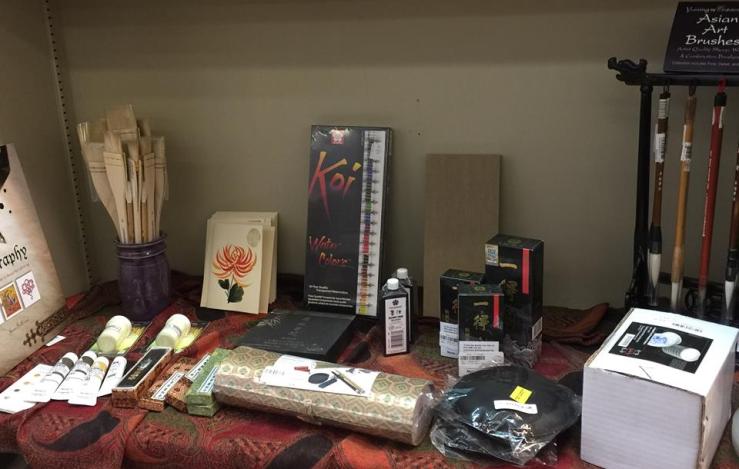
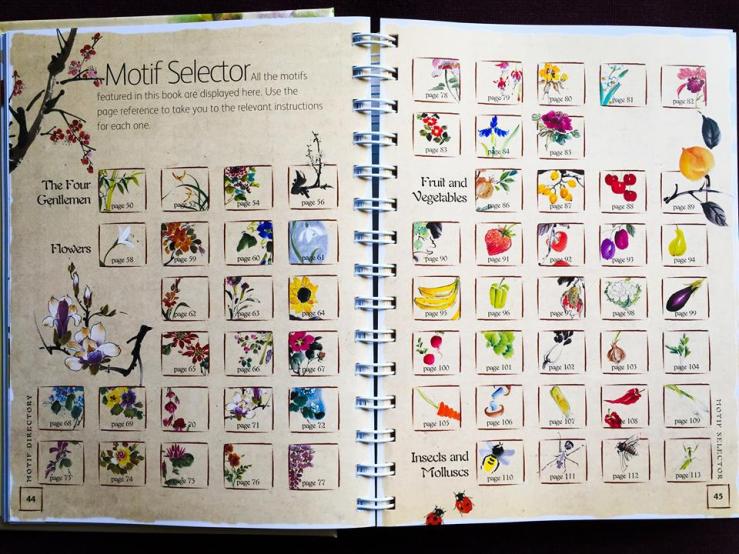
Chinese brush painting display at Book ‘N’ Brush. These intriguing and beautifully made tools were so enticing I was tempted to try this specialty, and I was led to another hidden gem….
“Absorbing and calming, spiritual and steeped in history, the tradition offers something for everyone….Most satisfyingly, the pictures you paint will be in your own ‘handwriting,’ unique to you. ‘Writing a picture’ is the usual way of describing the painting process in China.”
Each page contains simple instructions for making a flower, a fruit, a vegetable, an animal, an insect, a fish….Who knew with just a few strokes I could make a snail, a fuchsia, a chili pepper, a peacock, a relaxing woman, a couple in conversation….
Plenty of staff recommendations at Book ‘N’ Brush too, the mark of a good bookstore. I spy a few familiar faces…
On my to-read shelf, an urban writer observes birds outside her window for a year: “The artist peered at me thoughtfully for a moment. Her blue eyes were clear and perfectly lined with kohl. Finally she spoke, with a hint of bemusement. She said the students who came to her were always full of hunger. They were seventeen-year-old aspiring artists and eighty-five-year-old retired businessmen. People of mourned, mislaid, or unmined creativity. Their yearning was like the white puff of a dandelion. All she had to do was blow gently and watch their creative spores lift, scatter, and take seed.”
We were in Portland, too. At the Woodstock Public Library I found a life-sized etching of a poem written by Kim Stafford. (Earlier this year, I took one of Kim’s online classes, Daily Writing in the Spirit of William Stafford.) You have the power to open centuries that trees hold/silent in their rings. This palace of the possible needs you,/your hand on the door. Enchant this place awake.
Many thanks to Browers Bookshop and Book ‘N’ Brush for much browsing pleasure, for great books I wouldn’t have discovered anywhere else, and for giving so much to their communities. What would we do without independent bookstores?
Here’s one more quote by Hannah Hinchman, from A Trail Through Leaves; it occurs to me that I must have been not that far away from this scene as it happened – I was in college in Appalachian Ohio in 1976:
“The girls wore plain long dresses with a sort of blazer coat, equally plain. They led me to the barn with no concern for the mud. They showed me the milk vat, half full of milk. Startling to see a whole lake of milk like that, with cat tracks on the lid of the vessel. Such an austere cold and windy gray day, spitting pellets of snow. Arriving at this farm in the deepest of Ohio agricultural land, far from the mainstream of the world, and meeting these youngsters, plain as the winter landscape, but with faces like young peaches, smooth as fresh-shelled beans, like sprouts in winter.”Hannah Hinchman’s journal, Volume 19, Ohio, 1976.
(Since I wrote this post, I found out Hannah Hinchman has another classic book, A Life in Hand: Creating the Illuminated Journal.It’s available as an e-book, but the print versions are now quite expensive. It would be great if a publisher would re-issue a print edition. Print books such as this one disappearing from the world are a loss.)
What are you reading this summer? If you’ve been traveling, where to, and have you found any bookstores to recommend?











 The German scientist and naturalist Alexander von Humboldt has been largely forgotten, even though he was an international “rock star” of his time, and even though many parks, lakes, mountains, towns, and counties in the US are named after him. Andrea Wulf’s biography, published in 2015, has resurrected his legacy and spirit. Her book won the James Wright Award for Nature Writing, the Royal Geographical Society Ness Award, and many others, and it was named a best book of the year by many newspapers and publications.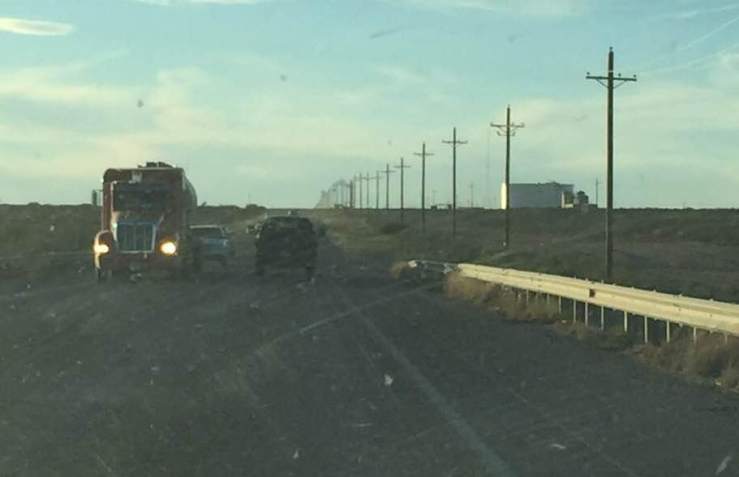


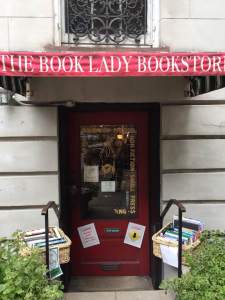 On our road trip across the US (south to Florida, then west to Tucson, Arizona, then north to Portland, Oregon) we spent nearly two weeks visiting family in the St. Petersburg area. Along the way, we stopped in Savannah, Georgia, my first time in that lovely city. An afternoon wasn’t nearly long enough, but we did visit
 with adorable Old Florida bungalows, many being renovated. Even though most of the windows of our airbnb were painted shut, we had air conditioning, and two large windows in the sleeping porch let in breezes from Tampa Bay two blocks away.









 “From 2000 to 2004, five Black young men I grew up with died, all violently, in seemingly unrelated deaths. The first was my brother, Joshua, in October 2000. The second was Ronald in December 2002. The third was C.J. in January 2004. The fourth was Demond in February 2004. The last was Roger in June 2004. That’s a brutal list, in its immediacy and its relentlessness, and it’s a list that silences people. It silenced me for a long time. To say this is difficult is understatement; telling this story is the hardest thing I’ve ever done.
  If you enjoy memoir, Men We Reaped is a good one. If you want to sample the National Book Award short list for fiction, Ward’s novel, Sing, Unburied, Sing, would be a great choice. I hope to get to it soon.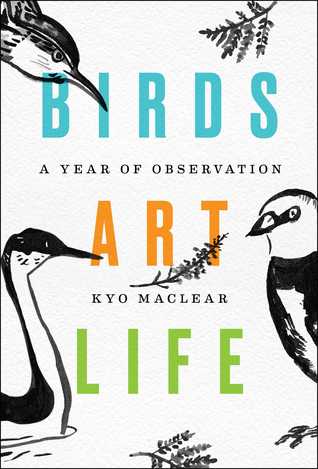

 “Humans are free. We can commit suicide for the benefit of a Singularity. We can engineer our genes to better support an imaginary hive mind. We can make culture and journalism into second-rate activities and spend centuries remixing the detritus of the 1960s and other eras from before individual creativity went out of fashion.
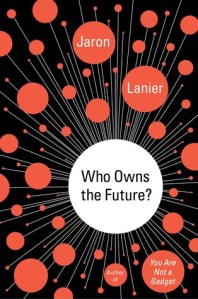 I haven’t had a chance to synthesize my thoughts about You Are Not a Gadget. Before too much time goes by and I forget what I read, I wanted to at least post a few of my favorite quotes from the book, which inspired me as much as Who Owns the Future?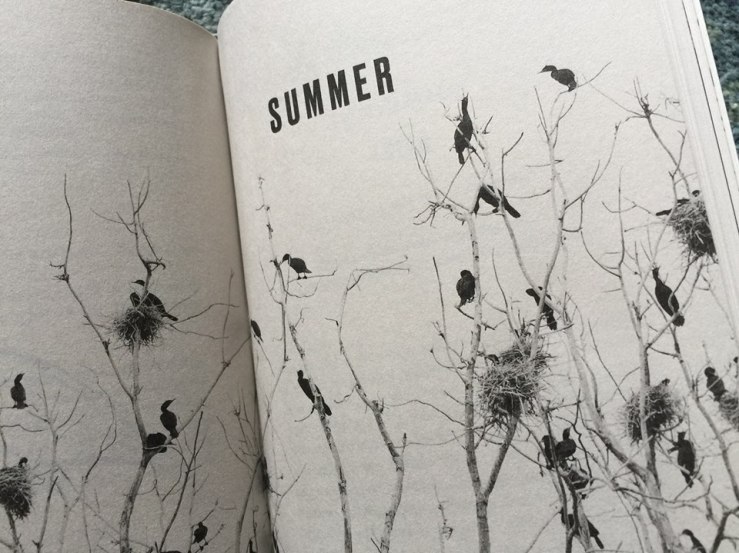







 Books Can Save A Life