
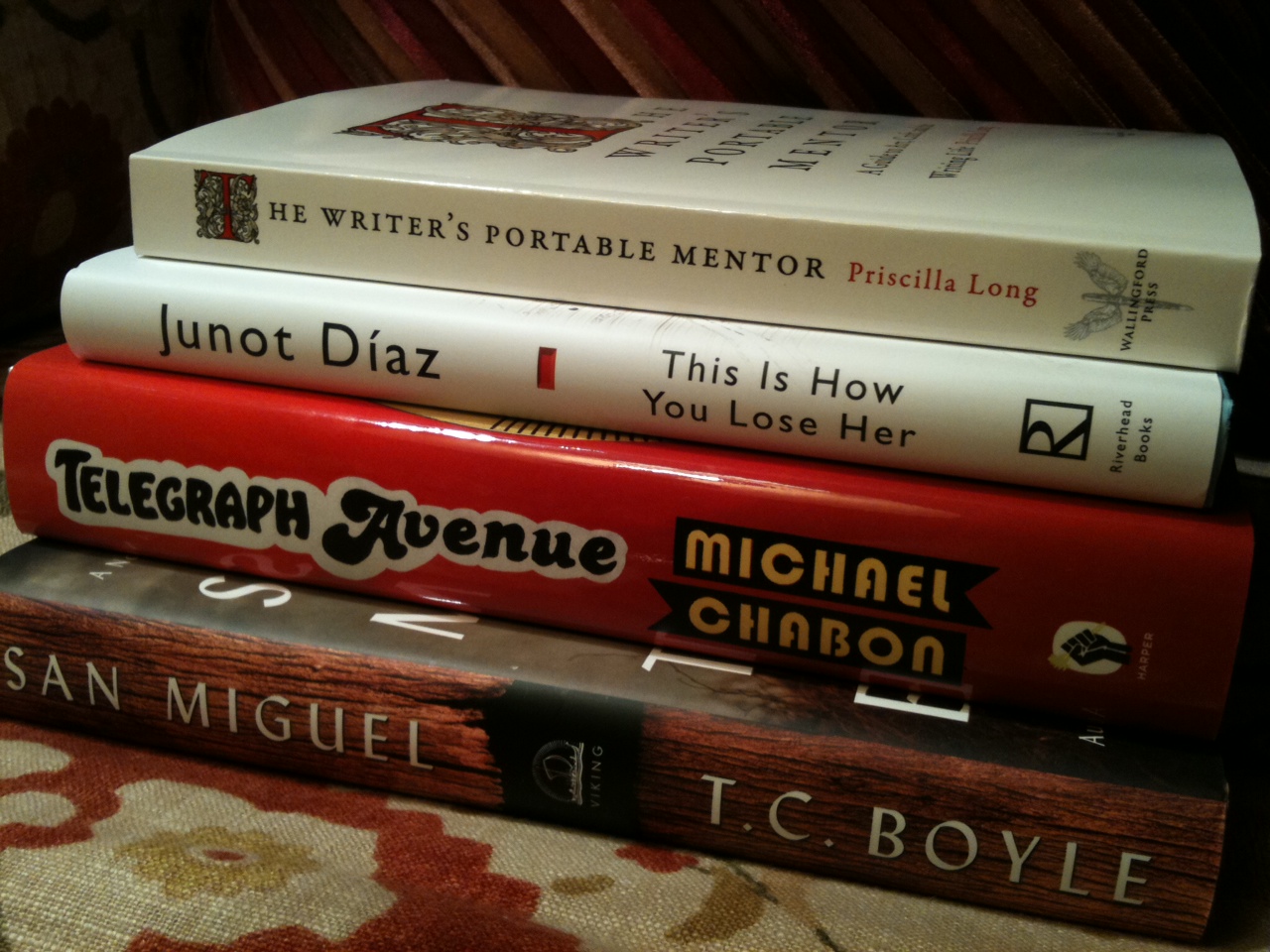
 I love it when I find new books waiting on my doorstep.
Category: Writing
Please excuse my language (Blame it on Dear Sugar)
Cheryl Strayed, author of the memoir Wild, is otherwise known as Sugar, the advice columnist for The Rumpus, an online culture and literary magazine.
Cheryl had been writing the column anonymously until this past Valentine’s Day, when she “came out” just as her newly published memoir was rising to the top of the bestseller list.
The Rumpus is a clever, intelligent magazine. I’m a bit too old for it, or it’s a bit young for me, so I’m not a regular reader, nor do I follow Cheryl’s advice column (which is not your ordinary, everyday kind of advice column). But somewhere along the line, I came across a piece of wisdom I liked that Cheryl gave to a struggling young writer who’d sent a letter to Dear Sugar.
This bit of wisdom went viral and the people over at The Rumpus decided to put it on a mug. I ordered the mug and it came in the mail yesterday.
I’ve read all kinds of books about creativity and writing to keep my own writing going and because I’m fascinated by the creative process. A couple of pages on this site are devoted to books about writing and creativity, and I’ll be featuring some of these on Books Can Save a Life as time goes by.
But sometimes just a short, pithy, to-the-point kick in the pants is all I need.
So I’ve got my new mug sitting on my writing desk, ready to be filled with coffee or tea on a moment’s notice.

I would say this is Cheryl’s approach to writing, to walking, to life.
Wild is to be made into a movie starring Reese Witherspoon.
There is a fabulous interview with Cheryl over at Bookslut, but beware of spoilers. You may want to finish Wild first, before you read it.
Hey, is anyone reading Wild? If so, let us know what you think in the comments below.
I’m heading off to the land of Wild (the Pacific Northwest) later this week to attend a medical librarian conference with some of my colleagues (profoundly intelligent readers, all of them). Then some vacation time with family, where I’ll be reading other books with a Pacific Northwest theme, exploring Seattle (including The Elliott Bay Book Company), and the surrounding terrain. Watch for posts and pictures!
Try some book spine poetry: National Poetry Month
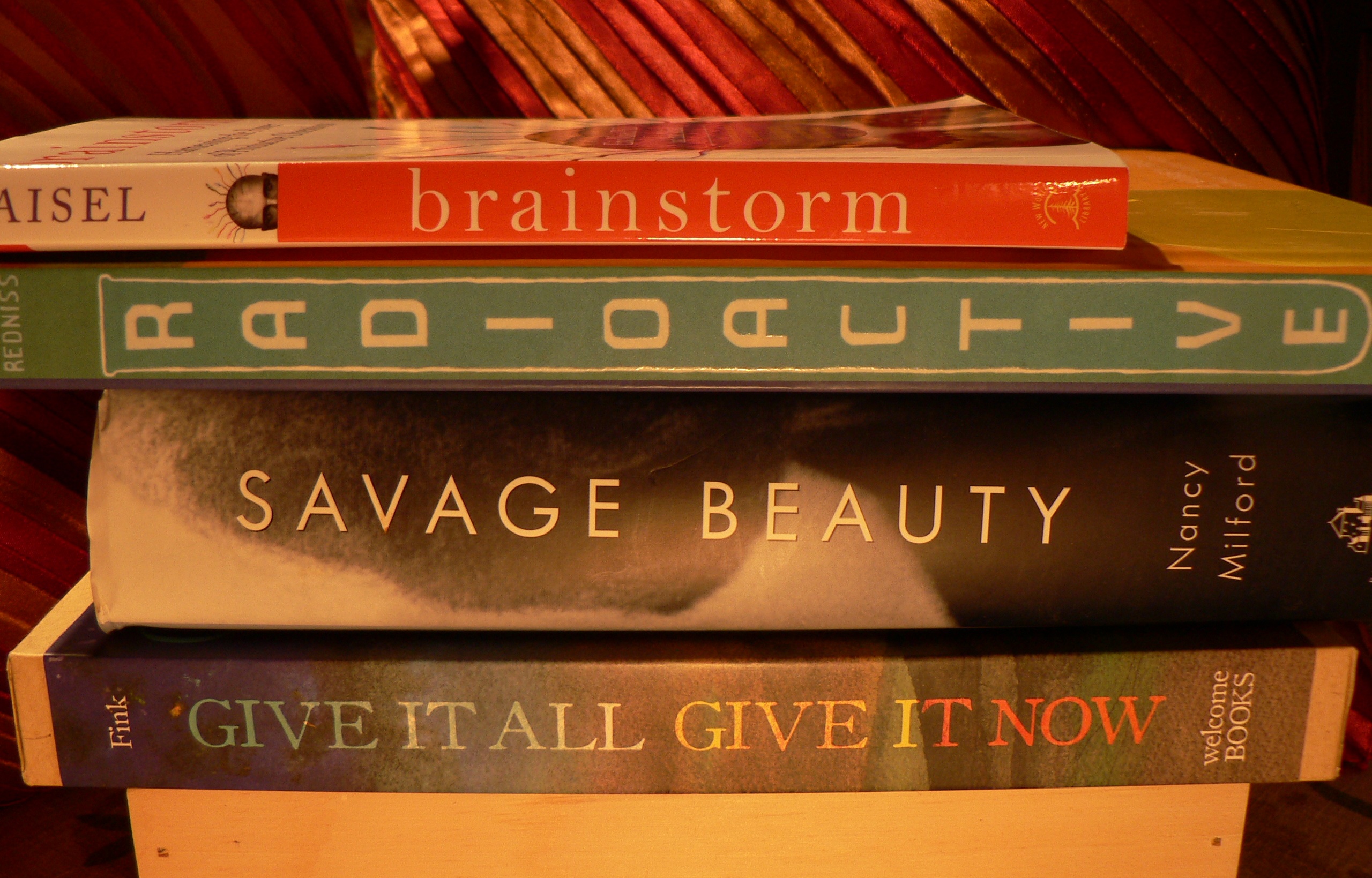
In celebration of National Poetry Month, here is my book spine poetry.
Try it. This small act of creation will bring you to a different place. Send me yours and I’ll post them.

________________________________________________________
What Steven Pressfield told me
I wanted to share author Steven Pressfield’s recent blog post, “Why I Don’t Speak,” the minute I read it on the “Writing Wednesdays” column of his website. He writes about why he doesn’t accept invitations to speak about his books on writing and creativity.
But my blog is for book lovers, I reminded myself, and he wrote “Why I Don’t Speak” primarily for writers and others involved in creative projects. (Though he would be the first to say creativity is any sustained effort to bring something to fruition, such as training for a marathon, overcoming an addiction, advocating for a social cause.)
He writes,
“In the secret communion between writer and reader, soul-altering material was gifted to me, and I accepted it with gratitude. No one knew. Not even the writer. But he or she had imparted something seminal, and it changed me and saved me.”
The italics are mine.
I think readers already know about the secret communion between writer and reader.
But what they may not know: Pressfield says the biggest challenge of any creative act, of giving the gift of soul-altering material, is overcoming resistance.
I have Pressfield’s book, Do the Work, on my “What I’m Reading” sidebar. I’ve been spending time with Do the Work along with his other book, The War of Art, as I look at my own writing process.
He has hard things to say about how insidious resistance can be. How we often blame our lack of progress, our inability to do the work, on some external obstacle when, really, we need to look inside ourselves.
I felt squirmy as I read certain passages. I didn’t like knowing these things about myself. And once I knew these uncomfortable truths, I then had to actually change.
Pressfield writes,
“I’m confessing some of the darkest hours and most shameful failures of my life. But more than that, I’m holding these moments up to the reader, who no doubt has experienced the same in her own life, as a means of confronting her and making her face her own shit. I don’t know how to do that in a public setting, and I wouldn’t want to try. It’s too private. It’s too personal.”
That’s why Pressfield doesn’t do speaking engagements.
Even though authors make pulling off that communion between writer and reader look easy, it’s not. The great, gifted writers confront the same resistance that is in all of us.
The next time you finish reading a book that possessed you or changed you; the next time you re-read a favorite, treasured work – know that the writer may have had to fight a great battle to bring her creation into the world.
She fought, and won.
Mary Oliver: a girl in the woods reading poetry

“Instructions for living a life: Pay attention. Be astonished. Tell about it.” – Mary Oliver
In my hometown near Cleveland, Ohio, there once was a girl who liked to play hooky from school. She’d walk in the woods and read poetry. Back then, my town still had some of its original rural flavor, with creeks, farmland, and forest where neighborhood kids could play for hours. Poetry and nature were the two things in the world the girl loved most.
When she was seventeen, the young woman got in her car and drove to the home of Edna St. Vincent Millay in upstate New York. The poet had died, but her sister, Norma, lived there. The young woman stayed for a time, helping Norma organize Millay’s papers and manuscripts, while she also wrote her own poetry.
Years later, when this same woman from Maple Heights, Ohio won the Pulitzer Prize for poetry in the 1980s, I didn’t pay much attention, even though I’d been an English major in college. I was working in New York City and had left my poetry reading days behind.
It wasn’t until I was in my forties and beginning to do some of my own writing that I thought I’d take a closer look at Mary Oliver, that girl from my hometown, to see what she was all about.
I hadn’t expected to be stunned. I mean, really. Why had I never read her poetry before?
I could describe Mary’s poetry with words like “powerful” and “transcendent” and “life-changing,” but those weak words wouldn’t do her poems justice. Let’s just say it was exactly the right time for Mary Oliver’s poems to enter my life. A lot of it had to do with my novice efforts as a creative writer and with believing in myself.
Mary Oliver grew up in a house just around the corner from where I did, though she left home around the time I was born. Our hometown went through especially hard times around 2008. A Cleveland neighborhood nearby was called ground zero in the mortgage disaster.
Some homes were abandoned, some torn down; wildflowers and weeds took over what used to be carefully tended lawns. Much of the wooded areas are now gone, but occasionally people spot deer, usually at dusk. The town has held its own, though; the people who live there have great spirit.
When I go back home to visit, sometimes I think of a girl skipping school, sitting cross-legged under a big, friendly tree in the once nearby woods, reading poetry.
*******************
 New and Selected Poems, by Mary Oliver, published in 1992, includes poems from 1963 – 1991.
 Books Can Save A Life