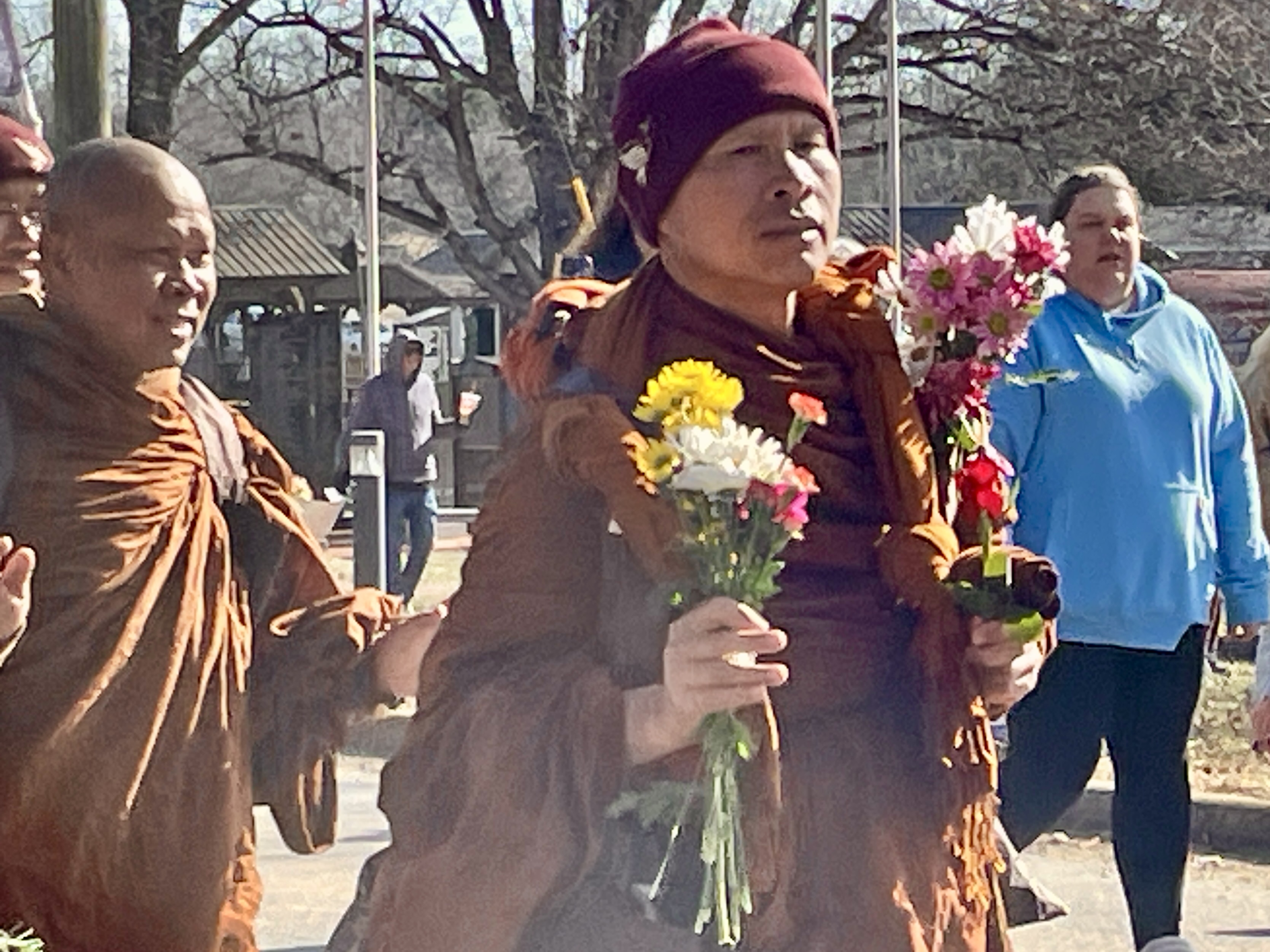
Walking for Peace in Liberty, NC

The Walk for Peace is an offering to the community regardless of faith, culture, or background…to promote national healing, unity, and compassion by awakening the peace that lives within each of us. – Paraphrased from the Dhammacetiya website of the Huong Dao Vipassana Bhavana Center, Fort Worth, Texas

The nearly two dozen Buddhist monks walking 2300 miles for peace have been making their way across North Carolina for the past several days, with large, enthusiastic turnouts. The monks set out from their home base, a Vietnamese Buddhist monastery in Fort Worth, with Washington, DC, as their final destination.

My husband, our friend Beth, and I wanted to see them, but figuring out their route was a challenge, as it often changes. On Day 88 of their journey, we caught up with them in Liberty, North Carolina. The day turned out to be deeply restorative and unforgettable.
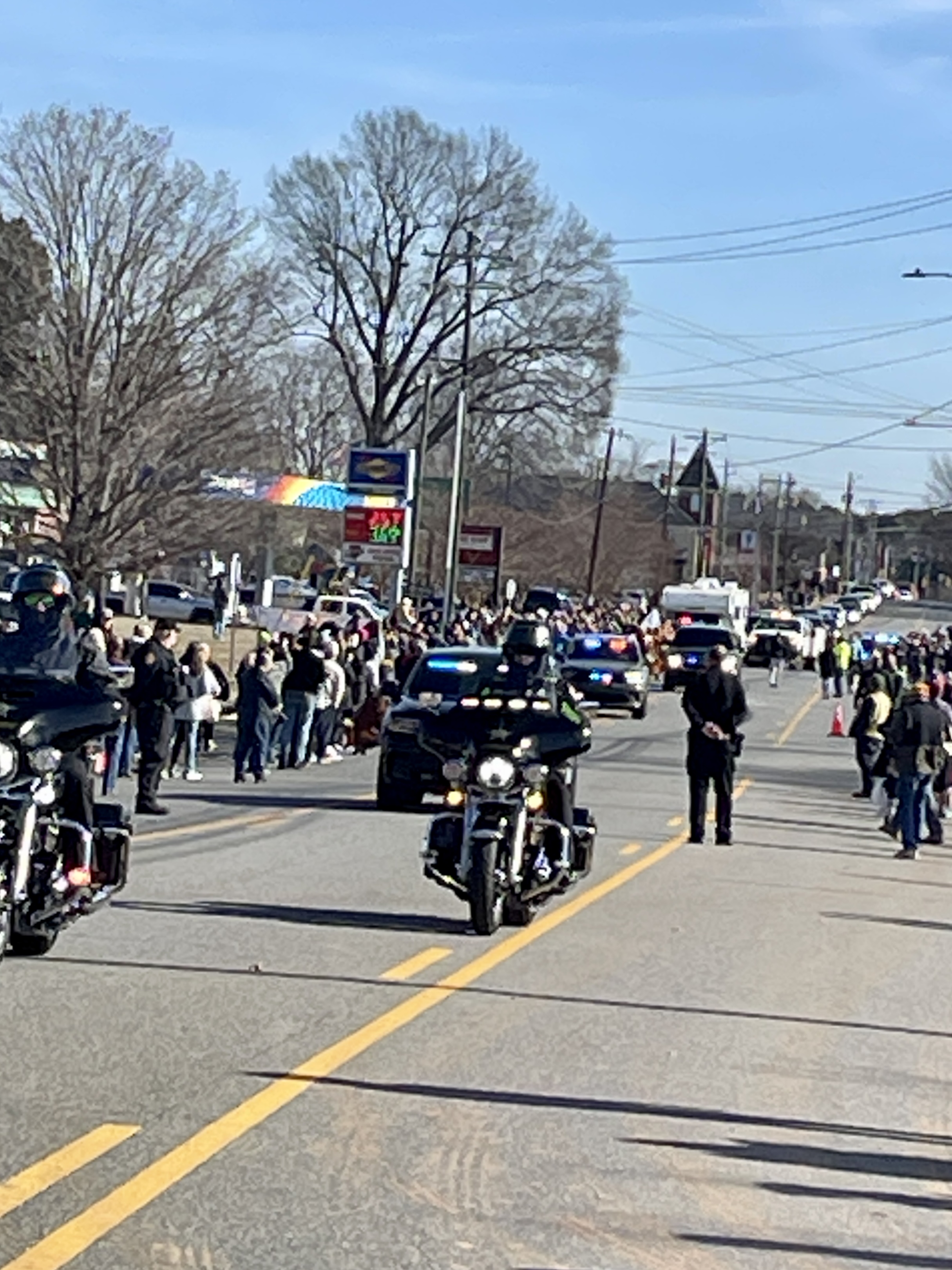
The town gave the monks a full escort. As they approached, a hush came over the crowd.

I’d never set foot in Liberty, a small, rural, and diverse town. When we arrived, the streets were blocked off, and crowds were gathering on the sidewalks and at the fire station, where the monks would have their only meal of the day, give a talk, and pass out peace bracelets.
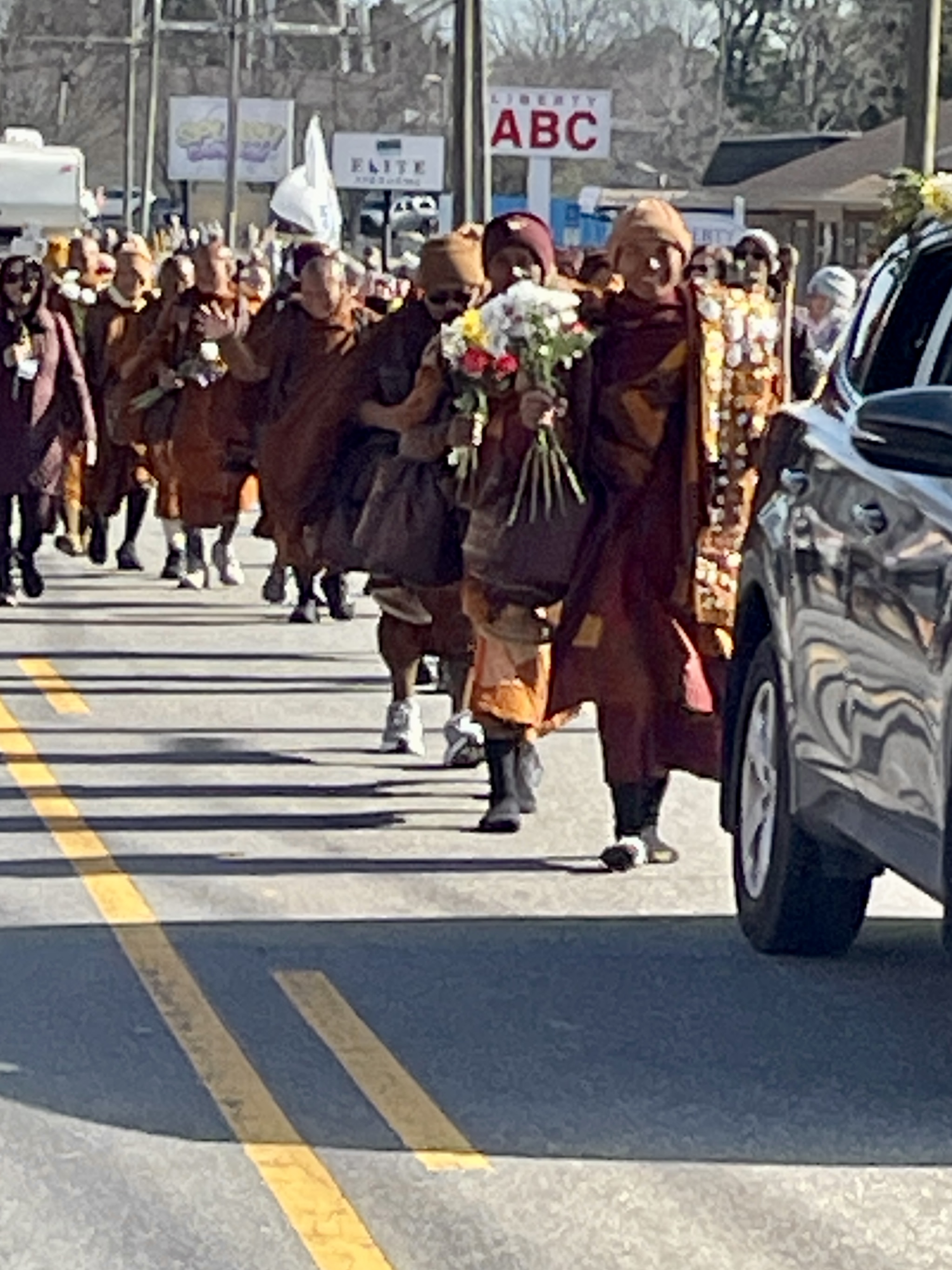
I spoke with the clerk at the mini-mart, the other customers, and a few of the volunteer traffic monitors, but no one knew the monks’ arrival time. The clerk, perhaps of Indian descent, seemed excited but unsure of who exactly they were. I encouraged her to step outside when the monks passed by, saying she wouldn’t regret it.

There was such a sense of anticipation, and the community vibes were so welcoming. We stood next to a long-time resident, Faye, a committed Christian, thrilled that Buddhist monks were going to pass through her town.

Nearby, a young man with a megaphone and loudspeaker preached about Jesus and how the monks were unsaved, sent by Satan. More than one person asked him to stop, but he persisted. I was relieved to see everyone leave him alone and then forget all about him when the monks passed by a short time later.

Venerable Bhikkhu Pannakara spoke about mindfulness meditation and its benefits; he pointed out that meditation has nothing to do with religion or Buddhism, per se. It is something any of us can do to become grounded, centered, and focused in an age of distraction.

Learning to be mindful and in the present moment may sound like a cliché, but it can give us our lives back, he said. I’ve recently become certified to teach mindfulness meditation, and hearing his message confirmed the work I’ve been doing.

“We should feel grateful because we have so many religions in the world to serve all human beings…At the end we are having one religion together, the religion of peace, loving kindness, and compassion.”

Venerable Bhikkhu Pannakara

In the midst of Venerable Bhikkhu’s talk, there was a medical emergency in the crowd. As the paramedics arrived, Bhikkhu encouraged us all to place our hands on our hearts, sense our hearts beating, and maintain silence. I’d never seen such a large crowd in deep, meditative silence, which lasted about 15 minutes. The love and caring were palpable. Fortunately, after a time, the woman recovered enough to walk to the ambulance.
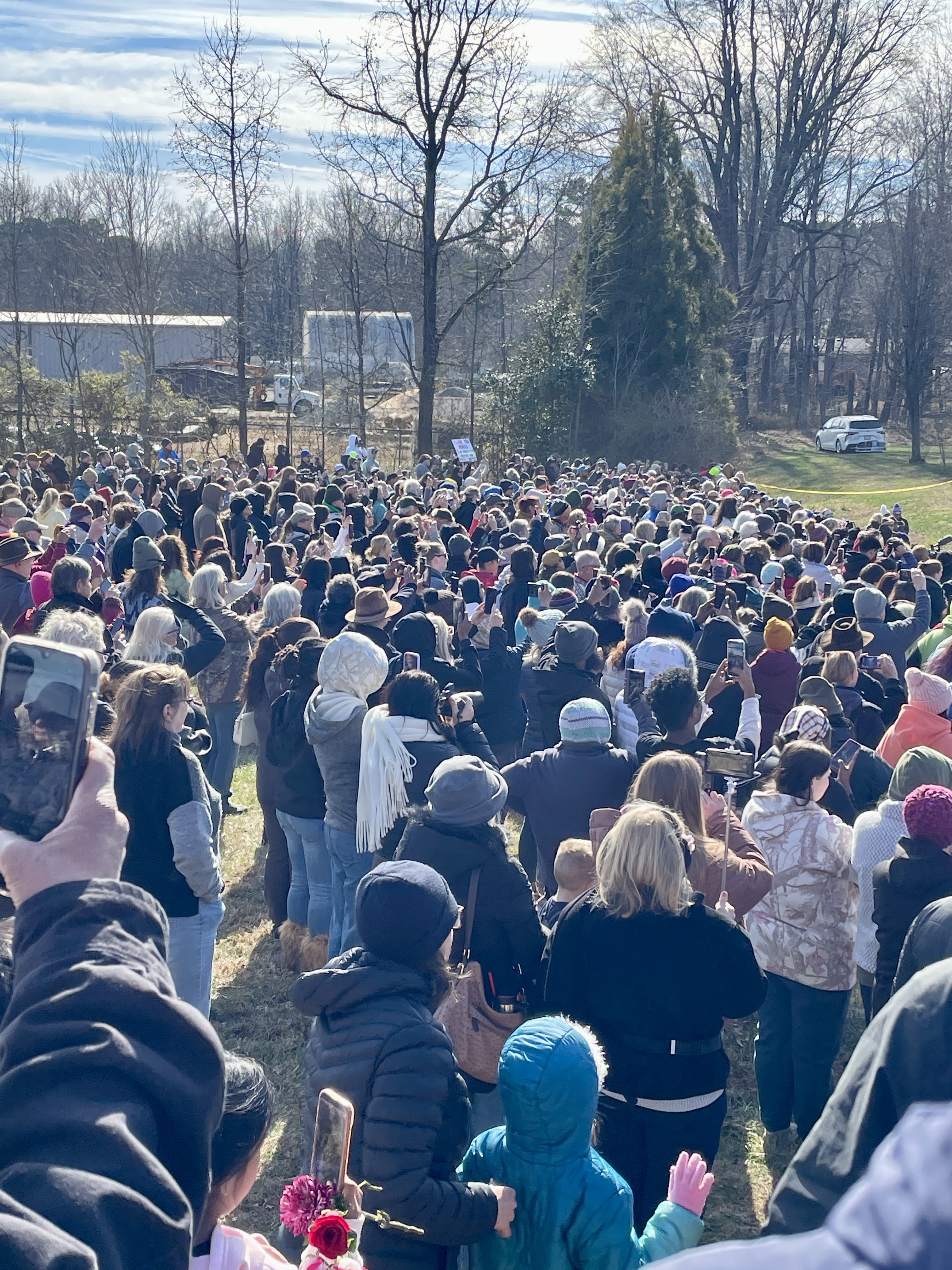
Deep silence as the crowd meditated

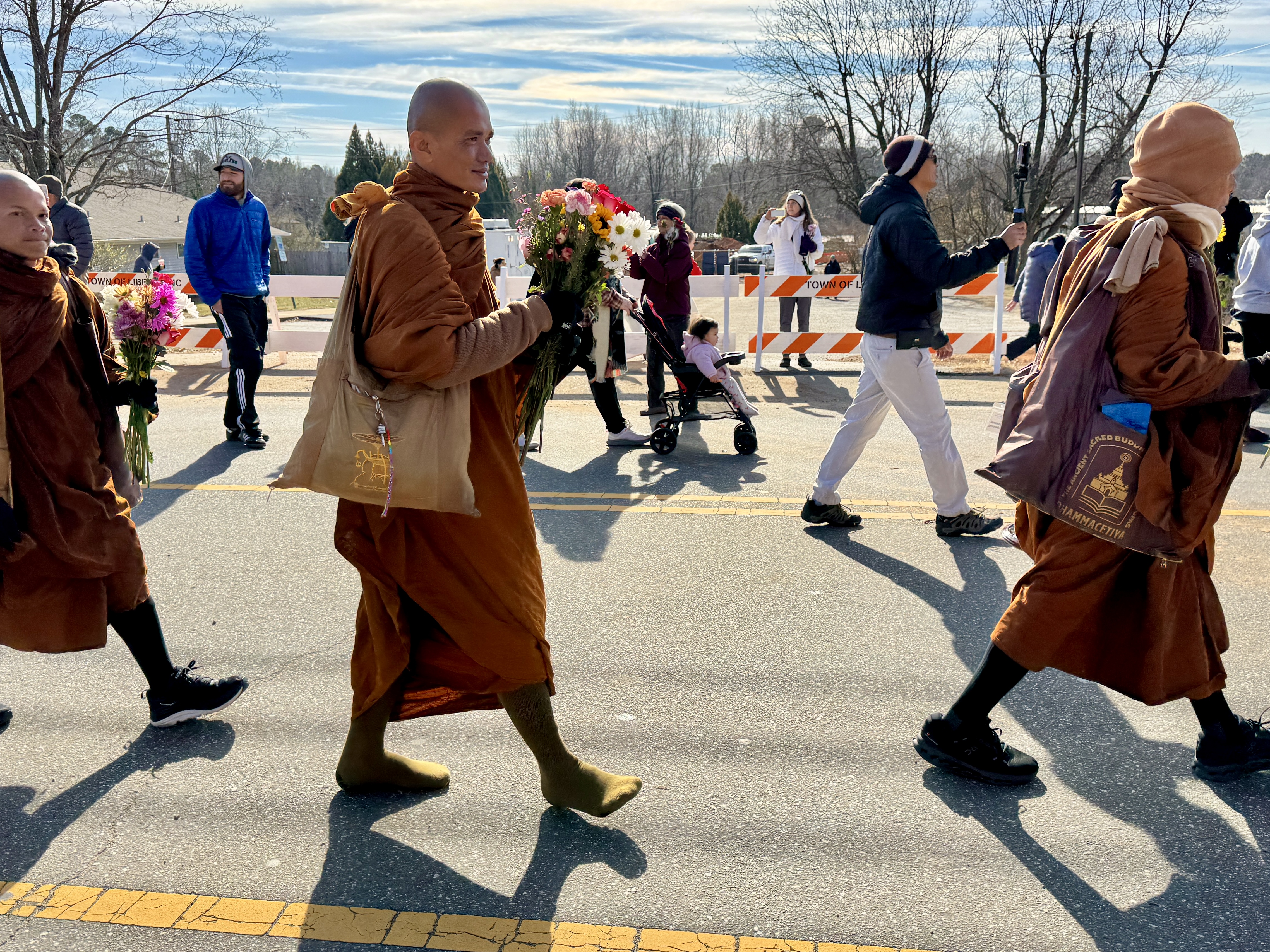
Some of the monks walk without shoes. They have one meal a day.

The monks say that peace is not a destination, but a practice. Beautiful encounters such as these can touch something sacred deep within a person, which begins to unfold.

I thought about how sustaining a mindfulness practice can be for anyone fighting to preserve freedom and democracy, as these difficult times demand.
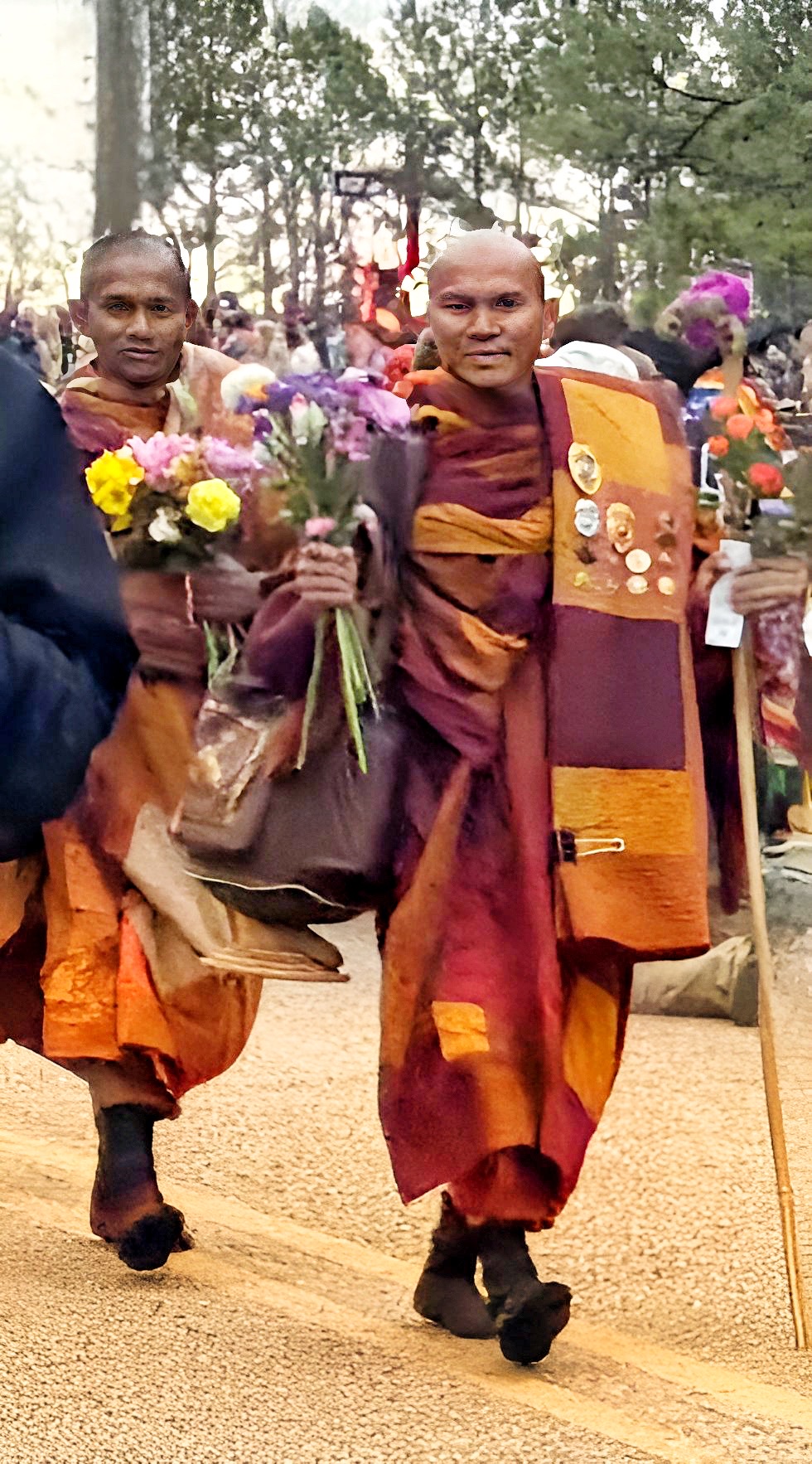
Photo by MJ Merwin

I wrote this post as news reports emerged that federal agents shot and killed Alex Jeffrey Pretti in Minneapolis.

The world will surely need this great gift that the monks would like us to know about.
Excavating a Life

Momphotos-18This is a happy coincidence: I’m starting a new, ongoing theme here at Books Can Save a Life (in addition to my usual book posts) called Excavating a Life on my fourth anniversary, to the day, of blogging.
Excavating a Life will be my informal, occasional, online creative journal: notes and jottings about the writing life as I try to finish this exhilarating and confounding marathon of writing a memoir, which I’m aiming to complete in 2016.

I hope these musings will speak to you who are immersed in a creative endeavor, or inspire you to begin one, and that you’ll share the challenges and high points of your own journey.

For those who follow me primarily for books, I’ll often highlight an author or work that has taught me something about pursuing a writing or creative practice with intention–so books will be a big part of Excavating a Life, too.

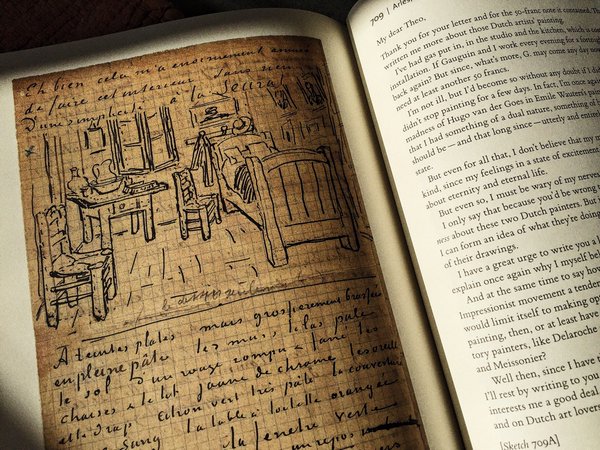
For instance, you’ll see a lot of Vincent Van Gogh here. I’m not a painter by any means, never learned to draw (though I’m making attempts to keep a nature journal), but I find Van Gogh’s letters an endless source of inspiration; I have three collections of them.

Here is a nugget of wisdom from Van Gogh. And it doesn’t just apply to painting (or writing) does it?

Vincent
“If a peasant painting smells of bacon, smoke, potato steam–fine–that’s not unhealthy–if a stable smells of manure–very well, that’s what a stable’s for….Painting peasant life is a serious thing…”  Vincent Van Gogh: Ever Yours, The Essential Letters, Yale University Press 2014


I’m thrilled to acknowledge and thank my longtime friend and writing coach extraordinaire, Debra Marrs, who presented this gift of an idea for Excavating a Life when we met up a couple of times in Florida for afternoon tea and some fabulous Cuban food. We were in Florida to spend holiday time with family–a Christmas quite different from our usual upstate New York kind.

Thanks to my sister- and brother-in law, who have the perfect guest quarters, I started off the year with a week of intensive writing. During my mini-retreat, I was able to add 10,000 words to my memoir–not quite my goal of 13,000, but good enough.

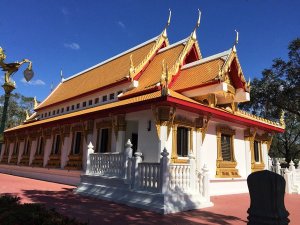
Temple
Wat Mongkolrata Temple

My sister-in law, who is from Thailand, took us to the local Buddhist temple, where I meditated and enjoyed the beautiful surroundings. It was a unique blend of spiritualities for me this mid-winter. That, and a change of scene, did wonders for my writing.

Before I close, here is one more tidbit. Have you ever heard of the Helsinki Bus Station Theory of creativity? I hadn’t, but apparently it is well known among many photographers. I found out about it yesterday. I love it and agree with it. Don’t get off that #!?&! bus. And remember, in the first stages of a project, feedback from others or your own emotions “aren’t a reliable indication of how you’re doing.”

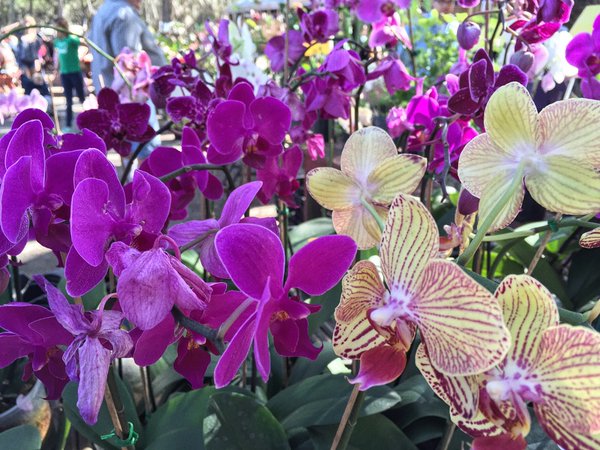
Orchids
A different Christmas this year: orchids instead of evergreen. My niece said these look like butterflies, and I agree.


Are you immersed in bringing something to fruition? Or would you like to be? It could be anything: writing a book, building a stone wall, starting a business, learning to knit, climbing all the Adirondack mountain peaks, whatever. What’s your biggest creative challenge at the moment?

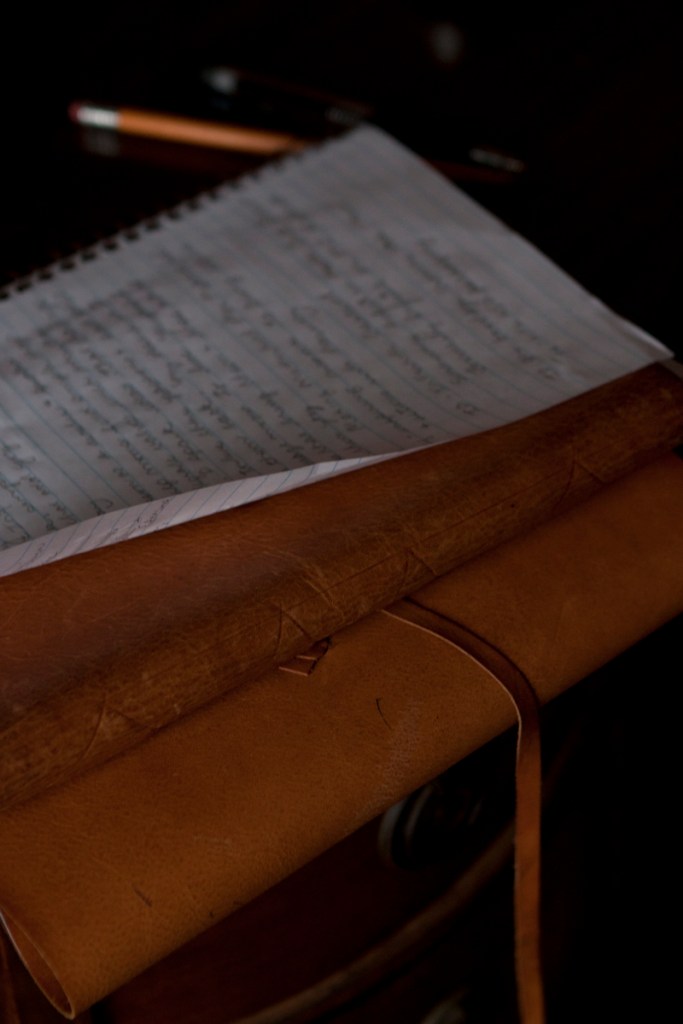
Journal
I bought this well worn leather journal cover in Florence years ago.


The most important thing

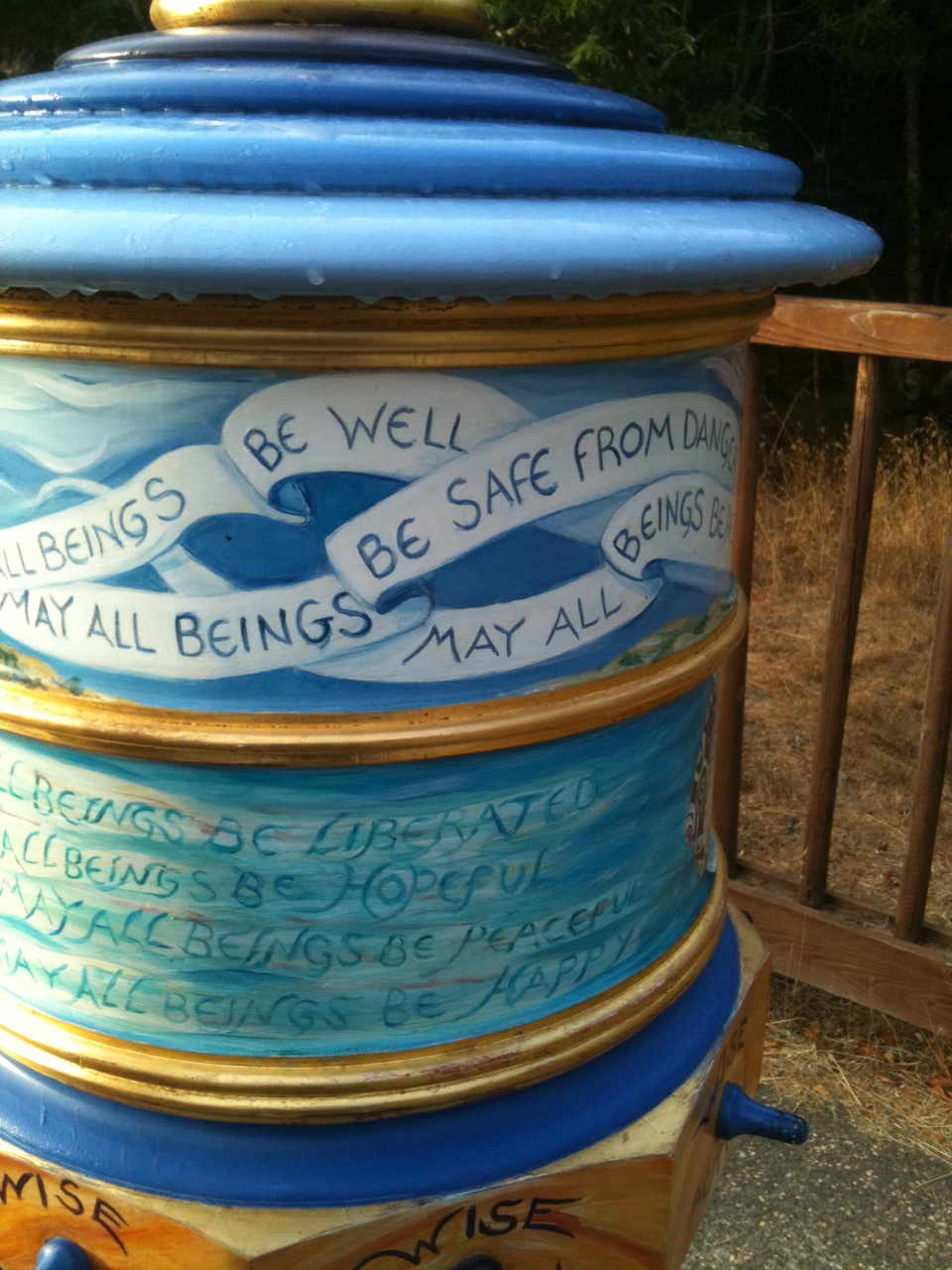
Prayer wheel

For three days I’ve been thinking about the families of the children who died in Newtown, Connecticut.

I’ve been thinking about what it’s like to be a parent.

Our first child was born prematurely on a bright, crisp autumn day. One minute I was lying in bed planning how I’d spend my Sunday, the next my husband and I were racing to the hospital. Our wee one seemed determined to make his appearance on planet earth right then and there on Interstate 90.

A few hours later – after a very short labor – we had a son.

I looked at him sleeping on his tummy in his isolette in the NICU. A scrunched-up bundle in a baby blanket with his little bottom in the air and a head of black Irish/Sicilian hair. Suddenly I knew I would sacrifice anything, even my life, for this new little person. It was like when you look at someone you’ve seen before and realize you’re in love – except it was much, much more than that.  For a moment my ego dissolved. I was no longer the center of my own little universe.

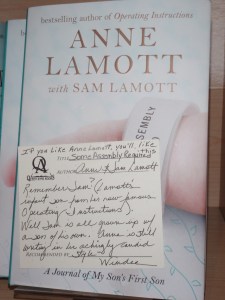
Book cover, Some Assembly Required
As displayed in Queen Anne Books, Seattle

A few years later, when I read Anne Lamott’s words in Operating Instructions, I thought: she has it exactly right. Last week, I came across the same passage again on one of my favorite blogs, and I planned to share the post and add my thoughts. Then Friday happened and Lamott’s words took on a greater urgency for me as I shopped at the market for Christmas cookies and decorations.

Before I got pregnant with Sam, I felt there wasn’t anything that could happen that would utterly destroy me. . . . Now there is something that could happen that I could not survive: I could lose Sam. I look down into his staggeringly lovely little face, and I can hardly breathe sometimes. He is all I have ever wanted, and my heart is so huge with love that I feel like it is about to go off. At the same time, I feel that he has completely ruined my life, because I didn’t used to care all that much.

I think that moments of great joy and great tragedy shock us out of the ordinary and awaken within us a singular intensity of compassion, good will, and love. The boundaries between us and them, between the self and the other, fall away, if only temporarily.

There will be plenty of time later to ask why and bicker and debate the meaning of Newtown and what can be done to stop it from happening again.

The most important thing now is to ride the great wave of love and compassion this tragedy has released into the world – for as long as it lasts –  and take care of our children, 27 heartbroken families, and each other.

Quote: Operating Instructions: A Journal of My Son’s First Year, Anne Lamott. Fawcett Columbine, New York: 1993.