
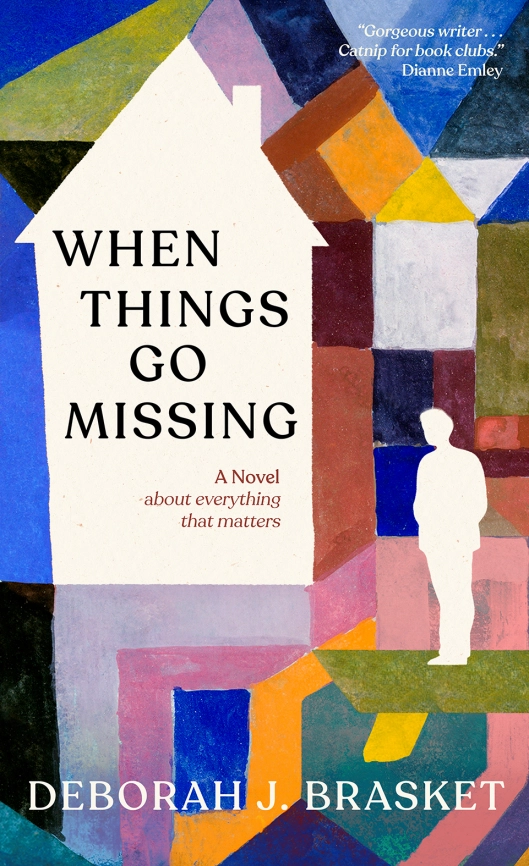
“To all families who fall apart and struggle to find their way home again.” – Deborah J. Brasket
What happens when a mother leaves her family?
Shopping list and coupons in hand, fifty-something Fran heads to the grocery store. But instead of shopping, she keeps driving – all the way to the California border, into Mexico, and beyond.
It is 1997. Fran will not be coming home anytime soon.
With deep pleasure, I bring Books Can Save a Life out of retirement to tell you about Deborah J. Brasket’s debut novel, When Things Go Missing.
But first, let me say that I have been following Deborah’s blog, Writing on the Edge of the Wild, for many years on WordPress. (She now has a Substack version as well.) I have always found her insights about art, literature, truth, beauty, and the human dilemma to be evocative and profound. Truly, her blog has always stood apart from the rest. So it was with great anticipation that I powered up my Kindle and let Deborah’s story carry me away.
We witness Fran’s confused, angry, and bereft family as they begin to navigate life on their own, on ground that has shifted dramatically. The family Fran leaves behind, like so many families, was already fractured – I would even say traumatized. Where do they go from here, when it feels like the end of life as they’ve known it?
Kay, an aspiring archeologist, receives periodic voice mails from her mother:
“She’s in mourning, she tells herself, mourning a mother she thought she knew who she now realizes she may never have truly known: A mother who always was the still center of comfort she could turn to in times like these, who is there no more. A mother who held her dysfunctional family together, a family she now fears will fall apart. The grief isn’t only about losing her mother but losing everything her mother represented: family, home, security, unconditional love. It’s like her mother’s absence blew a hole through the center of her universe, and everything is flying apart, including Kay. There’s nothing left to hold onto.”
To her son Cal, a heroin addict, Kay mails her mysterious photographs from various South American locations. As the mother of two adult sons, I was haunted by this passage, as I considered what it must have taken for Fran to let go of her son:
“…he gets sideswiped by this opposing flood of thoughts that gushes through his mind like his mother’s conscience. That’s how he sees it too – not his conscience but some uncomfortable and undesirable feeling that drifts in from his mother’s looks and sighs and follows him around like a fucking rain cloud. Hell, if she isn’t still doing it, even now when she’s disappeared.
He clears out a space on the bathroom mirror so he can look at himself, the image blurry in the wetness, surreal, with the steam all around, his face ringed by a bright halo of light. He thinks if he stares at this face ringed with light long enough, hard enough, deep enough, he might catch a glimmer of who the hell he really is or was supposed to be in another lifetime. Whatever it was, he knows it was good. Whatever could have been, whatever he blew away, it was all unbelievably good.”
Walter, Fran’s husband, a taciturn, sometimes volatile, father, gets Fran’s credit card bills:
“He’s been taking care of Frannie since she graduated from high school and he got home from Vietnam….He never minded that she didn’t work. Why should she: He earned enough on his own…
He’s never tried to stop her before from doing anything she wanted. He just has to keep letting the rope out more, giving her as much lead as she needs, and then, when she’s ready, she’ll find her way home again. It’s what he tells himself, what he needs to believe to get through the day.”
We get a sense of the kind of wife and mother Fran was and is, as Kay, Cal, and Walter at first simply react to Fran’s abandonment. As each of them barely manages to keep going – largely on their own and isolated from one another – they begin to separate from the mother and wife bonds. They begin to individuate. We are witness to a trio of heroic journeys that unfolds in surprising and unexpected directions.
When Things Go Missing will stay with you long after you’ve read the final page. To me, this is the mark of a powerful and authentic story, one that is so true for America and for our time. You may find yourself reflecting on your own life path, the choices you’ve made, and the choices that await you.
What are our responsibilities as mothers, parents, and partners?
Is there such a thing as the perfect mother?
Are there limits to the bonds of love and family? How do these relationships change over time? Are they meant to be forever?
What are our responsibilities to our own self-actualization? When do we sacrifice our own desires and aspirations for the good of our families and communities?
How do we come to find our chosen families? Can they ever replace our families of origin? Is it possible to achieve a happy blend of the two?
As a longtime reader of Deborah Brasket’s work, I trust her wisdom and relish the grace and richness of her writing. When Things Go Missing is a beautiful unfolding – a tender, loving portrait of a family contending with grief, loss, and regret, while fully embracing all the joy that life can hold.
I will close with the epigraph that opens When Things Go Missing:
“I have loved thee with an everlasting love: therefore, with lovingkindness have I drawn thee.” – Jeremiah 31:3
When Things Go Missing, an excellent book club choice, includes discussion questions. Publication date: September, 2025, Sea Stone Press.
When Things Go Missing is now available for pre-order at Amazon, Bookshop, and Barnes & Noble.
 “Martin holds his burning cigarette upright. The cherry is just barely visible in the dark; above it, the tower of ash. He turns it slowly, inspecting it from all angles. He says, ‘You want me to eat that scorpion?’
 Books Can Save A Life