
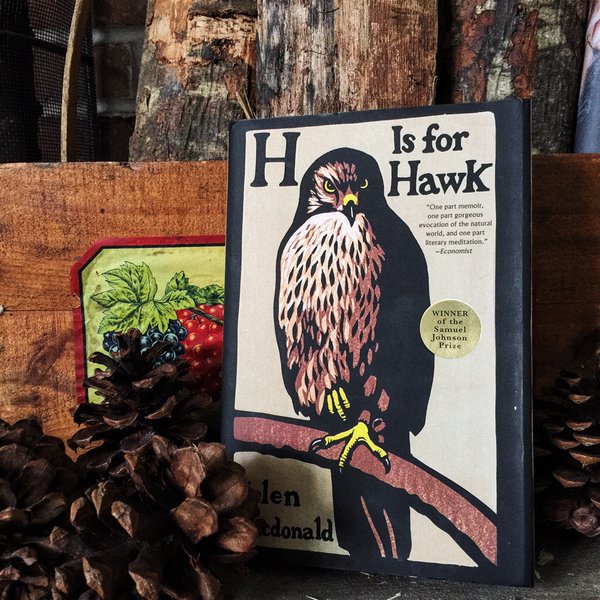
“….her feet were gnarled and dusty, her eyes a deep, fiery orange, and she was beautiful. Beautiful like a granite cliff or a thunder-cloud. She completely filled the room. She had a massive back of sun-bleached grey feathers, was as muscled as a pit bull, and intimidating as hell….” H is for Hawk, by Helen Macdonald
Helen Macdonald’s father, Alisdair Macdonald, was an iconic British photojournalist, and his daughter’s biggest fan. “He was the only person who understood me,” Helen says in his eulogy.
This isn’t hard to believe. Helen is a brilliant entomologist, difficult and eccentric, as portrayed in the just-released movie based on the memoir.
The movie, H Is for Hawk, is good. The memoir is better. It is the story of Helen’s training of a goshawk, a fiendishly difficult undertaking, and a metaphor for her struggle with grief and depression. (A book blogging friend of mine suggested that H stands for Helen, too, and I think she is right.)
At the time of its publication, H Is for Hawk was something of a breakthrough for its unique way of combining memoir with nature writing.
H Is for Hawk is well worth your time if you are up for challenging, multi-layered nature writing that explores the mysteries of human and wildlife psychology. This memoir is a classic.
Here is my post from 2016:
Helen Macdonald’s reaction to her father dying suddenly was to embark on the extraordinarily difficult task of training a goshawk, one of nature’s fiercest and most ruthless predators.
Goshawks are cold-hearted, lifelong loners with no social instincts whatsoever. They bond with no one, not the goshawk they mate with, not other goshawks, not any human who wants to train them. You can’t look them in the eye, either, because if you do they might attack you.
Goshawks don’t respond to punishment. The only way to train a goshawk is to be submissive and patient, eyes cast down at all times. Tim Gallagher, in a review of H Is for Hawk, likens this to being a kind of monk. It is not a part-time thing. Training a goshawk is all-consuming. It takes over your life.
Helen writes about the hawk she is training, whom she names Mabel:
“Everything about the hawk is tuned and turned to hunt and kill. Yesterday I discovered that when I suck air through my teeth and make a squeaking noise like an injured rabbit, all the tendons in her toes instantaneously contract, driving her talons into the glove with terrible, crushing force. This killing grip is an old, deep pattern in her brain, an innate response that hasn’t yet found the stimulus meant to release it. Because other sounds provoke it: door hinges, squealing breaks, bicycles with unoiled wheels – and on the second afternoon, Joan Sutherland singing an aria on the radio. Ow. I laughed out loud at that. Stimulus: opera. Response: kill.”
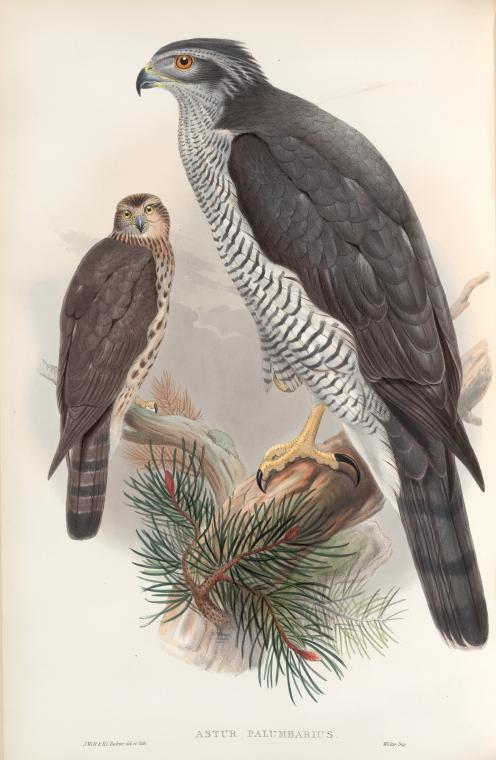
When Helen was a child, she and her father spent many days roaming the countryside as Alisdair indulged his passion for airplanes and Helen her growing passion for birds.
After Alisdair died, Helen wanted a distraction from her grief, something deeply immersive and challenging. In this respect, H Is for Hawk is unlike other memoirs. There isn’t a lot about Helen’s father or her relationship with him, or about Helen’s feelings of sadness and loss, per se. These are subsumed into an arresting narrative of Helen’s struggle to achieve what seems to be impossible as she grapples with her grief.
As Helen comes to understand, “Shocking loss isn’t to be shared, no matter how hard you try.”
Helen was, in fact, an experienced falconer, but she’d never taken on a goshawk before. She brought along a companion in her unusual undertaking: T. H. White’s, The Goshawk, White’s account of his own experience training a goshawk in the 1930s. (Remember T.H. White’s The Sword in the Stone, The Once and Future King, and other tales of Arthurian legend? Even if you didn’t read the books, you’ve probably seen the movie/musical Camelot and the Disney version of The Sword in the Stone.)
This weaving of T.H. White’s experiences into Helen’s narrative is fascinating; White, who was gay in a culture and time when this was unacceptable, was grappling with his own loss and inner darkness. Helen writes,
“It took me a long time to realise how many of our classic books on animals were by gay writers who wrote of their relationships with animals in lieu of human loves of which they could not speak.”
And this:
“….White wrote one of the saddest sentences I have ever read: ‘Falling in love is a desolating experience, but not when it is with a countryside.’ He could not imagine a human love returned. He had to displace his desires onto the landscape, that great, blank green field that cannot love you back, but cannot hurt you either.”
Helen’s immersion with Mabel, her goshawk, is harrowing. She holds nothing back in the struggle, and she holds nothing back from her reader.
Ultimately, Helen has to confront her obsession with the goshawk and her nearly complete withdrawal from friends and family. Where does obsession end and madness begin?
Before you read H Is for Hawk, I highly recommend that you read this fascinating review by Tim Gallagher at the Cornell Lab of Ornithology All About Birds site. Gallagher puts the human-training-a-goshawk challenge into context, and I think it will pique your interest. Not knowing a raptor from a falcon from a hawk myself, I wish I’d read this review first. And I’ve a soft spot in my heart for the Cornell Lab of Ornithology and the good work they do. We live not far from there, and I’ve seen at least one of their research sites in the Finger Lakes countryside.
Read H Is for Hawk if you want a different kind of memoir that demands to be read slowly, one word, one phrase, one sentence at a time. If you’re willing and want to slow down and immerse in another world entirely.
I expect I’ll read H Is for Hawk once or twice more down the road, as I simply couldn’t take it all in the first time through. If I’ve painted a rather dark picture of this unusual memoir, there is light and wisdom gained, too:
“There is a time in life when you expect the world to be always full of new things. And then comes a day when you realise that is not how it will be at all. You see that life will become a thing made of holes. Absences. Losses. Things that were there and are no longer. And you realise, too, that you have to grow around and between the gaps, […]”

 Books Can Save A Life