What Steven Pressfield told me

I wanted to share author Steven Pressfield’s recent blog post, “Why I Don’t Speak,” the minute I read it on the “Writing Wednesdays” column of his website. He writes about why he doesn’t accept invitations to speak about his books on writing and creativity.

But my blog is for book lovers, I reminded myself, and he wrote “Why I Don’t Speak” primarily for writers and others involved in creative projects. (Though he would be the first to say creativity is any sustained effort to bring something to fruition, such as training for a marathon, overcoming an addiction, advocating for a social cause.)

He writes,

“In the secret communion between writer and reader, soul-altering material was gifted to me, and I accepted it with gratitude. No one knew. Not even the writer. But he or she had imparted something seminal, and it changed me and saved me.”

The italics are mine.

I think readers already know about the secret communion between writer and reader.

But what they may not know: Pressfield says the biggest challenge of any creative act, of giving the gift of soul-altering material, is overcoming resistance.

I have Pressfield’s book, Do the Work, on my “What I’m Reading” sidebar. I’ve been spending time with Do the Work along with his other book, The War of Art, as I look at my own writing process.

He has hard things to say about how insidious resistance can be. How we often blame our lack of progress, our inability to do the work, on some external obstacle when, really, we need to look inside ourselves.

I felt squirmy as I read certain passages. I didn’t like knowing these things about myself. And once I knew these uncomfortable truths, I then had to actually change.

Pressfield writes,

“I’m confessing some of the darkest hours and most shameful failures of my life. But more than that, I’m holding these moments up to the reader, who no doubt has experienced the same in her own life, as a means of confronting her and making her face her own shit. I don’t know how to do that in a public setting, and I wouldn’t want to try. It’s too private. It’s too personal.”

That’s why Pressfield doesn’t do speaking engagements.

Even though authors make pulling off that communion between writer and reader look easy, it’s not. The great, gifted writers confront the same resistance that is in all of us.

The next time you finish reading a book that possessed you or changed you; the next time you re-read a favorite, treasured work – know that the writer may have had to fight a great battle to bring her creation into the world.

She fought, and won.

Intrepid girl detectives and student nurses: Nancy Drew & the gang

When I asked about books that made a strong impression when you were growing up, many of you mentioned the Nancy Drew Mystery Series.

The Hidden StaircaseI was a Nancy Drew reader, too. I bought the first dozen or so books one by one and tried to read them in order, but soon gave up because my reading habits outpaced my cash flow. So I borrowed them from the library and a friend and fellow Nancy Drew fan.
That same friend tells me she is now collecting Nancy Drew dust jacket covers, which are quite valuable.

Another friend and blog reader told me about a slew of girl detective series I’d never heard of: Trixie Belden, Kay Tracey, Judy Bolton, Melody Lane, and Connie Blair, among others. Vicki Barr, airline stewardess and amateur detective, investigated all manner of criminal activity in her travels.

I must have encountered some of these heroines on library shelves, but I remained loyal to Nancy.

Browsing around the Internet for more girl heroines, I came across the nurses. Remember them? Cherry Ames and Sue Barton? Cherry Ames, Student Nurse. Sue Barton, Senior Nurse. Visiting Nurse. Rural Nurse. Neighborhood Nurse. Superintendent of Nurses. I remember months of intensely reading the Sue Barton books during my wanting-to-be-a-nurse phase, after I’d ratcheted down from my original ambition to be a brain surgeon. Sue Barton

Feminist and literary scholars have written about Nancy Drew and other heroines as developing and changing female prototypes. According to some, Nancy evolved from a feisty, independent, fearless young woman in the early years of the series, around 1930, to a more conventional, passive one in the 1960s, when she was often portrayed as a potential victim of harm. Her boyfriend, Ned Nickerson, began to play a more prominent role, whereas in earlier books Nancy usually worked alone or with her female chums, George and Bess.

The way I remember her, Nancy could do anything, perfectly. She was strong,  supremely confident, and competent. At sixteen, she had her own car (a blue roadster). Her father let her go anywhere and do just about anything.

Laura Bush, Barbara Walters, Beverly Sills, three female Supreme Court justices, and other prominent female figures have said Nancy Drew was a role model.

What impressed me most, I think, was Nancy’s freedom and independence as she made her way out in the world.

I took for granted I would have the same sort of life someday.

________________________

Nancy Drew is alive and well. The NancyDrewSlueth.com unofficial website has everything  you’d want to know about the series. There is even an annual Nancy Drew convention.

Did you have a favorite series? Tell us about it.


Best Short Animated Film: The Fantastic Flying Books of Mr. Morris Lessmore

If you haven’t seen it yet, take fifteen minutes to watch this year’s Oscar winner for best animated short.

It’s an affecting tribute to books and the curative powers of story, with a beautiful musical score.

The Fantastic Flying Books of Mr. Morris Lessmore is available as an app from iTunes.

Reading in another dimension

I remember the book, which I think of as my Hunger Games book, and I remember the reading of it. Where I was (in my bedroom, my favorite place to read), how old I was (ten), and how I started reading as soon as I got home from school and didn’t stop until I reached the end sometime after dark.

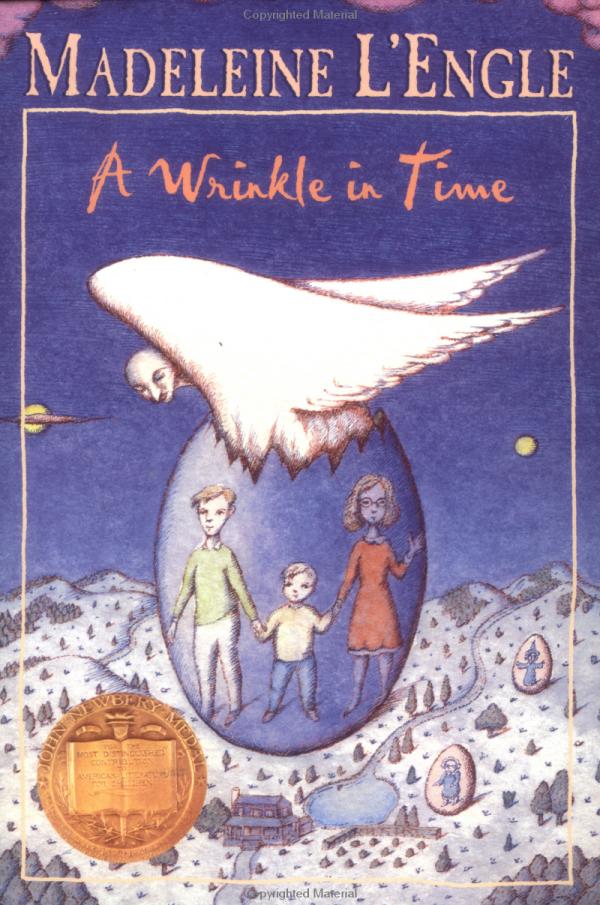
A wrinkle in timeIn A Wrinkle in Time by Madeleine L’Engle, Meg Murry wore glasses like me (she had a habit of pushing them up on her nose, just like me) and braces, (me too) and her hair never looked quite right (me too, again). She was a social misfit in danger of being held back a grade in school. I could slip easily into Meg’s skin; even though I had plenty of friends and good grades, I felt I could lose my tenuous social standing in a flash if anyone found out about my strange mother who, around that time, had succumbed to mental illness.

It was as if the book had been written just for me. As if, somehow, L’Engle had looked into my soul and put all of its good parts and bad parts right there on the page. I felt recognized for what I was.  Understood. Authenticated.

Meg’s family was like no other family I’d ever heard of. Her mother, Katherine Murry, was the mother I wanted: a beautiful, brilliant scientist who ran experiments in the kitchen pantry. There weren’t many scientist moms in 1965 Cleveland, Ohio, and Mrs. Murry’s brand of strangeness was the kind I could live with. (She won the Nobel Prize in a later book by L’Engle, but always had home-made cookies waiting for Meg and her younger, genius brother, Charles Wallace, when they came home from school.) Meg’s Princeton educated father worked at Cape Canaveral and had been away for a long time on a secret mission. The gossip was that he’d abandoned his family.

Meg’s friend, Calvin O’Keefe, was a revelation to me, too. He made it clear you could be from an unhappy family and still be your own strong, separate self. He was kind, popular in school, and a talented basketball player (yes, way too good to be believable) even though his mother had missing teeth, wispy, gray hair, and paddled her children with wooden spoons.

Meg, Charles Wallace, and Calvin are swept away to another dimension to search for Meg’s father and fight a great evil. I was swept away with them. This was new territory for me. I didn’t typically read fantasy or science fiction and I’d never encountered such odd, mesmerizing characters. L’Engle based the sci-fi elements of her story on Einstein’s theory of relativity, and I had always been fascinated by outer space and its mysteries. Yet, for all of its science, A Wrinkle in Time is infused with spirituality, too, and though I couldn’t have verbalized it back then, that fusion of science and spirituality rang true for me.  And while L’Engle invoked Christian themes I could relate to, she gave equal time to the Buddha, Gandhi, and the great artists. This was a viewpoint I hadn’t considered before.

A Wrinkle in Time, for me, was an escape from unhappiness, a preview, in Katherine Murry, of what a strong woman could be, and a glimpse of a different, more complex world than my own familiar one.

Many years later, I met Madeleine L’Engle when she spoke at the Cathedral Church of St. John the Divine in New York City, where she was the librarian and writer in residence. We shared a neighborhood, those blocks clustered around the massive Episcopal cathedral. As she spoke about her life and her beliefs, I recognized the themes I’d encountered in her fiction: a passionate spirituality inseparable from a reverence and respect for the laws and mysteries of the cosmos.

When I was doing research for this post, I discovered that this year is the 50th anniversary of A Wrinkle in Time. When it was published half a century ago, it won the Newbery Medal. Yet, because it combines fantasy with an inclusive spirituality, (rather than an exclusively Christian one) A Wrinkle in Time is often on banned book lists in schools across the country.

*****************

Did you have a Hunger Games book when you were growing up? If so, tell us in the comments below.

Someone is always watching in The Hunger Games

“The greatest multiplex in the universe is in your mind, and the only ticket you need is a good, well-written novel.” Carlos Ruiz Zafon

I agree with Zafon. But still, I can’t wait for The Hunger Games movie. If it’s good, that will be partly because it’s based on a fantastic young adult novel.

On March 23, Katniss, Gale, Peeta, Primrose, Cinna, Rue and the rest of The Hunger Games’ characters will come to life on the big screen, as will the world of Panem, the futuristic North American country that emerged after climate change and war.

As YA literature goes, The Hunger Games is controversial. Every year in this harsh dystopia, twenty-four teenagers, two from each of the poor districts that serve the ruling Capitol district, are chosen in a “reaping” to fight to the death. The last contender alive wins.

These teens, some as young as twelve, kill each other on TV to entertain the Capitol citizens; their families get to watch them suffer and die.

A New York Times reviewer observed that the reality show motif adds complexity to the drama of alliances made and broken for the sake of survival. In this “double storytelling,” Katniss and Peeta must put on a good show because the audience favorites may win a share of mercy from the unseen game masters.

We, the readers, are privy to Katniss’ innermost thoughts and feelings, while we watch her present a false self to the cameras. She and Peeta form a bond that, for Katniss, may or may not be love. They play up their romance to captivate their viewers while they play out their “true” relationship under cover. Except, for all concerned, it’s sometimes hard to tell which is which.

And, in the end, they both know one of them will have to kill the other.

The Hunger Games is, in part, a nightmarish look at a culture of reality shows taken to an extreme.

It strikes me that young people are always “on.” They have never known life without incessant friending and following and posting. I’m ambivalent, to say the least, about the constant staging of oneself that’s necessary now if you don’t want to be completely out of the mainstream. 

In fact, it’s getting harder to deliberately choose privacy and anonymity. Recently, in a nearby town, over a dozen teen-age girls developed an illness with symptoms resembling Tourette Syndrome. Reporters and television cameras have besieged the town in an unrelenting media storm.  The story has gone viral.

It’s not just news. It has become our entertainment.

For peace of mind, some of the girls have given up social media altogether, at least for the time being.

Back to The Hunger Games –  there is still time to read or reread it before the movie comes out. My niece, a soon-to-become librarian, is a big fan of The Hunger Games.  She wears a mockingjay necklace (a mockingjay is a bird that symbolizes liberation from the evil Capitol) and knows everything there is to know about the upcoming movie. In fact, I found out about the movie when she posted the trailer online.

I saw it because I’m her friend on Facebook.

What was your Hunger Games book?

Did you have a Hunger Games book when you were growing up? A sci fi kind of book about a different world, that made you feel alive on every page? With a heroic character so real you could step inside his/her skin?

Tell us your Hunger Games book in the comments. I’ll tell you mine in my next post. Hint: It’s the 50th anniversary of this book’s publication.