The Walk for Peace is an offering to the community regardless of faith, culture, or background…to promote national healing, unity, and compassion by awakening the peace that lives within each of us. – Paraphrased from the Dhammacetiya website of the Huong Dao Vipassana Bhavana Center, Fort Worth, Texas
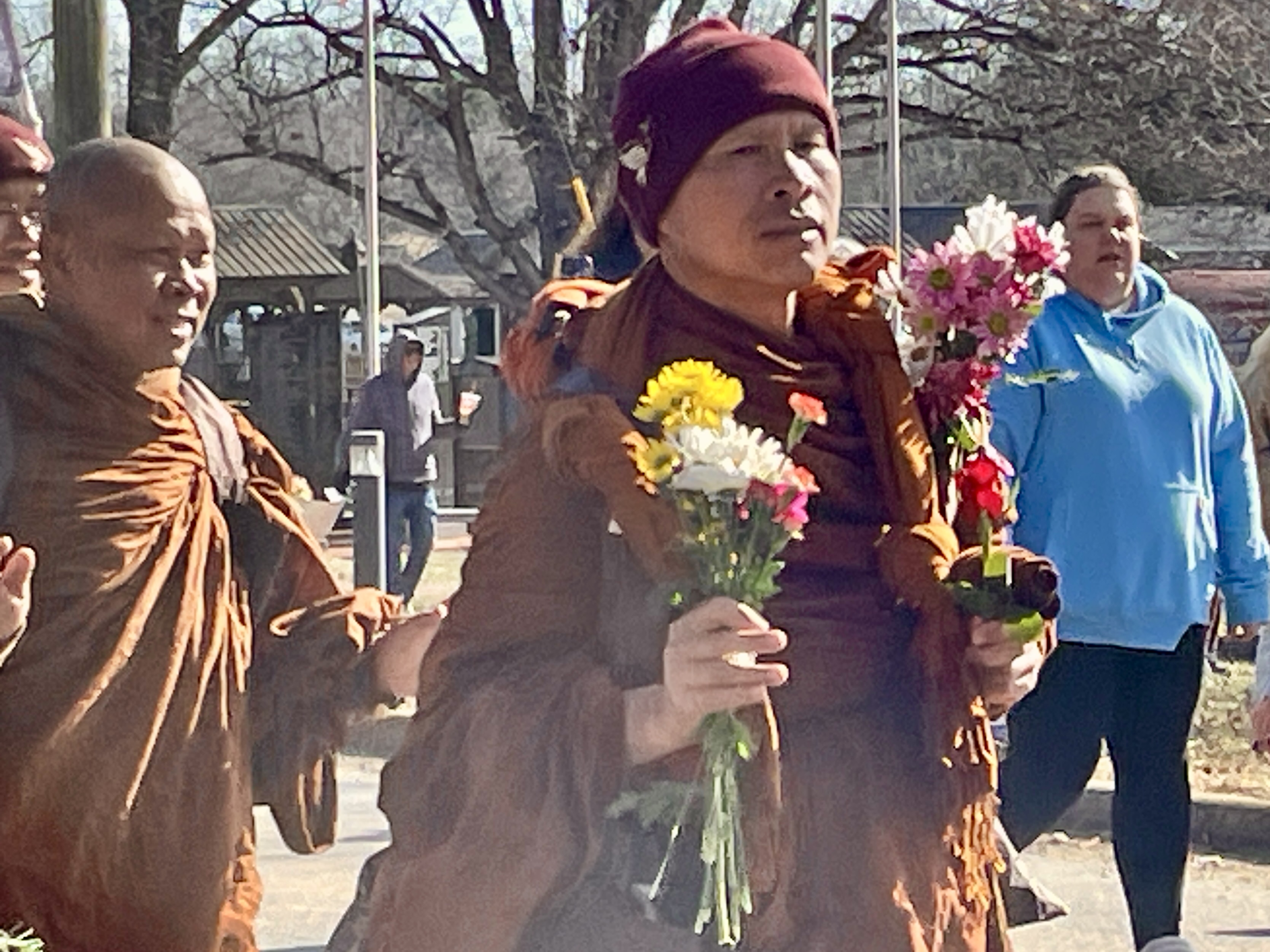
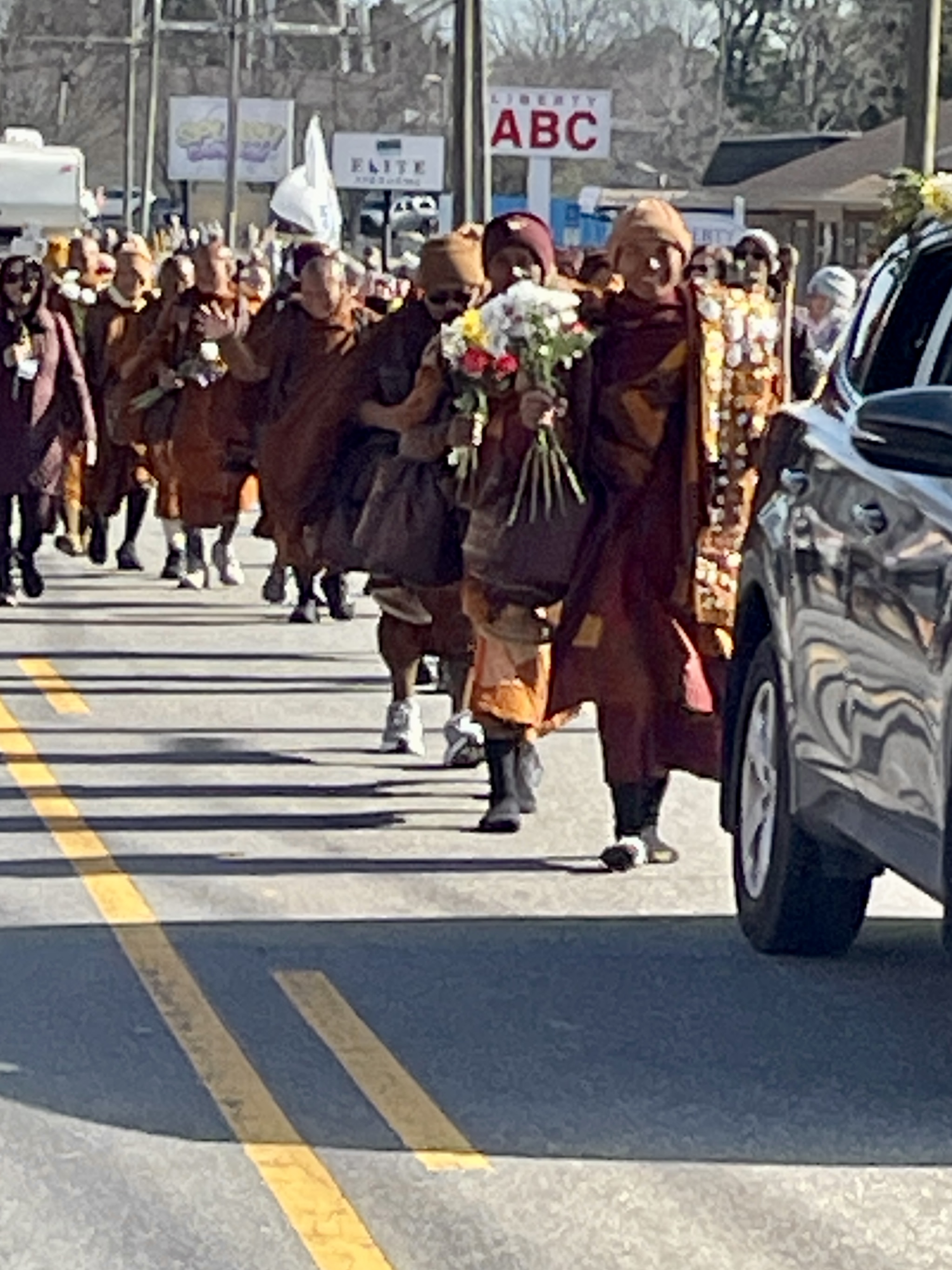
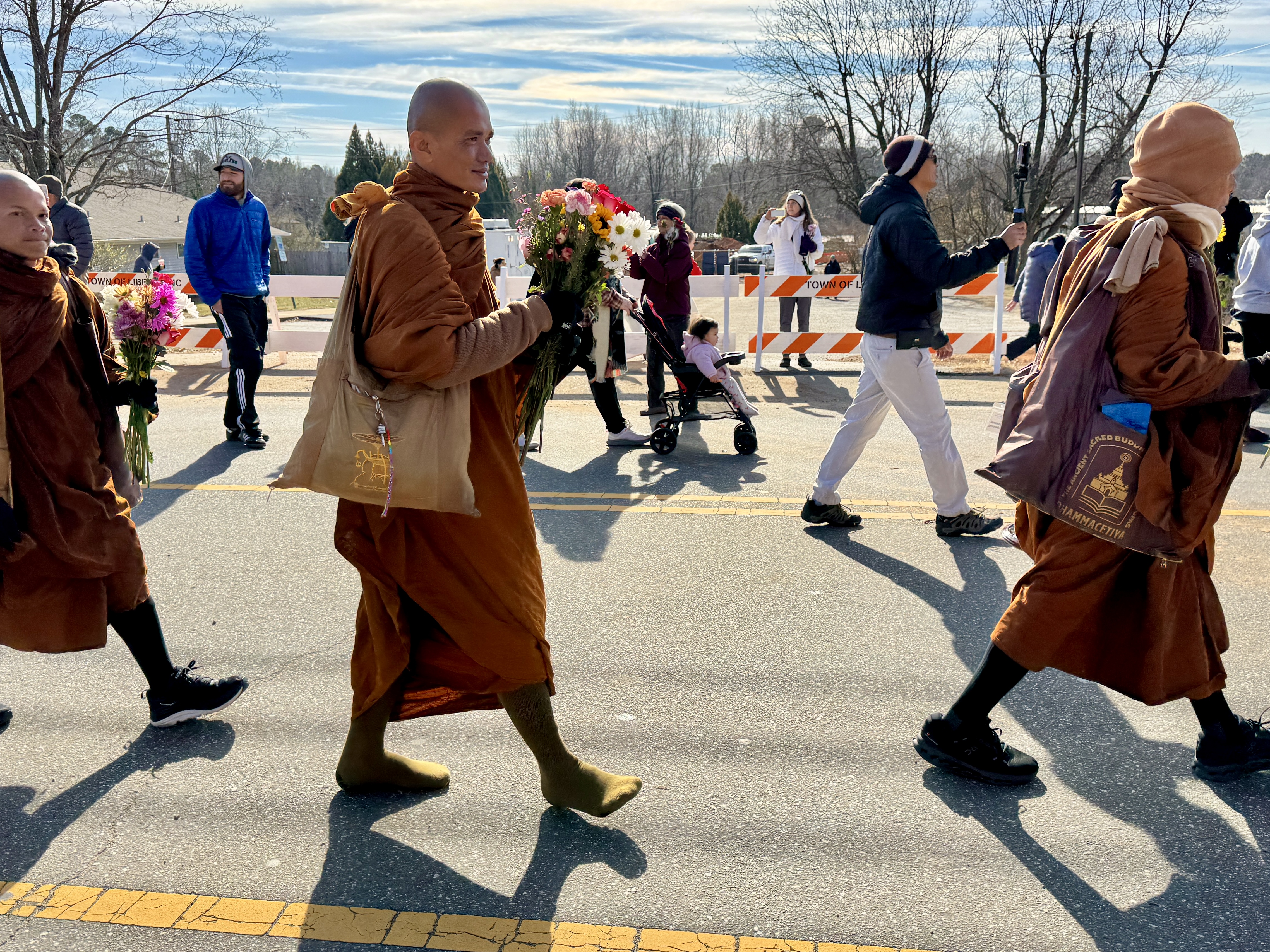
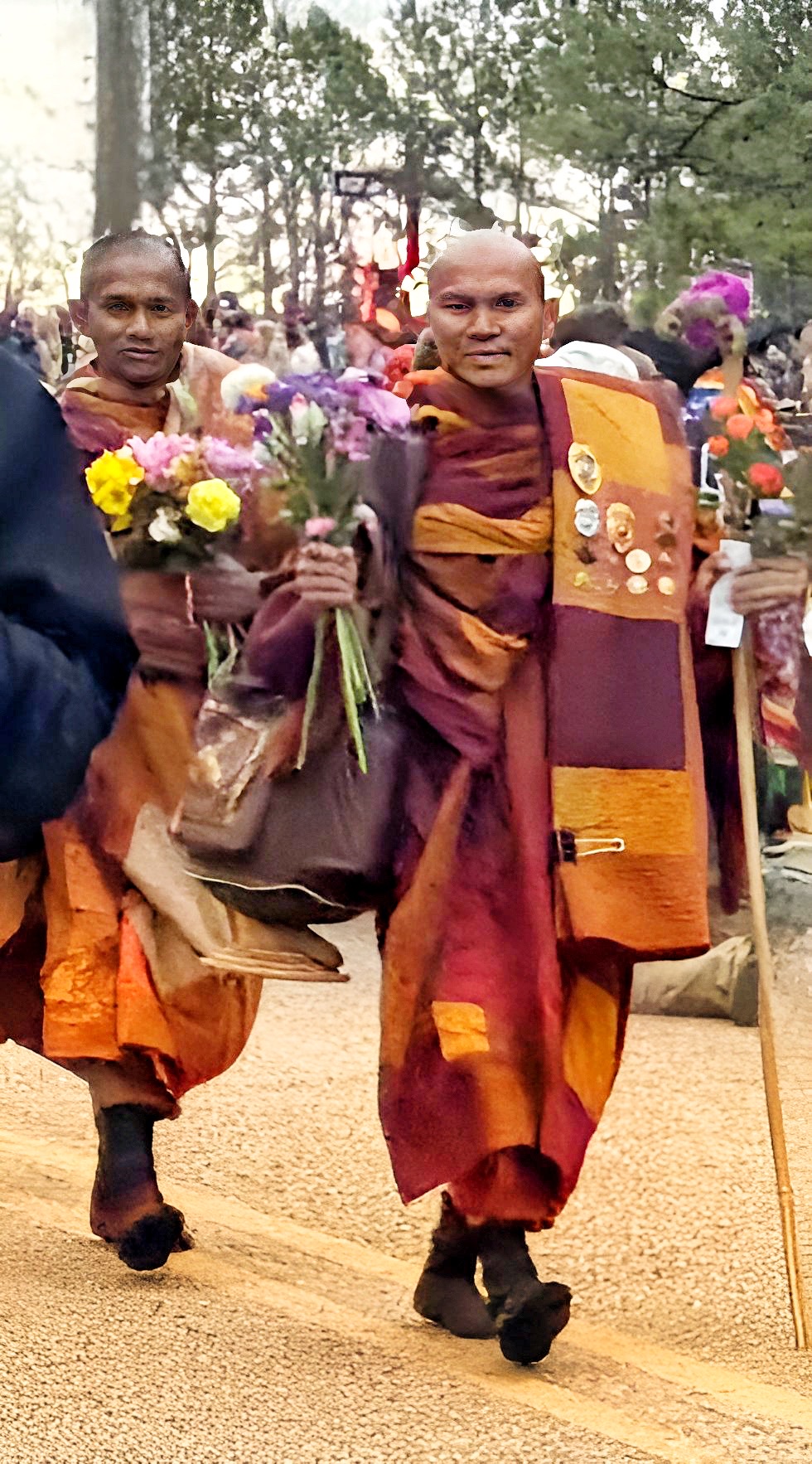
The nearly two dozen Buddhist monks walking 2300 miles for peace have been making their way across North Carolina for the past several days, with large, enthusiastic turnouts. The monks set out from their home base, a Vietnamese Buddhist monastery in Fort Worth, with Washington, DC, as their final destination.
My husband, our friend Beth, and I wanted to see them, but figuring out their route was a challenge, as it often changes. On Day 88 of their journey, we caught up with them in Liberty, North Carolina. The day turned out to be deeply restorative and unforgettable.
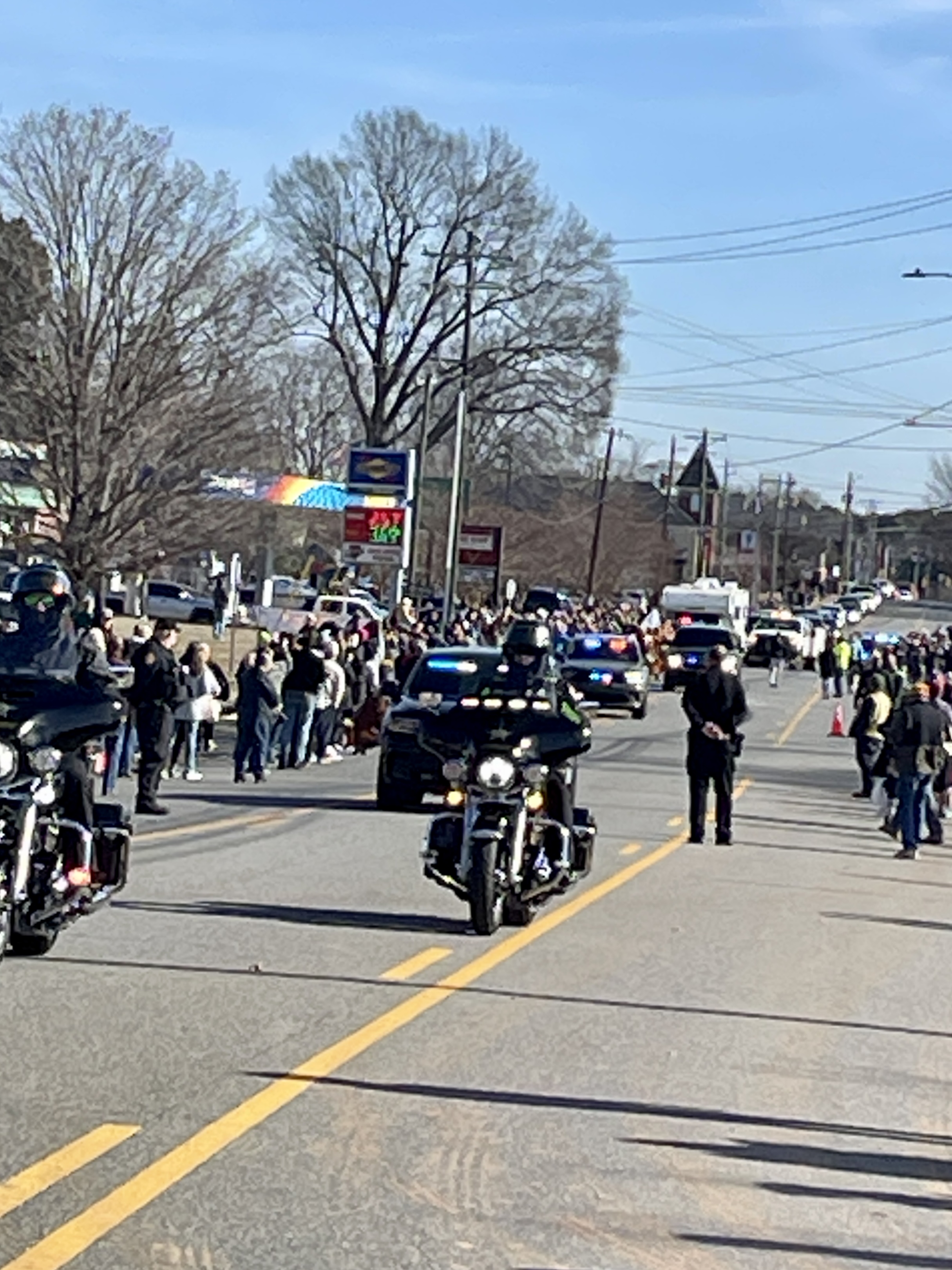
The town gave the monks a full escort. As they approached, a hush came over the crowd.
I’d never set foot in Liberty, a small, rural, and diverse town. When we arrived, the streets were blocked off, and crowds were gathering on the sidewalks and at the fire station, where the monks would have their only meal of the day, give a talk, and pass out peace bracelets.
I spoke with the clerk at the mini-mart, the other customers, and a few of the volunteer traffic monitors, but no one knew the monks’ arrival time. The clerk, perhaps of Indian descent, seemed excited but unsure of who exactly they were. I encouraged her to step outside when the monks passed by, saying she wouldn’t regret it.
There was such a sense of anticipation, and the community vibes were so welcoming. We stood next to a long-time resident, Faye, a committed Christian, thrilled that Buddhist monks were going to pass through her town.
Nearby, a young man with a megaphone and loudspeaker preached about Jesus and how the monks were unsaved, sent by Satan. More than one person asked him to stop, but he persisted. I was relieved to see everyone leave him alone and then forget all about him when the monks passed by a short time later.
Venerable Bhikkhu Pannakara spoke about mindfulness meditation and its benefits; he pointed out that meditation has nothing to do with religion or Buddhism, per se. It is something any of us can do to become grounded, centered, and focused in an age of distraction.
Learning to be mindful and in the present moment may sound like a cliché, but it can give us our lives back, he said. I’ve recently become certified to teach mindfulness meditation, and hearing his message confirmed the work I’ve been doing.
“We should feel grateful because we have so many religions in the world to serve all human beings…At the end we are having one religion together, the religion of peace, loving kindness, and compassion.”
Venerable Bhikkhu Pannakara
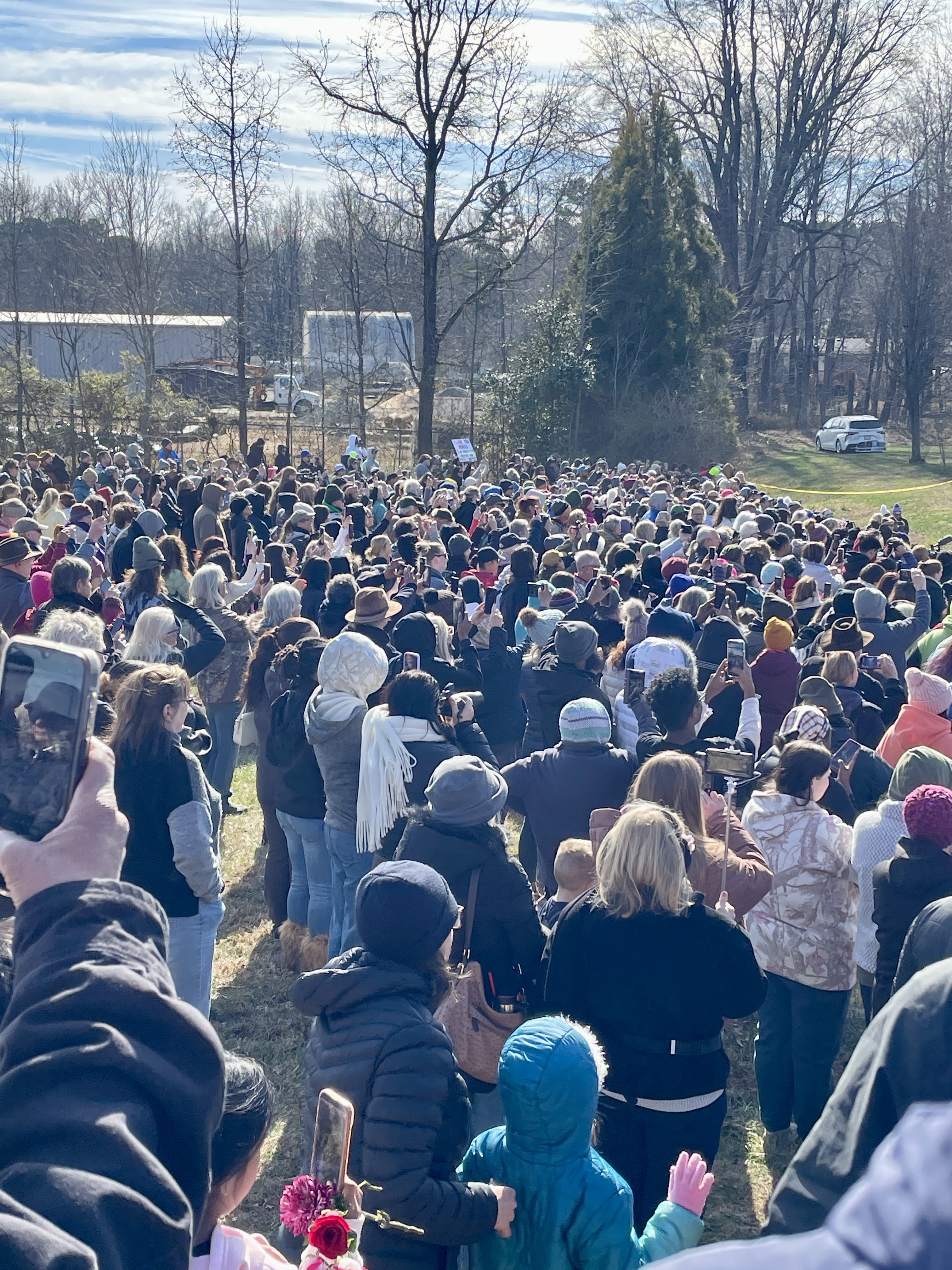
In the midst of Venerable Bhikkhu’s talk, there was a medical emergency in the crowd. As the paramedics arrived, Bhikkhu encouraged us all to place our hands on our hearts, sense our hearts beating, and maintain silence. I’d never seen such a large crowd in deep, meditative silence, which lasted about 15 minutes. The love and caring were palpable. Fortunately, after a time, the woman recovered enough to walk to the ambulance.
Deep silence as the crowd meditatedSome of the monks walk without shoes. They have one meal a day.
The monks say that peace is not a destination, but a practice. Beautiful encounters such as these can touch something sacred deep within a person, which begins to unfold.
I thought about how sustaining a mindfulness practice can be for anyone fighting to preserve freedom and democracy, as these difficult times demand.
Photo by MJ Merwin
I wrote this post as news reports emerged that federal agents shot and killed Alex Jeffrey Pretti in Minneapolis.
The world will surely need this great gift that the monks would like us to know about.
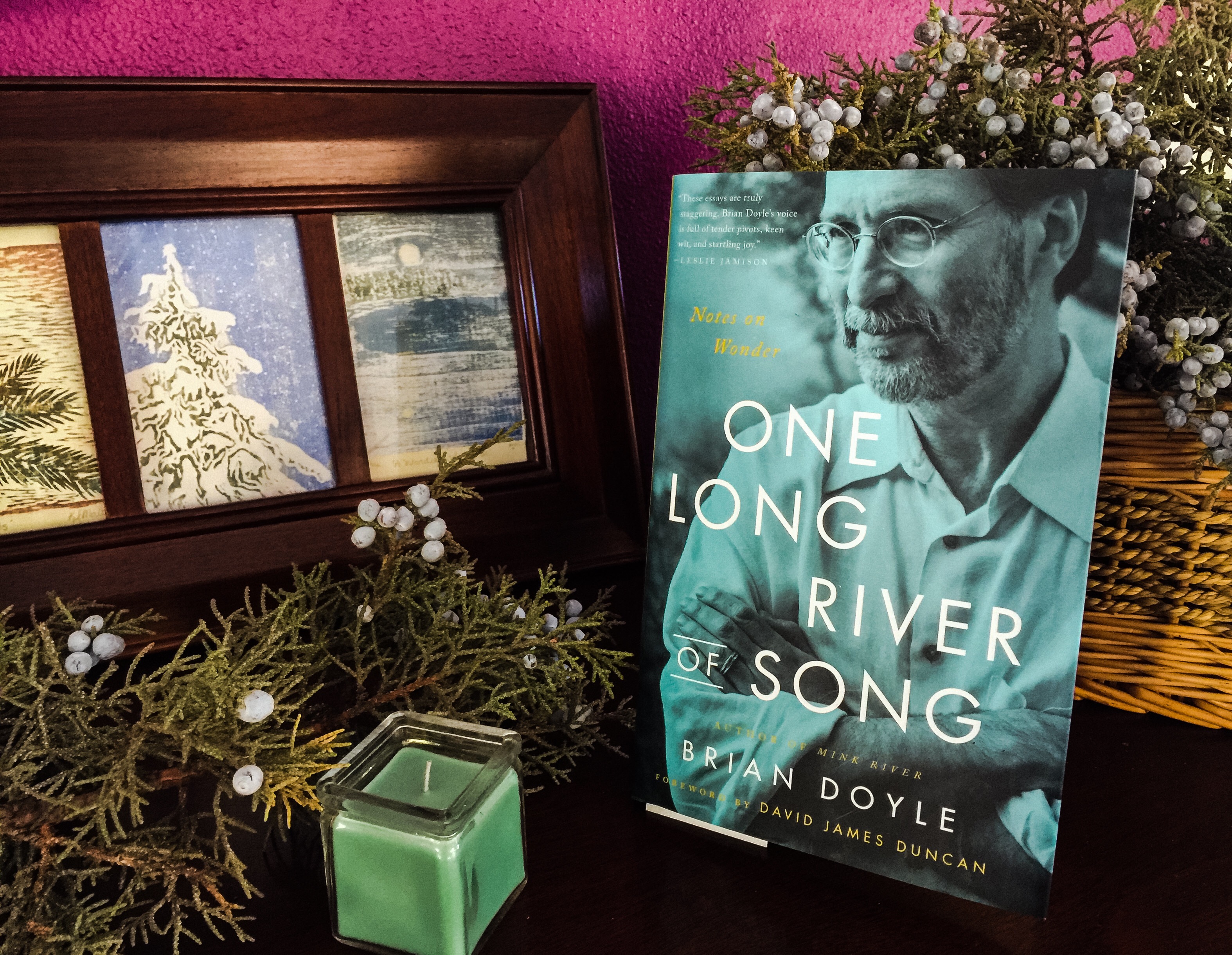
“So much held in a heart in a lifetime. So much held in a heart in a day, an hour, a moment. We are utterly open with no one, in the end — not mother and father, not wife or husband, not lover, not child, not friend. We open windows to each but we live alone in the house of the heart. Perhaps we must. Perhaps we could not bear to be so naked, for fear of a constantly harrowed heart…..You can brick up your heart as stout and tight and hard and cold and impregnable as you possibly can and down it comes in an instant, felled by a woman’s second glance, a child’s apple breath, the shatter of glass in the road, the words ‘I have something to tell you,’ a cat with a broken spine dragging itself into the forest to die, the brush of your mother’s papery ancient hand in a thicket of your hair, the memory of your father’s voice early in the morning echoing from the kitchen where he is making pancakes for his children.” –One Long River of Song: Notes on Wonder for the Spiritual and Nonspiritual Alike by Brian Doyle
Easter Sunday, 2020 in the time of COVID-19: Just about the coolest and most uplifting and loving and literary and funny and expansive collection of essays you could ever read.
In my last post I wrote that I discovered two favorite, amazing, new-to-me authors in my 2019 reading. Margaret Renkl is one; Brian Doyle is the other.
During the first month of our time in Oregon, we lived in Lake Oswego. The first time I entered the public library, I saw a Christmas tree decorated with hand-written tributes to Brian Doyle, who had made his home in Lake Oswego and who had recently died.
I ended up reading a collection of his essays and his most famous novel. If you are looking for joy in the midst of this pandemic, Brian Doyle would be the writer to read.
Here is what Margaret Renkl had to say about One Long River of Song:
“If you are in love with language, here is how you will read Brian Doyle’s posthumous collection of essays: by underlining sentences and double-underlining other sentences….by marking whole astonishing paragraphs with a squiggly line in the margin, and by highlighting many of those squiggle-marked sections with a star to identify the best of the astonishing lines therein…. and, finally, by dog-earing whole pages, and then whole essays, because there is not enough ink in the world to do justice to such annotations, slim as this book is and so full of white space, too.” – Margaret Renkl in The New York Times
Below are some excerpts. By the way, Brian was a devout Catholic, but you do not have to be a Catholic, or a Christian, or religious or spiritual in any way to sip from the wellspring of joy that runs like a river through all of Brian’s writing.
“But you cannot control everything…All you can do is face the world with quiet grace and hope you make a sliver of difference…You must trust that you being the best possible you matters somehow…That being an attentive and generous friend and citizen will prevent a thread or two of the social fabric from unraveling.”
****
“A 5.56-millimeter bullet can punch nearly half an inch into steel, and punch right through a bulletproof vest, and punch right through a human being of any size and shape and age and nationality and gender and religion and sexual orientation and combatant status, or not….
Dear outraged shrieking lunatic, you who are about to lecture me on how this was just an accident, and how it’s a necessary part of the capitalist system, and how I am clearly a yellow liberal pansy: Are you only stupid, or are you insane?”
****
[On hummingbirds} “Each one visits a thousand flowers a day. They can dive at sixty miles an hour. They can fly backward. They can fly more than five hundred miles without pausing to rest. But when they rest they come close to death: on frigid nights, or when they are starving, they retreat into torpor, their metabolic rate slowing to a fifteenth of their normal sleep rate, their hearts sludging nearly to a halt, barely beating, and if they are not soon warmed, if they do not soon find that which is sweet, their hearts grow cold and they cease to be.”
****
“Every creature on earth has approximately two billion heartbeats to spend in a lifetime. You can spend them slowly, like a tortoise and live to be two hundred years old, or you can spend them fast, like a hummingbird, and live to be two years old.”
Mink River
This novel is about the quirky people who make up a quirky “little green cup of a town” on the Oregon coast.
“On a clear day the Oregon coast is the most beautiful place on earth—clear and crisp and clean, a rich green in the land and a bright blue in the sky, the air fat and salty and bracing, the ocean spreading like a grin. Brown pelicans rise and fall in their chorus lines in the wells of the waves, cormorants arrow, an eagle kingly queenly floats south high above the water line.”
****
“Rained gently last night, just enough to wash the town clean, and then today a clean crisp fat spring day, the air redolent, the kind of green minty succulent air you’d bottle if you could and snort greedily on bleak, wet January evenings when the streetlights hzzzt on at four in the afternoon and all existence seems hopeless and sad.”
****
“She’ll be a fierce woman, that one. It’ll take a hell of a man to love her right. Be like living with a thunderstorm. Same as her mother. A fierce woman. Force of nature. The kind of woman you just hand on for the ride. The most exciting and the most heartbreaking woman you could ever meet. They don’t know their own minds most of the time, but their hearts are so damn big it hurts em inside.”
****
“Dawn. A pregnant green moist silence everywhere: and the robins start, and then starlings, and the jays, and the juncos, and the barred owl closing up shop for the night, and a hound howling in the hills which starts a couple other dogs going, which sets a guy to shouting at the dogs to shut up for chrissake, and someone tries to get a recalcitrant truck going, and the truck just can’t get going, it gasps and gasps and gasps, which sets the owl going again….and then the truck finally starts but then immediately dies, which sets the driver to cursing steadily feck feck feck which sets his passenger to giggling and the passenger’s giggle is so infectious that the driver can’t help but laugh either, so they are laughing…”
****
“They pull in the lines and up come three small halibut, a vermilion rockfish that is the reddest thing Nicholas has ever seen, and a ling cod with a gaping mouth the size of China. They clean and ice the fish. Gulls wheel and dive at the offal flung into the water.
See? No snot, no shit, and birds clean up after you, says Grace.
Can I ask you a question? says Nicholas.
No.
Do you miss your dad?
No.
Is your mom dead?
No.
Should we bait up again?
Yes.
Am I bugging you?
Yes.
I’ll stop talking.
No.”
****
“These things matter to me, Daniel, says the man with six days to live. They are sitting on the porch in the last light. These things matter to me, son. The way the hawks huddle their shoulders angrily against hissing snow. Wrens whirring in the bare bones of bushes in winter. The way swallows and swifts veer and whirl and swim and slice and carve and curve and swerve. The way that frozen dew outlines every blade of grass. Salmonberries thimbleberries cloudberries snowberries elderberries salalberries gooseberries. My children learning to read. My wife’s voice velvet in my ear at night in the dark under the covers. Her hair in my nose as we slept curled like spoons. The sinuous pace of rivers and minks and cats. Fresh bread with too much butter. My children’s hands when they cup my face in their hands. Toys. Exuberance. Mowing the lawn. Tiny wrenches and screwdrivers. Tears of sorrow, which are the salt sea of the heart. Sleep in every form from doze to bone-weary. Pay stubs. Trains. The shivering ache of a saxophone and the yearning of a soprano. Folding laundry hot from the dryer. A spotless kitchen floor. The sound of bagpipes. The way horses smell in spring. Red wines. Furnaces. Stone walls. Sweat. Postcards on which the sender has written so much that he or she can barely squeeze in the signature. Opera on the radio. Bathrobes, back rubs. Potatoes. Mink oil on boots. …..Rain in every form from mist to sluice. The sound of my daughters typing their papers for school. My wife’s eyes, as blue and green and gray as the sea. The sea, as blue and green and gray as her eyes. Her eyes. Her.”
Brian Doyle passed away from complications of a brain tumor in 2017.
Columbia River, view from Amtrak train heading for Portland, 2018.
Birdsong on the trolley trail, Easter Sunday, 2020.
We come from Joy; we are sustained in Joy, and to Joy we will return. – The Upanishads
I discovered James Fielden’s site more than a year ago. Ever since, I’ve been enjoying his writing, photography and, more recently, his music and audio meditations – all paths in which James explores aspects of spirituality and the inner life. James lives in Los Angeles, where he mixes sound for film and television.
His 23-minute guided meditation, Journey Across a Lake, is a wonderful way to begin the new year.

 Mink River

 Books Can Save A Life