Inheritance

Inheritance.jpg


“Now the details are so clear to me, as if contained in a time capsule: the Hudson River in the darkness; the lights strung across the George Washington Bridge; the even timbre of my mother’s voice; the high plane of her cheekbone. Her long-fingered hands clasped in her lap. Institute. World-famous. Philadelphia.” Inheritance, Dani Shapiro

A Memoir of Genealogy, Paternity, and Love

Over the next month or two, I’ll be looking at memoir through the lens of inheritance – genetic, ancestral, cultural, and otherwise. This, as I send off my DNA to be analyzed and journey to my two ancestral homes: Sweden, for the first time; and Sicily, where we’ve traveled as a family on several occasions while raising our sons.

I’m not sure what I’ll find in Sweden – more about that in upcoming posts. As for Sicily, I look forward to seeing my extended family again and their stunningly beautiful landscape, their small city on the sea which has been their ancestral home for centuries, and their warm, embracing culture.

I wanted to begin with Dani Shapiro’s jaw-dropping Inheritance because it is a “big,” important memoir, masterfully executed by a seasoned memoirist and novelist, about an increasingly common situation: more people are having their DNA analyzed, and some are getting huge surprises. Others are having long-held suspicions about maternity or paternity confirmed.

In Dani’s case, she learned that her father, whom she adored, was not her biological father. Which meant that her half sister was not her sister. Her beloved aunts, uncles, cousins, and grandparents were not her blood relations, either. Their rich, storied Jewish history and culture were not hers. (Or were they? Do true blood ties matter? Or can nurture make up the difference? Dani explores this.)

Some of Dani’s memories are especially resonant and ironic in hindsight:

At a writer’s retreat, when she was young, aspiring, and still unknown, a famous poet, observing her fair-skinned features, commented: “There’s no way you are Jewish. No way.”

At a backyard barbecue in their close-knit, Jewish neighborhood, a friend and Holocaust survivor said to a baffled, eight-year-old Dani: ““We could have used you in the ghetto, little blondie. You could have gotten us bread from the Nazis.”

After a photographic portrait session, three-year-old Dani was selected by Kodak for the Grand Central Station Colorama photo: the iconic, blonde, All-American (non-Jewish) child in front of the Christmas tree waiting eagerly for Santa.

But I found the following memory most haunting of all: it speaks of Dani’s staggering loneliness and bewilderment as an only child who had always had an innate, deeply felt sense she didn’t belong in her own family. Years after it happened, a neighbor recalled how one day Dani ran across the street to her house, frightened and crying. A home security alarm had gone off, and Dani’s babysitter had been apparently indifferent or unconcerned. The neighbor said she later called Dani’s mother, fed up with Dani’s endless string of babysitters and what she saw as parental neglect. I should say here that Dani had a challenging, contentious relationship with her mother who was, to say the least, a difficult woman.

Inheritance is an important memoir for many reasons; among other things, it raises moral and ethical questions that we, as a society, need to confront. I’ve written before about Jaron Lanier’s call for a more humanitarian focus as our culture becomes shaped and influenced in unforeseen ways by advances in technology. As genetic identities become easily obtainable, we’d do well to ask:

At what point does the quest to have children, at all costs, become morally questionable?  (There is something deeply ironic about the profession chosen by Dani’s biological father, whose identity she goes on to discover.)

Is it not the basic human right of every individual to know his or her genetic identity? Is it ever right for that genetic identity to be legally or otherwise withheld?

Dani comes to think of her discovery as a form of trauma:

“Later, I will become a student of trauma. I will read deeply on the subject as a way of understanding the two opposite poles of my own history: the trauma my parents must have experienced in order to have made a decision so painful that it was buried at the moment it was made, and the trauma of my discovery of that decision more than half a century later.

It is the nature of trauma that, when left untreated, it deepens over time. I had experienced trauma over the years and had developed ways of dealing with it. I meditated each morning. I had a decades-long yoga practice. I had suffered other traumas – my parents’ car accident, Jacob’s childhood illness – and had come out the other side, eventually. What I didn’t understand was that as terrible as these were, they were singular incidents….

But this – the discovery that I wasn’t who I had believed myself to be all my life, that my parents had on some level, no matter how subtle, made the choice to keep the truth of my identity from me – this was no singular incident. It wasn’t something outside myself, to be held to the light and examined, and finally understood. It was inseparable from myself. It was myself.

Their trauma became mine – had always been mine. It was my inheritance, my lot.”

Dani Shapiro now has a podcast series, “Family Secrets.”

Memoir, as a genre, is coming into its own, partly because we are finally realizing how silence and secrets can deepen trauma, with impacts on individuals, families, communities, and our larger culture.

Coming up on Books Can Save a Life:

  • The Book of Help: A Memoir in Remedies, by Megan Griswold. There is something uniquely American and West Coast about this hilarious and deeply honest memoir by a fabulous writer. I’ll be looking at her familial and cultural “inheritance.”
  • My personal stake in memoir, my own writing of memoir, and what aspects of inheritance I’ll be searching for when I travel to Europe.
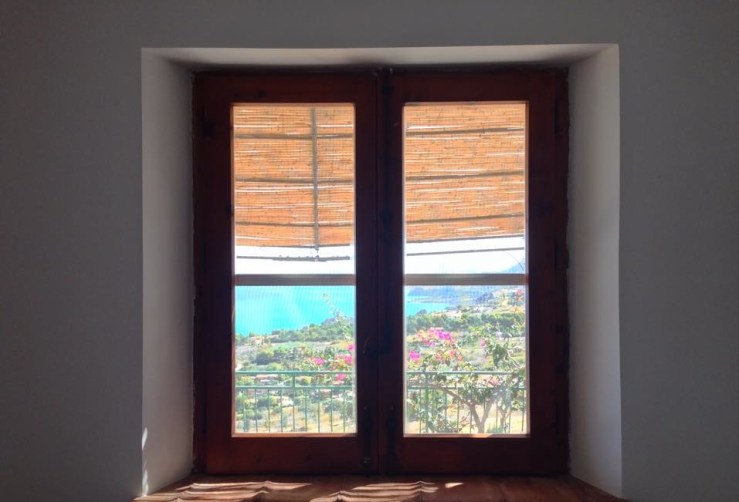
 

Villa window
Coming up: What I’ll be searching for in Sweden and Sicily


Sea, beach, sky
Not far from my Sicilian ancestral home

Kim Stafford, feasting on beauty

IMG_9096.JPG
Oregon Poet Laureate Kim Stafford


Oregon Poet Laureate Kim Stafford came “home” to our little town last week to read poetry, tell stories, sing, call up local history, and conjure memories of many Stafford family vacations spent here in a home-made cabin.

It was a lively, friendly, intimate couple of hours. I’m new to central Oregon, but I could feel the great love long-timers here have for Kim’s family, which includes his sister, Kit, a local artist and teacher, and his father, William Stafford, now deceased, one of America’s most beloved and important poets. It’s been a long, cold winter, and Kim’s energy and love resurrected our spirits, a perfect springtime happening.

A couple of weeks ago, I wrote about David Wallace-Wells’ vision of an uninhabitable earth, followed by a post on A Paradise Built in Hell and the hope Rebecca Solnit discovered when she looked at how people spontaneously come together in the extraordinary communities that can arise in disaster.

It seems a natural progression to next look at how we, as individuals, can cope and thrive in challenging times, and how we can slow down our lives to nurture and sustain our creative work – which may in turn serve as witness to what needs changing and as a catalyst for that change. This is what Kim Stafford’s life is all about, and what his father’s life was about, too.

Kim’s visit happened to coincide with my reading Christian McEwen’s magnificent World Enough & Time: On Creativity and Slowing Down.    It’s a primer on how living slowly can sustain creative work and allow it to flourish, filled with the words and wise ways of contemporary and past literary and spiritual thinkers – including William and Kim Stafford.

If you want to be uplifted and fed, I suggest getting a copy of World Enough & Time. I didn’t read World Enough & Time straight through, but picked it up between other books, reading chunks here and there, especially when I wanted creative or spiritual uplift.

You’d want to keep World Enough & Time handy on your desk or nightstand to pick up as needed. Its bibliography alone is a gold mine.

Chapters are organized around themes that include: having face-to-face conversations with friends and loved ones; approaching life with the playfulness and imagination of a child; walking; looking; reading; writing letters and keeping journals; pausing; and dreaming. You can read chapters out of order, picking and choosing as you please.

World Enough & Time is a an especially rich collection. For a decade, McEwen interviewed contemporaries; unearthed insights from past poets, artists, writers, composers, and musicians; and culled from her own life experiences.

The passages below are about or by writers, but I think you can adapt their wisdom to your particular work and daily life. Here, McEwen quotes William Stafford explaining his daily 4 am writing habit:


WorldEnough
Christian McEwen feasting on beauty. How we can, too.

“I get pen and paper, take a glance out of the window (often it is dark out there), and wait. It is like fishing. But I do not wait very long, for there is always a nibble – and this is where receptivity comes in. To get started I will accept anything that occurs to me.”

McEwen goes on to say:

“Years later, Kim Stafford wrote a memoir about his father entitled Early Morning. He described William’s steady practice as a ‘symposium with the self.’ A particular day’s writing might include images from a recent dream, news of the family and the world at large – and a couple of poems…. by lending ‘faith and attention’ to what he called those ‘waifs of thought,’ a total of more than sixty books made their slow way into print.”

How could I not quote a few of McEwen’s words about Mary Oliver’s creative practice:

“Mary Oliver’s day starts at five each morning, when she sets off on a long, solitary, attentive walk. ‘What I write begins and ends with the act of noticing and cherishing…’ Like Coleridge, who scribbled words and phrases while he was out in the field, Mary Oliver likes to use a pocket notebook, ‘small, three inches by five inches, and hand-sewn.'”

Kim Stafford, William Stafford, Mary Oliver, Christian McEwen, and many others. Feast on the beauty of their work and on the beauty of the world around you. You can’t go wrong.

At Kim’s event, I picked up a small gem of a book for $5, Meditations and Poems for Writers, which you can order from Lulu:

meditations

“Writing could be the door to a new kind of individual life, community life, national life, and earth citizenship. We each could greet the day as seeker, artist, witness.”

In The Muses Among Us: Eloquent Listening and Other Pleasures of the Writer’s Craft, a favorite of mine, Kim Stafford writes this, which I’ve copied into my daily work planner:

“What is it like to live your life story, to feed on the beauty meant for you alone, to insist on the conditions that make it possible to live the precise, full life you are here to accomplish?

Don’t wait for the right time. Don’t hesitate. Cross into your beauty now. Carry your seeing, your feasting, your selfish pleasures in the art you choose to the place you need to be, and enact what you have to do there. If you are awake, you have no choice.

Life begins with your witness there.”   


IMG_9077.JPG
Recently, I took part in my first sacred drumming session with 40 other women in a big, old barn warmed by a wood-burning stove, filled with animal skin rugs and sacred objects. I borrowed this drum, owned by a woman whose spirit animal is the wolf.


Here is a link to one of William Stafford’s best loved poems, “The Way It Is.”

Do you have favorite books, authors, or pursuits (such as gardening, drumming, hiking) that sustain you in your work and/or feed your spirit? Let us know in the comments.

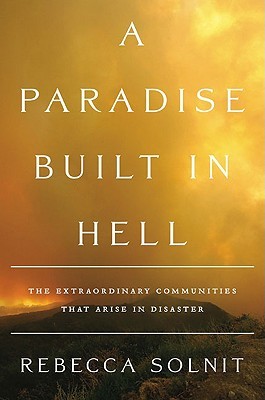
A Paradise Built in Hell

ParadiseBuilt


The Extraordinary Communities That Arise in Disaster

“Imagine a society where money plays little or no role, where people rescue each other and then care for each other, where food is given away, where life is mostly out of doors in public, where the old divides between people seem to have fallen away, and the fate that faces them, no matter how grim, is far less so for being shared, where much once considered impossible, both good and bad, is now possible or present, and where the moment is so pressing that old complaints and worries fall away, where people feel important, purposeful, at the center of the world.”  A Paradise Built in Hell: The Extraordinary Communities that Arise in Disaster, by Rebecca Solnit

An upside to disaster is that it can create community out of the ashes. Utopia, even, temporary though that might be. And among individuals, a clarified, reinvigorated sense of life purpose.

In light of my last post about David Wallace-Wells’ The Uninhabitable Earth, it occurred to me that Rebecca Solnit’s A Paradise Built in Hell can be an antidote to despair, because it arms us with a deeply optimistic view of human nature. When it was published in 2009, it was named best book of the year by The Washington Post, The New York Times, the LA Times, the Chicago Tribune, The New Yorker, and the San Francisco Chronicle.

Two hundred years from now, when people want to know what it was like to be alive early in the 21st century, they’ll read Rebecca Solnit: journalist, scholar, historian, and immensely gifted storyteller. Solnit’s prose is a joy to read, because she so seamlessly blends deep research with exquisite portrayals of the humans involved in whatever stranger-than-fiction story she happens to be telling.

Solnit is a soulful activist with a decidedly liberal bent, so she may not appeal if you have more conservative leanings. On the other hand, her books are not partisan diatribes, but suspenseful, exquisitely-researched works often drawing surprising conclusions that transcend our tired, inaccurate political and cultural divides. She does so in A Paradise Built in Hell.

We see a handful of disasters: the 1906 San Francisco earthquake and fire, the 1917 Halifax explosion, the 1985 Mexico City earthquake, 9/11, and Hurricane Katrina, among others – and how the government, other well-established institutions, and ordinary citizens responded. Mostly, citizens rose to the occasion magnificently. But, often, the government, the military, and officially designated emergency responders – not so much. Solnit interviews disaster studies experts (it never occurred to me that disaster studies is a well established and growing academic discipline) and other specialists and draws upon what she learned to posit theories as to why might be so.

We also see, up close and personal, overwhelmed individuals who mustered inner resources they didn’t know they had, permanently transformed by the utopian-like goodwill and community that, in the right circumstances, can arise in the days after disaster.

Here’s a passage written by a survivor of the 1906 San Francisco earthquake and fire:

“….everybody was your friend and you in turn everybody’s friend. The individual, the isolated self was dead. The social self was regnant. Never even when the four walls of ones own room in a new city shall close around us again shall we sense the old lonesomeness shutting us off from our neighbors. Never again shall we feel singled out by fate for the hardships and ill luck that’s going. And that is the sweetness and the gladness of the earthquake and the fire. Not of bravery, not of strength, nor of a new city, but of a new inclusiveness.”

Here are the memories of a young woman who survived the London Blitz:

“A bomb fell two streets away. Another landed nearer as they raced inside, came near enough to buffet her with waves, ‘like bathing in a rough sea.’ She found herself clutching the floor as if to keep from falling while dust was everywhere, her mouth was full of plaster….She was taken in by a neighbor who plied her with blankets and a hot-water bottle ‘for the shock’ and when she said she wasn’t in shock her hostess ‘referred darkly to ‘delayed shock.’ And when she was left alone: ‘I lay there feeling indescribably happy and triumphant. ‘I’ve been bombed!’ I kept saying to myself, over and over again – trying the phrase on, like a new dress, to see how it fitted.’ She concluded, ‘It seems a terrible thing to say, when many people must have been killed and injured last night; but never in my whole life have I ever experience such pure and flawless happiness.’

She was young, she’d survived with her love by her side, and she had fifty-five more nights of bombing to endure…..but time and war did not change her memory. Thirty-five years later Harrison….followed up on her story. She had recently become a grandmother, and she looked back on her night of being bombed as a ‘peak experience – a sense of triumph and happiness’ that she compared to the ‘experience of having a baby.’

All is not roses and optimism in Solnit’s book, however. For example, she takes a good, hard look at what went wrong in New Orleans after Katrina. I found the chapters on New Orleans especially moving, a nuanced portrait of a city and its citizens in a years-long recovery, permanently changed. (It would be fascinating to see what Solnit might make of Puerto Rico in the aftermath of Hurricane Maria.)

(Her portrayal of Katrina reminded me of the riveting Five Days at Memorial: Life and Death in a Storm-Ravaged Hospital by Sheri Fink, about a New Orleans hospital forced to cope on its own, with disastrous results. I wrote about this on Books Can Save a Life when I was a medical librarian and interested in the issue of medical rationing during disasters, something we’ll be hearing more about in the coming years.)

In the epilogue of A Paradise Built in Hell, Solnit writes:

“The paradises built in hell are improvisational; we make them up as we go along, and in so doing they call on all our strength and creativity and leave us free to invent even as we find ourselves enmeshed in community. These paradises built in hell show us both what we want and what we can be….

In the 1906 earthquake, a mansion burned down but its stone portals remained standing. A photograph shows that suddenly, rather than framing the entrance to a private interior, they framed the whole city beyond the hill where the ruins stood. Disaster sometimes knocks down institutions and structures and suspends private life, leaving a broader view of what lies beyond. The task before us is to recognize the possibilities visible through that gateway and endeavor to bring them into the realm of the everyday.”


InfiniteCitySanFra n
I found Solnit’s San Francisco Atlas when I traveled there to visit our son and attend a memoir conference. Her Infinite City series includes New York and New Orleans. Not your standard atlases, but quirky reinvented ones, an acquired taste that conceives of cities as complex layers of culture, history, architecture, trends, personal stories, you name it. Intriguing, but somewhat text-heavy for my taste. Compiled with the help of cartographers, artists, and writers, the San Francisco Atlas includes a map called “Dharma Wheels and Fish Ladders” that pairs ancient/current salmon migrations with Zen Buddhism arrivals.


IMG_9031
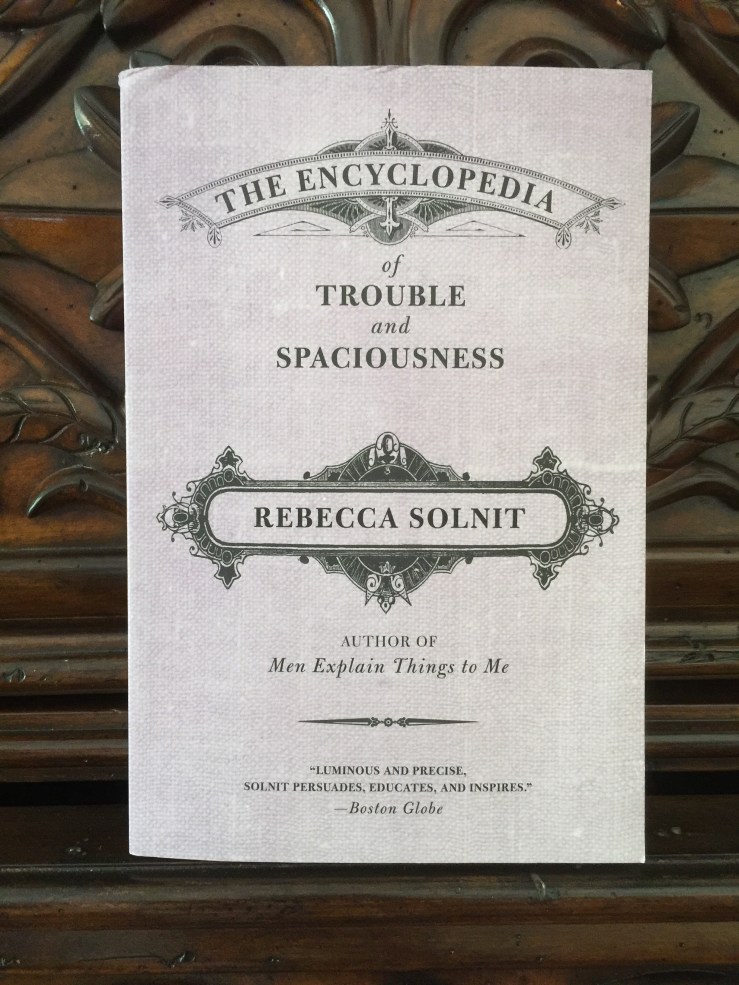
My son gave me Solnit’s The Encyclopedia of Trouble and Spaciousness, though I haven’t read it yet. Here’s a passage from the essay, “Detroit Arcadia: Exploring the Post-American Landscape.” (I’m all for Rust Belt writing.) Solnit is often funny, always astute:  “….the lobby was bisected by drywall, the mural seemed doomed, and the whole place was under some form of remodeling that resembled ruin, with puddles in the lobby and holes in the walls, few staff people, fewer guests, and strange grinding noises at odd hours. I checked out after one night because of the cold water coming out of the hot-water tap and the generally spooky feeling generated by trying to sleep in a 413-room high-rise hotel with almost no other guests….but….as I have explored this city over the last few years, I have seen an oddly heartening new version of the landscape it [the mural] portrays, a landscape that is not quite post-apocalyptic but that is strangely – and sometimes even beautifully – post-American….This continent has not seen a transformation like Detroit’s since the last days of the Maya.”

I highly recommend getting to know Rebecca Solnit, especially if you’re restless to find a new nonfiction writer who is entertaining and spot-on when it comes to portraying our current culture, or if you need to become re-enchanted with the world. I have my eye on reading these books by her someday:

Wanderlust: A History of Walking

A Field Guide to Getting Lost

The Faraway Nearby

Hope in the Dark: Untold Histories, Wild Possibilities

Coming up on Books Can Save a Life:

From the dark specter of an uninhabitable earth, to Solnit’s redeeming vision of community and resilience to, next up, a book well on its way to becoming a classic: one that shows us how to constructively turn inward, live slowly, and cultivate an authentic, deeply felt creativity that can be our gift to a world that sorely needs it. Hint: the author is Christian McEwen.

What are you reading now? Fiction? Nonfiction? Books worth your time, I hope. Please let us know your recommendations in the comments.