Barry Lopez brought us I, Snow Leopard

Snow Leopard

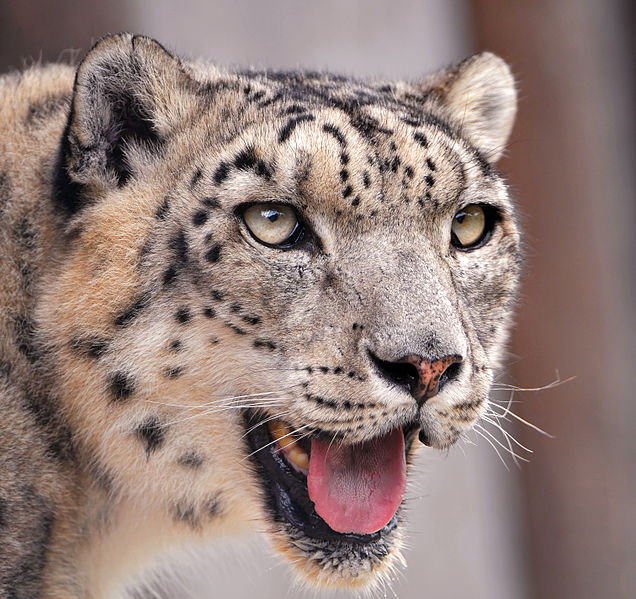
Photo by Tambako The Jaguar Creative Commons Attribution-Share Alike 2.0 Generic license

“I, SNOW LEOPARD is both a lyric and an elegy. It is easy to imagine its lines being loudly hailed in whatever country the poem finds itself in. It’s publication comes at a time when people everywhere have begun to wonder what a voice like this, suppressed for centuries, wishes to say now, in this moment when the Snow Leopard’s human brothers and sisters find themselves side by side with him. Imperiled.”   Barry Lopez
Barry Lopez

Happy New Year, everyone! In honor of Barry’ Lopez’s passing on Christmas Day, I’m reposting my previous Books Can Save a Life writings about him. I wrote the following post on April 16, 2016, after Lopez visited Rochester, NY:

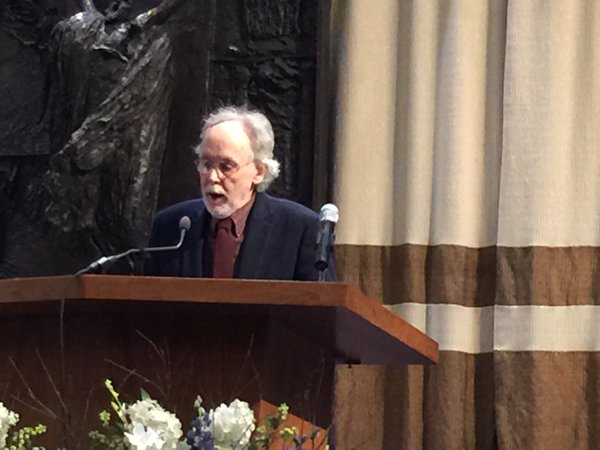
Barry Lopez came to Rochester this week to receive “The Art of Fact” award for literary nonfiction presented by The College at Brockport Writers Forum and M&T Bank.

If you’ve been following my blog, you know that Barry Lopez is one of my heroes, not quite at the level of Pope Francis and the Dalai Lama, but close. (See my blog’s header quote.)

Lopez is one of the very best nature writers, and if you love animals and wildlife, you’ll love his nonfiction books, essays, and short stories. He has travelled to 90 countries and has a tremendous respect for the animal world and the many indigenous peoples he’s come to know.
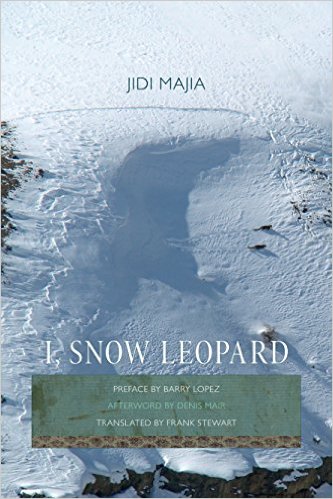
I, Snow Leopard

Lopez came to Rochester to receive his award and to deliver to us the poem “I, Snow Leopard” by Jidi Majia. 

I wasn’t familiar with either the poet or the poem, but Lopez said that when he found out “I, Snow Leopard” had been published in Asia and Europe, but not in the United States, he had to set things right.

He felt that it was vitally important that the American people hear the words of the snow leopard in this poem. So he saw to its publication here, and wrote the foreword to the English edition.

Jidi Majia, a member of the indigenous Nuosu (Yi) people who live in the mountains of southwestern China, has won numerous literary awards.  As far as I could tell from what I found online, few of his poems have been translated into English.

Majia’s poem is written in the words of a snow leopard, which is viewed by the Nuosu as a wisdom keeper, a being with “biological authority,” according to Lopez.

He told us that when he first began traveling the world and exploring, in his thirties, he viewed wild animals in an amateur, superficial, childlike way, until he learned to embrace the much more refined view held by native peoples.

A poem is a door anyone can walk through, Lopez said, and this poem is the mysterious and elusive snow leopard’s expression of grief and a warning to human kind:  “Do not hunt me any longer.”  Human violence toward animals puts everyone in peril, animals and humanity alike.

Before Lopez began, he said he wasn’t worthy to read “I, Snow Leopard,” but he’d try. He said that, as far as he knew, we’d be the very first American audience to hear the poem.

We listened to this exclusive reading in the soaring space that is the chapel in Rochester’s Temple B’rith Kodesh. “I, Snow Leopard” is beautiful, haunting, simply expressed and accessible even to listeners not accustomed to hearing poetry.
Uncia_uncia
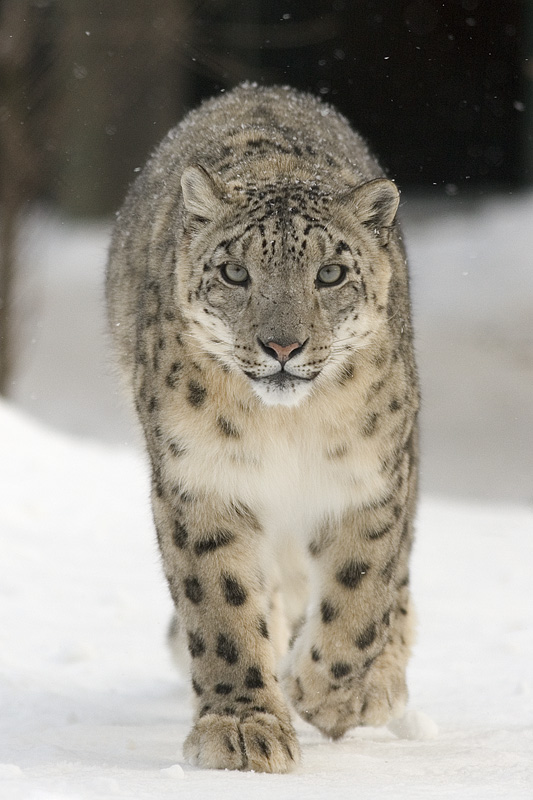
Photo by Bernard Landgraf. CC BY-SA 3.0

After the reading Lopez answered questions and spoke informally and earnestly. As we listened, the audience seemed to be hanging on his words.  Here are some direct quotes I managed to scribble in my notebook:

“Each soul is essential to the warp and weft of the universe.”

“I want to see people come alive.”

“We know what to do and we have to do it now.”

Fixing our world “will take people of great courage. People like you. Because Washington is not doing it.”

“We should be holding hands.”

“The only thing that really matters is to be in love.”

I wrote down the following words, too, but I don’t recall if they are from the poem or if they are Barry Lopez’s words. I believe they are both:

“There is no other place for any of us to go.”

“I, Snow Leopard” is available on Amazon. Barry Lopez told me it is also to be published in a future issue of Orion Magazine.
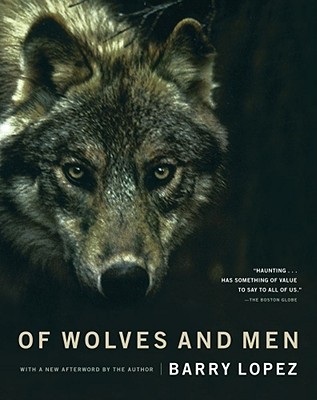
Of Wolves and Men

If you’d like to read Barry Lopez, Arctic Dreams, his nonfiction work about the Far North that won the National Book Award, is a great book to start with. I haven’t yet read Of Wolves and Men, but when I saw the mesmerizing cover photo of a wolf on display at the reading, I added it to my to-read list.

Lopez writes fiction, too. I especially liked his subversive collection of short stories, Resistance, which he wrote shortly after 9/11, about surveillance and “parties of interest” to the government.

If you want to know more about the fascinating snow leopard, Peter Matthiessen’s memoir, The Snow Leopard, is a great read.

The Secret Life of Walter Mitty, with Ben Stiller and Sean Penn, is one of my favorite movies. Watch it. You might spot a snow leopard.

Barry Lopez passing, gathering words

The role of the artist, in part, is to develop the conversations, the stories, the drawings, the films, the music—the expressions of awe and wonder and mystery—that remind us, especially in our worst times, of what is still possible, of what we haven’t yet imagined.  – Barry Lopez

Barry Lopez passed away on Christmas Day, 2020. You can read a brief, beautiful account of his passing by his wife, Debra Gwartney, on his website. Over the next months, his family will begin the work of restoring their home on the McKenzie River, which was burned in the 2020 wildfires.

During the next week I’ll be featuring some of my past posts about Barry. Here is one, which I wrote in 2013:

When I began this blog I chose for my tagline a quote by Barry Lopez about stories because it rang true for me. But I’d never actually read any of Lopez’s books. So I began with Arctic Dreams, which won the National Book Award.

If you want to be an armchair traveler of the world, if you love nature, if you crave being transported to another time and place by extraordinary writing, you must read Barry Lopez. Arctic Dreams has some of the most dazzling and poetic passages about the natural world you’ll ever encounter.

“The aurora borealis, pale gossamer curtains of light.”

“The mother-of-pearl iridescence of the sun’s or moon’s corona in clouds.”

“The outcry of birds, the bullet-whirr of their passing wings, the splashing of water, is, like the falling light, unending.”

You will find uncommon truths, beautifully expressed. Here is Lopez on the great Arctic explorers of the past: “The day after a little trouble on the ice it is possible to imagine, if but imperfectly, the sort of reach some of these men made into the unknown, day after day.” 

“I think we can hardly reconstruct the terror of it, the single-minded belief in something beyond the self.”

“Inescapable hardship transcended by a desire of spiritual elevation, or the desire to understand, to comprehend what lay in darkness.”

“What dreams there must have been that were never written down….that remained in the heart. The kind of dreams that give a whole life its bearing, what a person intends it should be, having seen those coasts.”

If you want to write, how can you move closer to this kind of mastery of language?

old dictionary

As I was reading Lopez, I happened to make a happy discovery in my writing bible, Priscilla Long’s The Writer’s Portable Mentor:  Lexicon Practice. Lexicon Practice involves looking up words you don’t know and words you want to know better, not in in a pocket dictionary or online, but in a mammoth 600,000-word dictionary, the kind you still see in some libraries. 

(Long advises writers to search online for a dictionary published in the 1930s, 40s, and 50s. They aren’t cheap, but they are a wise investment.) Copy the definitions of a word in a notebook. These old dictionaries have detailed diagrams and illustrations, and occasionally I copy these as well.

I write down the word in its language of origin, too. If it has a Latin, Italian or Spanish root, I can brush up on my foreign language vocabulary. Long instructs you to write out the sentence where you found the word and make up a sentence of your own, preferably a sentence you can use in a piece of writing you’re working on. You can choose a lexicon theme based on the work you are doing at the moment. Since I’m writing a memoir, for example, I have a lexicon with words commonly used in the 1960s – products, types of clothing, etc.

Long believes in Lexicon Practice. Otherwise, our writing derives from the uninspired language of generic, overused words and phrases we find in newspapers, magazines, advertising, and social media. As a teacher of writing, Long knows immediately when a writer doesn’t have a Lexicon Practice. She mentions Lopez as the kind of master writer we can emulate. He uses words with Old English and Old German roots, and “…he favors concrete words…that can be seen, smelled, touched, tasted, or heard. For Lopez, language is a musical instrument…”

Now, Lexicon Practice is a geeky, writerly thing, but it appeals to me. This kind of practice slows you down, teaches you to choose words with care. If you want to write rich, compelling fiction or nonfiction, you need to be in love with words in this way, or allow yourself to fall in love with them by doing work of this nature.

Definitions and drawings

Culling words from Arctic Dreams was an inspiring way to for me to establish a habit of Lexicon Work. A variety of birds populate the first pages of my first lexicon: plover, whimbrel, curlew. There are many boats and nautical references: pinnace, tender, portolano chart.  Geographical terms, too: archipelago, scree, promontory.  (As I write this, my word processor does not recognize a few of these uncommon words and highlights them as misspellings.)

Long advises writers to compose word lists, too. Her examples: every possible synonym for blue (sapphire, smalt, cobalt, woad) and all the parts of a fiddle (peg box, side rib, bridge, button). You can work according to a theme. Chairs and chair parts. Types of roofs. Clothes for people who love the outdoors. Get an L.L. Bean catalog and find words like cargo pants, fleece, sun-washed, twill, seersucker, Mary Janes, wellies.

I found that keeping a lexicon is a good excuse to buy one of those expensive, fancy journals I love. Mine has a silvered filigree cover designed in Germany around 1800. (I haven’t kept up a lexicon practice as of 2020, but I do it from time to time for specific writing projects.)

I am now using the second edition of Pricilla Long’s The Writer’s Portable Mentor, published in 2018 by the University of New Mexico Press. It has been updated with all new craft models and to reflect changes in the publishing industry.

***

If you want to be uplifted or if you would like encouragement in your life’s work, listen to a few minutes of this conversation between Barry Lopez and Bill Moyers.

Here is a moving and enlightening interview with Barry Lopez on Idaho Public Television from 2019. He talks about his latest book, Horizon, (which is a wonderful and urgent read!!!) and opens up about the impact of childhood sexual abuse on his life, and what he hoped to accomplish by finally writing about it in the New Yorker as an elder. Those of you writing memoir about traumatic events will find it helpful.

Here is a link to the McKenzie River Trust, which is devoted to conservation of the western Oregon region where Barry Lopez lived. Much of the river corridor was destroyed by the fall fires. If you wish, you can make a donation in memory of Barry Lopez.