On the seventh day of Christmas: Los Rodriguez Life

Winter snow scene

Los Rodriguez Life always makes me happy when I visit. Bilingual, so I can practice reading Spanish, and it feels like a grand celebration of family and being alive. There’s gardening, food, travel, photography, music and lots of personality.

I think you’ll enjoy “Fly On.” (Scroll down to the music video.) I love fiddle music.

December morning photo by Putneypics under CC By-NC 2.0

On the second day of Christmas: 66 Square Feet

Two turtle doves

Originally from South Africa, 66 Square Feet blogger Marie Viljoen lived in Brooklyn for many years while cultivating an amazing garden (from which she harvested fruits and vegetables) on her small terrace. Recently, she moved to Harlem, and it will be interesting to see her new not-so-secret garden in progress. Marie calls herself a writer, gardener, forager, and cook.

66 Square Feet book coverI have her new book, 66 Square Feet: A Delicious Life, which I love. I’m a former New Yorker, and I especially enjoy her nature and foraging expeditions around the city. I don’t have much of a garden, but I garden vicariously when I visit 66 Square Feet.

If you only have time for a quick blog stop, 66 Square Feet is perfect – the photography is fabulous, and often there is just a bit of text. Marie has another blog, 66 Square Feet (The Food) where you’ll find her recipes.

It so happens Marie was in South Africa when Nelson Mandela passed away. Here is a link to her post, Madiba’s Garden, about Mandela cultivating a garden while he was in prison and what it meant to him.

(Vintage bird illustration, turtle doves, photo from Vintageprintable1 is licensed under CC BY-SA 2.0)

Tasting Home – Judith Newton on writing memoir

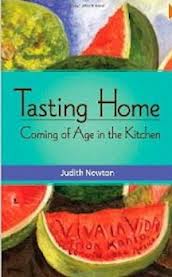
Tasting Home book coverI’ve been reading Judith Newton’s  Tasting Home: Coming of Age in the Kitchen.

I was curious about how Judith so successfully conquered new territory by authoring a memoir, having spent her career writing for academic audiences. My background as a marketing communications writer has been both a help and a hindrance when it comes to memoir and other personally expressive writing.

If you are a writer who wants to try new forms or reach new audiences, you may find Judith’s insights helpful.  And if you simply want to read more fine food memoir collections, Judith has some excellent suggestions.

In your acknowledgements you mention having to transition from writing academic texts to writing memoir. Can you comment about some of these challenges and how you overcame them?

When you write as an academic,  you are writing defensively.  It’s customary to begin a book by outlining  the arguments of other works on the subject. You then situate your own argument in relation to those of other works and point out how your own says something better or new. You’re always aware of how others might criticize your argument and you’re careful to defend yourself against that.  It’s a competitive culture and some people are downright mean.

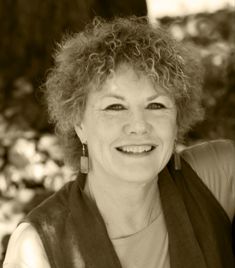
Judith NewtonWriting a memoir requires a different emotional orientation.  The idea is to open yourself up, to share private stories with your public, and  to engage with readers on an emotional level. I had to imagine a non-academic audience to write like that and, even then, writing the memoir sometimes felt like jumping into free fall off a cliff.   Taking classes was helpful with this.  I often imagined my audience as the other people in the class.

I did read other memoir writers. M.F.K. Fisher’s The Gastronomical Me was a big influence because it conveyed a great deal about the emotional hungers that are fed in cooking for, and dining with, others.  Laura Esquivel’s novel Like Water for Chocolate implicitly connects food to politics, which is something  I wanted to do. In Like Water cooking for, and eating with, others is what sustains women and men, physically, emotionally, spiritually, and politically as well.  Mollie Wizenberg’s A Homemade Life, which, among other food memoirs, combines personal vignettes with recipes, supplied a model for the form.Like Water for Chocolate

I had to learn how to write differently as well.  Although I made a habit of including personal stories in my academic writing,  those stories were an addition to, or comment on, the argument I was advancing.  I had to learn how to sustain a personal story for the length of a book, how to give it a narrative arc, how to write scenes, develop characters, write dialogue, use imagery and all the rest.  I took classes to do this (at U.C. Extension and Osher Lifelong Learning), and I really believe in classes for the instruction and for the community they give you.  I needed that community support.  (I also loved being a student rather than the teacher!)  I made a conscious decision to go into my classes feeling open to criticism because insightful criticism is a writer’s gold.  I wanted to experience, in a full way, whatever the class brought.

Your Life as StoryI can remember feeling that Annie Lamott’s Bird by Bird was incredibly liberating and comforting.  Two other really helpful books were Tristine Rainer’s Your Life as Story and Janet Burroway’s Imaginative Writing.  I especially like Rainer’s book and think that people who write screenplays have a lot to teach us.

If there are food memoirs and cookbooks you’ve especially enjoyed, let us know in the comments below.

Judith Newton is Professor Emerita in Women and Gender Studies at U.C. Davis. While at U.C. Davis she directed the Women and Gender Studies program for eight years and the Consortium for Women and Research for four.

Tasting Home is the recipient of a 2013 Independent Publisher Book Award.

In addition to Tasting Home, Judith is the author and co-editor of five works of nonfiction on nineteenth-century British women writers, feminist criticism, women’s history, and men’s movements. Four of these were reprinted by Routledge and the University of Michigan Press in fall 2012. Currently she writes for The Huffington Post.

Tasting Home – Judith Newton on cooking, coming of age, feminism

“…cookbooks were more to me than a reflection of my past. They’d been agents of my recovery – from childhood misery, from profound self-loss, from my fear, even as an adult, that the world would never seem like home. I’d cooked from them to save my life, and I’d succeeded.”

In her newly published memoir, writer and historian Judith Newton looks at her own life and the culture of her time, from the 1940s to the 2000s. Along the way she writes of the cookbooks and cuisine that fed her in body and spirit.

I can’t say enough good things about Tasting Home: Coming of Age in the Kitchen I just loved it. Judith writes of her difficult early childhood in Compton, California, of coming of age at Stanford and Berkeley in the 1960s, and of her beautiful and haunting relationship with her husband, Dick. I found Judith to be especially eloquent in describing her intellectual and spiritual awakening and continual growth.

As a young girl, I watched the 1960s unfold mostly on television and in newspapers and magazines. Reading Judith’s memoir, for me, was like hearing stories from an older sister who actually lived those events.

And the food! Judith includes childhood recipes inherited from her parents and the land they lived on (Death Valley Date Nut Bread, for example) and recipes from influential and groundbreaking cookbooks of the day, such as Mastering the Art of French Cooking by Julia Child, et al., and The New York Times Cookbook by Craig Claiborne. (Moosewood Cookbook is another classic Judith knows well. See a previous post with an excerpt from Tasting Home.) Throughout her memoir, Judith speaks of the joy, fulfillment, and healing power of cooking and sharing meals with loved ones.

Here is part 1 of an interview with Judith. Watch for part 2 in my next post. Thank you for talking with me and sharing your thoughts with us, Judith!

When I read your comment about cookbooks being an agent of your recovery, I realized I view books and music in the same way. I’m sure many of your readers have had a beloved pastime that got them through tough times. Has reader response to Tasting Home borne this out? Did this theme resonate with those who supported you during the writing process?

Tasting Home book coverYes,  it did!  One woman in my writing group found release in jazz and in singing and  dancing. Another reader, Linda Joy Myers, who is herself a memoirist, writes of how she was sustained by the warmth of a music teacher, by the beauty of music, art, and the Midwestern plains. Several of my old colleagues at Davis found refuge in cooking and understood very well how a kitchen table can lay the groundwork for political community.

How did you come to believe the personal affects the political and society?

My years of teaching women’s studies had made me aware that the private and public spheres are dependent on each other and that the personal always informs the political. Traditionally, for example, women have fed, cared for, educated, and humanized members of their household including men, children, and the old.  This frequently invisible and unpaid labor is essential to having a society at all, and especially one that involves people working in cooperation with each other.

In writing a book that celebrates home cooking as a humanizing and healing kind of work, I  think of myself as carrying on a feminist project—that of giving value to a traditionally female,  often unseen, but essential form of labor, one that the political scientist Janet Flammang, in her book A Taste for Civilization, calls a preparation for civil society itself.

Another feminist project has been to show how political movements also depend on a kind of emotion work.  The sociologist Belinda Robnett,  for example, in her book How Long? How Long? African American Women and the Struggle for Civil Rights, writes about how African American women worked behind the scenes during the Civil Rights Movement, meeting ordinary people, listening to their needs, and building face to face relations of friendship and trust. This emotion work was critical to the success of building a grassroots movement, and is critical to the success of present-day coalition as well. By demonstrating how cooking can bring people into connection with each other, not just in a domestic setting but in a political group as well, Tasting Home continues this project of linking the political to the personal and emotional.

Do you feel this healing through cooking helped you make a more meaningful contribution through your work?

Judith NewtonAbsolutely!  I learned from reading James Baldwin in 1963, the year I joined the Civil Rights Movement,  that a committed political life could and should involve “sensuality.”  “To be sensual,” Baldwin wrote, “is to respect and rejoice in the force of life itself, and to be present in all that one does, from the effort of loving to the breaking of bread.”

For me sensuality and joy in life were primarily expressed in food.  Being able to access this joy in a daily way kept me going in every facet of my life and work, making it possible for me to retain the optimism that has informed my politics and my writing.  If I didn’t feel that optimism, I wouldn’t write at all.

Judith Newton is Professor Emerita in Women and Gender Studies at U.C. Davis. While at U.C. Davis she directed the Women and Gender Studies program for eight years and the Consortium for Women and Research for four.

Tasting Home is the recipient of a 2013 Independent Publisher Book Award.

In addition to Tasting Home, she is also the author and co-editor of five works of nonfiction on nineteenth-century British women writers, feminist criticism, women’s history, and men’s movements. Four of these were reprinted by Routledge and the University of Michigan Press in fall 2012. Currently, she writes for The Huffington Post.

The Stories We Tell

Speaking of memoir, this just-released family documentary directed by Sarah Polley looks so tantalizing, and it’s gotten rave reviews. There are a few trailers floating around but I like this one the best:  The Stories We Tell.

First anniversary book giveaway

What one loves in childhood stays in the heart forever.   Mary Jo Putney

Snow-covered trees
After the storm.


Books Can Save a Life is a year old this month.

I’ve grown so fond of it here and of you who visit and comment. Meeting people from all over and re-connecting with friends and distant family  –  I never expected that.

Not to mention the beautifully conceived and produced blogs about books, writing, food, nature, gardening, travel, creativity, and other topics I’ve discovered, and the artistic geniuses behind them.

Books Can Save a Life is a lot like my backyard retreat, where I sit by our homemade pond after I walk or run. I always look forward to visiting Books to set down my thoughts and see who has stopped by.

To celebrate a year of Books, I’m having a book giveaway. By the end of February, leave a comment about a book you’re reading. a book you want to read, a book that’s becoming a movie, a book memory, or anything at all to do with reading, and I’ll put your name in a hat. (Actually, I use a rice bowl.) If I draw your name I’ll send you the book of your choice. If you can’t decide on a book, I’ll surprise you.

You might have noticed I’ve redecorated, too. I’ve chosen a new design theme in honor of the coming year and to signify a more expansive focus on topics beyond books. There’s so much I want to write about.

But you’ll still find plenty of books here.

Your comments and guest posts are what I absolutely love about this blog. Many of you spoke of books from your childhood that years later still evoke memories of family and loved ones, places you’ve been, and particular times in your lives. I think sometimes the very story or book we need comes along, or  somehow we’re led to find it.

Here are a a few comments from readers of Books this past year. Please keep them coming.

I can’t imagine my room without my personal bookcase, or a world without books. (Giuseppe)

It’s hard to put yourself in their places [The Hunger Games], living their lives and going through what they do daily in their “world,” but that’s what’s so great about books, they take you to different places and times through the amazing imagination of the authors. (Diana)

I find many so called adult novels pretentious. I want a story. I return, often, to what is classified as young adult literature, mostly because these are stories of life. Stories – in the true sense of the word. And, I can’t help but say that, years ago, I was saying to people, “Have you read the Harry Potter book?” And everyone said no. Then came that glorious day on the L in Chicago, traveling home from work, and I saw not one, not two, but six adults reading the book. I wanted to laugh out loud at the thought of those six people entering into another world…. (Donna)

Agatha Christie wrote a story without heroes; to me, that was heroic honesty.  Conversely, the inevitability of justice satisfied me. For all my contempt for two-faced authority, I still relished the idea of wrongdoers punished by divine oversight.  My sense of my own weakness as a child needed that reassurance. (Doug)

Cooking from Moosewood, even with its imperfections, was utopian. Funny how small, utopian practices can make you feel, despite the deepest contradictions, that summer is everlasting and life is good. (Judith)

….even the smallest person can step away from comfort and into challenge, that change is possible on scales small and large, that our efforts and intentions matter. The story reinforced for me that there are things in this world worth protecting–fellowship and love, food and conversation, adventure and courage, songs and stories. These are the things that sustain us when life is difficult, when we are hurt or afraid and have to be so much braver than we feel. (Adrienne)

Snow-covered bench

A WWII era classic American cookbook

canned goods

After my post about family cookbooks passed down through the generations, reader Deborah Brasket left a detailed comment I’ve highlighted in this guest post.

I like what Deborah has to say about one of her favorite cookbooks, published during World War II, because that was my parents’ era. Whenever I hear about Victory Gardens and rationing, I remember my mother telling me about how you couldn’t buy silk stockings back then, and how she and her siblings had to take turns tending the kitchen garden, and how there were no boys to go out with because they were all fighting overseas.

I think about my father in the Army in Europe, 1943. He missed his mother’s Italian cooking, and one cold November day while exploring Luxembourg he happened upon a tavern where there was an Italian wedding celebration. The family welcomed him with open arms and invited him to dinner the following day. It was my father’s last good meal before he was wounded at Cherbourg a few days later. He ate Army hospital rations for over a year while he recuperated.

Discovering book gems from the past is a pleasure quite different from cracking open a brand new book. I’m looking forward to tracking down a copy of Deborah’s family treasure.

Here’s what she had to say:

One of my favorite cookbooks was passed down to me from my mother: The Lily Wallace New American Cook Book, published in 1941. What I love about it is how it shows a whole different era of cooking “basics”. It has recipes for cooking frogs legs (3 recipes), grouse (3), rabbit (4), squirrel (2), turtle (2), snail (alas, 1) as well as other kinds of game (quail, partridge, venison, woodchuck, and pheasant.) It also has sections on preserving food, including canning, brining, and pickling.

My favorites are sections on: Ration Cooking, Saving Food for Victory, Saving Fuel, and Sugar Ration Cooking. The “Saving Food and Expense for Victory” chapter starts out:

“America may march to victory on its stomach. A nation’s morale and health depend greatly upon food. If the homemaker can do nothing else, she can wage an earnest battle for health and strength for her family in the kitchen, and thus contribute her share to ultimate victory on the military front.”

Another chapter I love is on menu planning, which includes sections on a Plan for a Liberal Diet ($3000 or over income) down to A Plan for a Restricted Diet for Emergency Use ($1000 or less annual income  – this one restricts meats mostly–Thursday’s dinner consists of whole-wheat chowder with carrots and potatoes, and bread; Saturday’s dinner consists of Hominy soup, stewed prunes, bread and butter. Yum.)

Deborah has sailed around the world, and she blogs about her journey, and nature, and writing at her beautiful site, Living at the Edge of the Wild. She writes fiction, essays, articles, poems and book reviews. You can read her work at http://www.djbrasket.com/.

Please tell us about your favorite family cookbook in the comments, or share a family cookbook story with us – send me an email at valoriegracehallinan@gmail.com.

Next up: I’ll be celebrating the first-year anniversary of Books Can Save a Life with an “open house” and a book giveaway.

Photo: Library of Congress

Christmas comfort

For the first course of my Christmas dinner, there must be something hot and inspiring – a cup of what is to me quite the most marvelous and stimulating of soups ever created, a deep carnelian-clear and concentrated fish consommè, an essence of Mediterranean fish and shellfish made aromatic with leeks and tomatoes, fennel stalks, lemon peel, olive oil and white wine.  Elizabeth David, in Elizabeth David’s Christmas

Friday was the winter solstice, a typically cold, gray day in upstate New York. This year, barren of snow and darker than usual in spirit.

The 50-bell carillon in the Rush Rhees Library tower at the University of Rochester rang 26 times, followed by melodies children love: “Mr. Rogers Theme,” “It’s a Small World,” and others. In the medical center chapel that afternoon, we lit candles to brighten the longest night and welcome the lengthening days.

Giant evergreen treesSnow fell that evening. The next morning, in the woodsy part of our backyard, I saw two young white-tailed deer hopping nimbly over a fallen tree.

We need comfort food more than ever this year. On Christmas Eve, I’ll make a feast of four fishes, not quite keeping up with the feast of seven fishes traditionally prepared in seaside Mediterranean villages. Seven for the seven sacraments of the Catholic Church. As for what kinds of fish you’d find on the Christmas Eve table in villages of old, I imagine whatever the fishermen caught that day.

When we travel to Sicily we stay in Scopello, a small village by the sea. We hear the fishing boats heading out before sunrise. Later, we go to the market and look over the fresh catch. One day, on a trip several years ago, our boys were thrilled to see a magnificent six-foot swordfish on display.

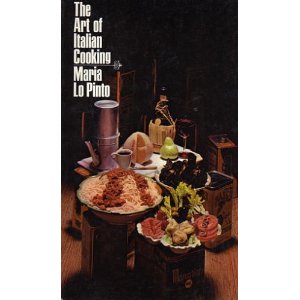
This year, I thumbed through an old paperback cookbook my Sicilian father often consulted, The Art of Italian Cooking by Maria Lo Pinto, to plan our holiday menu. The pages are yellow and I’ve lost the back cover of this edition, which was the 40th printing. First published by Doubleday in 1948, the cookbook was picked up by Bantam in 1955. The Art of Italian Cooking cover

The Christmases of my life seem to fall into distinct phases. Do yours? The holidays of my childhood and adolescence I spent in my family’s floral shop surrounded by poinsettias, piles of fragrant evergreen boughs, and fresh flowers by the dozens.

Then came Christmases in New York. I remember the paper bags filled with warm chestnuts I bought from street vendors, the Salvation Army bells ringing along Fifth Avenue, and the department store window displays: Lord & Taylor, Saks Fifth Avenue, B. Altman, Macy’s. I’d buy a small Christmas tree and bring it home by taxi to my third floor walk-up.

On to upstate New York, and Christmases with my husband and two boys. Decorating the tree, watching the children dressed as angels and sheep in the Christmas pageant, waiting for Santa, leaving cookies and milk for him by the fireplace and a little something for the reindeer. One Christmas morning, the boys discovered a fresh hoof print pressed into the small bowl of oats.

Now, we wait for two young men to come home for the holidays. We have a wonderful time, and the holidays are over way too soon.

If you’d like, leave a Christmas memory in the comments below.

Quote from Elizabeth David’s Christmas, edited by Jill Norman. David R. Godine, Boston: 2008.

Evergreen photo by M. Hallinan

Family cookbooks that become heirlooms

I asked my brother, John, to contribute to my series on favorite family cookbooks. I’ve tasted some of the recipes from the cookbook below, prepared by John. Fabulous, unpretentious Sicilian cooking, the kind we grew up with.
The Sicilian Gentleman's Cookbook book coverI often consult The Sicilian Gentleman’s Cookbook [by Don Baratta] when I want to do some Sicilian cooking. I think cooking becomes very personal, because we all have different tastes. I remember my dad describing different ways to make tomato sauce.  His mom, my grandmother, liked to make simple sauce. You cook down the tomatoes, add spices and, of course, garlic and onion, and you’re done….simple. But my grandfather had to have his sauce strained. Absolutely forbidden to have seeds and skin involved.
To me, The Sicilian Gentleman’s Cookbook is simple cooking. Just the way I imagine peasants cooked in Sicily, because they didn’t have much. They made do with what was available. I usually pull down the book for a quick idea and I go with what we have. Simple. I suggest the artichoke hearts with pasta, which is a family favorite when we get together with friends for Valentine’s Day. I also like the fish stew/soup recipe. It’s really a remarkable meal.
When we were visiting at Thanksgiving, I was browsing through the cookbook and found the Sicilian gentleman’s secret to losing weight: have a bowl of homemade soup every night for dinner. Sounds like a great idea for the long, cold winter nights to come. A hot bowl of homemade soup with a slice of fresh bread and a glass of Malbec or Beaujolais Nouveau, then a good book in front of the fire.
Elizabeth David’s literature of cookery
Italian Food book cover
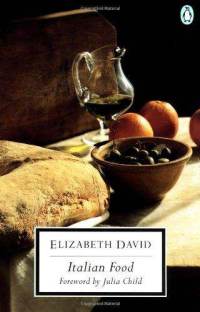
John’s story got me thinking about one of my favorite Italian cookbooks – Elizabeth David’s Italian Food.  The recipes are somewhat antiquated and difficult to re-create, because you can’t always find the proper, authentic ingredients, but they’re mouthwatering all the same. David, who was British, raises food writing to a high art. This is a book you could read and enjoy by a winter fire every evening, without ever making a recipe.
It was difficult to choose an excerpt, the writing is so good, but here are two of my favorites:
It is worth noting that in the dining-cars of trains, where the food is neither notably good nor to everyone’s taste, a dish of uova al burro may always be ordered instead of the set meal and will be brought rapidly and with perfect amiability by the dining-car waiter. So browbeating are the attendants in certain French and English railway dining cars over this question of ordering eggs or sandwiches instead of the dull, expensive, six-course meal provided that I have thought the matter worth mentioning.
She’s talking about a bygone era that sounds wonderful to me. Here is a link to the dining car menus on Amtrak’s long-distance trains – they even serve meals on Christmas Day.
Here is David’s description of a Venetian fish market:
The colours of the peaches, cherries, and apricots, packed in boxes lined with sugar-bag blue paper matching the blue canvas trousers worn by the men unloading the gondolas, are reflected in the rose-red mullet and the orange vongole and cannestrelle which have been prised out of their shells and heaped into baskets….In Venice even ordinary sole and ugly great skate are striped with delicate lilac lights, the sardines shine like newly-minted silver coins, pink Venetian scampi are fat and fresh, infinitely enticing in the early dawn.
I’d like to continue this family cookbook series, so send me the titles of your favorite family cookbooks and I’ll list them here. If you have a story or anecdote about a particular cookbook, please send it along.
Barbara Kingsolver’s Flight Behavior goes to….
Darlene Niman, who owns and operates Out With a Friend, a senior companion service in New York City. She says one of the best books she’s read recently is That Summer in Sicily by Marlena De Blasi.
Quotes from:
Italian Food, Elizabeth David, Penguin Books, New York: 1987.
The Sicilian Gentleman’s Cookbook, 3rd Revised Edition, Don Baratta, Firefly Books, Buffalo: 2002.

Moosewood Days

Cooking from Moosewood…was utopian.      – J. L. Newton

Moosewood Cookbook Cover
J. L. Newton’s well-used copy of the Moosewood Cookbook by Mollie Katzen

Just hours after I posted a call for stories and anecdotes about treasured family cookbooks, author J. L. Newton sent me a delightful excerpt from her forthcoming memoir, Tasting Home: Coming of Age in the Kitchen.

For me, nothing captures the essence of upstate New York’s lush, Finger Lakes farmland and local, fresh produce like the Moosewood cookbooks and the Moosewood Restaurant. I raised my kids on many a Moosewood recipe. Whenever we camped in Taughannock Falls State Park, we’d look forward to a meal at the restaurant in Ithaca.  Our boys always ordered the macaroni and cheese.

A few years back, during a month-long artist-in-residence stay at the Constance Saltonstall Foundation for the Arts, I enjoyed the home cooking of Judy Barringer, a Moosewood co-founder, who at the time was the Saltonstall chef and cook. Never in my life have I tasted such wonderful vegetarian comfort food. I didn’t know a hamburger made from polenta could taste so good.

So you can see why I was delighted when Judy Newton offered to share Moosewood memories from her “mini-commune” days. Here’s what she had to say:

In the summer of 1985, I was living with three men—-my first husband, Dick, who now had a boyfriend named Ed; my second husband, Max, whom I’d  married with many misgivings the year before; and Nigel, a longtime friend of Max who was doing research in Philadelphia.

A photo shows me sitting with Dick and Max at the table on our deck. Pregnant and wearing striped work overalls, I have long, curly hair. I’m resting my head on my hand and looking pleased, as if paradise had come again.

Dick’s honey-colored mustache droops seductively.  Max has a Jewish Afro and a wide, full beard. Pink flowers float above a green vase in the center of the table, and our plates are full of chicken, rice, and broccoli. It is a plain meal, with few ingredients, which means Max cooked it.

Dick took his recipes from gourment magazines, but Nigel and I had discovered Moosewood Cookbook. On the (separate) nights we cooked that summer, dinner consisted of our garden on a plate.

Excerpt from Tasting Home: Coming of Age in the Kitchen:

I never looked to Moosewood for two-star recipes. Indeed, many of its dishes squeaked by, in our rating system, with only a star above a check, meaning they were fine for everyday meals but not for guests.  “Swiss Cheese and Mushroom Quiche” fell into this category, though it involved a cup and a half of tangy gruyere cheese. My note in the margin said Julia Child’s version was better. Was it the Moosewood crust, partly whole wheat and made with buttermilk instead of water? Was it that Child’s Mastering the Art of French Cooking used heavy cream and nutmeg rather than milk and mustard? Was it that the mushrooms in Moosewood were innocent of shallots and Madeira?

Several Moosewood dishes earned only a check above a star, which translated as “not worth the effort.” We assigned “Vegetarian Chili” (with kidney beans, bulgur, celery, carrots, peppers, and tomatoes) to that category. “Don’t bother,” I wrote in the margin.  Was it the tomato juice? Did I under spice?

Going wrong with Moosewood recipes was a drag because they usually called for a ton of ingredients. It was great when the recipes worked because they allowed you to unload a basket of summer produce (after a good deal of chopping) into a single pot.“Vegetable Stroganoff” called for onions, mushrooms, and six cups of broccoli, carrots, cauliflower, zucchini, peppers, and cherry tomatoes.

“Vegetable Stew” featured potatoes, carrots, celery, eggplant, zucchini, broccoli, mushrooms and tomatoes. Both were tasty dishes in the check/star category.

But “Ode to Chang Kung” with its broccoli, mushrooms, bean sprouts, water chestnuts, bamboo, tofu and sesame seeds (plus cashews, scallions, and chopped green peppers on top) came out weird and bland. Was it the quarter cup of something called “taman?”

“Never again!” Nigel wrote at the top of the recipe.

At other times Moosewood recipes, with their cornucopia of ingredients, demanded additions that seemed designed to remind us of their hippie roots. Why else would “Spinach-Rice Casserole” (which featured brown rice, spinach, onion, garlic, eggs, milk and a cup-and-a-half of cheddar cheese) call for tamari and a quarter cup of sunflower seeds?

Why did “Vegetable Stew,” an otherwise straightforward dish, demand molasses? And why did “Broccoli Noodle Casserole” with its decadent three cups of ricotta, one cup of cheddar, and one cup sour cream even bother with wheat germ sprinkled over the top?

But it didn’t matter. I cooked from Moosewood that summer because I liked the idea of it. The book was produced by a collective, and we were a collective too. The restaurant had no “boss,” and despite Max’s alpha personality, our house had no boss either. We rotated shopping, cooking, and washing dishes, which made me feel heady, and slightly guilty, about having such domestic and culinary leisure.

I was also drawn to the Moosewood philosophy of “convenience and economy” which we certainly got to practice since our ingredients came from our garden outside the kitchen door.

Moosewood celebrated “health, lightness, purity,” a trinity I wanted to pursue, and I liked the homemade quality of the book itself – the hand lettering, the sparkly drawings.

Our favorite recipe, “Spinach–Rice Casserole,” was illustrated with a hairy unicorn encountering a large, strange bird. Hand drawn unicorns called attention to the creativity, love, and labor that, often invisibly, go into making the sweetness of the everyday.

Cooking from Moosewood, even with its imperfections, was utopian. Funny how small, utopian practices can make you feel, despite the deepest contradictions, that summer is everlasting and life is good.

Judith Newton’s memoir, Tasting Home: Coming of Age in the Kitchen, will be published by She Writes Press in February, 2013. Visit her blog at tasting-home.com.

Judith is Professor Emerita in Women and Gender Studies at U.C. Davis. She is the author and co-editor of five works of nonfiction on nineteenth-century British women writers, feminist criticism, women’s history, and men’s  movements. Four of these works will be reprinted as E-Books by Routledge and the University of Michigan Press in the fall of 2012.

More Moosewood

The November/December 2012 issue of Spirituality & Health includes a feature story, “40 Years of Mooosewood.” (Print version only.)  The restaurant is celebrating its 40th anniversary this year.

Do you have a tried and true Moosewood recipe? Tell us in the comments below.

Do You Have a Treasured Family Cookbook?

Between now and the New Year, my readers and I will be sharing our favorite family cookbooks. Please tell us in the comments below about special cookbooks meaningful to you and your family. Or, send your stories and anecdotes to valoriegracehallinan@gmail.com.

Let’s share family cookbooks and food traditions

Antique cooking utensilsIn one of my recent posts, Children’s lit of my ancestry, my Italian cousin wrote about a book traditionally read by Italian families, and I wondered if my father read it when he was growing up.

A friend of mine commented that she’d inherited many of her father’s children’s books, and her grandmother had passed on to her a family Czech cookbook.

That gave me the idea of sharing our best-loved family cookbooks and food traditions as we approach the holiday season. I’ve a few books I’d like to share, and it would be fun to hear from you, too.

Is there a much-loved, well-worn cookbook your mother, father, grandparents or even great-grandparents used? What is special about it or meaningful to you? It could be out of print or a familiar classic. I’d like to share an eclectic mix of titles and traditions.

Maybe you have a story to tell in connection with a particular recipe, meal, holiday, or family memory.

Over the next two months, as we prepare to cook some of our favorite holiday meals, I’d love to hear about cookbooks unique and special to your family. Guest posts about a valued family cookbook or food tradition, or slice-of-life memoir snippets are especially welcome.  Please send cookbook titles, comments, anecdotes, and inquiries about doing a guest post to my email at valoriegracehallinan[at]gmail[dot]com.

Photo from Library of Congress photostream.