The Narrow Road to the Deep North

“On the bedside table by the living Buddha, now dead, was an old copy of Basho’s great travel journal The Narrow Road to the Deep North. Hashimoto opened it to a page marked with a dry blade of grass. Days and months are travellers of eternity, he read. So too the years that pass by.”   (Last book read before death by a WWII Japanese commander of the Thai-Burma Death Railway, in Richard Flanagan’s The Narrow Road to the Deep North)

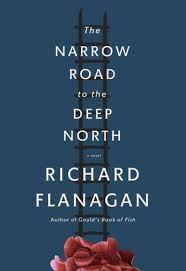
The Narrow Road to the Deep North book coverRichard Flanagan’s father was one of nearly 3,000 Australian POWs who worked on what became known as the Thai-Burma Death Railway in World War II. Flanagan’s father survived. According to Wikipedia, estimates of the death toll are guesses: about 180,000 Asian civilians and 60,000 Allied POWs labored on the railway under inhuman conditions battling cholera, starvation, and beatings. Some 90,000 perished, including over 12,000 Allied POWs. Over 100 Japanese and Koreans were tried for war crimes, and 32 were sentenced to death.

I’m partial to WWII novels, but I don’t know much about the Pacific theater of the war, and next to nothing about the prisoners of war who worked on the Thai-Burma Railway. I’m so glad I read The Narrow Road to the Deep North and encountered Flanagan’s extraordinary writing, but do not attempt it unless you can stomach brutally explicit prose about hellish conditions.

An Australian surgeon, Dorrigo Evans, tries to save as many of the men under his command as he can, but his efforts are mostly futile. We see Dorrigo as a young boy in Tasmania, as a young soldier in an affair with his uncle’s wife who is the love of his life, as a prisoner of war, and as an older, successful, but deeply scarred surgeon and war hero.

There are several moving, intimate, stream-of-consciousness portrayals of other Australian POWs under Dorrigo’s command  as well. Especially riveting is a scene in which the Japanese commanders, cruel and relentless in their mission to get the railroad built, discuss the fine points of haiku. Flanagan follows these men after the war, too, those who managed to have others take the fall for their crimes, and their amazingly clear consciences after the war.

The Narrow Road to the Deep North won the Man Booker Prize and has received many excellent reviews. Michiko Kakutani of The New York Times  is more mixed in her review: she feels that Amy, Dorrigo’s lover, should have been excised from the book for the sake of unity and coherence; she describes Flanagan’s writing about the love affair as “treacly prose,” whereas I found many of these passages beautiful. I disagree with her assessment here.

Have you ever thoroughly loved a book or movie only to encounter a respected critic who points out how seriously deficient or flawed is the thing you absolutely love? At this link is an especially vicious review in the London Review of Books. Flanagan must have poured his heart and soul into writing about a terrible time that his father survived, and he spent years working on the novel. This negative review is not reasoned literary criticism that I value or trust, and I wonder what motivates the critic. Sometimes I think critics analyze so much creative work they become jaded, unable to approach a novel or movie in a fresh, unbiased way.

By the way, I don’t consider my blog posts to be book reviews or literary criticism. My intention is to write about how a book affects me, personally, or how I think it might affect you, the reader, or why it may be especially significant in some way. If I don’t feel a book is well written, or if it doesn’t speak to me in some strong way, I don’t write about it here.

I’ll leave you with a passage I especially love, about POWs newly home from the war:

“He brought the fish and chips to their table, then filled some small glass tumblers behind the counter with red wine and brought them out too. Then he sat with them. As they ate, he let them talk. When they flagged he talked of how such a winter meant it would be a good summer for apricots, yes….Then he started up about his own life….How people told him coming to his fish shop made them happy. He hoped that was true. I really do, he said. That’s a life….The old Greek made his own coffee for them – little cups, thick, black and sweet – and he gave them walnut pastries his daughter had made….The simple chairs felt easy, and the place, too, felt right, and the people felt good….”

The Narrow Road to the Deep North illustration


The Narrow Road to the Deep North book coverBasho’s The Narrow Road to the Deep North, written in the 17th century, is a classic work of haibun, which melds haiku with prose. It makes for excellent reading alongside Flanagan’s contemporary novel.

Have you ever encountered scathing criticism of writing that you love? How does it make you feel? Does it alter or influence your opinion of the work?


Books from Around the World, Under Our Tree

The Narrow Road to the Deep North Book CoverThe Narrow Road to the Deep North, by Richard Flanagan. This World War II novel about an Australian surgeon in a Japanese POW camp won the 2014 Man Booker Prize.  (The purpose of this UK prize is to bring quality fiction to intelligent general readers who might otherwise not hear about the work.) The prisoners helped build what became known as the Thailand-Burma Death Railway. The Narrow Road to the Deep North book cover The books is named after one of the most famous books in Japanese literature, written by the 17th century Japanese poet Matsuo Basho. I plan to read the books together. I’ll let you know how that works out.


A Platter of Figs cookbook coverA Platter of Figs and Other Recipes, by David Tanis I like this cookbook because it’s about eating with the seasons, and it features uncomplicated family meals you can easily make at home. Sections include “How to Cook a Rabbit,” “Feeling Italian,” “Nuevo Mexico,” “Peasant from a Parisian Kitchen,” and “Hot Day, Cold Chicken.” David Tanis is the head chef at Chez Panisse in Berkeley six months of the year; the other six months he lives in Paris, where he prepares meals in a tiny galley kitchen for his private dining club. I will read any cookbook affiliated with Alice Waters and Chez Panisse. My son bought this book at Spoonbill & Sugartown Booksellers in Williamsburg.


Cereal magazine coverCereal: Travel & Lifestyle Magazine, Vol. 8 Click on this link right now and visit Cereal, a stunningly photographed and designed magazine and online journal. This volume features, among other things, a section on Yukon, Canada with spreads on Kluane National Park & Reserve and the Demptster Highway which leads to the Arctic Circle. (Someone in the family has been to the Arctic Circle via the Dalton Highway.) This mag’s style and visual aesthetic reminded me of a cookbook and lifestyle book I received last Christmas, The Kinfolk Table: Recipes for Small Gatherings. (Kinfolk is a magazine, too.) So I got out the book and saw there are a couple of recipes and a profile of food writer Rosa Park, who happens to be the editor of Cereal. Both Cereal and Kinfolk are beautifully designed and photographed, wonderful for browsing.


Southern Light: Images of Antarctica book coverSouthern Light: Images from Antarctica, by David Neilson. Someone in our family dreams of visiting Antarctica.  This is a luscious collection of black and white and color photos, including several gatefolds that open up to three panels of photos on each side. At least seven kinds of penguins, all the major mountain ranges, Deception and Elephant Islands, historic exploration sites, and essays on climate change, too. Our son bought this book at Strand Books in New York. (“Come for the books and stay for the synth musik.”)


RHS Vegetables for the Gourmet Gardener book cover

RHS Vegetables for the Gourmet Gardener, by Simon Akeroyd. To feed my gardening habit and enrich my gardening and nature writing. RHS stands for Royal Horticultural Society, the UK’s leading gardening charity. This beautiful book was designed and produced by Quid Publishing in England, the same publisher that produced another volume I own, RHS Latin for Gardeners.

Our son purchased this at Daunt Books for Travellers in London. On the bookmark tucked inside:  “The heart of Daunt Books is an original Edwardian bookshop with long oak galleries and graceful skylights. Its soul is the unique arrangement of books by country – where guides, novels, and nonfiction of all kinds will interest traveller and browser alike.” If I ever get to London this shop will be on my bookstore list.


Four Seasons in Rome book coverFour Seasons in Rome: On Twins, Insomnia, and the Biggest Funeral in the History of the World, by Anthony Doerr. If you read my blog, you know I’ve been wild about Anthony Doerr lately. His novel, All the Light We Cannot See, was a National Book Award finalist and has become a bestseller. He happened to visit Rome when Pope John Paul II was dying and attended the vigil. I can’t wait to see Doerr’s take on this fabulous city.


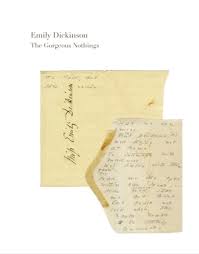
The Gorgeous Nothings book coverEmily Dickinson: The Gorgeous Nothings, by Marta Werner, a scholar of poetry, and Jen Bervin, a visual artist. No other book is quite like this one – a work of art, a facsimile publication of Emily Dickinson’s poems as she wrote them on fifty-two envelopes. These artifacts let the reader see Emily’s original line breaks and words spread across the entire space of a page, together with variant word lists that are meant to be part of the texts themselves. Reading these poems in their original medium, as opposed to in a traditional typeset book, is an entirely different experience.


My Struggle book coverMy Struggle, Book Three, by Karl Ove Knausgaard. My son has read the first two autobiographical novels in the hugely popular series (there are to be six!) by the Norwegian author, published in 22 languages. I hope to tackle the first two volumes myself this year.


Berlin Wonderland book coverBerlin Wonderland: Wild Years Revisited 1990 – 1996 Amazing photos by seven photographers documenting the wild, artistic subculture that bloomed after the Berlin Wall came down. One of our sons is studying in Germany and bought this at Hundt Hammerstein in Berlin, a gift for the photographer in our family. The text is in English and German.


Manage Your Day to Day book coverManage Your Day-to-Day: Build Your Routine, Find Your Focus & Sharpen Your Creative Mind, edited by Jocelyn K. Glei. This is a great little book about how to meet creative goals and fulfill your calling rather than spend your days reacting to the demands of social media and new technology – a huge issue creative souls in the past did not have to deal with. Creative work, in the context of this book, can be anything from painting to starting a business to launching a volunteer effort or charity drive.

These very short articles by creatives and thought leaders like Seth Godin and Gretchen Rubin are practical and full of wisdom. I love this tiny red and black book and decided to pass it on to my photographer son (the industrial designer has browsed through it, too.) The most important take-away for me: disconnect from the Internet and get creative work done first thing, NO MATTER WHAT. Produced by Behance, which “is on a mission to empower the creative world.”   (See: http://www.99u.com; http://www.behance.com)


All the Light We Cannot See

“At dusk they pour from the sky. They blow across the ramparts, turn cartwheels over rooftops, flutter into the ravines between houses. Entire streets swirl with them, flashing white against the cobbles. Urgent message to the inhabitants of this town, they say. Depart immediately to open country.”     All the Light We Cannot See, Anthony Doerr

All the Light We Cannot SeeWhen she is six, Marie-Laure LeBlanc goes blind. Her widowed father, a locksmith at the Natural History Museum, constructs a miniature replica of the Paris neighborhood where they live so Marie-Laure can memorize nearby streets and landmarks.

Some years later, when she and Monsieur LeBlanc flee to the coastal city of Saint-Malo during the Nazi occupation, Marie-Laure’s father constructs a replica of that city, too, so Marie-Laure can make her way around independently. Eventually, Marie-Laure joins the resistance, along with her uncle, Etienne, who is a shell-shocked World War I veteran. She finds herself quite alone on the eve of the massive American bombing of Saint-Malo in August of 1944.

In the meantime, German orphan Werner Pfennig takes a keen interest in building and fixing radios. Eventually, he is recruited by the academy for Hitler Youth. During the war, Werner tracks the resistance by searching for secret radio broadcasts. Werner detects illegal broadcasts coming from Saint-Malo, and the very street where Marie-Laure lives.

All the Light We Cannot See was a 2014 National Book Award finalist. Anthony Doerr, who grew up in Cleveland but now lives in Idaho, is a writer I intend to follow. I’ve put his memoir, Four Seasons in Rome, on my holiday wish list, and am enjoying his collection of short stories, The Shell Collector. His prose is breathtaking, poetic. (I’m studying favorite sentences from the novel as a writing exercise.)

When I read World War II European-front fiction I try to imagine where my father would have been at the time. He arrived in France and Luxembourg a few months after the bombing of Saint-Milo and fought during the weeks leading to the Battle of the Bulge.

Here is a 9-minute video I found on YouTube of Americans bombing and entering Saint-Malo. There were about 850 buildings in the town, and after the bombing only 150 or so remained standing.

A couple of my favorite passages from All the Light We Cannot See:

“She places a ration coupon on the counter. ‘One ordinary loaf, please.’

‘And how is your uncle?’ The words are the same, but the voice of Madame Ruelle is different. Galvanized.

‘My uncle is well, thank you.’

Madame Ruelle…reaches across the counter and cups Marie-Laure’s face in her floury palms. ‘You amazing child.’

…the loaf comes to her: heavy, warm, larger than normal. ‘Tell your uncle that the hour has come. That the mermaids have bleached hair.’

‘The mermaids, Madame?’

‘They are coming dear. Within the week.'”

++++++++++++++++++++++

“They cross the Channel at midnight. There are twelve and they are named for songs: Stardust and Stormy Weather and In the Mood and Pistol-Packin’ Mama…

Inside each airplane, a bombardier peers through an aiming window and counts to twenty. Four five six seven. To the bombardiers, the walled city on its granite headland, drawing ever closer, looks like an unholy tooth, something black and dangerous, a final abscess to be lanced away.”

++++++++++++++++++++++

“But God is only a white, cold eye, a quarter-moon poised above the smoke, blinking, blinking as the city is gradually pounded to dust.”

In Sicily

“I had found my island, and I wanted to stay forever.”  Theresa Maggio, Mattanza

Villa window


Mattanza book coverWhen I visit Sicily, I enjoy following in the footsteps of Theresa Maggio, author of Mattanza: The Ancient Sicilian Ritual of Bluefin Tuna Fishing and The Stone Boudoir: Travels through the Hidden Villages of Sicily.  

My family and I first travelled to Sicily 14 years ago, in part to re-connect with my father’s relatives. That was when I discovered Theresa’s splendid books.

Reading them again on our recent trip was like meeting up with an old friend. When I see Sicily through Theresa’s eyes, I see the island so vividly, with a more nuanced understanding of the complex people, culture, and history of this stunningly beautiful place.

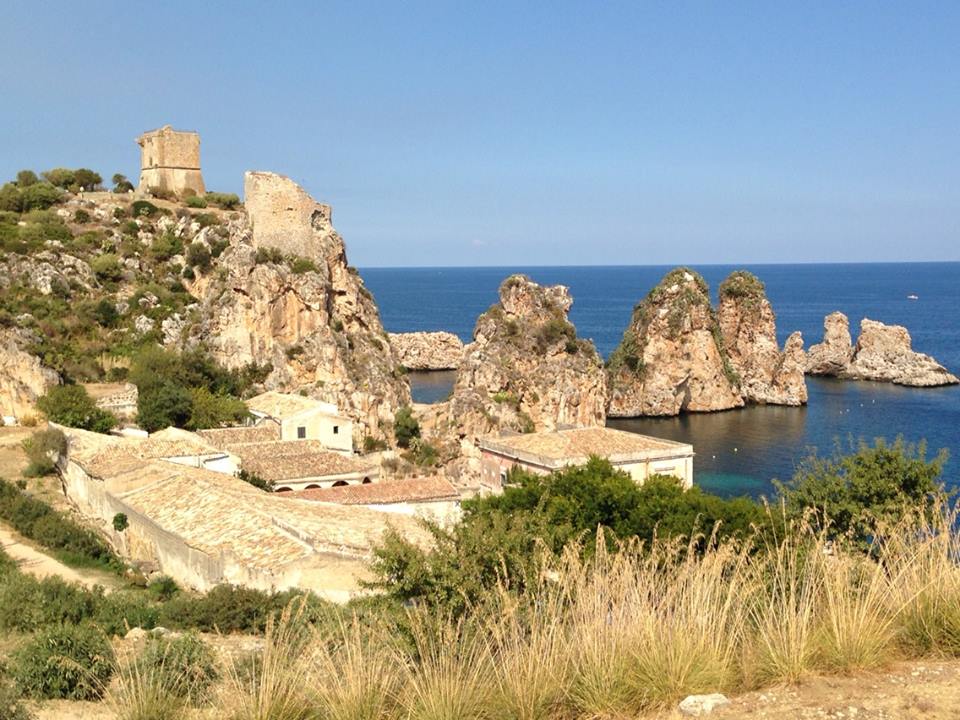
We usually stay on the outskirts of Scopello, a small fishing village that is now a quiet, secluded haven for tourists. On this trip, we rented a villa halfway up a mountain on the edge of Zingaro Nature Reserve. Once the home of a tonnara (tuna factory), in years past Scopello celebrated the mattanza, the ritualized killing of bluefin tuna, every May and June. The mattanza was first practiced by the Arabs, or perhaps the Carthaginians before them.  The custom died out in the 1980s when industrial over-fishing made it obsolete.


Former tuna factory in Scopello
Scopello’s former tonnara, converted to tourist apartments


Theresa’s book is a love letter and an elegy to the mattanza and the people whose lives were intimately bound to it. During one of the last years of the mattanza, Theresa befriended the fishermen (tonnatori) on the island of Favignana and accompanied them on their boats as they watched and waited for the tuna to become trapped in their underwater chambers of ropes and nets. When several hundred tuna had been captured, the tonnaroti lured them from one chamber to the next, while chanting thanks and prayers to God, the Virgin Mary, the saints.

The bluefins’ final destination: the chamber of death.

“After a while huge black shapes rose up into the backlit square. Their slow rising was mystical, like a birth. They rose higher. Dorsal fins swirled, wild animals drawn up from a silent abyss.

They were giants, eight feet long, some bigger, and there were hundreds of them. The net was drawn taut and they skittered in front of us, half out of the water. I looked into their glassy black eyes. The fish were as big as men, some bigger than four men. When their tails slapped the water it rose in columns above our heads. I remember the din, the thunder of falling water, and their frantic thrashing. They darted to the corners of the net, but there was no way out.

The crowd went wild. People were soaked, screaming and cheering….The fish were churning the sea into a white froth, and then the froth turned pink.”

Rusted anchors
Tonnara anchors


At one time, these hand-made tuna traps were in Spain, France, Algeria, Tunisia, Turkey, Dalmatia and Corsica, as well as Italy; some sixty tonnaras dotted the Sicilian coast.

“Gone, all gone,” writes Theresa.

The old tonnara in Scopello is beautiful, but I didn’t like seeing it in the hands of tourists. In their heyday, the tonnaras employed, directly or indirectly, thousands of men and women; some even had child care centers on site. Theresa writes with great sadness of the tonnaroti who netted fewer and fewer tuna each year until they had to stop.

I don’t like a world where men and women who love working on or near the sea, who make their living by physical labor, can no longer do so because it is not profitable. I’ve never seen a mighty bluefin tuna, but I’d prefer to have our seas teeming with them.

Theresa Maggio is a compassionate and keenly intelligent traveler. Her passion for discerning the heart and soul of a people and a place will enrich your own explorations.

Scopello sunset
Scopello sunset

Sunset photo by A. Hallinan.


Cleveland was my home but I lost it

Go down and tell them what you’ve seen:

that the river burned and was not consumed.

“River on Fire” by David Lucas in Rust Belt Chic: The Cleveland Anthology

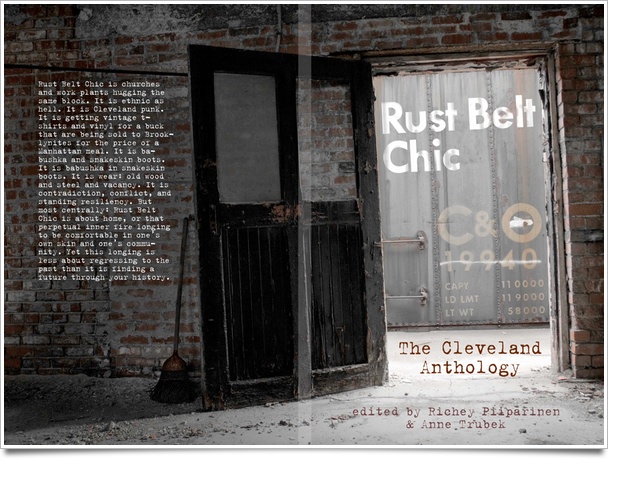
Rust Belt Chic cover photoI’ve been writing about the town where I grew up, how you can’t go home again and all that, and about my fraught relationship with Cleveland. This kind of ambivalence permeates Rust Belt Chic: The Cleveland Anthology, (published by the editors of the online magazine Belt) which I’ve been reading in between novels and book-length nonfiction. But all is not bleak – the collection includes a good share of essays by writers who unabashedly love Cleveland. The writing is excellent, the social commentary and history fascinating.

My childhood home just outside of Cleveland shared a driveway with our floral shop, where the locals bought their wedding and funeral flowers, Easter corsages and prom nosegays. We earned a good living in that small shop.

Those were prosperous times. I remember boarding a passenger ship docked on the dowtown shores of Lake Erie with my mother, some time in the late 1950s. We were going to visit my aunt, who lived in Michigan on the Detroit River, across from a mighty steel mill. This was no mere ferry we travelled on, but a big old steel ship; my memory of this seems outlandish to me now but, based on my cursory research, I presume we travelled on the SS Aquarama, a World War II troop carrier that was converted to a passenger ship after the war.

I loved going to my aunt’s house, where barges as big as factories floated past the backyard every day. Back then, Detroit and Cleveland were first-tier cities.

Today, Detroit is ranked first in the United States for poverty, and Cleveland is second.

As an adult, I moved to New York City, but eventually I settled and raised a family in another Rust Belt city on a lake (probably no coincidence). In Rochester, New York I worked for Kodak, for a time, but now the company is a shell of its former self. Rochester is ranked third in the US for poverty.

In 2008, my Ohio hometown was the epicenter of the mortgage crisis and still has not recovered. It has essentially become an extension of the blight that is East Cleveland. Homes have sold for as little as $1000 there. Other houses have been abandoned and stripped of their copper plumbing and aluminum siding. Many have been demolished.

Sometimes, I think about what it would be like to move back to Cleveland. I could host a book club for schoolchildren in the old flower shop. It would be a safe haven from the drugs in the vacant lot next door, the guns, the crime. We’d read poetry by Mary Oliver, who is from my hometown, and the novels of Toni Morrison, who is from Lorain. I’d give each child a book to take home.

But, of course, my life has long been elsewhere and I won’t move back. You can’t go home again and, besides, our house and the shop are (finally) about to be sold (fingers crossed).

Both optimists and pessimists write about Cleveland in this Rust Belt Chic anthology. (Rust Belt Chic anthologies of Detroit and Cincinnati have been published as well. Additional volumes are in the planning stages.) When it comes down to it, I’m essentially an optimist, because I don’t think things can get much worse, and I see a commitment to community and volunteerism among young people who choose to stay or settle in Rust Belt cities.

But I’m sad and bitter, too, when I think about what my childhood home has become. I feel shame, too, but I don’t mean I’m ashamed of where I’m from. I’m proud to be from Cleveland. Rather, I feel shame in the sense that we could have and should have done better in terms of taking care of our communities and each other.

What is the Rust Belt, and Rust Belt Chic? From the Cleveland Anthology

“What I’ve figured out, though, is that maybe I didn’t want baseball – I wanted Cleveland. I wanted to walk from the stadium past Tower City to my dad’s office parking lot at 11:34 pm after a Tribe game on a hot August night….ecstatic crowd walking outside the Gund, of guys in black sneakers and ladies with bra straps exposed and tans darker than the Cuyahoga in December….” Norene Malone

“I want to laugh when I hear that people are moving to Cleveland to practice their art. Then I want to spit in their faces….The first sign of the coming apocalypse is the art walk: the Typhoid Marys of gentrification. Developers show up, displaying all the sensitive charm of a multinational corporation….

All that beautiful decay, they seemed to say. Look at how wonderful this place used to be. Look how terrible it all was.”   Eric Anderson

“I was in love with Little Italy the moment I laid eyes on it, and still am, though it’s a long-distance thing now, with me pining away from the East Coast.”   Clare Malone

“But as Iraq fell apart on sectarian lines, Cleveland’s little Iraq fused closer together. I wasn’t authentic enough to intuit from last names and cities of origin which of our friends were Sunni and which were Shia, and for our purposes, the distinction was irrelevant.”   Huda Al-Marashi

“I have never, ever, met any single person of color with any great passion for this city.”   Jimi Izrael

“Rust Belt Chic is the opposite of Creative Class Chic. The latter [is] the globalization of hip and cool. Wondering how Pittsburgh can be more like Austin is an absurd enterprise and, ultimately, counterproductive. I want to visit the Cleveland of Harvey Pekar, not the Miami of LeBron James.”     Jim Russell

“The lips are gone. For years, they floated on an abutment at the base of the Detroit-Superior bridge in the Flats: a big pair of shiny red-enamel lips framing a mouthful of teeth….The lips first appeared sometime in the late 1970s, covering up an obscene tag someone had scrawled on the wall with an aerosol paint can. Below the lips was an equally mysterious signature announcing that this graffiti was the work of some so-called “Regional Art Terrorists.”    David C. Barnett

“Decades ago, Pekar’s work was already refuting the idea of the Rust Belt as a non-culture. Like today’s Rust Belt artists, he was fascinated by the city’s ethnic heritage, fluent in the history recorded in their grand architecture, obsessed with a sense of loss and ruin. But there’s one very important difference between him and his enthusiastic Rust Belt chic successors: Pekar’s view of Cleveland and the Rust Belt was almost entirely devoid of optimism.”  Erick Trickey

Mother and daughter in front of flower shop
Our flower shop, opening day


Note: The title for this post was inspired by a photograph on NewGeography.com.

Quilt

“Hello Mommie. We made it to AMERICA!!!!”

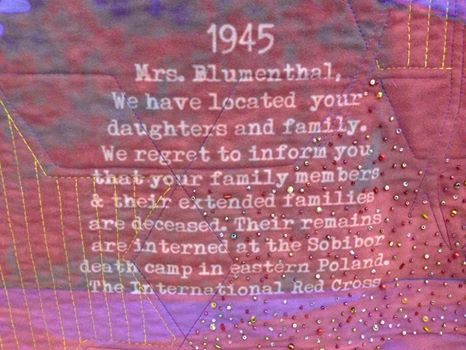
I didn’t read a book this week, I read a quilt.

Our community center hosted a quilt show last weekend, where we saw a quilt that tells one Rochester family’s story. It is well worth reading.

Created by Julie S. Brandon as a tribute to her great grandmother, Estera Blumenthal, A Cruel Twist of Fate won “Best Interpretation of a Theme” in the 2012 Mid-Atlantic Quilt Fest and 2nd prize in the 2011 Wall Hanging Diamond Jubilee Quilt Fest in Rochester.

(Photo #2 may be more legible. If you have a View function on your computer, select Zoom In. The conclusion is in Photo #3.)

Quilt with writing and photo
A Cruel Twist of Fate, by Julie S. Brandon


Excerpts from family letters
See the conclusion below.

Telegram

Life After Life

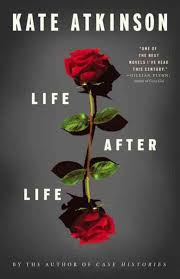
Life After Life book cover

The first time Ursula Todd is born, on a snowy winter night in England, 1910, she dies before she makes it out of the birth canal. Then the story starts over and Ursula is born again, only to die a few years later when she falls off a roof. She’s born yet again and subsequently dies in childhood from the Spanish flu.

Ursula is born over and over again, and along the way she makes different choices that prolong her life and send her down alternate paths. Ultimately, she and the reader arrive at World War II, which is at the heart of this novel, and a new round of opportunities for Ursula to live or die.

Once I got the hang of this unusual plot device, I became entranced with Kate Atkinson’s Life After Life. Judging from the reviews I’ve read, readers either love or hate that Ursula has multiple lives and multiple deaths. In moments of deja vu, Ursula senses death is just around the corner and, somehow, she must do something different in order to stay alive.

There is a short opening scene in Life After Life that occurs before Ursula’s birth that is completely mystifying until many pages into the book, when you begin to understand Ursula’s lives could eventually lead to something big, to her being in the right place at the right time to prevent great suffering.

As each death opens the door to a new life, Ursula begins to discover a moral purpose for her existence, one that requires great courage and sacrifice. In a sense, she lives each life more perfectly than the one before it.

We see, for example, that who you marry can make a difference in who you ultimately become, and it can change the course of your life entirely.

I’m partial to fiction about World War II, and through Ursula’s many lives I saw her experience the war from different vantage points, all riveting and poignant. She has many second chances – wouldn’t we all like to have second chances?

Watching Ursula inspired me to think about how I want to live my life. It made me want to make more courageous choices and not worry so much about the outcome.

This is one book that will stay with me. I look forward to reading more of Kate’s fiction.

Have you read any of Kate Atkinson’s novels? Which ones, and what did you think?

On the sixth day of Christmas: Letters of Note

Cardinal

Letters of Note is, in the words of its editor, Shaun Usher, “an attempt to gather and sort fascinating letters, postcards, telegrams, faxes, and memos.”

They are the extraordinary words of real people. Here are a few of my favorites:

Our Frank

The Outsiders

We were not found wanting

I am very real

Everything comes to an end

There is a Letters of Note book, too!

Northern Cardinal photo by Putneypics under CC By-NC 2.0

On the fourth day of Christmas: Ephemeral New York

Christmas tree

You could spend hours browsing the photos and traveling back in time at Ephemeral New York.

The photo above is from “Which city park hosted the first Christmas tree?”  New York City during the holidays is transcendent, no matter what the century.

Years ago, I jogged past Carl Shurtz Park every day, but I never knew Peter Pan lived there.

Nine Barrow Street in Greenwich Village bears a version of my husband’s family name, in honor of an inventive Irish blacksmith. I found that out when I read, “A village monument to a 19th century blacksmith.”

There are 75 posts about out-of-date guidebooks.

And 45 posts about defunct department stores.

Many a bittersweet tale, as well:  “The Tragedy of the Loveliest Woman in America” and “Notes Pinned to Babies at the Foundling Asylum.”

You could write a book about each and every post at Ephemeral New York.

Photo: Bain News Service