Today’s selection is not a blog, but an artist’s website, quite simply, one of the most unusual and stunning I’ve ever seen. Viewing Michael Cherney’s photographic Asian scrolls is like taking a journey to a secret, faraway place. See, for example, Five Peaks. Enjoy.
Los Rodriguez Life always makes me happy when I visit. Bilingual, so I can practice reading Spanish, and it feels like a grand celebration of family and being alive. There’s gardening,food, travel, photography, music and lots of personality.
I think you’ll enjoy “Fly On.” (Scroll down to the music video.) I love fiddle music.
Strayed’s memoir has turned out to be not just a bestseller, but a transformational story that has given many women the courage to take enormous risks.
The other day I was reading an essay by Barry Lopez, “Landscape and Narrative.” He tells of visiting a small village in the Brooks Range of Alaska and listening to stories about animals and hunting. He says:
“The stories had renewed in me a sense of the purpose of my life. This feeling, an inexplicable renewal of enthusiasm after storytelling, is familiar to many people. It does not seem to matter greatly what the subject is, as long as the context is intimate and the story is told for its own sake.”
Cheryl Strayed’s Wild has that kind of magic.
This summer Heather Anderson broke a record by backpacking the length of the Pacific Coast Trail, alone and without support, in 61 days. It’s good to see women taking risks and feeling more at home in the world.
“Keep close to nature’s heart…and break clear away, once in a while, and climb a mountain or spend a week in the woods. Wash your spirit clean.” John Muir
Lopez quote: “Landscape and Narrative” in Crossing Open Ground by Barry Lopez, Vintage Books, 1989.
Traveling in Oregon’s Hood River Valley, we’ve had marionberry syrup on pancakes at the B & B we’re staying at and huckleberry smoothies at an arts & crafts fair. Peaches, apricots, pears, cherries, strawberries, blueberries and grapes also grow in this land of orchards, vineyards, and farm stands.
I just finished Amanda Coplin’s The Orchardist, set in early 20th century Washington, where an orchardist takes in two pregnant, runaway teenagers. Amanda’s prose is as lush and beautiful as the land she writes about. The Orchardistis one of the best novels I’ve read in a long time. Amanda is a major new talent, and she’s young, so we can look forward to more of her books.
We stopped at The Old Trunk Antiques , which has an excellent collection of used and older books. I found a rare edition of Pearl S. Buck’sThe Good Earththat had a book jacket with promotional photos from the 1937 movie. (See a previous post on The Good Earth.)
That was too expensive for me, but I bought Buck’s, Peony,a novel I’m unlikely to encounter in my everyday book browsing.The Old Trunk proprietors are gracious and very knowledgeable about the history of the Hood River area.
Before we head to our family reunion in Cannon Beach, Oregon, we’ve been exploring the high desert east of the Cascades. Of course, I had to find a book indigenous to this place, so I settled on Sarahlee Lawrence’s memoir, River House.
Sarahlee is a kind of modern-day superwoman: an expert river runner who navigated the most dangerous rivers in South America and Africa by the time she was 21, a rancher who built from scratch her own log cabin with the help of her father, and a talented young writer who gives us an honest, unromantic vision of what it is like to live off the land here.
After her almost unbelievably dangerous river adventures, Sarahlee decided to return to the ranch where she grew up with her parents and grandparents, to reconnect to the land and build her own log cabin.
River Housechronicles the building of the cabin, Sarahlee’s struggle to reconcile her love of river running with the land-locked life of the ranch, and her fraught relationship with her father, a former surfer (riding wild water is in their blood) who has ranched for thirty years and is worn out by the land and the unrelenting physical labor.
If you want to steep yourself in the physical terrain and culture of central Oregon’s high desert, if you want a vicarious taste of backbreaking labor as told by a young woman with a strong spiritual connection to the land, River House is the book for you.
If your aim is to build a luxury McMansion with all the creature comforts and a picture window view of Three Sisters, this memoir will probably make you uncomfortable.
I found River House to be a great read. As we drove around the hot, dry land and hiked in the stunning forests along the ice-cold Metolius River and around the secluded Suttle Lake, I was very conscious of being a tourist, a stranger in this unusual place.
There is a vast divide between those of us who live a sedentary life behind computer screens and plugged into social media and those who work the land every single day of the year.
MEMOIRS OF LAND AND PLACE
River House, Sarahlee Lawrence
Dakota: A Spiritual Geography, Kathleen Norris
A Country Year, Sue Hubbell
Cross Creek, Marjorie Kinnan Rawlings
My First Summer in the Sierra, John Muir
Under the Tuscan Sun, Frances Mayes
Sunday morning, Chapel in the Pines, Camp ShermanQuilting is a fine art and craft here.A day after we saw this sign, it was 99 degrees and the fire precaution was upgraded to Extreme.Ponderosa pine
I wished I had died before I ever loved anyone but her. Ernest Hemingway, A Moveable Feast
I was prepared not to like The Paris Wife,Paula McLain’s novel about Ernest Hemingway’s first of four marriages, to Hadley Richardson, written from Hadley’s point of view. Generally, I don’t like novelized versions of real people’s lives. The author has to work doubly hard for me to wholeheartedly enter her fictional world, because I can’t forget we’re seeing actual events filtered through her idiosyncratic speculations, which could be way off base.
I read The Paris Wife back-to-back with Hemingway’s The Sun Also Rises(which I read years ago) because I thought it would be interesting to see portrayed, in The Paris Wife, the “real” people who were models for Hemingway’s characters in The Sun Also Rises. (I hope you can follow this.) These two books I read while spending a few days in Key West with my family and visiting Hemingway’s former home, now a museum.
I found The Sun Also Risesjust as tedious as when I read it as a baffled teenager. Aimless, self-absorbed people endlessly drinking in European bars and cafes, and then they go to a bullfight. I half-wished Hemingway would kill off the insufferable former war-time nurse, Lady Brett Ashley, but I knew better. I had to laugh when a note left by a previous reader fluttered out from between the pages of my library book: “Brett is a low-class whore.”
But this time, I tried to understand who these people were: the post World War I Lost Generation, stunned and alienated after the bloodiest war in history, surrounded by stratospheric, dissipated wealth alongside abject poverty. Despite my initial reservations, The Paris Wife was a good read and helped me see Hemingway and his first novel in a new light. Hemingway (and Jake Barnes, Hemingway’s alter ego in The Sun Also Rises) almost certainly had what we’d call today post-traumatic stress disorder. I hadn’t realized Hemingway was only 18 (about my son’s age) when he served as an ambulance driver in the war, saw horrific battles, and was seriously wounded. He then fell in love with a nurse a few years older than he (Catherine was her incarnation in A Farewell to Arms) who called off their marriage after she fell in love with an Italian officer.
This was Hemingway’s state of mind at 21 when he met Hadley, who was 28. I don’t mean to suggest his early adult experiences explain everything about Hemingway, because personalities and destinies are more complex than that. But Paula McLain is an excellent storyteller, and I trust her when she portrays a couple who were so right for each other at the time in their lives when they met, and then so wrong for each other a few years later, when both needed to move on.
(By the way, Paula lives in Cleveland, my hometown, and she wrote much of this book in a Starbucks there. Paula has also written a memoir about growing up in foster homes, Like Family: Growing Up in Other People’s Houses, which I look forward to reading.)
Here are some of my thoughts and impressions:
The Paris Wife didn’t fare well with many critics, but it is a bestseller. I think the more of a literary scholar and purist you are, the pickier you’ll be about how accurately McLain portrays motivations and personalities, how authentically and gracefully she finesses the dialog, and other matters. What I loved about her book was how richly she recreated the unconventional life led by an artistic, adventure-loving couple living in strange, unsettling times.
I appreciate the dynamic of the Hemingway-Hadley relationship McLain depicts. How the strong, self-effacing (and some would say stodgy and boring) Hadley appreciated, nurtured, and was subservient to the great artistic personality. But it wasn’t all one way. As Hadley wrote much later, Hemingway entered her life like an explosion and liberated her from what could have been a circumscribed, unrealized life. For a time, there was deep, genuine love between the two, and even though the marriage broke up, the trajectory of Hadley’s life was forever altered.
Marriages that end the way the first Hemingway marriage did are never pretty, but I think the ending of this marriage was especially nasty and torturous for Hadley. Pauline Pfeiffer, Vogue writer and wife #2, literally made my skin crawl. At the end of his life, Hemingway wrote an apology to Hadley, which he included in A Moveable Feast,a memoir in which he lovingly recalls his early years with Hadley. There has been more than one edition of A Moveable Feast, and I find it amusing that the edition published by one of the descendents of the Hemingway-Pfeiffer children removed the apology.
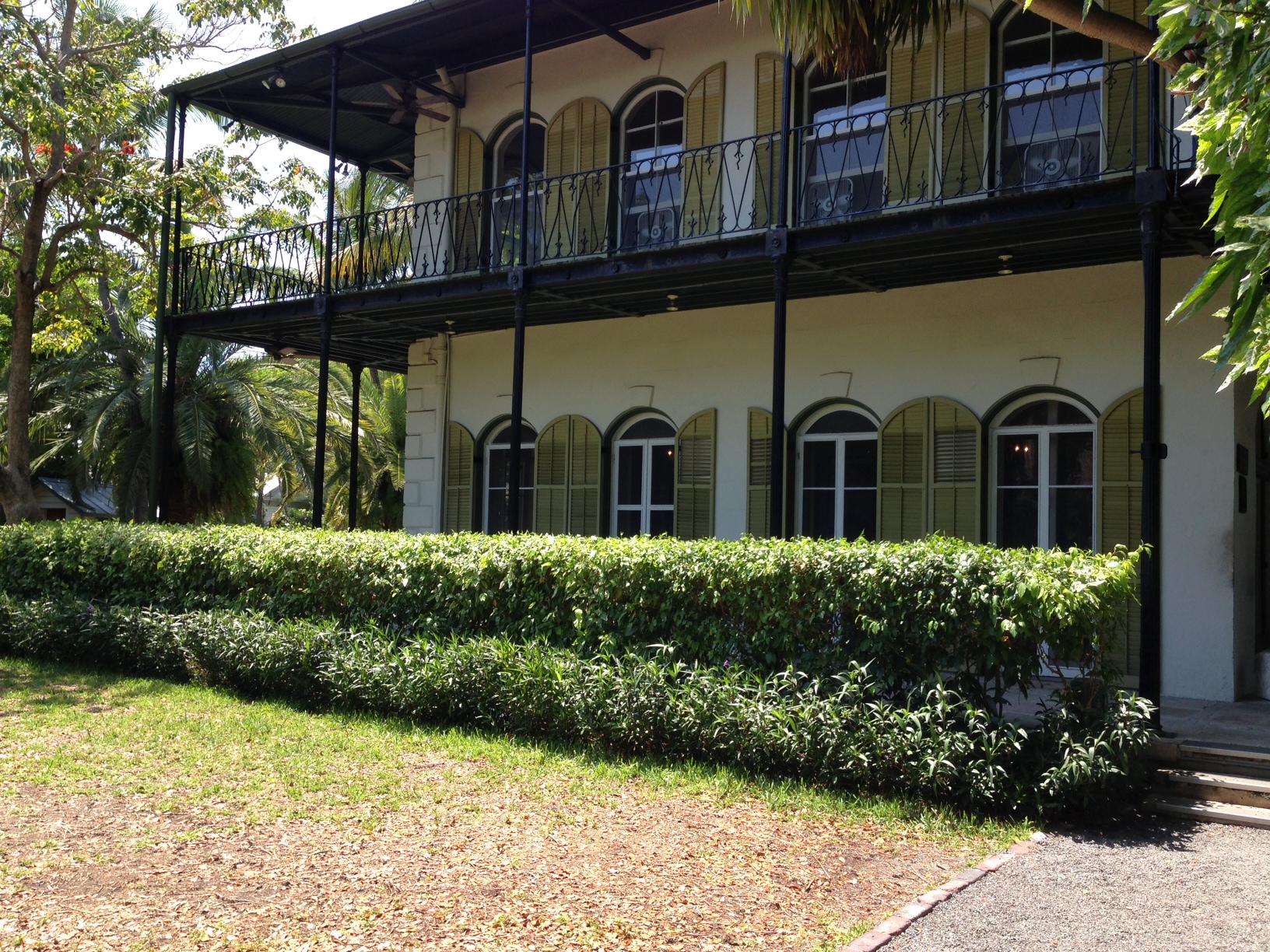
Ernest Hemingway’s Key West home
After Hemingway married Pauline, they moved to Key West. Visiting their former Spanish colonial home, I loved the wraparound balcony on the second floor and the tall, shuttered windows that let in the sea breezes, but there was an air of sadness and neglect about the place.
After his marriage to Pauline ended, Hemingway moved to Cuba, where he married journalist Martha Gellhorn. That marriage ended, too, and he spent his last years married to Mary Welsh in Idaho.
When my husband and son went snorkeling off the coast of Key West, their guide pointed out four posts several miles out. At one time, Hemingway’s “stilt” house, or fishing shack, sat atop these posts, where he’d spend days in solitude, writing. The writing life, Hemingway once wrote, is a lonely life.
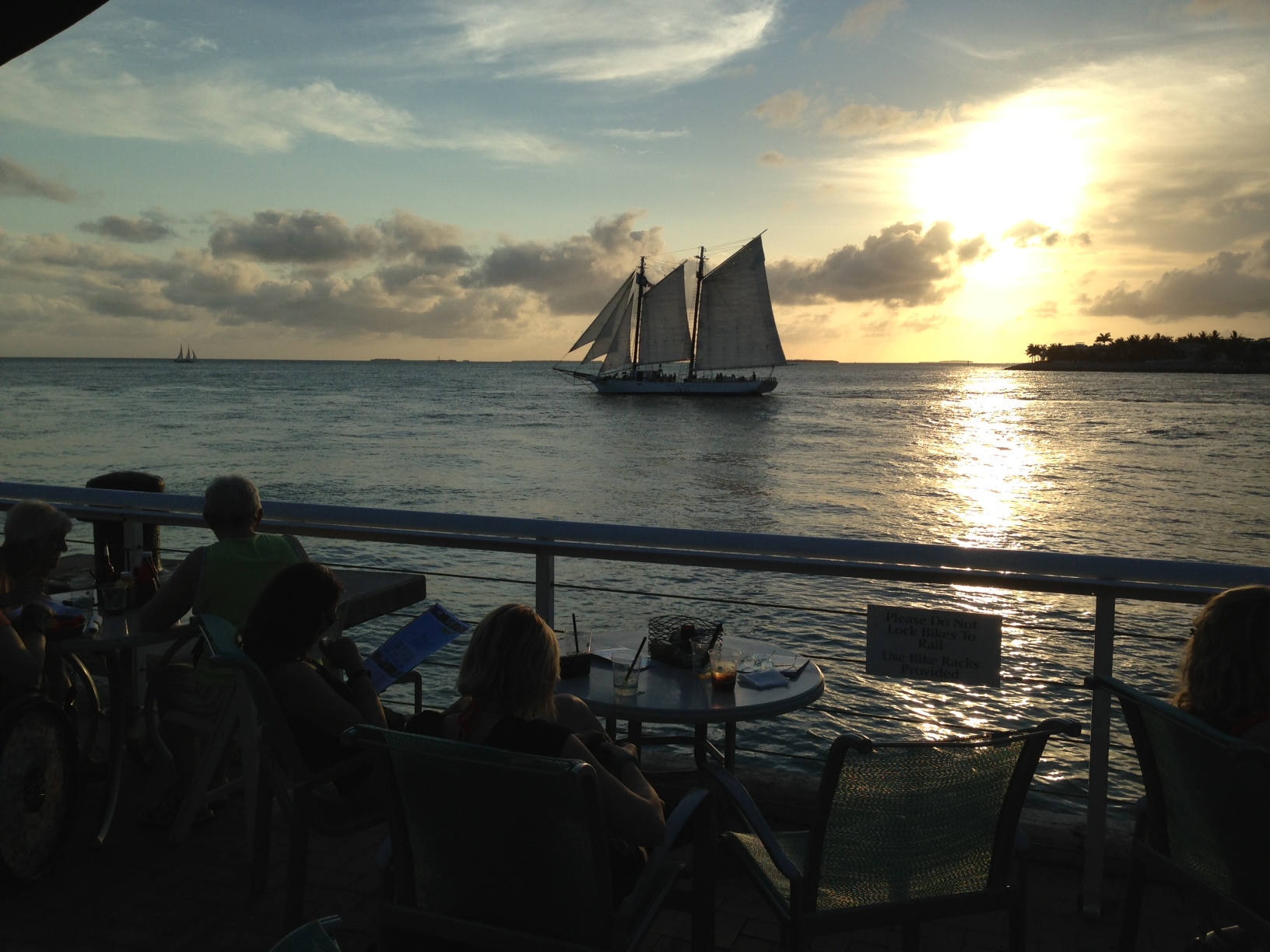
Key West sunset
If you’ve read The Paris Wife and want to comment, or if you have thoughts about Ernest Hemingway, please add them to the comments below.
Stories…offer patterns of sound and association, of event and image. Suspended as listeners and readers in these patterns, we might reimagine our lives…As long as it took for me to see that a writer’s voice had to grow out of his own knowledge and desire, that it could not rise legitimately out of the privilege of race or gender or social rank, so did it take time to grasp the depth of cruelty inflicted upon all of us the moment voices are silenced, when for prejudicial reasons people are told their stories are not valuable, not useful. Barry Lopez
In the introduction to his essay collection About This Life: Journeys on the Threshold of Memory, Barry Lopez tells of meeting a man on a plane who asked what words of advice he could pass on to his teen-age daughter, who wanted to be a writer. This is what Lopez said:
She must read, and her choices should be whatever she is drawn to.
She should read the classics, too, but she’ll have to work harder to find stories of heroism, love, and our noblest values that are written by women.
Second, she must “become someone” and “speak to us from within those beliefs.”
Third, he advised that she “separate herself from the familiar.” After exploring other places and meeting a diversity of people, she`ll know why she loves the familiar and share this knowledge through her writing.
Early on, Lopez felt he was noticed, accepted, and rewarded as a writer in part because he was white, male, privileged and well educated. If you read his work, you’ll find he is keenly sensitive to the fact that many voices haven’t been heard because they are different or not within traditional circles of power. He thrives on traveling to the far corners of the earth and seeking these people out – artists, artisans, farmers, naturalists, explorers who live close to the land, indigenous peoples, and others.
I was mesmerized by an essay in About This Life, “Effleurage: The Stroke of Fire.” An Oregon potter and builder of a unique anagama kiln invites clay artists from around the world to fire their work. Jack doesn’t care about marketing or commercial success; he’s totally immersed in the process of making pottery out of materials from nature. Every three or four months, up to twenty artists bring their work to be fired in the Dragon Kiln. Families, friends, even pets tag along. The firing goes around the clock for several days. Building the tremendous fire that heats the kiln is an art in and of itself. Different kinds of wood – black locust, maple, cherry, Lombardy poplar, red cedar – make different kinds of fires, and keeping the fire properly stoked is a community effort of like-minded artists who put aside their egos for the benefit of the group.
Lopez says you must become someone to write. I think he would agree the kiln designer and the clay artists are “becoming” through their life’s work, just as their clay pieces are forged in the fire. It’s a process that never ends. Even the clay pot continues to change, subtly, after the firing.
Over and over, Lopez celebrates journeys into the unknown, strangers who become friends, coming home again, and the writing of the story. You see this in About This Life and in his fable, Crow and Weasel.
Recently, Lopez published a revelatory personal essay that has received a lot of attention, “Sliver of Sky,” in Harper’s Magazine, about a period of sexual abuse he endured as a child. That Lopez waited until his seventies to write about this suggests how deeply confounding and wounding it was. The trauma and years of silence may explain in part Lopez’s empathy and compassion for others who were silenced for one reason or another. And no doubt it has contributed to his sense of mission as a writer.
I’ve written about years of being silent and feeling silenced by others because of my mother’s mental illness. I think that is partly why I didn’t make the commitment to becoming a writer when I was younger. How can you mature as a human being and as a writer when you can’t work with the very material that is woven into your identity?
If we’re silenced, we’re blocked. We don’t become our fullest selves. Diminished in what we are able to offer the world, the world will be diminished, too. It is in our bests interests to see that no one among us is silenced.
So I find reading Lopez to be a rare and important form of encouragement.
In an interview with Bill Moyers, Lopez says he’s viewed as a nature writer but, actually, he is writing about humanity.
“Every story is an act of trust between a writer and a reader; each story, in the end, is social. Whatever a writer sets down can harm or help the community of which he or she is a part.”
Quotes from: About This Life: Journeys on the Threshold of Memory, Barry Lopez, Vintage Books, New York: 1998.
The role of the artist, in part, is to develop the conversations, the stories, the drawings, the films, the music—the expressions of awe and wonder and mystery—that remind us, especially in our worst times, of what is still possible, of what we haven’t yet imagined. Barry Lopez
If you want to be an armchair traveler of the world, if you love nature, if you crave being transported to another time and place by extraordinary writing, you must read Barry Lopez. Arctic Dreams has some of the most dazzling and poetic passages about the natural world you’ll ever encounter.
“The aurora borealis, pale gossamer curtains of light.”
“The mother-of-pearl iridescence of the sun’s or moon’s corona in clouds.”
“The outcry of birds, the bullet-whirr of their passing wings, the splashing of water, is, like the falling light, unending.”
You will find uncommon truths, beautifully expressed. Here is Lopez on the great Arctic explorers of the past: “The day after a little trouble in the ice it is possible to imagine, if but imperfectly, the sort of reach some of these men made into the unknown, day after day.”
“I think we can hardly reconstruct the terror of it, the single-minded belief in something beyond the self.”
“Inescapable hardship transcended by a desire of spiritual elevation, or the desire to understand, to comprehend what lay in darkness.”
“What dreams there must have been that were never written down….that remained in the heart. The kind of dreams that give a whole life its bearing, what a person intends it should be, having seen those coasts.”
If you want to write, how can you move closer to this kind of mastery of language?
Webster’s New International Dictionary, 2nd ed., unabridged, 1944
When I was reading Lopez, I happened to make a happy discovery in my writing bible, Priscilla Long’s The Writer’s Portable Mentor: Lexicon Practice. Lexicon Practice involves looking up words you don`t know and words you want to know better, not in in a pocket dictionary or online, but in a mammoth 600,000-word dictionary, the kind you still see in some libraries. (Long advises writers to search online for such a dictionary, commonly published in the 1930s, 40s, and 50s. They aren’t cheap, but they are a wise investment.) You copy all of the definitions of a word in a notebook. These old dictionaries have detailed diagrams and illustrations, and occasionally I copy them as well.
I write down the word in its language of origin, too. If it has a Latin, Italian or Spanish root, I can brush up on my foreign language vocabulary. Long instructs you to also write out the sentence where you found the word and make up a sentence of your own, preferably a sentence you can use in a piece of writing you’re working on. You can choose a lexicon theme based on the work you are doing at the moment. Since I’m writing a memoir, for example, I have a lexicon with words commonly used in the 1960s – products, types of clothing, etc.
Long believes in Lexicon Practice. Otherwise, our writing derives from the uninspired language of generic, overused words and phrases we find in newspapers, magazines, advertising, and social media. As a teacher of writing, Long can tell immediately when a writer does not do a form of Lexicon Practice. She mentions Lopez as the kind of master writer we can emulate. He uses words with Old English and Old German roots, she says, and “…he favors concrete words…that can be seen, smelled, touched, tasted, or heard. For Lopez, language is a musical instrument…”
Now, Lexicon Practice is a geeky, writerly thing, but it appeals to me. I can certainly stand to expand my vocabulary, and I find it an especially relaxing pastime in front of a fire on a cold winter`s night. This kind of practice slows you down, teaches you to choose words with care. If you want to write rich, compelling fiction or nonfiction, you need to be in love with words in this way, or allow yourself to fall in love with them by doing work of this nature.
Culling words from Arctic Dreams was an inspiring way to for me to establish the habit of Lexicon Work. A variety of birds populate the first pages of my first lexicon: plover, whimbrel, curlew. There are many boats and nautical references: pinnace, tender, portolano chart. Geographical terms, too: archipelago, scree, promontory. (As I write this, my word processor does not recognize a few of these uncommon words and highlights them as misspellings.)
Long advises writers to compose word lists, too. Her examples: every possible synonym for blue (sapphire, smalt, cobalt, woad) and all the parts of a fiddle (peg box, side rib, bridge, button). You can work according to a theme. Chairs and chair parts. Types of roofs. Clothes for people who love the outdoors. Get an L.L. Bean catalog and find words like cargo pants, fleece, sun-washed, twill, seersucker, Mary Janes, wellies.
I found that keeping a lexicon is a good excuse to buy one of those expensive, fancy journals I love. Mine has a silvered filigree cover designed in Germany around 1800.
Currently, I’m gathering words from About This Life.
In my next post, more about Lopez and his themes. In the meantime, if you want to be uplifted, if you need encouragement in your life’s work, listen to a few minutes of this conversation between Barry Lopez and Bill Moyers.
Have you discovered any unusual words lately that you especially like? Leave them in the comments in my left sidebar.
This is the memory of the landscape. That landscape is gone. It may never be seen again in the history of civilization. James Balog
He is a master photographer, an obsessed and possessed artist documenting our dying glaciers.
We sat with a packed audience Tuesday evening at The Little Theatre in Rochester watching Chasing Ice, a documentary about James Balog’s quest, which has become the quest of many others. After the movie, producer/director Jeff Orlowski (thoughtful, intelligent, thoroughly engaging) spoke with the audience via Skype.
Your first stop should be here, to listen to and watch this perfect marriage of music, image and theme: Scarlett Johansson singing “Before My Time” to a montage of Balog’s magnificent work.
Chasing Ice is playing in selected cities around the country. You can request to host a screening by filling out a form on the Chasing Ice site. Let’s hope that it will be available on Netflix and other venues soon.
While you’re waiting for the documentary, visit the Extreme Ice Survey (art meets science) to see the official trailer, and then stop by the Earth Vision Trust.
Balog has just published Ice: Portraits of Vanishing Glaciers. His other books include Tree: A New Vision of the American Forest; Wildlife Requiem; Anima; and Survivors: A New Vision of Endangered Wildlife.
The filmmakers dedicated Chasing Ice to their children and their children’s children.
At the moment I’m interested in nature, art, memoir, and fiction all rolled into one, so I’ll be featuring Barry Lopez (Arctic Dreams, Winter Count, About This Life, and “Sliver of Sky,” a recently published essay in Harper’sMagazine); The Voyage of the Narwhal by Andrea Barrett; and When Women Were Birds, by Terry Tempest Williams.
Remembering spring (just a few weeks ago) in the Jardín Japonés, Buenos Aires. All these wishes placed end to end would make a poem long enough to fill a book.







 Books Can Save A Life