Losing our newspapers is not a good thing

I visited my hometown of Cleveland, Ohio this weekend. On Sunday,  The Plain Dealer printed artist and critic Karen Sandstrom’s creative work ethic, “I Must Remember This.”

Enchanted, I happily discovered Karen and her blog, Pen in Hand, as well.

Even better, Karen succinctly and eloquently sang the praises of The Plain Dealer, daily newspapers, and printed newspapers.

I’m all for electronic media and the creative flourishing and publishing opportunities now open to more people.

But Karen reminds us not to forget our daily newspapers and their talented, hardworking staffs. They are doing important work.

Some daily newspapers have disappeared, with more to go, I’m sure.

Journalism is changing like everything else, but we still need unbiased investigative reporting, long-form news and analysis, depth and breadth of content, and media everyone is comfortable with. (I believe a significant number of readers still prefer their news in print, and have not found or would not know how to go about finding comparable news online).

Most important, we need engaged readers and citizens who care and understand what vibrant journalism means to a healthy democracy.

If we let our daily newspapers go, we damn well better make sure we know what we are doing.

Bay Village view of Lake Erie
Bay Village view of Lake Erie at sunset. To the east, the Cleveland skyline glittered and fireworks blossomed over Lakewood.

(Full disclosure: a member of my family works for The Plain Dealer.)

What do you think? Please comment!

Please excuse my language (Blame it on Dear Sugar)

Cheryl Strayed, author of the memoir Wild, is otherwise known as Sugar, the advice columnist for The Rumpus, an online culture and literary magazine.

Cheryl had been writing the column anonymously until this past Valentine’s Day, when she “came out” just as her newly published memoir was rising to the top of the bestseller list.

The Rumpus is a clever, intelligent magazine. I’m a bit too old for it, or it’s a bit young for me, so I’m not a regular reader, nor do I follow Cheryl’s advice column (which is not your ordinary, everyday kind of advice column). But somewhere along the line, I came across a piece of wisdom I liked that Cheryl gave to a struggling young writer who’d sent a letter to Dear Sugar.

This bit of wisdom went viral and the people over at The Rumpus decided to put it on a mug. I ordered the mug and it came in the mail yesterday.

I’ve read all kinds of books about creativity and writing to keep my own writing going and because I’m fascinated by the creative process. A couple of pages on this site are devoted to books about writing and creativity, and I’ll be featuring some of these on Books Can Save a Life as time goes by.

But sometimes just a short, pithy, to-the-point kick in the pants is all I need.

So I’ve got my new mug sitting on my writing desk, ready to be filled with coffee or tea on a moment’s notice.

Write like a m*****f***** mug

I would say this is Cheryl’s approach to writing, to walking, to life.

Wild is to be made into a movie starring Reese Witherspoon.

There is a fabulous interview with Cheryl over at Bookslut, but beware of spoilers. You may want to finish Wild first, before you read it.

Hey, is anyone reading Wild? If so, let us know what you think in the comments below.

I’m heading off to the land of Wild (the Pacific Northwest) later this week to attend a medical librarian conference with some of my colleagues (profoundly intelligent readers, all of them). Then some vacation time with family, where I’ll be reading other books with a Pacific Northwest theme, exploring Seattle (including The Elliott Bay Book Company), and the surrounding terrain. Watch for posts and pictures!

Try some book spine poetry: National Poetry Month

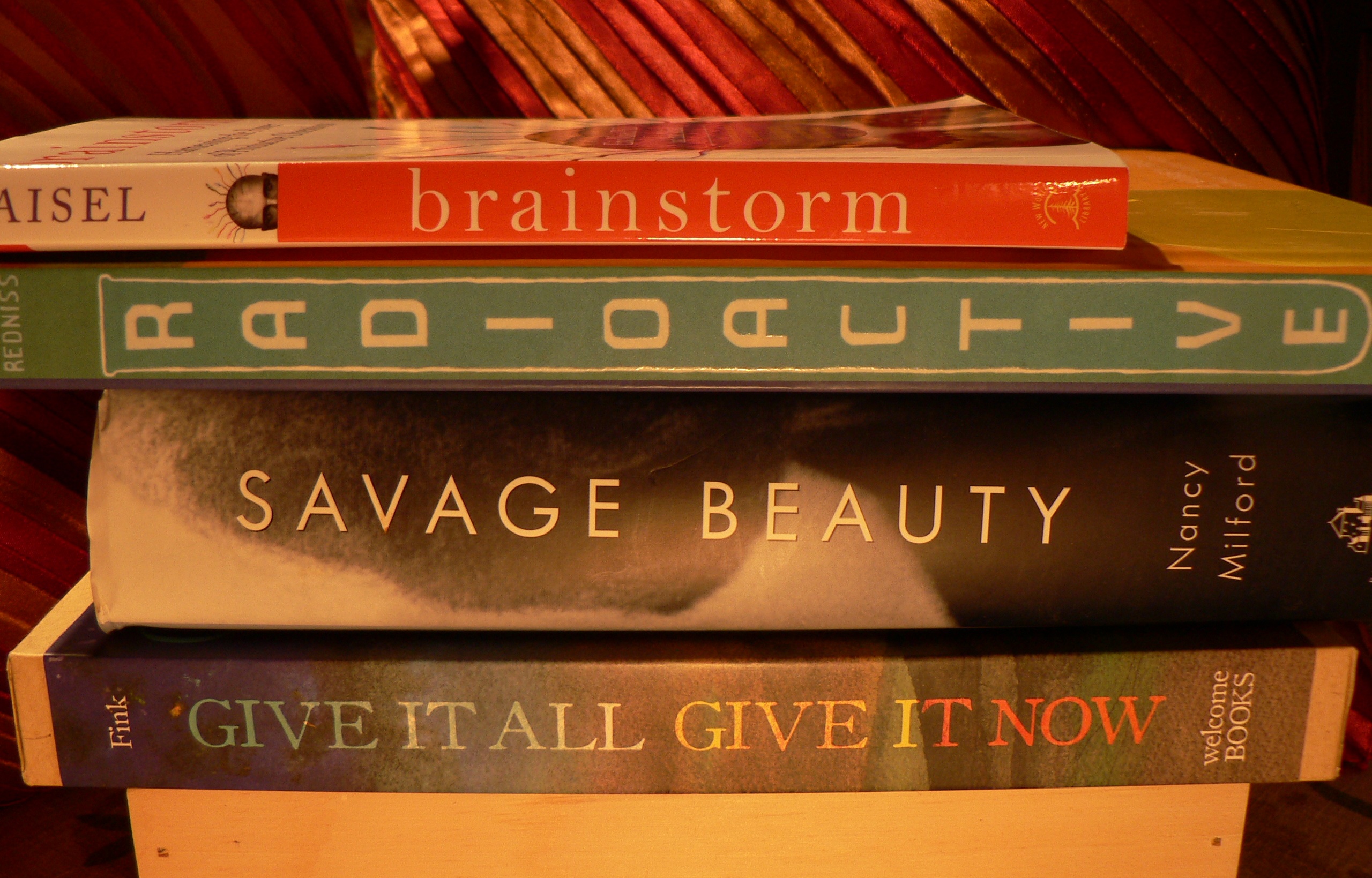
In celebration of National Poetry Month, here is my book spine poetry.

Try it. This small act of creation will bring you to a different place. Send me yours and I’ll post them.

the open road running with the mind of meditation falling off the map the writer's path

________________________________________________________

brainstorm radioactive savage beauty give it all give it now

What Steven Pressfield told me

I wanted to share author Steven Pressfield’s recent blog post, “Why I Don’t Speak,” the minute I read it on the “Writing Wednesdays” column of his website. He writes about why he doesn’t accept invitations to speak about his books on writing and creativity.

But my blog is for book lovers, I reminded myself, and he wrote “Why I Don’t Speak” primarily for writers and others involved in creative projects. (Though he would be the first to say creativity is any sustained effort to bring something to fruition, such as training for a marathon, overcoming an addiction, advocating for a social cause.)

He writes,

“In the secret communion between writer and reader, soul-altering material was gifted to me, and I accepted it with gratitude. No one knew. Not even the writer. But he or she had imparted something seminal, and it changed me and saved me.”

The italics are mine.

I think readers already know about the secret communion between writer and reader.

But what they may not know: Pressfield says the biggest challenge of any creative act, of giving the gift of soul-altering material, is overcoming resistance.

I have Pressfield’s book, Do the Work, on my “What I’m Reading” sidebar. I’ve been spending time with Do the Work along with his other book, The War of Art, as I look at my own writing process.

He has hard things to say about how insidious resistance can be. How we often blame our lack of progress, our inability to do the work, on some external obstacle when, really, we need to look inside ourselves.

I felt squirmy as I read certain passages. I didn’t like knowing these things about myself. And once I knew these uncomfortable truths, I then had to actually change.

Pressfield writes,

“I’m confessing some of the darkest hours and most shameful failures of my life. But more than that, I’m holding these moments up to the reader, who no doubt has experienced the same in her own life, as a means of confronting her and making her face her own shit. I don’t know how to do that in a public setting, and I wouldn’t want to try. It’s too private. It’s too personal.”

That’s why Pressfield doesn’t do speaking engagements.

Even though authors make pulling off that communion between writer and reader look easy, it’s not. The great, gifted writers confront the same resistance that is in all of us.

The next time you finish reading a book that possessed you or changed you; the next time you re-read a favorite, treasured work – know that the writer may have had to fight a great battle to bring her creation into the world.

She fought, and won.