Train Dreams

Mount Index
Mount Index

I first published this post in May, 2012, when we were staying in a remote cabin near the town of Index in Washington State’s Cascade Mountains. I was also reading the novella, Train Dreams, by Denis Johnson. I’m reposting it now because the gorgeous movie adaptation has just been released. (It is currently in theaters and on Netflix.)

Train Dreams is a beautifully filmed, meditative story about an early 20th century Idaho logger who travels to Washington and environs to work on crews that take down the largest trees in the forest. I promise you, the movie will sweep you away, completely and utterly, to another time and place. New York Magazine calls Train Dreams a staggering work of art, and they are right. The translation from book to film is flawless, and those of us who are avid readers know how special it is when the essence of a beloved book comes to life on the screen.

Here is my original post:

Just steps from our front door, the peaks of Mount Index are illuminated in great detail by the last rays of sun.

It’s spring and we’re in Washington’s Cascade Mountains. This is wild, intimidating territory. Rivers and creeks rage as snow melts in the mountains. Along the highway, as we made our way here, we passed by dozens of cascades of snowmelt tumbling down steep walls of rock on either side.

Our vacation cabin is perched on the banks of the Skykomish River. It was raining our first night here, and the rain, together with the rushing river, created quite a din. The mountaintop had been hidden by fog.

We built a fire in the wood burning stove, which took the chill out of the air and made everything cozier. Later in the evening, a dull roll of thunder swelling to a roar overpowered the sounds of downpour and river flow outside our picture window. My first, nervous thought was “flash flood,” but when the high-pitched whine of metal-on-metal joined the mix, we realized the sound was a train.
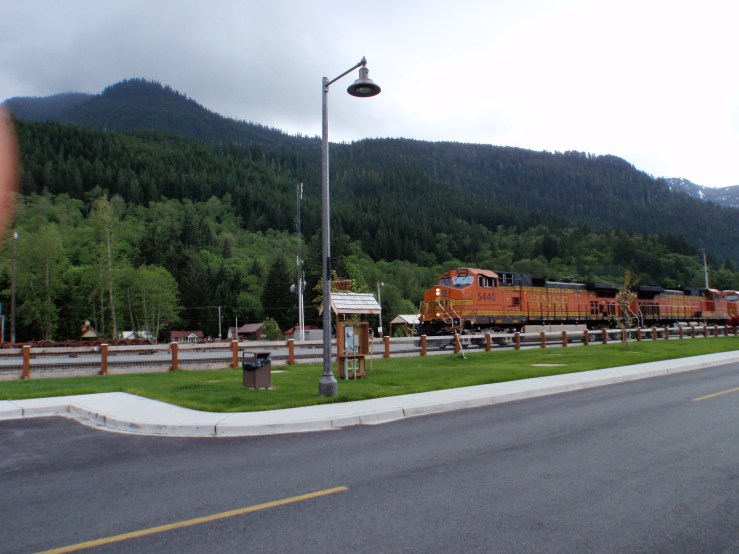
Train in Skykomish
View from the Cascadia Hotel in Skykomish

We are in high train country. The legend of the Great Northern Railroad is very much alive here, though nowadays the trains that run are mostly on the Burlington Northern Santa Fe line. Twice now, while having lunch at the Cascadia Hotel Cafe in Skykomish, we’ve watched trains pass through, heading east from the port of Seattle with container cars from China, Germany, and Scandinavia.

Several times a day and into the night we hear the trains.

In a kind of parallel journey to my vacation, I’m reading Train Dreams, a novel by Denis Johnson about a logger and laborer who worked for the Pacific Northwest train companies of the early twentieth century.

The Pacific Northwest is surreal and dangerous in Train Dreams, as much a character as Johnson’s protagonist, Robert Grainier.
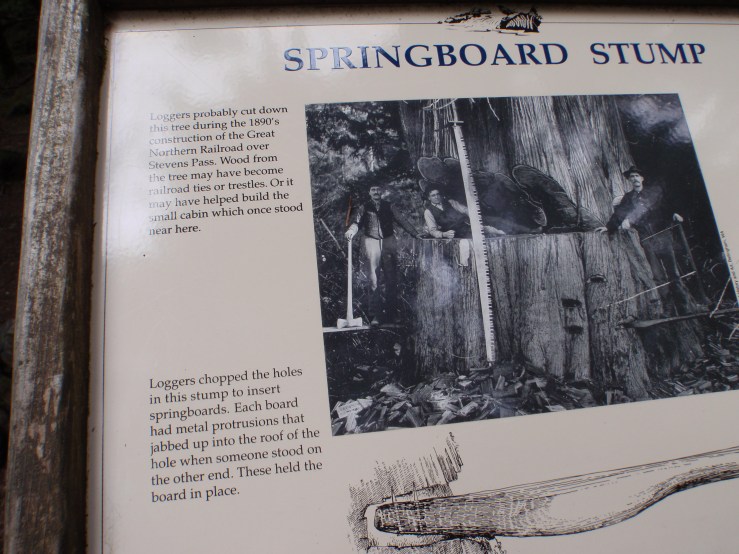
Photos of loggers
Loggers taking down 500-year-old cedar and fir

I thought about the life and times of Grainier when we hiked the Iron Goat Trail the other day, along the now abandoned Great Northern Railway bed. On plaques along the way, old photographs depicted loggers like Grainier taking down giant cedar and fir trees.

Grainier grew “hungry to be around….massive undertakings, where swarms of men did away with portions of the forest and assembled structures as big as anything going, knitting massive wooden trestles in the air of impassable chasms, always bigger, longer, deeper.”

Yet Grainier also saw the great mountains and forests defeat the ambitious plans of mere humans. The land defeated him, too, in a very personal way, but he learned acceptance and, finally, a kind of reverence for the terrible beauty of the place he called home.

The Iron Goat was the last spur of the Great Northern Railway, crossing the Cascades at the treacherous Stevens Pass. I found Stevens Pass stunning the first time we drove through, going east at sunny noon. But on the late afternoon return trip, when it was foggy with rain turning to sleet, I could hardly stand the vertigo as we tried to avoid skidding on the slick highway.

Disaster Viewpoint on the Iron Goat Trail marks the spot where, in 1910, an avalanche swept two snowbound passenger trains into the Tye River below, killing nearly 100 people.

Snowshed
Snowshed

To alleviate the dangers of avalanches, the railroad companies eventually built snowsheds, huge retaining walls to protect trains from tumbling snow. My husband and I walked alongside an old snowshed on our hike.

We knew our hike would be cut short because a sign at the trailhead indicated an avalanche had made the trail impassable a half mile in.

Sure enough, just a few feet from where the snowshed ended, we could go no further, thanks to a wall of hard-packed, dirt-encrusted snow.

“All his life Robert Grainier would remember vividly the burned valley at sundown, the most dreamlike business he’d ever witnessed waking—the brilliant pastels of the last light overhead, some clouds high and white, catching daylight from beyond the valley, others ribbed and gray and pink, the lowest of them rubbing the peaks of Bussard and Queen mountains; and beneath this wondrous sky the black valley, utterly still, the train moving through it making a great noise but unable to wake this dead world.” – Denis Johnson, Train Dreams


View from Spirit Lake trail
View from Spirit Lake Trail

Train Dreams, Denis Johnson, Farrar, Straus & Giroux, New York, 2011.

I found enlightenment in the Pacific Northwest

In May, I happily stumbled on the secret to enlightenment when I attended the Medical Library Association (MLA) annual meeting in Seattle and vacationed with my family in the Cascades.

It all started with MLA speaker and best-selling author Steven Johnson, who told us about a theory he encountered while researching his latest book, Where Good Ideas Come From: The Natural History of Innovation.  (Steven is a great speaker, not to mention that he reminds me of one of my favorite Downton Abbey characters.)

Some believe the 18th century’s Age of Enlightenment occurred, in part, when the middle class switched from alcohol to coffee and tea as their beverage of choice. With clean drinking water scarce, people drank ale or wine, even for breakfast. When coffee and tea imports became available, many switched from alcohol – a depressant – to caffeine, a stimulant.

Coffeehouses, where “ideas [could] spill from one mind to another,” became popular, according to Johnson. “The coffeehouse was a multidisciplinary space.” (So are libraries, he said, in a nod to his audience.) People from all walks of life who normally would not encounter one another engaged in “a diversity of conversations.”

So, coffee and tea led people to a kind of hyperactive exchange of ideas, which in turn led to innovation.

Johnson predicts that the internet and social media are a new kind of global, virtual coffeehouse spawning another great age of innovation.

I experienced coffee and coffeehouses on an entirely new level during my stay in Washington. In Rochester, New York, we don’t have drive-through espresso kiosks as in the Pacific Northwest. They are ubiquitous in the Seattle area, even on the edge of wilderness. Up in the Cascades, if you need a dentist, quick, or someone who knows how to repair a transmission, you may be out of luck – but you can almost always find a cup of coffee.

My theory is, there is so little sunshine people need the caffeine to keep going.

At any rate, I also noticed that the Pacific Northwest has thriving literary communities. People here really appreciate books, and they love coffee, and they love combining the two.

For me, the combination of exceptional coffee, great bookstores, access to the internet and, last but certainly not least, absolutely stunning scenery and fresh, mountain air, was so invigorating. I felt the ideas flowing. Like I was on the verge of my own personal enlightenment.

The Elliott Bay Book Company, Seattle

The Elliott Bay Book CompanyWe spent several hours visiting The Elliott Bay Book Company, Seattle’s largest independent bookstore, which also has (of course) great coffee. Elliott Bay has a full roster of book signings and author readings, and a terrific blog. Here is what I bought there:

The Housekeeper and the Professor, by Yoko Ogawa

The Spiral Staircase: My Climb Out of Darkness, by Karen Armstrong

Zen in the Art of Archery, by Eugen Herrigel

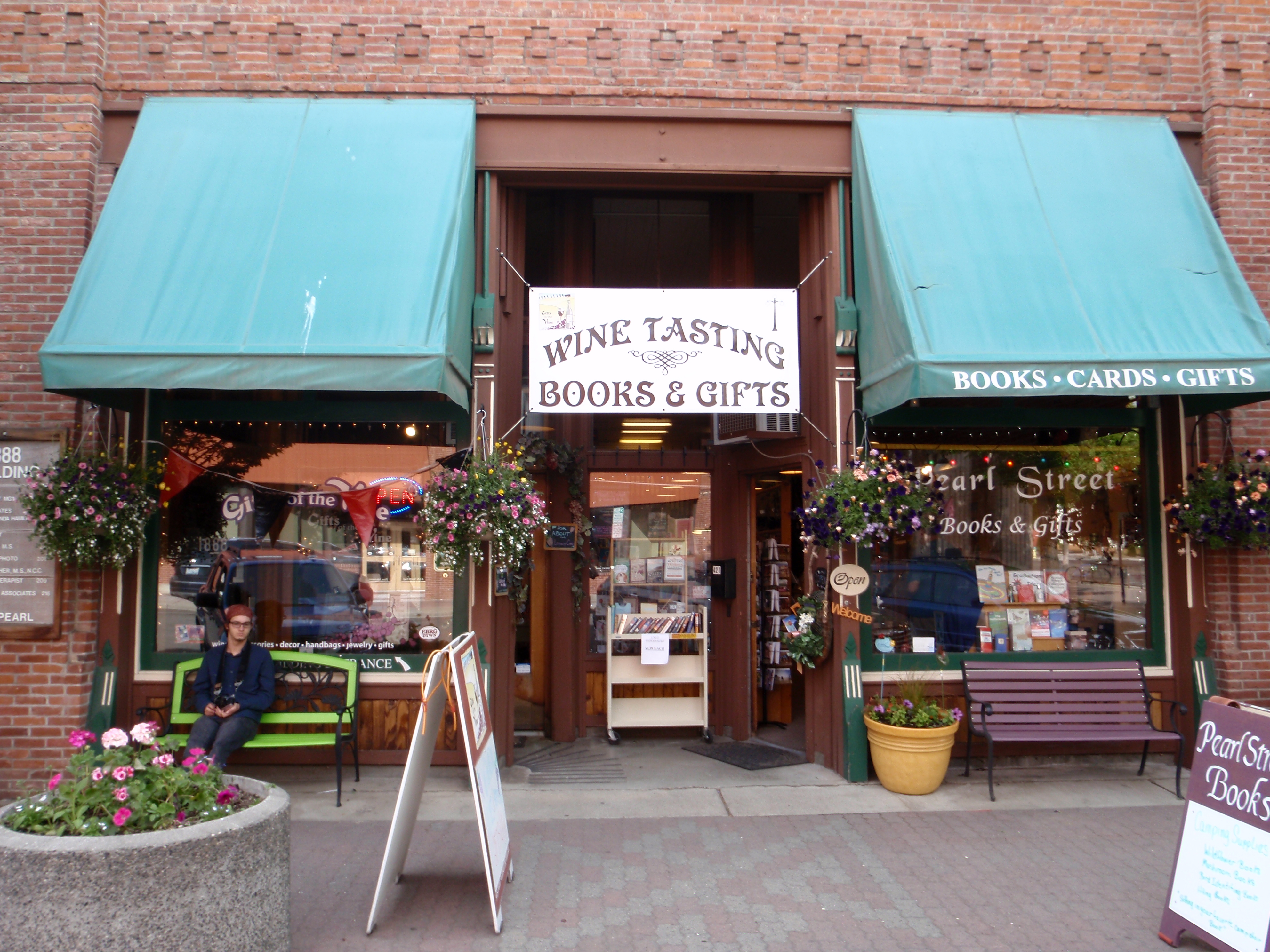
Pearl Street Books & Gifts in Ellensburg, WA. Pearl Street Books & Gifts

I wanted to see the high desert on the eastern side of the Cascades, so we drove to Ellensburg, WA, where we discovered the delightful Pearl Street Books & Gifts. Owner Michele Bradshaw is passionate about books and literature.  She and I talked about our reading interests. Michele enjoys making recommendations, and it’s obvious she puts a lot of thought into creative, customer-responsive bookselling.

I liked the Magic Table, a display of enticing best-sellers and high quality fiction and nonfiction. Quality is apparent on every shelf and surface in the shop, where carefully chosen books are displayed cover side up. Michele has put together a number excellent book collections, including young adult, children’s, fiction, memoir/biography, and Pacific Northwest authors.

Pearl Street Books & Gifts also hosts 11 book clubs, a tea club, a knitting club, and yoga workouts.

While I was there, I bought:

The White Cascade: The Great Northern Railway Disaster and America’s Deadliest Avalanche, by Gary Krist

The Big Burn: Teddy Roosevelt and the Fire that Saved America, by Timothy Egan

Booklust to Go, by Nancy Pearl

Queen Anne Books

Cover of Some Assembly Required by Anne Lamott Climb, climb, climb Queen Anne Avenue in Seattle and you’ll be rewarded at the top of the hill with tree-lined streets and all manner of shops, including Queen Anne Books. On the shelves are literally hundreds of hand-written staff recommendations, the sign of a great bookstore. Here, Windee recommends Anne Lamott’s latest book about her new grandson, Some Assembly Required.


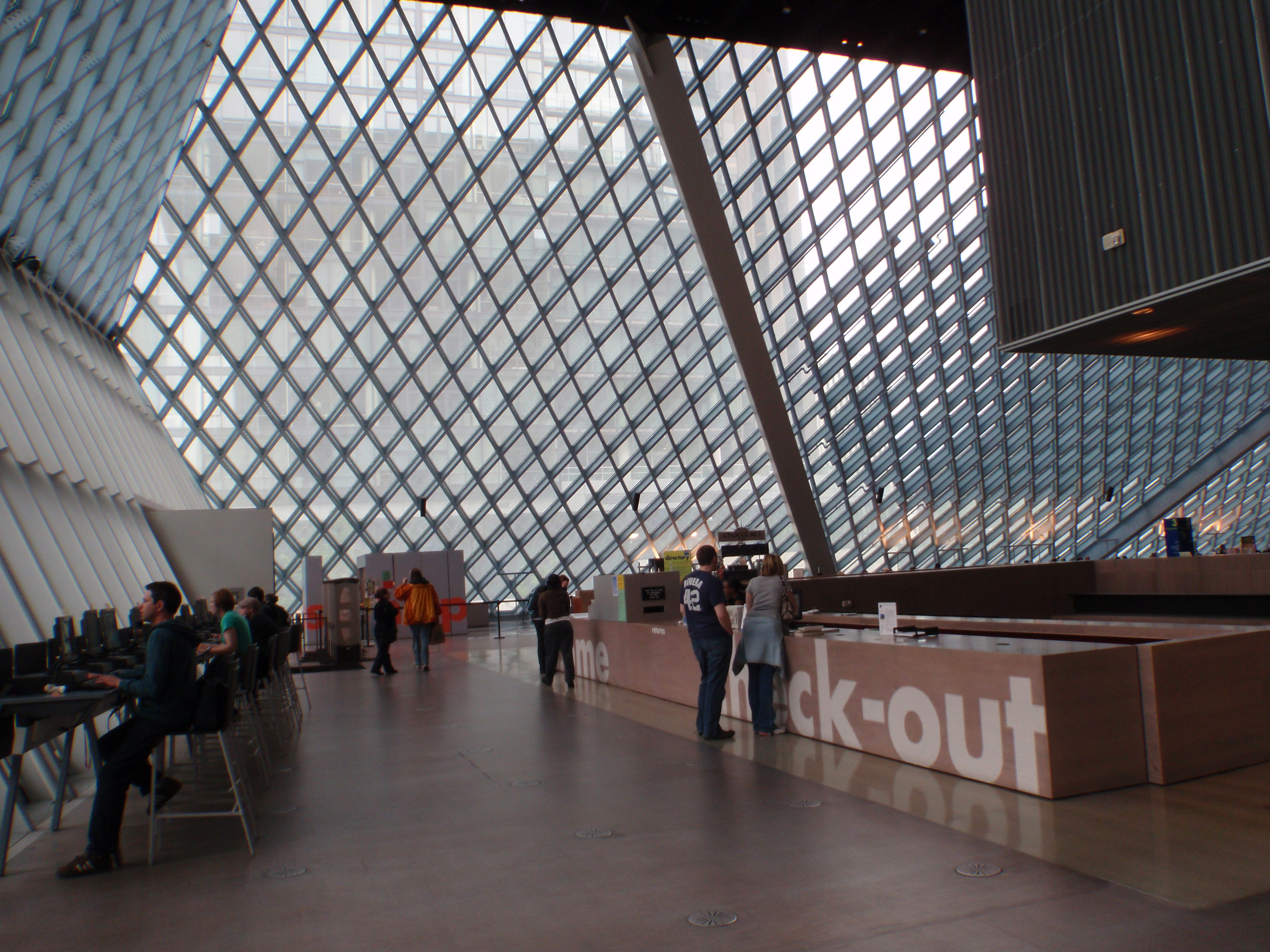
Seattle Central Library The Seattle Central Library, designed by Dutch architect Rem Koolhaas and a local architectural firm.

I had a great time this spring walking the Pacific Crest Trail with Cheryl Strayed (who has just inspired Oprah Winfrey to revive her book club!), sailing the waters off British Columbia with M. Wylie Blanchet and her children, clearing forest trails with Ana Maria Spagna, and observing life through the eyes of the characters in Denis Johnson’s Train Dreams.

In June: The Lifeboat by Charlotte Rogan

“Today I shocked the lawyers, and it surprised me, the effect I could have on them.”

This is the opening line of The Lifeboat by Charlotte Rogan (first-time, best-selling novelist making her debut at age 57, wrote novels in secret for 25 years when the kids were at school), which I’ll be reading in June.

Highlights from the jacket copy: 1914. A bride on her honeymoon. Adrift on the Atlantic Ocean. Not enough to go around. A power struggle. Choosing sides.

Will you read it with me?

Quote from: The Lifeboat, Charlotte Rogan, Little, Brown and Company, New York, 2012.

Why There Should Have Been a Pulitzer Prize for Fiction

There was no Pulitzer Prize for fiction awarded this year because none of the three finalists received a majority vote from the Pulitzer board.

The judges who screened 300 or so books, narrowed the field to three, and submitted their choices to the board were just as surprised as everyone else when the decision was announced.

I think there should have been a fiction Pulitzer winner this year. Here’s why:

  1. Ann Patchett said so.
  2. Authors of books that may have been years in the making shouldn’t be denied the chance to win this prestigious prize just because they published in 2011.
  3. Fiction needs all the support it can get. The book as a form of artistic expression is reinventing itself before our eyes, and some think it may go the way of the dinosaur. This isn’t the time to be stingy with book awards.
  4. The Pulitzer Prize celebrates great storytelling about who we are and how we live in America. The three nominated books, as well as the other contenders, had important and unique things to say about that. Prizes such as the Pulitzer bring more readers to these works.
  5. We reward our sports figures and entertainers lavishly. Our greatest storytellers will never make that kind of money or achieve the fame of baseball players and movie stars, but they do deserve to be rewarded and honored.
  6. Many books published in 2011 were good enough to have been chosen, not just the three nominated; the lack of a prize creates the impression NO books were deemed worthy. I would think this was especially disappointing to the authors of two of the nominated books. (The Pale King was published posthumously.)

One of the disappointed judges said perhaps this will draw readers to three deserving books, rather than just one.

Maybe the Pulitzer board should change the rules so no artist or artistic form suffers when the numbers don’t add up just right.

The three Pulitzer nominees were:

Swamplandia! by Karen Russell

The Pale King, by David Foster Wallace

Train Dreams, by Denis Johnson

There are many fantastic books from 2011 to choose from. Let’s all buy one to show our support for the great writers and the great books.