The making of a first novel, When Things Go Missing

One of my favorite writers and bloggers, Deborah J. Brasket, will publish her first novel, When Things Go Missing, in just a few days! It’s a pleasure to participate in Deborah’s Book Blog Tour along with nine other bloggers. Please enjoy Deborah’s guest post below, and be sure to scroll to the end to find links to the other posts.

I hope you’ll leave comments here and on the other book blogger sites for a chance to win a free E-book with extra chapters of the novel! Here also is a link to my review of When Things Go Missing.

Here is what Deborah has to say about an important phase in the writing of her novel:

I thought I’d share something that I wrote six years ago about When Things Go Missing when it was still a novel-in-progress. At that time the working title of my novel was From the Far Ends of the Earth, and it was in the hands of an agent who was submitting it to publishers. This post shows how long and messy the road to publication can be and the choices writers must make along the way

Endings and Beginnings, A Writer’s Life

Well, I just finished rewriting the ending of my novel as requested by a publisher. We will see what they think.

Either way, I believe this new ending is stronger–-still hopeful, but less certain. More in keeping with the way things are for most of us when things we love go missing, or when struggling with our own demons and addictions.

I’ve decided something else too. Quite a few publishers wanted to see more of the missing mother in my story, yet I wasn’t willing to do that. It would have unraveled the very premise of my novel, which was, how do we cope when the center holding everything together falls apart? When the person upon which we most depend disappears?

I wanted the mother to be part of the puzzle, not a presence herself, but that “absent” presence we feel, even yearn for, but cannot quite pin down, and never really know for certain.

Do any of us ever, really, know our mothers? Don’t we only know them through our own often faulty and incomplete perceptions of them? What they’ve allowed us to see, or what we choose to believe? All knowledge is partial and open to revision. We may know the facts that lay before us. But do facts a person make?

Yet even while I’ve resisted the call to add the mother’s perspective to this novel, I can understand how a reader might want more of her, to hear about her journey as she travels away from her family and through South America. What does she learn as she discovers the world through the new lens of her photography? Does it lend insight into her past? Into herself as a mother and wife and now an artist? How does it shape her anew?  Where does it take her?

So I’m considering a “sequel” to From the Far Ends of the Earth, if we can call it that, since it will cover the same time-space as the first novel.

I think it might be fun to give the mother her own voice and space, to see what shaped her past and how her journey shapes her future.

It’s the thing I love most about writing, discovering what I never knew I knew before I began to write it, as if the words themselves are drawn from some inner well of insight or vision I never knew I had.

“We create ourselves out of our innermost intuitions,” so writes a sage.

I believe that. And I also believe our characters are created in much of the same way. I wonder if we all contain multiple characters within us that make themselves known to us through our writing? Or are we just writing our larger selves?

Perhaps all the selves of all the people we’ve come to know, to experience, in this wider world, once known, become part of us, at least partially?

I believe there is a collective consciousness that we tap into from time to time, and writers, perhaps, most of all.

Sometimes I don’t know where I end and another begins.

My son says I have boundary issues. No doubt he’s right.

When Things Go Missing BOOK BLOG TOUR

Below are the bloggers, authors, and book reviewers participating in this tour promoting When Things Go Missing. Participants will either be spotlighting the book, posting reviews, or interviewing the author.

GIVEAWAY

Please bookmark this and join us on the tour! Those who leave the most likes and comments on the participating sites will have a chance to win a free E-book PLUS extra chapters of the novel (which the author reluctantly had to cut.)

BOOK BLOG PARTICIPANTS

• Sep. 15 – Sally Cronin, Smorgasbord Blog Magazine – SPOTLIGHT

• Sep. 16 – Valorie Hallinan, Books Can Save a Life – INTERVIEW / GUEST POST

• Sep. 18 – Laura Bruno Lilly, Classical Guitarist/Composer – BOOK REVIEW

• Sept. 20 – Margaret Moon, Book Chat – AUTHOR INTERVIEW

• Sept. 21 – Luanne Castle, Poet/Author – BOOK REVIEW

• Sep. 23 – Dr. Vicki Atkinson, Therapist/Author – BOOK REVIEW

• Sep. 24 – Jacqui Murray, Author, Book Reviewer – BOOK REVIEW

• Sep. 25 – Liz Gauffreau, Poet/Author – SPOTLIGHT

• Sep. 26 – Wynne Leon, The Heart of the Matter Podcast – INTERVIEW

• Sep. 27 – Liz Dexter – Editor, Book Reviewer – BOOK REVIEW

When Things Go Missing will be published by Sea Stone Press September 22, 2025.

PRE-ORDER NOW

Amazon Bookshop Barnes & Noble
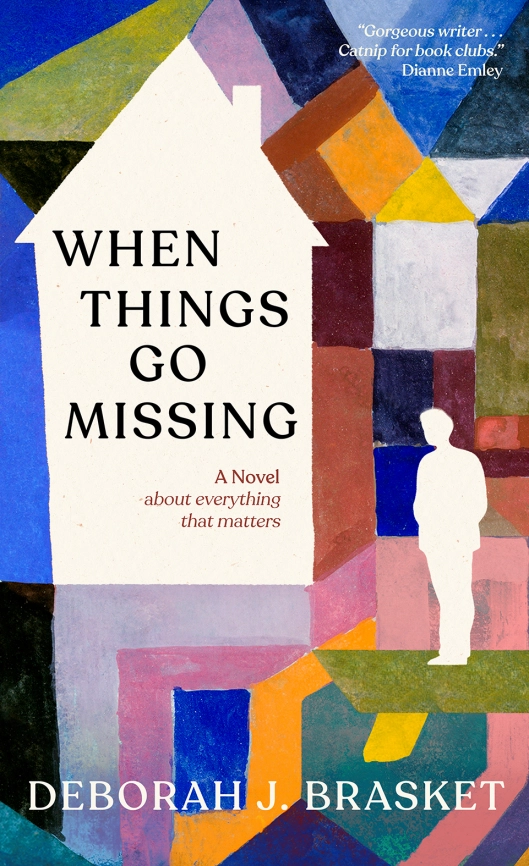
When Things Go Missing

“To all families who fall apart and struggle to find their way home again.”Deborah J. Brasket

What happens when a mother leaves her family?

Shopping list and coupons in hand, fifty-something Fran heads to the grocery store. But instead of shopping, she keeps driving – all the way to the California border, into Mexico, and beyond.

It is 1997. Fran will not be coming home anytime soon.

With deep pleasure, I bring Books Can Save a Life out of retirement to tell you about Deborah J. Brasket’s debut novel, When Things Go Missing. 

But first, let me say that I have been following Deborah’s blog, Writing on the Edge of the Wild, for many years on WordPress. (She now has a Substack version as well.) I have always found her insights about art, literature, truth, beauty, and the human dilemma to be evocative and profound. Truly, her blog has always stood apart from the rest. So it was with great anticipation that I powered up my Kindle and let Deborah’s story carry me away. 

We witness Fran’s confused, angry, and bereft family as they begin to navigate life on their own, on ground that has shifted dramatically. The family Fran leaves behind, like so many families, was already fractured – I would even say traumatized. Where do they go from here, when it feels like the end of life as they’ve known it?

Kay, an aspiring archeologist, receives periodic voice mails from her mother:

“She’s in mourning, she tells herself, mourning a mother she thought she knew who she now realizes she may never have truly known: A mother who always was the still center of comfort she could turn to in times like these, who is there no more. A mother who held her dysfunctional family together, a family she now fears will fall apart. The grief isn’t only about losing her mother but losing everything her mother represented: family, home, security, unconditional love. It’s like her mother’s absence blew a hole through the center of her universe, and everything is flying apart, including Kay. There’s nothing left to hold onto.”

To her son Cal, a heroin addict, Kay mails her mysterious photographs from various South American locations. As the mother of two adult sons, I was haunted by this passage, as I considered what it must have taken for Fran to let go of her son:

“…he gets sideswiped by this opposing flood of thoughts that gushes through his mind like his mother’s conscience. That’s how he sees it too – not his conscience but some uncomfortable and undesirable feeling that drifts in from his mother’s looks and sighs and follows him around like a fucking rain cloud. Hell, if she isn’t still doing it, even now when she’s disappeared.

He clears out a space on the bathroom mirror so he can look at himself, the image blurry in the wetness, surreal, with the steam all around, his face ringed by a bright halo of light. He thinks if he stares at this face ringed with light long enough, hard enough, deep enough, he might catch a glimmer of who the hell he really is or was supposed to be in another lifetime. Whatever it was, he knows it was good. Whatever could have been, whatever he blew away, it was all unbelievably good.”

Walter, Fran’s husband, a taciturn, sometimes volatile, father, gets Fran’s credit card bills: 

“He’s been taking care of Frannie since she graduated from high school and he got home from Vietnam….He never minded that she didn’t work. Why should she: He earned enough on his own…

He’s never tried to stop her before from doing anything she wanted. He just has to keep letting the rope out more, giving her as much lead as she needs, and then, when she’s ready, she’ll find her way home again. It’s what he tells himself, what he needs to believe to get through the day.”

We get a sense of the kind of wife and mother Fran was and is, as Kay, Cal, and Walter at first simply react to Fran’s abandonment. As each of them barely manages to keep going – largely on their own and isolated from one another – they begin to separate from the mother and wife bonds. They begin to individuate. We are witness to a trio of heroic journeys that unfolds in surprising and unexpected directions. 

When Things Go Missing will stay with you long after you’ve read the final page. To me, this is the mark of a powerful and authentic story, one that is so true for America and for our time. You may find yourself reflecting on your own life path, the choices you’ve made, and the choices that await you.  

What are our responsibilities as mothers, parents, and partners? 

Is there such a thing as the perfect mother? 

Are there limits to the bonds of love and family? How do these relationships change over time? Are they meant to be forever?

What are our responsibilities to our own self-actualization? When do we sacrifice our own desires and aspirations for the good of our families and communities?

How do we come to find our chosen families? Can they ever replace our families of origin? Is it possible to achieve a happy blend of the two?

As a longtime reader of Deborah Brasket’s work, I trust her wisdom and relish the grace and richness of her writing. When Things Go Missing is a beautiful unfolding – a tender, loving portrait of a family contending with grief, loss, and regret, while fully embracing all the joy that life can hold. 

I will close with the epigraph that opens When Things Go Missing: 

“I have loved thee with an everlasting love: therefore, with lovingkindness have I drawn thee.”Jeremiah 31:3

When Things Go Missing, an excellent book club choice, includes discussion questions. Publication date: September, 2025, Sea Stone Press.

When Things Go Missing is now available for pre-order at AmazonBookshop, and Barnes & Noble.

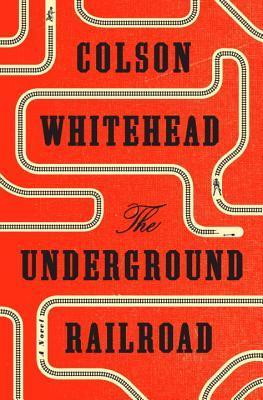
The Underground Railroad

the-underground-railroad“She never got Royal to tell her about the men and women who made the underground railroad. The ones who excavated a million tons of rock and dirt, toiled in the belly of the earth for the deliverance of slaves like her. Who stood with all those other souls who took runaways into their homes, fed them, carried them north on their backs, died for them. The station masters and conductors and sympathizers. Who are you after you finish something this magnificent – in constructing it you have also journeyed through it, to the other side. On one end there was who you were before you went underground, and on the other end a new person steps out into the light. The up-top world must be so ordinary compared to the miracle beneath, the miracle you made with your sweat and blood. The secret triumph you keep in your heart. – Colson Whitehead, The Underground Railroad
Continuing my post-election reading and holiday gift suggestions, I just finished The Underground Railroad by Colson Whitehead, which won this year’s National Book Award and many say is destined to become an American classic.

The Underground Railroad was an Oprah Book Club selection. In fact, Oprah Winfrey was so excited about the novel that she persuaded the publisher to release it over a month early so she could feature it as her next book club choice.

As Oprah says, there is “no better book for our times,” given the Black Lives Matter movement and our divisive political landscape.

Cora is a young, orphaned slave whose entire life has been spent on a Georgia plantation. She decides to run and is hunted by Ridgeway, a slave catcher, as she makes her way north.

At first blush, The Underground Railroad reads like historical fiction, but as the story unfolds it becomes clear that Cora is caught in a dystopia with many dimensions, depending on which state she happens to be in. The underground railroad is a literal tunnel built beneath the ground with secret way stations. Each state that Cora passes through embodies a unique, nightmarish vision of slavery in America.

Colson Whitehead has said that he had the idea for this novel some sixteen years ago, but didn’t feel he had the chops as a writer to pull it off until his mid forties.

I think The Underground Railroad is a masterpiece but, scanning the reviews on Goodreads, I noticed that, while most readers gave it five stars, others were lukewarm or disappointed. A common complaint was that Cora is one-dimensional; readers had a hard time feeling an emotional connection with Cora and some of the other characters.

For me, this wasn’t a problem, maybe because I view the characters as mythic, and so my expectations were different. In her New York Times review, Michiko Kakutani says the novel is “almost hallucinatory,” and that is what I felt, too. Rather than at an emotional distance, I was trapped along with the desperate characters in The Underground Railroad and the people trying to help them. I have a much greater appreciation for the intergenerational strength and resilience of blacks in America and the enormous risks taken by abolitionists and later by activists in the civil rights movement.

Nonetheless, I can see how this novel may not appeal to some readers. I would say it’s well worth picking up: at the very least, you’ll be reading the novel everyone is talking about.

“Cora ran her hand along the wall of the tunnel, the ridges and pockets. Her fingers danced over valleys, rivers, the peaks of mountains, the contours of a new nation hidden beneath the old. Look outside as you speed through, and you’ll find the true face of America.”

I’m not fond of the network morning shows, but here is a quick introduction to Colson Whitehead and his novel:

Have you read The Underground Railroad? What did you think?

Winners of the Literary Blog Hop Are…

Lynne Clark at Two Reads and Marie Stone are the Literary Blog Hop winners at Books Can Save a Life. Many thanks to Judith at Leeswammes for hosting this great event, and for all of you who stopped by to share what you’ve been reading.

The Signature of All Things book coverI’ll be sending Elizabeth Gilbert’s The Signature of All Things to Lynne.

We Are Water book coverAnd to Marie, We Are Water by Wally Lamb.

Here is the list of tantalizing books you shared:

Back When We Were Grown-Ups, by Anne Tyler

The Luminaries, by Eleanor Catton

Forever, by Pete Hammill

Gone Girl, by Gillian Flynn

Netherland, by Joseph O’Neill

Dreams of Joy, by Lisa See

The Kite Runner; A Thousand Splendid Suns; And The Mountains Echoed, by Khaled Hosseini

Dept. of Speculation, by Jenny Offill

Easy: Burial Rites, by Hannah Kent

Good Bones and Simple Murders, by Margaret Atwood

The Fault in Our Stars, by John Green

I Am Livia, by Phyllis T. Smith

The Goldfinch, by Donna Tartt

Dr. Sleep, by Stephen King

NOS4A2, by Joe Hill

Written in Red, by Ann Bishop

The Great Gatsby, by F. Scott Fitzgerald

The Dovekeepers, by Alice Hoffman

The Book Thief, by Markus Zusak

Life After Life, by Kate Atkinson

Mansfield Park, by Jane Austen

Wuthering Heights, by Emily Bronte

Dear Life, by Alice Munro

Dark Triumph, by Robin LaFevers

We Have Always Lived in the Castle, by Shirley Jackson

We Are Water, by Wally Lamb

The Snow Child, by Eowyn Ivey

In the Garden of the Beast, by Erik Larson

Under the Wide and Starry Sky, by Nancy Horan

The Kabbalist, by Yoran Katz

The Dog Boy, by Eva Hornung

Dinner With Lenny, by Jonathan Cott

Isolation Door, by Anish Majumdar

The Count of Monte Cristo, by Alexandre Dumas

The Rosie Project, by Graeme Simsion

The Constellation of Vital Phenomena, by Anthony Marra

One Thousand Gifts, by Ann Voskamp

Standing in the Rainbow; The All-Girl Filling Station’s Last Reunion; Can’t Wait to Get to Heaven, by Fannie Flagg

Solomon the Peacemaker, by Hunter Welles

Once We Were Brothers, by Ronald H. Balson

Books to read in 2014

Here’s my to-read list for 2014. It’s incomplete, always changing, and I’m sure I won’t get to all of these, not by a long shot, but it’s a convenient list when I’m choosing my next book. You may see a few of them featured on Books Can Save a Life. I’ve included titles that will be published in 2014, so you won’t find all of them on the shelves yet.

If you have enticing choices on your list, please share them in the comments!

Watch for my book giveaway in February to celebrate the second anniversary of Books Can Save a Life.

FICTION

The Snow Queen book cover

The Snow Child, by Eowyn Ivey    “If All of Rochester Read the Same Book,” 2014

The Goldfinch, by Donna Tartt

Someone, by Alice McDermott

Carthage, by Joyce Carol Oates

Arctic Summer, by Damon Galgut

The Unknowns, by Gabriel Roth

The Circle, by David Eggers

Colorless Tsukuru Tazaki and His Years of Pilgrimage, by Haruki Murakami

The Signature of All Things, by Elizabeth Gilbert

Life After Life, by Kate Atkinson

How Should a Person Be? by Sheila Heti

The Paying Guests, by Sarah Waters

And Then We Came to the End; The Unnamed; To Rise Again at a Decent Hour, by Joshua Ferris

Orfeo, by Richard Powers

Never Go Back, by Lee Child

The Language of Flowers, by Vanessa Diffenbaugh

The Snow Queen, by Michael Cunningham

The Bone Clocks, by David Mitchell

The Interestings, by Meg Wolitzer

The Luminaries, by Eleanor Catton

Lila, by Marilynne Robinson

By Blood, Ellen Ullman

Canada, by Richard Ford

In Sunlight and in Shadow; and Winter’s Tale, by Mark Helprin

The Cuckoo’s Calling, by Robert Galbraith (J.K. Rowling) and Untitled (2014)

The Woman Who Lost Her Soul, by Bob Shacochis

Off Course, by Michelle Huneven

Gone Girl; Dark Places, by Gillian Flynn (movies in 2014)

Wolf Hall, by Hilary Mantel (Best book of the 21st century, according to Elizabeth Gilbert)

****************

IN TRANSLATION

My Struggle, Books 1, 2, 3 by Karl Ove Knausgaard (Norwegian)

Treasure Hunt; The Dance of the Seagull by Andrea Camilleri (Sicilian)

Story of a New Name, by Elena Ferrante (Italian)

YOUNG ADULT

Son book cover

The Giver Quartet Series (including Son), by Lois Lowry

Divergent Series, by Veronica Roth

Mockingjay, by Suzanne Collins

The Fault in Our Stars, by John Green

*************************

MEMOIR

Wave book cover

Men We Reaped, by Jessamyn Ward

Still Writing, by Dani Shapiro

This Is the Story of a Happy Marriage, by Ann Patchett

Wave, by  Sonali Deraniyagala

Intensive Care: A Doctor’s Journey; and Medicine in Translation: Journeys with My Patients, by Danielle Ofri

**************

NONFICTION

Five Days at Memorial book cover

Big Data: A Revolution that Will Transform How We Live, Work, and Think, by Victor Mayer-Schonberger and Kenneth Cukier

Who Owns the Future? by Jaron Lanier

The Burglary: The Discovery of J. Edgar Hoover’s Secret FBI, by Betty Medsger

Thank You for Your Service, by David Finkel

Five Days at Memorial: Life and Death in a Storm-Ravaged Hospital, by Sheri Fink

What Doctors Feel: How Emotions Affect the Practice of Medicine, by Danielle Ofri

Manson: The Life and Times of Charles Manson, by Jeff Guinn

The Unwinding: An Inner History of the New America, by George Packer

Margaret Fuller: A New American Life, by Megan Marshall

The Skies Belong to Us: Love and Terror in the Golden Age of Hijacking, by Brendan I. Koerner

The Gorgeous Nothings: Emily Dickinson’s Envelope Poems

Stalking the Divine, by Kristin Ohlson

Sons of Madness: Growing Up and Older with a Mentally Ill Parent, by Susan Nathiel

Is There No Place on Earth for Me? by Susan Sheehan

Dear Genius: The Letters of Ursula Nordstrom, by Leonard S. Marcus

If you want to be lifted up, read Kent Haruf

Benediction book coverShe looked at the two old brothers….

I want you to think about taking this girl in.

They stared at her.

You’re fooling, Harold said.

No, Maggie said. I am not.

They were dumbfounded. They looked at her, regarding her as if she might be dangerous. Then they peered into the palms of their thick callused hands spread out before them on the kitchen table and lastly they looked out the window toward the leafless and stunted elm trees.    

                                                                             Plainsong, by Kent Haruf

Yesterday I finished reading Kent Haruf’s new novel, Benediction, about an elderly hardware store owner, Dad Lewis, dying of cancer.  I realized it was three years to the day since my father passed away from cancer. More than a coincidence, probably. I imagine something unconscious was at play. But I would have read this book eventually, no matter what, because I read everything Haruf writes.

My devotion to Haruf began when I read Plainsong, which he published in 1999. One of Haruf’s critics describes Haruf’s work as “exalted.” If you want to be exalted, get a copy of  Plainsong or Eventide or Benediction and drop into the lives of the folks who live on the dry plains in the fictional town of Holt, Colorado.

Haruf writes about goodhearted people way off the beaten path trying to do the right thing. His prose is entrancing, deceptively simple, powerful. You may begin to be lulled by the humanity Haruf captures on the page, but before you get to feeling incredulous he hits you with some dark reality: bigotry, abuse, cruelty, abandonment, addiction.

I was surprised Haruf said in an interview one of the books that most influenced him as a writer was Ernest Hemingway’s The Sun Also Rises, a novel that underwhelmed me both times I read it. But in Haruf’s plain, spare prose I can see Hemingway’s legacy. And it reinforces my interest in how what we read speaks to us, personally. That’s going to be different for everyone.

Benediction is a beautiful book, but an especially quiet and somber one. If you want to sample a novel by Haruf, I suggest you begin with Plainsong, which has more action and a greater diversity of intriguing characters, followed by Eventide and then Benediction. All are set in Holt, in eastern Colorado. Plainsong and Eventide are companion novels that feature the same cast, while Benediction introduces a new set of characters. I suspect Haruf may continue their stories in a future novel.

In Benediction, an eighty-year-old woman, two sixty-year-old women, and an eight-year-old girl skinny-dip on a hot afternoon in a muddy water trough for cattle. Cool and refreshed, they lie down under a tree in their thin, sleeveless cotton dresses to take a nap. Somehow, Haruf makes this scene riveting. It is emblematic of his writing.

Two of my favorite characters in all of fiction are Plainsong’s rough-hewn cattle ranchers Harold and Raymond McPheron, who take in Victoria Roubideaux, a homeless, pregnant teenager. They are so sweet, and clueless to the point of hilarity. One of the funniest scenes I’ve ever read is their visit to the ob-gyn with Victoria.

As much as I enjoyed Benediction, the McPheron brothers from Plainsong and Eventide will always be in my heart.

Plainsong book coverRaymond, you’re my brother. But you’re getting flat unruly and difficult to abide. And I’ll say one thing more.

What?

This ain’t going to be no goddam Sunday school picnic.

No, it ain’t, Raymond said. But I don’t recall you ever attending Sunday school either.

Quotes from Plainsong, Kent Haruf. Vintage Books, New York: 1999.

BY KENT HARUF:

Plainsong

Eventide

Benediction

The Tie That Binds

Where You Once Belonged

Hemingway on life and death, love and war

I believe that basically you write for two people: yourself to try to make it absolutely perfect; or if not that then wonderful. Then you write for who you love whether she can read or write or not and whether she is alive or dead. Ernest Hemingway on Writing.

Ernest Hemingway on Writing book coverWhen I visit a new place, I like to read the literature associated with that place or the literature created there. So when I went to Key West last month and the home of Ernest Hemingway, I reread The Sun Also Rises, which Hemingway wrote there, followed by A Farewell to Arms. Last night I finished For Whom the Bell Tolls for the first time and went to bed feeling rather devastated.

In my last post I was dismissive of The Sun Also Rises. When I read it the first time, in high school, I didn’t understand the novel. Decades later, I again found the characters tedious, which was Hemingway’s intention, but I at least better understood the context of those alienated, war-devastated years. His writing style, a breakthrough in Hemingway’s time, was for me so stilted and self-conscious it sometimes pulled me completely out of the story, and I especially disliked his sole female character, Lady Brett Ashley.

My post about Hemingway generated a handful of interesting and insightful comments, all by women and mostly about Hemingway’s ego and sexism and macho persona. I wish my blog attracted more male readers, but I have noticed some gender segregation in the book blog world, and I can understand that. I tend to gravitate toward female authors, and when I find I’m reading only books written by women, I’ll switch to a male author. Reading Junot Diaz, for example, was a stretch for me, but I’m glad I did. I had to talk myself into reading Hemingway again, too, but I’m glad I did that as well.

I felt uncomfortable after I was dismissive of The Sun Also Rises, and I thought about that as I read Hemingway’s other novels. Because when all is said and done, I believe Hemingway is a master and, despite my personal reactions to it, I believe The Sun Also Rises is a great book. Visiting Hemingway’s home in Key West and looking at the many candid photos on every wall in every room, I sensed something of his spirit lingering. Reading The Paris Wife and Ernest Hemingway on Writing, I saw not just Hemingway the god-like, iconic writer but Hemingway the vulnerable artist.

I don’t do the close reading of a literary scholar or a book critic, though I admire those that do. On this blog, I don’t write book reviews, and I’ve been frustrated occasionally when I hear people say I do, although I understand why they wouldn’t make these distinctions. If you were to ask me to write a book synopsis or a book review, I’d have no enthusiasm for it. (And I’m a librarian.) Here, I want to share and talk about our own, highly individual reading journeys and our personal reactions to the books we read. I think if you’re an avid reader, books help to make you the person you are, and that’s going to make a difference in what you do and who you are out in the world.

(If you’re not an avid reader, maybe you love nature and have trekked across your country, or you know almost everything there is to know about the earliest jazz recordings, or you can recite from memory every baseball statistic ever recorded, or you’re devoted to helping the poor in Third World countries. You may be on some kind of personal journey of discovery that says something important about who you are and your place in the world. That journey of discovery is what I’m interested in.)

For Whom the Bell Tolls book coverHere are some of my personal reactions to Hemingway’s novels:

  • I disliked Lady Brett Ashley because she was self-centered and slept with every man who came her way (except for Jake Barnes). Then I realized the men in The Sun Also Rises were the same, yet I wasn’t as critical of them. I held the female to a different standard.
  • When I was young I accepted and enjoyed Hemingway’s fictional romances without question. I didn’t find them sexist or offensive until literary opinion told me I should, even though I came of age just after the feminist heyday. Now, while I don’t especially enjoy Hemingway’s portrayal of women, I have to say many women acted that way. I think Hemingway understood how we idealize the other in romantic love, and how we look to each other for rescue or at least a safe haven.
  • I have trouble understanding the American Robert Jordan’s  idealism and motivation for volunteering to fight in the Spanish Civil War in For Whom the Bell Tolls. But when I think about the Americans in Iraq and Afghanistan, I’m bothered that many of us are so emotionally removed from the reality of these wars and the sacrifices a small number of Americans are making. Since I’m not especially attracted to war novels, at first I didn’t take to For Whom the Bell Tolls. I didn’t want to follow Robert Jordan and the others on their mission to blow up the bridge. Of course, I became emotionally entangled in Robert’s relationship with Maria and the others. Hemingway fought and was nearly killed in World War I and reported from the front lines during the Spanish Civil War and World War II, so he understood war and he knew how to write about it. The last one hundred pages of For Whom the Bell Tolls contain some of the most beautiful, poignant and universally truthful passages I’ve ever read. With the final sentence, I do believe Hemingway achieved perfection.

BY ERNEST HEMINGWAY

A Moveable Feast

For Whom the Bell Tolls

The Old Man and the Sea

A Farewell to Arms

The Sun Also Rises

A Clean Well-Lighted Place

In Our Time

The Garden of Eden

To Have and Have Not

Men Without Women

Islands in the Stream

Death in the Afternoon

Southernmost Beach Cafe interior
This Key West cafe is the southernmost restaurant in the US, 90 miles from Cuba. I’m sure Hemingway must have enjoyed a brandy (or two or three) here.

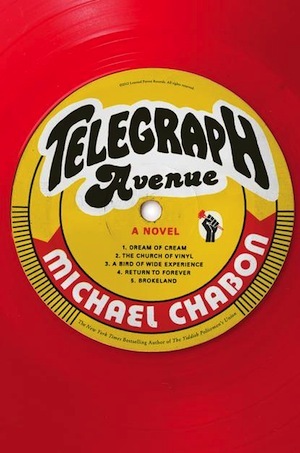
Bestsellers Tell What Possesses Us – Telegraph Avenue

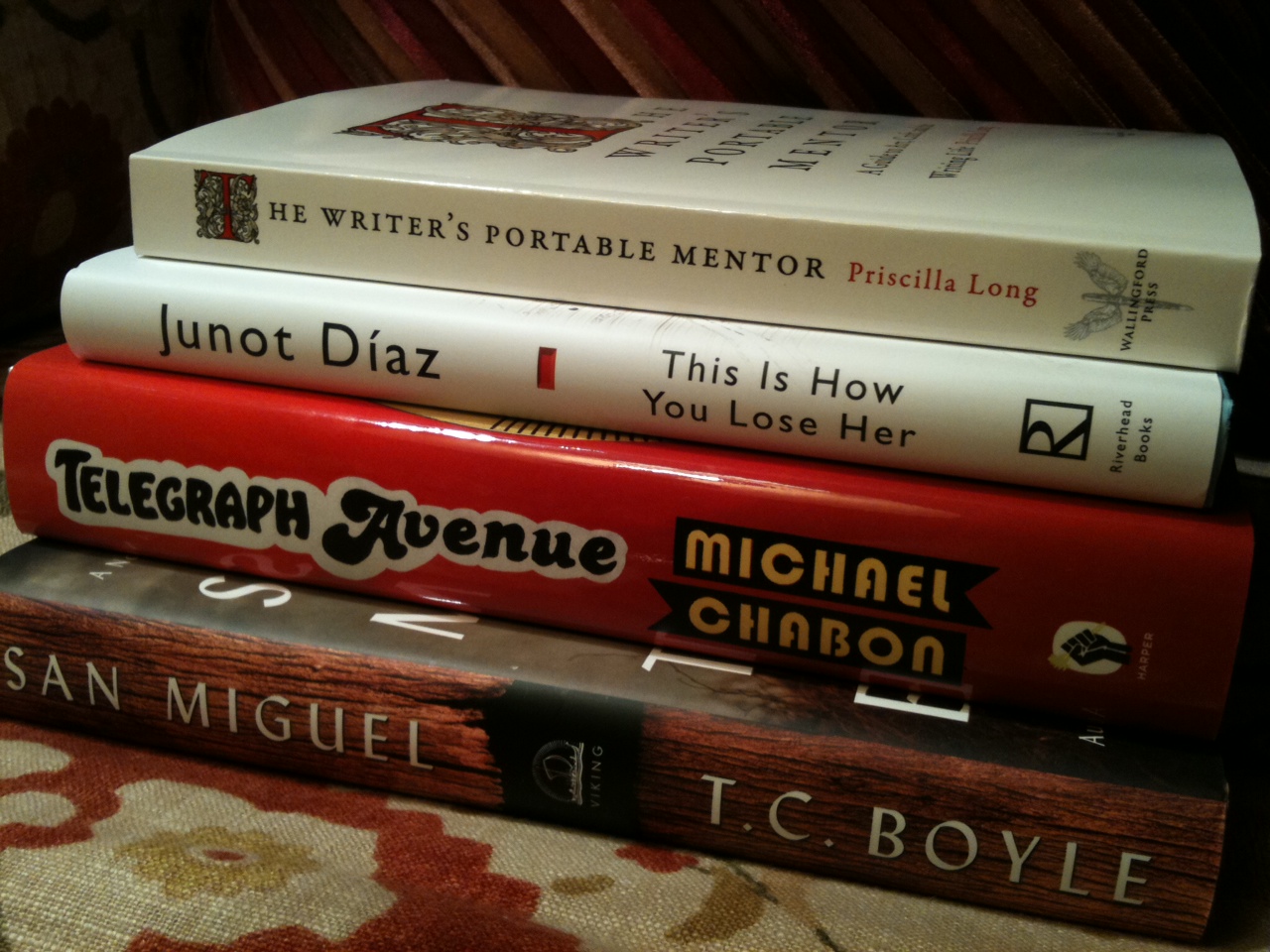
This past fall and early winter there was a perfect storm of top authors publishing new books. I wanted to read a handful of them to see what possesses some of our best creative minds and our popular culture. I wanted to break out of old habits and venture to new places I wouldn’t normally find on my own.

I didn’t get to as many books as I’d planned, but I did read:

  • Flight Behavior, by Barbara Kingsolver
  • San Miguel, by T.C. Boyle
  • This Is How You Lose Her; and a previously published book, The Brief Wondrous Life of Oscar Wao, by Junot Diaz
  • Telegraph Avenue, by Michael Chabon
  • Sweet Tooth, by Ian McEwan

Most difficult of all was acclimating to the world of Telegraph Avenue. I almost gave up on it. I couldn’t keep Chabon’s characters straight, I was clueless about the endless blaxploitation and 1970s cultural allusions, even though that was my coming-of-age time, and I sometimes struggled with the rich, complex (and masterful) prose. The great librarian Nancy Pearl has a Rule of 50: Stop reading after 50 pages if you don’t like the book, and if you’re over 50 you can subtract your age from 100 and stop there. So I was well within my rights to stop before 50 pages, but I kept going with Telegraph Avenue, and it was worth it.

Telegraph Avenue book coverTo me, Telegraph Avenue and Junot Diaz’s books are similar in that I entered completely unfamiliar hearts, minds, and worlds. I’m unlikely to stop by a used record store in Oakland, California any time soon, or meet the kinds of characters (and I mean that in more than one sense of the word) who might hang out there.  In Telegraph Avenue, Archy (who is black) and Nat (who is white) are best friends, vinyl record shop business partners, and musicians struggling to make a living in a neighborhood that’s seen better days.

For one reason or another – race, ethnicity, gender, sexual orientation, changing times – the characters in Telegraph Avenue are outsiders or has-beens or both: former blaxploitation and martial arts stars, connoiseurs of soul and jazz and long-forgotten record albums, fine musicians in their own right. Many are regulars at Archy and Nat’s Brokeland Records, which reminded me of the bar in the TV show “Cheers.” I grew to like and care about these characters in large part because of their passion for music and devotion to their art. My godfather was a jazz pianist, and I dated a jazz musician. I remember how both lived and breathed jazz, in the same way Archy, Nat, and others do in Telegraph Avenue. Music shaped their lives, and when they were playing a gig, they had an aura of dignity and charisma others envied.

Yet, both my godfather and the musician I dated played the kind of jazz that was seen by many as antiquated in the 1960s and 70s when music was reinventing itself. There is the same sense of this passing away of art forms in Telegraph Avenue, and of people being rushed headlong into the future while trying to preserve what shouldn’t be lost.

If you’ve read Telegraph Avenue, what did you think? Please comment!

I’d like to give equal time to new, lesser known, and independent authors, so I plan in the coming months to read a sampling of fiction by some of these writers. If you have a book to suggest please do in the comments.

First sentences, Junot Diaz

This Is How You Lose Her book coverSelected first sentences, from short stories in This Is How You Lose Her by Junot Diaz:

“I’m not a bad guy.”

“Nilda was my brother’s girlfriend. This is how all these stories begin.”

“You, Yunior, have a girlfriend named Alma, who has a long tender horse neck and a big Dominican ass that seems to exist in a fourth dimension beyond jeans.”

“Your girl catches you cheating. (Well, actually she’s your fiancee, but hey, in a bit it so won’t matter.”)

“Those last months.”

“Years later you would wonder if it hadn’t been for your brother would you have done it?”

As fate would have it, one day in April when I went to Joe Bean (whose website has great photos, including one by A. Hallinan) to meet my son and have a cup of incredible coffee, I was given a free book, The Brief and Wondrous Life of Oscar Wao by Junot Diaz in celebration of World Book Night.

I haven’t read this Pulitzer Prize winning book yet, so I thought I would now, right along with This Is How You Lose Her.  Both books feature the narrator, Yunior, who, according to NPR reviewer Carmen Gimenez Smith, “might someday rank with Philip Roth’s Nathan Zuckerman or John Updike’s Harry Angstrom as an enduring American literary protagonist.”

While we’re getting to know this next great American literary protagonist, whose native land is the Dominican Republic, I’ll be posting from Argentina, where I’ll also be rereading Imagining Argentina, visiting a larger-than-life bookstore, and….well, we’ll see.

Quotes from This Is How You Lose Her, Junot Diaz, Riverhead Books, New York, 2012.

Books at my door

Four fall books 2012 I love it when I find new books waiting on my doorstep.