Enchanted, I happily discovered Karen and her blog, Pen in Hand, as well.
Even better, Karen succinctly and eloquently sang the praises of The Plain Dealer, daily newspapers, and printed newspapers.
I’m all for electronic media and the creative flourishing and publishing opportunities now open to more people.
But Karen reminds us not to forget our daily newspapers and their talented, hardworking staffs. They are doing important work.
Some daily newspapers have disappeared, with more to go, I’m sure.
Journalism is changing like everything else, but we still need unbiased investigative reporting, long-form news and analysis, depth and breadth of content, and media everyone is comfortable with. (I believe a significant number of readers still prefer their news in print, and have not found or would not know how to go about finding comparable news online).
Most important, we need engaged readers and citizens who care and understand what vibrant journalism means to a healthy democracy.
If we let our daily newspapers go, we damn well better make sure we know what we are doing.
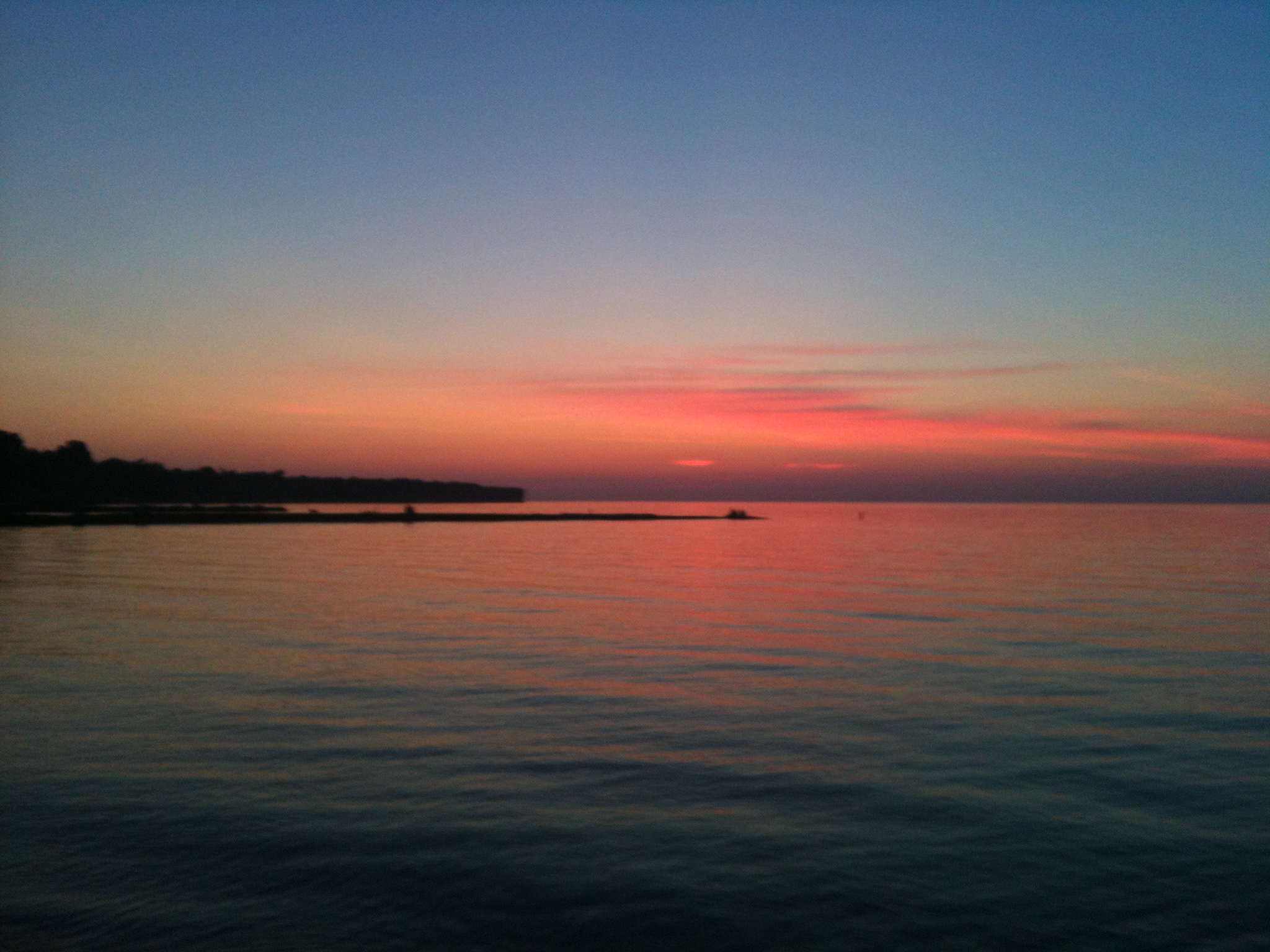
Bay Village view of Lake Erie at sunset. To the east, the Cleveland skyline glittered and fireworks blossomed over Lakewood.
(Full disclosure: a member of my family works for The Plain Dealer.)
In May, I happily stumbled on the secret to enlightenment when I attended the Medical Library Association (MLA) annual meeting in Seattle and vacationed with my family in the Cascades.
It all started with MLA speaker and best-selling author Steven Johnson, who told us about a theory he encountered while researching his latest book, Where Good Ideas Come From: The Natural History of Innovation. (Steven is a great speaker, not to mention that he reminds me of one of my favorite Downton Abbey characters.)
Some believe the 18th century’s Age of Enlightenment occurred, in part, when the middle class switched from alcohol to coffee and tea as their beverage of choice. With clean drinking water scarce, people drank ale or wine, even for breakfast. When coffee and tea imports became available, many switched from alcohol – a depressant – to caffeine, a stimulant.
Coffeehouses, where “ideas [could] spill from one mind to another,” became popular, according to Johnson. “The coffeehouse was a multidisciplinary space.” (So are libraries, he said, in a nod to his audience.) People from all walks of life who normally would not encounter one another engaged in “a diversity of conversations.”
So, coffee and tea led people to a kind of hyperactive exchange of ideas, which in turn led to innovation.
Johnson predicts that the internet and social media are a new kind of global, virtual coffeehouse spawning another great age of innovation.
I experienced coffee and coffeehouses on an entirely new level during my stay in Washington. In Rochester, New York, we don’t have drive-through espresso kiosks as in the Pacific Northwest. They are ubiquitous in the Seattle area, even on the edge of wilderness. Up in the Cascades, if you need a dentist, quick, or someone who knows how to repair a transmission, you may be out of luck – but you can almost always find a cup of coffee.
My theory is, there is so little sunshine people need the caffeine to keep going.
At any rate, I also noticed that the Pacific Northwest has thriving literary communities. People here really appreciate books, and they love coffee, and they love combining the two.
For me, the combination of exceptional coffee, great bookstores, access to the internet and, last but certainly not least, absolutely stunning scenery and fresh, mountain air, was so invigorating. I felt the ideas flowing. Like I was on the verge of my own personal enlightenment.
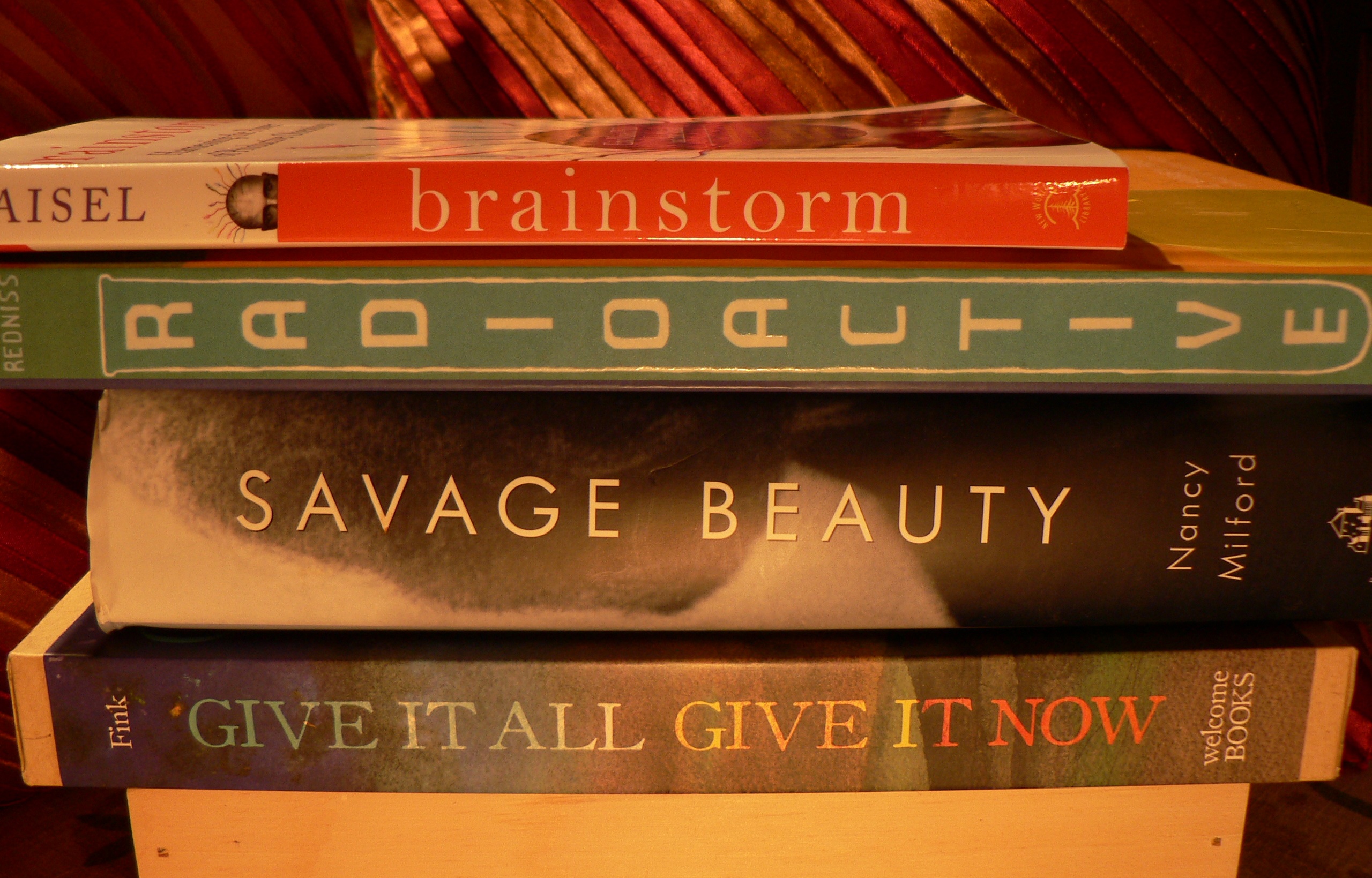
We spent several hours visiting The Elliott Bay Book Company, Seattle’s largest independent bookstore, which also has (of course) great coffee. Elliott Bay has a full roster of book signings and author readings, and a terrific blog. Here is what I bought there:
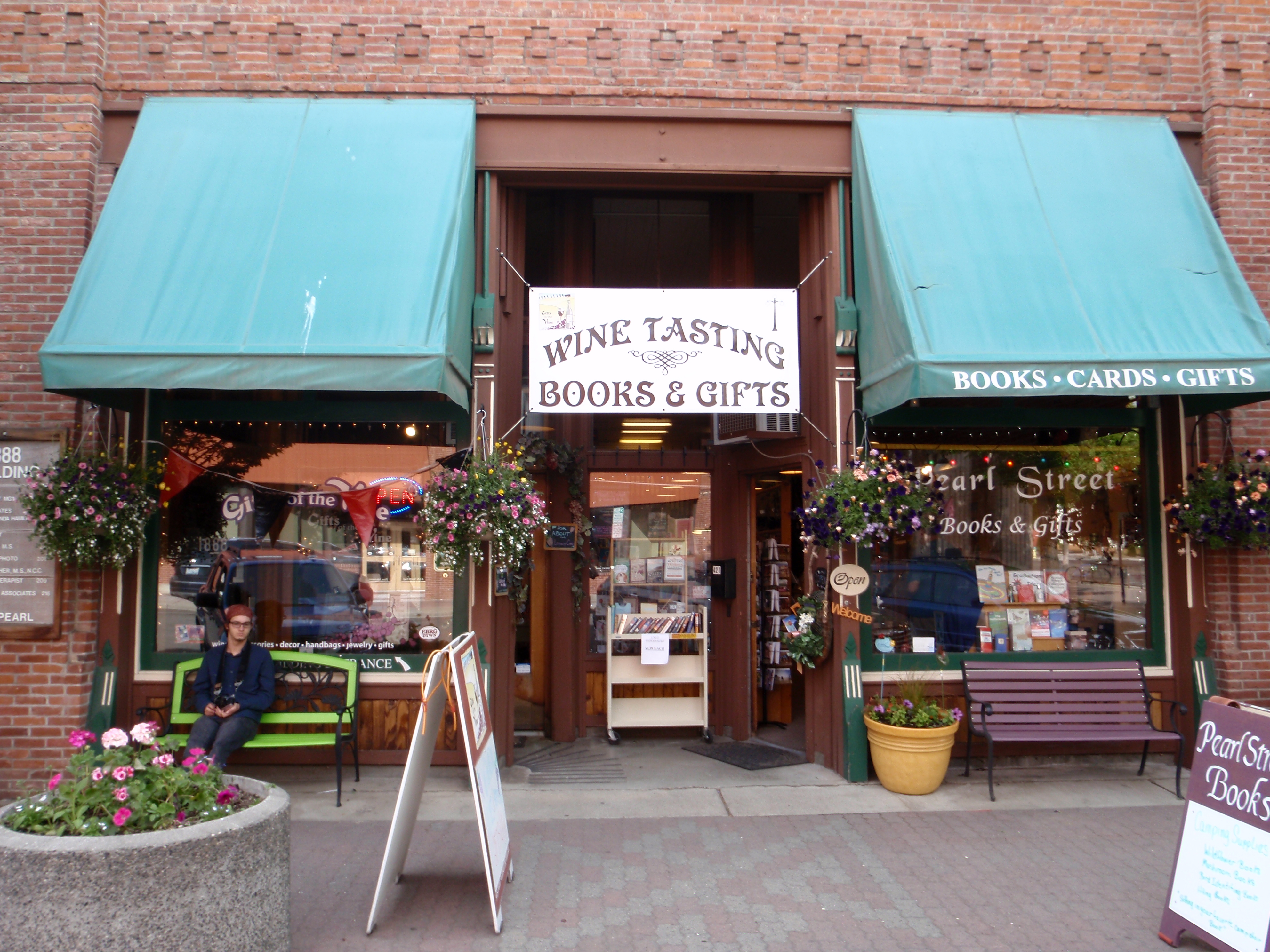
I wanted to see the high desert on the eastern side of the Cascades, so we drove to Ellensburg, WA, where we discovered the delightful Pearl Street Books & Gifts. Owner Michele Bradshaw is passionate about books and literature. She and I talked about our reading interests. Michele enjoys making recommendations, and it’s obvious she puts a lot of thought into creative, customer-responsive bookselling.
I liked the Magic Table, a display of enticing best-sellers and high quality fiction and nonfiction. Quality is apparent on every shelf and surface in the shop, where carefully chosen books are displayed cover side up. Michele has put together a number excellent book collections, including young adult, children’s, fiction, memoir/biography, and Pacific Northwest authors.
Pearl Street Books & Gifts also hosts 11 book clubs, a tea club, a knitting club, and yoga workouts.
While I was there, I bought:
The White Cascade: The Great Northern Railway Disaster and America’s Deadliest Avalanche, by Gary Krist
The Big Burn: Teddy Roosevelt and the Fire that Saved America, by Timothy Egan
Booklust to Go, by Nancy Pearl
Queen Anne Books
Climb, climb, climb Queen Anne Avenue in Seattle and you’ll be rewarded at the top of the hill with tree-lined streets and all manner of shops, including Queen Anne Books. On the shelves are literally hundreds of hand-written staff recommendations, the sign of a great bookstore. Here, Windee recommends Anne Lamott’s latest book about her new grandson, Some Assembly Required.
The Seattle Central Library, designed by Dutch architect Rem Koolhaas and a local architectural firm.
I had a great time this spring walking the Pacific Crest Trail with Cheryl Strayed (who has just inspired Oprah Winfrey to revive her book club!), sailing the waters off British Columbia with M. Wylie Blanchet and her children, clearing forest trails with Ana Maria Spagna, and observing life through the eyes of the characters in Denis Johnson’sTrain Dreams.
In June: The Lifeboat by Charlotte Rogan
“Today I shocked the lawyers, and it surprised me, the effect I could have on them.”
This is the opening line of The Lifeboat by Charlotte Rogan (first-time, best-selling novelist making her debut at age 57, wrote novels in secret for 25 years when the kids were at school), which I’ll be reading in June.
Highlights from the jacket copy: 1914. A bride on her honeymoon. Adrift on the Atlantic Ocean. Not enough to go around. A power struggle. Choosing sides.
Will you read it with me?
Quote from: The Lifeboat, Charlotte Rogan, Little, Brown and Company, New York, 2012.
If you want to read this treasure of a memoir you’ll have to do a bit of work. It’s out of print, so I ordered it from a used bookstore listed on Amazon. I love finding small packages on my doorstep from faraway bookstores. Blanchet and her five (FIVE!) children spent many summers on their 25-foot boat, the Caprice, exploring the British Columbia coast. This, after Blanchet’s husband had been lost at sea on the Caprice – only the boat was found.
Often, Blanchet followed the route of Captain Vancouver, who explored the waters in 1792. She read a copy of Vancouver’s diary to her children, and they tried to identify landmarks the sea captain had written about.
They followed no particular schedule except for being mindful of tides and weather, stopping when they pleased to explore little islands, hidden coves and beaches, and secluded inlets and bays that often didn’t show up on the map.
“We were very comfortable in the daytime with everything stowed away. The cockpit was covered, and had heavy canvas curtains that fastened down or could be rolled up. There was a folding table whose legs jammed tightly between the two bunks to steady it….We washed our dishes (one plate, one mug each) over the side of the boat; there was a little rope ladder that could be hung over the stern, and we used that when we went swimming.”
Her stories remind me of our many trips over the years rediscovering nature through the eyes of our children. This is the kind of book you’ll want to read aloud with children and grandchildren. Blanchet’s children were amazingly hardy and brave, often finding themselves with their intrepid mother doing things I couldn’t imagine doing with my children: crawling on a log suspended over rapids, exploring Native American burial grounds (in which bodies were “buried” dangling from trees in nets), making their way along a cliff in fog on a slippery, snowy mountaintop.
Few children today will have these kinds of adventures. Much of the wild, pristine country Blanchet wrote about in The Curve of Time has been developed. “I lighted a fire [on the beach] and piled it up with bark…We always carried a rack for broiling fish. Soon they were spluttering and browning over a perfect fire, which I raked over between two flat stones. We built it up with more driftwood…The Northern Lights were edging this way…and that way…across the northern sky – reaching above us – white and elusive, then retreating hurriedly down to the horizon.”
All photos were taken on Whidbey Island.
The quotes are from: The Curve of Time: The Classic Memoir of a Woman and Her Children Who Explored the Coastal Waters of the Pacific Northwest, M. Wylie Blanchet, Seal Press, Berkeley, CA, 1968.
After college, Spagna made a commitment to work on trail crews for the National Park Service in spring, summer, and fall, and to travel during the winter months. Eventually, she settled in Stehekin, Washington, a remote town in the northern Cascades, where she and her partner built their own house. I believe she still works the trail crews several months out of the year.
I tend to romanticize what it would be like to call such a place home. In her essays, Spagna captures the glamour and majesty of living surrounded by natural beauty, but she also writes about the never-ending challenges.
Ana Maria writes about how Republicans and Democrats, liberals and conservatives, tree huggers and loggers, religious fundamentalists and atheists get along (or don’t) in a small community.
There are the forest fires, flash floods, and avalanches. There are the costs incurred to keep residents of these areas safe from natural disasters, costs often borne by taxpayers who live in more populated areas.
It hadn’t occurred to me that precautions to prevent forest fires may cause the buildup of flammable, dense growth that could result in The Big One, a massive fire that destroys everything.
Spagna’s writing is important. She’s a voice from another world, the last bastions of nature, a voice whose wisdom we need to hear.
Here are some of my favorite quotes:
“I visited the Magic Kingdom thirty-seven times before I turned nineteen, and by then I craved something, anything, that would be the antithesis of Disney, the real thing. That’s what I found on the highway: places you can count on, places where in the morning without fail, there will be coffee at the gas station heading out of town….[and] people who….were honest, if quirky, and unexpectedly generous, and they lived an ethic that the land itself, no matter how pretty, can’t teach…..The Golden Rule.” “These places…wilderness areas, national parks – are supposed to transform us, make us new…..they do not continuously dispense spiritual wowness like a fountain….I stripped myself of everything to be out there–out there!–and the problem with being out there is that then it is not out there anymore. It is more like in here….you can’t be made new at home.”
Quotes are from Now Go Home: Wilderness, Belonging, and the Crosscut Saw, by Ana Maria Spagna, Oregon State University Press, Corvallis, 2004.
I used to read Where the Wild Things Are every day, sometimes more than once, to my son. It was his favorite book.
He was three, but he hadn’t yet left his terrible two’s when it came to temper tantrums. The first time we read the story, its wild (there’s no other word for it), authentic power seized us and didn’t let go until the last page. My son felt it, I felt it.
No matter how outlandish and dark the words and pictures, this story was about something very real to my son and me. Our arguments when I tried to discipline him and grew exasperated, his uncontrollable rage at being sent to time out – all of it was right there on the page. Another little boy and his mommy were doing THE EXACT SAME THING.
When I read, I had to roar my terrible roar and roll my terrible eyes. That was the very best part.
We wore that book out. Some of the pages tore and fell out. I still have our sons’ favorite books, but not Where the Wild Things Are. I looked for it this morning after I found out Maurice Sendak had passed away, but it wasn’t there. Must have been too tattered to keep.
Or maybe my son couldn’t bear to part with it and took it with him when he moved out on his own.
Thank you, Maurice Sendak.
It occurs to me I’ve written two blog posts in a row about books with “wild” in their titles. I think these authors are on to something when it comes to writing about human nature.
Do you have a Where the Wild Things Are memory? Children, grown children, mommies, daddies, anyone, please share in the comments.
I write this on the night of the supermoon, high in the sky outside my dining room window.
In her journal, Cheryl Strayed kept a list of the books she burned as she walked the Pacific Crest Trail: Dubliners by James Joyce; Lolita by Vladimir Nabokov; The Novel by James Michener; The Pacific Crest Trail, Volume 1: California and Volume 2: Oregon and Washington; plus a few more.
Every evening she’d make a campfire, tear out the pages she’d read that day, and feed them to the flames to lighten the load in her over-stuffed pack. I imagine her performing her nightly ritual, the words on paper turning to ash.
Cheryl carried one book the length of her trip: The Dream of a Common Language, by Adrienne Rich.
Reading Wild, I remember this stray fact: In college, I wrote my senior seminar English paper on Adrienne Rich’s Diving Into the Wreck. I’d like to find that old English paper so I can read it after all these years and see what I had to say about Rich’s poetry.
Reading Wild, I remember a vacation in Portland, Oregon to visit family. Our boys were six and nine at the time.
We decided to hike with my sister-in-law and her family along the lower elevations of Mount Hood in search of a waterfall whose name I can’t remember. The map posted at the trail head indicated the hike was a couple of miles. A manageable trip for young children, we thought. The day was hot and sunny, but we walked in the shade of a beautiful pine forest along an easy, well-cleared path.
When Cheryl began walking, her pack was so heavy she couldn’t lift it, and her brand new REI hiking boots were too small. Along the way, she shed many layers of skin from the pads of her feet and several toenails as well.
She’d walk a week without seeing anyone. She’d go days with a handful of change to her name until she reached a town where a supply pack (mailed by a friend) awaited, with necessities and two ten dollar bills to tide her over for the next couple hundred miles.
The day of our hike we walked. And walked. And walked some more. Until it got to be not so much fun anymore. Until the children were dragging, and the teenage cousin and her friend decided to go on ahead.
One of our boys (who shall remain nameless) grew cranky. The heat was intense and our water was running low. But we figured we were almost to the waterfall, so we kept going.
We walked another half hour, and then in a full meltdown, the thoroughly overheated and tired boy refused to go any further. We’d stopped next to a creek, and my husband took his handkerchief, dipped it in the ice-cold mountain water, and we took turns bathing our faces with it.
My in-laws decided to keep going with their children while we cooled off at the stream. Before long, I was ready to move on. My husband stayed behind with the tired one, cajoling him to take off his shoes and socks and wade in the stream.
Our original group had now split into four groups, which made me uneasy. Walking along holding my son’s hand, I hoped the path wouldn’t split off. What if we went the wrong way and got lost? We saw an older couple approaching as they headed back down the trail.
“Are we close to the waterfall?” I asked.
“You’re getting there. But you’ve a ways to go,” the man said. Not what I wanted to hear.
At the age of 26, with little preparation and no extreme hiking experience, Cheryl decided to hike the Pacific Crest Trail. She was grieving for her mother, who had died in her early forties a month after a cancer diagnosis, and Cheryl had been making a mess of her life ever since. She hoped the trip would save her in some way.
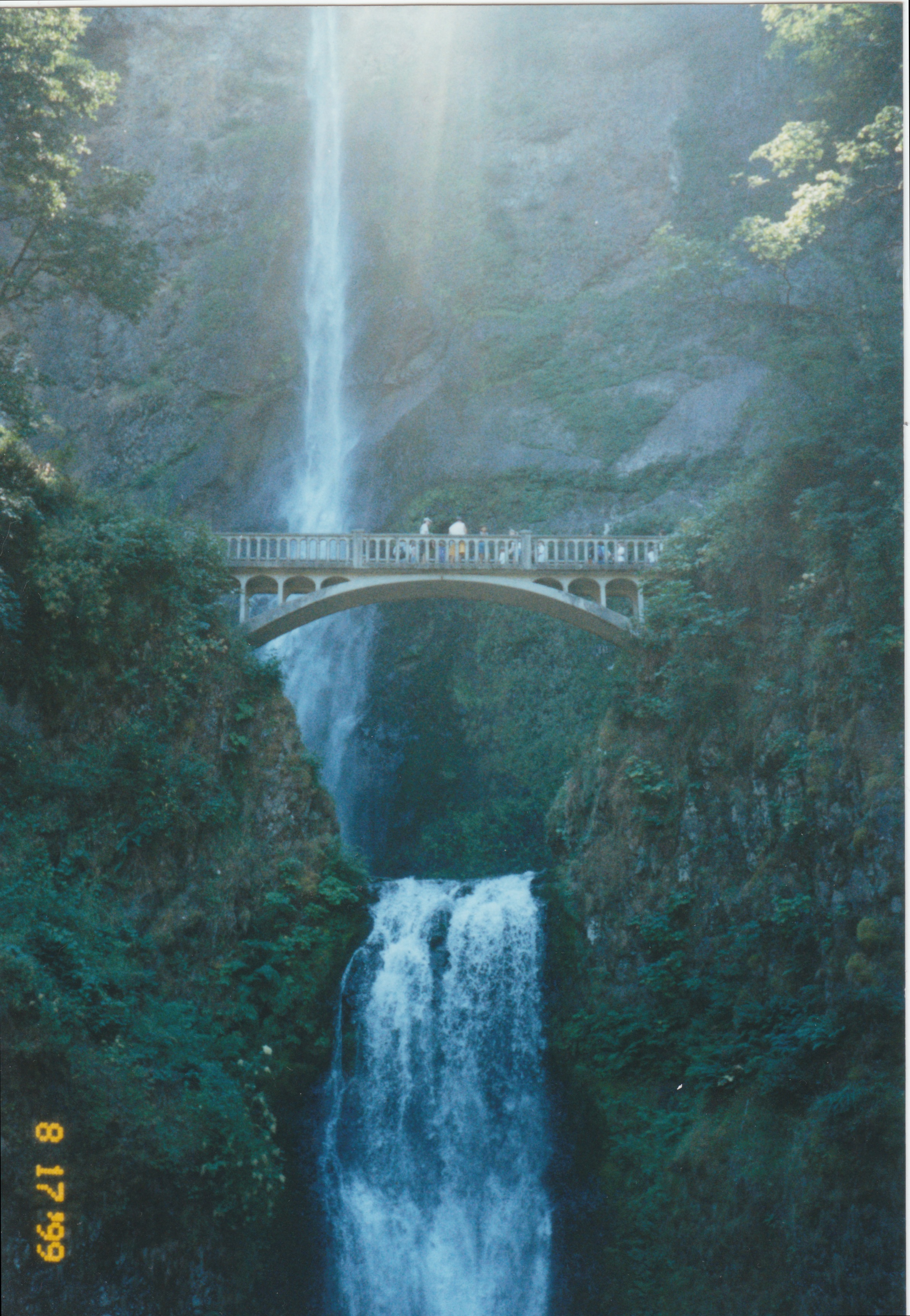
My son and I heard rushing water and felt a million invisible, blessedly cool droplets on our skin before we saw the waterfall. In the clearing ahead, ribbons of spray curved and tumbled down a wall of solid rock, like a bridal veil fluttering in a breeze. Instantly, the temperature dropped ten degrees. We were like parched plants coming back to life after a generous watering.
Everyone had arrived except for my husband and the tired one; they came along a few minutes later. In this peaceful and secluded Shangri La we stretched ourselves out on large, flat rocks and talked as the kids splashed about the stream looking for tadpoles.
Having walked 1100 miles, Cheryl ended her journey at the Bridge of the Gods spanning the Columbia River, which lay between Oregon and Washington.
“She was not terrified that the patient would die or she would lose the baby, she was terrified that she was doing something wrong in the eyes of Dr. Swenson.”
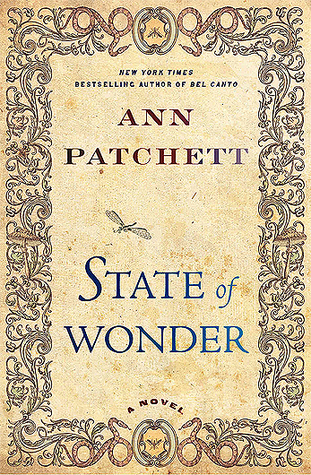
Ann Patchett’s State of Wonder is about a life severely, intentionally curtailed.
Marina Singh is a successful scientist conducting important research at a pharmaceutical company. Only she knows that long ago she’d bailed out of her own life.
When Marina was a chief resident in obstetrics, she performed a complicated delivery that ended badly. There was a lawsuit. Her marriage to a fellow resident dissolved. She wasn’t asked to leave the residency program, but she felt compelled to punish herself and leave on her own.
That way, she never had to face her classmates, or patients, or the brilliant, intimidating Dr. Swenson, again. Anick Swenson had been the attending physician on call the day of the crisis. All the medical students both revered and feared her.
“She was harder on the women…She would tell them stories of her own days in medical school and how when she came along the men knit their arms together to keep her out. They made a human barricade against her, they kicked at her when she climbed over them, and now all the women were just walking through, no understanding or appreciation for the work that had been done for them.”
Marina never told her mother why she abruptly decided not to become a doctor. She never told her lover, Mr. Fox, who is president of the pharmaceutical company she works for. She never told her close friend and colleague, Anders Eckman, who has just died of fever in the Amazon jungle.
Now, Anders’ wife has begged Marina to find out what she can about Anders’ death and retrieve his body. And Mr. Fox has asked her to check on the progress of a top secret research project being conducted by none other than Dr. Swenson, who makes it a practice of remaining incommunicado.
Marina doesn’t want to set foot in the jungle, and she doesn’t want to see Dr. Swenson. But she goes, because she cares deeply for Anders, who has left behind a wife and three young boys.
Here is the particular nugget of the story I keep coming back to:
“The great, lumbering guilt that slept inside of her at every moment of her life had shifted, stretched.”
Marina has suffered and continues to suffer deeply, even though her suffering is hidden away. She knows what she’s lost. She was a bright, capable young woman who wanted to devote herself to caring for women and helping them bring new life into the world. Yet in the space of a few hours she walked away from it all. She’d spent the greater part of her adult life only half alive, using a fraction of her potential. She seems to be very much alone; she holds the other people in her life at a distance, and she settles for a less than fulfilling relationship with Mr. Fox.
Marina has never gotten over her past. She locked it away in a dark corner of her mind and got on with life. Facing her demons is the psychological story within the story of Marina’s journey into the Amazon jungle. It turns a plot driven novel into something more urgent and real for the reader, even if the reader is only half aware of it.
This fusing of outward adventure and inner journey is what ultimately made it impossible not to follow Marina into the darkness. I revisited some of my own life issues as Marina revisited hers.
I admire Marina, but not all of the decisions she makes as her story unfolds, and that’s as it should be when reading about a character who is real, alive.
The essential story in this book, for me, is the reclaiming of a life. By the end of the story, I was different. Not in a dramatic way, but nonetheless something had shifted. A truly great book such as this one stays with me and continues to wield its power. And I can’t begin to measure the impact of many books read over a lifetime.
Some people say the book is in danger of disappearing. But in a recent essay, Timothy Egan writes that people are actually reading more and buying more books. I think we will always hunger for the power of story and the collective wisdom of the great writers and thinkers.
There was no Pulitzer Prize for fiction awarded this year because none of the three finalists received a majority vote from the Pulitzer board.
The judges who screened 300 or so books, narrowed the field to three, and submitted their choices to the board were just as surprised as everyone else when the decision was announced.
I think there should have been a fiction Pulitzer winner this year. Here’s why:
Ann Patchett said so.
Authors of books that may have been years in the making shouldn’t be denied the chance to win this prestigious prize just because they published in 2011.
Fiction needs all the support it can get. The book as a form of artistic expression is reinventing itself before our eyes, and some think it may go the way of the dinosaur. This isn’t the time to be stingy with book awards.
The Pulitzer Prize celebrates great storytelling about who we are and how we live in America. The three nominated books, as well as the other contenders, had important and unique things to say about that. Prizes such as the Pulitzer bring more readers to these works.
We reward our sports figures and entertainers lavishly. Our greatest storytellers will never make that kind of money or achieve the fame of baseball players and movie stars, but they do deserve to be rewarded and honored.
Many books published in 2011 were good enough to have been chosen, not just the three nominated; the lack of a prize creates the impression NO books were deemed worthy. I would think this was especially disappointing to the authors of two of the nominated books. (The Pale King was published posthumously.)
One of the disappointed judges said perhaps this will draw readers to three deserving books, rather than just one.
Maybe the Pulitzer board should change the rules so no artist or artistic form suffers when the numbers don’t add up just right.
I write with unfortunate news of Dr. Eckman, who died of a fever two nights ago. Given our location, this rain, the petty bureaucracies of government (both this one and your own), and the time sensitive nature of our project, we chose to bury him here in a manner in keeping with his Christian tradition….Despite any setbacks, we persevere.
The letter writer, Dr. Annick Swenson, is a fearless force of nature.
Marina Singh, the protagonist, is not.
Watching the relationship between these two women unfold in Ann Patchett’sState of Wonder was one reason I couldn’t stop turning the pages.
If you’ve read the book or are in the process of reading it, I’d like to know what you think about these two women. Do you like them? Do they change as the story unfolds? For better or for worse?
What do you think about their relationship with men? I found myself comparing Dr. Swenson’s relationship with Dr. Rapp to Marina’s relationship with the men in her life, especially her father and Mr. Fox.
Any thoughts about Marina’s nightmares, induced by taking a drug to prevent malaria?
The conventional roles of mother, father, friend, lover, husband, wife, and child seem to become less strictly defined and more fluid as the story unfolds. What do you think about that? Consider the Lakashi tribe, too.
What exactly was Easter all about? What do you think of the way Marina, Dr. Swenson, and other characters treated him?
Many of Patchett’s characters must make difficult moral choices. Do you agree with the choices they made? Do any surprise or upset you?
We encounter addicting yellow tree bark, blue mushrooms with hidden power, and lavender moths unlike any other species of moth. What do you make of how the characters responded to these discoveries? What would you do?
Please tell me what you think about any of this in the comments below. There are bound to be disagreements – the more discussion, the better!
What Albert Einstein Said to a Girl
It occurred to me that the books I’ve featured on this blog have so far been about strong, independent women departing from traditional roles. When I was checking my email subscriptions before I wrote this post, I found this:
Albert Einstein once had a correspondence with a young girl who wanted to be a scientist. She regretted the fact that she was a girl but said she’d grown resigned to it. She hoped Einstein wouldn’t think less of her for being female.










 Books Can Save A Life