The making of a first novel, When Things Go Missing

One of my favorite writers and bloggers, Deborah J. Brasket, will publish her first novel, When Things Go Missing, in just a few days! It’s a pleasure to participate in Deborah’s Book Blog Tour along with nine other bloggers. Please enjoy Deborah’s guest post below, and be sure to scroll to the end to find links to the other posts.

I hope you’ll leave comments here and on the other book blogger sites for a chance to win a free E-book with extra chapters of the novel! Here also is a link to my review of When Things Go Missing.

Here is what Deborah has to say about an important phase in the writing of her novel:

I thought I’d share something that I wrote six years ago about When Things Go Missing when it was still a novel-in-progress. At that time the working title of my novel was From the Far Ends of the Earth, and it was in the hands of an agent who was submitting it to publishers. This post shows how long and messy the road to publication can be and the choices writers must make along the way

Endings and Beginnings, A Writer’s Life

Well, I just finished rewriting the ending of my novel as requested by a publisher. We will see what they think.

Either way, I believe this new ending is stronger–-still hopeful, but less certain. More in keeping with the way things are for most of us when things we love go missing, or when struggling with our own demons and addictions.

I’ve decided something else too. Quite a few publishers wanted to see more of the missing mother in my story, yet I wasn’t willing to do that. It would have unraveled the very premise of my novel, which was, how do we cope when the center holding everything together falls apart? When the person upon which we most depend disappears?

I wanted the mother to be part of the puzzle, not a presence herself, but that “absent” presence we feel, even yearn for, but cannot quite pin down, and never really know for certain.

Do any of us ever, really, know our mothers? Don’t we only know them through our own often faulty and incomplete perceptions of them? What they’ve allowed us to see, or what we choose to believe? All knowledge is partial and open to revision. We may know the facts that lay before us. But do facts a person make?

Yet even while I’ve resisted the call to add the mother’s perspective to this novel, I can understand how a reader might want more of her, to hear about her journey as she travels away from her family and through South America. What does she learn as she discovers the world through the new lens of her photography? Does it lend insight into her past? Into herself as a mother and wife and now an artist? How does it shape her anew?  Where does it take her?

So I’m considering a “sequel” to From the Far Ends of the Earth, if we can call it that, since it will cover the same time-space as the first novel.

I think it might be fun to give the mother her own voice and space, to see what shaped her past and how her journey shapes her future.

It’s the thing I love most about writing, discovering what I never knew I knew before I began to write it, as if the words themselves are drawn from some inner well of insight or vision I never knew I had.

“We create ourselves out of our innermost intuitions,” so writes a sage.

I believe that. And I also believe our characters are created in much of the same way. I wonder if we all contain multiple characters within us that make themselves known to us through our writing? Or are we just writing our larger selves?

Perhaps all the selves of all the people we’ve come to know, to experience, in this wider world, once known, become part of us, at least partially?

I believe there is a collective consciousness that we tap into from time to time, and writers, perhaps, most of all.

Sometimes I don’t know where I end and another begins.

My son says I have boundary issues. No doubt he’s right.

When Things Go Missing BOOK BLOG TOUR

Below are the bloggers, authors, and book reviewers participating in this tour promoting When Things Go Missing. Participants will either be spotlighting the book, posting reviews, or interviewing the author.

GIVEAWAY

Please bookmark this and join us on the tour! Those who leave the most likes and comments on the participating sites will have a chance to win a free E-book PLUS extra chapters of the novel (which the author reluctantly had to cut.)

BOOK BLOG PARTICIPANTS

• Sep. 15 – Sally Cronin, Smorgasbord Blog Magazine – SPOTLIGHT

• Sep. 16 – Valorie Hallinan, Books Can Save a Life – INTERVIEW / GUEST POST

• Sep. 18 – Laura Bruno Lilly, Classical Guitarist/Composer – BOOK REVIEW

• Sept. 20 – Margaret Moon, Book Chat – AUTHOR INTERVIEW

• Sept. 21 – Luanne Castle, Poet/Author – BOOK REVIEW

• Sep. 23 – Dr. Vicki Atkinson, Therapist/Author – BOOK REVIEW

• Sep. 24 – Jacqui Murray, Author, Book Reviewer – BOOK REVIEW

• Sep. 25 – Liz Gauffreau, Poet/Author – SPOTLIGHT

• Sep. 26 – Wynne Leon, The Heart of the Matter Podcast – INTERVIEW

• Sep. 27 – Liz Dexter – Editor, Book Reviewer – BOOK REVIEW

When Things Go Missing will be published by Sea Stone Press September 22, 2025.

PRE-ORDER NOW

Amazon Bookshop Barnes & Noble

Excavating a Life

IMG_3500.jpg

About the creative life and writing memoir…

“I didn’t know that if you want to write and don’t, because you don’t feel worthy enough or able enough, not writing will eventually begin to erase who you are.”

“What if writing were as important as a basic human function and as significant to maintaining and promoting our psychic and physical wellness as, say, exercise, healthful food, pure water, clean air, rest and repose, and some soul-satisfying practice?”

“This book is an invitation for you to use the simple act of writing as a way of reimagining who you are or remembering who you were.”      – Louise DeSalvo

When I was staying in Port Townsend, I picked up a copy of Louise DeSalvo’s book, Writing As a Way of Healing, at The Writers’ Workshoppe and Imprint Bookstore.

I’d heard DeSalvo speak at a free National Association of Memoir Writers teleseminar, and she was fantastic. (The founder of NAMW is my wonderful writing coach, Linda Joy Myers, who does an outstanding job connecting the best memoir writers and teachers with those of us trying to make our way through the wilderness of writing our own memoirs.)

I would say if you are writing a memoir, a novel, or any long-form work of nonfiction, or if you want to write about your life as a form of self-expression, this book is a must-read, a valuable companion to have at your side at all times while you work. DeSalvo’s voice is warm, wise, encouraging, and firm. She’ll help you develop a common sense writing practice that is less of a struggle and more intentional, self-caring, and restorative.

One of DeSalvo’s key points is that writing your story is healing and transformative, but only if you go about it the right way. As a medical librarian, I’m all for looking at what the scientific research has to say before making a claim about anything, and DeSalvo does just that.

We’ve all heard that writing can be healing, but simply venting emotions on the page may cause a writer to get stuck or even set the writer back. On the other hand, telling what happened in a dispassionate way – a mere listing of events – won’t do much, either.

Writers need to do both – honestly tell about events and honestly recount their emotions – and link them in a meaningful way. “A healing narrative links feelings with events.”

Research has shown that only when a person tells what happened with honesty, nuance, and detail that includes not just events, but feelings, and with the intention of unearthing and crafting a true, meaningful story – only then does writing about one’s life hold the possibility of transformation.

This is not easy. It requires honest self-evaluation and facing aspects of yourself you may have kept hidden. It requires putting yourself in the place of others so you can understand why they may have behaved in certain ways.

Vivid characterization, dialogue reconstructed to the best of your ability, movie-like scenes that highlight key events and emotional peaks and valleys, all woven into a narrative, is a lot of work, but it’s a way to re-experience life events that can bring catharsis, insight, and meaning.

DeSalvo points to research that suggests people who recall traumatic events in a vague, general way – without detail or nuance – have not yet begun the healing process. I was amazed when I read this, because my first drafts tend to be frustratingly superficial. As a child and adolescent, I’d numbed out to protect myself and, as an adult, to avoid grappling with painful events. Writing about them now often requires several drafts as I gradually mine through to the essentials of the experience. I thought this was a sign that I was a mediocre writer. DeSalvo helped me understand that this is a normal part of the healing and writing process.

Even though I haven’t finished writing my memoir, I’ve already reaped benefits. Writing about events that are emotionally difficult or that arouse shame indeed lose their repressive power over me once they are on the page.

Honoring people’s privacy is also a concern that can hold writers back, but DeSalvo encourages us to remember we are writing a draft, and that these issues can be carefully considered later, if we want to publish. At that time, we can make revisions to protect privacy.

She reminds us, too, that there is a lot to be said for public testimony (in a way that doesn’t harm others) about trauma and issues that society has pressured many of us to keep silent about. In the case of mental illness, for example, no one is healed and nothing can improve unless long-avoided issues are brought into the light of day and confronted.

For me, DeSalvo’s book is most valuable because she has given me a way to write a memoir without losing my mind. She breaks down the process into phases and walks me through each one: Preparing, Planning, Germinating, Working, Deepening, Shaping, Ordering, and Completing.

Not every phase is pleasurable, and if we have difficulty, we aren’t to blame ourselves, but persist. It’s just part of the process. We learn what we can realistically expect in each phase, which greatly reduces anxiety.

I’m still learning how to integrate writing into my everyday life so it becomes habitual, manageable, and enjoyable. I’m still learning how to care for myself as I write – for example, by writing in short, frequent doses so I’m not overwhelmed emotionally and by judiciously sharing my writing only with those who support my work and have some understanding of the rigors of the process.

I should add that, as I’ve excavated my life and the effects of my mother’s mental illness on our family over the years, I’ve had the help of an excellent therapist. DeSalvo encourages writers to connect with a good therapist if they’re having difficulties. Writing is not a substitute for therapy. She says: “I personally believe it is essential for people wanting to write about extreme situations to have skilled professional support while writing or to attend a reputable support group.”

There is so much more to this book. DeSalvo draws on the wisdom of psychologists, researchers, and well-known writers, integrating their knowledge into a compelling and enormously helpful guide.

Many, many passages in my copy of Writing As a Way of Healing are underlined. Here are a few:

“Sometimes the writer is unsure about precisely what happened because…she or he was in a state of shock or emotional numbness while it was happening. The most basic and important survival tactics often involve blunting the emotions, carefully watching, splitting the consciousness (watching the event as if it’s happening to someone else), even splitting the self (into two or more personae). Finding words, finding literary forms to convey these self-preserving defensive tactics, these superlinguistic layers of meaning, often seems impossible.”

“Virginia Woolf said moments of profound insight that come from writing about our soulful, thoughtful examination of our psychic wounds should be called ‘shocks.’ For they force us into an awareness about ourselves and our relationship to others and our place in the world that we wouldn’t otherwise have had. They realign the essential nature of our being.”

“In time, I learned how Zen artists and writers devote themselves to an orderly, contemplative way of life that prepares them for their work. But how doing their work, too, becomes a form of meditation. Work and life are deeply integrated.”

A quote by Henry Miller:“[Writing] lifts the sufferer out of his obsessions and frees him for the rhythm and movement of life by joining him to the great universal stream in which we all have our being.”

Note: After reading this post, my dear writing coach, Linda Joy, tried to leave a comment, but either WordPress or my comment settings didn’t allow her to. So I’m putting her words here, which I greatly appreciate:

What a wonderful essay about the essentials in writing memoir and narrating our truths. I have loved Louise DeSalvo’s book for years and was so happy when she joined us for two NAMW presentations last year! I also got the other books, Jane Eyre’s Sisters thanks to you Valorie, and love it. It offers a more accurate template for the heroine’s story, which is necessarily an internal journey, not just an external one. Thank you for illuminating these gems and what you find valuable in your lovely blog! – Linda Joy Myers

Thank you, Linda Joy.

Below are photos of Port Townsend, where I did some writing and read Louise DeSalvo’s book. Nature is a wonderful restorative when you’re writing memoir.

(By the way, the photo above shows Jane Eyre’s Sisters, which I also picked up at The Writer’s Workshoppe and Imprint Bookstore. I’m still making my way through it. Jane Eyre has a role to play in my memoir.)


IMG_3333
My airbnb had a secret garden with a view of Puget Sound, which has many moods…


IMG_3330
7 a.m.


IMG_3450
Shades of pink as sunset approaches


IMG_3473
One morning I woke up and saw the Cascades.


IMG_3384
A blue and gray day


IMG_3493
I zoomed in with my iPhone so the photo is grainy, but this day was exceptionally crisp and clear.


IMG_3465
Port Townsend has many fascinating and unusual shops where you just want to linger. (Note the reflection of the bay in the window.)


IMG_3456
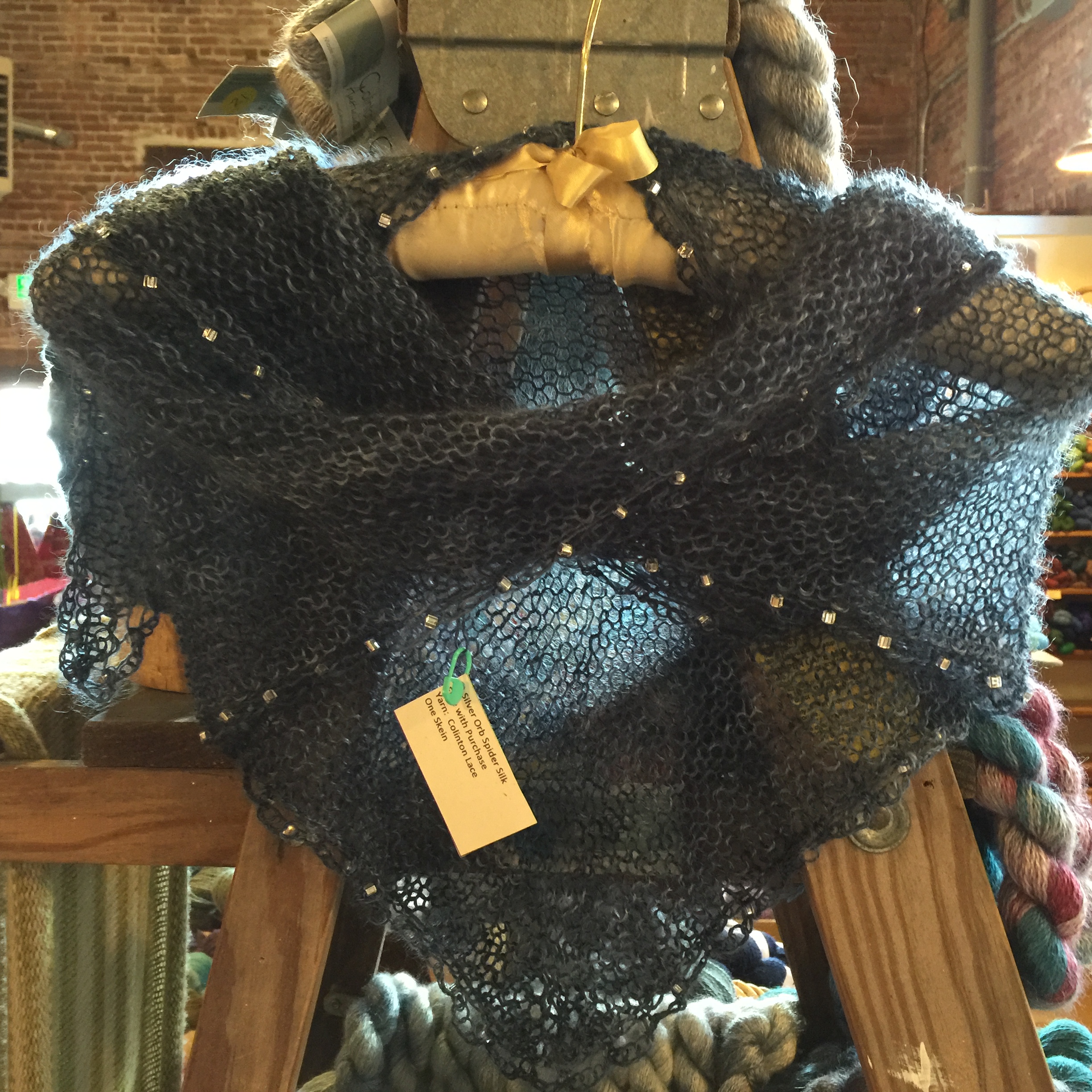
I bought this luscious Australian mohair in another color at Bazaar Girls Yarn Shop & Fibre Emporium on Quincy Street for my sister-in-law. They are a crafting community, crafting community. Don’t you love their tagline?


IMG_3376
The Port Townsend Farmer’s Market is lots of fun, and a good place to meet people because everyone there loves to talk about the wonders of living on the Olympic Peninsula. The musicians below are Ranger & the Re-Arrangers, a Gypsy jazz band from Seattle.