I’ll be taking a break from Books Can Save a Life until December so I can finish a draft of my memoir and get a good start on the revision. Before I go, I wanted to share highlights of my trip to San Francisco, where I attended the 2016 Magic of Memoir conference and spent some time with my son.
I’ve been working with Linda Joy for well over a year, and I had the chance to meet her in person for the first time. We had lunch together and talked memoir, of course. I was fascinated to hear about behind-the-scenes research she did for her second memoir, Song of the Plains, which will be published in 2017 – a delving into family history that took her to Oklahoma, Iowa, and Scotland. (Linda Joy’s first memoir is Don’t Call Me Mother: A Daughter’s Journey from Abandonment to Forgiveness.)
Linda gave me a whirlwind tour of Berkeley, too, whisking me past Chez Panisse, a restaurant I’ve long admired, and other famous spots like Telegraph Avenue, the UC Berkeley campus, the Campanile, People’s Park, and the Berkeley Hills with their incredible views.
At the conference, I met many other writers who have memoirs in progress, which is one of the most valuable aspects of a conference like this. Memoir writing can be lonely, and it’s tremendously inspiring to meet others making the same journey.
We shared our writing with each other as we worked through the exercises and activities concocted by Brooke and Linda Joy to supplement their excellent instruction on the craft of memoir and developing an effective author platform.
Several brave souls shared their work in progress during an open mic session hosted by Laurel Bookstore.
Brooke and Linda Joy are top-notch, experienced teachers in the art of memoir. Their discussions of memoir craft cover the important elements of theme, scene, narration, characterization, and takeaway. They demonstrate these elements with excerpts and examples from memoir classics, such as H Is for Hawk by Helen MacDonald,Wildby Cheryl Strayed,The Duke of Deceptionby Gregory Wolff, and The Glass Castle by Jeannette Walls.
Also cited were some newer memoirs and others I haven’t yet read that you might want to check out if you enjoy the genre, including Body 2.0 by Krista Haapala,Drinking by Caroline Knapp, Sex Object by Jessica Valenti, Brain on Fire by Susannah Cahalan, Love Warriorby Glennon Doyle Melton,Dog Medicine by Julie Barton, and Not My Father’s Son by Alan Cumming.
Here, for example, is takeaway – the heart of a good memoir, a big-picture message or moment of shared connection with the reader, from Body 2.0:
“Endurance pain will not relent with change, as indeed this flavor of pain has changed you. Loved ones may find you unrecognizable. You will see life through different eyes. In fact, endurance pain affords us the incredible opportunity to shed many useless cultural constructs like superficial success, unfulfilling relationships, and external validation.”
To this list I would add another excellent, just-published memoir, Lab Girl by Hope Jahren, which I wrote about in my last post.
With that, I’m off to write. I plan to finish my draft in conjunction with NaNoWriMo,which takes place in November. Since I’m not working on a novel, I guess that makes me a NaNoWriMo rebel. I’ll see you all back here in December, when I hope to have plenty of books to recommend for holiday giving and receiving.
Do you enjoy reading memoir? If so, can you recommend some of your favorites?
I stayed in Bernal Heights and made it nearly to the top of Bernal Heights Park, where I was treated to this view of the city.
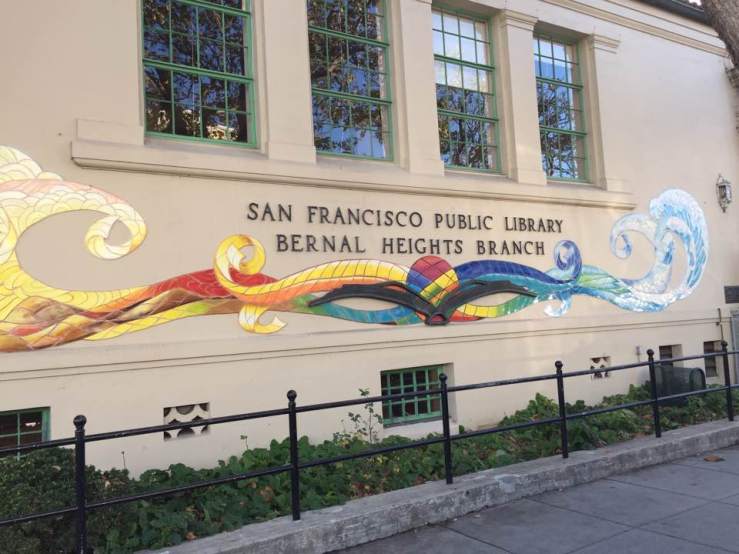
I love all the colorful, artistic touches.
I explored Golden Gate Park with my son. This is Stowe Lake.
At my airbnb, I found this wonderful surprise, a beautifully designed backyard retreat.
“Each beginning is the end of a waiting. We are each given exactly one chance to be. Each of us is both impossible and inevitable. Every replete tree was first a seed that waited.” – Hope Jahren, Lab Girl
“After scientists broke open the coat of a lotus seed (Nelumbo nucifera) and coddled the embryo into growth, they kept the empty husk. When they radiocarbon-dated this discarded outer shell, they discovered that their seedling had been waiting for them within a peat bog in China for no less than two thousand years. This tiny seed had stubbornly kept up the hope of its own future while entire human civilizations rose and fell. And then one day this little plant’s yearning finally burst forth within a laboratory.”
“Science has taught me that everything is more complicated than we first assume, and that being able to derive happiness from discovery is a recipe for a beautiful life.”
Lab Girl is an extraordinary memoir, and Hope Jahren is an important new voice who breaks new ground in literary autobiography. We just don’t hear from enough scientists and researchers, and certainly we don’t hear from enough women in science who have struggled and prevailed at making careers in difficult, often male-dominated fields.
Lab Girl is for the lay person who loves plants, trees, and nature, and for the lay person who thinks plants, trees, and nature are boring and who wants to be dazzled, moved, changed, and reconnected with the holiness and mystery of life.
Lab Girl is for women in science and research, and women thinking of careers in science and research. But men in science and research will love the book, too.
Lab Girl is for anyone making a career and building a family in the face of a serious mental illness, and for those who want to better understand people with mental illness.
Lab Girl is for those who care about the environment and climate change, and who want to connect with someone of like mind whose passion and energy are contagious. Because, as Hope says, we won’t have any trees left in six hundred years if we keep on our current path.
Lab Girl is for anyone who has important work to do and wants to be inspired and emboldened by someone not afraid to be different and go her own way.
I have Katie at Doing Deweyto thank for letting me know about this book. I’ve included several passages from the memoir because I couldn’t decide between them. They make me want to read Lab Girl all over again. I’m sure I will, since I’m working on a memoir of my own. For those of you who are memoir writers, this one is both inspiring and a great memoir model.
Women, and men, doing important work in science simply don’t get enough attention in our culture, which is especially saturated by superficial drivel at the moment. Lab Girl is the antidote. When I was a clinical librarian at UR Medicine, I was always impressed and mystified by the grad students and faculty, the women especially, who had lives so different from mine, who spent hours and hours in labs and out in the field researching esoteric topics that had the potential to change lives.
We should know more about them, the important work they are doing, and how they navigate the challenge of carving out rich, fulfilling personal lives as well. There is a deep vein of fascinating life stories in science that appeal to experts and lay people alike, and I hope Lab Girlwill inspire many more memoirs of this kind.
The excerpt below is a good example of the organizing metaphor in Lab Girl:the rich and evocativeparallels between plant life and human life. Hope alternates between chapters about plant life and her own life, which makes for a satisfying structure:
“Every species on Earth – past or present – from the single-celled microbe to the biggest dinosaur, daisies, trees, people – must accomplish the same five things in order to persist: grow, reproduce, rebuild, store resources, and defend itself….It seemed outrageous to hope that fertility, resources, time, desire, and love could all come together in the right way, and yet most women did eventually walk that path.”
Below are a few more quotes. Read the memoir!
“On some deep level, the realization that I could do good science was accompanied by the knowledge that I had formally and terminally missed my chance to become like any of the women that I had ever known.”
The boldface in the next quote is mine; I think it is an important point:
“A true scientist doesn’t perform prescribed experiments; she develops her own and thus generates wholly new knowledge. This transition between doing what you’re told and telling yourself what to do generally occurs midway through a dissertation. In many ways, it is the most difficult and terrifying thing that a student can do, and being unable or unwilling to do it is much of what weeds people out of Ph.D. programs.”
“Public and private organizations all over the world have studied the mechanics of sexism within science and have concluded that they are complex and multifactorial. In my own small experience, sexism has been something very simple: the cumulative weight of constantly being told that you can’t possibly be what you are.”
“I’m good at science because I’m not good at listening. I have been told that I am intelligent, and I have been told that I am simple-minded. I have been told that I am trying to do too much, and I have been told that what I have done amounts to very little. I have been told that I can’t do what I want to do because I am a woman, and I have been told that I have only been allowed to do what I have done because I am a woman. I have been told that I can have eternal life, and I have been told that I will burn myself out into an early death. I have been admonished for being too feminine and I have been distrusted for being too masculine. I have been warned that I am far too sensitive and I have been accused of being heartlessly callous. But I was told all of these things by people who can’t understand the present or see the future any better than I can. Such recurrent pronouncements have forced me to accept that because I am a female scientist, nobody knows what the hell I am, and it has given me the delicious freedom to make it up as I go along. I don’t take advice from my colleagues, and I try not to give it. When I am pressed, I resort to these two sentences: You shouldn’t take this job too seriously. Except for when you should.”
Have you read Lab Girl? Do you have memoir favorites to recommend?
I’d love to hear what you’ve been reading, too, so let us know in the comments. Book suggestions are appreciated and welcome, especially for those categories I’ve left blank.
By the way, Ann just released her new novel, Commonwealth. Many of you know she’s one of my favorite novelists, so I’ll be sure to get my hands on it as soon as I can.
True story, when Ann was a girl, one morning she woke up to find kids she didn’t know in the kitchen. Turned out, her mother had gotten remarried, and these were her new half siblings.
Ann has translated some of that strange family experience into a novel that isn’t, literally, a true story, but that I imagine has plenty of emotional truth, as writers of fiction often say about their work.
Read a nonfiction book about science: Lab Girl, by Hope Jahren. (I’m reading it now). It has gotten excellent reviews, a memoir about a female scientist. It’s an eye opener, in part about what women in science are (still) up against, but there’s a lot more to this memoir about a woman passionate about plants.
I just borrowed Half-Earth: Our Planet’s Fight for Life, by Edward O. Wilson from the library. Nearing the end of his life, Wilson felt compelled to sound the alarm once more. He proposes that we devote half the surface of the earth to nature.
Read a book out loud to someone else: TheHarry Potter series; The Giver;andHatchet. Not this year, but when our sons were growing up, these were unforgettable read alouds. Harry Potteris especially captivating read deep in the woods at night when you’re camping.
Read a middle grade novel: see above, none this year for me.
Read a biography (not memoir or autobiography): Charlotte Bronté: A Fiery Heart,by Claire Harmon is on my to-read list. See the feminist category below.
Read a dystopian or post-apocalyptic novel: The Buried Giantby Kazuo Ishiguro, and Find Me,by Laura Van Den Berg.I read everything by Ishiguro. The latter novel by Van Den Berg was well reviewed and is excellent, though it didn’t really speak to me.
Read a book originally published in the decade you were born: I’ve been wanting to re-read Australian Neville Shute’s chilling dystopian novel, On the Beach. His A Town Like Alice blew me away in 1981 as a 5-hour Masterpiece Theatre production, and I would love to watch it again. (It’s only available on VHS.) I don’t believe I ever read the book.
Listen to an audiobook that has won an Audie Award:
The Bully Pulpit: Theodore Roosevelt, William Howard Taft, and the Golden Age of Journalism,by Dorothy Kearns Goodwin.OK, I haven’t read this book or even listened to it, but I gave it as a gift to a friend who loves Teddy Roosevelt. It won an Audie in 2015 for the best History/Biography category. This would qualify for the over 500 pages category, too, which is reason enough to listen to the audio version. I should read this or listen to it, considering that I believe journalism today is in a sorry state.
There is an Audie Classic Category, which I didn’t know about but just may entice me to finally start listening to audio books. Here’s a suggestion that sounds intriguing, also an Audie award winner: The New York Stories by John O’Hara.
I will try audio books soon, but I resist them. I don’t want to constantly fill my head with media, I need plenty of silence to think and to let my own writing germinate.
I’ve read and hear often that print books will disappear. Some people announce this with a great deal of glee, and I don’t understand why. Can we have both? Why does it seem to make some people happy that print books may disappear?
Read a book over 500 pages long:Elena Ferrante’sNeapolitan Novels. I’m counting this as a long read, even though there are four in the series. Had a great discussion about these books in a book club attended by many Italian-American women. One day I’ll read her other novels, which I’ve heard are rather devastating.
Read a book under 100 pages: Tribe, by Sebastian Junger. (130 pages, close enough)
Read a book by or about a person that identifies as transgender: Middlesex, by Jeffrey Eugenides, one of my favorites. Read this a few years back, superb.
Read a book that is set in the Middle East
Read a book that is by an author from Southeast Asia
Read a non-superhero comic that debuted in the last three years: This book is older than three years–I picked up Fun Home: A Family Tragicomic, by Alison Bechdel, but didn’t finish it. I may get back to it someday. It’s becoming a classic.
Read a book that was adapted into a movie, then watch the movie. Debate which is better:
I did see the movie, Brooklyn, by Colm Toibin, but didn’t read the book, don’t plan to. The movie was pretty good, mostly because of the acting, otherwise predictable.
I also saw this year the movie Carol based on the novel, The Price of Salt, by Patricia Highsmith. I thought it was excellent, haven’t read the novel. I was flabbergasted when someone I know said the main character in the movie was a predator. That is not how I interpreted the character in this movie about a lesbian relationship in the 1950s. I saw her as sympathetic. If anyone else has seen the movie and can comment, I’d love to hear your thoughts. I felt the predator comment revealed perhaps unconscious LGTBQ bias; but then again, Highsmith’s novels have disturbing characters. Perhaps the actual novel was darker, and some of that came through in the movie?
Read a nonfiction book about feminism or dealing with feminist themes:
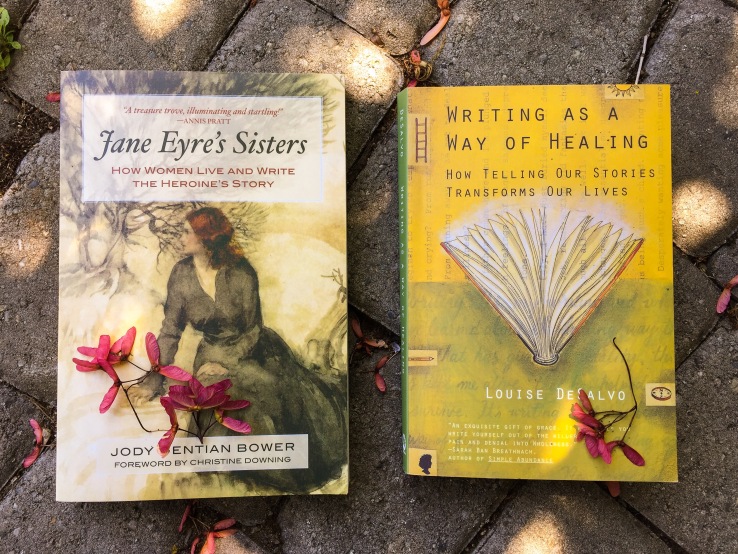
My Life on the Road,by Gloria Steinem is a big bio this year, though I haven’t read it. I HAVE read, this year, and in the case of Bronté’s novel, many years in the past: Jane Eyre’s Sisters, by Jody Gentian BowerandJane Eyre. These, because my memoir has a Jane Eyre theme. Last year I read Bad Feminist by Roxane Gay. Fabulous.
Read a book about religion (fiction or nonfiction): After Buddhism, by Stephen Batchelor. (On my to-read list)
Read a food memoir: On my to-read list is Blue PlateSpecialby Kate Christensen. Classics I love are Laurie Colwin’s food memoirs. Elizabeth David was a superb food writer, though her books aren’t really memoirs. Ruth Reichl has come out with a new food memoir this year that I haven’t read, My Kitchen Life: 136 Recipes that Changed My Life.
Read a play
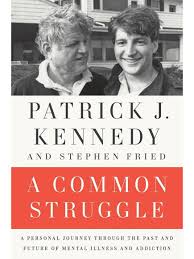
Read a book with a main character that has a mental illness: A Common Struggle, by Patrick J. Kennedy. This is a memoir. I also read the riveting memoir, A Mother’s Reckoning.The Eagle Tree by Ned Hayes is fiction, and it’s absolutely great.
Here’s a smidgen of The Masterpiece Theatre version of A Town Like Alice.
Have you read any books in these categories, or do you have any suggestions? Are you following the Read Harder challenge? Let us know in the comments.
“For all its occasional monotony, driving a dogsled never let my mind wander. It was an overwhelmingly physical experience: the cold, the shifting runners, the wandering trail. It made my mind shallower. There was the brushing sound of snow under the sled. There were the dogs, the beautiful dogs, running, and I could spend hours watching the changing, hypnotic rhythms of their back legs punching up and down. Occasionally I talked to them, and then I’d drift off in midsentence and recall the rest of my thoughts minutes later. Or else I’d run up a hill, or fix a tangle, or scooter my feet to keep warm. It didn’t matter. I was still just driving dogs.”
I’m so glad she did, and not just because it was great reading in the middle of a hot July. This is an exquisitely written coming of age story about Blair’s love affair with the North, focusing especially on her stays in Norway, where she set up a small museum, learned to drive sled dogs, and befriended a town; and her stint as a tour guide on a glacier in Alaska.
I loved reading about Blair’s adventures, and her depictions of nature and the wild are so well done. But for me the heart of the story was her relationship with the folks in a northern Norwegian town, Mortenhals, especially a sixties-something shopkeeper, Arild, who becomes a beloved friend and Blair’s Norwegian “father.”
There is a dark theme that motivates Blair to make her way in the North that is just as strong as her love of the harsh and beautiful land, but this is not really a memoir about trauma: there is so much more light than shadow.
Raised in California, Blair had a clear calling for the North, but one of her first stays in Norway had an unfortunate twist. As a 16-year-old exchange student, she didn’t feel safe around the strange, sexually threatening father of the family she was placed with. Her subsequent journeys North become, in part, a way for Blair to prove to herself she could be tough and strong in a world where women are often vulnerable to physically threatening men.
If you are a fan of autobiographical writing, you’ll appreciate the quiet, intimate scenes of small town life just as much, if not more, as Blair’s adventures out in the elements. I marveled at the skill with which Blair rendered scene after scene, and found myself deconstructing long passages so I could capture some of her magic in my writing.
Blair is now a dogsledder in northern Wisconsin and training to race the Iditerod in 2019. She’ll have lots more to write about, which is great for us readers who love top-notch memoirs and nature writing.
Here’s a 9-minute look at what it’s like to run a 100-mile dogsled race.
“I didn’t know that if you want to write and don’t, because you don’t feel worthy enough or able enough, not writing will eventually begin to erase who you are.”
“What if writing were as important as a basic human function and as significant to maintaining and promoting our psychic and physical wellness as, say, exercise, healthful food, pure water, clean air, rest and repose, and some soul-satisfying practice?”
“This book is an invitation for you to use the simple act of writing as a way of reimagining who you are or remembering who you were.” – Louise DeSalvo
I’d heard DeSalvo speak at a free National Association of Memoir Writers teleseminar, and she was fantastic. (The founder of NAMW is my wonderful writing coach, Linda Joy Myers, who does an outstanding job connecting the best memoir writers and teachers with those of us trying to make our way through the wilderness of writing our own memoirs.)
I would say if you are writing a memoir, a novel, or any long-form work of nonfiction, or if you want to write about your life as a form of self-expression, this book is a must-read, a valuable companion to have at your side at all times while you work. DeSalvo’s voice is warm, wise, encouraging, and firm. She’ll help you develop a common sense writing practice that is less of a struggle and more intentional, self-caring, and restorative.
One of DeSalvo’s key points is that writing your story is healing and transformative, but only if you go about it the right way. As a medical librarian, I’m all for looking at what the scientific research has to say before making a claim about anything, and DeSalvo does just that.
We’ve all heard that writing can be healing, but simply venting emotions on the page may cause a writer to get stuck or even set the writer back. On the other hand, telling what happened in a dispassionate way – a mere listing of events – won’t do much, either.
Writers need to do both – honestly tell about events and honestly recount their emotions – and link them in a meaningful way. “A healing narrative links feelings with events.”
Research has shown that only when a person tells what happened with honesty, nuance, and detail that includes not just events, but feelings, and with the intention of unearthing and crafting a true, meaningful story – only then does writing about one’s life hold the possibility of transformation.
This is not easy. It requires honest self-evaluation and facing aspects of yourself you may have kept hidden. It requires putting yourself in the place of others so you can understand why they may have behaved in certain ways.
Vivid characterization, dialogue reconstructed to the best of your ability, movie-like scenes that highlight key events and emotional peaks and valleys, all woven into a narrative, is a lot of work, but it’s a way to re-experience life events that can bring catharsis, insight, and meaning.
DeSalvo points to research that suggests people who recall traumatic events in a vague, general way – without detail or nuance – have not yet begun the healing process. I was amazed when I read this, because my first drafts tend to be frustratingly superficial. As a child and adolescent, I’d numbed out to protect myself and, as an adult, to avoid grappling with painful events. Writing about them now often requires several drafts as I gradually mine through to the essentials of the experience. I thought this was a sign that I was a mediocre writer. DeSalvo helped me understand that this is a normal part of the healing and writing process.
Even though I haven’t finished writing my memoir, I’ve already reaped benefits. Writing about events that are emotionally difficult or that arouse shame indeed lose their repressive power over me once they are on the page.
Honoring people’s privacy is also a concern that can hold writers back, but DeSalvo encourages us to remember we are writing a draft, and that these issues can be carefully considered later, if we want to publish. At that time, we can make revisions to protect privacy.
She reminds us, too, that there is a lot to be said for public testimony (in a way that doesn’t harm others) about trauma and issues that society has pressured many of us to keep silent about. In the case of mental illness, for example, no one is healed and nothing can improve unless long-avoided issues are brought into the light of day and confronted.
For me, DeSalvo’s book is most valuable because she has given me a way to write a memoir without losing my mind. She breaks down the process into phases and walks me through each one: Preparing, Planning, Germinating, Working, Deepening, Shaping, Ordering, and Completing.
Not every phase is pleasurable, and if we have difficulty, we aren’t to blame ourselves, but persist. It’s just part of the process. We learn what we can realistically expect in each phase, which greatly reduces anxiety.
I’m still learning how to integrate writing into my everyday life so it becomes habitual, manageable, and enjoyable. I’m still learning how to care for myself as I write – for example, by writing in short, frequent doses so I’m not overwhelmed emotionally and by judiciously sharing my writing only with those who support my work and have some understanding of the rigors of the process.
I should add that, as I’ve excavated my life and the effects of my mother’s mental illness on our family over the years, I’ve had the help of an excellent therapist. DeSalvo encourages writers to connect with a good therapist if they’re having difficulties. Writing is not a substitute for therapy. She says: “I personally believe it is essential for people wanting to write about extreme situations to have skilled professional support while writing or to attend a reputable support group.”
There is so much more to this book. DeSalvo draws on the wisdom of psychologists, researchers, and well-known writers, integrating their knowledge into a compelling and enormously helpful guide.
Many, many passages in my copy of Writing As a Way of Healing are underlined. Here are a few:
“Sometimes the writer is unsure about precisely what happened because…she or he was in a state of shock or emotional numbness while it was happening. The most basic and important survival tactics often involve blunting the emotions, carefully watching, splitting the consciousness (watching the event as if it’s happening to someone else), even splitting the self (into two or more personae). Finding words, finding literary forms to convey these self-preserving defensive tactics, these superlinguistic layers of meaning, often seems impossible.”
“Virginia Woolf said moments of profound insight that come from writing about our soulful, thoughtful examination of our psychic wounds should be called ‘shocks.’ For they force us into an awareness about ourselves and our relationship to others and our place in the world that we wouldn’t otherwise have had. They realign the essential nature of our being.”
“In time, I learned how Zen artists and writers devote themselves to an orderly, contemplative way of life that prepares them for their work. But how doing their work, too, becomes a form of meditation. Work and life are deeply integrated.”
A quote by Henry Miller:“[Writing] lifts the sufferer out of his obsessions and frees him for the rhythm and movement of life by joining him to the great universal stream in which we all have our being.”
Note: After reading this post, my dear writing coach, Linda Joy, tried to leave a comment, but either WordPress or my comment settings didn’t allow her to. So I’m putting her words here, which I greatly appreciate:
What a wonderful essay about the essentials in writing memoir and narrating our truths. I have loved Louise DeSalvo’s book for years and was so happy when she joined us for two NAMW presentations last year! I also got the other books, Jane Eyre’s Sisters thanks to you Valorie, and love it. It offers a more accurate template for the heroine’s story, which is necessarily an internal journey, not just an external one. Thank you for illuminating these gems and what you find valuable in your lovely blog! – Linda Joy Myers
Thank you, Linda Joy.
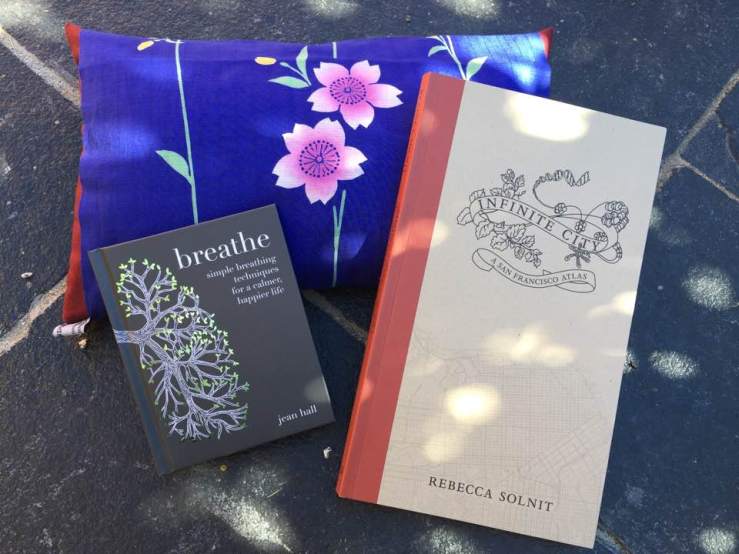
Below are photos of Port Townsend, where I did some writing and read Louise DeSalvo’s book. Nature is a wonderful restorative when you’re writing memoir.
(By the way, the photo above shows Jane Eyre’s Sisters, which I also picked up at The Writer’s Workshoppe and Imprint Bookstore. I’m still making my way through it. Jane Eyre has a role to play in my memoir.)
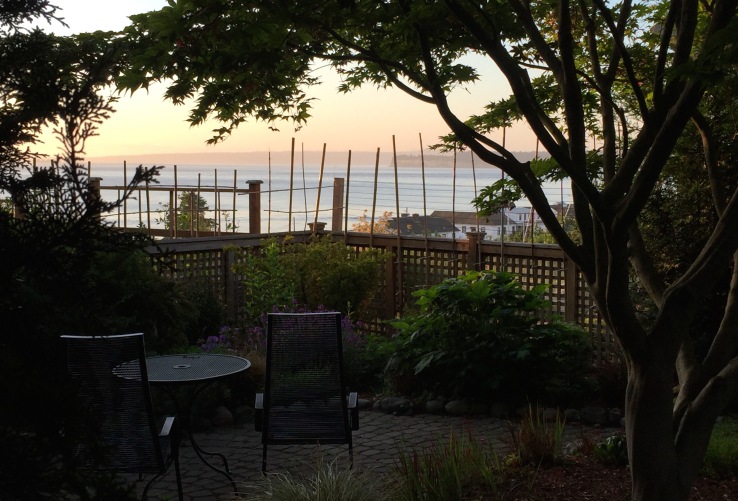
My airbnb had a secret garden with a view of Puget Sound, which has many moods…
7 a.m.
Shades of pink as sunset approaches
One morning I woke up and saw the Cascades.
A blue and gray day
I zoomed in with my iPhone so the photo is grainy, but this day was exceptionally crisp and clear.
Port Townsend has many fascinating and unusual shops where you just want to linger. (Note the reflection of the bay in the window.)
I bought this luscious Australian mohair in another color at Bazaar Girls Yarn Shop & Fibre Emporium on Quincy Street for my sister-in-law. They are a crafting community, crafting community. Don’t you love their tagline?
The Port Townsend Farmer’s Market is lots of fun, and a good place to meet people because everyone there loves to talk about the wonders of living on the Olympic Peninsula. The musicians below are Ranger & the Re-Arrangers, a Gypsy jazz band from Seattle.
“Hold out your hands and let me lay upon them a sheaf of freshly picked sweetgrass, loose and flowing, like newly washed hair… Hold the bundle up to your nose. Find the fragrance of honeyed vanilla over the scent of river water and black earth and you understand its scientific name: Hierochloe odorata, meaning the fragrant, holy grass. In our language it is called wiingaashk, the sweet-smelling hair of Mother Earth. Breathe it in and you start to remember things you didn’t know you had forgotten.” Robin Wall Kimmerer, Braiding Sweetgrass
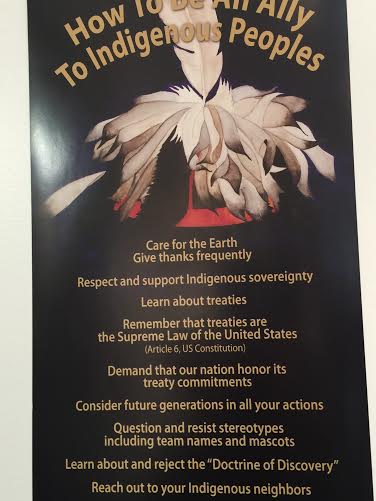
I’ve been working on my first podcast in a nature series, and as part of my research I visited Ganondagan, a cultural center and historic site that was the home of the Seneca Nation of the Iroquois Confederacy. It has an intriguing array of programs, from animal tracking to music to meditation to dance. Last Sunday, I heard Robin Wall Kimmerer speak about her book, Braiding Sweetgrass, which I highly recommend to anyone who cares about nature, the land, and saving the earth.
Robin Wall Kimmerer leads us in a song to save the earth at Ganondagan
I’m about a quarter of the way through Braiding Sweetgrass. I’m loving the poetry of her writing as I take in the simple but profound indigenous wisdom Kimmerer is eager to pass on. It’s wisdom we as a culture have long overlooked and which may save us all, if we pay attention. Braiding Sweetgrass is a book to read slowly and savor.
Robin is a botanist, a professor of environmental biology, and a member of the Citizen Potawatomi Nation. She is descended from the Anishinabekwe of the New England region; in the forced Native American migration her people settled in Oklahoma.
There, her grandfather, by law, had to leave the reservation when he was nine years old to attend public school. At that point, their language and most of their indigenous wisdom was lost.
Robin has spent a good part of her adulthood reclaiming both as she also pursues the life of a botanist and university professor.
Here Robin expresses what she aimed for in writing Braiding Sweetgrass:
“I offer…a braid of stories meant to heal our relationship with the world. This braid is woven from three strands: indigenous ways of knowing, scientific knowledge, and the story of an Anishinabekwe scientist trying to bring them together in service to what matters most. It is an intertwining of science, spirit, and story – old stories and new ones that can be medicine for our broken relationship with earth, a pharmacopoeia of healing stories that allow us to imagine a different relationship, in which people and land are good medicine for each other.”
I’ve still many pages to go, so I’ll write more once I finish the book. I’ll leave you with this:
“In the settler mind, land was property, real estate, capital or natural resources. But to our people, it was everything: identity, the connection to our ancestors, the home of our nonhuman kinfolk, our pharmacy, our library, the source of all that sustained us….It belonged to itself; it was a gift, not a commodity, so it could never be sold.”
A Personal Journey Through the Past and Future of Mental Illness and Addiction
“‘I have never seen a case worse than you, Patrick. You’ve been at this for so long, and the fact that you’ve survived and you’re still doing it almost makes you more dangerous. You’re able to manage it, just like your father managed it….’
He [Chris Lawford, Patrick Kennedy’s cousin] said he knew that at any given moment, I could say I wanted to go off to Australia with all my money and drink and drug myself to death. What he didn’t know, and neither did Amy, was that I had considered such a plan.”Patrick J. Kennedy,A Common Struggle
I never thought I’d read a Kennedy memoir, we’ve been so saturated through the years with media coverage about the Kennedy family. Usually, I read literary memoirs, and this one isn’t. But I knew I had to read A Common Struggle, given my interest in mental health issues and wanting to see things change for the better, for once, rather than for the worse.
Patrick Kennedy has bipolar disorder, severe anxiety disorder, and has struggled with addiction to alcohol and prescription medication most of his life. His memoir, A Common Struggle,co-written with Stephen Fried, describes in excruciating detail how Ted Kennedy’s son managed somehow to keep this a secret (more or less) even as he served as Congressman from Rhode Island for many years.
In fact, Patrick’s entire nuclear family struggled with addiction, and all of them went through rehab at least once, if not multiple times – all except for Ted Kennedy. Not that he didn’t need it – Ted Kennedy’s family staged an intervention once, but Kennedy refused to acknowledge or accept that he had an addiction to alcohol.
This is a fascinating read. The Kennedys have a remarkable record of public service and, despite his debilitating mental health and addiction issues, Patrick Kennedy led the fight for successful passage of the Mental Health Parity and Addiction Equity Act. Given our complex and often dysfunctional political system, this is truly an achievement, even though the act, which requires insurance coverage of mental illness and addiction equal to coverage of physical illnesses, hasn’t yet been fully implemented.
Patrick Kennedy and others had to fight hard to make sure that addiction was included along with mental health. This was an enlightened step. It’s about time, since there is an epidemic of opioid and heroin addiction and overdose in the US. Only now are attitudes beginning to change so that addiction is increasingly viewed as a health problem, not a crime or a personal weakness.
Patrick ultimately decided that he couldn’t sustain his lifestyle as a Congressman and handle his addiction and mental health issues, so he eventually left Congress. He is currently the leading advocate in the US for mental health and substance abuse care, research and policy.
I’ve sometimes been dismissive of the Kennedys and their privilege, but Patrick’s memoir made me realize how devoted the extended family is to public service and what a difference they’ve made on many fronts. If you are interested in mental health and substance abuse issues, and/or if you want to become an advocate for better mental health care and research, I think you’ll get a lot out of Kennedy’s memoir. He weaves into his personal story a detailed history of mental health legislation in this country – legislation that is woefully lacking.
There are fantastic appendices, too, that summarize the many issues we need to advocate for and change, and that list the most prominent mental health and substance abuse support groups and organizations in the US.
I get discouraged about the lack of funding and services for people who suffer from mental illness and addiction and the long road it has been over the years to see improvement. Seems like common sense that we’d want to make changes for the better, but sadly our priorities are elsewhere. This is a shame, because these issues affect one out of five families – so is there anyone among us who hasn’t been touched in some way by mental illness or addiction?
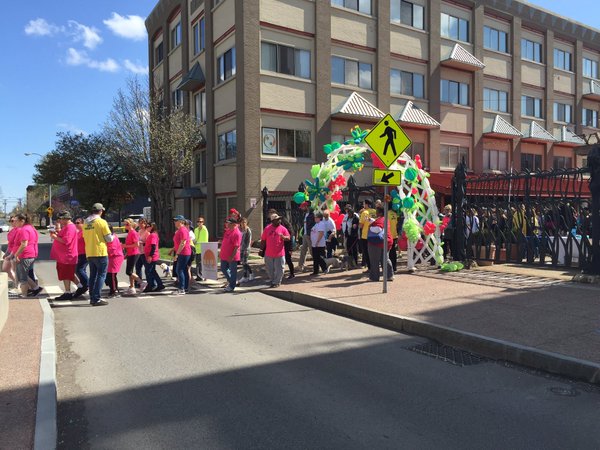
Last weekend my husband and I took part in NAMI Walks in Rochester, an annual May is Mental Health Month fund-raiser for the National Alliance on Mental Illness. Over a thousand people walked. (There is still time to donate, go to the NAMI Walks link!)
I’m also proud to report that NAMI Rochester has such an extensive and devoted cadre of family members and volunteers working on behalf of mental health education and advocacy, they have been named the TOP NAMI affiliate in the country for 2016. They will be honored at the NAMI National Convention in July.
NAMI Rochester Streakers take the lead for NAMI Walks.NAMI Walks leaving the Village Gate in Rochester’s Neighborhood of the Arts.
“…Kent State on that early afternoon of May 4 is where all the raging waters of the 1960s, bad and good, evil and sublime, flowed together for one brief, horrible moment.”
“…the Guardsmen turned back toward the parking lot, went down on one knee or crouched, and raised their M1s to their shoulders.” – Howard Means,67 Shots: Kent State and the End of American Innocence
Excavating a Life
May 4, 2016 is the 46th anniversary of the shootings at Kent State in Ohio, where four students were killed and nine injured by the National Guard during campus protests of US involvement in the Vietnam War.
I was fifteen at the time and lived about 40 minutes away from the Kent State campus. That tragic day has a part to play in the memoir I’m writing, but at first I didn’t realize it. In early memoir drafts, I mentioned May 4 only briefly. In my view it was someone else’s story, and I was having a hard time remembering how I felt about this tragedy that happened so long ago.
But the more I wrote, the more Kent State haunted me. I began to realize May 4 had been a turning point in my political consciousness. It’s probably more accurate to say that Kent State was the birth of my political consciousness.
I began to think about the role of the tumultuous 1960s in the life of my family. I had two younger brothers, and I didn’t realize back then how much my father worried about them being drafted. Years later, he told me he’d happily have given them some cash and urged them off to Canada. A World War II veteran with a Purple Heart and an active member of AMVETS, my dad kept his anti-war opinions to himself because he’d have been viewed as unpatriotic by most of his friends.
My father was badly wounded during World War II, and in retrospect I think he may have had a form of PTSD. In the days after May 4, it was common to hear angry locals say the National Guard should have shot all of the student protesters. I don’t recall talking with my father about Kent, but he must have been horrified by the military takeover of the campus and the fact that students had been killed.
As for me, up until May 4, 1970, I’d been just an interested onlooker while the 1960s played out on the nightly news. I had my hands full maneuvering my teen years with a mentally ill mother, and I hadn’t given much thought to social causes. But suddenly the older brothers and sisters of my friends were hitchhiking home, refugees from Kent State, Ohio State, and other local colleges that had been shut down amid protests, tear gassing, and riots. I recall plenty of arguing about who did what to whom and who was at fault.
To me, it seemed clear: the National Guard had bullets, and the students didn’t.
For decades, people have been trying to piece together the sequence of events that led to the Kent State tragedy on May 4, with only partial success. No one directly or indirectly involved has the big picture, and it’s unlikely anyone ever will. My Spanish teacher took a leave for a couple of months to serve on the federal grand jury that investigated the shootings. Later, she told us that she remained baffled. No one admitted to giving the order to fire on the students, and no one was held accountable.
67 Shots: Kent State and the End of American Innocenceby Howard Means was published in April, and I bought the book as soon as it was available. It’s a fascinating read that has given me a much clearer picture of the fraught atmosphere in my part of the world and in the nation in 1970. This historical context will be invaluable as I continue to work on my memoir.
I think Means has done a good job of even-handedly summarizing what is known about May 4, the events that led up to it, and its aftermath. His book is a page-turner, packed with many first-person accounts from all sides: student onlookers, student protesters, Guardsmen, Kent faculty and administration, and many others.
Now I understand that there was no focused planning by the students protesting the war in the days before May 4 and on that fateful afternoon. In fact, the hard-core protesters were only a small group among many thousands of students who were curious onlookers or simply passing by on their way to class. Nor did the Kent State administration, the office of Ohio Governor Jim Rhodes, or the National Guard have a rational plan for diffusing the situation.
Instead, as Means clearly depicts, there was only monumental incompetence and mismanagement on the part of just about everyone.
Ultimately, Means takes the view that the students had a right to peacefully assemble and protest, and this right was violated by a vast over-reaction that turned deadly when the military became involved.
Means makes clear that the students weren’t blameless. A small group of them burned down the ROTC building on the Friday evening before the Monday shootings, and a crowd of drunk students vandalized businesses in downtown Kent, badly frightening the residents. (ROTC buildings on many a campus across the nation were destroyed.) Just before the shootings, the hard-core war protesters were throwing rocks and bricks at the Guardsmen. But Means says that videotapes show these students weren’t close enough to the Guardsmen to seriously hurt them, and in the end only one Guardsman was taken to the hospital, for hyperventilation.
Here are a few excerpts that I found enlightening but disturbing. I hadn’t realized the depth of the hostility between Kent State and the larger community back then:
“’The town hated the students, and the town hated the faculty,’ recalled Lew Fried, who joined the English faculty in the fall of 1969 and would remain at Kent State for the rest of his career. ‘This was a very conservative, right-wing-to-reactionary town. I was told that after the shootings, when students were being forced to leave campus, the majority of the town, which had grown fat on student-generated income, refused to sell them food, refused to sell them gas.'”
And this:
“Janice Marie Wascko was sitting with her roommates on the front lawn of their house in downtown Kent that evening when a patrolling police cruiser noticed antiwar slogans chalked on the sidewalk and a low retaining wall. The cruiser, she said, had no license plates. Badge numbers were taped over. ‘They had a sawed-off shotgun and pulled it on us. And they got out of the cruiser and stood there, pulled the guns on us, and said, ‘Wipe it up, scum,’ and made us get down on our hands and knees and wipe it off, the slogans off the wall and the sidewalk. [They were] saying, ‘We should have killed you all,’ and laughing at us. A short time later…they caught somebody down by what is Pufferbelly’s [restaurant] now and beat the crap out of him against a wall.’”
I’ve been selective in the excerpts I’ve included, based on my own stance and bias. I want to emphasize that Means provides a more balanced, nuanced view in 67 Shots.
Here are additional points from the book that I found noteworthy:
Over 1300 National Guardsmen, 17 helicopters, and 250 half tracks, full tracks and armored personnel carriers, including three mortar launchers, were sent to the Kent State campus. On Saturday and Sunday before the shootings, helicopters hovered 24/7 over the campus and town, lighting the sky with searchlights throughout the night. This greatly fueled paranoia, suspicion, and fear among the students and townspeople.
After initial media stories mistakenly reported that National Guard soldiers had been killed, some residents of Kent were armed and ready in the streets and on rooftops for the hordes of students they feared were about to raid their town. Rumors circulated that student radicals had poisoned the water supply with LSD.
The vast majority of Kent State students were interested onlookers, not war protestors, but some became instantly radicalized by the overwhelming military presence. Most students and faculty assumed that the National Guardsmen’s M1 rifles were not loaded. Many of the Guardsmen were young, inexperienced, and poorly led – local boys who were the same age as the students.
President Nixon was frustrated when FBI Director J. Edgar Hoover and his COINTELPRO program of spying on war protestors, black activists, and women’s rights and lesbian/gay groups found no evidence of communist involvement in the protests at Kent and other universities. Some historians believe Kent State was the beginning of Nixon’s downfall – his obsession with spying eventually ended in the Watergate scandal.
Some say Kent State helped stopped the Vietnam War. Others believe the military response had a chilling effect on protests; in the 1970s social movements died out and people turned inward.
There’s lots more I could say about 67 Shots and its impact on my own story. I also worry about how ripe we are here in the US again for protests to become violent. But for now, I’ll leave you with this:
My dad often told stories about World War II, which I now realize he censored quite heavily. One day when our sons, Andrew and Matt, were just old enough to appreciate that their grandfather had once been a young man with interesting experiences, we’d been talking about the war in Iraq. My father reminisced about being drafted in World War II and boarding the train with his cousin, bound for basic training, and how the extended family saw them off. He talked about the Battle of Metz, where he was wounded and many were killed.
“I think about the war every single day of my life.” Turning to Andrew and Matt, my father said, “War is a terrible thing. Just because someone tells you to do something, doesn’t mean you have to do it.”
The song “Ohio” by Crosby, Stills, Nash & Young captures the tenor of the times. There is a video with Kent State photos and an “Ohio” soundtrack uploaded by Mars Daniels on YouTube you might want to check out. Daniels claims fair use, but I have my doubts about copyright legality, so I’m not linking to it directly.
Note: Ten days after the Kent State shootings, two African American students were killed and many were wounded by police and state troopers at Jackson State College in Mississippi. The students were protesting racial intimidation as well as the killings at Kent State. The tragedy at Jackson State received little media coverage, whereas the deaths of white students at Kent was all over the news.
If you lived through the 1960s, are there events that resonate for you on a personal level? If you’re younger, do your parents have memories of that time that they find especially meaningful? If you write memoir, have you used historical sources to shed light on your own formative experiences?
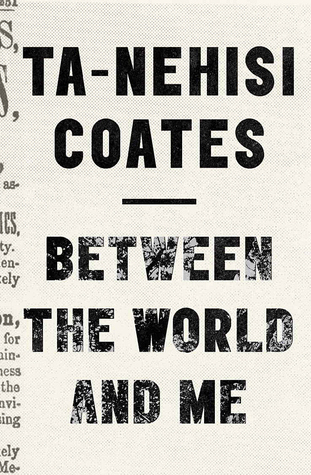
“We should seek not a world where the black race and white race live in harmony but a world in which black and white have no real political meaning.” Ta-Nehisi Coates, Between the World and Me
“You are growing into consciousness, and my wish for you is that you feel no need to constrict yourself to make other people comfortable.”
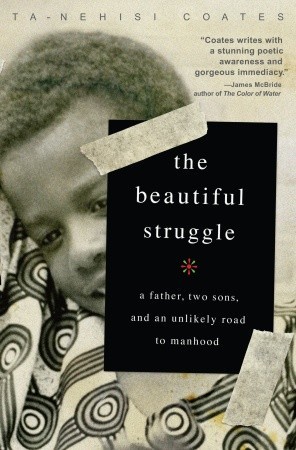
I read this book together with Ta-Nehisi Coates’ The Beautiful Struggle, a coming of age memoir about growing up black in West Baltimore, and the two are excellent read back to back. If you want to see what Ta-Nehisi Coates is all about, I recommend reading the memoir first, so you’ll have background about Coates’ childhood and family, and then follow up with Between the World and Me so you have some context.
Fair warning, though, I found neither book an easy read emotionally, and you may not either if you are a white American. (Or, as Coates would say, if you think you are white. Coates believes race is a falsehood.)
“Americans believe in the reality of ‘race’ as a defined, indubitable reality of the natural world. Racism – the need to ascribe bone-deep features to people and then humiliate, reduce, and destroy them – inevitably follows from this inalterable condition. In this way racism is rendered as the innocent daughter of Mother Nature, and one is left to deplore the Middle Passage or the Trail of Tears the way one deplores an earthquake, a tornado, or any other phenomenon that can be cast as beyond the handiwork of men.”
There is plenty of uncomfortable truth in these two books, and Coates does not mince words. Between the World and Me,especially, is meant to awaken America from its false Dream.
I grew up in a somewhat racially diverse town outside of Cleveland and attended public school alongside African Americans, but there was de facto segregation, with blacks in their own neighborhood not far from where I lived. In retrospect, and especially after having read Coates, I see how absolutely separate and different our lives actually were.
When I began reading The Beautiful Struggle, I found myself baffled by the words and phrases Coates used and many of his cultural references. I was reading a different language, the language of urban black America. The language is perhaps deliberately exaggerated in the first pages, and not decoded, maybe to act as a kind of culture shock or wake-up call to the reader.
A senior writer at The Atlantic, Ta-Nehisi Coates grew up in one of the toughest, most marginalized and deprived communities in America. His father was a Black Panther who later became a librarian; his employment at the Howard University library enabled his children to attend school there tuition free.
I’m not going to summarize too much about the books, because I can’t do justice to Coates’ eloquent, powerful prose as he describes how the African American body has been violated through slavery, segregation, incarceration, and death at the hands of our criminal justice system. His words are sometimes hard to take, and both books are unfailingly hard to put down. I was especially struck by these aspects:
How very terrifying it is to be pulled over or questioned by a police officer if you are black in America. I think the only thing more powerful than Coates’ words are the videos we’ve seen of incidents gone wrong these past few years. I respect the bravery of police officers doing incredibly challenging work, but I’ve also been following the news in Cleveland, where I grew up, and how the police department there has been investigated by the US Department of Justice. My son attends the U. of Cincinnati, where this past year an unarmed black man was killed by a campus security officer for no apparent reason. (The officer has been charged with murder.) When the video went viral, I was chilled by what I saw, frightened for my son and anyone who might be at the wrong place at the wrong time.
Coates recounts the first time he visited Paris, France. Growing up in West Baltimore, he could never have imagined such a gracious and beautiful place or that he would ever go there. It was moving to read Coates’ description of how easy it was for him to walk the streets of Paris, how differently he was treated, and how for the first time he wasn’t afraid.
Coates concludes that the fate of all of us is in the hands of those with power who think they are white – he believes many, though not all, African Americans are still too disenfranchised to change the system. But he fears that we as a country will reap what we’ve sown; that our hunger for power has also meant the abuse and destruction of the earth. He fears that in the end the earth will prevail, likely at great cost to humanity.
Here is one more quote from Between the World and Me, an example of his powerful use of language that some may see as divisive or offensive:
“The truth is that the police reflect America in all of its will and fear, and whatever we might make of this country’s criminal justice policy, it cannot be said that it was imposed by a repressive minority. The abuses that have followed from these policies—the sprawling carceral state, the random detention of black people, the torture of suspects—are the product of democratic will. And so to challenge the police is to challenge the American people who send them into the ghettos armed with the same self-generated fears that compelled the people who think they are white to flee the cities and into the Dream. The problem with the police is not that they are fascist pigs but that our country is ruled by majoritarian pigs.”
(And from “Whitey” Tim Kreider, read this. I happened to discover this link on my Facebook page the day I wrote this post.)
Have you read Between the World and Me or The Beautiful Struggle? What do you think of the final quote above? Please share your thoughts in the comments.
“There is perhaps only one thing to say to this infant, who is all future, overlapping briefly with me, whose life, barring the improbable, is all but past.
That message is simply:
When you come to one of the many moments in life where you must give an account of yourself, provide a ledger of what you have been, and done, and meant to the world, do not, I pray, discount that you filled a dying man’s days with a sated joy, a joy unknown to me in all my prior years, a joy that does not hunger for more and more but rests, satisfied. In this time, right now, that is an enormous thing.”Paul Kalanithi, in a letter to his daughter. Excerpt from When Breath Becomes Air
My brother passed away from pancreatic cancer last fall, and I didn’t feel quite ready for When Breath Becomes Air, a Stanford neurosurgery resident’s memoir about his cancer diagnosis. Also, in my work as a clinical librarian, I’d spent time supporting and rounding with clinical staff in neurology/neurosurgery. I had a special affection and respect for the brilliant, hard-working residents, who were about the same age as my sons. So to read about the death of a young resident from lung cancer….
But if you are a living, breathing person who likes to read memoir and nonfiction, and if you consider yourself an engaged participant in our death-denying culture, I would say When Breath Becomes Air is required reading.
One of my favorite authors, Ann Patchett, who owns a bookstore that practices the art of making personal recommendations to readers based on their interests, says, “This is one of the handful of books I consider to be a universal donor – I would recommend it to anyone, everyone.”
On publication, When Breath Becomes Air shot to number 1 on the New York Times Nonfiction Bestseller List. So when I saw Paul Kalanithi’s memoir on our library’s “Most Wanted Book” shelf, I decided to grab it.
Paul Kalanithi set out to be a writer and then switched to medicine and neurosurgery, one of the most challenging and consuming of all clinical disciplines. He believed that a person’s brain determines his identity, which is inseparable from his values and sense of life’s meaning.
Finding meaning was all-important to Kalanithi. During his residency, Paul came to see it was his responsibility to do his best to give his patients the quality of life that would allow them to live according to their most precious values.
We need more doctors who have both the time and desire to get to know and serve their patients in this way, wouldn’t you say?
In his memoir, Kalanithi says the twin pursuits of caring for patients with brain illnesses and writing as a way to explore the meaning of life’s joys and traumas was his perfect calling.
It’s just that he hadn’t planned on doing the writing part until much later in his career. Many months after his diagnosis, when he could no longer work as a neurosurgeon, Paul chose to use his remaining time to write a memoir that, among other things, explores living and dying from the unique perspective of someone who is both a patient and healer.
He and his wife decided to have a child, too. Paul writes of becoming a father with great joy. It reminded me of last summer, when my brother (and our extended family) lived with end-of-life illness, even as we celebrated his daughter’s wedding.
As you can see from the memoir excerpt above, Paul was an extraordinary writer. Medical humanities literature, also known as narrative medicine, written by patients, doctors, nurses, and clinicians, is really coming into its own, and I think When Breath Becomes Air will become a classic.
Paul Kalanithi stands right alongside Anthony Verghese,Danielle Ofri, Sherwin B. Nuland,Tilda Shalof, Theresa Brown,Atul Gawande,Oliver Sachs, and othersas one of the best. Really, his memoir is not to be missed.
“The fact of death is unsettling. Yet there is no other way to live.” Paul Kalanithi
Below is the trailer for When Breath Becomes Air.
Have you read When Breath Becomes Air, and what did you think? Have you read another medical humanities or health related memoir, novel, or essay that you have especially liked? Please share your thoughts and recommendations in the comments.





 “Each beginning is the end of a waiting. We are each given exactly one chance to be. Each of us is both impossible and inevitable. Every replete tree was first a seed that waited.” –
  Lab Girl is for women in science and research, and women thinking of careers in science and research. But men in science and research will love the book, too.
 By the way, Ann just released her new novel,
  Read a collection of essays:
  Read a dystopian or post-apocalyptic novel:
  Read a book over 500 pages long:
  Read a book of historical fiction set before 1900:
  Read a book about politics, in your country or another (fiction or nonfiction):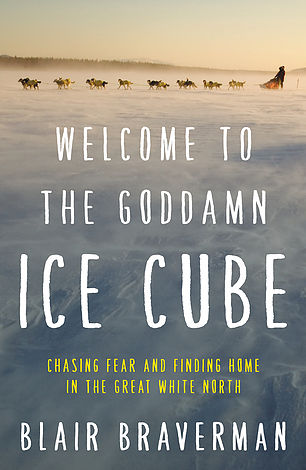






 Books Can Save A Life