Children’s lit of my ancestry – Cuore: The Heart of a Boy

Coincidence or serendipity?

I was writing this post about my Sicilian cousin and his favorite children’s book in Wegmans when I heard the strumming of a mandolin. It was the theme song from The Godfather. Today, the cafe was featuring Italian folk songs along with Italian food.

Then, I heard someone speaking Italian. At a nearby table, a young girl was giving an Italian lesson to an older woman.

I’m not in Italy. I’m at a Wegmans in upstate New York.

But to get on with this post: My cousin Giuseppe, who lives in Carini, Sicily, recently graduated from the University of Palermo with a degree in translation. (Actually, he is my much younger cousin. His grandmother and my father were cousins, making him my third cousin, I think.) Giuseppe plans to further his studies in literary translation. Recently, he was the translator for Susan Vreeland when she was in Sicily speaking about her books and her passion for Italy.

Now that he’s finished his studies, Giuseppe had time for some literary discussion. He told me his favorite American writers are Jack London, Ernest Hemingway, Truman Capote, and Stephen King. Currently, he’s reading E’ Stato il Figlio, (loosely translated, “It Was the Son”) a book about the Mafia by the Sicilian writer Roberto Alajmo.  Giuseppe calls Alajmo a “wizard” of a writer; the book was recently made into a movie.

When I asked Giuseppe if books had made a difference in his life, and if there was one in particular that was special to him, he said:
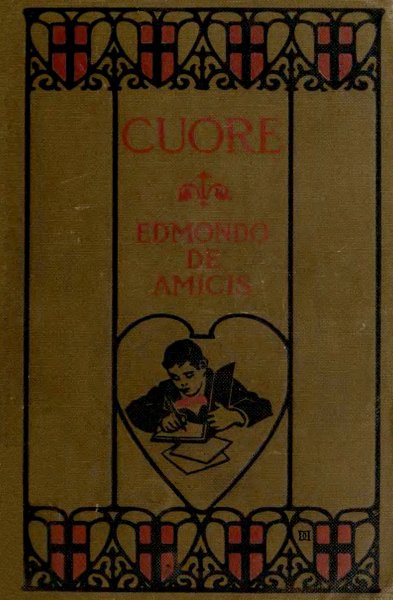
book cover: Cuore: The Heart of a Boy“I can’t imagine my room without my personal bookcase, or a world without books. One of the first books that I read when I was a child was Cuore: An Italian Schoolboy’s Journal, by Edmondo de Amicis, which left an indelible mark in my life. I believe this book must be read during childhood, with the sensibility and imagination of a child, when one can physically enter the story and share the characters’ feelings with one’s own heart.”

The books was written by de Amicis during the unification of Italy in 1866 and is one of the most famous books in Italian children’s literature. It has influenced generations of Italians and has also been widely read in East Asia (where it was published as “The Education of Love” in China) and Latin America.

Some modern-day readers may find it didactic and sentimental, but I’m fascinated to know more about books that my grandparents and great grandparents may have grown up with. I wonder if my father read Cuore. I wish I could ask him.

If you read reviews of Cuore on Amazon you’ll find that people have revisited this book later in life and have been as moved by it as when they were young, if not more so. The best children’s books resonate at any age.

Perhaps someday Giuseppe will return to Cuore with the full heart of an older man.

An English translation of the book (also known as Cuore: The Heart of a Boy), can be downloaded from Project Gutenberg. The translation leaves something to be desired and the format is difficult to read, but you might want to sample a few chapters, especially if you have Italian ancestry. Illustration from Cuore: Heart of a Boy(Or Latino or Asian)

Giuseppe told me that for his thesis he created a medical glossary of terms related to the heart in Italian, English, and French. He said he had no particular reason for choosing this topic. But I wonder.

Giuseppe Di Stefano is affiliated with the translation services website http://www.icanlocalize.com/site.

Are you familiar with books your parents or grandparents read as children? If so, tell us about them in the comments below.

A housekeeper, a professor, a boy, a baseball game

The Professor never really seemed to care whether we figured out the right answer to a problem. He preferred our wild, desperate guesses to silence, and he was even more delighted when those guesses led to new problems that took us beyond the original one. He had a special feeling for what he called the “correct miscalculation,” for he believed that mistakes were often as revealing as the right answers. This gave us confidence even when our best efforts came to nothing.

Paulownia tree
Photo courtesy Coolmitch

The Housekeeper and the Professor by Yoko Ogawa is a quiet story you’ll want to experience just for what it is. A story I don’t want to say a lot about, because too much talking will diminish it.

The Professor is a number theory expert with a traumatic brain injury. He remembers nothing after 1975, with one exception: in the present, his memory lasts exactly 80 minutes.

He rarely leaves his house. He wears scraps of paper pinned to his clothes to remind him of the important things: “My memory lasts only eighty minutes” and “the new housekeeper” (next to a sketch of the housekeeper’s face). He must live in the moment because that is all he has. He is a humble, self-effacing man who loves baseball and the great Japanese pitcher, Yukata Enatsu.

The housekeeper, a single mother, has come to cook the Professor’s meals, clean his small bungalow, and tend to his needs for a few hours every day. Her son has never known his father.

The Professor nicknames the housekeeper’s son “Root” because the top of his head is flat, like the square root symbol. These three lonely people become a self-made family. They find peace and refuge in the daily rituals of preparing and eating a meal, solving a math problem, listening to the radio.

When the Professor isn’t lost in his numbers or helping Root with his math homework, he likes to watch the housekeeper prepare dinner. With great fascination and single-mindedness he observes her stuffing and wrapping dumplings; he’s entirely caught up in the watching. Surprised by the undivided attention the Professor shows her, the housekeeper is given to understand she and her daily tasks are not insignificant.

They attend their first baseball game together. We see the stadium, the lights, the players, the crowds as if for the first time through the eyes of Root, the Professor, and the housekeeper.

The Professor buys Root popcorn, ice cream, and juice only from one particular girl selling food in the stands. “Because she’s the prettiest,” he says.

Another moment: “The ball cracked off the bat and sailed into the midnight blue sky, tracing a graceful parabola. It was whiter than the moon, more beautiful than the stars.”

In her spare prose, Yoko Ogawa never uses the word “love,” but that is what this story is about.

Quotes from The Housekeeper and the Professor, by Yoko Ogawa, Picador, New York, 2009.

Great books coming this fall

Been too long away from the blog. Visiting family, and it’s the busiest time of year at the library, where I’ve had the privilege of working with eleven first-year medical students. I’ll be their personal librarian for the next four years, a role we librarians are inventing and making our own as we go along.

When it comes to Books Can Save A Life, I often wonder who might stop by and whether I can make their visit personal and meaningful, especially considering most of my readers are anonymous.

One thing I know, I have to feel passionate or intensely curious about the books, writers, and topics I feature here.

You may be inspired to read some of the books or authors you find on Books Can Save A Life but, ultimately, I hope Books gives you a moment of pleasure, speaks to some aspect of your own life, stirs up memories of past good reads, or inspires you to try a new path in your personal reading.

After visiting my favorite book spots on the Internet, I was energized to find that this fall will bring a perfect storm of new fiction and nonfiction by some of our best writers. Everyone in the book world is excited about the upcoming publishing season.

Some of my favorite authors will publish new books, and others have been on my to-read list for a while. This fall and winter I want to feature some of them on Books Can Save A Life. Let’s immerse ourselves in the spirit and mood of our time. What are our obsessions, passions, predictions, hopes, fears, delusions and delights? How are we, personally, caught up in all of it?

Let’s find out.

Tops on my list are Barbara Kingsolver and Ian McEwan.

I loved Kingsolver’s The Poisonwood Bible. Her new book, Flight Behavior, is right up my alley, with a larger-than-life plot about a farmer’s wife caught up in a biological disaster that draws worldwide attention and fuels the controversy over climate change.

Sweet Tooth book coverI’ve read McEwan’s Saturday twice (someday I’ll tell you why that book is so special to me), and I’m looking forward to his Sweet Tooth.  It’s about a Cold War spy who falls in love with the novelist she’s supposed to be manipulating. One reviewer calls it a complex “Russian doll of a novel” that’s really about readers, reading, how we respond to fiction, and what we want from it.

Mark Helprin will have a new book out, too, In Sunlight and In Shadow. Have any of you read Winter’s Tale? Among other things, it’s a love letter to New York City of the early 1900s (and of the future.) I read it when I was saying goodbye to New York and a particular time in my life. Helprin’s newest book takes place in post World War II New York and is, I think, a similarly fabulous and grand tale.

I’m curious about J.K. Rowling’s new novel, The Casual Vacancy, but I may wait for the reviews to make the commitment.

Some authors publishing this fall I’ll be meeting for the first time:

San Miguel, by T. C. Boyle (two families on an island off the coast of California)

Telegraph Avenue, by Michael Chabon (two families in Oakland, California – doesn’t that sound just like Boyle’s book?)

This Is How You Lose Her, by Junot Diaz (all kinds of love)

Every Love Story Is a Ghost Story, by D. T. Max (a biography of David Foster Wallace)

But first, I promised you Yoko Ogawa’s The Housekeeper and the Professor in August. Better late than never, it’s a book I can’t pass up that will be front and center in my next post.

Also coming up: two book stories to share with you from a couple of my readers, and a trip to Buenos Aires in October, where I’ll be re-reading Imagining Argentina and writing about my adventures.

What are you reading? Are there any forthcoming books you plan to buy the minute they’re available?

She read The Lord of the Rings and said what you’re not supposed to say to get the job

…everyone deserves these chances, moments when something pierces the everyday and points a path toward health and wholeness, toward growth and adventure and change.   – Adrienne Furness

In February, when we began talking about The Hunger Games (the book and the movie), I asked readers to share books that affected them in a profound way when they were growing up.

A couple of people said The Lord of the Rings trilogy had been an unforgettable and transformative reading experience. I considered writing about J. R. Tolkien’s trilogy on Books Can Save a Life, but I knew I couldn’t do his books justice. I’d read Tolkien when I was young, but for whatever reason his fantasy novels didn’t speak to me in the way they have to countless other readers.

Then the other day I visited a favorite blog, What Adrienne Thinks About That, authored by a librarian friend, Adrienne Furness. Adrienne is a superb librarian and a superb writer. Anyone, child or adult, who walks into her library is very lucky indeed. She has just become director of the Henrietta Public Library, and there’s a story behind how that came about.

Adrienne graciously agreed to let me re-post her story:

When I went on my interview, the hiring committee asked me why I became a librarian. For many years now, people who give advice on these matters have been telling librarians not to answer this question, “Because I love to read.”

But I answered this question the same way I’ve answered it in every single job interview I’ve ever gone on. I told the truth.

I became a librarian because I love to read.

The Fellowship of the RingI tell this story often because it was a moment that’s defined my life: I read The Lord of the Rings for the first time when I was in the fifth grade. I got to the end and was overwhelmed by the sadness of the story being over, and so I got my copy of The Fellowship of the Ring and read the whole trilogy again.

I’ve reread the series more times than I can count. My love for these books has nothing to do with elves or magic or swords, although those things are all fine, as far as I’m concerned. What makes me return to this story again and again, though, is the notion of life as a quest. My fifth grade self couldn’t have articulated what she found in those books, but I know now that I needed to see that even the smallest person can step away from comfort and into challenge, that change is possible on scales small and large, that our efforts and intentions matter. The story reinforced for me that there are things in this world worth protecting–fellowship and love, food and conversation, adventure and courage, songs and stories. These are the things that sustain us when life is difficult, when we are hurt or afraid and have to be so much braver than we feel.

These books told me to find people who value the things I do and to treasure them, because they are essential. That’s a lesson that led me from fifth grade straight to this moment when I’m sitting here writing this to you.

I’ll never know how many lives have changed because of a book I made sure was on the shelf or something I helped someone find, but I’ll spend my last couple weeks at WPL watching children check out stacks of books, knowing that some of them will find something that will still matter to them when they’re adults trying to figure out this world that defies understanding.

I became a librarian because everyone deserves these chances,  moments when something pierces the everyday and points a path toward health and wholeness, toward growth and adventure and change.

I believe we all get to write our own stories. When I was in fifth grade, I decided my story was going to be a little epic.

I like the way that’s working out so far.

About Adrienne

Henrietta Public Library’s newly appointed director, Adrienne Furness, was formerly head of the Children’s Department at the Webster Public Library in Webster, NY, where she managed over $100,000 in grants focused on providing better services to homeschoolers in Monroe County, expanding the reach of storytimes and other literature-based programs, and creating a space for tweens in the Children’s Room.

Adrienne is the author of Helping Homeschoolers in the Library, ALA Editions, 2008. She has taught library staff all over the country about working with homeschoolers, and has published articles in Library Journal, School Library Journal, Public Libraries, Children and Libraries, and AudioFile Magazine.

Share your book stories

If you’d like to share a story about a book that is special to you, send an email to valoriegracehallinan[at]gmail[dot]com with the subject line: My Book Story. Please include a post of about 500 words or less in the body of the email or an idea/book you’re interested in writing about.

What my best friend never told me

…he had doubts, like me, about who he was.

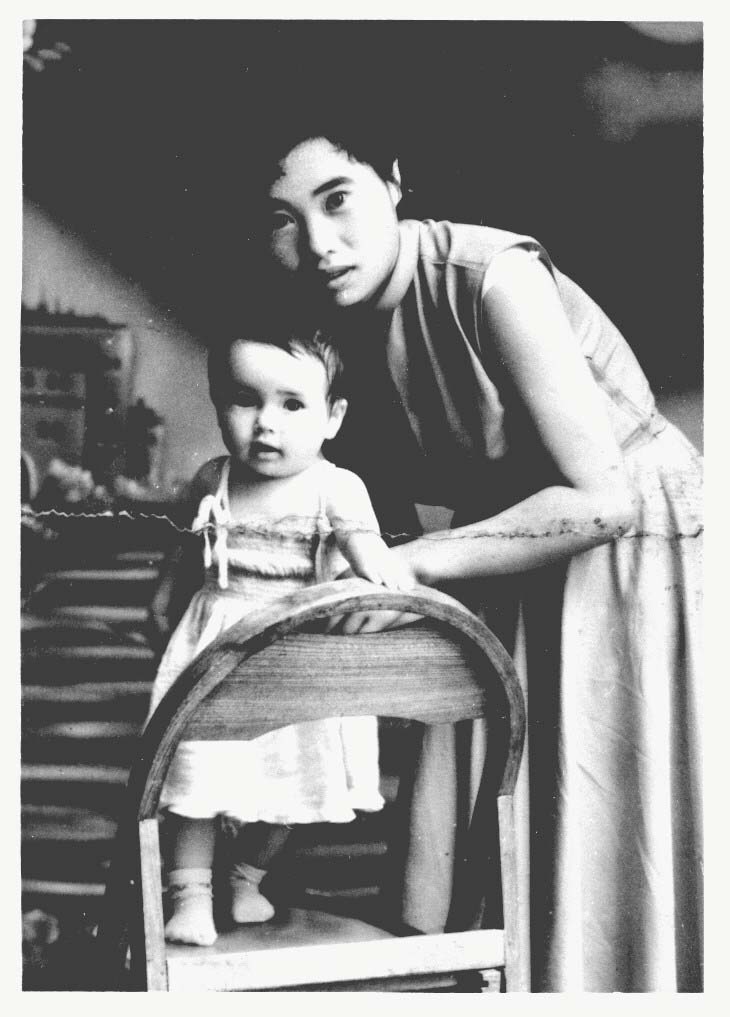
Korean mother and child
Nena (Ho Mi Hyung) and her Korean mother,  Ho Soon Ja, 1956

After I asked readers to share stories about books that have made a difference in their lives, I was thrilled to hear from my best friend from childhood.

Nena Adams Benhoff and I go way back.  We shared Nancy Drew books. We played piano duets and went to Brownie meetings together. We were in Mrs. Ryan’s kindergarten class of 1960 at Broadway Elementary School. Nena’s first job was in my family’s flower shop, where my father taught her floral design.

Sometimes I was a little jealous of Nena, because she was something of a celebrity in our town.

But even best friends don’t tell each other everything, and I didn’t know the whole story.

So when she sent this guest post, I was amazed. I’m still getting to know my best friend after all these years.

Here is Nena’s story.

I was born in South Korea and adopted by an American family when I was 15 months old. In my new hometown, it was a newsworthy occasion because foreign country adoptions were unheard of in the 1950s. Articles were printed in the Cleveland Press, The Plain Dealer, and the local papers. My life story was known to just about everyone in our town.

When I started school, my teachers always spoke about how wonderful it was that I, a poor little Korean orphan, was given a chance to grow up in the United States. I was expected to bring in my Korean clothes to share with the class and talk about Korea. Now, I had no memories of Korea, I wasn’t even walking when I arrived, so I really didn’t have anything to share. Only half Korean, I thought I looked more Italian than Asian. Everyone thought I should think and act Korean, when I looked and thought, “American.”

I was confused about myself and my place in the world.

When I was about thirteen, a librarian recommended a book to read.

That book was The New Year by Pearl S. Buck, the story of a mixed race boy, half Korean and half Caucasian, who was brought to the United States by his birth father’s wife at the age of ten. While his story was not at all like mine, he had doubts, like me, about who he was. In Korea he was considered American, while in the United States he was considered Korean. Pearl Buck explained about mixed race children being like “bridge organisms,” not wholly of one world or another, but joining the best attributes of both.

After reading The New Year, I must admit I was thinking quite highly of myself, as being better than anyone!

But after a short time, I came back to reality, and started the journey of just becoming myself.

Nena Adams Benhoff has been a floral designer for over forty years. She lives in Oklahoma City.

The New Year is out of print but available from used booksellers and libraries.

About Pearl S. Buck

Pearl S. Buck won the Nobel Prize in Literature in 1938 and the Pulitzer Prize, among other high honors and awards. She published dozens of novels, as well as short stories, biographies, and other nonfiction.

Visit Book Tips – Pearl S. Buck on the official site of the Nobel Prize to see comments by readers of Pearl Buck’s books, and to comment on your favorite books by Nobel Prize winners.

Share your book stories

If you’d like to share a story about a book that is special to you, send an email to valoriegracehallinan[at]gmail[dot]com with the subject line: My Book Story. Please include a post of about 500 words or less in the body of the email or an idea/book you’re interested in writing about.

In Rogan’s The Lifeboat, it’s a man’s world

DriftwoodIn my last post, I said the women fared better than the men in Charlotte Rogan’s book The Lifeboat.

Once the survivors are back on land, though, it’s still a man’s world.

Narrator Grace Winter is on trial for murder. In 1914, all the lawyers for the prosecution and the defense are men. The judge is a man. All the laws were written by men. The psychiatrist appointed to appraise Grace’s sanity and her true motives is, of course, a man.

Reading The Lifeboat and trying to imagine what the characters and the times were like, I recalled scenes from Titanic, the movie. I thought about Rose (Kate Winslet) being pressured by her mother to marry the wealthy son of a steel magnate to save her family from financial ruin.

Then there is Downton Abbey’s Mary Crawley of the same time period, disinherited from the family fortune by a distant male cousin.

In fact, Grace is on the lifeboat in the first place because she was on her honeymoon voyage, having pulled off marrying the already-engaged banker Henry Winter to save herself from having to be a governess.

A seismic male-female battle occurs in The Lifeboat, but it is never really acknowledged or spoken of aloud. Some of the most revealing dialogue occurs in whispers among the desperate survivors.

We can see where the conversation about gender issues is at a century later by reading the provocative piece published in The Atlantic this past week. Written by Anne-Marie Slaughter, it’s called “Why Women Still Can’t Have It All” (not my first choice for a title.)

Slaughter quotes Facebook COO Sheryl Sandberg: “Women are not making it to the top. A hundred and ninety heads of state; nine are women. Of all the people in the world, 13 percent are women. In the corporate sector, [the share of] women at the top….tops out at 15, 16 percent.”

Quote: Slaughter, Anne-Marie. “Why Women Still Can’t Have It All,”  The Atlantic, July/August. 2012.

The men and women don’t get along on The Lifeboat

Beach scene

He’s a man. Most men think they are God.

If you’re a man who ends up on Lifeboat 14 adrift in the Atlantic Ocean, you’d better play your cards right.

The women tend to fare better.

On this particular lifeboat, being a traditional male authority figure of the time (1914) will take you only so far. Whereas, if you get along with people, if you’re nurturing and supportive, if you’re a rock of strength and give people what they need, even though you’re a woman you can then manipulate them just a little to get them to do what you want…..

Charlotte Rogan’s The Lifeboat is the PERFECT book for reading groups and book clubs, especially those with both men and women, because you’re going to have great discussions about gender, the battle of the sexes, how men and women use each other…..the whole ball of wax when it comes to male/female relations.

And that’s just scratching the surface of this confounding book.

The Lifeboat is about morality – the difficult, impossible choices we make to survive, and how we justify those choices after the fact.

It’s the kind of book I want my family and friends to read so they can help me sort out who is right and who is wrong, which characters have the moral high ground and which ones don’t.

On page 16, at the end of the chapter entitled “Day One,” the narrator, Grace Winter, makes a statement I found morally repugnant. I don’t like this woman, I thought. In her place, I’d make a very different decision.

Or would I?

If you’re reading or have read The Lifeboat, what do you think it says about men and women? Are there particular incidents from the book you can’t get out of your mind? Does it leave you feeling morally confused? Please comment below. I’d love to hear from men and women!

Quote is from The Lifeboat, Charlotte Rogan, Little, Brown and Company, New York, 2012