Do you want your books and holiday gifts delivered by drones?
Please leave a comment and tell us what you think.
(Photo from FreeFoto.com)
"Sometimes a person needs a story more than food to stay alive." Barry Lopez
Do you want your books and holiday gifts delivered by drones?
Please leave a comment and tell us what you think.
(Photo from FreeFoto.com)
I liked the movie version of the first book in the The Hunger Games trilogy, (unlike many viewers) and I liked Catching Fire, the movie version of book #2, even more.
When a book or movie is wildly popular, I’m curious to know the reasons. I want to know how the creator birthed a story that inspires passion in so many people. The Hunger Games is epic, powerful, and true to our times, and in capable artistic hands it speaks to us whether the medium is the page or the screen. The Hunger Games books and the movies have become fused in my memory, and it is difficult for me to separate the two – it’s the story itself that stays with me.
Suzanne Collins’ trilogy is based, in part, on the Greek myth of Theseus and the Minotaur, which she read when she was eight years old. According to Wikipedia, in one version of the myth, the king of Crete demanded that every nine years seven Athenian girls and seven Athenian boys be sacrificed to the half-man, half-bull Minotaur. Theseus volunteers to go in place of one of them and slays the Minotaur. (In The Hunger Games, Katniss volunteers to go in place of her younger sister, Prim, and Peeta volunteers to replace Haymitch.)
In interviews, Suzanne has said she was intrigued by reality TV shows that feature ordinary people viewers can relate to trying to prevail in impossible situations; she has also noticed our voyeuristic desire to watch others in their most private, vulnerable, and humiliating moments. Flipping through TV channels one evening, Suzanne was struck by news footage from the Iraq war on one channel and “Survivor” competitors on another channel. A former writer of children’s television programming, Collins has spoken in interviews about how viewers become desensitized to real-world violence if they are continuously exposed to the entertainment violence of modern media.
Probably most formative of Suzanne’s artistic vision was the fact that when she was six years old, her father served as a military advisor in Vietnam. News footage on TV of the death and destruction in Vietnam confused and frightened her. After the war, when her family was living in Europe, Suzanne’s father often took them on tours of famous World War I and World War II battlefields, where he taught them about military strategy and history.
Although she’s been criticized for depicting children killing children, Suzanne is not an advocate of violence or war. Katniss, Peeta, and many of the others in The Hunger Games clearly suffer the post-traumatic effects of war, oppression and deprivation. In my mind, they echo the child soldiers and the children who are victims of bombings and other atrocities we see often in the news. Several stories about The Hunger Games in the media have highlighted the irony of the fact that Suzanne lives in Sandy Hook, Connecticut. I wonder if that experience will result in another powerful and timely story.
For me, iconic images from Catching Fire include the silhouettes at sunset of Katniss, Peeta, and a dying tribute who has just sacrificed her life for Peeta; the citizens of Rue’s District 11 giving the three-fingered salute; and, in one of the closing scenes, a riveting shot of Katniss that embodies the essence of sacrifice.
I’ve been especially moved by these characters: Cinna (Lenny Kravitz) and how he takes a stand with his art; Haymitch (Woody Harrelson) and his flawed strength; Eppie (Elizabeth Banks) and her transformation; the growing strength of Prim (Willow Shields); the fire and directness of Johanna Mason (Jena Malone); and the depth of feeling and loyalty of the deceptively shallow Finnick Odair (Sam Claflin).
Recently, Suzanne Collins published Year of the Jungle, a picture book about a child whose father goes off to war.
Have you seen Catching Fire? What do you think of the movie and/or or the book? Please share your thoughts in the comments below.
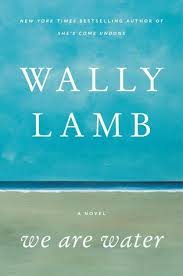
“Viveca’s wedding dress has a name: Gaia. Layers of sea green silk chiffon, cap sleeves, an empire waist, an asymmetrical A-line skirt with the suggestion of a train….Gaia: I Googled it yesterday….chaos, incest, monsters, warring siblings: it’s a strange name for a wedding dress.” – Outsider artist Annie Oh, in We Are Water
Annie Oh throws a mug of red wine on the designer wedding dress of her future wife because she’s momentarily feeling ambivalent about the marriage. She likes the effect of the wine on the chiffon and proceeds to pour wine on the three expensive dresses Viveca has chosen for Annie to consider wearing on their wedding day. Thus she turns the dresses into pricey art that will fetch five figures, if not more.
I had a hard time engaging with Wally Lamb’s latest novel, at first, but I kept on because, having read I Know This Much Is True (the best book about schizophrenia and being a family member of someone with schizophrenia I’ve ever read) and She’s Come Undone, I’m loyal to Lamb and interested in his body of work. At first, the characters in We Are Water seemed pretentious; I’m used to the blue collar world he often writes about. But the writing is fabulous, as usual, and it wasn’t long before I was invested in the Job-like trials, tribulations, and family secrets of the Oh’s – Annie’s husband, Orion, and their adult children Ariane, Marissa, and Andrew.
After 27 years of marriage, Annie has left her husband and is about to marry Viveca, the art dealer who has made her famous. The wedding sets off a chain of events that harks back to 1963, when Annie, as a five-year-old, lost her mother and little sister in a flood that swept through her town. Lamb builds the story on a flood that actually occurred in his hometown of Norwich, Connecticut when he was a boy.
Annie has never told anyone what, exactly, happened in the flood and its aftermath. These secrets have an impact on the kind of wife and mother she is, they fuel her art, and they result in a tragic turn in the lives of one of her children. Lamb always has compassion for his characters, but he is also unflinching about placing them in terrible circumstances. One of the things he does so well here is show how the devastating effects of child abuse and neglect can pass from generation to generation.
Lamb is a generous, down-to-earth true believer in the healing power of art. For many years, he as led a writer’s group for women at the York Correctional Institution. (See Couldn’t Keep It To Myself: Wally Lamb and the Women of York Correctional Institution.) While he was working on We Are Water, the shootings at Sandy Hook Elementary School in Newtown occurred; in a postscript to the novel he invites readers to contribute to the Brady Campaign to Prevent Gun Violence and the National Alliance for Mental Illness.
“For the first nine months of our lives, we float underwater. Then we hit the cold air, the glaring light of day, and start crying salty tears. Begin the lifelong challenge of trying to figure out why we’re here, what it all means.” – Orion Oh, We Are Water
You are going to die.
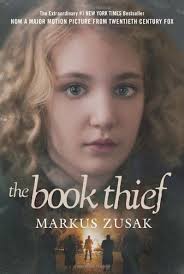
….the grave diggers were rubbing their hands together and whining about the snow and the current digging conditions. “So hard to get through all the ice,” and so forth. One of them couldn’t have been more than fourteen. An apprentice. When he walked away, after a dozen paces, a black book fell innocuously from his coat pocket without his knowledge.” The Book Thief, by Markus Zusak
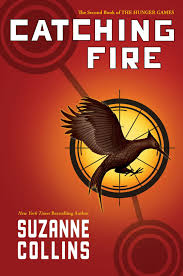
“If it were up to me, I would try to forget the Hunger Games entirely.” Katniss Everdeen
Catching Fire, by Suzanne Collins
I’ll be at the movies this month watching two visions of apocalypse. One really happened. The other – well, take a world of haves and have-nots to the extreme, and maybe that’s where we’re headed.
I love watching my favorite books on the screen, as long as it’s done well. If you’ve read these young adult books that obsess grown-ups, too, and/or see the movies, stop by Books Can Save a Life and tell us your thoughts. Why do you think these end-of-the-world stories are so popular? I’ll revisit this soon, once I’ve seen the movies.
“Angels…what glorious shapes take place within you….” Hildegard of Bingen
“I discovered Hildegard and her medicine…and that is where God’s Hotel starts.”…..Victoria Sweet, MD, author of God’s Hotel
The Hŏtel-Dieu (God’s Hotel) cared for the sick in the Middle Ages. Hildegard’s music.
(And it’s All Saints’ Day weekend.)
Victoria Sweet at TEDxMiddlebury.
Photo: Recoleta Cemetary, Buenos Aires
What are the pros and cons of getting genetic testing if your parent has Huntington’s Disease? What about dating and relationships?
A resident in the pediatric intensive care unit wants patient education information about shaken baby syndrome and traumatic brain injury.
A mother whose child has just been diagnosed with epilepsy wants to know if a special diet will help.
At teaching rounds, medical students on their first patient rotations are led through the process of making a diagnosis. “He has weakness in his arm and leg,” says the neurologist. “If his symptoms are on the right side, where is the lesion in the brain?”
These are some of the situations I’ve seen as a medical librarian. Sometimes we forget how precious and fragile are our bodies and minds. We can walk, run, speak, love, laugh, cry, sing, read, write, think, create, make plans, give comfort, enjoy a meal with family and friends. Until one day something changes.
I know from personal experience a mind can become irrevocably altered and an identity can vanish seemingly overnight. Which is probably why I am so fascinated by medicine, especially medicine having to do with the brain and behavior.
Here are some of my favorite books (fiction and nonfiction) about illness, recovery, medicine, the search for cures and miracles, and the people caught up in it all: medical professionals, researchers, patients and families. If you follow my blog, a few of the books will be familiar.
FICTION
I Know This Much is True, by Wally Lamb
“On the afternoon of October 12, 1990, my twin brother Thomas entered the Three Rivers Connecticut Public Library, retreated to one of the rear study carrels, and prayed to God the sacrifice he was about to commit would be deemed acceptable.”
This is the best evocation of schizophrenia I’ve ever read. Wally Lamb is my hero.
By the way, Wally’s newest novel, We Are Water, was just published this month. It is on my nightstand in my little stack of books to read.
Saturday, by Ian McEwan
A neurosurgeon. Huntington’s Disease. A home invasion. A poem.
(The poem nestled deep within the plot sparks a crucial turning point. It also happens to be one of my lifelong favorites.)
State of Wonder, by Ann Patchett
“She was not terrified that the patient would die or she would lose the baby, she was terrified that she was doing something wrong in the eyes of Dr. Swenson.”
“I write with unfortunate news of Dr. Eckman, who died of a fever two nights ago. Given our location, this rain, the petty bureaucracies of government (both this one and your own), and the time sensitive nature of our project, we chose to bury him here in a manner in keeping with his Christian tradition….Despite any setbacks, we persevere.”
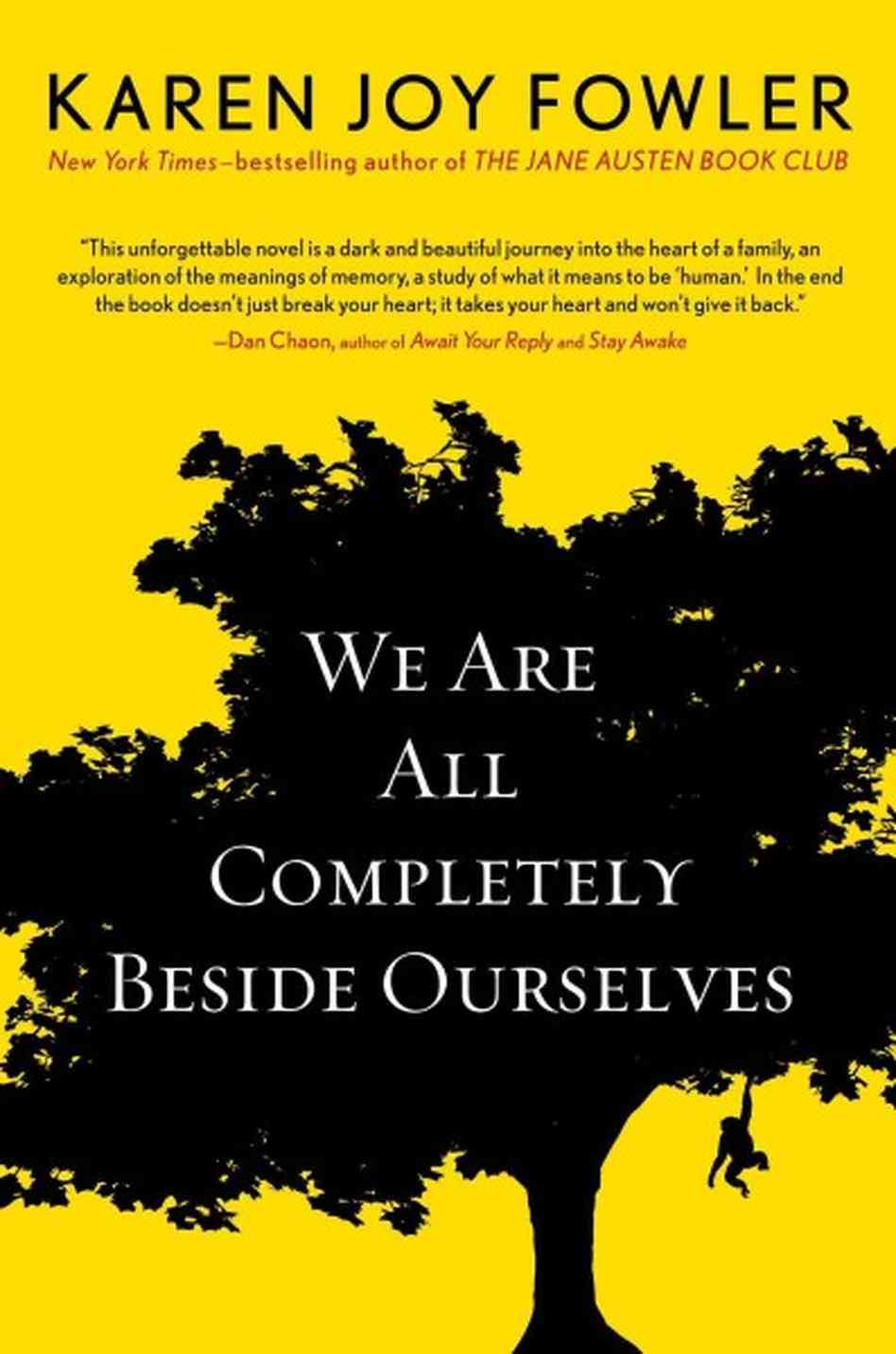
We Are All Completely Beside Ourselves, by Karen Joy Fowler
“…I’d made a careful decision to never ever tell anyone about my sister, Fern. Back in those college days I never spoke of her and seldom thought of her…..Though I was only five when she disappeared from my life, I do remember her. I remember her sharply – her smell and touch, scattered images of her face, her ears, her chin, her eyes. Her arms, her feet, her fingers.”
***************************
MEMOIR
God’s Hotel: A Doctor, a Hospital, and a Pilgrimage to the Heart of Medicine, by Victoria Sweet
Inspired by Hildegard of Bingen (12th century German mystic and medical practitioner), as well as her own instinct for compassionate, attentive care, Dr. Sweet practices “slow medicine” at the last almshouse in the U.S. as it transitions to the modern age. We should all have a physician like Dr. Sweet.
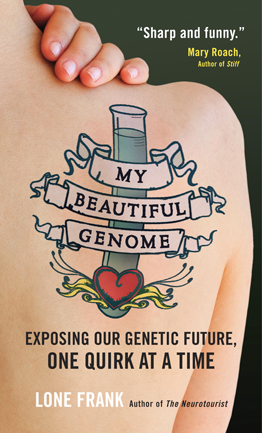
My Beautiful Genome, by Lone Frank
“…we are each of us temporary depositories of information that has an almost eternal life, and which is passed on and on and on…”
“I am what I do with the beautiful information that has flowed through millions of years through billions of organisms and has, now, finally been entrusted to me.”
“…we all know that one way to do a job poorly is to be negative about it. Say we need to clean a shelf. If we spend the hour before the shelf-cleaning talking down the process of cleaning the shelf, complaining about it, dreading it, investigating the moral niceties of cleaning the shelf, whatever, then what happens is, we make the process of cleaning the shelf more difficult than it really is. We all know very well that that “shelf” is going to be cleaned, given the current climate, either by you or the guy who replaces you and gets your paycheck….So the point of this memo is: Positive.” -“Exhortation” in Tenth of December, by George Saunders
The “shelf” that has to be cleaned is a euphemism for…what?
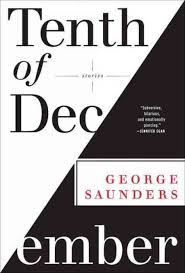
I don’t often read short stories, but I’d heard so many good things about Tenth of December by George Saunders, when I saw the book in our local library’s “Most Wanted” display I checked it out.
Saunders has been called the Kurt Vonnegut of our day. He says he’s been influenced by Monty Python. Many highly regarded writers (Mary Karr, David Foster Wallace, Lorrie Moore, Jonathan Franzen, among others) can’t say enough good things about Saunders, who teaches creative writing at Syracuse University.
Before he became a highly praised short story writer, Saunders lived here in Rochester, where he was a contract worker for Kodak and a technical writer for a local consulting firm.
I was once a Kodak contract worker, too, and that’s partly why I’m so fascinated with Saunders. He writes about the workplace in a liberating, irreverent and hilarious way. In an interview, Saunders has said that he’s grateful for the corporate jobs he held early on that helped support his young family, but that working in a corporate culture long-term can be difficult if you have a creative calling.
You can listen to the full interview with Saunders at the link further down in this post. You’ll hear the writer interviewing Saunders tell how she started off in book publishing (as I did) and at times she considered stealing the toilet paper as a small revenge. Working for a prestigious publisher in a Manhattan skyscraper was glamorous but, on the other hand, her salary was tiny, and many employees were exploited.
Getting back to Saunders’ stories, they are darkly comic, subversive, strange, and compelling. They’ve been called “alarming” and “tender.” Some are dystopian. You’ll be disturbed, aroused and, perhaps, comforted by the fact that someone recognizes and so eloquently expresses the absurdities of how we live our lives and the dreadful possibilities for the future if certain trends continue.
This week Tenth of December was named one of the finalists for the National Book Award.
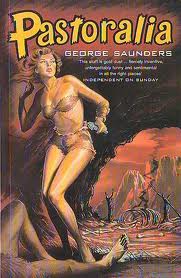
You can listen to Saunders read an excerpt from one of his older stories, “Sea Oak,” (from his collection, Pastoralia) on the National Book Award website, which features audio recordings of all the nominees. (Start listening at the 10-minute mark unless you want to hear the program host brag about how Brooklyn is now the literary capital of America.)
I’ll warn you in advance, though, that Saunders doesn’t read the ending of “Sea Oak.” He’d prefer that you buy the book, of course. In an interview after the reading, Saunders said it took him four years to come up with an ending to “Sea Oak” that he was satisfied with.
I, for one, can’t get out of my mind the two teenagers in the opening story, “Victory Lap,” in Tenth of December. Or the strange and horrifying lawn ornaments that are the ultimate status symbols in “The Semplica Girl Diaries.” Or the poor guy who’s in prison and becomes a guinea pig in a pharmaceutical experiment and must choose how it will end.
There’s really nothing like a George Saunders short story.
Great book club reading, too, guaranteed to spark excellent conversation.
“It’s time for you to pull yourselves up by the bootstraps like I done….Let me tell you something, something about this country. Anybody can do anything….It’s the frickin’ American way. You start out in a dangerous crap hole. And work hard. So you can someday move up to a somewhat less dangerous crap hole. And finally maybe you get a mansion.” – “Sea Oak,” by George Saunders
Tenth of December, by George Saunders
Pastoralia, by George Saunders
Welcome to the Monkey House, by Kurt Vonnegut
The Collected Works of Katherine Anne Porter
Binocular Vision, by Edith Pearlman
The Love of a Good Woman, by Alice Munro (2013 Nobel Prize in Literature)
Been away for a bit while designer Nicole Bateman of The Pixel Boutique gives Books Can Save a Life a fresh, new look. (Thank you, Nicole!) But I’ve been reading, as always, and here’s what’s coming up:
After Her – Joyce Maynard’s latest novel. Joyce has written several novels as well as the memoir, At Home in the World. After Her is loosely based on the true story of a serial killer who terrorized Northern California in the late 1970s.
Tenth of December – I don’t usually read short stories, but I’d heard so many wonderful things about George Saunders I had to pick up a copy of his latest collection when I saw it on our public library’s “Most Wanted” shelf. Besides, he teaches a stone’s throw away at Syracuse University – he’s someone I should know about.
Sons of Madness – I’ve written about Susan Nathiel’s excellent Daughters of Madness: Growing Up and Older With a Mentally Ill Mother, a collection of interviews with adult women. Sons of Madness: Growing Up and Older With a Mentally Ill Parent is a companion volume.
The Art of the Commonplace – I’ve always wanted to know what Wendell Berry is all about, so I’m reading his collection of agrarian essays.
Catching Fire, the second book in Suzanne Collins’ Hunger Games trilogy has been made into a movie and will be released November 22. I wrote about the first movie and book here, so I just have to check out the next installment.
And last but not least, I can’t wait to dip into Elizabeth Gilbert’s latest novel, The Signature of All Things. Beautiful book jacket and end papers. The epigraph: “What life is, we know not. What life does, we know well.” Lord Perceval
I’ll be back with a closer look at all of these.
As I write this, I have a hangover from staying up too late reading David Schickler’s new memoir, The Dark Path, in one sitting.
When he was a boy attending Mass with his family in Rochester, New York, David fantasized about a blonde, blue-eyed Catholic girl named Caitlin. When he went to the country club swimming pool he pined after Leslie, a brown-haired, amber-eyed beauty who was Protestant and therefore dangerous.
David was obsessed with girls, but he also dreamed of becoming a priest. He’d walk the dark path through the woods behind his house, hoping to hear the voice of God telling him what he should do with his life.
Attending McQuaid Jesuit High School here in Rochester, David’s loyalties were still divided, and they remained so when he went off to college. Needless to say, this greatly complicated his love life.
His newly published memoir, The Dark Path, is about David’s comic, convoluted, and often anguished discernment of whether he should become a celibate priest or forgo all that for another kind of life altogether.
Thursday evening at our local Barnes and Noble, David read excerpts from his book to a standing-room-only crowd that included his family and many of his lifelong friends. After living in New York City for a while, David returned to Rochester several years ago. In addition to his literary writing, he is a screenwriter (co-creator of the TV series Banshee) who commutes to Los Angeles and New York.
Years ago, I’d read and loved his Kissing in Manhattan. It’s a collection of strange and haunting linked stories about young singles in the 1990’s looking for love, living in a beautiful old building on the upper West side loosely based on the Dakota, where John Lennon lived and Rosemary’s Baby was filmed. (I’d been single in New York in the 80’s, which is partly why Kissing drew me in – David captured so well the big city headiness shot through with loneliness.) Last week, when I found out David was about to publish a memoir, I didn’t want to miss the debut.
David read a scene from The Dark Path about jockeying for space in the bathroom while fighting with his sisters, vying for the hair dryer and mousse as they got ready for church.
I thought the scene sounded a lot like how it must have been when my husband’s family got ready for Mass when he was a boy. I’d brought my husband along with me to the reading – he’s not an obsessed reader like I – and he was immensely entertained, as were all the men in the audience. David is a natural stand-up comic, a down-to-earth, regular guy who appeals to other regular guys. Women love him, too, of course. Look at his photo and you’ll see why.
Let me say a few words about Kissing in Manhattan before I tell you more about David’s memoir. I’ve never forgotten one particular story in Kissing, about a rich, handsome, deeply wounded stockbroker with a dark side. (Christian Grey comes to mind, but with a twist, and Schickler’s writing is orders of magnitude better.) Patrick Rigg can have any woman he wants, but instead of making love to them, he – well, he does something else. It falls to a priest, Father Thomas Merchant, to see if he can save Patrick from himself.
When Kissing was first published, it was an immediate sensation. David achieved literary stardom overnight. But when his father, a devout Catholic, read an early version of the manuscript, he’d been horrified.
“You think women will read your perverted stuff and let you baptize their babies?”
“But what about Andrew Greeley?” David asked. “He’s a priest and an author.”
David’s father pointed out that Greeley was a priest for 25 years before he began to write bodice-rippers.
In The Dark Path, David writes about the publication of Kissing. Yes, he became an overnight success, but there was fallout in his personal life. The Dark Path is about David’s crisis of faith; as well, it’s about what, exactly, a writer is supposed to write about. Truthful, authentic writers write about their obsessions, but what if you’re drawn to the dark stuff?
For that matter, to be a priest who truly ministers to those in need, don’t you have to acknowledge darkness (both inside ourselves and in the world) and help people grapple with it?
I think, for writers, it’s the stance you take. Parts of Kissing in Manhattan startled me, but I admired how David played out the tragic elements of his story. It was clear to me he wasn’t sugar-coating reality or condoning the grimmer, inexplicable aspects of human behavior. In my view, he offered readers glimmers of hope, a pathway to the light.
David doesn’t hold back in The Dark Path. He’s blazingly honest about his failings, vulnerabilities, struggles, and relationships with women. He’s hilarious, too. During his reading, he said he doesn’t write for therapy, he writes to entertain people.
The Dark Path is definitely book club material. In fact, it would be interesting to read Kissing in Manhattan and The Dark Path together. I believe these stories have something to say to Catholics and non-Catholics alike, to those of other faiths, to agnostics and atheists as well. To anyone who’s grappled with the absurdities of life and their place in the world.
For more memoirs of the spiritual journey, see my little book list below.
The Dark Path, by David Schickler
The Spiral Staircase, by Karen Armstrong
The Cloister Walk, by Kathleen Norris
Traveling Mercies, by Anne Lamott
The Crosswicks Journals, by Madeline L’Engle

One of my favorite columnists, Nicholas Kristof, wrote recently that Cheryl Strayed’s memoir, Wild, has inspired “hordes of young women” to hike the Pacific Crest Trail.
Wild was one of the first books I wrote about on Books Can Save a Life.
Strayed’s memoir has turned out to be not just a bestseller, but a transformational story that has given many women the courage to take enormous risks.
The other day I was reading an essay by Barry Lopez, “Landscape and Narrative.” He tells of visiting a small village in the Brooks Range of Alaska and listening to stories about animals and hunting. He says:
“The stories had renewed in me a sense of the purpose of my life. This feeling, an inexplicable renewal of enthusiasm after storytelling, is familiar to many people. It does not seem to matter greatly what the subject is, as long as the context is intimate and the story is told for its own sake.”
Cheryl Strayed’s Wild has that kind of magic.
This summer Heather Anderson broke a record by backpacking the length of the Pacific Coast Trail, alone and without support, in 61 days. It’s good to see women taking risks and feeling more at home in the world.

Lopez quote: “Landscape and Narrative” in Crossing Open Ground by Barry Lopez, Vintage Books, 1989.