Enter my book giveaway: Kingsolver’s Flight Behavior

Been traveling for the Thanksgiving holidays and forgot to mention here at Books Can Save a Life that I’m giving away a free copy of Barbara Kingsolver’s Flight Behavior.

Flight Behavior book coverAll you need to do for a chance to win the book is check out my recent post, Now is the time to read Kingsolver’s Flight Behavior, and leave a comment about where you stand on climate change, or if you think a work of fiction such as Kingsolver’s can make a difference one way or the other.

I’m extending the deadline to December 3, when I’ll put the names of all who comment in a hat and draw the lucky winner.

I read an essay the other day in which the author mused that perhaps New York City will no longer exist in a hundred years. Or it will be located in Westchester County.

What do you think?

I welcome all thoughts and opinions (as long as we’re friendly and polite!)

So, comment away, please!

Reading Junot Diaz

This Is How You Lose Her book coverYou ask yourself why you’re reading This Is How You Lose Her, the short story collection by Junot Diaz. How could you possibly relate to Yunior, the irreverent, hard-drinking Dominican-born narrator and serial cheater of the most extreme sort?

You write this post in second person point of view, as Diaz does in his short story, “A Cheater’s Guide to Love,” just to try it on for size.

You read that Yunior cheated on the love of his life with no less than 50 women over six years. And then she found out.

Diaz writes, “You claim you’re a sex addict and start attending meetings. You blame your father. You blame your mother. You blame the patriarchy. You blame Santo Domingo. You find a therapist. You cancel your Facebook. You give her the passwords to all your e-mail accounts. You start taking salsa classes like you always swore you would so that the two of you could dance together.”

Yunior’s ex-fiancee assembles all the damning evidence (emails, photos, etc.) in an album (the Doomsday Book) and sends it to Yunior with a note: For your next book.

You think: This is one funny writer.

The writing is so musical and overflowing with Spanish, maybe you can brush up on the language: blanquita, moreno, salcedeña, sucio, cuero. Then you realize some of the words are made up, and others are words you’re not likely to use any time soon.

Yunior’s suffering seems to know no bounds, as if he’s channeling all the deprivation of his poor, difficult, immigrant life  (which the other stories in this collection portray) into mourning his lost love.

Yunior becomes a professor of fiction in Boston. Having grown up in Santo Domingo and New York City, he has a hard time in New England: “White people pull up at traffic lights and scream at you with a hideous rage, like you nearly ran over their mothers….Security follows you in stores and every time you step on Harvard property you’re asked for ID.”

Yunior visits the Dominican Republic with his friend, Eric, to see Eric’s presumed love child; the child and mother live in the Nadalands, where Yunior’s father was born and where his ex-fiancee is from. Mud, shanties, no running water or electricity, raw sewage.

You remember the volunteer work your family did in Nicaragua – you’ve only seen that kind of poverty once and, after a few days, you could return to your comfortable home in America.

You know Diaz’s  fiction is partly autobiographical and you wonder which parts are true, which are made up. You find the second person point of view can be confusing: Does the “you” refer to Yunior, or to the author himself? Sometimes you think the “you” refers to you, the reader, because by now you’ve become so invested in Yunior you find yourself beginning to understand and identify with him.

There is that moment of self-reckoning when Yunior has to face what he has done. You agree with Yunior’s assessment of the half-life of love.

You think: this blurring of boundaries between author, narrator, reader – maybe that’s the point.

If you’ve read this book, please comment!

Quotes from This Is How You Lose Her, Junot Diaz, Riverhead Books, New York: 2012.

First sentences, Junot Diaz

This Is How You Lose Her book coverSelected first sentences, from short stories in This Is How You Lose Her by Junot Diaz:

“I’m not a bad guy.”

“Nilda was my brother’s girlfriend. This is how all these stories begin.”

“You, Yunior, have a girlfriend named Alma, who has a long tender horse neck and a big Dominican ass that seems to exist in a fourth dimension beyond jeans.”

“Your girl catches you cheating. (Well, actually she’s your fiancee, but hey, in a bit it so won’t matter.”)

“Those last months.”

“Years later you would wonder if it hadn’t been for your brother would you have done it?”

As fate would have it, one day in April when I went to Joe Bean (whose website has great photos, including one by A. Hallinan) to meet my son and have a cup of incredible coffee, I was given a free book, The Brief and Wondrous Life of Oscar Wao by Junot Diaz in celebration of World Book Night.

I haven’t read this Pulitzer Prize winning book yet, so I thought I would now, right along with This Is How You Lose Her.  Both books feature the narrator, Yunior, who, according to NPR reviewer Carmen Gimenez Smith, “might someday rank with Philip Roth’s Nathan Zuckerman or John Updike’s Harry Angstrom as an enduring American literary protagonist.”

While we’re getting to know this next great American literary protagonist, whose native land is the Dominican Republic, I’ll be posting from Argentina, where I’ll also be rereading Imagining Argentina, visiting a larger-than-life bookstore, and….well, we’ll see.

Quotes from This Is How You Lose Her, Junot Diaz, Riverhead Books, New York, 2012.

Books at my door

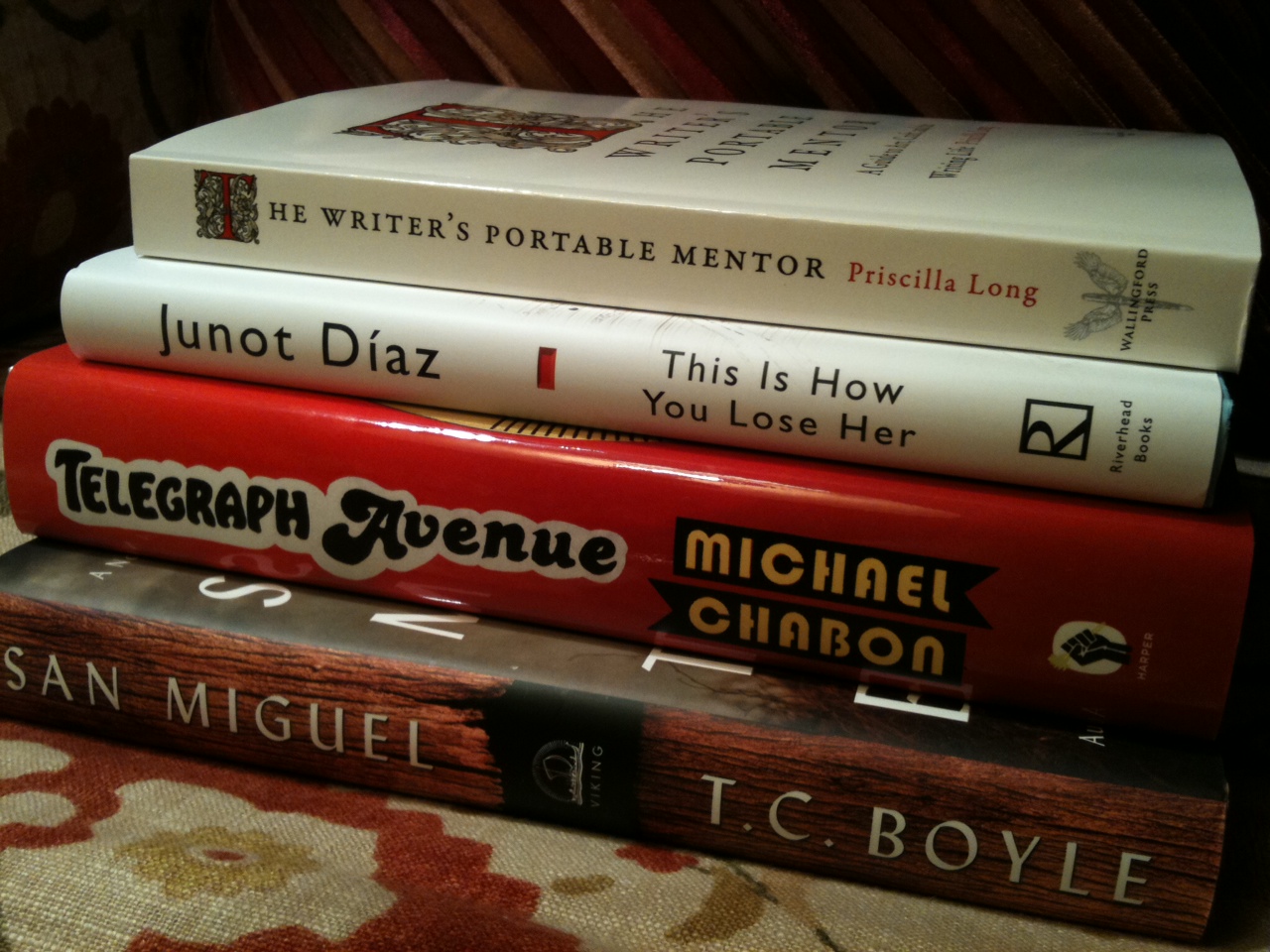
Four fall books 2012 I love it when I find new books waiting on my doorstep.

A housekeeper, a professor, a boy, a baseball game

The Professor never really seemed to care whether we figured out the right answer to a problem. He preferred our wild, desperate guesses to silence, and he was even more delighted when those guesses led to new problems that took us beyond the original one. He had a special feeling for what he called the “correct miscalculation,” for he believed that mistakes were often as revealing as the right answers. This gave us confidence even when our best efforts came to nothing.

Paulownia tree
Photo courtesy Coolmitch

The Housekeeper and the Professor by Yoko Ogawa is a quiet story you’ll want to experience just for what it is. A story I don’t want to say a lot about, because too much talking will diminish it.

The Professor is a number theory expert with a traumatic brain injury. He remembers nothing after 1975, with one exception: in the present, his memory lasts exactly 80 minutes.

He rarely leaves his house. He wears scraps of paper pinned to his clothes to remind him of the important things: “My memory lasts only eighty minutes” and “the new housekeeper” (next to a sketch of the housekeeper’s face). He must live in the moment because that is all he has. He is a humble, self-effacing man who loves baseball and the great Japanese pitcher, Yukata Enatsu.

The housekeeper, a single mother, has come to cook the Professor’s meals, clean his small bungalow, and tend to his needs for a few hours every day. Her son has never known his father.

The Professor nicknames the housekeeper’s son “Root” because the top of his head is flat, like the square root symbol. These three lonely people become a self-made family. They find peace and refuge in the daily rituals of preparing and eating a meal, solving a math problem, listening to the radio.

When the Professor isn’t lost in his numbers or helping Root with his math homework, he likes to watch the housekeeper prepare dinner. With great fascination and single-mindedness he observes her stuffing and wrapping dumplings; he’s entirely caught up in the watching. Surprised by the undivided attention the Professor shows her, the housekeeper is given to understand she and her daily tasks are not insignificant.

They attend their first baseball game together. We see the stadium, the lights, the players, the crowds as if for the first time through the eyes of Root, the Professor, and the housekeeper.

The Professor buys Root popcorn, ice cream, and juice only from one particular girl selling food in the stands. “Because she’s the prettiest,” he says.

Another moment: “The ball cracked off the bat and sailed into the midnight blue sky, tracing a graceful parabola. It was whiter than the moon, more beautiful than the stars.”

In her spare prose, Yoko Ogawa never uses the word “love,” but that is what this story is about.

Quotes from The Housekeeper and the Professor, by Yoko Ogawa, Picador, New York, 2009.

Genetic kinship: Who are we and where do we come from?

In My Beautiful Genome, Lone Frank probes her past by having her DNA analyzed for genetic kinship.

State-of-the-art genetic testing can trace ancestry ten or eleven generations back, by looking at a man’s Y-chromosome DNA (which he inherits unchanged from his father) or the mitochondrial-DNA of a man or a women (which they inherit unchanged from their mother.)

Many people interested in genealogy are now supplementing their research with DNA testing of this kind.

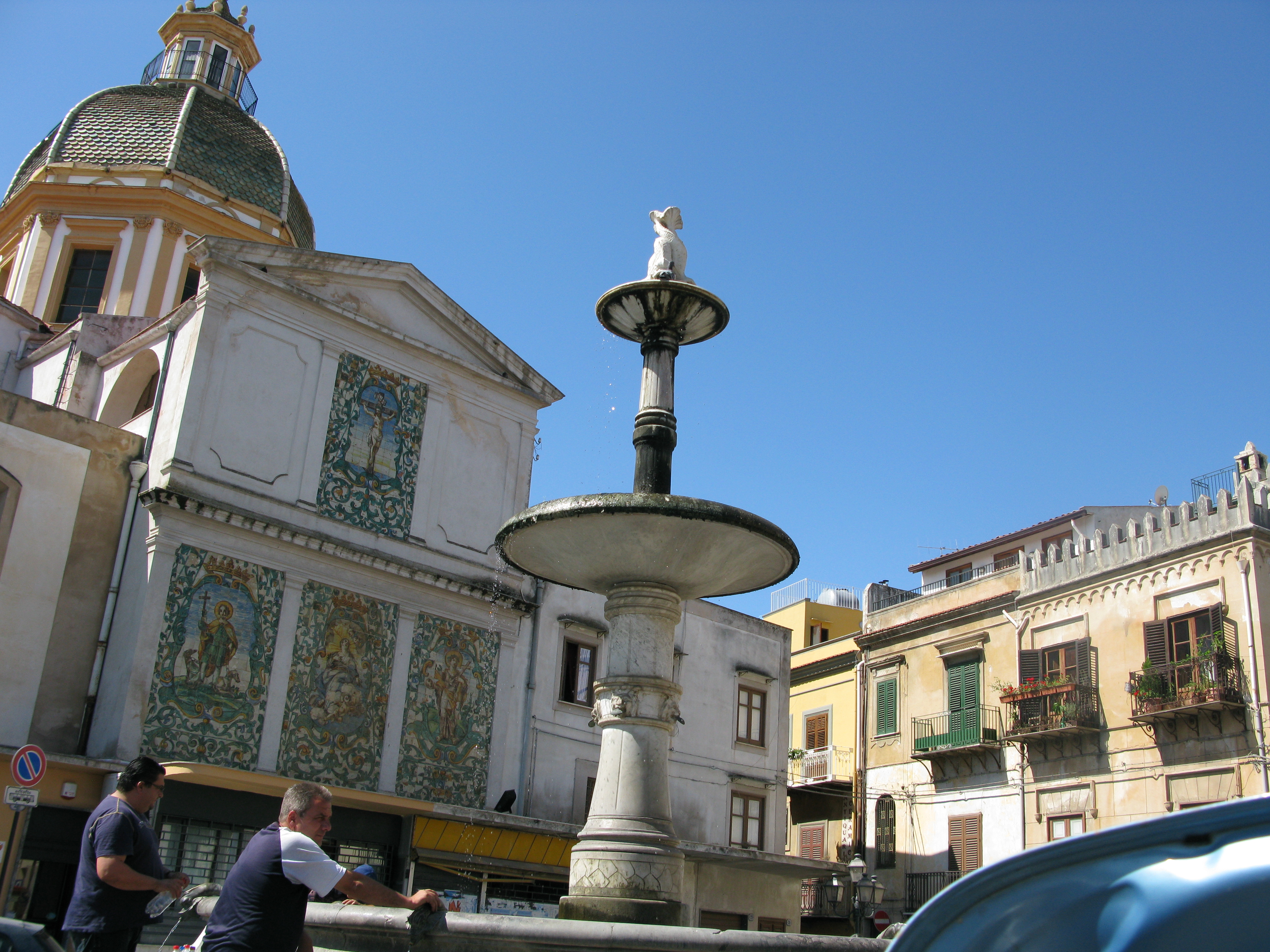
Piazza in Carini, Sicily
Piazza in my father’s hometown, Carini, Sicily

As I read about Lone tracing her ancestry, I thought about trips to my father’s birthplace in Sicily I’ve taken with my family. My father was a baby when he crossed the Atlantic Ocean with my grandmother to Ellis Island. I heard the story many times growing up. My grandparents kept in touch with their relatives and returned to Sicily several times to visit.

Because they did, I’ve been able to travel to Carini to meet my father’s family, and my sons have had the opportunity to get to know their Sicilian cousins. That connection with the “old country” is continuing into the next generation, and I hope my children will keep it going with their children.

On our first trip, when we were exploring the cobblestone streets of Carini, we stopped in a bakery. There, we met a man who had my last name (my maiden name.) My family’s surname name is common in Carini.

That day our cousins took us to a nearby castle that had been built around 1075. In the evening we gathered for an elaborate, home-cooked meal at my father’s cousin’s villa in the old section of Carini. Like most Sicilian homes, it is walled off and gated. We sat at several picnic tables end-to-end next to a large, well-tended garden and talked late into the night.

I was steeped in antiquity but surrounded by modernity. Vespas and other traffic passed by outside the garden walls.  I felt a sense of completion. Here were my roots, or half of them, anyway. I looked at the faces of my family and thought about the fact that Sicily has been conquered repeatedly, by the Greeks, Romans, Byzantines, Muslims, Normans, Spanish, and probably others. We have the blood of many races, and who knows what parts of the world our earliest ancestors came from.

I think people are looking for this sense of identity when they do genealogical research and probe their DNA for ancestry. We are, each of us, unique. Yet when it comes down to it, we all come from the same human family.

Have you had your DNA analyzed for ancestry? Are you considering it? If so and you’d like to share your thoughts and experiences, please do in the comments below.

The men and women don’t get along on The Lifeboat

Beach scene

He’s a man. Most men think they are God.

If you’re a man who ends up on Lifeboat 14 adrift in the Atlantic Ocean, you’d better play your cards right.

The women tend to fare better.

On this particular lifeboat, being a traditional male authority figure of the time (1914) will take you only so far. Whereas, if you get along with people, if you’re nurturing and supportive, if you’re a rock of strength and give people what they need, even though you’re a woman you can then manipulate them just a little to get them to do what you want…..

Charlotte Rogan’s The Lifeboat is the PERFECT book for reading groups and book clubs, especially those with both men and women, because you’re going to have great discussions about gender, the battle of the sexes, how men and women use each other…..the whole ball of wax when it comes to male/female relations.

And that’s just scratching the surface of this confounding book.

The Lifeboat is about morality – the difficult, impossible choices we make to survive, and how we justify those choices after the fact.

It’s the kind of book I want my family and friends to read so they can help me sort out who is right and who is wrong, which characters have the moral high ground and which ones don’t.

On page 16, at the end of the chapter entitled “Day One,” the narrator, Grace Winter, makes a statement I found morally repugnant. I don’t like this woman, I thought. In her place, I’d make a very different decision.

Or would I?

If you’re reading or have read The Lifeboat, what do you think it says about men and women? Are there particular incidents from the book you can’t get out of your mind? Does it leave you feeling morally confused? Please comment below. I’d love to hear from men and women!

Quote is from The Lifeboat, Charlotte Rogan, Little, Brown and Company, New York, 2012

What I didn’t expect about The Lifeboat by Charlotte Rogan

The lifeboat book coverThe saddest thing about the sacrifice was that it was being made for people such as we.

Thirty-nine men and women adrift in the Atlantic Ocean, 1914.

What I hadn’t expected about The Lifeboat is how my feelings toward newlywed Grace Winter (the narrator) would constantly change.

How one minute I like her, and the next minute, I don’t.

How sometimes Grace is full of insight, and other times she’s fooling herself.

How, just like the jury and her lawyers, I’m constantly trying to figure out if she’s telling the truth.

I hadn’t expected a grand battle of the sexes. As if they don’t have enough to contend with.

I’m wondering how this will end.

Subtle, masterful writing by Charlotte Rogan.

If you’re reading The Lifeboat, too, what do you think? Please share your comments.

Quote from The Lifeboat, Charlotte Rogan, Little, Brown and Company, New York, 2012

Losing our newspapers is not a good thing

I visited my hometown of Cleveland, Ohio this weekend. On Sunday,  The Plain Dealer printed artist and critic Karen Sandstrom’s creative work ethic, “I Must Remember This.”

Enchanted, I happily discovered Karen and her blog, Pen in Hand, as well.

Even better, Karen succinctly and eloquently sang the praises of The Plain Dealer, daily newspapers, and printed newspapers.

I’m all for electronic media and the creative flourishing and publishing opportunities now open to more people.

But Karen reminds us not to forget our daily newspapers and their talented, hardworking staffs. They are doing important work.

Some daily newspapers have disappeared, with more to go, I’m sure.

Journalism is changing like everything else, but we still need unbiased investigative reporting, long-form news and analysis, depth and breadth of content, and media everyone is comfortable with. (I believe a significant number of readers still prefer their news in print, and have not found or would not know how to go about finding comparable news online).

Most important, we need engaged readers and citizens who care and understand what vibrant journalism means to a healthy democracy.

If we let our daily newspapers go, we damn well better make sure we know what we are doing.

Bay Village view of Lake Erie
Bay Village view of Lake Erie at sunset. To the east, the Cleveland skyline glittered and fireworks blossomed over Lakewood.

(Full disclosure: a member of my family works for The Plain Dealer.)

What do you think? Please comment!

I found enlightenment in the Pacific Northwest

In May, I happily stumbled on the secret to enlightenment when I attended the Medical Library Association (MLA) annual meeting in Seattle and vacationed with my family in the Cascades.

It all started with MLA speaker and best-selling author Steven Johnson, who told us about a theory he encountered while researching his latest book, Where Good Ideas Come From: The Natural History of Innovation.  (Steven is a great speaker, not to mention that he reminds me of one of my favorite Downton Abbey characters.)

Some believe the 18th century’s Age of Enlightenment occurred, in part, when the middle class switched from alcohol to coffee and tea as their beverage of choice. With clean drinking water scarce, people drank ale or wine, even for breakfast. When coffee and tea imports became available, many switched from alcohol – a depressant – to caffeine, a stimulant.

Coffeehouses, where “ideas [could] spill from one mind to another,” became popular, according to Johnson. “The coffeehouse was a multidisciplinary space.” (So are libraries, he said, in a nod to his audience.) People from all walks of life who normally would not encounter one another engaged in “a diversity of conversations.”

So, coffee and tea led people to a kind of hyperactive exchange of ideas, which in turn led to innovation.

Johnson predicts that the internet and social media are a new kind of global, virtual coffeehouse spawning another great age of innovation.

I experienced coffee and coffeehouses on an entirely new level during my stay in Washington. In Rochester, New York, we don’t have drive-through espresso kiosks as in the Pacific Northwest. They are ubiquitous in the Seattle area, even on the edge of wilderness. Up in the Cascades, if you need a dentist, quick, or someone who knows how to repair a transmission, you may be out of luck – but you can almost always find a cup of coffee.

My theory is, there is so little sunshine people need the caffeine to keep going.

At any rate, I also noticed that the Pacific Northwest has thriving literary communities. People here really appreciate books, and they love coffee, and they love combining the two.

For me, the combination of exceptional coffee, great bookstores, access to the internet and, last but certainly not least, absolutely stunning scenery and fresh, mountain air, was so invigorating. I felt the ideas flowing. Like I was on the verge of my own personal enlightenment.

The Elliott Bay Book Company, Seattle

The Elliott Bay Book CompanyWe spent several hours visiting The Elliott Bay Book Company, Seattle’s largest independent bookstore, which also has (of course) great coffee. Elliott Bay has a full roster of book signings and author readings, and a terrific blog. Here is what I bought there:

The Housekeeper and the Professor, by Yoko Ogawa

The Spiral Staircase: My Climb Out of Darkness, by Karen Armstrong

Zen in the Art of Archery, by Eugen Herrigel

Pearl Street Books & Gifts in Ellensburg, WA. Pearl Street Books & Gifts

I wanted to see the high desert on the eastern side of the Cascades, so we drove to Ellensburg, WA, where we discovered the delightful Pearl Street Books & Gifts. Owner Michele Bradshaw is passionate about books and literature.  She and I talked about our reading interests. Michele enjoys making recommendations, and it’s obvious she puts a lot of thought into creative, customer-responsive bookselling.

I liked the Magic Table, a display of enticing best-sellers and high quality fiction and nonfiction. Quality is apparent on every shelf and surface in the shop, where carefully chosen books are displayed cover side up. Michele has put together a number excellent book collections, including young adult, children’s, fiction, memoir/biography, and Pacific Northwest authors.

Pearl Street Books & Gifts also hosts 11 book clubs, a tea club, a knitting club, and yoga workouts.

While I was there, I bought:

The White Cascade: The Great Northern Railway Disaster and America’s Deadliest Avalanche, by Gary Krist

The Big Burn: Teddy Roosevelt and the Fire that Saved America, by Timothy Egan

Booklust to Go, by Nancy Pearl

Queen Anne Books

Cover of Some Assembly Required by Anne Lamott Climb, climb, climb Queen Anne Avenue in Seattle and you’ll be rewarded at the top of the hill with tree-lined streets and all manner of shops, including Queen Anne Books. On the shelves are literally hundreds of hand-written staff recommendations, the sign of a great bookstore. Here, Windee recommends Anne Lamott’s latest book about her new grandson, Some Assembly Required.


Seattle Central Library The Seattle Central Library, designed by Dutch architect Rem Koolhaas and a local architectural firm.

I had a great time this spring walking the Pacific Crest Trail with Cheryl Strayed (who has just inspired Oprah Winfrey to revive her book club!), sailing the waters off British Columbia with M. Wylie Blanchet and her children, clearing forest trails with Ana Maria Spagna, and observing life through the eyes of the characters in Denis Johnson’s Train Dreams.

In June: The Lifeboat by Charlotte Rogan

“Today I shocked the lawyers, and it surprised me, the effect I could have on them.”

This is the opening line of The Lifeboat by Charlotte Rogan (first-time, best-selling novelist making her debut at age 57, wrote novels in secret for 25 years when the kids were at school), which I’ll be reading in June.

Highlights from the jacket copy: 1914. A bride on her honeymoon. Adrift on the Atlantic Ocean. Not enough to go around. A power struggle. Choosing sides.

Will you read it with me?

Quote from: The Lifeboat, Charlotte Rogan, Little, Brown and Company, New York, 2012.