Train Dreams

Mount Index
Mount Index

I first published this post in May, 2012, when we were staying in a remote cabin near the town of Index in Washington State’s Cascade Mountains. I was also reading the novella, Train Dreams, by Denis Johnson. I’m reposting it now because the gorgeous movie adaptation has just been released. (It is currently in theaters and on Netflix.)

Train Dreams is a beautifully filmed, meditative story about an early 20th century Idaho logger who travels to Washington and environs to work on crews that take down the largest trees in the forest. I promise you, the movie will sweep you away, completely and utterly, to another time and place. New York Magazine calls Train Dreams a staggering work of art, and they are right. The translation from book to film is flawless, and those of us who are avid readers know how special it is when the essence of a beloved book comes to life on the screen.

Here is my original post:

Just steps from our front door, the peaks of Mount Index are illuminated in great detail by the last rays of sun.

It’s spring and we’re in Washington’s Cascade Mountains. This is wild, intimidating territory. Rivers and creeks rage as snow melts in the mountains. Along the highway, as we made our way here, we passed by dozens of cascades of snowmelt tumbling down steep walls of rock on either side.

Our vacation cabin is perched on the banks of the Skykomish River. It was raining our first night here, and the rain, together with the rushing river, created quite a din. The mountaintop had been hidden by fog.

We built a fire in the wood burning stove, which took the chill out of the air and made everything cozier. Later in the evening, a dull roll of thunder swelling to a roar overpowered the sounds of downpour and river flow outside our picture window. My first, nervous thought was “flash flood,” but when the high-pitched whine of metal-on-metal joined the mix, we realized the sound was a train.

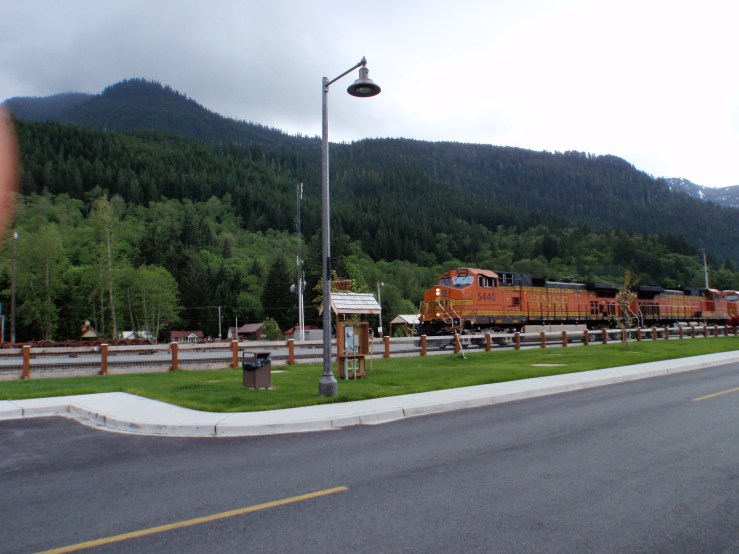
Train in Skykomish
View from the Cascadia Hotel in Skykomish

We are in high train country. The legend of the Great Northern Railroad is very much alive here, though nowadays the trains that run are mostly on the Burlington Northern Santa Fe line. Twice now, while having lunch at the Cascadia Hotel Cafe in Skykomish, we’ve watched trains pass through, heading east from the port of Seattle with container cars from China, Germany, and Scandinavia.

Several times a day and into the night we hear the trains.

In a kind of parallel journey to my vacation, I’m reading Train Dreams, a novel by Denis Johnson about a logger and laborer who worked for the Pacific Northwest train companies of the early twentieth century.

The Pacific Northwest is surreal and dangerous in Train Dreams, as much a character as Johnson’s protagonist, Robert Grainier.

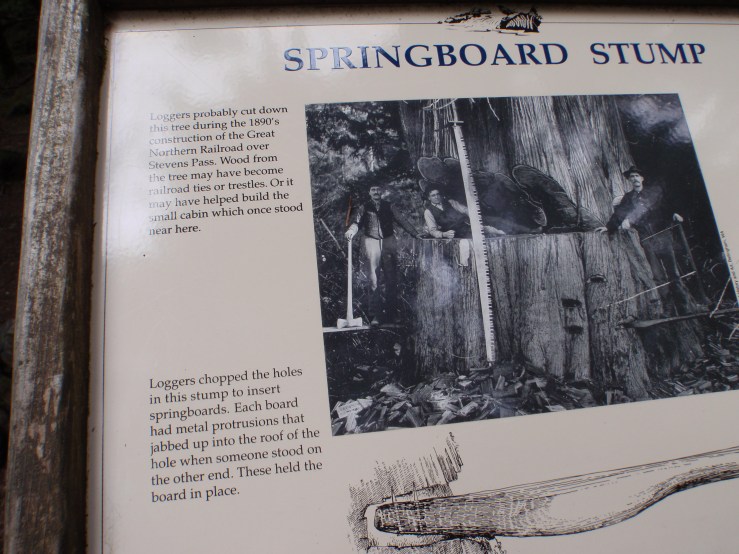
Photos of loggers
Loggers taking down 500-year-old cedar and fir

I thought about the life and times of Grainier when we hiked the Iron Goat Trail the other day, along the now abandoned Great Northern Railway bed. On plaques along the way, old photographs depicted loggers like Grainier taking down giant cedar and fir trees.

Grainier grew “hungry to be around….massive undertakings, where swarms of men did away with portions of the forest and assembled structures as big as anything going, knitting massive wooden trestles in the air of impassable chasms, always bigger, longer, deeper.”

Yet Grainier also saw the great mountains and forests defeat the ambitious plans of mere humans. The land defeated him, too, in a very personal way, but he learned acceptance and, finally, a kind of reverence for the terrible beauty of the place he called home.

The Iron Goat was the last spur of the Great Northern Railway, crossing the Cascades at the treacherous Stevens Pass. I found Stevens Pass stunning the first time we drove through, going east at sunny noon. But on the late afternoon return trip, when it was foggy with rain turning to sleet, I could hardly stand the vertigo as we tried to avoid skidding on the slick highway.

Disaster Viewpoint on the Iron Goat Trail marks the spot where, in 1910, an avalanche swept two snowbound passenger trains into the Tye River below, killing nearly 100 people.

Snowshed
Snowshed

To alleviate the dangers of avalanches, the railroad companies eventually built snowsheds, huge retaining walls to protect trains from tumbling snow. My husband and I walked alongside an old snowshed on our hike.

We knew our hike would be cut short because a sign at the trailhead indicated an avalanche had made the trail impassable a half mile in.

Sure enough, just a few feet from where the snowshed ended, we could go no further, thanks to a wall of hard-packed, dirt-encrusted snow.

“All his life Robert Grainier would remember vividly the burned valley at sundown, the most dreamlike business he’d ever witnessed waking—the brilliant pastels of the last light overhead, some clouds high and white, catching daylight from beyond the valley, others ribbed and gray and pink, the lowest of them rubbing the peaks of Bussard and Queen mountains; and beneath this wondrous sky the black valley, utterly still, the train moving through it making a great noise but unable to wake this dead world.” – Denis Johnson, Train Dreams


View from Spirit Lake trail
View from Spirit Lake Trail

Train Dreams, Denis Johnson, Farrar, Straus & Giroux, New York, 2011.

Inside an enchanting herban apothecary in Portland

herban enclave in Portland

as we round the midpoint between autumn equinox & winter solstice,
the leaves blaze lighting up the darkening sky
before they dance towards the earth.
the moon waxes full as we bask in the light of the beaver moon, a supermoon.
soak in the luminous glow & energies.

times continue to be be unprecedentedly wild
as the cold sets in. this season of release as the light fades
& the leaves fall leaving a bare lacework of branches.
this liminal season, a threshold.

i am reaching out with an offer of winter comfort.
bolstering against both the winter chill & the heartache from the news cycle.

remember always to lean in to the plant allies and the potency of community.

- Polly Hatfield, herban enclave November newsletter

Every CSA (community supported agriculture) venture is unique, but Polly Hatfield’s home-based, herban apothecary in the heart of Portland, Oregon is SO special. You can think of it as community-supported alchemy as well – read on, and you’ll see what I mean.

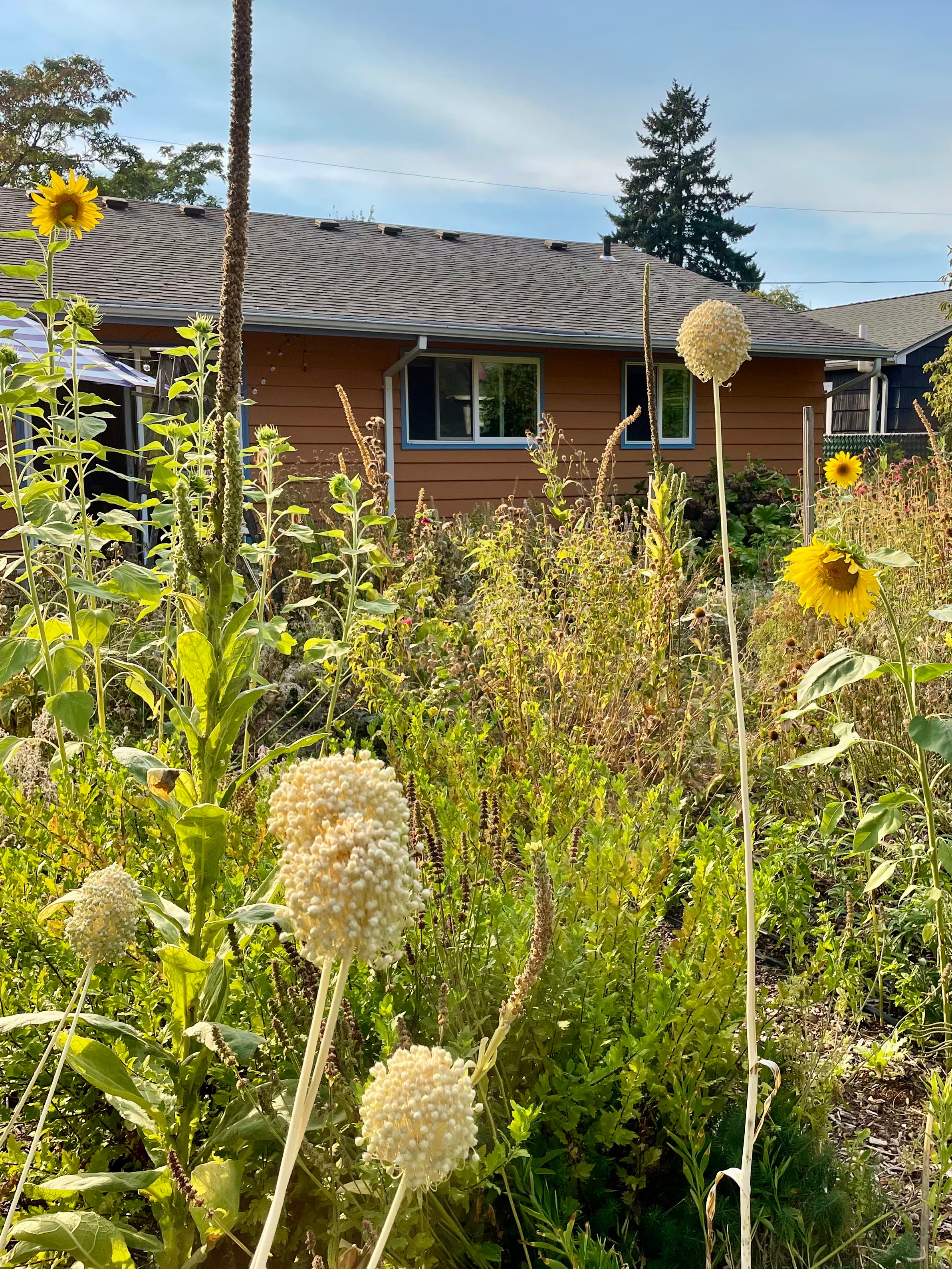
I was thrilled to have the chance to meet Polly and her teeming gardens, front yard and back, when I was in Portland at summer’s end.

I’d been on Polly’s mailing list for a few years, delighting in her poetic, strikingly visual seasonal newsletter, and occasionally sampling her offerings or sending them as gifts. Every year when I enroll in artist Suzi Banks Baum’s Advent Dark Journal workshop, a packet of Polly’s homemade bath salts is tucked into the envelope of art supplies Suzi sends us. (You’ll meet Suzi and Advent Dark Journal in a future post.)

Portland neighborhoods can be one delight after another: poetry boxes, little free libraries, sidewalk chalk drawings galore, pocket gardens, and other inventive gifts to be shared with the community. But herban enclave stands out. The moment I turned down Polly’s street, I guessed which home was the one I was looking for. Clearly, this was a neighborhood of gardeners, but one lot in particular burst at the seams with late-summer plantings.

No space there is wasted, and I marveled at how Polly and her partner managed to grow and lovingly handcraft so many offerings on this modestly sized patch of land.

For example, in November, herban enclave’s winter csa care package (available to order until November 21) includes:

  • syrup made from aronia berry, rose, and holy basil
  • nasturtium flower finishing salt (with sichuan peppercorns, smoked salt, and rose)
  • a “winter quiet” tincture of milky oats, ashwaganda root, rose, and wood betony
  • a replenishing tea of nettles, raspberry leaf, oatstraw, and other plant allies
  • a soaking salts blend of eucalyptus, lemon, ginger, ashwaganda elixir, and wild rose flower essence
  • A “breathe deeply” oxymel of nasturtium, anise hyssop, holy basil, and aronia berry

(Photos by Polly Hatfield)

Polly’s conjurings have me heading for the dictionary or to my plant and flower identification app because, quite often, I’ve never even heard of the plants and flowers she cultivates that become her ingredients.

By the way, can you tell from Polly’s newsletter sentiments and herbal conjuring names that she is not just a master gardener, but a published poet, too? (Photo by Laura Glazer)

In addition to a seasonal care package, Polly usually has small batch offerings on hand. These enticements and several others are currently available until November 21:

  • nocino (an Italian liquor made from immature green walnuts)
  • a variety of tinctures, topical balms, and salves
  • an herbal gomasio (look it up!) of jimmy nardello peppers, smoked salt, black sesame seed, and rose
  • a douglas fir elixir
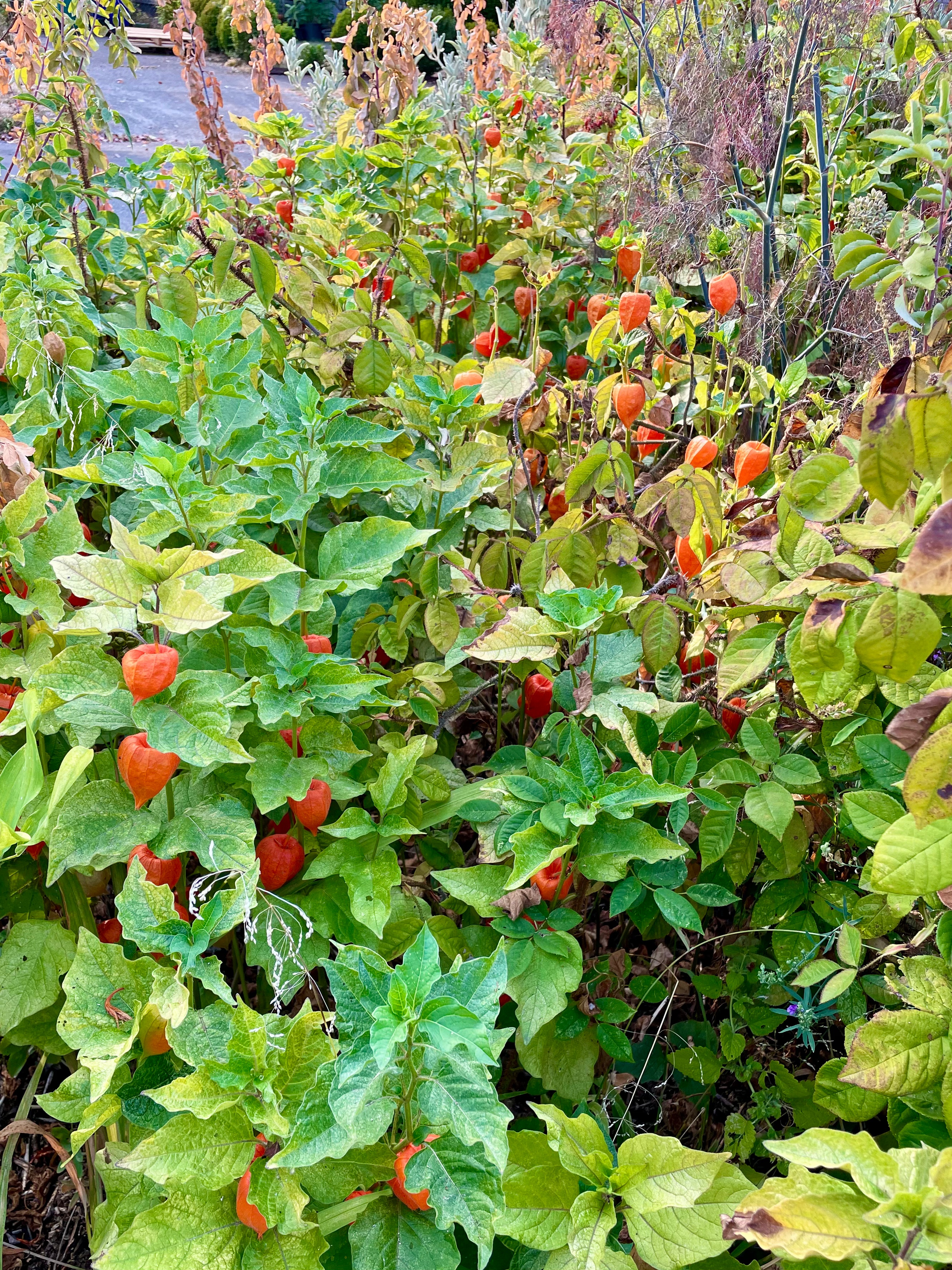
Chinese lantern, Physalis alkekengi

The September afternoon when Polly and I visited, the weather was gorgeous. We sat outside in the sun and I soaked up Polly’s earth-based knowledge as she told me the story of how she and her beloved found their ideal home, planted the extensive gardens, and established such a unique CSA.

Before our meeting, I’d asked Polly if a particular book had been her “bible,” one that had contributed to a vision for her work and way of living. “Gardening at the Dragon’s Gate,” she’d said, and I ordered a used copy.

As I write this, I’m two-thirds of the way through Wendy Johnson’s classic book about gardening and Zen Buddhism (published in 2008), still wondering how I got to be my age without encountering this extraordinary title. I’m a middling, on-again, off-again gardener with grander ideas than I know how to execute. I’m an insight meditation student and teacher as well (and I admire the Zen school of thought, too.) So Gardening at the Dragon’s Gate speaks to me on many levels. Turn to any page and you’re likely to find a nugget of wisdom. You’ll never plumb all of its depths.

Author Wendy Johnson is one of the first influential, ground-breaking California organic farmers and gardeners who came of age in the 1960s and 70s. Johnson, Alice Waters, Eliot Coleman and others pioneered the farm-to-table movement. She is the founder of the extensive gardens at Green Gulch Farm Zen Center near San Franscisco and a Buddhist meditation teacher.

In Buddhist texts, consciousness is said to be a field, a piece of earth on which every kind of seed is planted. On this field of consciousness are sown the seeds of hope and suffering, the kernel of happiness and sorrow, anger and joy. The quality of our life depends entirely on which seeds we garden and nourish in our consciousness.

Growing a garden, like cultivating the wide field of consciousness, is original work. Each time we plant a garden we are returning to origin, to the source of every garden ever grown. The word “origin” derives from the Latin verb oriri, to rise, as the sun and moon rise in a cyclical pattern in the day and night sky. Originality has a still older meaning described by the upwelling of deep springwater through stony ground. Growing a garden depends on this double force of originality that is both rhythmic and permeating. – Wendy Johnson, Gardening at the Dragon’s Gate

I’ve learned as a meditator that we can deliberately and lovingly set an intention for our days. We can do the work of our intentions in a way that gives meaning and shape to our lives. I think that master gardener/herbalist Polly Hatfield and her partner are doing this every day at herban enclave. I love how the work of gardening and a way of life inevitably become woven together.

I think about other home gardens we enjoy seeing in another part of Portland when we visit extended family. They have a gorgeous new garden, and another more vintage garden that is a vital part of the Montessori school they founded, where very young folks spend lots of time playing, learning, and enjoying nature’s riches.

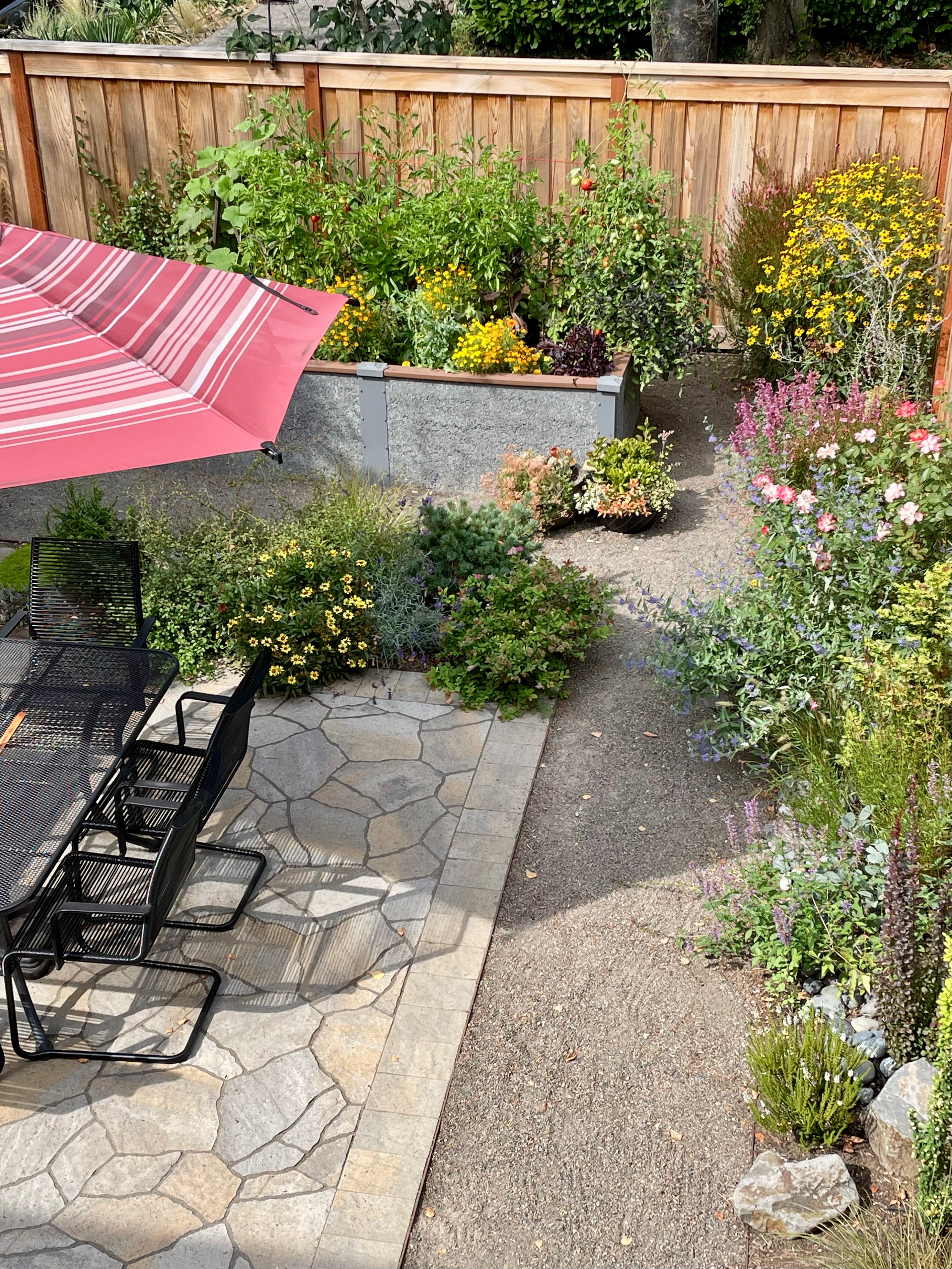
Portland is a city of gardens and garden lovers. Here is one of two home gardens created by my niece, sister-in-law and family. (This is the new garden.)

The Montessori garden, where children spend time every day.

As I write this post at my desk, the wind is kicking up, I hear the patter of raindrops, and I’ll need to close my studio window soon. After a balmy Indian summer, the temperature here in North Carolina is expected to drop twenty degrees. We’re entering the cold, dark time, when Polly’s makings (even simply reading about them) can give us warmth and comfort.

And with that, I will let Miss Polly have the honor of signing off:

may you allow yourself to rest.
to sink into a season of dormancy.
& to tend your heart well.

with love & full moon blessings galore,
heal // whole // holy
warmly & always with love, polly

Here is a link to Polly’s newsletter, with ordering information (order by Nov. 21, 2025).

https://mailchi.mp/b57eef719645/rose-magic-summer-spell-solstice-love-12930906?e=b8a80062f5

You can find Polly Hatfield on Instagram, and sign up for her seasonal newsletter on her linktree site:

https://www.instagram.com/achilleaswooning/

linktr.ee/Miss_Polly

Still reading Barry Lopez

Stories…offer patterns of sound and association, of event and image. Suspended as listeners and readers in these patterns, we might reimagine our lives…As long as it took for me to see that a writer’s voice had to grow out of his own knowledge and desire, that it could not rise legitimately out of the privilege of race or gender or social rank, so did it take time to grasp the depth of cruelty inflicted upon all of us the moment voices are silenced, when for prejudicial reasons people are told their stories are not valuable, not useful.                    Barry Lopez

About This Life book coverIn the introduction to his essay collection About This Life: Journeys on the Threshold of Memory, Barry Lopez tells of meeting a man on a plane who asked what words of advice he could pass on to his teen-age daughter, who wanted to be a writer. This is what Lopez said:

She must read, and her choices should be whatever she is drawn to.

She should read the classics, too, but she’ll have to work harder to find stories of heroism, love, and our noblest values that are written by women.

Second, she must “become someone” and “speak to us from within those beliefs.”

Third, he advised that she “separate herself from the familiar.” After exploring other places and meeting a diversity of people, she`ll know why she loves the familiar and share this knowledge through her writing.

Early on, Lopez felt he was noticed, accepted, and rewarded as a writer in part because he was white, male, privileged and well educated. If you read his work, you’ll find he is keenly sensitive to the fact that many voices haven’t been heard because they are different or not within traditional circles of power. He thrives on traveling to the far corners of the earth and seeking these people out –  artists, artisans, farmers, naturalists, explorers who live close to the land, indigenous peoples, and others.

I was mesmerized by an essay in About This Life, “Effleurage: The Stroke of Fire.”  An Oregon potter and builder of a unique anagama kiln invites clay artists from around the world to fire their work. Jack doesn’t care about marketing or commercial success; he’s totally immersed in the process of making pottery out of materials from nature. Every three or four months, up to twenty artists bring their work to be fired in the Dragon Kiln.  Families, friends, even pets tag along. The firing goes around the clock for several days. Building the tremendous fire that heats the kiln is an art in and of itself. Different kinds of wood – black locust, maple, cherry, Lombardy poplar, red cedar – make different kinds of fires, and keeping the fire properly stoked is a community effort of like-minded artists who put aside their egos for the benefit of the group.

Lopez says you must become someone to write. I think he would agree the kiln designer and the clay artists are “becoming” through their life’s work, just as their clay pieces are forged in the fire. It’s a process that never ends. Even the clay pot continues to change, subtly, after the firing.

Crow and Weasel book coverOver and over, Lopez celebrates journeys into the unknown, strangers who become friends, coming home again, and the writing of the story. You see this in About This Life and in his fable, Crow and Weasel.

Recently, Lopez published a revelatory personal essay that has received a lot of attention, “Sliver of Sky,”  in Harper’s Magazine, about a period of sexual abuse he endured as a child. That Lopez waited until his seventies to write about this suggests how deeply confounding and wounding it was. The trauma and years of silence may explain in part Lopez’s empathy and compassion for others who were silenced for one reason or another. And no doubt it has contributed to his sense of mission as a writer.

I’ve written about years of being silent and feeling silenced by others because of my mother’s mental illness. I think that is partly why I didn’t make the commitment to becoming a writer when I was younger. How can you mature as a human being and as a writer when you can’t work with the very material that is woven into your identity?

If we’re silenced, we’re blocked. We don’t become our fullest selves. Diminished in what we are able to offer the world, the world will be diminished, too. It is in our bests interests to see that no one among us is silenced.

So I find reading Lopez to be a rare and important form of encouragement.

In an interview with Bill Moyers, Lopez says he’s viewed as a nature writer but, actually, he is writing about humanity.

“Every story is an act of trust between a writer and a reader; each story, in the end, is social. Whatever a writer sets down can harm or help the community of which he or she is a part.”

Quotes from: About This Life: Journeys on the Threshold of Memory, Barry Lopez, Vintage Books, New York: 1998.