Train Dreams

Mount Index
Mount Index

I first published this post in May, 2012, when we were staying in a remote cabin near the town of Index in Washington State’s Cascade Mountains. I was also reading the novella, Train Dreams, by Denis Johnson. I’m reposting it now because the gorgeous movie adaptation has just been released. (It is currently in theaters and on Netflix.)

Train Dreams is a beautifully filmed, meditative story about an early 20th century Idaho logger who travels to Washington and environs to work on crews that take down the largest trees in the forest. I promise you, the movie will sweep you away, completely and utterly, to another time and place. New York Magazine calls Train Dreams a staggering work of art, and they are right. The translation from book to film is flawless, and those of us who are avid readers know how special it is when the essence of a beloved book comes to life on the screen.

Here is my original post:

Just steps from our front door, the peaks of Mount Index are illuminated in great detail by the last rays of sun.

It’s spring and we’re in Washington’s Cascade Mountains. This is wild, intimidating territory. Rivers and creeks rage as snow melts in the mountains. Along the highway, as we made our way here, we passed by dozens of cascades of snowmelt tumbling down steep walls of rock on either side.

Our vacation cabin is perched on the banks of the Skykomish River. It was raining our first night here, and the rain, together with the rushing river, created quite a din. The mountaintop had been hidden by fog.

We built a fire in the wood burning stove, which took the chill out of the air and made everything cozier. Later in the evening, a dull roll of thunder swelling to a roar overpowered the sounds of downpour and river flow outside our picture window. My first, nervous thought was “flash flood,” but when the high-pitched whine of metal-on-metal joined the mix, we realized the sound was a train.

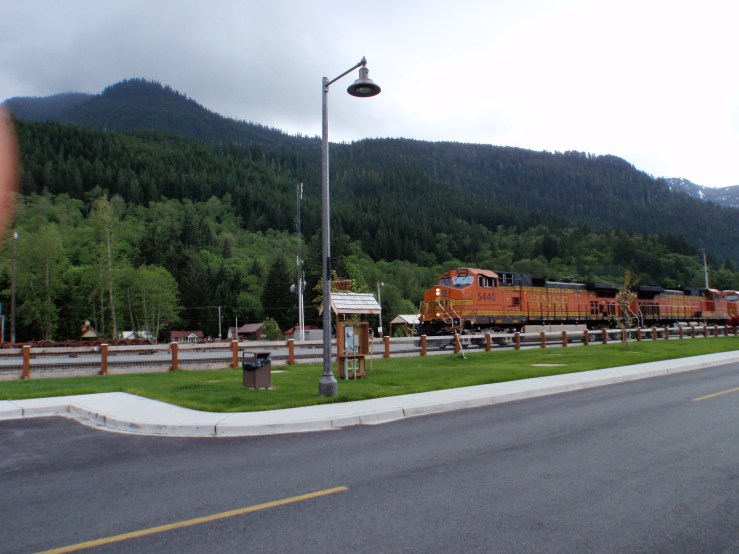
Train in Skykomish
View from the Cascadia Hotel in Skykomish

We are in high train country. The legend of the Great Northern Railroad is very much alive here, though nowadays the trains that run are mostly on the Burlington Northern Santa Fe line. Twice now, while having lunch at the Cascadia Hotel Cafe in Skykomish, we’ve watched trains pass through, heading east from the port of Seattle with container cars from China, Germany, and Scandinavia.

Several times a day and into the night we hear the trains.

In a kind of parallel journey to my vacation, I’m reading Train Dreams, a novel by Denis Johnson about a logger and laborer who worked for the Pacific Northwest train companies of the early twentieth century.

The Pacific Northwest is surreal and dangerous in Train Dreams, as much a character as Johnson’s protagonist, Robert Grainier.

Photos of loggers
Loggers taking down 500-year-old cedar and fir

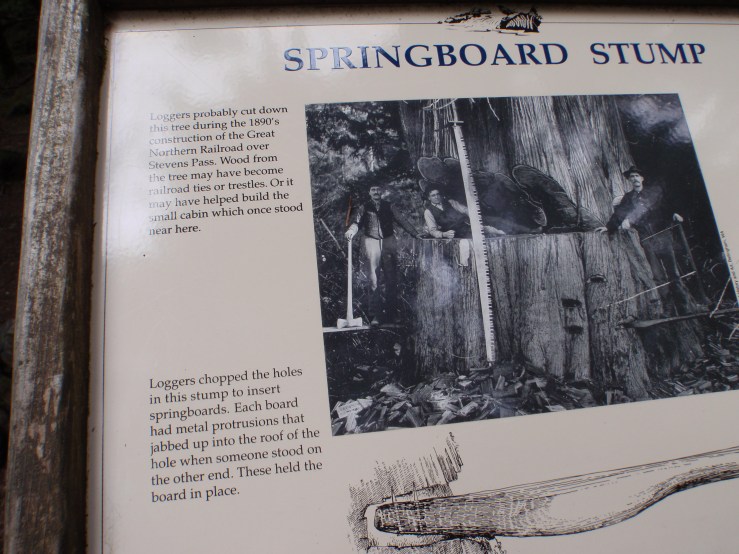
I thought about the life and times of Grainier when we hiked the Iron Goat Trail the other day, along the now abandoned Great Northern Railway bed. On plaques along the way, old photographs depicted loggers like Grainier taking down giant cedar and fir trees.

Grainier grew “hungry to be around….massive undertakings, where swarms of men did away with portions of the forest and assembled structures as big as anything going, knitting massive wooden trestles in the air of impassable chasms, always bigger, longer, deeper.”

Yet Grainier also saw the great mountains and forests defeat the ambitious plans of mere humans. The land defeated him, too, in a very personal way, but he learned acceptance and, finally, a kind of reverence for the terrible beauty of the place he called home.

The Iron Goat was the last spur of the Great Northern Railway, crossing the Cascades at the treacherous Stevens Pass. I found Stevens Pass stunning the first time we drove through, going east at sunny noon. But on the late afternoon return trip, when it was foggy with rain turning to sleet, I could hardly stand the vertigo as we tried to avoid skidding on the slick highway.

Disaster Viewpoint on the Iron Goat Trail marks the spot where, in 1910, an avalanche swept two snowbound passenger trains into the Tye River below, killing nearly 100 people.

Snowshed
Snowshed

To alleviate the dangers of avalanches, the railroad companies eventually built snowsheds, huge retaining walls to protect trains from tumbling snow. My husband and I walked alongside an old snowshed on our hike.

We knew our hike would be cut short because a sign at the trailhead indicated an avalanche had made the trail impassable a half mile in.

Sure enough, just a few feet from where the snowshed ended, we could go no further, thanks to a wall of hard-packed, dirt-encrusted snow.

“All his life Robert Grainier would remember vividly the burned valley at sundown, the most dreamlike business he’d ever witnessed waking—the brilliant pastels of the last light overhead, some clouds high and white, catching daylight from beyond the valley, others ribbed and gray and pink, the lowest of them rubbing the peaks of Bussard and Queen mountains; and beneath this wondrous sky the black valley, utterly still, the train moving through it making a great noise but unable to wake this dead world.” – Denis Johnson, Train Dreams


View from Spirit Lake trail
View from Spirit Lake Trail

Train Dreams, Denis Johnson, Farrar, Straus & Giroux, New York, 2011.

Inside an enchanting herban apothecary in Portland

herban enclave in Portland

as we round the midpoint between autumn equinox & winter solstice,
the leaves blaze lighting up the darkening sky
before they dance towards the earth.
the moon waxes full as we bask in the light of the beaver moon, a supermoon.
soak in the luminous glow & energies.

times continue to be be unprecedentedly wild
as the cold sets in. this season of release as the light fades
& the leaves fall leaving a bare lacework of branches.
this liminal season, a threshold.

i am reaching out with an offer of winter comfort.
bolstering against both the winter chill & the heartache from the news cycle.

remember always to lean in to the plant allies and the potency of community.

- Polly Hatfield, herban enclave November newsletter

Every CSA (community supported agriculture) venture is unique, but Polly Hatfield’s home-based, herban apothecary in the heart of Portland, Oregon is SO special. You can think of it as community-supported alchemy as well – read on, and you’ll see what I mean.

I was thrilled to have the chance to meet Polly and her teeming gardens, front yard and back, when I was in Portland at summer’s end.

I’d been on Polly’s mailing list for a few years, delighting in her poetic, strikingly visual seasonal newsletter, and occasionally sampling her offerings or sending them as gifts. Every year when I enroll in artist Suzi Banks Baum’s Advent Dark Journal workshop, a packet of Polly’s homemade bath salts is tucked into the envelope of art supplies Suzi sends us. (You’ll meet Suzi and Advent Dark Journal in a future post.)

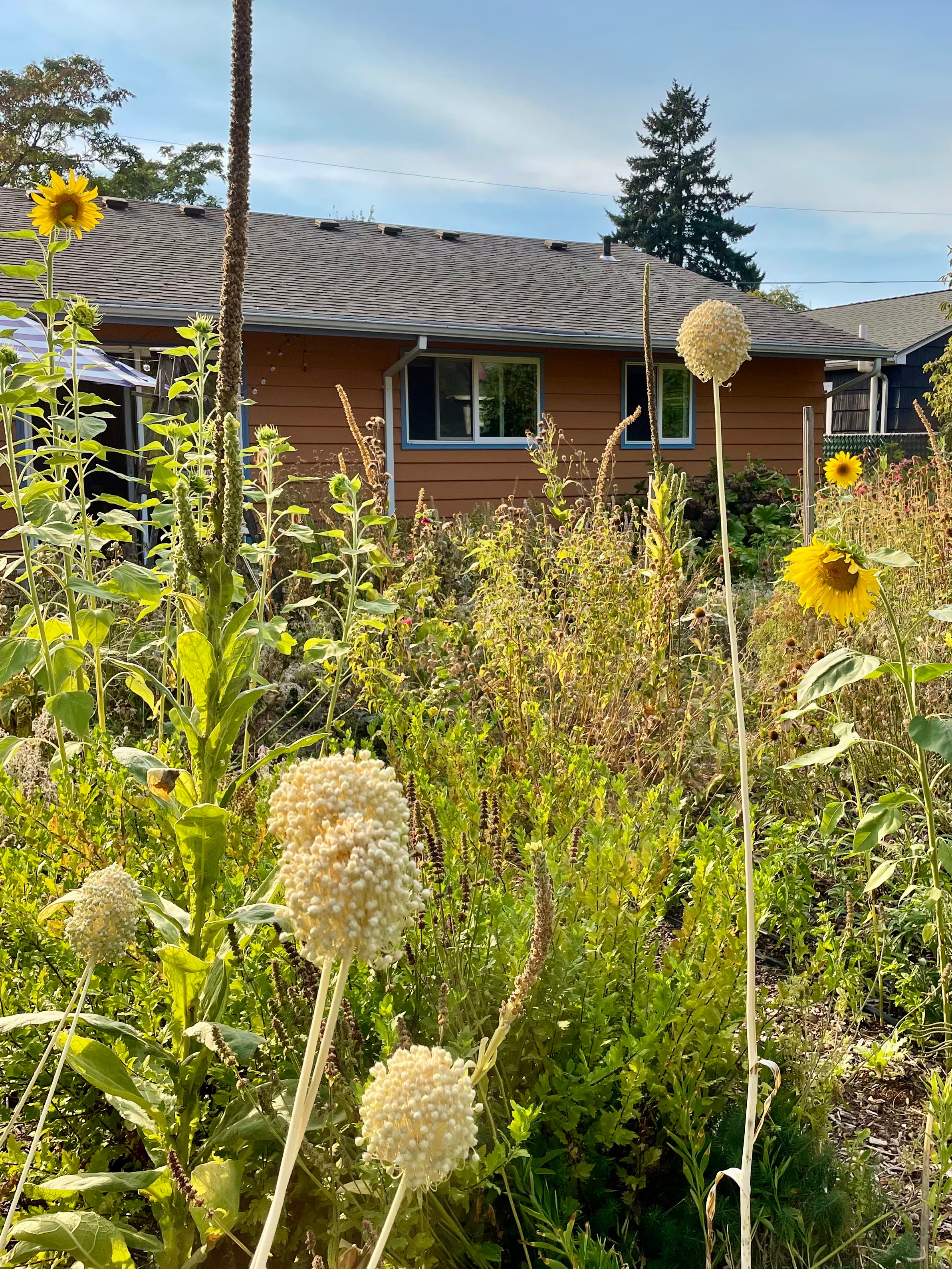
Portland neighborhoods can be one delight after another: poetry boxes, little free libraries, sidewalk chalk drawings galore, pocket gardens, and other inventive gifts to be shared with the community. But herban enclave stands out. The moment I turned down Polly’s street, I guessed which home was the one I was looking for. Clearly, this was a neighborhood of gardeners, but one lot in particular burst at the seams with late-summer plantings.

No space there is wasted, and I marveled at how Polly and her partner managed to grow and lovingly handcraft so many offerings on this modestly sized patch of land.

For example, in November, herban enclave’s winter csa care package (available to order until November 21) includes:

  • syrup made from aronia berry, rose, and holy basil
  • nasturtium flower finishing salt (with sichuan peppercorns, smoked salt, and rose)
  • a “winter quiet” tincture of milky oats, ashwaganda root, rose, and wood betony
  • a replenishing tea of nettles, raspberry leaf, oatstraw, and other plant allies
  • a soaking salts blend of eucalyptus, lemon, ginger, ashwaganda elixir, and wild rose flower essence
  • A “breathe deeply” oxymel of nasturtium, anise hyssop, holy basil, and aronia berry

(Photos by Polly Hatfield)

Polly’s conjurings have me heading for the dictionary or to my plant and flower identification app because, quite often, I’ve never even heard of the plants and flowers she cultivates that become her ingredients.

By the way, can you tell from Polly’s newsletter sentiments and herbal conjuring names that she is not just a master gardener, but a published poet, too? (Photo by Laura Glazer)

In addition to a seasonal care package, Polly usually has small batch offerings on hand. These enticements and several others are currently available until November 21:

  • nocino (an Italian liquor made from immature green walnuts)
  • a variety of tinctures, topical balms, and salves
  • an herbal gomasio (look it up!) of jimmy nardello peppers, smoked salt, black sesame seed, and rose
  • a douglas fir elixir
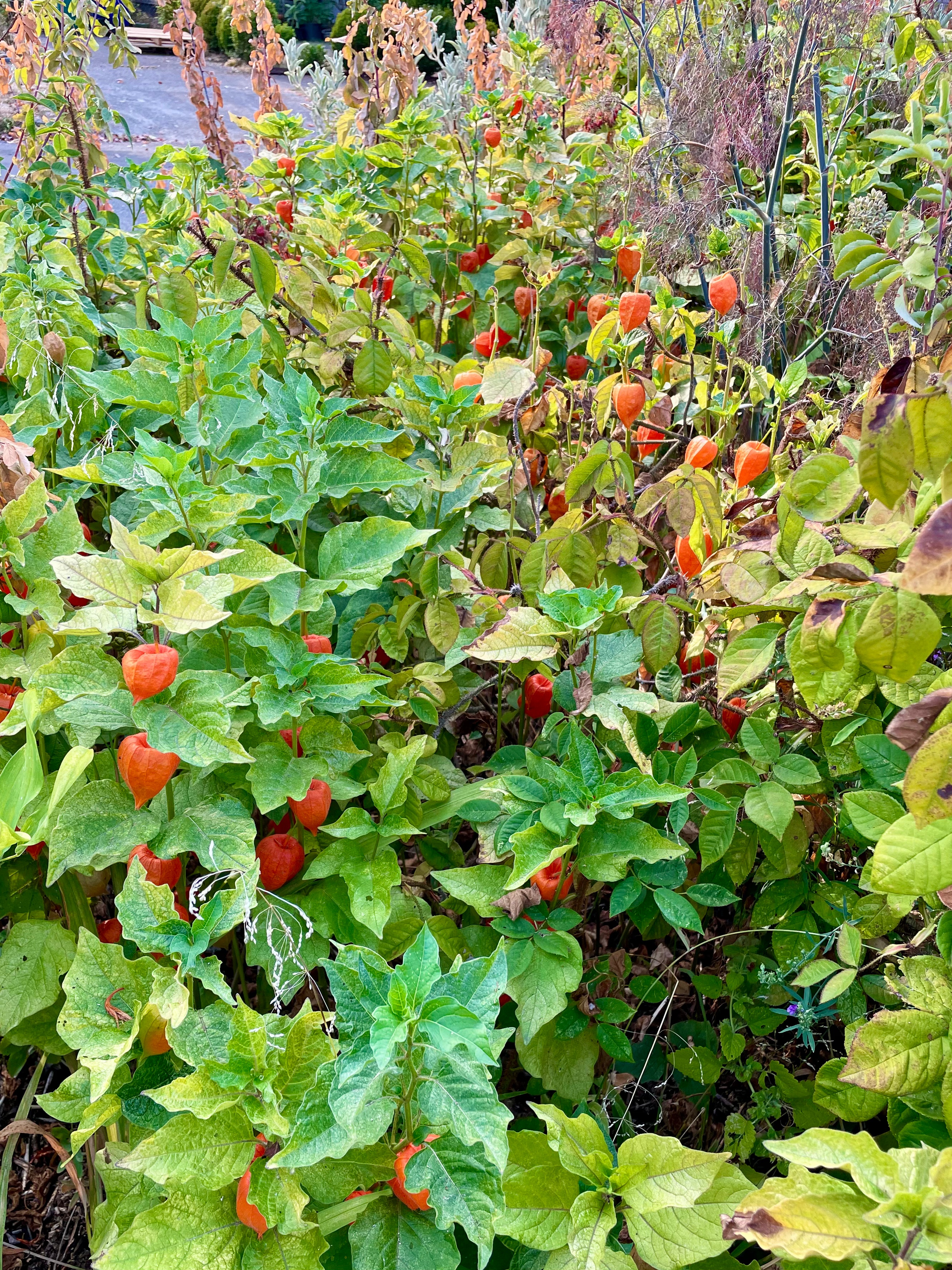
Chinese lantern, Physalis alkekengi

The September afternoon when Polly and I visited, the weather was gorgeous. We sat outside in the sun and I soaked up Polly’s earth-based knowledge as she told me the story of how she and her beloved found their ideal home, planted the extensive gardens, and established such a unique CSA.

Before our meeting, I’d asked Polly if a particular book had been her “bible,” one that had contributed to a vision for her work and way of living. “Gardening at the Dragon’s Gate,” she’d said, and I ordered a used copy.

As I write this, I’m two-thirds of the way through Wendy Johnson’s classic book about gardening and Zen Buddhism (published in 2008), still wondering how I got to be my age without encountering this extraordinary title. I’m a middling, on-again, off-again gardener with grander ideas than I know how to execute. I’m an insight meditation student and teacher as well (and I admire the Zen school of thought, too.) So Gardening at the Dragon’s Gate speaks to me on many levels. Turn to any page and you’re likely to find a nugget of wisdom. You’ll never plumb all of its depths.

Author Wendy Johnson is one of the first influential, ground-breaking California organic farmers and gardeners who came of age in the 1960s and 70s. Johnson, Alice Waters, Eliot Coleman and others pioneered the farm-to-table movement. She is the founder of the extensive gardens at Green Gulch Farm Zen Center near San Franscisco and a Buddhist meditation teacher.

In Buddhist texts, consciousness is said to be a field, a piece of earth on which every kind of seed is planted. On this field of consciousness are sown the seeds of hope and suffering, the kernel of happiness and sorrow, anger and joy. The quality of our life depends entirely on which seeds we garden and nourish in our consciousness.

Growing a garden, like cultivating the wide field of consciousness, is original work. Each time we plant a garden we are returning to origin, to the source of every garden ever grown. The word “origin” derives from the Latin verb oriri, to rise, as the sun and moon rise in a cyclical pattern in the day and night sky. Originality has a still older meaning described by the upwelling of deep springwater through stony ground. Growing a garden depends on this double force of originality that is both rhythmic and permeating. – Wendy Johnson, Gardening at the Dragon’s Gate

I’ve learned as a meditator that we can deliberately and lovingly set an intention for our days. We can do the work of our intentions in a way that gives meaning and shape to our lives. I think that master gardener/herbalist Polly Hatfield and her partner are doing this every day at herban enclave. I love how the work of gardening and a way of life inevitably become woven together.

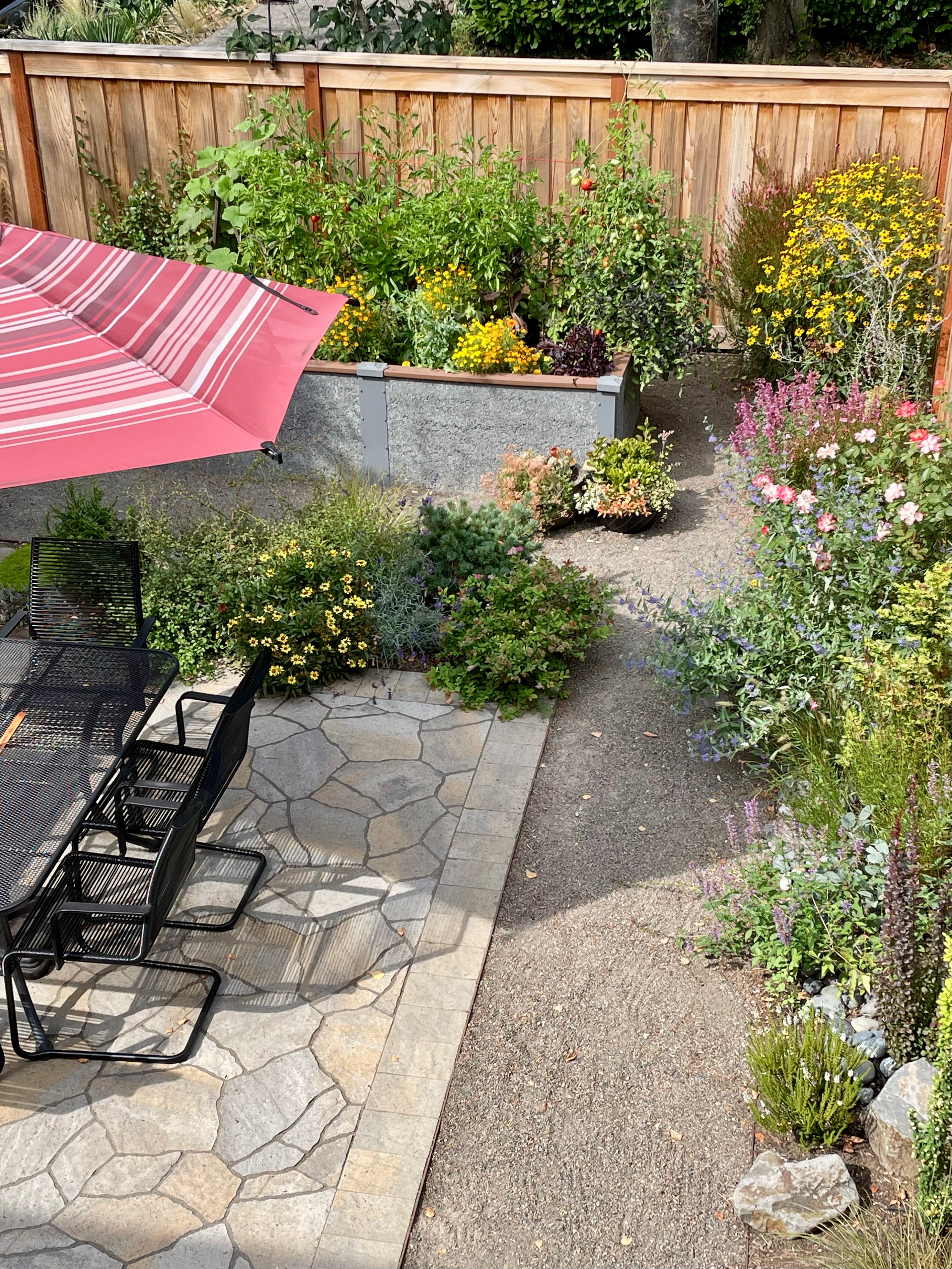
I think about other home gardens we enjoy seeing in another part of Portland when we visit extended family. They have a gorgeous new garden, and another more vintage garden that is a vital part of the Montessori school they founded, where very young folks spend lots of time playing, learning, and enjoying nature’s riches.

Portland is a city of gardens and garden lovers. Here is one of two home gardens created by my niece, sister-in-law and family. (This is the new garden.)

The Montessori garden, where children spend time every day.

As I write this post at my desk, the wind is kicking up, I hear the patter of raindrops, and I’ll need to close my studio window soon. After a balmy Indian summer, the temperature here in North Carolina is expected to drop twenty degrees. We’re entering the cold, dark time, when Polly’s makings (even simply reading about them) can give us warmth and comfort.

And with that, I will let Miss Polly have the honor of signing off:

may you allow yourself to rest.
to sink into a season of dormancy.
& to tend your heart well.

with love & full moon blessings galore,
heal // whole // holy
warmly & always with love, polly

Here is a link to Polly’s newsletter, with ordering information (order by Nov. 21, 2025).

https://mailchi.mp/b57eef719645/rose-magic-summer-spell-solstice-love-12930906?e=b8a80062f5

You can find Polly Hatfield on Instagram, and sign up for her seasonal newsletter on her linktree site:

https://www.instagram.com/achilleaswooning/

linktr.ee/Miss_Polly

The making of a first novel, When Things Go Missing

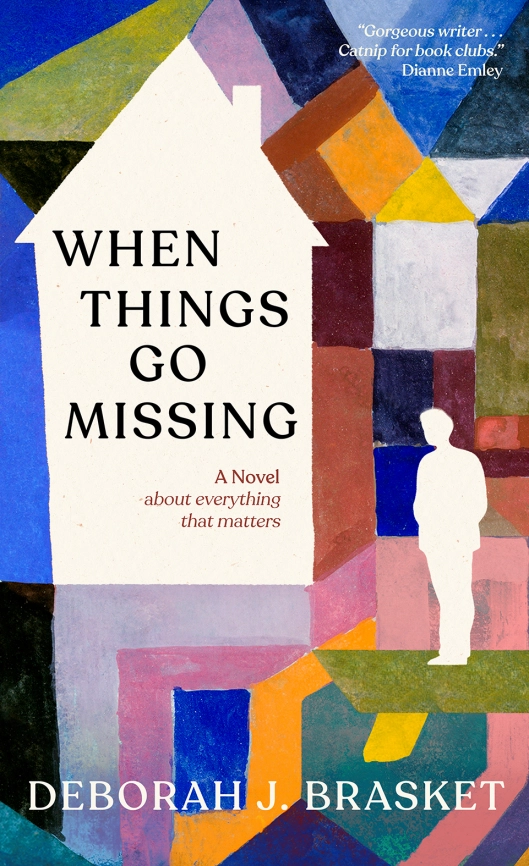
One of my favorite writers and bloggers, Deborah J. Brasket, will publish her first novel, When Things Go Missing, in just a few days! It’s a pleasure to participate in Deborah’s Book Blog Tour along with nine other bloggers. Please enjoy Deborah’s guest post below, and be sure to scroll to the end to find links to the other posts.

I hope you’ll leave comments here and on the other book blogger sites for a chance to win a free E-book with extra chapters of the novel! Here also is a link to my review of When Things Go Missing.

Here is what Deborah has to say about an important phase in the writing of her novel:

I thought I’d share something that I wrote six years ago about When Things Go Missing when it was still a novel-in-progress. At that time the working title of my novel was From the Far Ends of the Earth, and it was in the hands of an agent who was submitting it to publishers. This post shows how long and messy the road to publication can be and the choices writers must make along the way

Endings and Beginnings, A Writer’s Life

Well, I just finished rewriting the ending of my novel as requested by a publisher. We will see what they think.

Either way, I believe this new ending is stronger–-still hopeful, but less certain. More in keeping with the way things are for most of us when things we love go missing, or when struggling with our own demons and addictions.

I’ve decided something else too. Quite a few publishers wanted to see more of the missing mother in my story, yet I wasn’t willing to do that. It would have unraveled the very premise of my novel, which was, how do we cope when the center holding everything together falls apart? When the person upon which we most depend disappears?

I wanted the mother to be part of the puzzle, not a presence herself, but that “absent” presence we feel, even yearn for, but cannot quite pin down, and never really know for certain.

Do any of us ever, really, know our mothers? Don’t we only know them through our own often faulty and incomplete perceptions of them? What they’ve allowed us to see, or what we choose to believe? All knowledge is partial and open to revision. We may know the facts that lay before us. But do facts a person make?

Yet even while I’ve resisted the call to add the mother’s perspective to this novel, I can understand how a reader might want more of her, to hear about her journey as she travels away from her family and through South America. What does she learn as she discovers the world through the new lens of her photography? Does it lend insight into her past? Into herself as a mother and wife and now an artist? How does it shape her anew?  Where does it take her?

So I’m considering a “sequel” to From the Far Ends of the Earth, if we can call it that, since it will cover the same time-space as the first novel.

I think it might be fun to give the mother her own voice and space, to see what shaped her past and how her journey shapes her future.

It’s the thing I love most about writing, discovering what I never knew I knew before I began to write it, as if the words themselves are drawn from some inner well of insight or vision I never knew I had.

“We create ourselves out of our innermost intuitions,” so writes a sage.

I believe that. And I also believe our characters are created in much of the same way. I wonder if we all contain multiple characters within us that make themselves known to us through our writing? Or are we just writing our larger selves?

Perhaps all the selves of all the people we’ve come to know, to experience, in this wider world, once known, become part of us, at least partially?

I believe there is a collective consciousness that we tap into from time to time, and writers, perhaps, most of all.

Sometimes I don’t know where I end and another begins.

My son says I have boundary issues. No doubt he’s right.

When Things Go Missing BOOK BLOG TOUR

Below are the bloggers, authors, and book reviewers participating in this tour promoting When Things Go Missing. Participants will either be spotlighting the book, posting reviews, or interviewing the author.

GIVEAWAY

Please bookmark this and join us on the tour! Those who leave the most likes and comments on the participating sites will have a chance to win a free E-book PLUS extra chapters of the novel (which the author reluctantly had to cut.)

BOOK BLOG PARTICIPANTS

• Sep. 15 – Sally Cronin, Smorgasbord Blog Magazine – SPOTLIGHT

• Sep. 16 – Valorie Hallinan, Books Can Save a Life – INTERVIEW / GUEST POST

• Sep. 18 – Laura Bruno Lilly, Classical Guitarist/Composer – BOOK REVIEW

• Sept. 20 – Margaret Moon, Book Chat – AUTHOR INTERVIEW

• Sept. 21 – Luanne Castle, Poet/Author – BOOK REVIEW

• Sep. 23 – Dr. Vicki Atkinson, Therapist/Author – BOOK REVIEW

• Sep. 24 – Jacqui Murray, Author, Book Reviewer – BOOK REVIEW

• Sep. 25 – Liz Gauffreau, Poet/Author – SPOTLIGHT

• Sep. 26 – Wynne Leon, The Heart of the Matter Podcast – INTERVIEW

• Sep. 27 – Liz Dexter – Editor, Book Reviewer – BOOK REVIEW

When Things Go Missing will be published by Sea Stone Press September 22, 2025.

PRE-ORDER NOW

Amazon Bookshop Barnes & Noble

When Things Go Missing

“To all families who fall apart and struggle to find their way home again.”Deborah J. Brasket

What happens when a mother leaves her family?

Shopping list and coupons in hand, fifty-something Fran heads to the grocery store. But instead of shopping, she keeps driving – all the way to the California border, into Mexico, and beyond.

It is 1997. Fran will not be coming home anytime soon.

With deep pleasure, I bring Books Can Save a Life out of retirement to tell you about Deborah J. Brasket’s debut novel, When Things Go Missing. 

But first, let me say that I have been following Deborah’s blog, Writing on the Edge of the Wild, for many years on WordPress. (She now has a Substack version as well.) I have always found her insights about art, literature, truth, beauty, and the human dilemma to be evocative and profound. Truly, her blog has always stood apart from the rest. So it was with great anticipation that I powered up my Kindle and let Deborah’s story carry me away. 

We witness Fran’s confused, angry, and bereft family as they begin to navigate life on their own, on ground that has shifted dramatically. The family Fran leaves behind, like so many families, was already fractured – I would even say traumatized. Where do they go from here, when it feels like the end of life as they’ve known it?

Kay, an aspiring archeologist, receives periodic voice mails from her mother:

“She’s in mourning, she tells herself, mourning a mother she thought she knew who she now realizes she may never have truly known: A mother who always was the still center of comfort she could turn to in times like these, who is there no more. A mother who held her dysfunctional family together, a family she now fears will fall apart. The grief isn’t only about losing her mother but losing everything her mother represented: family, home, security, unconditional love. It’s like her mother’s absence blew a hole through the center of her universe, and everything is flying apart, including Kay. There’s nothing left to hold onto.”

To her son Cal, a heroin addict, Kay mails her mysterious photographs from various South American locations. As the mother of two adult sons, I was haunted by this passage, as I considered what it must have taken for Fran to let go of her son:

“…he gets sideswiped by this opposing flood of thoughts that gushes through his mind like his mother’s conscience. That’s how he sees it too – not his conscience but some uncomfortable and undesirable feeling that drifts in from his mother’s looks and sighs and follows him around like a fucking rain cloud. Hell, if she isn’t still doing it, even now when she’s disappeared.

He clears out a space on the bathroom mirror so he can look at himself, the image blurry in the wetness, surreal, with the steam all around, his face ringed by a bright halo of light. He thinks if he stares at this face ringed with light long enough, hard enough, deep enough, he might catch a glimmer of who the hell he really is or was supposed to be in another lifetime. Whatever it was, he knows it was good. Whatever could have been, whatever he blew away, it was all unbelievably good.”

Walter, Fran’s husband, a taciturn, sometimes volatile, father, gets Fran’s credit card bills: 

“He’s been taking care of Frannie since she graduated from high school and he got home from Vietnam….He never minded that she didn’t work. Why should she: He earned enough on his own…

He’s never tried to stop her before from doing anything she wanted. He just has to keep letting the rope out more, giving her as much lead as she needs, and then, when she’s ready, she’ll find her way home again. It’s what he tells himself, what he needs to believe to get through the day.”

We get a sense of the kind of wife and mother Fran was and is, as Kay, Cal, and Walter at first simply react to Fran’s abandonment. As each of them barely manages to keep going – largely on their own and isolated from one another – they begin to separate from the mother and wife bonds. They begin to individuate. We are witness to a trio of heroic journeys that unfolds in surprising and unexpected directions. 

When Things Go Missing will stay with you long after you’ve read the final page. To me, this is the mark of a powerful and authentic story, one that is so true for America and for our time. You may find yourself reflecting on your own life path, the choices you’ve made, and the choices that await you.  

What are our responsibilities as mothers, parents, and partners? 

Is there such a thing as the perfect mother? 

Are there limits to the bonds of love and family? How do these relationships change over time? Are they meant to be forever?

What are our responsibilities to our own self-actualization? When do we sacrifice our own desires and aspirations for the good of our families and communities?

How do we come to find our chosen families? Can they ever replace our families of origin? Is it possible to achieve a happy blend of the two?

As a longtime reader of Deborah Brasket’s work, I trust her wisdom and relish the grace and richness of her writing. When Things Go Missing is a beautiful unfolding – a tender, loving portrait of a family contending with grief, loss, and regret, while fully embracing all the joy that life can hold. 

I will close with the epigraph that opens When Things Go Missing: 

“I have loved thee with an everlasting love: therefore, with lovingkindness have I drawn thee.”Jeremiah 31:3

When Things Go Missing, an excellent book club choice, includes discussion questions. Publication date: September, 2025, Sea Stone Press.

When Things Go Missing is now available for pre-order at AmazonBookshop, and Barnes & Noble.

Cabin 135: A Memoir of Alaska

TIME

“During the Great Depression, the federal government created new agricultural settlements in a number of states, including Alaska. Farmers who had run out of other options applied for the chance to start over in one of these government-sponsored colonies. In 1935, over two hundred families were accepted for the Matanuska Colony.”

***

“She might as well have said, you know you’re going to make an offer. How can you not? A unique house. Acreage for your horse. Exquisite views. A ready-made vegetable garden. A separate plot for potatoes and a raspberry patch in a swale north of the house. Chuck and I glanced at each other with a look that said ‘this is it.’ We didn’t consider there might have been reasons that the place hadn’t sold during a year on the market…

In May 1983 we moved into the house that had been built forty-eight years earlier for the Matanuska Colony. Chuck was returning to the community where he’d grown up. I was yet another person in a long procession of migrants to Alaska.” – Katie Eberhart, Cabin 135: A Memoir of Alaska

Annie Dillard advises writers to “give voice to your own astonishment.” Katie Eberhart does just that in her memoir of Alaska, Cabin 135.

When we moved to Bend, Oregon, I wanted to connect with other writers. I came across Katie Eberhart’s website, and I realized she didn’t live far from me. I hesitated, not wanting to invade her privacy, but sent her an email anyway to see if she wanted to meet for coffee. Katie responded graciously and invited me to join her small writer’s group. Lucky for me, because it was an excellent group, and Katie and I became friends.

Katie was in the final stages of revising her memoir and negotiating a publishing contract with the University of Alaska Press. Cabin 135 was published in December, 2020, part of the Alaska Literary Series. It was gratifying to watch Katie find a publishing home with editors who understood her vision and wanted her book to be part of their distinguished series. A few months ago, I listened to Peggy Shumaker, editor of the series, interview Katie at a virtual reading hosted by Fireside Books in Palmer, Alaska. Their rich discussion captured the expansive nature of Katie’s story.

I’ve read Katie’s memoir twice and, with a third reading, I’m sure I’ll continue to glean new meanings and insights. This is a book I can’t fully grasp on a first reading; Katie has a singular, uncommon sensibility, and she explores her fascinations in a nontraditional narrative. Instead of a linear story, you will find in Cabin 135 a text divided into thematic sections such as Time, Cabin, Earth, Terrain, Greenhouse, Migration, Sky, Denali, and Archaeology.


Cabin 135, within sight of three mountains: Matanuska Peak, Lazy Mountain, and Pioneer Peak.

Done well, as in Katie’s memoir, this type of narrative has momentum and captures the cumulative, unsentimental emotional power of a life thoughtfully lived. I suppose my reaction is partly personal: Katie and I are about the same age, we raised two sons at about the same time, we have in our histories relationships with older, complicated, quirky houses, and we value nature and place – although for Katie, these passions arose earlier in life, and have been more intentionally explored.

In Cabin 135, you won’t see much of Katie’s husband or sons and their daily lives. But her family is there in the background; I heard the echo of little pajama’d feet bounding down the cabin’s stairs, which reminded me of domestic scenes with our own boys. 

Instead of the dramas of family life, Katie focuses on time, history, imagination, geography and memory – on what we remember and why we remember it. Her story is centered largely on the parcel of Alaska frontier she called home for thirty years, and on her travels, as well. An idea I’ve encountered often in my recent study of eco-psychology is that we are moved by a place – its landscape, flora, and fauna – because it mirrors the landscape of our souls. Katie captures something of this reciprocity in her memoir.

I’m intrigued with Katie’s writing process and how much can be communicated by juxtaposing seemingly disparate ideas. Her narrative pulls me along: where will she go next, I wonder, and what connections will she make? I think, as a reader, if you are receptive to this kind of reading adventure, you will quickly become comfortable and fully committed to going along for the ride. 


The fantastic literary map of Alaska, by Alaska-based artist and graphic designer Ruth Hulbert, and published by Fireside Books in Palmer. Can you find Katie’s memoir? I see a number of other books I’ve loved, or hope to read in the future. Ruth also designed the memoir cover.


In the memoir’s epilogue, Katie writes about her process:

“I write interactively, one revision after another. Each version exists, however briefly, as a quasi-meditation…

Writing provided a framework to explore place as both a literary construct and abstraction….The overlap between multitudinous narratives plus motivations, lucky breaks, and weird confluences proved fascinating, but the stories in this book represent only one possible route across a dimensional terrain that’s spatial, biological, societal, temporal, and laced with ideas – and where a small log-built house occupies a certain plot of land. As is the case with any memoir, much has been left out – omitted, ignored, or forgotten.”

A couple of ideas I want to highlight here: that each draft is a kind of quasi-meditation. I have never thought of the writing process in this way, but Katie’s insight helps me better appreciate the richness of our quirky, individual writing paths; our creative instincts, given free reign, possess a kind of logic and aesthetic sense that may surprise us.

And, secondly, across your own life span, which dramas, scenes, and moments stand out? We choose from an infinite number of moments to tell our stories. And yet we each have within us a multitude of stories.

TIME

“I wonder about the future of Cabin 135 and its surroundings. I imagine the house and the well. Or perhaps the town will overtake the house, and there will be city water, not a well. In a hundred years, the raspberry patch will be something else. Or the raspberry patch will still be a raspberry patch, but the raspberries will be different. I hope the startling flavor of the raspberries never changes.

Each summer, no matter where I am, when I bite into the first raspberry, memories flood my mind of city gardens and country gardens – my mother’s garden, my grandfather’s, and mine, but also generations of gardens. Indeed, even centuries of gardens. Gardens that no one remembers, well-tended or gone wild, and that hint at what comes next.”


Ruth Hulbert’s custom-made map of Cabin 135 territory.

(Still) reading Barry Lopez

Stories…offer patterns of sound and association, of event and image. Suspended as listeners and readers in these patterns, we might reimagine our lives…As long as it took for me to see that a writer’s voice had to grow out of his own knowledge and desire, that it could not rise legitimately out of the privilege of race or gender or social rank, so did it take time to grasp the depth of cruelty inflicted upon all of us the moment voices are silenced, when for prejudicial reasons people are told their stories are not valuable, not useful. Barry Lopez

About This Life: Journeys on the Threshold of Memory, Barry Lopez

Here is my third and final reposting of my Barry Lopez Books Can Save a Life writings, in honor of his passing on December 25, 2020:

In the introduction to his essay collection About This Life: Journeys on the Threshold of Memory, Barry Lopez tells of meeting a man on a plane who asked what words of advice he could pass on to his teen-age daughter, who wanted to be a writer. This is what Lopez said:

She must read, and her choices should be whatever she is drawn to.

She should read the classics, too, but she’ll have to work harder to find stories of heroism, love, and our noblest values that are written by women.

Second, she must “become someone” and “speak to us from within those beliefs.”

Third, he advised that she “separate herself from the familiar.” After exploring other places and meeting a diversity of people, she`ll know why she loves the familiar and share this knowledge through her writing.

Early on, Lopez felt he was noticed, accepted, and rewarded as a writer in part because he was white, male, privileged and well educated. If you read his work, you’ll find he is keenly sensitive to the fact that many voices haven’t been heard because they are different or not within traditional circles of power. He thrives on traveling to the far corners of the earth and seeking these people out –  artists, artisans, farmers, naturalists, explorers who live close to the land, indigenous peoples, and others.

I was mesmerized by an essay in About This Life, “Effleurage: The Stroke of Fire.”  An Oregon potter and builder of a unique anagama kiln invites clay artists from around the world to fire their work. Jack doesn’t care about marketing or commercial success; he’s totally immersed in the process of making pottery out of materials from nature. Every three or four months, up to twenty artists bring their work to be fired in the Dragon Kiln.  Families, friends, even pets tag along. The firing goes around the clock for several days. Building the tremendous fire that heats the kiln is an art in and of itself. Different kinds of wood – black locust, maple, cherry, Lombardy poplar, red cedar – make different kinds of fires, and keeping the fire properly stoked is a community effort of like-minded artists who put aside their egos for the benefit of the group.

Lopez says you must become someone to write. I think he would agree the kiln designer and the clay artists are “becoming” through their life’s work, just as their clay pieces are forged in the fire. It’s a process that never ends. Even the clay pot continues to change, subtly, after the firing.

Crow and Weasel book cover

Over and over, Lopez celebrates journeys into the unknown, strangers who become friends, coming home again, and the writing of the story. You see this in About This Life and in his fable, Crow and Weasel.

Recently, Lopez published a revelatory personal essay that has received a lot of attention, “Sliver of Sky,”  in Harper’s Magazine, about a period of sexual abuse he endured as a child. That Lopez waited until his seventies to write about this suggests how deeply confounding and wounding it was. The trauma and years of silence may explain in part Lopez’s empathy and compassion for others who were silenced for one reason or another. And no doubt it has contributed to his sense of mission as a writer.

I’ve written about years of being silent and feeling silenced by others because of my mother’s mental illness. I think that is partly why I didn’t make the commitment to becoming a writer when I was younger. How can you mature as a human being and as a writer when you can’t work with the very material that is woven into your identity?

If we’re silenced, we’re blocked. We don’t become our fullest selves. Diminished in what we are able to offer the world, the world will be diminished, too. It is in our best interests to see that no one among us is silenced.

So I find reading Lopez to be a rare and important form of encouragement.

In an interview with Bill Moyers, Lopez says he’s viewed as a nature writer but, actually, he is writing about humanity.

“Every story is an act of trust between a writer and a reader; each story, in the end, is social. Whatever a writer sets down can harm or help the community of which he or she is a part.”

Barry Lopez brought us I, Snow Leopard

Snow Leopard

Photo by Tambako The Jaguar Creative Commons Attribution-Share Alike 2.0 Generic license

“I, SNOW LEOPARD is both a lyric and an elegy. It is easy to imagine its lines being loudly hailed in whatever country the poem finds itself in. It’s publication comes at a time when people everywhere have begun to wonder what a voice like this, suppressed for centuries, wishes to say now, in this moment when the Snow Leopard’s human brothers and sisters find themselves side by side with him. Imperiled.”   Barry Lopez

Barry Lopez

Happy New Year, everyone! In honor of Barry’ Lopez’s passing on Christmas Day, I’m reposting my previous Books Can Save a Life writings about him. I wrote the following post on April 16, 2016, after Lopez visited Rochester, NY:

Barry Lopez came to Rochester this week to receive “The Art of Fact” award for literary nonfiction presented by The College at Brockport Writers Forum and M&T Bank.

If you’ve been following my blog, you know that Barry Lopez is one of my heroes, not quite at the level of Pope Francis and the Dalai Lama, but close. (See my blog’s header quote.)

Lopez is one of the very best nature writers, and if you love animals and wildlife, you’ll love his nonfiction books, essays, and short stories. He has travelled to 90 countries and has a tremendous respect for the animal world and the many indigenous peoples he’s come to know.

I, Snow Leopard

Lopez came to Rochester to receive his award and to deliver to us the poem “I, Snow Leopard” by Jidi Majia. 

I wasn’t familiar with either the poet or the poem, but Lopez said that when he found out “I, Snow Leopard” had been published in Asia and Europe, but not in the United States, he had to set things right.

He felt that it was vitally important that the American people hear the words of the snow leopard in this poem. So he saw to its publication here, and wrote the foreword to the English edition.

Jidi Majia, a member of the indigenous Nuosu (Yi) people who live in the mountains of southwestern China, has won numerous literary awards.  As far as I could tell from what I found online, few of his poems have been translated into English.

Majia’s poem is written in the words of a snow leopard, which is viewed by the Nuosu as a wisdom keeper, a being with “biological authority,” according to Lopez.

He told us that when he first began traveling the world and exploring, in his thirties, he viewed wild animals in an amateur, superficial, childlike way, until he learned to embrace the much more refined view held by native peoples.

A poem is a door anyone can walk through, Lopez said, and this poem is the mysterious and elusive snow leopard’s expression of grief and a warning to human kind:  “Do not hunt me any longer.”  Human violence toward animals puts everyone in peril, animals and humanity alike.

Before Lopez began, he said he wasn’t worthy to read “I, Snow Leopard,” but he’d try. He said that, as far as he knew, we’d be the very first American audience to hear the poem.

We listened to this exclusive reading in the soaring space that is the chapel in Rochester’s Temple B’rith Kodesh. “I, Snow Leopard” is beautiful, haunting, simply expressed and accessible even to listeners not accustomed to hearing poetry.

Uncia_uncia
Photo by Bernard Landgraf. CC BY-SA 3.0

After the reading Lopez answered questions and spoke informally and earnestly. As we listened, the audience seemed to be hanging on his words.  Here are some direct quotes I managed to scribble in my notebook:

“Each soul is essential to the warp and weft of the universe.”

“I want to see people come alive.”

“We know what to do and we have to do it now.”

Fixing our world “will take people of great courage. People like you. Because Washington is not doing it.”

“We should be holding hands.”

“The only thing that really matters is to be in love.”

I wrote down the following words, too, but I don’t recall if they are from the poem or if they are Barry Lopez’s words. I believe they are both:

“There is no other place for any of us to go.”

“I, Snow Leopard” is available on Amazon. Barry Lopez told me it is also to be published in a future issue of Orion Magazine.

Of Wolves and Men

If you’d like to read Barry Lopez, Arctic Dreams, his nonfiction work about the Far North that won the National Book Award, is a great book to start with. I haven’t yet read Of Wolves and Men, but when I saw the mesmerizing cover photo of a wolf on display at the reading, I added it to my to-read list.

Lopez writes fiction, too. I especially liked his subversive collection of short stories, Resistance, which he wrote shortly after 9/11, about surveillance and “parties of interest” to the government.

If you want to know more about the fascinating snow leopard, Peter Matthiessen’s memoir, The Snow Leopard, is a great read.

The Secret Life of Walter Mitty, with Ben Stiller and Sean Penn, is one of my favorite movies. Watch it. You might spot a snow leopard.

Barry Lopez passing, gathering words

The role of the artist, in part, is to develop the conversations, the stories, the drawings, the films, the music—the expressions of awe and wonder and mystery—that remind us, especially in our worst times, of what is still possible, of what we haven’t yet imagined.  – Barry Lopez

Barry Lopez passed away on Christmas Day, 2020. You can read a brief, beautiful account of his passing by his wife, Debra Gwartney, on his website. Over the next months, his family will begin the work of restoring their home on the McKenzie River, which was burned in the 2020 wildfires.

During the next week I’ll be featuring some of my past posts about Barry. Here is one, which I wrote in 2013:

When I began this blog I chose for my tagline a quote by Barry Lopez about stories because it rang true for me. But I’d never actually read any of Lopez’s books. So I began with Arctic Dreams, which won the National Book Award.

If you want to be an armchair traveler of the world, if you love nature, if you crave being transported to another time and place by extraordinary writing, you must read Barry Lopez. Arctic Dreams has some of the most dazzling and poetic passages about the natural world you’ll ever encounter.

“The aurora borealis, pale gossamer curtains of light.”

“The mother-of-pearl iridescence of the sun’s or moon’s corona in clouds.”

“The outcry of birds, the bullet-whirr of their passing wings, the splashing of water, is, like the falling light, unending.”

You will find uncommon truths, beautifully expressed. Here is Lopez on the great Arctic explorers of the past: “The day after a little trouble on the ice it is possible to imagine, if but imperfectly, the sort of reach some of these men made into the unknown, day after day.” 

“I think we can hardly reconstruct the terror of it, the single-minded belief in something beyond the self.”

“Inescapable hardship transcended by a desire of spiritual elevation, or the desire to understand, to comprehend what lay in darkness.”

“What dreams there must have been that were never written down….that remained in the heart. The kind of dreams that give a whole life its bearing, what a person intends it should be, having seen those coasts.”

If you want to write, how can you move closer to this kind of mastery of language?

old dictionary

As I was reading Lopez, I happened to make a happy discovery in my writing bible, Priscilla Long’s The Writer’s Portable Mentor:  Lexicon Practice. Lexicon Practice involves looking up words you don’t know and words you want to know better, not in in a pocket dictionary or online, but in a mammoth 600,000-word dictionary, the kind you still see in some libraries. 

(Long advises writers to search online for a dictionary published in the 1930s, 40s, and 50s. They aren’t cheap, but they are a wise investment.) Copy the definitions of a word in a notebook. These old dictionaries have detailed diagrams and illustrations, and occasionally I copy these as well.

I write down the word in its language of origin, too. If it has a Latin, Italian or Spanish root, I can brush up on my foreign language vocabulary. Long instructs you to write out the sentence where you found the word and make up a sentence of your own, preferably a sentence you can use in a piece of writing you’re working on. You can choose a lexicon theme based on the work you are doing at the moment. Since I’m writing a memoir, for example, I have a lexicon with words commonly used in the 1960s – products, types of clothing, etc.

Long believes in Lexicon Practice. Otherwise, our writing derives from the uninspired language of generic, overused words and phrases we find in newspapers, magazines, advertising, and social media. As a teacher of writing, Long knows immediately when a writer doesn’t have a Lexicon Practice. She mentions Lopez as the kind of master writer we can emulate. He uses words with Old English and Old German roots, and “…he favors concrete words…that can be seen, smelled, touched, tasted, or heard. For Lopez, language is a musical instrument…”

Now, Lexicon Practice is a geeky, writerly thing, but it appeals to me. This kind of practice slows you down, teaches you to choose words with care. If you want to write rich, compelling fiction or nonfiction, you need to be in love with words in this way, or allow yourself to fall in love with them by doing work of this nature.

Definitions and drawings

Culling words from Arctic Dreams was an inspiring way to for me to establish a habit of Lexicon Work. A variety of birds populate the first pages of my first lexicon: plover, whimbrel, curlew. There are many boats and nautical references: pinnace, tender, portolano chart.  Geographical terms, too: archipelago, scree, promontory.  (As I write this, my word processor does not recognize a few of these uncommon words and highlights them as misspellings.)

Long advises writers to compose word lists, too. Her examples: every possible synonym for blue (sapphire, smalt, cobalt, woad) and all the parts of a fiddle (peg box, side rib, bridge, button). You can work according to a theme. Chairs and chair parts. Types of roofs. Clothes for people who love the outdoors. Get an L.L. Bean catalog and find words like cargo pants, fleece, sun-washed, twill, seersucker, Mary Janes, wellies.

I found that keeping a lexicon is a good excuse to buy one of those expensive, fancy journals I love. Mine has a silvered filigree cover designed in Germany around 1800. (I haven’t kept up a lexicon practice as of 2020, but I do it from time to time for specific writing projects.)

I am now using the second edition of Pricilla Long’s The Writer’s Portable Mentor, published in 2018 by the University of New Mexico Press. It has been updated with all new craft models and to reflect changes in the publishing industry.

***

If you want to be uplifted or if you would like encouragement in your life’s work, listen to a few minutes of this conversation between Barry Lopez and Bill Moyers.

Here is a moving and enlightening interview with Barry Lopez on Idaho Public Television from 2019. He talks about his latest book, Horizon, (which is a wonderful and urgent read!!!) and opens up about the impact of childhood sexual abuse on his life, and what he hoped to accomplish by finally writing about it in the New Yorker as an elder. Those of you writing memoir about traumatic events will find it helpful.

Here is a link to the McKenzie River Trust, which is devoted to conservation of the western Oregon region where Barry Lopez lived. Much of the river corridor was destroyed by the fall fires. If you wish, you can make a donation in memory of Barry Lopez.

Hope in the Dark

A backyard in San Francisco, September 10, 2020

“This morning was perhaps the most unnatural-feeling and unnerving of my life, with darkness rather than daytime rolling in. People around California reported that the birds that would normally be singing were silent. On some of the days, since the freak lightning storm in the heat wave of mid-August launched this explosive fire season, the sun has been red, and when the moon was full it was also red near the horizon, but this morning there was no sun to be seen through the murk. Ash was falling, the ash of trees, forests, homes, towns, dreams burning up. In the strange light, the world around us looked ghostly, otherworldly, unnatural, unnerving, disturbing.”

Rebecca Solnit, The Guardian, September 10, 2020

There are no words to describe my grief over the fires in Oregon, California, and Washington, so I’ll defer to Rebecca Solnit and her Hope in the Dark:

“I write to give aid and comfort to people who feel overwhelmed by the defeatist perspective, to encourage people to stand up and participate, to look forward at what we can do and back at what we have done. This book was always for them. And if you’ve read this far, for you.”

“….sometimes it’s the most unlikely people who rise up and take power, the housewives who are supposed to be nobody, the prisoners who organize from inside, the people who have an intimate sense of what’s at stake.”

“Hope is not a lottery ticket you can sit on the sofa and clutch, feeling lucky. It is an axe you break down doors with in an emergency. Hope should shove you out the door, because it will take everything you have to steer the future away from endless war, from the annihilation of the earth’s treasures and the grinding down of the poor and marginal…”

“To hope is to give yourself the future – and that commitment to the future is what makes the present inhabitable.” 

Exceptional journalism for troubled times


fivedays


When I was a practicing medical librarian, I read an extraordinary work of medical humanities journalism by Sheri Fink, MD: Five Days at Memorial: Life and Death in a Storm-Ravaged Hospital. 

Dr. Fink won a Pulitzer Prize for her initial coverage of the disaster that played out in a New Orleans hospital serving the poor during Hurricane Katrina, and she is currently doing excellent reporting on the pandemic for The New York Times.

I wrote about Five Days at Memorial on Books Can Save a Life in 2014. I’m including a condensed version of the post below, because in pandemic hot spots around the United States, critical care resources are being stretched to their limits – needlessly so, thanks to the scandalously inadequate national response to COVID-19 – as they were in Hurricane Katrina.

Immersive and meticulously researched journalism like Dr. Fink’s can make these issues real for us in a way that is immediate and clarifying.

Secondly, I’m looking to pass along responsible, innovative journalism in this climate of conspiracy theories and misinformation. For excellent reporting about our current pandemic, for example, read or listen to Ed Yong’s work in The Atlantic, especially his must-read article published today, “How the Pandemic Defeated America.”

Here’s what Yong had to say about the current role of journalism in an interview with CNN: (Thanks to Tom Jones of The Poynter Report for passing this along.)

“I think of the information around the pandemic as rapids, really fast flowing torrential water. It’s so easy to be swept up in it and feel like you’re being carried along, feeling like you’re drowning in it. What I think really good journalism can do is to act as a rock in the middle of that fast flow to give people stable ground where they can stand and observe what is moving past them without being carried along by it.”

Below is a streamlined version of my original post about Five Days at Memorial:

“He would push 10 mg of morphine and 5 mg of the fast-acting sedative drug Versed and go up from there.”  –  Sheri Fink, Five Days at Memorial: Life and Death in a Storm-Ravaged Hospital

Five Days at Memorial is about five days in hell.

After Hurricane Katrina wreaked havoc on New Orleans, staff at Memorial Medical Center thought the facility and everyone in it had survived the storm intact.

Then the levees broke and the water came.

Darkness ensued, air conditioning stopped, and life support equipment shut down. No rescue was forthcoming from federal, state, or local disaster relief agencies or the hospital’s corporate owners. Toilets overflowed. Hospital staff occasionally heard gunshots in the surrounding neighborhood.

Memorial Medical Center had no evacuation plan for a disaster of this type, and staff were not trained in disaster management, even though the hospital had a history of flooding.

To get patients (most of them frail and elderly) to the helipad for the occasional helicopter that eventually did show up, staff had to carry them in sheets down several flights of dark stairs, through a small shaft into the parking garage, and up two more flights. This took well over half an hour for each patient.

By the time Memorial Medical Center was entirely evacuated, 45 patients had died. Twenty-three bodies were found to have high levels of morphine and other drugs.  According to the account Dr. Fink pieced together, it was alleged some patients were going to die anyway – they wouldn’t survive evacuation – and so they were euthanized to prevent suffering.

Dr. Fink covers the legal and political aftermath and discusses the role of families (or lack of it if they are excluded) in making difficult care decisions when resources are scarce. She calls for comprehensive national disaster response requirements for all US hospitals.

Five Days at Memorial will leave you unsettled by the perfect storm of failure on every level, and considerably more informed about the rationing of health care resources and the nearly impossible ethical decisions that must be made in disasters when there are not enough resources to save everyone.

Dr. Fink’s book could, literally, save lives.

Racism and social justice

Two outstanding, timely works of journalism I’ll be reading and posting about soon are by Pulitzer Prize winning Isabel Wilkerson. 

Wilkerson is an immensely gifted writer who spent decades researching and writing the two books below. In this powerful TED talk, she highlights the theme of her book The Warmth of Other Suns. Her Caste is getting rave reviews, and I expect will be on many a reading list this fall.

CasteCaste: The Origins of our Discontents (just published in the US today)

The Warmth of Other Suns: The Epic Story of America’s Great Migration (See Claire’s excellent post over at Word by Word.)