On the third day of Christmas: Pen in Hand

Dog on top of Christmas tree
Illustration by Karen Sandstrom

Karen Sandstrom blogs at Pen in Hand. I love her drawings, her little stories, her commentary, and her wry sense of humor. She’s a writer, journalist and illustrator who lives in Cleveland, my hometown.

Karen created something called “I Must Remember This,” about the daily habit of creativity, which is posted in my home office and gets me back on the writing track when I need it.

Visit her website and take a look at the woman standing in the rowboat clutching a book – I love that picture.

Here are a few of my favorite Pen in Hand posts:

Cut Flowers

I like “Cut Flowers” because I grew up in a flower shop and because I also love Molly Peacock’s book, The Paper Garden. Now I don’t have to write about the book on Books Can Save a Life, I’ll just link to Karen’s fascinating and informed post.

The Geography of Memory

This one’s about a Cleveland suburb on Lake Erie that I visit from time to time.

An Artist’s Stool

I like “An Artist’s Stool” because I will always remember listening to jazz in the Flats on the Cuyahoga River when I was in high school. Yes, that’s the river that caught fire.

Gimme Some of Dat Bitter, Bitter Love

This one, because I belong to that tribe, too.

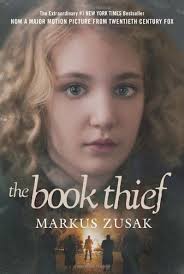
The Book Thief

“They say that war is death’s best friend, but I must offer you a different point of view on that one. To me, war is like the new boss who expects the impossible. He stands over your shoulder repeating one thing, incessantly: ‘Get it done, get it done.’ So you work harder. You get the job done. The boss, however, does not thank you. He asks for more.”       Death, in The Book Thief

The Book Thief book cover

Death is the narrator in The Book Thief, a young adult book about a German family during World War II that has a huge adult readership as well. It is one book not to be missed. The writing is outstanding. Published in 2005, The Book Thief won countless awards and honors, and has become a classic in YA fiction.

I recently reread the book before I saw the movie. I think the screen adaptation is a good one, although some viewers found it tame, and subtleties of the text can’t be captured on the screen. For example, Max, who is Jewish and hiding out in the home of Liesel and her foster parents, paints over every page of a copy of Mein Kampf and creates his own book, with illustrations. Max’s book is embedded within the pages of The Book Thief, and on the pages of Max’s book you can see faint traces of Hitler’s words.  One of the pages in Max’s book is a drawing of a girl and a boy holding hands and standing on a pile of bodies. Inscribed on the sun that shines down on them is a swastika, and the girl is saying, “Isn’t it a lovely day?”

The author, Markus Zusack, uses the written word as a thematic motif. While the Germans burn books thought to be subversive, Liesel and Hans write words on the wall of their basement as Liesel learns to read, and Liesel steals a book whenever she has the chance, in defiance of the Nazis. Liesel then begins to write her own book in order to make sense of the world’s chaos and carnage.

I do think the movie captured the essence of the story, and it is well cast, especially Sophie Nélisse as Liesel Meminger and Geoffrey Rush as Hans, her foster father. Death is the narrator in the movie, as he is in the book, and in both he is an unsettling storyteller who confesses he is haunted by humans. Of course, in addition to being the narrator, Death has a starring role in the plot as well.

My father was wounded in the war, just inside the German border. Occasionally, my mother spoke of her family’s Victory Garden, the rationing of meat and gasoline, and the “man shortage.”  I was born ten years after the war ended. As an adult, I eventually began to understand how the world turned upside down by war cast long shadows over my parents’ generation.

Have you seen the movie or read The Book Thief? What did you think?

On the second day of Christmas: 66 Square Feet

Two turtle doves

Originally from South Africa, 66 Square Feet blogger Marie Viljoen lived in Brooklyn for many years while cultivating an amazing garden (from which she harvested fruits and vegetables) on her small terrace. Recently, she moved to Harlem, and it will be interesting to see her new not-so-secret garden in progress. Marie calls herself a writer, gardener, forager, and cook.

66 Square Feet book coverI have her new book, 66 Square Feet: A Delicious Life, which I love. I’m a former New Yorker, and I especially enjoy her nature and foraging expeditions around the city. I don’t have much of a garden, but I garden vicariously when I visit 66 Square Feet.

If you only have time for a quick blog stop, 66 Square Feet is perfect – the photography is fabulous, and often there is just a bit of text. Marie has another blog, 66 Square Feet (The Food) where you’ll find her recipes.

It so happens Marie was in South Africa when Nelson Mandela passed away. Here is a link to her post, Madiba’s Garden, about Mandela cultivating a garden while he was in prison and what it meant to him.

(Vintage bird illustration, turtle doves, photo from Vintageprintable1 is licensed under CC BY-SA 2.0)

Twelve blogs for Christmas: Word by Word

Partridge in a pear tree

I thought it would be fun to feature twelve of my favorite blogs, one each for the twelve days of Christmas. These are among my favorites because the authors are passionate about something – books, gardening, nature, cooking, art, spirituality – and they consistently draw me in, even if I know nothing about the topic. Always, I find renewal and a deeper appreciation for life thanks their insights and unique perspectives.

On the first day of Christmas I’ll highlight a book blog, Word by Word. Claire never fails to come up with a book I know I’ll love. Often it’s a book off the beaten path, one I wouldn’t encounter on my own, and her reading is international in scope. She lives in France, and I enjoy when she tells us about the literary scene in Paris, London, and other places she visits. Often, I learn something new about a writer or a moment in literary history.

I’ve never been to the Cité du livre, which must be a book lover’s dream. In this post Claire offers us a tour.

(“Partridge in a Pear Tree” photo by Cindy Mc is licensed under CC-by-NC 2.0)

Books by drone?

Holiday gifrs

Do you want your books and holiday gifts delivered by drones?

Please leave a comment and tell us what you think.

(Photo from FreeFoto.com)

Catching Fire, the movie

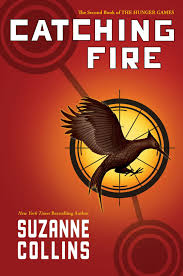
Catching Fire book coverI liked the movie version of the first book in the The Hunger Games trilogy, (unlike many viewers) and I liked Catching Fire, the movie version of book #2, even more.

When a book or movie is wildly popular, I’m curious to know the reasons. I want to know how the creator birthed a story that inspires passion in so many people. The Hunger Games is epic, powerful, and true to our times, and in capable artistic hands it speaks to us whether the medium is the page or the screen. The Hunger Games books and the movies have become fused in my memory, and it is difficult for me to separate the two – it’s the story itself that stays with me.

Suzanne Collins’ trilogy is based, in part, on the Greek myth of Theseus and the Minotaur, which she read when she was eight years old. According to Wikipedia, in one version of the myth, the king of Crete demanded that every nine years seven Athenian girls and seven Athenian boys be sacrificed to the half-man, half-bull Minotaur. Theseus volunteers to go in place of one of them and slays the Minotaur. (In The Hunger Games, Katniss volunteers to go in place of her younger sister, Prim, and Peeta volunteers to replace Haymitch.)

In interviews, Suzanne has said she was intrigued by reality TV shows that feature ordinary people viewers can relate to trying to prevail in impossible situations; she has also noticed our voyeuristic desire to watch others in their most private, vulnerable, and humiliating moments. Flipping through TV channels one evening, Suzanne was struck by news footage from the Iraq war on one channel and “Survivor” competitors on another channel. A former writer of children’s television programming, Collins has spoken in interviews about how viewers become desensitized to real-world violence if they are continuously exposed to the entertainment violence of modern media.

Probably most formative of Suzanne’s artistic vision was the fact that when she was six years old, her father served as a military advisor in Vietnam. News footage on TV of the death and destruction in Vietnam confused and frightened her. After the war, when her family was living in Europe, Suzanne’s father often took them on tours of famous World War I and World War II battlefields, where he taught them about military strategy and history.

Although she’s been criticized for depicting children killing children, Suzanne is not an advocate of violence or war. Katniss, Peeta, and many of the others in The Hunger Games clearly suffer the post-traumatic effects of war, oppression and deprivation. In my mind, they echo the child soldiers and the children who are victims of bombings and other atrocities we see often in the news.  Several stories about The Hunger Games in the media have highlighted the irony of the fact that Suzanne lives in Sandy Hook, Connecticut. I wonder if that experience will result in another powerful and timely story.

For me, iconic images from Catching Fire include the silhouettes at sunset of Katniss, Peeta, and a dying tribute who has just sacrificed her life for Peeta; the citizens of Rue’s District 11 giving the three-fingered salute; and, in one of the closing scenes, a riveting shot of Katniss that embodies the essence of sacrifice.

I’ve been especially moved by these characters: Cinna (Lenny Kravitz) and how he takes a stand with his art; Haymitch (Woody Harrelson) and his flawed strength; Eppie (Elizabeth Banks) and her transformation; the growing strength of Prim (Willow Shields); the fire and directness of Johanna Mason (Jena Malone); and the depth of feeling and loyalty of the deceptively shallow Finnick Odair (Sam Claflin).

Year of the Jungle book coverRecently, Suzanne Collins published Year of the Jungle, a picture book about a child whose father goes off to war.

Have you seen Catching Fire? What do you think of the movie and/or or the book? Please share your thoughts in the comments below.

Wally Lamb’s We Are Water

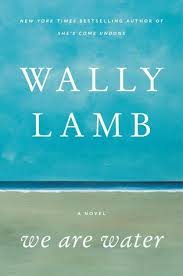
We Are Water book cover

“Viveca’s wedding dress has a name: Gaia. Layers of sea green silk chiffon, cap sleeves, an empire waist, an asymmetrical A-line skirt with the suggestion of a train….Gaia: I Googled it yesterday….chaos, incest, monsters, warring siblings: it’s a strange name for a wedding dress.”    – Outsider artist Annie Oh, in We Are Water

Annie Oh throws a mug of red wine on the designer wedding dress of her future wife because she’s momentarily feeling ambivalent about the marriage. She likes the effect of the wine on the chiffon and proceeds to pour wine on the three expensive dresses Viveca has chosen for Annie to consider wearing on their wedding day. Thus she turns the dresses into pricey art that will fetch five figures, if not more.

I had a hard time engaging with Wally Lamb’s latest novel, at first, but I kept on because, having read I Know This Much Is True (the best book about schizophrenia and being a family member of someone with schizophrenia I’ve ever read) and She’s Come Undone, I’m loyal to Lamb and interested in his body of work. At first, the characters in We Are Water seemed pretentious; I’m used to the blue collar world he often writes about. But the writing is fabulous, as usual, and it wasn’t long before I was invested in the Job-like trials, tribulations, and family secrets of the Oh’s – Annie’s husband, Orion, and their adult children Ariane, Marissa, and Andrew.

After 27 years of marriage, Annie has left her husband and is about to marry Viveca, the art dealer who has made her famous. The wedding sets off a chain of events that harks back to 1963, when Annie, as a five-year-old, lost her mother and little sister in a flood that swept through her town. Lamb builds the story on a flood that actually occurred in his hometown of Norwich, Connecticut when he was a boy.

Annie has never told anyone what, exactly, happened in the flood and its aftermath. These secrets have an impact on the kind of wife and mother she is, they fuel her art, and they result in a tragic turn in the lives of one of her children. Lamb always has compassion for his characters, but he is also unflinching about placing them in terrible circumstances. One of the things he does so well here is show how the devastating effects of child abuse and neglect can pass from generation to generation.

Wally LambLamb is a generous, down-to-earth true believer in the healing power of art. For many years, he as led a writer’s group for women at the York Correctional Institution. (See Couldn’t Keep It To Myself: Wally Lamb and the Women of York Correctional Institution.)  While he was working on We Are Water, the shootings at Sandy Hook Elementary School in Newtown occurred; in a postscript to the novel he invites readers to contribute to the Brady Campaign to Prevent Gun Violence and the National Alliance for Mental Illness. 

 “For the first nine months of our lives, we float underwater. Then we hit the cold air, the glaring light of day, and start crying salty tears. Begin the lifelong challenge of trying to figure out why we’re here, what it all means.”  – Orion Oh, We Are Water

One small fact

The Book Thief Book CoverHERE IS A SMALL FACT

You are going to die.

….the grave diggers were rubbing their hands together and whining about the snow and the current digging conditions. “So hard to get through all the ice,” and so forth. One of them couldn’t have been more than fourteen. An apprentice. When he walked away, after a dozen paces, a black book fell innocuously from his coat pocket without his knowledge.”   The Book Thief, by Markus Zusak

Catching Fire book cover

“If it were up to me, I would try to forget the Hunger Games entirely.”  Katniss Everdeen

Catching Fire, by Suzanne Collins

I’ll be at the movies this month watching two visions of apocalypse. One really happened. The other – well, take a world of haves and have-nots to the extreme, and maybe that’s where we’re headed.

I love watching my favorite books on the screen, as long as it’s done well. If you’ve read these young adult books that obsess grown-ups, too, and/or see the movies, stop by Books Can Save a Life and tell us your thoughts. Why do you think these end-of-the-world stories are so popular? I’ll revisit this soon, once I’ve seen the movies.

Hildegard of Bingen, slow medicine, God’s Hotel

Recolate angel“Angels…what glorious shapes take place within you….”  Hildegard of Bingen

“I discovered Hildegard and her medicine…and that is where God’s Hotel starts.”…..Victoria Sweet, MD, author of God’s Hotel

The Hŏtel-Dieu (God’s Hotel) cared for the sick in the Middle Ages.  Hildegard’s music.

(And it’s All Saints’ Day weekend.)

Victoria Sweet at TEDxMiddlebury.

Photo: Recoleta Cemetary, Buenos Aires

Body and mind

What are the pros and cons of getting genetic testing if your parent has Huntington’s Disease? What about dating and relationships?

A resident in the pediatric intensive care unit wants patient education information about shaken baby syndrome and traumatic brain injury.

A mother whose child has just been diagnosed with epilepsy wants to know if a special diet will help.

At teaching rounds, medical students on their first patient rotations are led through the process of making a diagnosis. “He has weakness in his arm and leg,” says the neurologist. “If his symptoms are on the right side, where is the lesion in the brain?”

These are some of the situations I’ve seen as a medical librarian. Sometimes we forget how precious and fragile are our bodies and minds. We can walk, run, speak, love, laugh, cry, sing, read, write, think, create, make plans, give comfort, enjoy a meal with family and friends. Until one day something changes.

I know from personal experience a mind can become irrevocably altered and an identity can vanish seemingly overnight. Which is probably why I am so fascinated by medicine, especially medicine having to do with the brain and behavior.

Here are some of my favorite books (fiction and nonfiction) about illness, recovery, medicine, the search for cures and miracles, and the people caught up in it all: medical professionals, researchers, patients and families. If you follow my blog, a few of the books will be familiar.

FICTION

I Know This Much Is True book cover

I Know This Much is True, by Wally Lamb

“On the afternoon of October 12, 1990, my twin brother Thomas entered the Three Rivers Connecticut Public Library, retreated to one of the rear study carrels, and prayed to God the sacrifice he was about to commit would be deemed acceptable.”

This is the best evocation of schizophrenia I’ve ever read. Wally Lamb is my hero.

By the way, Wally’s newest novel, We Are Water, was just published this month. It is on my nightstand in my little stack of books to read.

Saturday book cover

Saturday, by Ian McEwan

A neurosurgeon. Huntington’s Disease. A home invasion. A poem.

(The poem nestled deep within the plot sparks a crucial turning point. It also happens to be one of my lifelong favorites.)

State of Wonder book cover

State of Wonder, by Ann Patchett

“She was not terrified that the patient would die or she would lose the baby, she was terrified that she was doing something wrong in the eyes of Dr. Swenson.”

“I write with unfortunate news of Dr. Eckman, who died of a fever two nights ago. Given our location, this rain, the petty bureaucracies of government (both this one and  your own), and the time sensitive nature of our project, we chose to bury him here in a manner in keeping with his Christian tradition….Despite any setbacks, we persevere.”

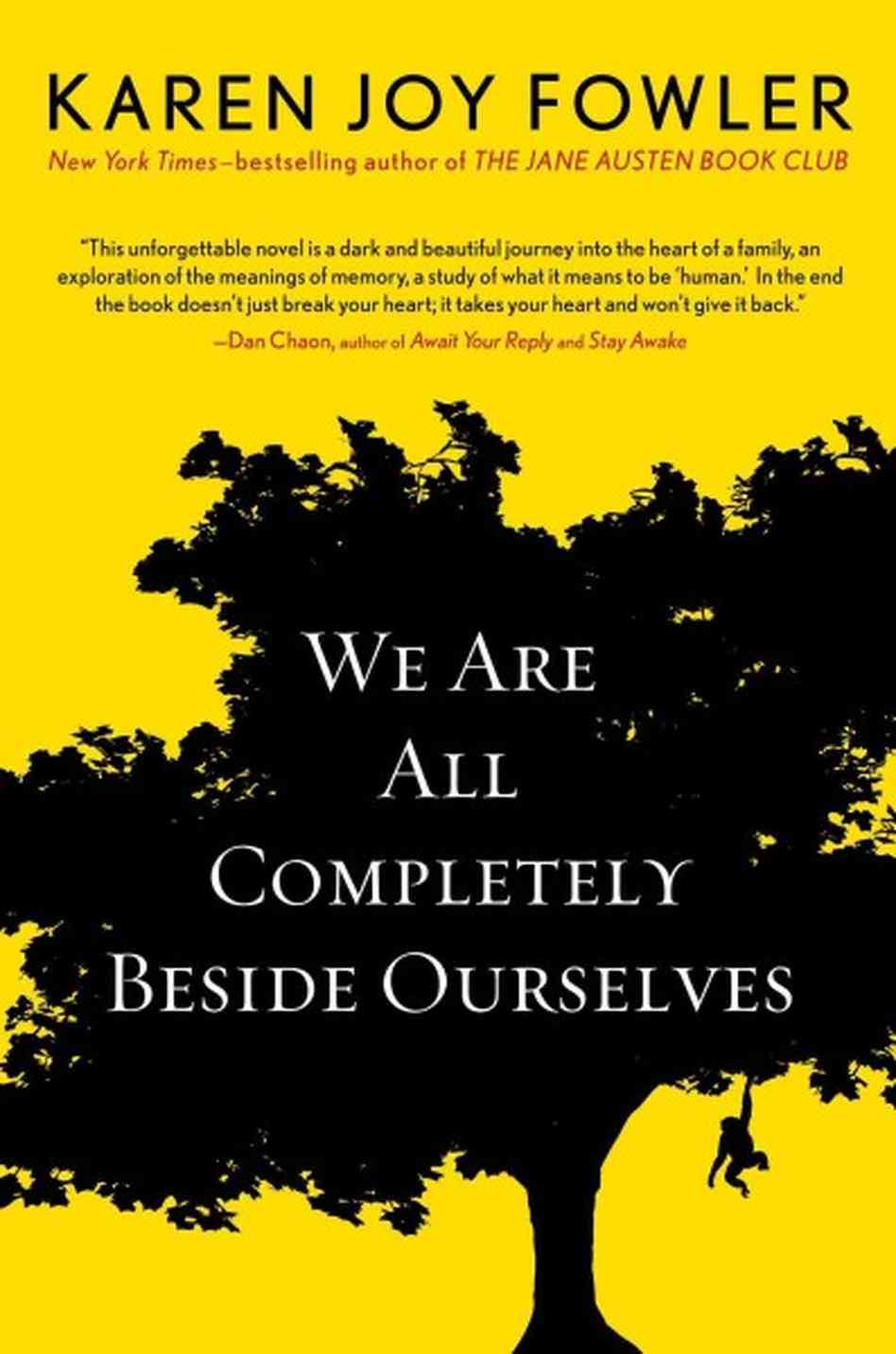
We Are All Completely Beside Ourselves book cover

We Are All Completely Beside Ourselves, by Karen Joy Fowler

“…I’d made a careful decision to never ever tell anyone about my sister, Fern. Back in those college days I never spoke of her and seldom thought of her…..Though I was only five when she disappeared from my life, I do remember her. I remember her sharply – her smell and touch, scattered images of her face, her ears, her chin, her eyes. Her arms, her feet, her fingers.”

***************************

MEMOIR

God's Hotel book cover

God’s Hotel: A Doctor, a Hospital, and a Pilgrimage to the Heart of Medicine, by Victoria Sweet

Inspired by Hildegard of Bingen (12th century German mystic and medical practitioner), as well as her own instinct for compassionate, attentive care, Dr. Sweet practices “slow medicine” at the last almshouse in the U.S. as it transitions to the modern age. We should all have a physician like Dr. Sweet.

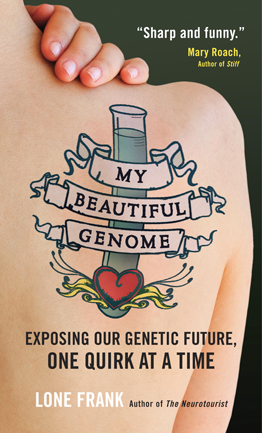
My Beautiful Genome book cover

My Beautiful Genome, by Lone Frank

“…we are each of us temporary depositories of information that has an almost eternal life, and which is passed on and on and on…”

“I am what I do with the beautiful information that has flowed through millions of years through billions of organisms and has, now, finally been entrusted to me.”