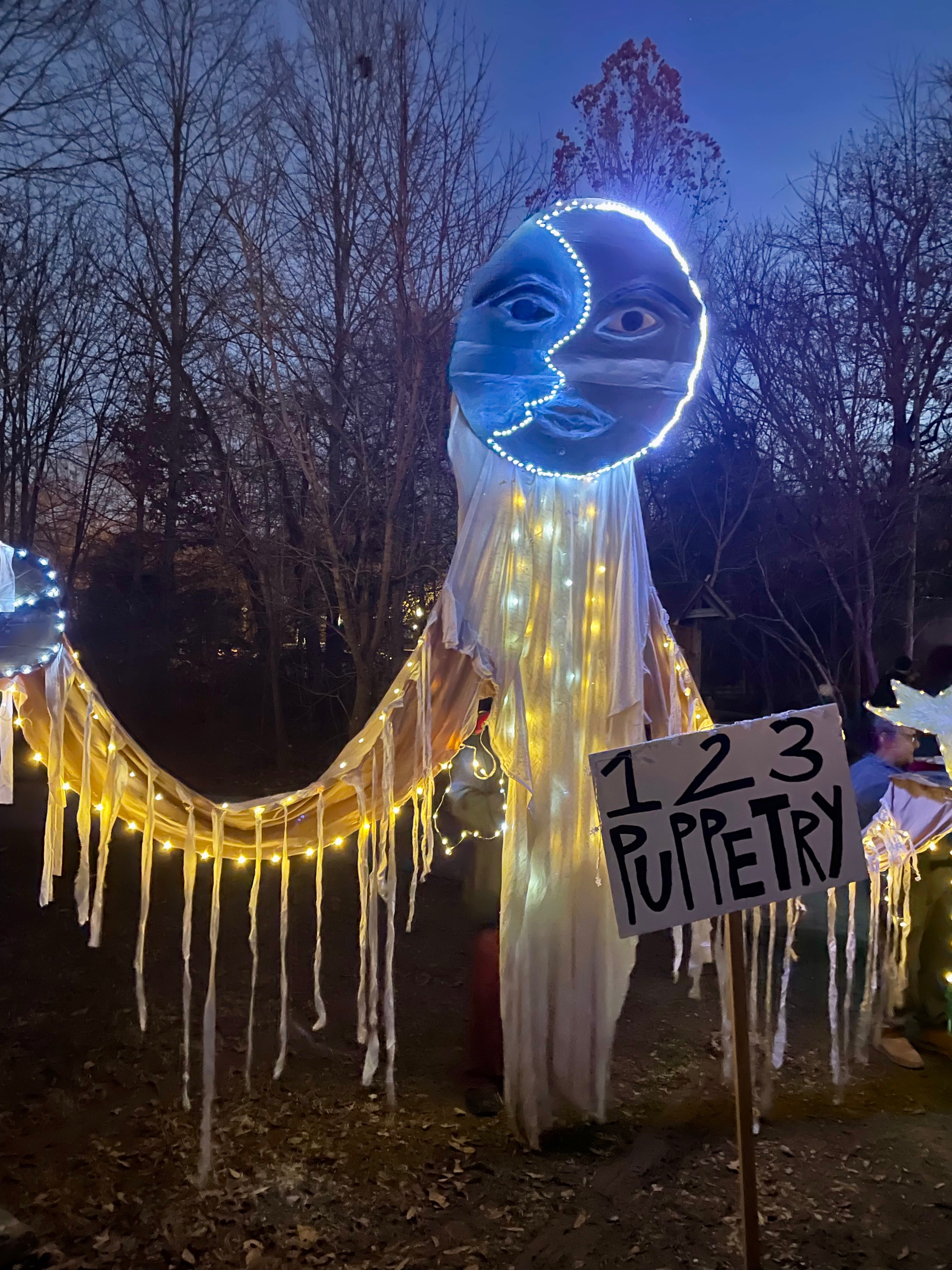
A highlight of the Winter Solstice Lantern Walk along the Eno River, NC, 2025.
The fear is ancient and uncomplicated, part of our human-animal inheritance…will the darkness swallow me, will it swallow us all together? Nina MacLaughlin, Winter Solstice: An Essay
Happy New Year to my friends and readers!
Here is a post full of little treasures to light up your midwinter days and usher in the New Year.
Never in my life have I seen the winter solstice celebrated with so much exuberance. Last year, on our first winter solstice in Hillsborough, North Carolina, I assumed the annual lantern walk along the Eno River would be a quiet affair with a few dozen souls. Not at all. Thousands of people showed up with the most inventive homemade lanterns I’d ever seen.
Before you read past this paragraph, PLEASE click the link below to last year’s walk. It will put you in the mood for the rest of this post, which is full of all things Winter Solstice. In last year’s video, you’ll see drone footage of the magical riverside procession, an illuminated spiral, and beyond-belief lanterns, with a poetic narration by our town’s very own Poet Laureate, Amal Kassir. (YES, our town has a Poet Laureate. More about Amal at the end of this post.)
Here is the link. Please turn up your volume, enjoy, and then hop back over here:
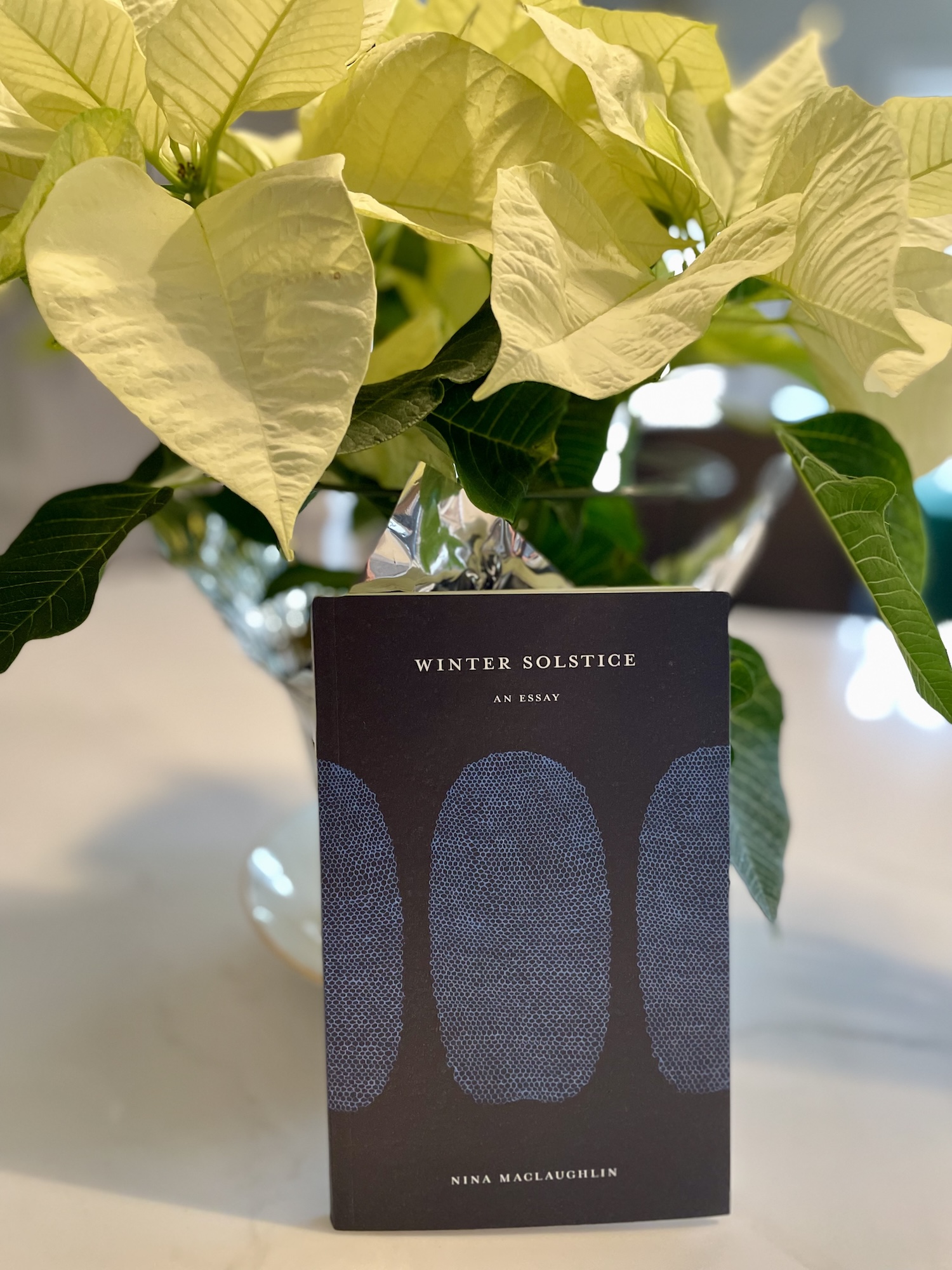
I’ve sprinkled quotes from Nina MacLaughlin’s earthy, primal Winter Solstice essay throughout this post, because it speaks deeply to writer and mixed-media/book artist Suzi Banks Baum, who created and leads Advent Dark Journal. This is an immersion in art, writing, nature, and daily creative practice that I enjoy during the last six weeks of the year.
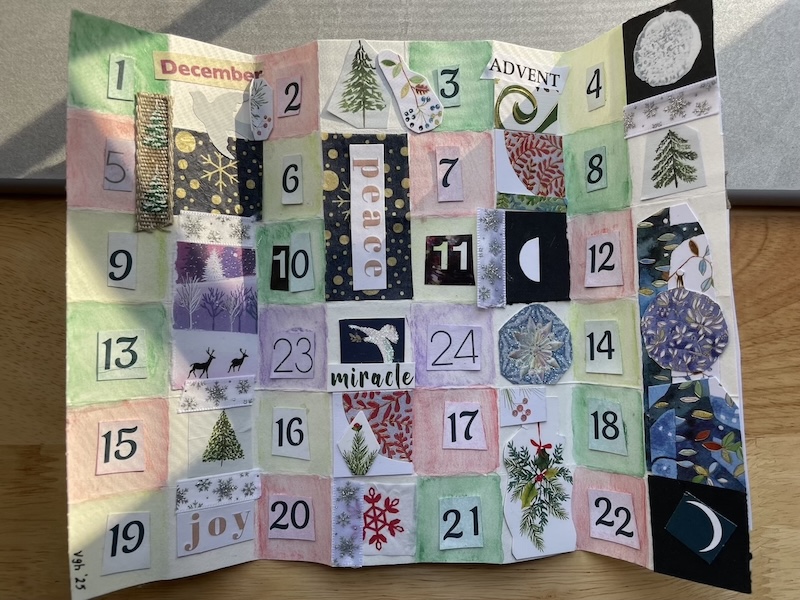
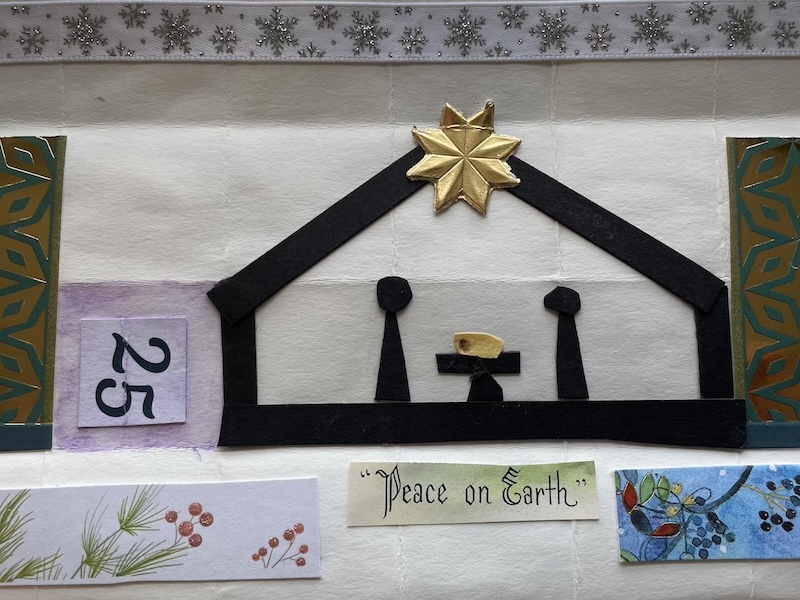
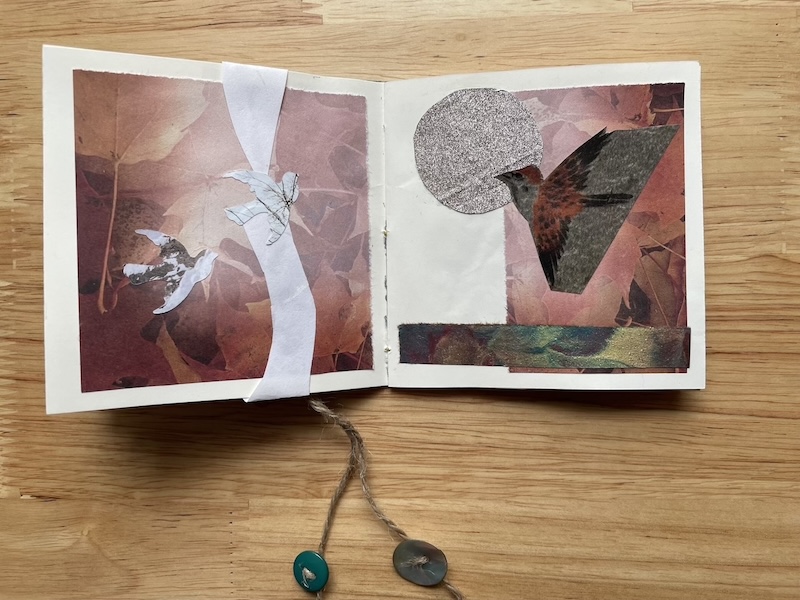
I’ll write more about Advent Dark Journal in an upcoming post, because Suzi and her creation are worth an in-depth look. For now, here is a glimpse of the small collage and art projects I’ve completed as part of this experience. You’ll see that my Advent calendar has a religious theme, but Advent Dark Journal is not centered around organized religion; rather, it is a “container” of rituals for participants to explore wherever our soulful arisings lead us during this sacred time of year.
“Advent Miracle”
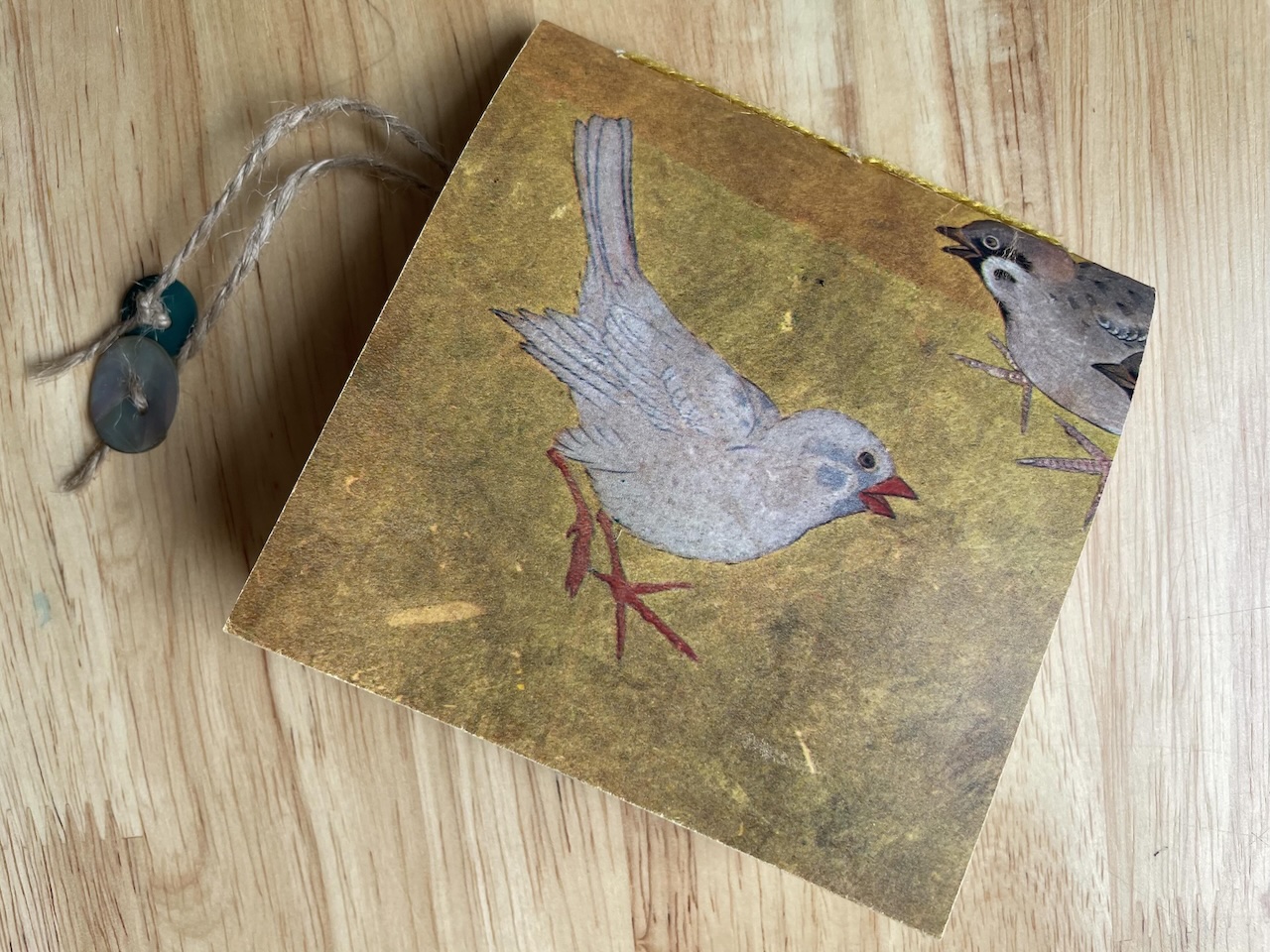
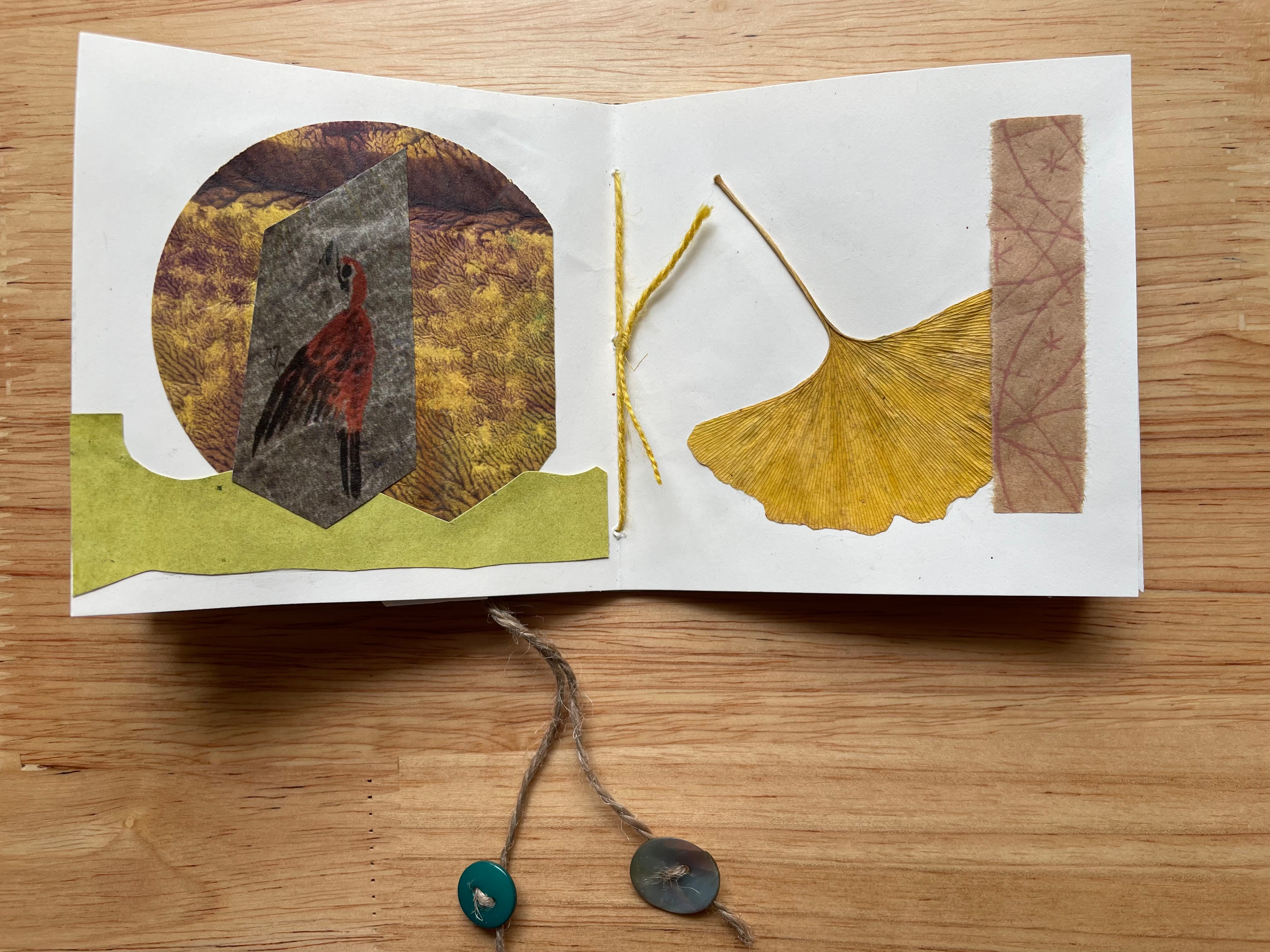
“Earth Holder”
These small, collaged journals and art pieces were sent off to friends – one in Australia – as soon as I completed them. In addition to the art we create in Advent Dark Journal, Suzi encourages us in new, transformational directions. Since I’ve become a regular in Suzi’s workshop, I’ve added a tradition our adult sons and partner enjoy when they visit for the holidays – a fireside Winter Solstice ritual. More about that in an upcoming post, but suffice it to say, Suzi has shown me how to weave a daily creative practice into my life in ways that promote my well-being and that of others in my life.
It is the animal in us that knows the dark. This season stirs that animal in us, and stirs the memories that live in all of us, submerged so deep, of the ancient dark, of a time before gods, before form and words and light….Winter reminds us: the dark was first.
…maybe death is all potential, a means of moving on. And on we go, absorbed into the wet warm belly of eternity, or the roaring big black void, back here as a robin or a wren, in dusted orbit around another planet’s moon, riding on the light. Winter Solstice
Nina MacLaughlin’s Winter Solstice is stellar writing, moody and mysterious. She reminds us of our primal, animal origins; ultimately, we are bound up in the life web and rhythms of the earth, whether we recognize this or not. I purchased Nina’s Summer Solstice essay as well, which I’ll read come summer.
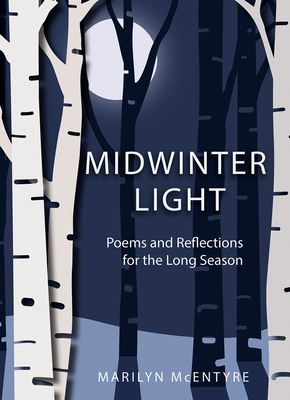
If you are interested in writing that is more traditional, something you can read in small bits alongside your daily journaling or meditation, I recommend Midwinter Light: Poems and Reflections for the Long Seasonby Marilyn McEntyre. Each day, she includes a poem with commentary that honors this dark season, when growth seems to stop but germinates unseen, to be manifested as the light returns.
“Winter makes us see differently. Noticing is rooted in desires so easily satisfied in spring we barely feel them—for color, for movement, for the sound of birds, and things that bloom. On a walk in midwinter, we experience solitude in a different key. We are surrounded by reminders of mortality and loss, by the absence of what is lush and vivid. We are clothed in layers and aware of our bodily needs in new ways. And the quiet, sometimes, is palpable. It is a good time for prayer: the veil between this dimension and the next seems to have thinned.” Marilyn McEntyre, Midwinter Light: Meditations for the Long Season
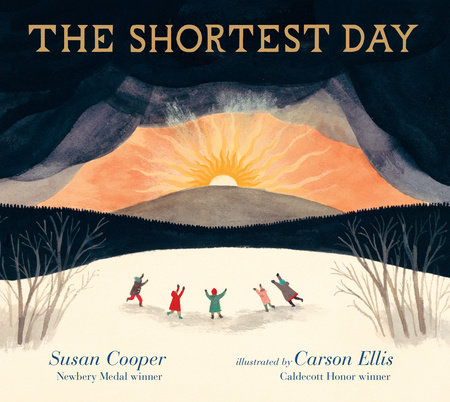
Finally, I discovered an excellent picture book with a poem by Susan Cooper and art by Carson Ellis. Both Susan and Carson have won the highest honors for children’s books, and this particular collaboration is special. Susan’s poem “The Shortest Day” is easy to find online. I encourage you to read it. I think you’ll find that Susan’s half-rhymes and cadence create an incantation that perfectly captures the magic and mystery of this dark season.
If you would like the perfect picture book for this time of year, for yourself, or as a gift, I suggest The Shortest Day, written by Newbery Medal winner Susan Cooper and illustrated by Caldecott Honor recipient Carson Ellis.
Happy New Year!
I will return in January with more about Advent Dark Journal, as well as commentary about a provocative documentary you won’t want to miss, especially if you are an avid reader and book-lover.
As Amal Kassir says in her winter solstice poem you may have listened to in the above-linked video, “It only gets brighter from here.”
By the way, PLEASE be sure to check out Amal Kassir’s website and watch her perform her heartbreaking poem, “Broken Arabic.” Her poetry collection, Scud Missile Blues, is available from Amazon. I encourage you to consider purchasing it. We need to support our young poets, and Amal is immensely talented. Just think of all the poems she has yet to give to the world!
In our village on the Erie Canal, we have a number of small nonprofit businesses run by volunteers, including a craft shop, a second-hand tool thrift store, and The Corner Bookstore with used and collectible books. All donate their profits to good causes. The bookstore proceeds support programs at our public library.
I love shopping at these small businesses. (The tool shop not as much, but we did buy an old-fashioned push lawn mower there. When my brother-in-law visited us a few years back, we lost him for a couple of hours, only to find him browsing in the tool shop.)
A number of clothing consignment shops are scattered around our village as well. I’ve been thinking about challenging myself this year to buy exclusively (or almost) from stores I can walk or bike to. Our farmer’s market runs from May to November, so it wouldn’t be difficult to purchase a good portion of our fruits and vegetables there, supplemented by our small backyard garden. (Our town has a community garden, too.)
Shelf-sacrifice is what The Corner Bookstore is all about. It’s an elfin wonderland of used and vintage books lovingly displayed in diminutive groupings: children’s books, poetry, graphic novels, history, fiction, local authors, and more.
The cookbook section has used cookbooks nestled in gift baskets along with vintage ice cream sundae glasses, martini glasses, and miniature ceramic casserole dishes. I found a blank recipe album with Bible verses and beautiful cover art in pristine condition. For my son, I found a Vietnamese cookbook – he loves Asian food.
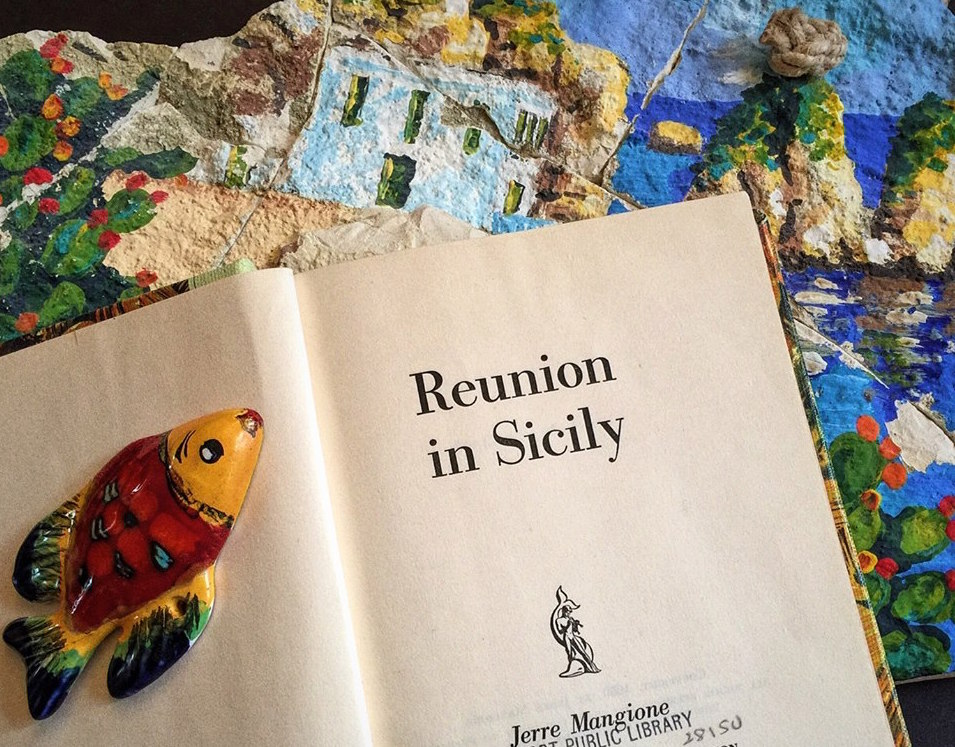
In the local authors bookcase, I spotted Reunion in Sicily by Jerre Mangione, a scholar of the Sicilian-American experience, according to Wikipedia. Jerre is the uncle of jazz musicians Chuck and Gap Mangione, who are from Rochester. Flipping through the pages of the book, which was published in 1950, I saw that the author visited Sicily in 1936 when Mussolini and the Fascists were in power. Mangione was watched closely by the police and interrogated more than once as to the purpose of his visit.
Mangione was awarded a Guggenheim Fellowship after WWII so he could return to Sicily to learn more about Italian politics and culture of the times. Reunion in Sicily is not listed in his Wikipedia entry; I’m interested to see what I can learn from the book. My father was Sicilian-American and a WWII veteran with extended family in the Old Country. The war, of course, essentially split Italian and Italian-American families in two, at least for a time.
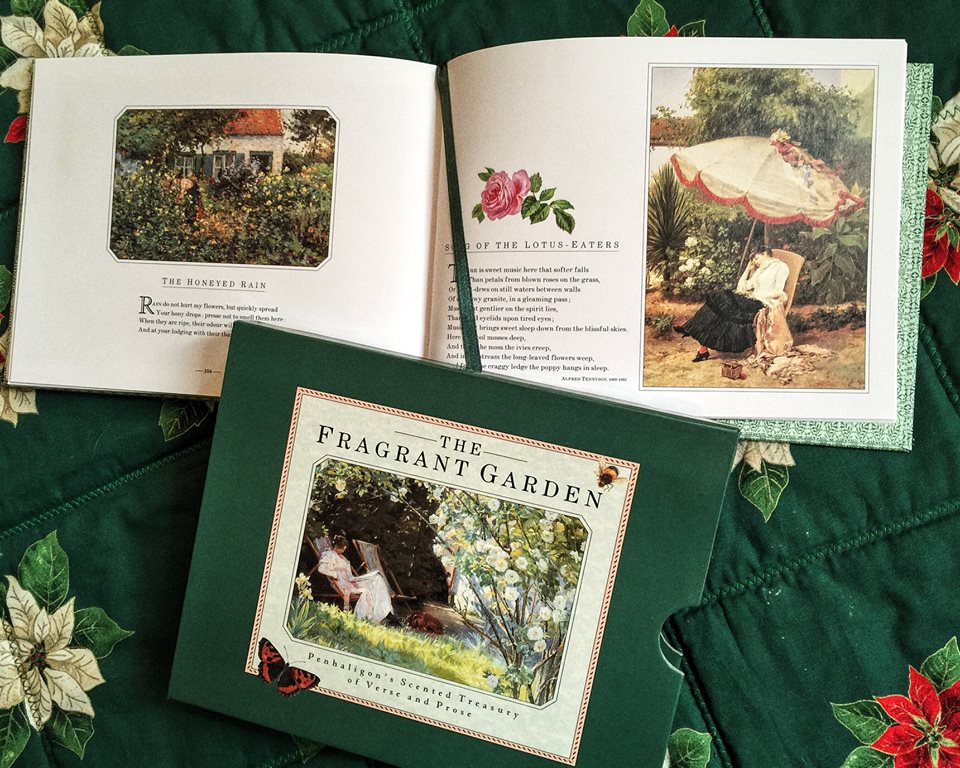
Another great find was The Fragrant Garden, a beautifully slipcased anthology of garden writing and art, the kind of book you can display open on a small easel. When I noticed the subtitle, Penhaligon’s Scented Treasury of Verse and Prose, I realized that a faint floral scent emanated from its pages. Upon reading the prologue I discovered that, indeed, the endpapers are scented with Penhaligon’sGardenia perfume. Gardenia is one of my all-time favorite floral scents; I had a gardenia in my bridal bouquet.
The volume was edited by Sheila Pickles (check out her Goodreads Page) and published in 1992. Never having heard of Penhaligon’s, I had to look that up, too. It was established in London in the late 1800s. There are shops in the US, but wouldn’t it be wonderful to visit the London shop? They have a blog, and here is an enticingly sensuous excerpt from it about the men’s perfume Endymion:
“….a complex blend of sophisticated scents, it opens with the orangy warmth of bergamot and mandarin wrapped in delicate lavender and sage. The dark coffee heart is rich and powerful giving way to the spicy velvet base of creamy nutmeg, vetiver, cardamom and a hint of leather. It is strong and romantic and very masculine.”
I’ve never heard of vetiver, have you? I had to look that up, too.
Wasn’t that fun? All this from a Christmas shopping trip to The Corner Bookstore.
Don’t overlook the independent bookstores and shops near you as you go about your holiday shopping. It’s a good way to support your local economy, and you’re much more likely to find unique gifts and treasures.
Do you have any independent bookstores that you like in your town?
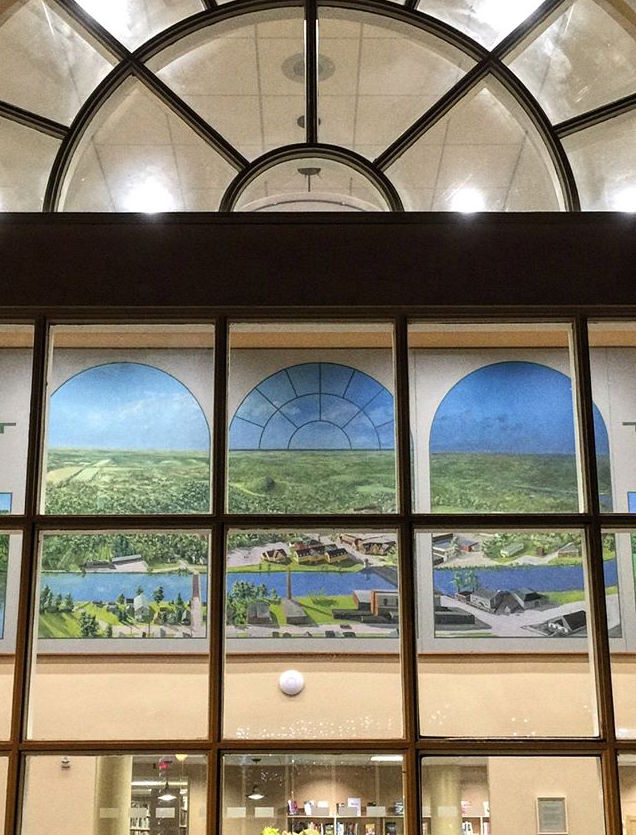
Our public library on the Erie Canal was recently renovated. Since 1938, it has boasted this mural by Carl W. Peters, created as part of Rochester’s WPA Murals project.
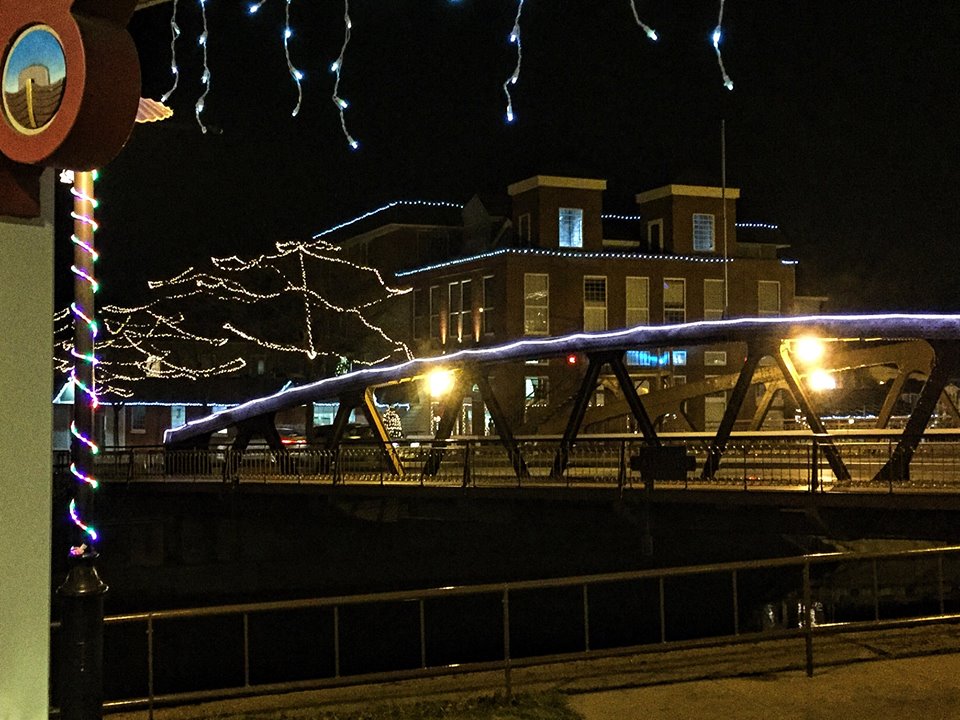
Our one-of-a-kind lift bridge spans the Erie Canal. It is an irregular decagon (10 sides), no two angles in the bridge are the same and no corners on the bridge are square. It is lifted by a 40 hp electric motor. When the kids were little they loved watching the bridge being lifted so boats could pass through.
I wanted to share a post I love written by Valerie Davies of New Zealand, an accomplished writer and journalist who left blogging for a while and has now returned, to the great pleasure of her many followers.
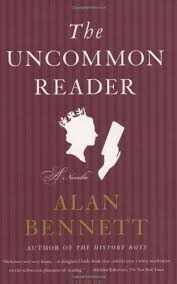
Valerie writes about reading aloud to your children in front of the fire or under the covers on a cold winter night….David Copperfield (Did you read it at a young, impressionable time in your life?)….a Queen who couldn’t stop reading….what Stephen King says about writing truthfully….the dangers of reading and writing….what some brave bloggers are doing….and for good measure, a recipe.
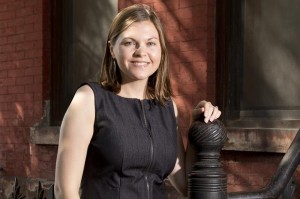
Yesterday, I had the pleasure of attending one of Karen’s readings at a local college, which was well attended by book lovers and book clubs alike. Many of the attendees have participated in “If All of Rochester Reads” since its inception 15 years ago.
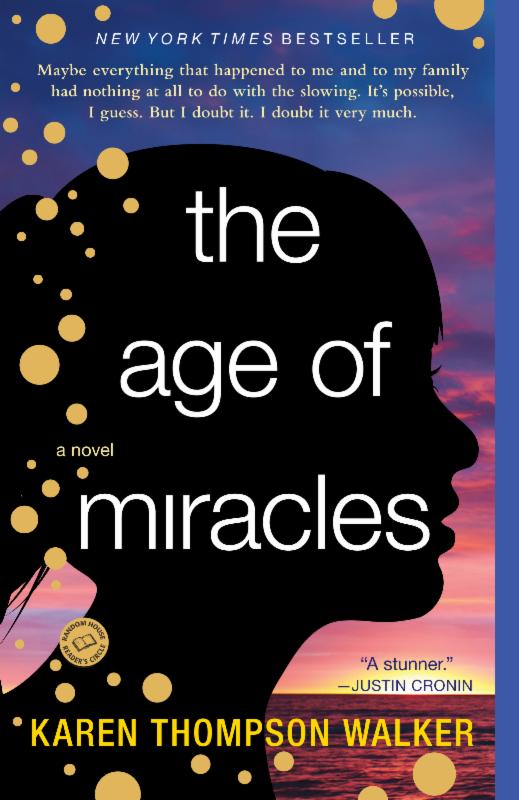
The Age of Miracles is a heart-breaker. After this one, I am going to have to lay off reading dystopian literature for a while.
Eleven-year-old Julia is living the ups and downs of a California childhood when, one day, this announcement is all over the new: scientists have learned the Earth’s rotation has slowed. The days and nights are growing longer and will most likely continue to do so. Life on Earth will never be the same. It is, in fact, very likely coming to an end, and “not with a bang, but with a whimper,” as Karen has said in an interview.
The world slows down with terrible consequences, while Julia copes with difficult friendships and betrayals, falls in love with Seth, and watches the possible dissolution of her parents’ marriage. The Age of Miracles is adult fiction, but it has had great appeal in the young adult market. I’ve read excellent adult dystopian literature recently (The Bone Clocks and Station Eleven), books that offer hope for the redemption of humanity. There is little hope in The Age of Miracles, which is one reason it is so powerful: we watch the blossoming of youth and young love in a world that is going dark.
Climate change and global warming are being hotly debated in the real world, but in The Age of Miracles, the catastrophe has nothing to do with human action. It just happens. Because blame and controversy over who is at fault are removed, the story is free to focus on the characters and how they mature and make ethical choices (or don’t) in impossible circumstances.
Karen said during her reading yesterday that the title of her book refers to both the miraculous time of adolescence as well as the miracle of the earth’s slowing. The miracle in the world Karen creates is an extraordinary, inexplicable event, but in this case one that does not bode well for the human race. It suggests that we humans are not the center of this vast, unknowable universe; the universe can carry on quite well without us.
I found myself, like Julia, not wanting to turn back time, but wishing I could change the laws of nature and reinvent my relationship with time.
“How much sweeter it would be if life happened in reverse, if, after decades of disappointments, you finally arrived at an age when you conceded nothing, when everything was possible.”
Karen is at work on a second novel which will once again place people in an extreme situation.
Click here for a fascinating list of post-apocalyptic/dystopian/utopian/speculative fiction. Jose Saramago’sBlindness stunned me when I read it several years ago; I went on to read all of his other work and I hope to take another look it someday. Saramago’s writing is difficult – he writes page-long sentences with little punctuation – but if you fall under his spell, there is absolutely nothing like it. I haven’t read P.D. James’ The Children of Men, but I remember when my husband and sons and I watched the movie directed by Alfonso Cuarón – an afternoon of movie-going we’ll never forget. Nor will we forget reading aloud the final scenes of The Giver when the boys were young.
Then there’s The Hunger Games (the trilogy) and the ongoing excellent movie series. Ishiguro’s Never Let Me Go is another all-time favorite of mine. (He has a new book, The Buried Giant, a kind of apocalyptic fantasy I’ve yet to read). Nevil Shute’s On The Beach was probably one of my first exposures to apocalyptic fiction many years ago.
If you have strong opinions about any of the books or movies on this list, I’d loved to hear your comments.
If All of Rochester Reads has greatly enriched Rochester’s literary scene. I wrote about our 2014 choice, The Snow Child by Iowyn Ivey, which I loved. Another Rochester Reads favorite of mine is Bel Cantoby Ann Patchett. Just so you know, Nancy Pearl, one of America’s greatest librarians, had the brainchild of an entire city reading the same book. She founded the program in Seattle and it has since been adopted by many cities.
Have you read The Age of Miracles? What/Who is your favorite dystopian novel or author? Does your city or town have an annual reading event?
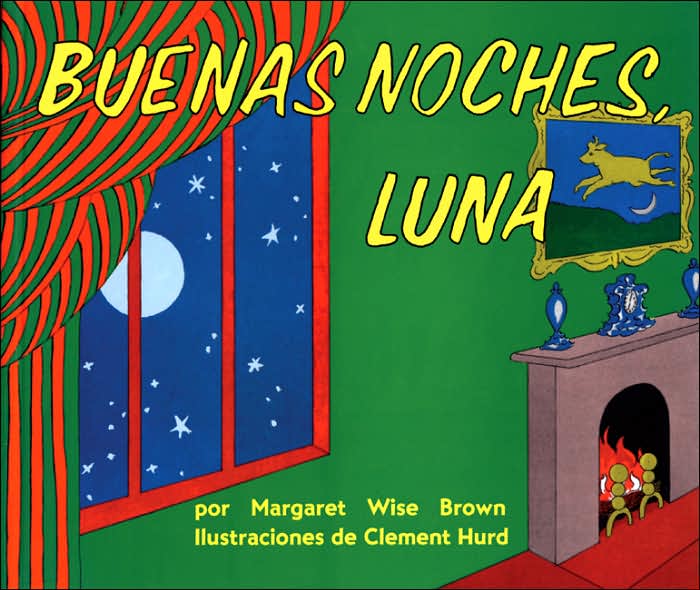
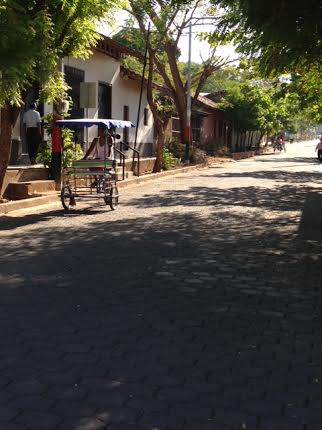
We’ve been in El Sauce, Nicaragua on vacation and doing volunteer work. We gave the classic Buenas Noches, Luna by Margaret Wise Brown to a couple of children in El Sauce. Reading it was a nightly ritual with my oldest son many years ago. This wonderful book still has universal appeal.
Morning in El Sauce
Nica volcano
We saw this passage by Nicaraguan poet Ruben Dario in a Leon cafe.
Here’s my to-read list for 2014. It’s incomplete, always changing, and I’m sure I won’t get to all of these, not by a long shot, but it’s a convenient list when I’m choosing my next book. You may see a few of them featured on Books Can Save a Life. I’ve included titles that will be published in 2014, so you won’t find all of them on the shelves yet.
If you have enticing choices on your list, please share them in the comments!
Watch for my book giveaway in February to celebrate the second anniversary of Books Can Save a Life.
FICTION
The Snow Child, by Eowyn Ivey “If All of Rochester Read the Same Book,” 2014
The Goldfinch, by Donna Tartt
Someone, by Alice McDermott
Carthage, by Joyce Carol Oates
Arctic Summer, by Damon Galgut
The Unknowns, by Gabriel Roth
The Circle, by David Eggers
Colorless Tsukuru Tazaki and His Years of Pilgrimage, by Haruki Murakami
The Signature of All Things, by Elizabeth Gilbert
Life After Life, by Kate Atkinson
How Should a Person Be? by Sheila Heti
The Paying Guests,by Sarah Waters
And Then We Came to the End; The Unnamed; To Rise Again at a Decent Hour, by Joshua Ferris
Orfeo, by Richard Powers
Never Go Back, by Lee Child
The Language of Flowers, by Vanessa Diffenbaugh
The Snow Queen, by Michael Cunningham
The Bone Clocks, by David Mitchell
The Interestings, by Meg Wolitzer
The Luminaries, by Eleanor Catton
Lila, by Marilynne Robinson
By Blood, Ellen Ullman
Canada, by Richard Ford
In Sunlight and in Shadow; and Winter’s Tale, by Mark Helprin
The Cuckoo’s Calling,by Robert Galbraith (J.K. Rowling) and Untitled (2014)
The Woman Who Lost Her Soul, by Bob Shacochis
Off Course, by Michelle Huneven
Gone Girl; Dark Places, by Gillian Flynn (movies in 2014)
Wolf Hall, by Hilary Mantel (Best book of the 21st century, according to Elizabeth Gilbert)
****************
IN TRANSLATION
My Struggle, Books 1, 2, 3by Karl Ove Knausgaard (Norwegian)
Treasure Hunt; The Dance of the Seagull by Andrea Camilleri (Sicilian)
Story of a New Name, by Elena Ferrante (Italian)
YOUNG ADULT
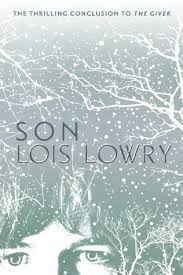
The Giver Quartet Series (including Son), by Lois Lowry
Divergent Series, by Veronica Roth
Mockingjay, by Suzanne Collins
The Fault in Our Stars,by John Green
*************************
MEMOIR
Men We Reaped, by Jessamyn Ward
Still Writing, by Dani Shapiro
This Is the Story of a Happy Marriage, by Ann Patchett
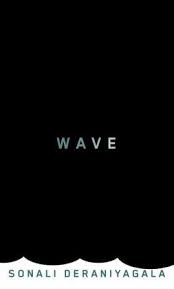
Wave, by Sonali Deraniyagala
Intensive Care: A Doctor’s Journey; and Medicine in Translation: Journeys with My Patients, by Danielle Ofri
**************
NONFICTION
Big Data: A Revolution that Will Transform How We Live, Work, and Think, by Victor Mayer-Schonberger and Kenneth Cukier
Who Owns the Future? by Jaron Lanier
The Burglary: The Discovery of J. Edgar Hoover’s Secret FBI, by Betty Medsger
Thank You for Your Service, by David Finkel
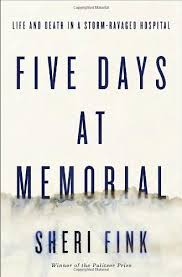
Five Days at Memorial: Life and Death in a Storm-Ravaged Hospital, by Sheri Fink
What Doctors Feel: How Emotions Affect the Practice of Medicine, by Danielle Ofri
Manson: The Life and Times of Charles Manson, by Jeff Guinn
The Unwinding: An Inner History of the New America, by George Packer
Margaret Fuller: A New American Life, by Megan Marshall
The Skies Belong to Us: Love and Terror in the Golden Age of Hijacking, by Brendan I. Koerner
The Gorgeous Nothings: Emily Dickinson’s Envelope Poems
Stalking the Divine,by Kristin Ohlson
Sons of Madness: Growing Up and Older with a Mentally Ill Parent, by Susan Nathiel
Is There No Place on Earth for Me? by Susan Sheehan
Dear Genius: The Letters of Ursula Nordstrom, by Leonard S. Marcus
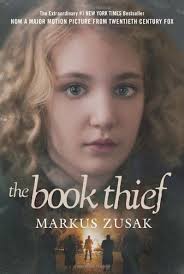
“They say that war is death’s best friend, but I must offer you a different point of view on that one. To me, war is like the new boss who expects the impossible. He stands over your shoulder repeating one thing, incessantly: ‘Get it done, get it done.’ So you work harder. You get the job done. The boss, however, does not thank you. He asks for more.” Death, in The Book Thief
Death is the narrator in The Book Thief, a young adult book about a German family during World War II that has a huge adult readership as well. It is one book not to be missed. The writing is outstanding. Published in 2005, The Book Thief won countless awards and honors, and has become a classic in YA fiction.
I recently reread the book before I saw the movie. I think the screen adaptation is a good one, although some viewers found it tame, and subtleties of the text can’t be captured on the screen. For example, Max, who is Jewish and hiding out in the home of Liesel and her foster parents, paints over every page of a copy of Mein Kampf and creates his own book, with illustrations. Max’s book is embedded within the pages of The Book Thief,and on the pages of Max’s book you can see faint traces of Hitler’s words. One of the pages in Max’s book is a drawing of a girl and a boy holding hands and standing on a pile of bodies. Inscribed on the sun that shines down on them is a swastika, and the girl is saying, “Isn’t it a lovely day?”
The author, Markus Zusack, uses the written word as a thematic motif. While the Germans burn books thought to be subversive, Liesel and Hans write words on the wall of their basement as Liesel learns to read, and Liesel steals a book whenever she has the chance, in defiance of the Nazis. Liesel then begins to write her own book in order to make sense of the world’s chaos and carnage.
I do think the movie captured the essence of the story, and it is well cast, especially Sophie Nélisse as Liesel Meminger and Geoffrey Rush as Hans, her foster father. Death is the narrator in the movie, as he is in the book, and in both he is an unsettling storyteller who confesses he is haunted by humans. Of course, in addition to being the narrator, Death has a starring role in the plot as well.
My father was wounded in the war, just inside the German border. Occasionally, my mother spoke of her family’s Victory Garden, the rationing of meat and gasoline, and the “man shortage.” I was born ten years after the war ended. As an adult, I eventually began to understand how the world turned upside down by war cast long shadows over my parents’ generation.
Have you seen the movie or read The Book Thief? What did you think?
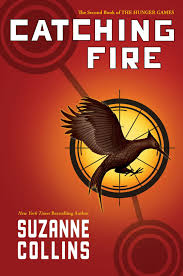
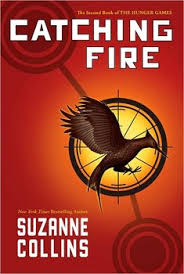
I liked the movie version of the first book in the The Hunger Gamestrilogy, (unlike many viewers) and I liked Catching Fire, the movie version of book #2, even more.
When a book or movie is wildly popular, I’m curious to know the reasons. I want to know how the creator birthed a story that inspires passion in so many people. The Hunger Games is epic, powerful, and true to our times, and in capable artistic hands it speaks to us whether the medium is the page or the screen. The Hunger Games books and the movies have become fused in my memory, and it is difficult for me to separate the two – it’s the story itself that stays with me.
Suzanne Collins’ trilogy is based, in part, on the Greek myth of Theseus and the Minotaur, which she read when she was eight years old. According to Wikipedia, in one version of the myth, the king of Crete demanded that every nine years seven Athenian girls and seven Athenian boys be sacrificed to the half-man, half-bull Minotaur. Theseus volunteers to go in place of one of them and slays the Minotaur. (In The Hunger Games, Katniss volunteers to go in place of her younger sister, Prim, and Peeta volunteers to replace Haymitch.)
In interviews, Suzanne has said she was intrigued by reality TV shows that feature ordinary people viewers can relate to trying to prevail in impossible situations; she has also noticed our voyeuristic desire to watch others in their most private, vulnerable, and humiliating moments. Flipping through TV channels one evening, Suzanne was struck by news footage from the Iraq war on one channel and “Survivor” competitors on another channel. A former writer of children’s television programming, Collins has spoken in interviews about how viewers become desensitized to real-world violence if they are continuously exposed to the entertainment violence of modern media.
Probably most formative of Suzanne’s artistic vision was the fact that when she was six years old, her father served as a military advisor in Vietnam. News footage on TV of the death and destruction in Vietnam confused and frightened her. After the war, when her family was living in Europe, Suzanne’s father often took them on tours of famous World War I and World War II battlefields, where he taught them about military strategy and history.
Although she’s been criticized for depicting children killing children, Suzanne is not an advocate of violence or war. Katniss, Peeta, and many of the others in The Hunger Gamesclearly suffer the post-traumatic effects of war, oppression and deprivation. In my mind, they echo the child soldiers and the children who are victims of bombings and other atrocities we see often in the news. Several stories about The Hunger Games in the media have highlighted the irony of the fact that Suzanne lives in Sandy Hook, Connecticut. I wonder if that experience will result in another powerful and timely story.
For me, iconic images from Catching Fire include the silhouettes at sunset of Katniss, Peeta, and a dying tribute who has just sacrificed her life for Peeta; the citizens of Rue’s District 11 giving the three-fingered salute; and, in one of the closing scenes, a riveting shot of Katniss that embodies the essence of sacrifice.
I’ve been especially moved by these characters: Cinna (Lenny Kravitz) and how he takes a stand with his art; Haymitch (Woody Harrelson) and his flawed strength; Eppie (Elizabeth Banks) and her transformation; the growing strength of Prim (Willow Shields); the fire and directness of Johanna Mason (Jena Malone); and the depth of feeling and loyalty of the deceptively shallow Finnick Odair (Sam Claflin).
Recently, Suzanne Collins published Year of the Jungle, a picture book about a child whose father goes off to war.
Have you seen Catching Fire? What do you think of the movie and/or or the book? Please share your thoughts in the comments below.
….the grave diggers were rubbing their hands together and whining about the snow and the current digging conditions. “So hard to get through all the ice,” and so forth. One of them couldn’t have been more than fourteen. An apprentice. When he walked away, after a dozen paces, a black book fell innocuously from his coat pocket without his knowledge.” The Book Thief, by Markus Zusak
“If it were up to me, I would try to forget the Hunger Games entirely.” Katniss Everdeen
Catching Fire, by Suzanne Collins
I’ll be at the movies this month watching two visions of apocalypse. One really happened. The other – well, take a world of haves and have-nots to the extreme, and maybe that’s where we’re headed.
I love watching my favorite books on the screen, as long as it’s done well. If you’ve read these young adult books that obsess grown-ups, too, and/or see the movies, stop by Books Can Save a Life and tell us your thoughts. Why do you think these end-of-the-world stories are so popular? I’ll revisit this soon, once I’ve seen the movies.











 Books Can Save A Life