Winter reading

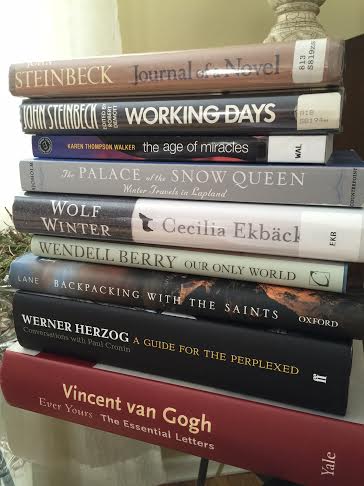
Stack of books


I’ve been out of town. A stack of books from the library and online were waiting when I got home.

The Steinbeck work journals for East of Eden and The Grapes of Wrath are recommended by Louise De Salvo in The Art of Slow Writing as essential if you’re writing a book-length work and want to learn about process.

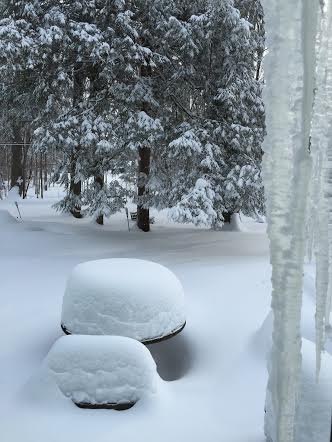
Deep snow in backyardThe Age of Miracles is this year’s selection for “If All of Rochester Read the Same Book.” We love to read through the deep winters in our part of the world, and this novel of catastrophe and survival will be on many a nightstand here. Why not try it along with us – I’ll be writing about this debut novel by Karen Thompson Walker soon.

The Palace of the Snow Queen: Winter Travels in Lapland, a memoir, and Wolf Winter, a novel. I want to know more about my Scandinavian roots; biography, memoir, and fiction are a great way to explore ancestry and heritage.

Wendell Berry’s Our Only World (ten essays), because Berry is one of our greatest prophets, writing about the clash between humanity and nature and how we must do better. He’s been called a modern-day Emerson or Thoreau.

Backpacking with the Saints, a travel narrative and spiritual memoir. Belden C. Lane’s take on Celtic, Catholic, Protestant, Buddhist, Hindu and Sufi Muslim writings as he treks the Ozarks and the American Southwest. The book jacket compares him to other lovers of the backcountry, including John Muir and Cheryl Strayed, whose memoir, Wild, was just released as a movie.

Werner Herzog: A Guide for the Perplexed, is an overdue Christmas gift for my photographer son. This newly published series of interviews with the filmmaker is so popular it’s been out of stock. I hope he finds it worth the wait.

No one writes about creating art with as much love and eloquence as Vincent Van Gogh.

More about these in upcoming posts at Books Can Save a Life.


The Bone Clocks

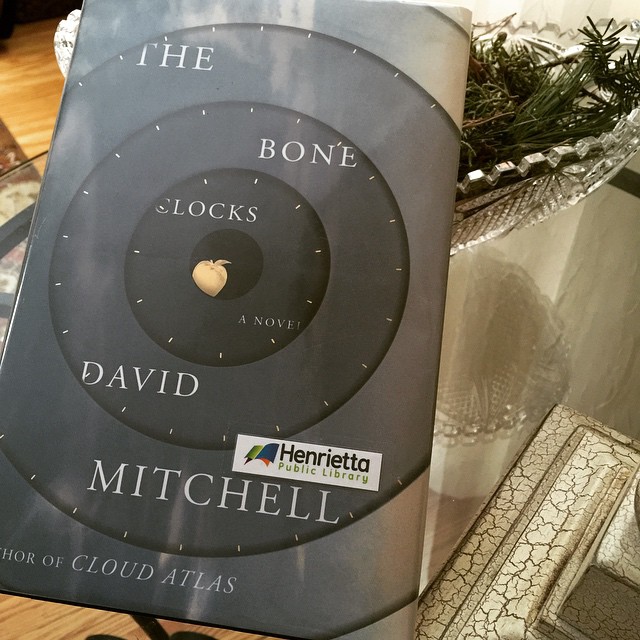
The Bone Clocks book cover


“It’s grief for the regions we deadlanded, the ice caps we melted, the Gulf Stream we redirected, the rivers we drained, the coasts we flooded, the lakes we choked with crap, the seas we killed, the species we drove to extinction, the pollinators we wiped out, the oil we squandered, the drugs we rendered impotent, the comforting liars we voted into office–all so we didn’t have to change our cozy lifestyles. People talk about the Endarkenment like our ancestors talked about the Black Death, as if it’s an act of God. But we summoned it, with every tank of oil we burned our way through. My generation were diners stuffing ourselves senseless at the Restaurant of the Earth’s Riches knowing–while denying–that we’d be doing a runner and leaving our grandchildren a tab that can never be paid.”   The Bone Clocks, David Mitchell

I debated whether or not to write a post about The Bone Clocks by David Mitchell. At least twice, I wasn’t even sure I wanted to finish reading it, but I’d already invested several hours in the book, so I kept on when the going got tough. In the end, I’m glad I finished The Bone Clocks. I think it’s worth writing about here, even though I don’t pretend to grasp its full meaning.

I’d picked up The Bone Clocks in the first place because it’s been called a genre-bending novel by a writer who’s reinventing fiction, so I wanted to find out what David Mitchell and his work is all about. It’s nearly impossible to summarize the plot of The Bone Clocks, which blends literary fiction with fantasy (not a genre I’m attracted to) and dystopian literature. There are six linked novella-type sections that take place in 1984, 1991, 2004, 2015, 2025, and 2043 (with flashbacks to medieval and other times) in settings as diverse as Ireland, New York, Iraq, England, Switzerland, Australia, and Iceland.

Among the half a dozen or so featured characters, apparently a couple of them have appeared in Mitchell’s past novels, including Cloud Atlas, none of which I’ve read. Holly Sykes is the highly appealing central character, and she is largely what kept me going when I wanted to stop, although I found many of the other characters arresting as well.

The fantasy thread features Horologists, a select group of immortal people battling the evil Anchorites, who suck the souls from people to stay alive. “A Horologist’s Labyrinth” is the section of the novel fully devoted to the final battle between the Horologists and the Anchorites–by far the most irritating part of the book, for me. I don’t like fantasy to begin with, and this section seemed to be poorly written, especially considering the brilliance of the rest of the book, although one critic pointed out we’re not to view it as serious fantasy, but rather a tongue-in-cheek portrayal.

I’m not even sure I understand why the fantasy element is present, though I know Mitchell sees it as central to his theme. The bone clocks are mortal and often foolish humans who inevitably age, decline, and die; they are contrasted with the brilliant, wise and immortal Horologists. I refer you to critics and reviewers in the mainstream publications who do a much better job of “figuring out” The Bone Clocks, especially if you’re interested in finding out more about the fantasy elements. Much of this aspect of the novel is simply over my head.

I’m not familiar with British and Irish slang from the 1980s, and so getting started was difficult–the first section depicts Holly as a runaway teenager from a working class English town. Despite all these difficulties, the The Bone Clocks marathon has a tremendous momentum, and for long sections I was riveted. Here, I want to focus on the dystopian final section of the book.

What an incredible life journey Holly Sykes has, but its end is devastating. Mitchell’s version of dystopia, while not especially original or inventive, is nonetheless disturbing. It is the time of the Endarkenment. Humanity is on its last legs. Holly knows one big storm is all it will take to finish off her rural Irish village. She’s living in poverty, with little food, minimal electricity and no internet, in a world ruled by the Chinese and a society that has all but disintegrated.

I read The Bone Clocks during a long, record-breaking deep freeze. Boston, where life seems to have stopped, is in dire straits: snow removal costs have gone over budget by millions, people can’t get to work, schools are closed, businesses are suffering, and the subway system is all but shut down.

We live in a country where many people do not believe in climate change or evolution or vaccines.

My Ohio hometown is a shadow of its former self, mired in poverty and crime. The governor boasts about balancing the state budget, but at the expense of towns starved for funds.

A member of my family is getting expensive medical treatment that, if not for insurance, would mean bankruptcy. And yet, many of our government leaders are determined to take affordable health insurance away from millions of poor and middle class families.

I went to a grocery store yesterday that had only two clerks at the check-out. At the dozen or so self-check-out stations, customers struggled with an automated system that doesn’t work. The store was crowded with people wanting to stock up during the bad weather but, according to the wonderful check-out clerk who helped me, the management would not call for extra help. God forbid this large grocery chain cut into its profits to gainfully employ a few more people or, at least, make sure the stores are adequately staffed.

Could we someday find ourselves in our own Endarkenment? Are we headed in that direction? In The Bone Clocks, when the Endarkenment came, it came fast.

The Bone Clocks isn’t an easy read. If you’re intrigued, if you like challenges, if you want a taste of cutting edge fiction by one of the world’s most highly acclaimed authors, then go for it.

Have you read The Bone Clocks? What do you think of dystopian fiction? Do you see parallels with our current state of affairs, or do you think that’s taking dystopian fiction too seriously?

By the way, you’ll notice a Henrietta Public Library sticker on the cover of The Bone Clocks in the photo above. I want to give a shout out to Henrietta Public Library, which is wonderful, and its dynamic director, Adrienne Furness, who was on the 2015 Caldecott Medal Selection Committee.

The Narrow Road to the Deep North

“On the bedside table by the living Buddha, now dead, was an old copy of Basho’s great travel journal The Narrow Road to the Deep North. Hashimoto opened it to a page marked with a dry blade of grass. Days and months are travellers of eternity, he read. So too the years that pass by.”   (Last book read before death by a WWII Japanese commander of the Thai-Burma Death Railway, in Richard Flanagan’s The Narrow Road to the Deep North)

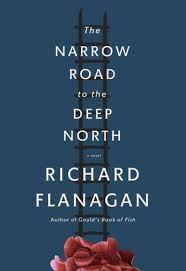
The Narrow Road to the Deep North book coverRichard Flanagan’s father was one of nearly 3,000 Australian POWs who worked on what became known as the Thai-Burma Death Railway in World War II. Flanagan’s father survived. According to Wikipedia, estimates of the death toll are guesses: about 180,000 Asian civilians and 60,000 Allied POWs labored on the railway under inhuman conditions battling cholera, starvation, and beatings. Some 90,000 perished, including over 12,000 Allied POWs. Over 100 Japanese and Koreans were tried for war crimes, and 32 were sentenced to death.

I’m partial to WWII novels, but I don’t know much about the Pacific theater of the war, and next to nothing about the prisoners of war who worked on the Thai-Burma Railway. I’m so glad I read The Narrow Road to the Deep North and encountered Flanagan’s extraordinary writing, but do not attempt it unless you can stomach brutally explicit prose about hellish conditions.

An Australian surgeon, Dorrigo Evans, tries to save as many of the men under his command as he can, but his efforts are mostly futile. We see Dorrigo as a young boy in Tasmania, as a young soldier in an affair with his uncle’s wife who is the love of his life, as a prisoner of war, and as an older, successful, but deeply scarred surgeon and war hero.

There are several moving, intimate, stream-of-consciousness portrayals of other Australian POWs under Dorrigo’s command  as well. Especially riveting is a scene in which the Japanese commanders, cruel and relentless in their mission to get the railroad built, discuss the fine points of haiku. Flanagan follows these men after the war, too, those who managed to have others take the fall for their crimes, and their amazingly clear consciences after the war.

The Narrow Road to the Deep North won the Man Booker Prize and has received many excellent reviews. Michiko Kakutani of The New York Times  is more mixed in her review: she feels that Amy, Dorrigo’s lover, should have been excised from the book for the sake of unity and coherence; she describes Flanagan’s writing about the love affair as “treacly prose,” whereas I found many of these passages beautiful. I disagree with her assessment here.

Have you ever thoroughly loved a book or movie only to encounter a respected critic who points out how seriously deficient or flawed is the thing you absolutely love? At this link is an especially vicious review in the London Review of Books. Flanagan must have poured his heart and soul into writing about a terrible time that his father survived, and he spent years working on the novel. This negative review is not reasoned literary criticism that I value or trust, and I wonder what motivates the critic. Sometimes I think critics analyze so much creative work they become jaded, unable to approach a novel or movie in a fresh, unbiased way.

By the way, I don’t consider my blog posts to be book reviews or literary criticism. My intention is to write about how a book affects me, personally, or how I think it might affect you, the reader, or why it may be especially significant in some way. If I don’t feel a book is well written, or if it doesn’t speak to me in some strong way, I don’t write about it here.

I’ll leave you with a passage I especially love, about POWs newly home from the war:

“He brought the fish and chips to their table, then filled some small glass tumblers behind the counter with red wine and brought them out too. Then he sat with them. As they ate, he let them talk. When they flagged he talked of how such a winter meant it would be a good summer for apricots, yes….Then he started up about his own life….How people told him coming to his fish shop made them happy. He hoped that was true. I really do, he said. That’s a life….The old Greek made his own coffee for them – little cups, thick, black and sweet – and he gave them walnut pastries his daughter had made….The simple chairs felt easy, and the place, too, felt right, and the people felt good….”

The Narrow Road to the Deep North illustration


The Narrow Road to the Deep North book coverBasho’s The Narrow Road to the Deep North, written in the 17th century, is a classic work of haibun, which melds haiku with prose. It makes for excellent reading alongside Flanagan’s contemporary novel.

Have you ever encountered scathing criticism of writing that you love? How does it make you feel? Does it alter or influence your opinion of the work?


Books from Around the World, Under Our Tree

The Narrow Road to the Deep North Book CoverThe Narrow Road to the Deep North, by Richard Flanagan. This World War II novel about an Australian surgeon in a Japanese POW camp won the 2014 Man Booker Prize.  (The purpose of this UK prize is to bring quality fiction to intelligent general readers who might otherwise not hear about the work.) The prisoners helped build what became known as the Thailand-Burma Death Railway. The Narrow Road to the Deep North book cover The books is named after one of the most famous books in Japanese literature, written by the 17th century Japanese poet Matsuo Basho. I plan to read the books together. I’ll let you know how that works out.


A Platter of Figs cookbook coverA Platter of Figs and Other Recipes, by David Tanis I like this cookbook because it’s about eating with the seasons, and it features uncomplicated family meals you can easily make at home. Sections include “How to Cook a Rabbit,” “Feeling Italian,” “Nuevo Mexico,” “Peasant from a Parisian Kitchen,” and “Hot Day, Cold Chicken.” David Tanis is the head chef at Chez Panisse in Berkeley six months of the year; the other six months he lives in Paris, where he prepares meals in a tiny galley kitchen for his private dining club. I will read any cookbook affiliated with Alice Waters and Chez Panisse. My son bought this book at Spoonbill & Sugartown Booksellers in Williamsburg.


Cereal magazine coverCereal: Travel & Lifestyle Magazine, Vol. 8 Click on this link right now and visit Cereal, a stunningly photographed and designed magazine and online journal. This volume features, among other things, a section on Yukon, Canada with spreads on Kluane National Park & Reserve and the Demptster Highway which leads to the Arctic Circle. (Someone in the family has been to the Arctic Circle via the Dalton Highway.) This mag’s style and visual aesthetic reminded me of a cookbook and lifestyle book I received last Christmas, The Kinfolk Table: Recipes for Small Gatherings. (Kinfolk is a magazine, too.) So I got out the book and saw there are a couple of recipes and a profile of food writer Rosa Park, who happens to be the editor of Cereal. Both Cereal and Kinfolk are beautifully designed and photographed, wonderful for browsing.


Southern Light: Images of Antarctica book coverSouthern Light: Images from Antarctica, by David Neilson. Someone in our family dreams of visiting Antarctica.  This is a luscious collection of black and white and color photos, including several gatefolds that open up to three panels of photos on each side. At least seven kinds of penguins, all the major mountain ranges, Deception and Elephant Islands, historic exploration sites, and essays on climate change, too. Our son bought this book at Strand Books in New York. (“Come for the books and stay for the synth musik.”)


RHS Vegetables for the Gourmet Gardener book cover

RHS Vegetables for the Gourmet Gardener, by Simon Akeroyd. To feed my gardening habit and enrich my gardening and nature writing. RHS stands for Royal Horticultural Society, the UK’s leading gardening charity. This beautiful book was designed and produced by Quid Publishing in England, the same publisher that produced another volume I own, RHS Latin for Gardeners.

Our son purchased this at Daunt Books for Travellers in London. On the bookmark tucked inside:  “The heart of Daunt Books is an original Edwardian bookshop with long oak galleries and graceful skylights. Its soul is the unique arrangement of books by country – where guides, novels, and nonfiction of all kinds will interest traveller and browser alike.” If I ever get to London this shop will be on my bookstore list.


Four Seasons in Rome book coverFour Seasons in Rome: On Twins, Insomnia, and the Biggest Funeral in the History of the World, by Anthony Doerr. If you read my blog, you know I’ve been wild about Anthony Doerr lately. His novel, All the Light We Cannot See, was a National Book Award finalist and has become a bestseller. He happened to visit Rome when Pope John Paul II was dying and attended the vigil. I can’t wait to see Doerr’s take on this fabulous city.


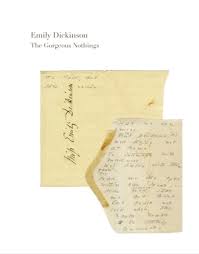
The Gorgeous Nothings book coverEmily Dickinson: The Gorgeous Nothings, by Marta Werner, a scholar of poetry, and Jen Bervin, a visual artist. No other book is quite like this one – a work of art, a facsimile publication of Emily Dickinson’s poems as she wrote them on fifty-two envelopes. These artifacts let the reader see Emily’s original line breaks and words spread across the entire space of a page, together with variant word lists that are meant to be part of the texts themselves. Reading these poems in their original medium, as opposed to in a traditional typeset book, is an entirely different experience.


My Struggle book coverMy Struggle, Book Three, by Karl Ove Knausgaard. My son has read the first two autobiographical novels in the hugely popular series (there are to be six!) by the Norwegian author, published in 22 languages. I hope to tackle the first two volumes myself this year.


Berlin Wonderland book coverBerlin Wonderland: Wild Years Revisited 1990 – 1996 Amazing photos by seven photographers documenting the wild, artistic subculture that bloomed after the Berlin Wall came down. One of our sons is studying in Germany and bought this at Hundt Hammerstein in Berlin, a gift for the photographer in our family. The text is in English and German.


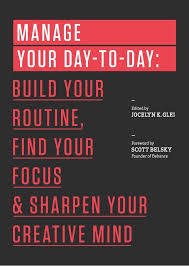
Manage Your Day to Day book coverManage Your Day-to-Day: Build Your Routine, Find Your Focus & Sharpen Your Creative Mind, edited by Jocelyn K. Glei. This is a great little book about how to meet creative goals and fulfill your calling rather than spend your days reacting to the demands of social media and new technology – a huge issue creative souls in the past did not have to deal with. Creative work, in the context of this book, can be anything from painting to starting a business to launching a volunteer effort or charity drive.

These very short articles by creatives and thought leaders like Seth Godin and Gretchen Rubin are practical and full of wisdom. I love this tiny red and black book and decided to pass it on to my photographer son (the industrial designer has browsed through it, too.) The most important take-away for me: disconnect from the Internet and get creative work done first thing, NO MATTER WHAT. Produced by Behance, which “is on a mission to empower the creative world.”   (See: http://www.99u.com; http://www.behance.com)


Blue Dawn

Birds on branches in snow

“Christmas Eve he drove all the way to Helena to buy her figure skates. In the morning they wrapped themselves head to toe in furs and went out to skate the river. She held him by the hips and they glided through the blue dawn, skating hard up the frozen coils and shoals, beneath the leafless alders and cottonwoods, only the bare tips of creek willow showing above the snow.” “The Hunter’s Wife,” from The Shell Collector by Anthony Doerr.

Photo by Putneypics. CC By-NC 2.0

Redeployment

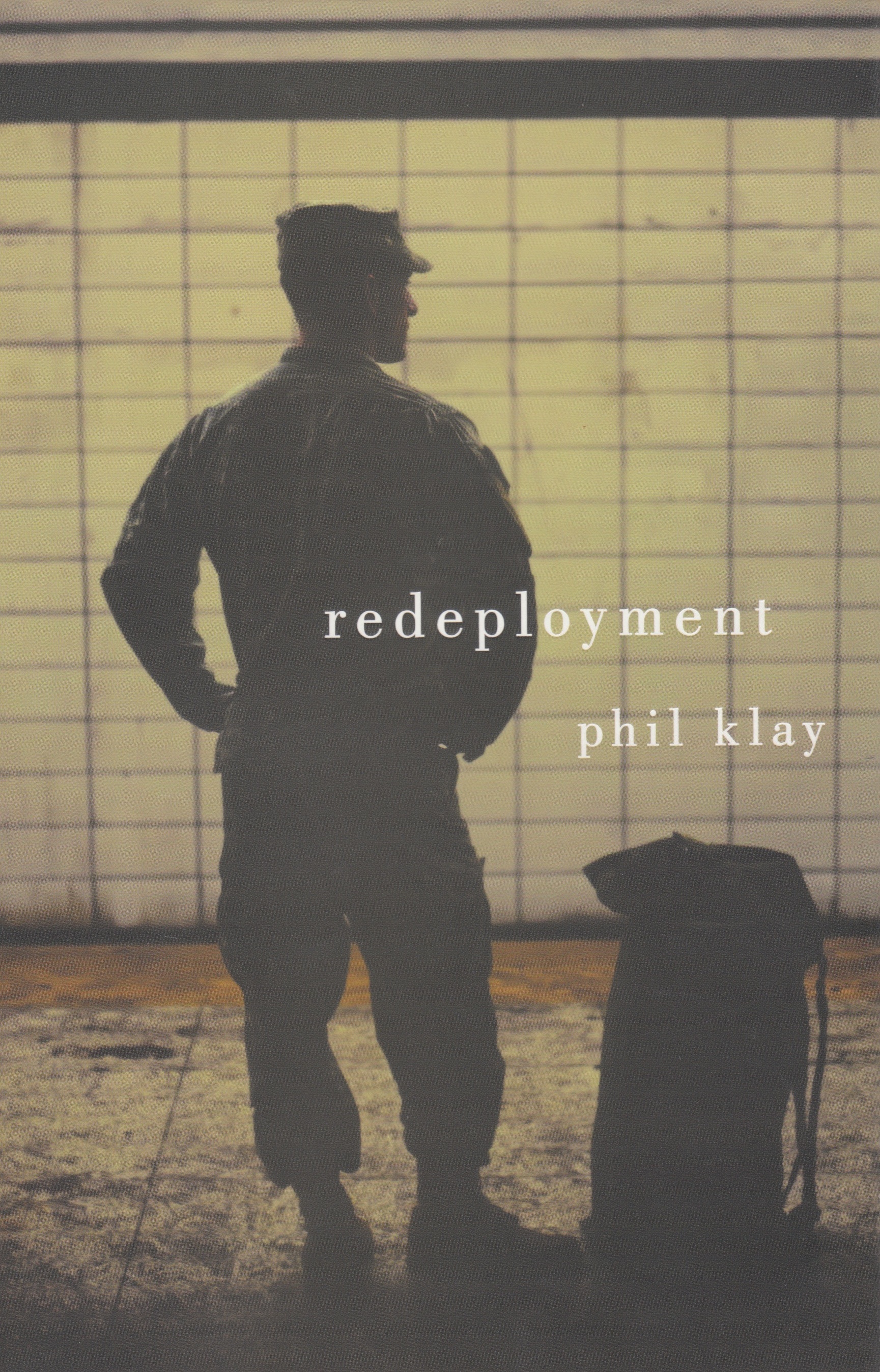
Redeployment book cover

“Your wife takes you shopping in Wilmington. Last time you walked down a city street, your Marine on point went down the side of the road, checking ahead and scanning the roofs across from him. The Marine behind him checks the windows on the top levels of the buildings, the Marine behind him gets the windows a little lower, and so on down until your guys have the street level covered, and the Marine in back has the rear…

In Wilmington you don’t have a squad, you don’t have a battle buddy, you don’t even have a weapon. You startle ten times checking for it and it’s not there. You’re safe, so your alertness should be at white, but it’s not. 

Instead, you’re stuck in an American Eagle Outfitters. Your wife gives you some clothes to try on and you walk into the tiny dressing room. You close the door, and you don’t want to open it again.”      Redeployment, by Phil Klay


Redeployment, Phil Klay’s collection of short stories, won this year’s National Book Award. It’s been hailed as THE literary work that captures the Iraq and Afghanistan wars, destined to become a classic of war literature.

Klay served during the Surge as a public affairs officer in Anbar (Iraq), which has now been infiltrated by ISIS. All the stories in this collection are written from the first person point of view: a military chaplain, a Mortuary Affairs officer, a Marine home on leave, and others because, as Klay said in an interview, each person has a different experience of war. He wanted to capture those varied perspectives.

If you read Redeployment, you’ll encounter stark realism, much profanity, and a bewildering array of acronyms: SITREP (Situation Report), RPG (Rocket-Propelled Grenade), CASEVAC (Casualty Evacuation), EOD (Explosive Ordnance Disposal), UXO (Unexploded Ordnance).  There is no glossary, of course. Reading along without knowing what the acronyms mean has a confusing and disorienting effect that adds to the sense of overwhelming fear and danger.

Klay is a master at conveying situation and character through dialogue and idiosyncratic points of view. These soldiers are strangers in an utterly baffling land. They return home as aliens, isolated and unable to relate to “normal” American life. They are ciphers to an American public tragically disengaged from the war being conducted by their own country. I, myself, do not know a single Iraq or Afghanistan war veteran.

There have been a number of interesting interviews with Klay, especially since he won the National Book Award. An NPR interview by Terry Gross is one of my favorites. Terry is adept at asking the hard questions, and Phil Klay is an intense, thoughtful man, a Catholic who attended Jesuit schools. He does not come out in favor of or against the wars, although it’s clear he does not like incompetent leaders or clueless, insensitive civilians.  As any good writer does, he lets character and situation tell the stories, allowing readers to draw their own conclusions.

In one interview, Klay says that when he returned from Iraq he ran into a friend who said she couldn’t possibly imagine what he’d been through. That did not sit well with Klay. He in fact wanted very much for his friends and American civilians to imagine and understand, which is one of the reasons he wrote the stories.

Klay has also said that asking veterans if they ever killed someone is “the most obscene question you can ask.”

After reading (surviving!) Redeployment, I feel as though saying “Thank you for your service” to military personnel I might encounter would be incredibly lame. I’m not sure I could come up with the right words to show I have even a semblance of an understanding and thatI want to understand more.

Redeployment is not comfortable or comforting reading, but necessary if we civilians want to pay attention.

Prayer of a military chaplain in Iraq:  “I asked God to protect the battalion from further harm. I knew He would not. I asked Him to bring abuses to light. I knew He would not. I asked him, finally, for grace. When I turned back to the Divine Office, I read the words with empty disengagement.”    from “Prayer in the Furnace,” Redeployment


The Hunter’s Wife

Northern Lights and trees

“That night he drove her all the way north to Sweetgrass, on the Canadian border, to see the Northern Lights. Great sheets of violet, amber and pale green rose from the distances. Shapes like the head of a falcon, a scarf and a wing rippled above the mountains. They sat in the truck cab, the heater blowing on their knees. Behind the aurora the Milky Way burned.”     “The Hunter’s Wife,” by Anthony Doerr

I liked All the Light We Cannot See so much, I got a copy of Anthony Doerr’s short story collection, The Shell Collector, and read “The Hunter’s Wife” (astonishing) while I had tea at Wegman’s today. One reviewer said about this collection: “Eight stunning exercises in steel-tipped feathery fineness….[Doerr is] able to pin down every butterfly wing and fleck of matter in the universe, yet willing to float the unanswerables….”

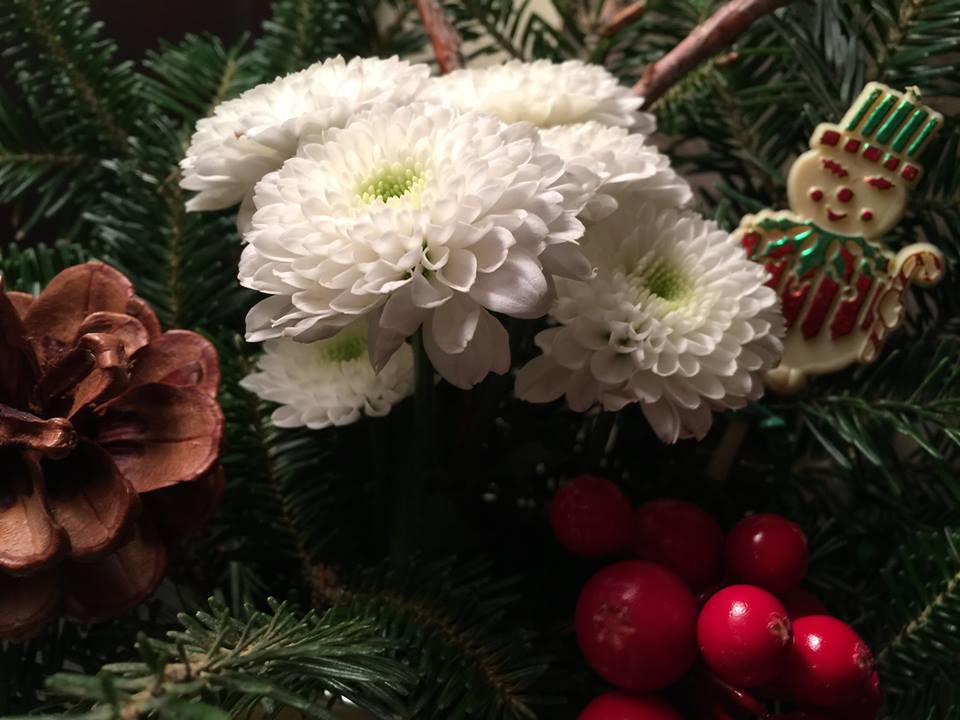
The snow was really coming down this afternoon. I watched people buying groceries for the evening’s dinner, rushing about and remarking on the weather, telling each other to drive safely. I bought some juniper boughs, white button mums, a ruby-red poinsettia. (And a meat loaf for supper.) The snow was still falling when I left. I swept about four inches’ worth off my car.

White mums, berries, snowman, pine cone


All the Light We Cannot See

“At dusk they pour from the sky. They blow across the ramparts, turn cartwheels over rooftops, flutter into the ravines between houses. Entire streets swirl with them, flashing white against the cobbles. Urgent message to the inhabitants of this town, they say. Depart immediately to open country.”     All the Light We Cannot See, Anthony Doerr

All the Light We Cannot SeeWhen she is six, Marie-Laure LeBlanc goes blind. Her widowed father, a locksmith at the Natural History Museum, constructs a miniature replica of the Paris neighborhood where they live so Marie-Laure can memorize nearby streets and landmarks.

Some years later, when she and Monsieur LeBlanc flee to the coastal city of Saint-Malo during the Nazi occupation, Marie-Laure’s father constructs a replica of that city, too, so Marie-Laure can make her way around independently. Eventually, Marie-Laure joins the resistance, along with her uncle, Etienne, who is a shell-shocked World War I veteran. She finds herself quite alone on the eve of the massive American bombing of Saint-Malo in August of 1944.

In the meantime, German orphan Werner Pfennig takes a keen interest in building and fixing radios. Eventually, he is recruited by the academy for Hitler Youth. During the war, Werner tracks the resistance by searching for secret radio broadcasts. Werner detects illegal broadcasts coming from Saint-Malo, and the very street where Marie-Laure lives.

All the Light We Cannot See was a 2014 National Book Award finalist. Anthony Doerr, who grew up in Cleveland but now lives in Idaho, is a writer I intend to follow. I’ve put his memoir, Four Seasons in Rome, on my holiday wish list, and am enjoying his collection of short stories, The Shell Collector. His prose is breathtaking, poetic. (I’m studying favorite sentences from the novel as a writing exercise.)

When I read World War II European-front fiction I try to imagine where my father would have been at the time. He arrived in France and Luxembourg a few months after the bombing of Saint-Milo and fought during the weeks leading to the Battle of the Bulge.

Here is a 9-minute video I found on YouTube of Americans bombing and entering Saint-Malo. There were about 850 buildings in the town, and after the bombing only 150 or so remained standing.

A couple of my favorite passages from All the Light We Cannot See:

“She places a ration coupon on the counter. ‘One ordinary loaf, please.’

‘And how is your uncle?’ The words are the same, but the voice of Madame Ruelle is different. Galvanized.

‘My uncle is well, thank you.’

Madame Ruelle…reaches across the counter and cups Marie-Laure’s face in her floury palms. ‘You amazing child.’

…the loaf comes to her: heavy, warm, larger than normal. ‘Tell your uncle that the hour has come. That the mermaids have bleached hair.’

‘The mermaids, Madame?’

‘They are coming dear. Within the week.'”

++++++++++++++++++++++

“They cross the Channel at midnight. There are twelve and they are named for songs: Stardust and Stormy Weather and In the Mood and Pistol-Packin’ Mama…

Inside each airplane, a bombardier peers through an aiming window and counts to twenty. Four five six seven. To the bombardiers, the walled city on its granite headland, drawing ever closer, looks like an unholy tooth, something black and dangerous, a final abscess to be lanced away.”

++++++++++++++++++++++

“But God is only a white, cold eye, a quarter-moon poised above the smoke, blinking, blinking as the city is gradually pounded to dust.”

Station Eleven

Station Eleven book cover“On Day Seven the networks began to blink off the air, one by one. ‘So that all of our employees may be with their families,’ a CNN anchor said, ashen and glassy-eyed after forty-eight hours without sleep, ‘we are temporarily suspending broadcast operations.’ ‘Good night,’ NBC said an hour later, ‘and good luck.’ CBS switched without comment to reruns of America’s Got Talent. This was at five in the morning, and everyone who was awake watched for a few hours – it was nice to take a quick break from the end of the world – and then in the early afternoon the lights went out.”     Station Eleven, Emily St. John Mandel

I’ve been reading dystopian fiction lately and looking forward to the third installment of The Hunger Games: Mockingjay. When neighboring Buffalo was buried in over 70 inches of snow this week, I thought of Cal in the futuristic novel California, whose parents were lost in a massive snowstorm that destroyed Cleveland. And just as I dipped into pandemic-ridden Station Eleven, Ebola was front and center in the news. Reality and fiction are getting too close for comfort.

California book coverIn California by Edan Lepucki, it’s post apocalypse: climate change, inequality, and societal decay on a massive scale have pushed civilization over the edge. The “haves” live in fiercely guarded gated communities, while others band together in communes and cultish groups, and some eke out a living in the wilderness on their own.

It’s Emily St. John Mandel’s Station Eleven I want to write about here, a National Book Award finalist. Of the two novels, I prefer this one, though both have gotten excellent reviews. In Station Eleven, a flu pandemic kills 99.9 percent of the population in a matter of days. We see the end of advanced civilization through the eyes of five characters, and the first decades after the collapse.

One of my favorite characters is Clark, a corporate consultant who specializes in coaching problematic executives and CEOs to change their behavior. Days before the outbreak of the Georgia flu, Clark interviews an especially perceptive employee to see what others think of a particular manager. I love this exchange:

“‘….it’s like the corporate world is full of ghosts. And actually, let me revise that, my parents are in academia so I’ve had front-row seats for that horror show, I know academia’s no different, so maybe a fairer way of putting this would be to say that adulthood’s full of ghosts.'”

“‘I’m talking about these people who have ended up in one life instead of another and they are just so disappointed. Do you know what I mean? They’ve done what’s expected of them. They want to do something different but it’s impossible now, there’s a mortgage, kids, whatever, they’re trapped. Dan’s like that….but I don’t think he even realizes it. You probably encounter people like him all the time. High-functioning sleepwalkers, essentially.'”

What was it in this statement that made Clark want to weep?

“…you go on like that, looking forward to five o’clock and then the weekend and then your two or three annual weeks of paid vacation time, day in day, and that’s what happens to your life.”

“Right,” Clark said. He was filled in that moment with an inexpressible longing.

“Guys like Dan, they’re like sleepwalkers,” she said, “and nothing ever jolts them awake.”

Clark, of course, is jolted awake in a very big way when his flight to Toronto is diverted to a small Michigan airport after the pandemic explodes. He and his fellow passengers, untouched by the flu, watch the end of life as they know it on television. They never leave the airport – it becomes their settlement, their home. Eventually, Clark establishes a Museum of Civilization, where people donate iPads and smart phones and other remnants of their now-lost advanced culture.

“Like educated children everywhere, the children in the airport school memorized abstractions: the airplanes outside once flew through the air. You could us an airplane to travel to the other side of the world, but….when you were on an airplane you had to turn off your electronic devices before takeoff and landing, devices such as the tiny flat machines that played music and the larger machines that opened up like books and had screens that hadn’t always been dark, the insides brimming with circuitry, and these machines were the portals into a worldwide network. Satellites beamed information down to Earth. Goods traveled in ships and airplanes across the world. There was no place on earth that was too far away to get to.”

Meanwhile, a roving theater troupe travels from town to town performing classical music and Shakespeare for groups of survivors living in abandoned Walmarts and gas stations. In this troupe are characters we’ve met earlier in the novel.  The younger members only dimly remember a world with electricity and and other marvels, and some were born after the collapse. One day, they arrive at Clark’s airport settlement, and there is a poignant reunion of sorts for Clark.

Station Eleven, among other things, asks whether art can save and redeem humanity. I can’t help but think of this outpouring of dystopian literature as the proverbial canary in the mine. A wake-up call for those of us who, like the characters in Station Eleven, may need it. Ursula Le Guin, in her stirring National Book Award speech the other night, said we will need more writers who can imagine a different way of being. Six minutes well worth listening to.

Redeployment by Phil Klay,  a veteran of the Iraq War, won the National Book Award for fiction, so this collection of short stories is on my reading list.


Mysterious Elena

“I concluded that first of all I had to understand better what I was. Investigate my nature as a woman. I had been excessive. I had striven to give myself male capacities. I had thought I had to know everything, be concerned with everything. What did I care about politics, about struggles. I wanted to make a good impression on men, be at their level. At the level of what, of their reason, most unreasonable. Such persistence in memorizing fashionable jargon, wasted effort. I had been conditioned by my education, which had shaped my mind, my voice. To what secret pacts with myself had I consented, just to excel. And now, after the hard work of learning, what must I unlearn. Also, I had been forced by the powerful presence of Lila to imagine myself as I was not. I was added to her, and I felt mutilated as soon as I removed myself. Not an idea, without Lila. Not a thought I trusted, without the support of her thoughts. Not an image. I had to accept myself outside of her. The gist was that. Accept that I was an average person. What should I do. Try again to write. Maybe I didn’t have the passion. I merely limited myself to carrying out a task. So don’t write anymore. Find some job. Or act the lady, as my mother said. Shut myself up in the family. Or turn everything upside down. Home. Children. Husband.”      Those Who Leave and Those Who Stay, Elena Ferrante

My Brilliant Friend book cover


I don’t often read books in translation, but when I visited Sicily this summer I decided to bring along a contemporary Italian writer. I chose Elena Ferrante and her trilogy of Neapolitan novels – a fourth novel will be published next year – not realizing what an incredible reading experience it would turn out to be.

Elena Ferrante is a pseudonym. The author of My Brilliant Friend, The Story of a New Name, and Those Who Leave and Those Who Stay does not grant in-person interviews. She does not do book signings or promotional tours. Even her translator, Ann Goldstein, has never met this international literary sensation.

There is a rumor that Elena Ferrante is a man, which many female readers find absurd. A myth, they say, spread by condescending males who think a woman wouldn’t write about male-female relations in the way that Ferrante does. I would be surprised and disappointed if Ferrante is ever revealed to be male. Certainly, such a thought never occurred to me as I read her novels. To me, she seems authentically female, though one who is remarkably uninhibited and self-revealing: a kind of brutal honesty born of the harsh, corrupt city where her novels are set.  It could be that professional anonymity gives Ferrante the freedom to write in this unfettered way. But I have the feeling that Ferrante’s strong, unusual voice would prevail regardless of her circumstances.

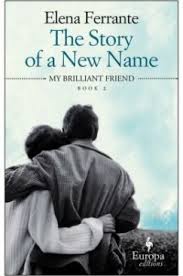
The Story of a New Name book coverThe Neapolitan novels span the 1950s to the present, depicting the fraught friendship of Elena Greco and Lila Cerullo, who live on a violent, poverty-stricken Naples stradone, and the fates of their neighborhood friends. Elena manages to become educated and lift herself out of poverty. She writes a bestselling novel, marries an esteemed professor of literature and “escapes” the old neighborhood. Lila, who Elena views as the more brilliant and talented of the two, is not permitted to attend school beyond the fifth grade. She fashions a very different kind of life that remains enmeshed in the corruption and conflict of Napoli.

The friendship between these two women is arresting, electrifying. Lila and Elena love each other but visit treachery and betrayal upon one another, too.  Lila takes the lead with bold, unconventional action; Elena reacts, making important life decisions almost in the wake of Lila. Elena senses Lila is the true, more talented writer, the one more deserving of success; she consciously crafts her own writer’s voice from a story Lila wrote as a child. No one knows Elena better than Lila, and vice versa. If one woman were to die, the other would lose her identity, and her life would be stripped of much of its meaning.

These novels remind me of the movie The Best of Youth in its depiction of an Italian family caught up in the cultural and political upheaval of the 1960s. Feminism is a strong theme, but as the decades pass, in these Neapolitan novels, men and women do not seem to make any progress understanding each other. Do you remember the vitriolic scene in The Godfather when Connie (Talia Shire) hurls the wedding china at her husband, Carlo (Gianni Russo) and they scream at each other? I thought of them when I read Ferrante’s riveting depiction of Lila’s wedding night. Returning from her honeymoon with a black eye, Lila visits her mother, who looks the other way, saying nothing. Such a thing was not out of the ordinary.

If you appreciate complex psychological portraits of women and female friendships, you will like these novels. I enjoyed them, too, for their depiction of Elena’s emotional and creative challenges as a writer, and because they helped me better understand the problematic history of women’s roles in Italian family and culture. The novels will resonate for anyone who has reinvented themselves through geographical distance or education or immersion in a different stratum of society.  We see Elena renouncing the rough dialect of Naples for cultured Italian, yet reverting to the aggressive language of her childhood when she’s angry or upset. Elena hovers between two identities: alienated from her people and place of origin, yet never really at home in her new life.

Those Who Leave and Those Who Stay book coverThis article in Slate is one of the better reviews I’ve read of Ferrante’s Neapolitan novels. There is an excellent discussion of Elena Ferrante by her translator Ann Goldstein and others in this New Yorker: Out Loud interview.

I plan on reading the fourth novel next year when it is published. Have you read any novels by Elena Ferrante? If so, what do you think?