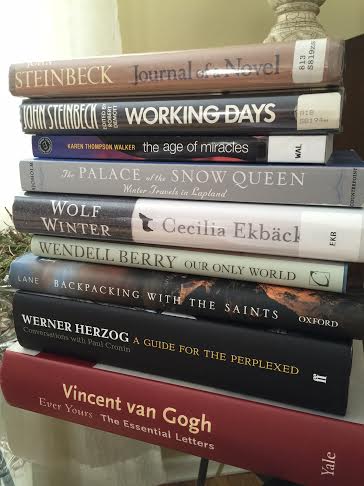
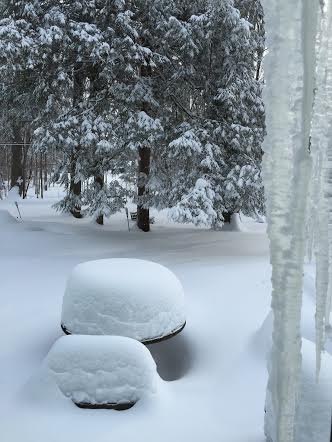
The Age of Miracles is this year’s selection for “If All of Rochester Read the Same Book.” We love to read through the deep winters in our part of the world, and this novel of catastrophe and survival will be on many a nightstand here. Why not try it along with us – I’ll be writing about this debut novel by Karen Thompson Walker soon.
Wendell Berry’sOur Only World (ten essays), because Berry is one of our greatest prophets, writing about the clash between humanity and nature and how we must do better. He’s been called a modern-day Emerson or Thoreau.
Backpacking with the Saints, a travel narrative and spiritual memoir. Belden C. Lane’s take on Celtic, Catholic, Protestant, Buddhist, Hindu and Sufi Muslim writings as he treks the Ozarks and the American Southwest. The book jacket compares him to other lovers of the backcountry, including John Muir and Cheryl Strayed,whose memoir, Wild,was just released as a movie.
Werner Herzog: A Guide for the Perplexed, is an overdue Christmas gift for my photographer son. This newly published series of interviews with the filmmaker is so popular it’s been out of stock. I hope he finds it worth the wait.
No one writes about creating art with as much love and eloquence as Vincent Van Gogh.
More about these in upcoming posts at Books Can Save a Life.
“It was one of those still days when you could hear snowdrifts collapsing in hisses, the sun so dazzling off the white-crusted ice that we seemed suspended on a cloud, bathed in light radiating from below. There we lay, three different species bound by a complex, often bitter history, taking simple comfort in the others’ presence, the sun’s warmth, and the passing of another winter.” A Wolf Called Romeo, Nick Jans
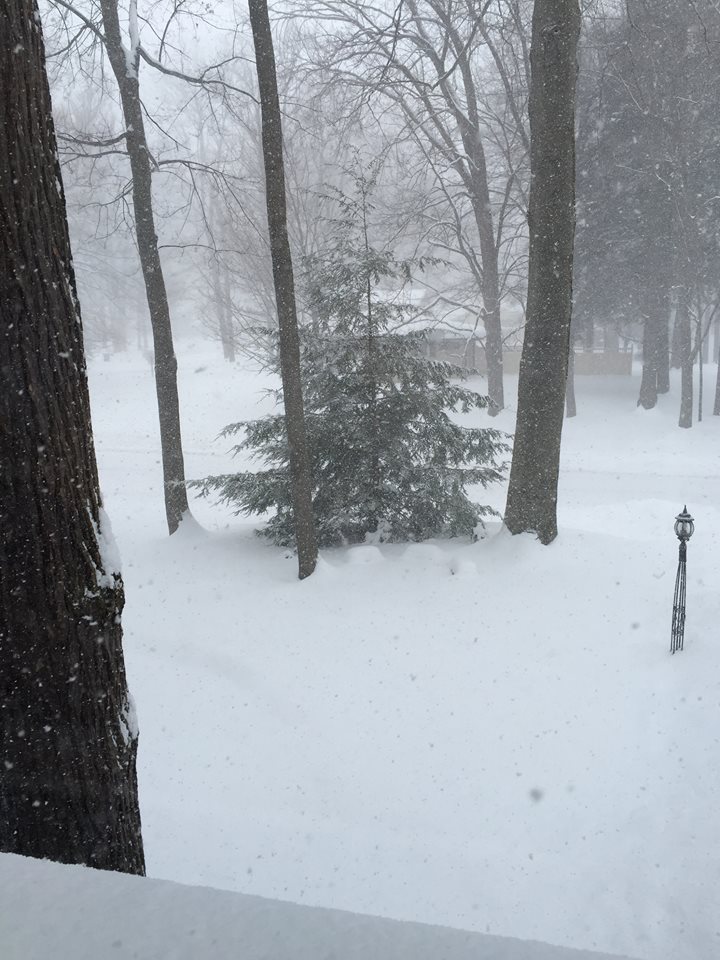
This winter I wanted to be sure to write about a remarkable work of nonfiction that I read a few months ago, A Wolf Called Romeo by Nick Jans. A winter storm is moving in to our parts today, so it seemed a good opportunity to settle in and revisit this captivating story about a very unusual wolf who “courted” the town of Juneau, Alaska. Nick Jans has lived in Alaska for more than three decades and is a nature writer of the highest order. If you love wildlife, wolves, and dogs, you won’t want to miss this book, and you’ll likely want to read Jans’ other work as well.
No one has solved the mystery of why a black wolf wanted to make friends with Nick’s dogs and the dogs of the other townspeople who let their pets romp in the vast open spaces outside of Juneau. The black wolf was playful and unfailingly polite, chivalrous, almost courtly, which inspired Nick’s wife to call him Romeo. For half a dozen years or so, Romeo seemed to confine himself to an area of about seven square miles outside of Juneau, whereas wolves usually roam a territory of hundreds of square miles. Romeo spent long days with his domesticated companions, while keeping his distance from their human owners. He’d disappear for days at a time; at least once Romeo was spotted with a pack of wolves that passed through the area.
This got to be a complicated and controversial situation for the citizens of Juneau. Many of them grew to love Romeo and were fascinated by the rare opportunity to observe a wolf up close, while others felt wolves were to be hunted or should stay where they belonged, in the wild. Some worried Romeo might attack their pets. Rules had to be devised about how to behave around Romeo. For example, Romeo was not to be fed, so as to keep his hunting and survival skills sharp. People were advised to keep their distance from Romeo and avoid physical contact.
It’s hard to believe that at one time Nick Jans hunted and killed wolves, because he is so passionate about protecting Romeo. He recounts the history of his own relationship with wildlife, as well as the fraught relationship between humans and wolves as the American frontier was settled.
Nick observed Romeo closely for several years. He recorded his observations with the intention of writing this book which was ten years in the making. I found myself worrying along with Nick every time Romeo disappeared. For, of course, Romeo’s befriending of the town also left him vulnerable to aspects of civilization that are destructive to wildlife and nature.
This is an emotionally powerful read. Nick Jans reminds me of Barry Lopez, a nature writer I greatly admire. Here, though, Nick has made the story of the relationship between humans and the wild very personal. Romeo is fascinating and haunting, a loner caught between two worlds, not fully at home in either one of them. Thanks to Nick Jans, his story has touched those of us who may go a lifetime without seeing a wolf in the wild.
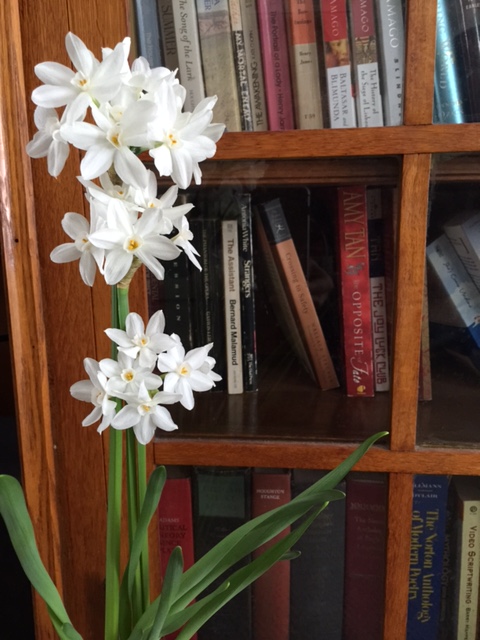
Taking this pic, I re-visited my long-ago college lit books on the bottom shelf: The Complete Pelican Shakespeare, The Norton Anthology of English Literature I and II, Victorian Poetry and Poetics, The Norton Anthology of Modern Poetry, Critical Theory Since Plato (oh, dear.) With many notes in the margins. Odd one out, a scriptwriting handbook. The “soil” of my literary leanings.
“I do believe that there’s something exquisitely powerful about taking something in nature and molding it with your own two hands. From the moment you dig up that first clump, you’re empowered because you immediately enter into collaboration with nature, and who better to be in collaboration with than the greatest force on earth?” Fran Sorin, Digging Deep
You don’t have to be a gardener to enjoy Fran’s book, though if you are, all the better. Fran says, “My mission is to show new and experienced gardeners alike how they can use their gardens – be they rolling, manicured lawns or tiny, blank plots of land – as tools for their creative awakening. I believe from the depths of my heart that gardening can be one of the most profound ways to unearth the creative spirit buried within every one of us. Once you unleash this creative energy, you’ll be amazed at what happens in all areas of your life. You’ll begin to see how living creatively opens up new vistas in your imagination and new windows of opportunity in your life.”
I’m a new gardener, and gardening has become for me a pleasurable, relaxing complement to writing, perfect for getting my body moving outdoors in nature. As I write about growing up in a family flower shop, sowing and tending and reaping resurrect the fragrance of fresh blooms and damp soil, and many other sensory pleasures, from my childhood.
When I ran across Fran’s book online, I was intrigued with her melding of gardening and creativity. The first edition of Digging Deep was immensely popular, hence the 10th anniversary edition in 2014. I’m glad to have discovered it this time around. In addition to being a garden expert and deep ecologist, Fran is an ordained interfaith minister and a soul tending coach. I point this out because the deceptively simple Digging Deep is a profound and spiritual book that is part memoir, as Fran draws upon her own rich life experiences to tell the story of how she arrived at the wisdom she shares here.
I’ve found that to nurture a creative practice (mine is writing), it is good to have other creative outlets just for pleasure, quite different from your primary practice. These “low-stakes” pastimes give your mind and body a break from routine and stimulate your imagination by allowing you to play and experiment. This spirit of play permeates Fran’s book. Her chapters take you sequentially through the cyclical nature of gardening, and creativity: Imagining: The Spark of Creativity. Envisioning: Giving Shape to Your Dreams. Planning: Laying Down the Bones. Planting: Taking Action. Tending: The Act of Nurturing. Enjoying: Reaping What You Have Sown. Completing: Cycling Through the Season.
Here is a favorite passage from a section called “Appreciating”: “Savoring your garden brings more than just sensory pleasure, though – it fills your creative well. In the moments that you experience the reverie of simply being there without working or planning or doing anything other than just drinking it in, you can experience a heightened awareness that elevates your consciousness. Any expression of art, be it a Rembrandt or your own garden, reflects the best of humankind, and tapping into this wonder expands your creative capacity so you may in turn create even more art – more awareness, more inspiration, more aliveness. The cycle feeds itself, but only if you stop to smell those literal and proverbial roses.” (boldface is mine)
Fran includes some excellent gardening guidance and tips, but her book is not a gardening manual. Rather, her aim is impart a deeper wisdom, a kind of spiritual instruction about connection to soil and nature, to foster creative awakening.
Jigs and Jo Ann Gardner’s Gardens of Use and Delightisabouta remarkable couple who for thirty years taught themselves how to live off the land on a farm on remote, hardscrabble Cape Breton Island in Nova Scotia. (They now live on a smaller farm in upstate New York.) I wanted to pair it with Digging Deep because, although Jigs and Jo Ann are immensely practical people, they are deeply connected to their land and passionate about homesteading, which they portray as at once the functional task of reawakening fertility and abundance in the landscape and making it beautiful as well. The subtitle is Uniting the Practical and the Beautiful in an Integrated Landscape, and that is exactly what Jigs and Jo Ann did on their isolated farm, while also raising four children (and a few foster children for good measure.)
Gardens of Use and Delight, like Digging Deep, is part memoir. More of a how-to book than Fran’s, Gardens, for me, stands out because of Jigs and Jo Ann’s instinctively creative approach to seamlessly blending beauty and fertility as they rejuvenate and work their land. I will never rehabilitate an entire farm as they did, but in Jigs and Jo Ann’s book I find an approach to making my much smaller landscape both productive and beautiful. Jigs and Jo Ann remind me of Helen and Scott Nearingand their classic and influential The Good Life,although Helen and Scott were not concerned with aesthetics as are Jigs and Jo Ann. The Gardners view their land as an artist does a blank canvas, to be molded and planted with flowers, herbs, vegetables, fruits, shrubs, and trees.
You’ll find some recipes and homemade craft instructions, too, such as pressed flower cards, candied petals, herb salt, rose petal jelly, and skin freshener. Elayne Sears’ watercolor illustrations of the landscape, fruits, vegetables, flowers, and Jo Ann’s rustic farm kitchen and pantry are delightful – I’d love to have prints of them to hang in my kitchen.
I have read other titles by Jo Ann Gardner and hope to collect everything written by this talented, tenacious homesteading and gardening virtuoso.
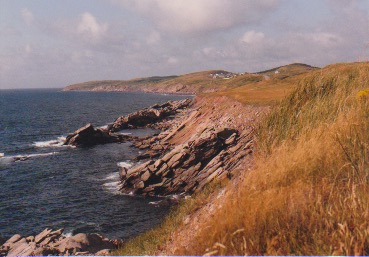
A very vintage photo of Cape Breton Island, from my honeymoon. Although I don’t believe they were on the coast, Jigs and Jo Ann Gardner must have encountered land much like this when they began to reclaim an old Nova Scotia farm.
Slow Flowers Challenge
I wanted to also tell you about Debra Prinzing’sSlow Flower Challenge for 2015, which you can join at any time. Every day, once a week, once a month, or once a season, you can design and make a floral arrangement using slow flowers. If you don’t know what slow flowers are, click on the above link, or read my post about Debra’s book, Slow Flowers. (St. Lynn’s Press)
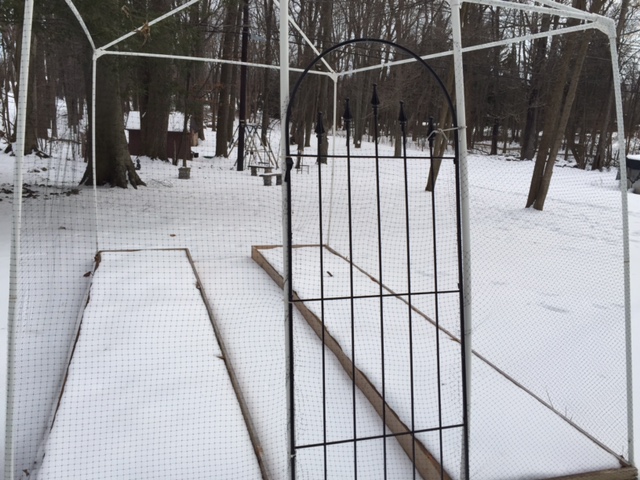
Our blank slate
Next up
More WW II fiction, a travel-to-the-ends-of-the-earth memoir, a wolf, Scandinavian literature, Little Golden Books, a favorite author visits Rome. Etc. Etc.
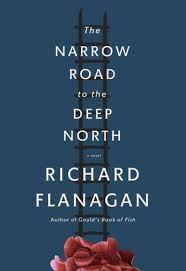
The Narrow Road to the Deep North, by Richard Flanagan. This World War II novel about an Australian surgeon in a Japanese POW camp won the 2014 Man Booker Prize. (The purpose of this UK prize is to bring quality fiction to intelligent general readers who might otherwise not hear about the work.) The prisoners helped build what became known as the Thailand-Burma Death Railway. The books is named after one of the most famous books in Japanese literature, written by the 17th century Japanese poet Matsuo Basho.I plan to read the books together. I’ll let you know how that works out.
A Platter of Figs and Other Recipes, by David Tanis I like this cookbook because it’s about eating with the seasons, and it features uncomplicated family meals you can easily make at home. Sections include “How to Cook a Rabbit,” “Feeling Italian,” “Nuevo Mexico,” “Peasant from a Parisian Kitchen,” and “Hot Day, Cold Chicken.” David Tanis is the head chef at Chez Panisse in Berkeley six months of the year; the other six months he lives in Paris, where he prepares meals in a tiny galley kitchen for his private dining club. I will read any cookbook affiliated with Alice Waters and Chez Panisse. My son bought this book at Spoonbill & Sugartown Booksellers in Williamsburg.
Cereal: Travel & Lifestyle Magazine, Vol. 8Click on this link right now and visit Cereal, a stunningly photographed and designed magazine and online journal. This volume features, among other things, a section on Yukon, Canada with spreads on Kluane National Park & Reserve and the Demptster Highway which leads to the Arctic Circle. (Someone in the family has been to the Arctic Circle via the Dalton Highway.) This mag’s style and visual aesthetic reminded me of a cookbook and lifestyle book I received last Christmas, The Kinfolk Table: Recipes for Small Gatherings. (Kinfolk is a magazine, too.) So I got out the book and saw there are a couple of recipes and a profile of food writer Rosa Park, who happens to be the editor of Cereal. Both Cereal and Kinfolk are beautifully designed and photographed, wonderful for browsing.
Southern Light: Images from Antarctica,by David Neilson. Someone in our family dreams of visiting Antarctica. This is a luscious collection of black and white and color photos, including several gatefolds that open up to three panels of photos on each side. At least seven kinds of penguins, all the major mountain ranges, Deception and Elephant Islands, historic exploration sites, and essays on climate change, too. Our son bought this book at Strand Booksin New York. (“Come for the books and stay for the synth musik.”)
RHS Vegetables for the Gourmet Gardener, by Simon Akeroyd. To feed my gardening habit and enrich my gardening and nature writing. RHS stands for Royal Horticultural Society, the UK’s leading gardening charity. This beautiful book was designed and produced by Quid Publishing in England, the same publisher that produced another volume I own, RHS Latin for Gardeners.
Our son purchased this at Daunt Books for Travellers in London. On the bookmark tucked inside: “The heart of Daunt Books is an original Edwardian bookshop with long oak galleries and graceful skylights. Its soul is the unique arrangement of books by country – where guides, novels, and nonfiction of all kinds will interest traveller and browser alike.” If I ever get to London this shop will be on my bookstore list.
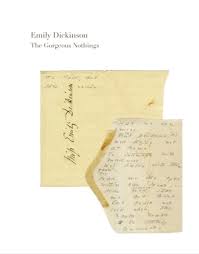
Emily Dickinson: The Gorgeous Nothings,by Marta Werner, a scholar of poetry, and Jen Bervin, a visual artist. No other book is quite like this one – a work of art, a facsimile publication of Emily Dickinson’s poems as she wrote them on fifty-two envelopes. These artifacts let the reader see Emily’s original line breaks and words spread across the entire space of a page, together with variant word lists that are meant to be part of the texts themselves. Reading these poems in their original medium, as opposed to in a traditional typeset book, is an entirely different experience.
My Struggle, Book Three, by Karl Ove Knausgaard. My son has read the first two autobiographical novels in the hugely popular series (there are to be six!) by the Norwegian author, published in 22 languages. I hope to tackle the first two volumes myself this year.
Berlin Wonderland: Wild Years Revisited 1990 – 1996 Amazing photos by seven photographers documenting the wild, artistic subculture that bloomed after the Berlin Wall came down. One of our sons is studying in Germany and bought this at Hundt Hammerstein in Berlin, a gift for the photographer in our family. The text is in English and German.
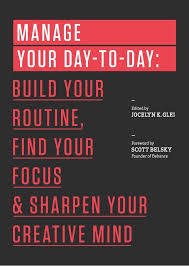
Manage Your Day-to-Day: Build Your Routine, Find Your Focus & Sharpen Your Creative Mind, edited by Jocelyn K. Glei. This is a great little book about how to meet creative goals and fulfill your calling rather than spend your days reacting to the demands of social media and new technology – a huge issue creative souls in the past did not have to deal with. Creative work, in the context of this book, can be anything from painting to starting a business to launching a volunteer effort or charity drive.
These very short articles by creatives and thought leaders like Seth Godin and Gretchen Rubin are practical and full of wisdom. I love this tiny red and black book and decided to pass it on to my photographer son (the industrial designer has browsed through it, too.) The most important take-away for me: disconnect from the Internet and get creative work done first thing, NO MATTER WHAT. Produced by Behance, which “is on a mission to empower the creative world.” (See: http://www.99u.com; http://www.behance.com)
“There were many moments early on when I wondered if it wouldn’t be better to be eaten alive by a wild animal than to show up for work. But in the midst of those hours, there was one that I always loved. It begins around 3:30 pm, when the servers set up the dining room. They set the tables, light the votives, and fill the water glasses. On the surface, it seems pretty mundane….But…for that hour, the room has this calm, consistent thrum to it, a sort of potential energy that feels peaceful and reassuring. I looked forward to it every day, and I still do.” Delancey
Delancey is a funny, beautifully written memoir about the founding of a wood-fired pizza restaurant in Seattle. It would make an excellent holiday present for readers who appreciate good food and frank, inspiring accounts of what it takes to start a business from scratch.
I loved Delanceybecause I grew up in our family’s floral shop, and the book is an authentic depiction of what it takes to establish and run a small business – the successes as well as the moments of despair when you question whether all the effort and sacrifice is worth it. Molly Wizenbergis frank and honest about the good and the bad. She is the author of the hugely popular blog Orangette, as well as another memoir, A Homemade Life.Orangette is one of my favorite blogs; Molly depicts her everyday life of cooking at home (recipes included), raising a daughter, and running Delancey with her husband, Brandon.
In the memoir, I especially enjoyed Molly’s descriptions of how Brandon developed and perfected their pizza recipes and the day-in, day-out routines and rituals of running a restaurant. They reminded me of days in the flower shop that began at the crack of dawn and sometimes ended after midnight, especially during the holidays.
Molly writes about the behind-the-scenes drama in the life of Delancey, but she also beautifully depicts her search for meaning in what she and Brandon are building. After the adrenaline of inspiration began to wear off, Molly got off the treadmill for a bit to take stock.
Here is one of my favorite parts, when Molly travels to London, dines with friends at the River Cafe and has an epiphany:
“…we watched the lunch crew set up their staff meal, a buffet along the bar. They filled their plates and began to stream past us to a lawn next to the patio, where they sat together, at least twenty of them, to eat. They smiled and gestured and leaned into each other, and the whole scene was eminently civilized, idyllic, the kind of vignette you find in an MFK Fisher essay about a restaurant in the French countryside in the first half of the last century. I couldn’t stop staring at them, watching the way they were with each other, the way they clearly enjoyed being there…These people, I thought, are making something here. ….These people know, and they care, that what they’re making is beautiful. They aren’t just going through the motions; they’re going after it. It was spectacular to watch: calm, precise, quietly exuberant.”
Oh, and, by the way, Molly includes twenty recipes for simple, homemade food she, Brandon, and their daughter June eat at home. This is a yummy, inspiring memoir.
“I was on a mission: to find the smallest mountain towns in Sicily. Tiny jewels, remote and isolated, these are places tourists seldom see. But they are the island’s hidden treasure and the secret spring of Sicilian endurance.”
“Maybe I am so drawn to Sicily because I am half Sicilian and the island is hard-wired into my genes.”
“‘I’m looking for a room,’ I said. ‘You have the face of a paesana, a countrywoman,’ she said. My grandparents’ gift to me, I thought. She was sure she recognized me from somewhere.”
“…there used to be a dark bottega that smelled of salami and strawberries….the owner once invented a panino, a little sandwich, just for me: pecorino cheese, pickled peppers, capers, and fresh tomatoes on fragrant yellow bread, chewy as steak and smeared with olive oil. He wouldn’t let me pay.”
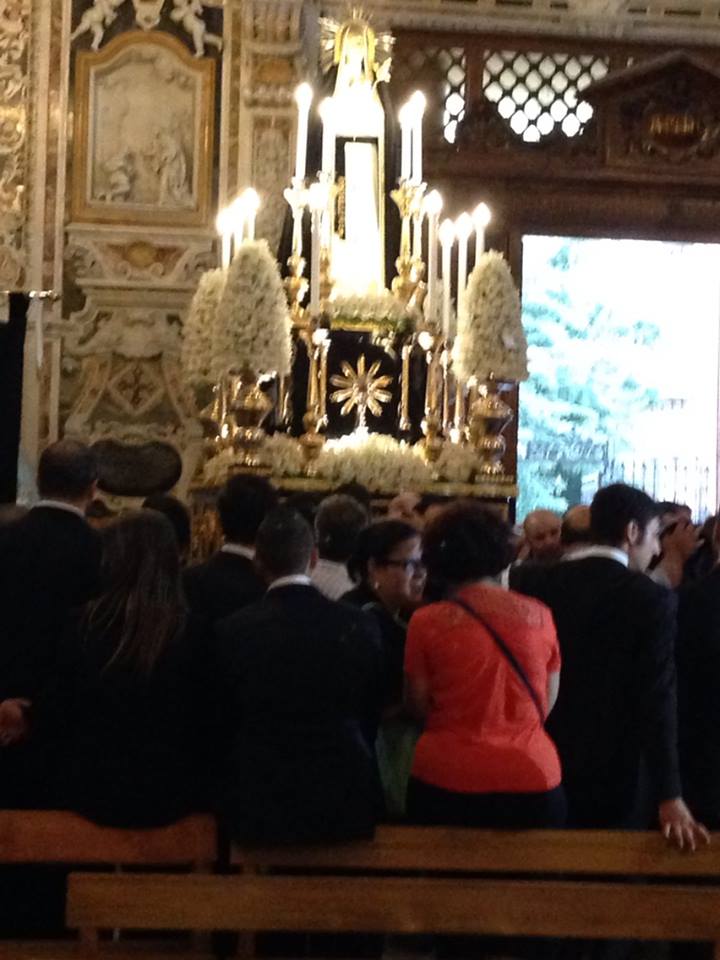
“Men who pulled her all night touched their hankies to the saint. I stared at her back as she floated above our heads down the cathedral’s nave, slowly, like a Norman queen under the pointed Arab arches….She was glorious. An amazing silence fell in the half-filled church.”
“These mountains make water,” he said.
“This island was deadly beautiful, very old, most powerful and strange.”
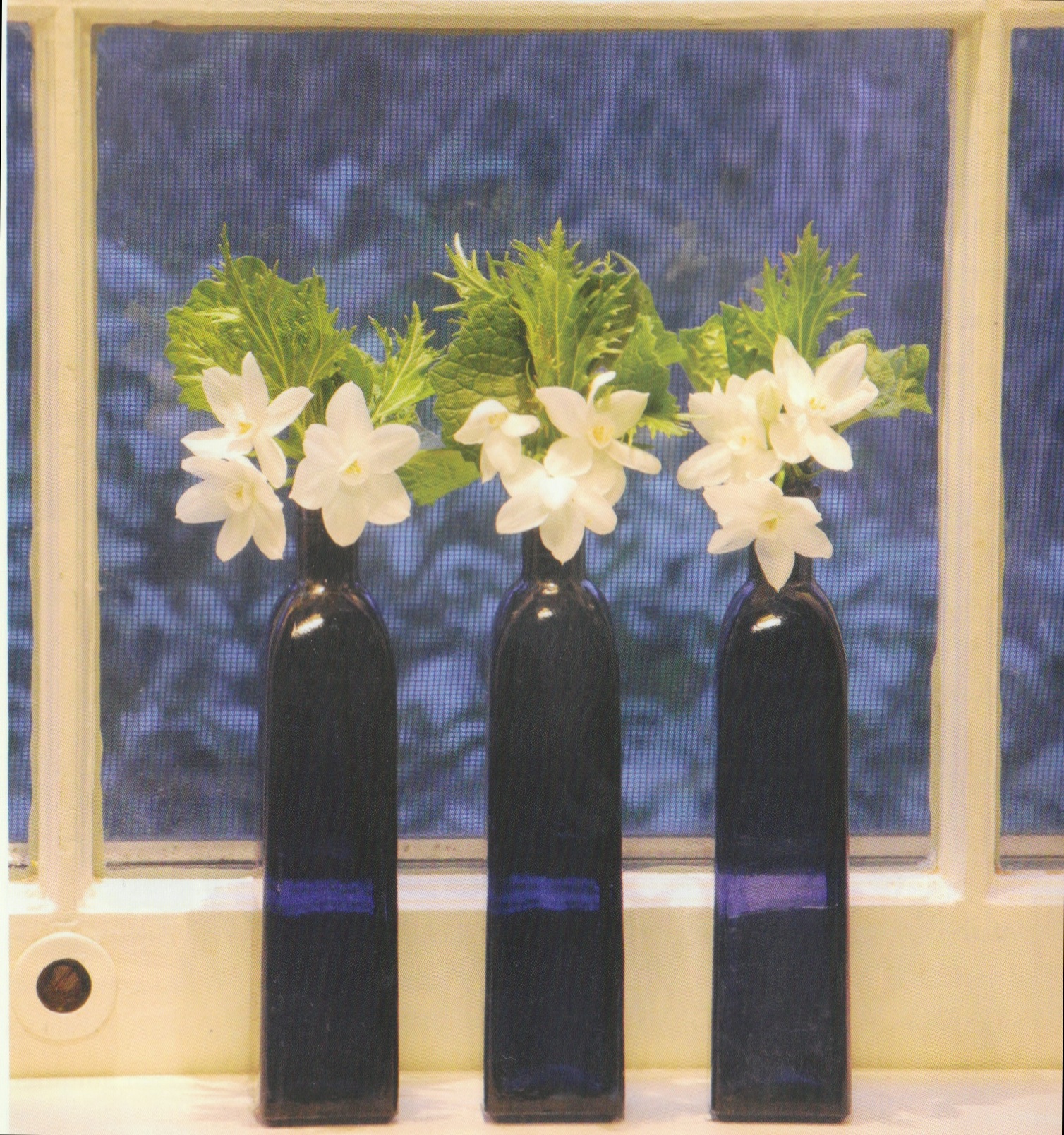
“For me, windowsill arranging is almost a spiritual practice. When I am looking for materials to display and placing them on the windowsill, I feel more like a poet placing words in a haiku than a floral designer placing stems in a vase. I love the limited space, the double connection to the outdoors (through the window and my materials), and the structure that repeating the same activity over and over provides.”Nancy Ross Hugo,Windowsill Art
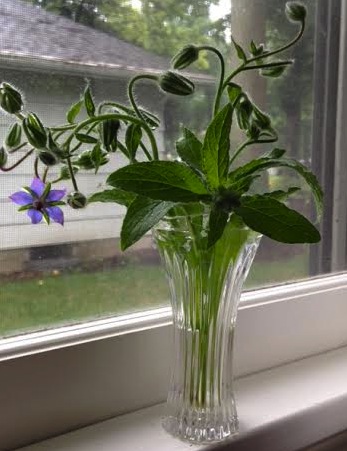
I was inspired by Nancy Ross Hugo’s delightful new book, Windowsill Art, to create this for “In a Vase on Monday,” the blog series by Rambling in the Garden. I used borage and pachysandra. The borage blossoms had flopped over from heavy rain the night before, so I decided to snip them off and enjoy them indoors.
I wrote about flowers and flower-themed books this past summer to commemorate the Ohio floral shop I grew up in (we just sold the building where my parents had the business for some fifty years) and to chronicle a renewed desire to have more flowers in my life. When St. Lynn’s Press asked me to review their new book, Windowsill Art, by Nancy Ross Hugo, I was thrilled. There is much, much more to this small, hand-sized book than meets the eye.
Windowsill Art is, first of all, about discovery: using seasonal blossoms and other easily accessible gifts of nature all around us – seedpods, cones, leaves, twigs, foliage, fruits, and vegetables – to make simple, striking designs we can display in the modest spaces of our windowsills.
Secondly, it is windowsill art as artist’s practice. Hugo writes, “Windowsill arranging can be to floral design what pen and ink drawing is to oil painting: a way to strip the art form to its basics and distill the essence of it.”
Nancy compares her windowsill practice to the work of a vegan cookbook author she once heard speak. The cookbook author focused exclusively on vegan cooking even though she was not a vegan. “She limited her universe in order to investigate a small part of it more deeply.” The simple art of windowsill arranging, Hugo writes, can be “a path back to….innocence and [the] beginner’s eye….And it can help focus a lifetime of practice and observation.”
The author is a naturalist and floral designer who, for three years, created floral windowsill art every day and posted photographs of it on her blog, Windowsill Arranging: Creating Nature on the Windowsill. She learned that her work greatly increased her readers’ sense of artistic freedom: techniques and ideas they hadn’t thought of before opened up new creative paths and possibilities.
Hugo offers instruction in how to find plant material and choose containers; ways to explore the process, including combining and shuffling materials and letting arrangements evolve; and experimenting with styles and techniques. She is suggestive and encouraging; there are no hard and fast rules. Nancy wants you to feel artistically uninhibited, free to try new things. Windowsill Art is generously photographed, featuring a gallery of Nancy’s arrangements through all four seasons.
You’ll want to keep Windowsill Artclose to your work area for inspiration.
April’s Lenten rose blossoms on the left, set against Japanese kerria blooming outdoors; daffodils and violas on the right. Windowsill Art features nature on the window ledge for every month and season. By Nancy Ross Hugo.
Windowsill Art has inspired me to try some arrangements myself. I’ve noticed bits and pieces from nature in our yard I would have overlooked for use in an arrangement. We have a great deal of moss because of shade from our huge hemlock and beech trees, so I hope to use moss in my next arrangement.
I’m expanding my collection of vases and containers, too. At a local dairy, I bought large and small glass bottles of milk and cream; the empty bottles are terrific vases. I recently put aside a small jug that was filled with maple syrup, as well as an empty balsamic vinegar decanter.
My family and I first travelled to Sicily 14 years ago, in part to re-connect with my father’s relatives. That was when I discovered Theresa’s splendid books.
Reading them again on our recent trip was like meeting up with an old friend. When I see Sicily through Theresa’s eyes, I see the island so vividly, with a more nuanced understanding of the complex people, culture, and history of this stunningly beautiful place.
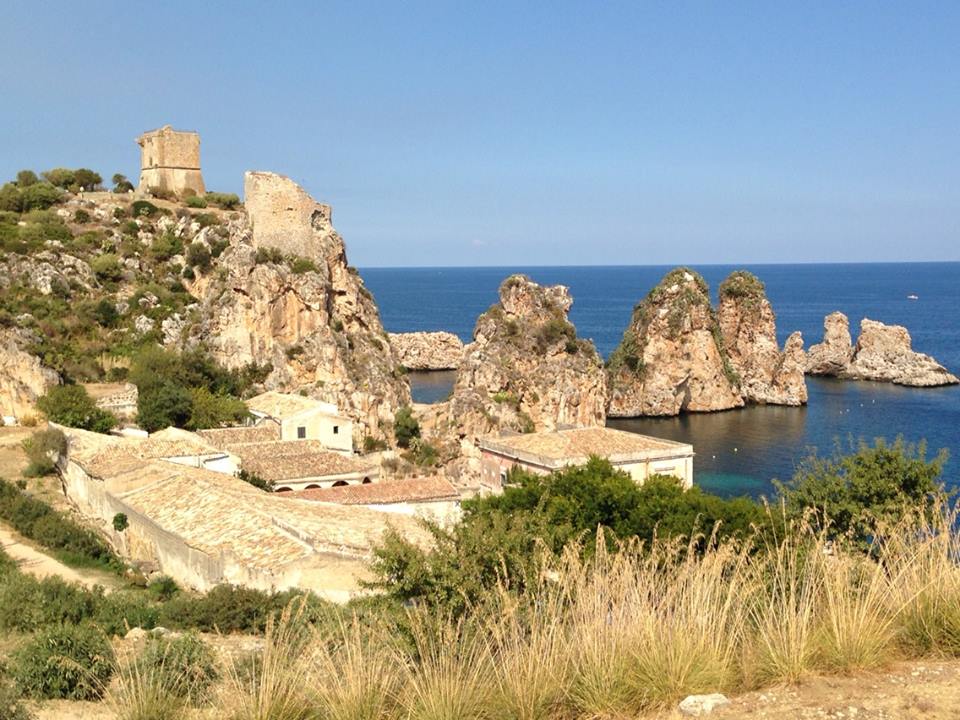
We usually stay on the outskirts of Scopello, a small fishing village that is now a quiet, secluded haven for tourists. On this trip, we rented a villa halfway up a mountain on the edge of Zingaro Nature Reserve. Once the home of a tonnara (tuna factory), in years past Scopello celebrated the mattanza, the ritualized killing of bluefin tuna, every May and June. The mattanza was first practiced by the Arabs, or perhaps the Carthaginians before them. The custom died out in the 1980s when industrial over-fishing made it obsolete.
Scopello’s former tonnara, converted to tourist apartments
Theresa’s book is a love letter and an elegy to the mattanza and the people whose lives were intimately bound to it. During one of the last years of the mattanza, Theresa befriended the fishermen (tonnatori) on the island of Favignana and accompanied them on their boats as they watched and waited for the tuna to become trapped in their underwater chambers of ropes and nets. When several hundred tuna had been captured, the tonnaroti lured them from one chamber to the next, while chanting thanks and prayers to God, the Virgin Mary, the saints.
The bluefins’ final destination: the chamber of death.
“After a while huge black shapes rose up into the backlit square. Their slow rising was mystical, like a birth. They rose higher. Dorsal fins swirled, wild animals drawn up from a silent abyss.
They were giants, eight feet long, some bigger, and there were hundreds of them. The net was drawn taut and they skittered in front of us, half out of the water. I looked into their glassy black eyes. The fish were as big as men, some bigger than four men. When their tails slapped the water it rose in columns above our heads. I remember the din, the thunder of falling water, and their frantic thrashing. They darted to the corners of the net, but there was no way out.
The crowd went wild. People were soaked, screaming and cheering….The fish were churning the sea into a white froth, and then the froth turned pink.”
Tonnara anchors
At one time, these hand-made tuna traps were in Spain, France, Algeria, Tunisia, Turkey, Dalmatia and Corsica, as well as Italy; some sixty tonnaras dotted the Sicilian coast.
“Gone, all gone,” writes Theresa.
The old tonnara in Scopello is beautiful, but I didn’t like seeing it in the hands of tourists. In their heyday, the tonnaras employed, directly or indirectly, thousands of men and women; some even had child care centers on site. Theresa writes with great sadness of the tonnaroti who netted fewer and fewer tuna each year until they had to stop.
I don’t like a world where men and women who love working on or near the sea, who make their living by physical labor, can no longer do so because it is not profitable. I’ve never seen a mighty bluefin tuna, but I’d prefer to have our seas teeming with them.
Theresa Maggio is a compassionate and keenly intelligent traveler. Her passion for discerning the heart and soul of a people and a place will enrich your own explorations.
“When I’m on the road in Sicily I eat street food. It’s cheap, it’s good, and it’s a way to watch Sicilians. Street food feeds a need in them much deeper than hunger – their need to be close. Sicilians telephone each other from the back of the bus to the front, and seek out the crowded beaches, the piazzas packed with people, and markets where they’re likely to get mauled. They must have company, or at least an audience, for whatever they do. In Sicily, where food is love and the street is a stage, street food is more than a cheap meal, it’s Communion.” “Love on a Plate” from The Stone Boudoir by Theresa Maggio
Filomena’s panelle di ceci
We’ve been in Sicily visiting family and I couldn’t wait to post something about our trip.
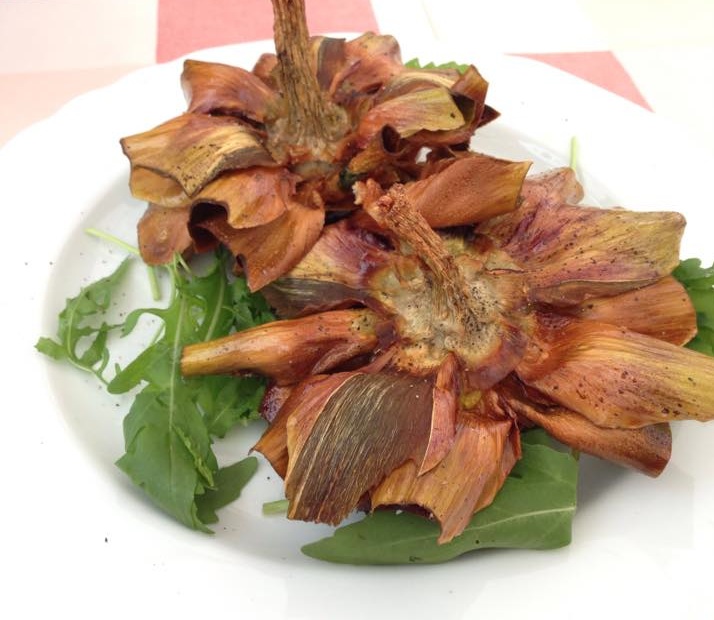
I decided to begin with Filomena’s wonderful panelle, made from chickpea flour, which she prepared for us and we enjoyed one night after our cousin and friends took us sightseeing in Terrasini. We drizzled the fritters with lemon juice and ate them in sandwiches made from thick, soft rolls.
Theresa writes that in Sicily you can buy bags of small, crisp panelle squares, which are great with beer.
During our stay I read once again Theresa Maggio’s lovely The Stone Boudoir: Travels through the Hidden Villages of Sicily, an old favorite. No one captures the poetry and romance of the island quite like Theresa, whose grandmother is from Sicily. More about her writing, and about Sicily, in my next post.
“There were Lupines, Sweet Peas, Phlox, Bluebells, Day and Tiger Lilies, Monkshood, Peonies, Columbine, Daffodils, single and double, a Bleeding-heart bush in the front yard, and vines at each corner, which at times nearly covered the house. And always there was Golden-glow by the kitchen door.” An Old-Time Gardener
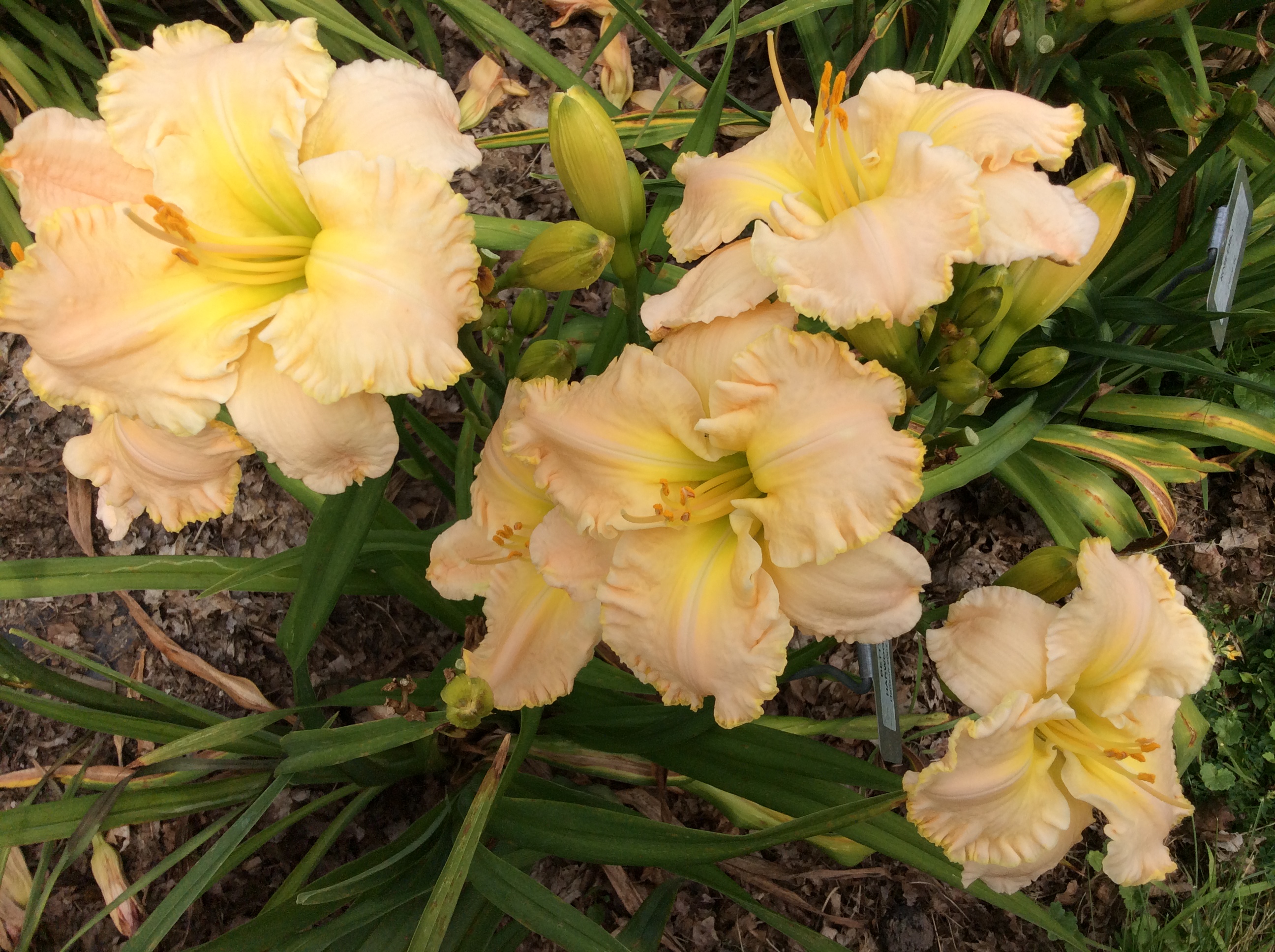
Grace’s Garden lilies
In The Language of Flowers, the main character, Victoria Jones, is a floral designer with a knack for choosing just the right foliage and blossoms for her customers, based on Victorian-inspired flower dictionaries that she’s studied. Having grown up in an Ohio floral shop, I was intrigued by the contemporary, upscale San Francisco flower scene depicted in Vanessa Diffenbaugh’s story.
In the 1950s, 60s, and 70s, our shop carried the standard blooms – roses, carnations, gladiolas and the like – which were shipped from California and South America – and laden with pesticides, though at the time we didn’t give that much thought. Nowadays, floral designers are artisans who use seasonal, locally grown, pesticide-free cultivated and wild flowers, in artful, natural-looking bouquets and arrangements.
In both books, Debra highlights American flower farmers who are passionate about sustainable methods and land stewardship. Slow Flowers is a colorful, lush, small-sized, book with flower arrangements for every week of the year. As in a cookbook, Debra lists the “ingredients” (4 stems hydrangea, 9 stems pink snowberry, 5 stems Dahlia ‘Nijinsky,’ 15 stems amaranth), provides instructions, and suggests vintage and unusual vases and containers.
In The Language of Flowers, Victoria Jones falls in love with Grant, a flower farmer. She first meets him at a flower market, where he is selling varieties of lilies: tiger, stargazer, imperial, and pure white Casablancas. Here is what Victoria has to say about Grant:
“His face had the dusty, lined look of a manual laborer. I imagined he planted, tended, and harvested his flowers himself. His body was lean and muscular as a result, and he neither flinched nor smiled as I examined him…
He withdrew a single orange tiger lily from a bucket.

 The Age of Miracles is this year’s selection for “If All of Rochester Read the Same Book.” We love to read through the deep winters in our part of the world, and this novel of catastrophe and survival will be on many a nightstand here. Why not try it along with us – I’ll be writing about this debut novel by Karen Thompson Walker soon.