Literary Blog Hop Book Giveaway

Literary Blog Hop logo


Welcome to The Literary Blog Hop!

My Giveaways: The Story of a New Name by Elena Ferrante

The Children Act by Ian McEwan

(I will ship to international addresses.)

Books Can Save a Life is participating in the 2015 Literary Blog Hop, hosted by My Book Self.

Between now and midnight on Sunday, April 12, you can hop over to a dozen or so blogs, all offering giveaways of books, book gift cards, or bookish items. Click HERE to see the many fabulous blogs participating in this hop!

My Giveaway

I will be giving away two works of literary fiction by renowned authors. (One book each to two lucky winners.) Just leave a comment about books on my blog (see left sidebar) between now and April 12 and you’re eligible. Winners will be notified via email and will have 48 hours to respond or an alternate winner will be selected.

The Story of a New Name book coverAccording to The New Yorker,Elena Ferrante is one of Italy’s best-known least-known contemporary writers.” An international literary sensation, Elena publishes under a pseudonym, so her identity remains unknown. I’m pleased to offer The Story of a New Name, the second in Ferrante’s best-selling Neapolitan trilogy. You’ve just got to experience her remarkable voice! Click HERE to read a previous post about Ferrante.

Ian McEwan has long been one of my favorites. The Children Act is the haunting story of a teen-age boy with a life-threatening disease who refuses medical treatment on religious grounds.The Children Act book cover

Anyone can enter The Literary Blog Hop. You do not need to have a blog or follow my blog, but if you find Books Can Save a Life of interest, please become one of my followers by email or on Facebook or Twitter.

Oh, and please share this post on your favorite social media!

The Literary Blog Hop ENDS:

MIDNIGHT EST April 12, 2015

Thank you for visiting Books Can Save a Life. Remember, leave a comment if you want a chance to win, and then start BLOG HOPPING!

This Changes Everything

“…only mass social movements can save us now.”  Naomi Klein, This Changes Everything: Capitalism vs. The Climate

This Changes Everything book cover
Notice the cover. No author, no subtitle. One clear message.

 “….this impossibly thin blue curve keeps everything alive beneath it.”  Reid Wiseman, #spacetweets.  

For starters, take two and a half minutes to watch astronaut Reid Wiseman’s video, “A Photo I Love,” and then come back here. You’ll see a new view of Italy (some of you know how much I love Italy). Notice in particular Reid’s photo of the earth’s atmosphere, “….so blue, so incredibly thin….” and Reid’s tweets (#spacetweets).

I wanted to begin on an upbeat note, hence Reid’s video of “watching our earth be alive” that so vividly highlights what the stakes are when it comes to the climate debate. It’s not that Canadian journalist Naomi Klein doesn’t offer hope in her latest book, This Changes Everything. Certainly, she does, but this is a read with plenty of emotional lows before you get to the highs.

This Changes Everything is proving to be enormously influential as well as controversial. If I read her correctly, Klein does not advocate a dismantling of capitalism, but her book is indeed a polemic against the extreme version of capitalism that pervades much of the world today. Her message is that the earth cannot possibly continue to sustain a world economy based on unlimited growth and the endless extraction of resources. We need to change course to keep the earth’s warming under two degrees Celsius (this is according to many climate scientists, who also maintain that a warming of four degrees Celsius would be catastrophic). We need to act now, on a massive scale.

If you care deeply about climate change, I highly recommend putting This Changes Everything at the top of your to-read list. There is so much I don’t know about this huge topic. Though I’ve been against fracking (recently outlawed here in New York), I didn’t know much about it, and I knew absolutely nothing of Canada’s tar sands project and its devastations. Klein brought me up to date on all of this, as well as the current climate change activist scene. She synthesized an enormous amount of research, which makes for slow reading at times, but it’s worth it if you want the big picture.

Here are some things I learned that surprised me:

  • We’ve come a long way with alternative energy technologies. It seems like a no-brainer – if we can meet our energy needs at very little cost using solar, wind, and other technologies, why would we continue using expensive and dirty fossil fuels?
  • Native Americans and indigenous populations around the world are winning important victories against the fossil fuel industry, more so than activists in the mainstream. In Canada and the US, for example, some of these groups, by treaty, retain rights to their land, including the right to make a living from it. The courts have, in many cases, upheld these rights, effectively blocking or delaying extraction projects. These delays have given alternative energy technologies time to develop.
  • Though it’s important for developed countries to convert to clean energy, it’s crucial that we help developing countries turn to clean energy, too–otherwise we’ll never be able to stop global warming. Klein and others maintain that, since developed countries have grown wealthy from fossil fuels, we have a responsibility to help developing countries pay for their energy infrastructures.

A New York Times review called This Changes Everything “…the most momentous and contentious book since Silent Spring,” and “…a book of such ambition and consequence it is almost unreviewable.”

This Changes Everything is absolutely a book that can save lives.

Have you read This Changes Everything? Do you recommend other important books about this topic? If so, please do in the comments. And if you care about climate change, I hope you’ll share this post.

Scopello sunset
What we don’t want to lose. View of Zingaro Nature Preserve in Sicily. (Photo by A. Hallinan)

The Age of Miracles

“We were, on that day, no different from the ancients: terrified of our own big sky.”  The Age of Miracles, Karen Thompson Walker

The Age of Miracles book cover


An estimated 25,000 people in Rochester, New York, are reading Karen Thompson Walker’s The Age of Miracles. Karen is currently in Rochester for three days visiting schools, libraries, and universities as part of the Writers and Books- sponsored “If All of Rochester Reads the Same Book 2015.”

Karen Thompson WalkerYesterday, I had the pleasure of attending one of Karen’s readings at a local college, which was well attended by book lovers and book clubs alike. Many of the attendees have participated in “If All of Rochester Reads” since its inception 15 years ago.

The Age of Miracles is a heart-breaker. After this one, I am going to have to lay off reading dystopian literature for a while.

Eleven-year-old Julia is living the ups and downs of a California childhood when, one day, this announcement is all over the new: scientists have learned the Earth’s rotation has slowed. The days and nights are growing longer and will most likely continue to do so. Life on Earth will never be the same. It is, in fact, very likely coming to an end, and “not with a bang, but with a whimper,” as Karen has said in an interview.

The world slows down with terrible consequences, while Julia copes with difficult friendships and betrayals, falls in love with Seth, and watches the possible dissolution of her parents’ marriage. The Age of Miracles is adult fiction, but it has had great appeal in the young adult market. I’ve read excellent adult dystopian literature recently (The Bone Clocks and Station Eleven), books that offer hope for the redemption of humanity. There is little hope in The Age of Miracles, which is one reason it is so powerful: we watch the blossoming of youth and young love in a world that is going dark.

Climate change and global warming are being hotly debated in the real world, but in The Age of Miracles, the catastrophe has nothing to do with human action. It just happens. Because blame and controversy over who is at fault are removed, the story is free to focus on the characters and how they mature and make ethical choices (or don’t) in impossible circumstances.

Karen said during her reading yesterday that the title of her book refers to both the miraculous time of adolescence as well as the miracle of the earth’s slowing. The miracle in the world Karen creates is an extraordinary, inexplicable event, but in this case one that does not bode well for the human race. It suggests that we humans are not the center of this vast, unknowable universe; the universe can carry on quite well without us.

I found myself, like Julia, not wanting to turn back time, but wishing I could change the laws of nature and reinvent my relationship with time.

“How much sweeter it would be if life happened in reverse, if, after decades of disappointments, you finally arrived at an age when you conceded nothing, when everything was possible.”

Karen is at work on a second novel which will once again place people in an extreme situation.

Click here for a fascinating list of post-apocalyptic/dystopian/utopian/speculative fiction. Jose Saramago’s Blindness stunned me when I read it several years ago; I went on to read all of his other work and I hope to take another look it someday. Saramago’s writing is difficult – he writes page-long sentences with little punctuation – but if you fall under his spell, there is absolutely nothing like it. I haven’t read P.D. James’ The Children of Men, but I remember when my husband and sons and I watched the movie directed by Alfonso Cuarón – an afternoon of movie-going we’ll never forget. Nor will we forget reading aloud the final scenes of The Giver when the boys were young.

Then there’s The Hunger Games (the trilogy) and the ongoing excellent movie series. Ishiguro’s Never Let Me Go is another all-time favorite of mine. (He has a new book, The Buried Giant, a kind of apocalyptic fantasy I’ve yet to read). Nevil Shute’s On The Beach was probably one of my first exposures to apocalyptic fiction many years ago.

If you have strong opinions about any of the books or movies on this list, I’d loved to hear your comments.

If All of Rochester Reads has greatly enriched Rochester’s literary scene. I wrote about our 2014 choice, The Snow Child by Iowyn Ivey, which I loved. Another Rochester Reads favorite of mine is Bel Canto by Ann Patchett. Just so you know, Nancy Pearl, one of America’s greatest librarians, had the brainchild of an entire city reading the same book. She founded the program in Seattle and it has since been adopted by many cities.

Have you read The Age of Miracles? What/Who is your favorite dystopian novel or author? Does your city or town have an annual reading event?

The Herb Lover’s Spa Book

Herb Lovers Spa Book


“Dear Reader – I write this because I love a garden that gives back. Flowers, fragrance, flavor…all of it. A true giving-garden is filled with herbs. Discover them. Grab a leaf, rub it, hold it to your nose and breathe in. Voila! That plain, leafy plant becomes so much more when you learn ways to use it. This is what I share with you.” Sue Goetz, The Herb Lover’s Spa Book

Herbal spa ingredientsIn the middle of a hard winter I couldn’t ask for a better pick-me-up than The Herb Lover’s Spa Book by Sue Goetz, just published by St. Lynn’s Press. This is a little gem of a book. Looking at the photos and skimming through the recipes for facial steams and oatmeal soaks and lavender heat pillows while the snow fell outside my window was a spa experience in and of itself.

I grow the standard kitchen garden herbs and I love cooking with them. Now Sue Goetz has inspired me to try out recipes for herbal preparations that heal, sooth, relax, and refresh. I’d been making a list of seeds to order for this year’s garden, and I’ll have to expand it to include new-to-me herbs like lemon balm and lemon verbena, scented geranium and camomile. I want to try the recipes and the end products myself, of course, and if all goes well, when holiday time rolls around I’ll have homegrown, handmade gifts to give family and friends.

A well-known garden designer, writer, and speaker from Washington State, Sue Goetz packs a lot of information into this little book, and her passion for using herbs in the home for pleasurable and nurturing spa experiences shines on every page.

The Herb Lover’s Spa Book has three parts: Surround, Grow, and Create.

Surround

You can enjoy the herbal preparations you’ll learn to make in this book in your very own private spa. Sue shows how you can create a retreat in your own home, indoors or outdoors, where you can read, relax, soak, sleep, or meditate. She suggests designs, colors, and textures conducive to rest and relaxation, whether in a garden or in a favorite indoor space.

Grow

You’ll find information about nineteen of the most common and popular herbs used for skin treatments and teas and infusions, including lavender, hops, dandelion, eucalyptus, sage, parsley, witch hazel, and thyme. Sue includes growing tips, healing properties, and suitable varieties for each herb, a list of seasonal herb garden tasks, and tips for harvesting and preserving.

Create

Lavender and herbal spa ingredientsIn addition to over 50 herbal recipes, Sue provides information about sourcing and working with common ingredients and materials such as beeswax, baking soda, essential oils, epsom salt, ginger root and jojoba oil.

I loved leafing through the recipes. I didn’t know there are so many varieties of bath brews, each with its own effects. For a relaxing bath you can use chamomile, hops, and lavender. For a stimulating bath, try eucalyptus, lemon balm, mint, rosemary, sage, or thyme. For a healing bath, use calendula, lavender, lemon verbena, parsley, or spearmint.

First on my list of recipes I’d like to try is the Inspiration Bath. When you want to get your creativity flowing, put some calendula petals in a muslin sachet or directly into a warm bath, and add 6 drops each of lavender essential oil and rose essential oil.

Scroll down to the bottom of this post to see the complete recipe for Sue’s Basic Bath Brew. Other tempting concoctions: Peppermint Foot Soak, Midsummer’s Eve Floral Garden Water, Dusty Rose Body Powder, Winter Warming Steam, Chamomile Eye Soothers, Rosewater Cream, and Floral Water Skin Brightener.

Jars of herbal preparationsSue includes fascinating tidbits about historical aspects of the spa experience and herbal pharmacopoeia. I’d never heard of a stillroom, for example – a special room in homes of the early American colonies set aside to prepare household products from the garden. Sue says the lost art of the stillroom is coming back, and she encourages us to find a special space in our modern homes where we can store ingredients and experiment with herbal remedies.

I like that a glossary of commonly used terms is included at the end of the book, as well as a list of resources, including places to purchase herbs, oils, packaging materials, plants, and seeds.

I’m so impressed with St. Lynn’s collection of how-to gardening books. I’ve written about a couple of other St. Lynn’s titles here at Books Can Save a Life: Debra Prinzing’s  Slow Flowers and Nancy Ross Hugo’s  Windowsill Art.

Tea and teacupI have a soft spot in my heart for small, inspired publishers with a strong sense of values and a well defined mission – I was an editor for such a publisher eons ago at the beginning of my career. I like St. Lynn’s because they make gardening so inviting and accessible to those of us who are beginners, and because they are strongly committed to ecology and our planet.

Make yourself a cup of tea and browse some of their other titles. (And if you want to know who St. Lynn is, click here.)

Bath Brew recipe
One of many tempting recipes in Sue Goetz’s The Herb Lover’s Spa Book


Do you make herbal preparations from your garden? If so, I’d love to hear about them, as well as books you recommend for those of us who want to learn more. 


John Steinbeck and Slow Writing

Clock, family photo

June 17, 1938

“Hope my nerves aren’t weak because they have a long haul ahead….Begin the detailed description of the family I am to live with for four months. Must take time in the description, detail, detail, looks, clothes, gestures. Ma very important. Uncle John important. Pa very. In fact all of them are important. Got to take it slowly. I don’t care how long it is. We have to know these people. Know their looks and nature. Must.”  Working Days: The Journals of The Grapes of Wrath, 1938 – 1941, John Steinbeck

The Art of Slow Writing book coverI’ve just finished reading Louise DeSalvo’s wonderful The Art of Slow Writing.  I like slow cooking, slow cities, slow flowers, and slow living, so of course I had to see what slow writing is all about.

In her book, Louise looks closely at every stage of the writing process and what it takes to achieve our best work.

Slow down, she recommends. Good writing cannot be rushed.

Slow writing is not a new trend: the best writers have always been slow writers.

Zadie Smith, Elizabeth Gilbert, Jo Ann Beard, Virginia Woolf, Michael Chabon, Henry Miller, D.H. Lawrence, Jeffrey Eugenides, Ian McEwan – DeSalvo synthesizes the wisdom of these and many other writers who have spoken frankly about what it takes to go deep into our creative process to achieve stellar writing.

Louise shows us her writing process, too (she has published several memoirs and other books), and shares anecdotes about getting stuck and how she eventually found a path forward.

Working Days book coverFor those of us writing a memoir or other book-length work, De Salvo recommends studying Steinbeck’s two published writing journals: Working Days: The Journals of the Grapes of Wrath and Journal of a Novel: The East of Eden Letters. She encourages us to keep our own writing journals, too, for long projects.

I’ve begun skimming Working Days. Notice in the opening quote above that John Steinbeck reminds himself to take it slowly, and give each character his or her due.

It’s surprising to see how lost Steinbeck sometimes felt and how he used his writing journal to keep himself going. Here are more excerpts:

September 7, 1938

“I’m afraid this book is going to pieces. If it does, I do too. I’ve wanted so badly for it to be good….if only I wouldn’t take this book so seriously. It is just a book after all, and a book is very dead in a very short time. I’ll be dead in a very short time too. [Steinbeck would live another 30 years.] So the hell with it….I must go on. I can’t stop…..How did I ever get started on this writing business anyway? To work.”

January 29, 1941

There are so many things to go into this book. An astonishing number of things. But I’ll get them all in if I just relax and get them in day by day and only worry about the 2000 words of each day’s work. That’s the only way to do it, I have found. But damn it, I have to learn it over again every time.

January 30, 1941

My head is a grey cloud in which colors drift about and images half-form. I’m bludgeoned and feel beaten by many little things. And I can’t figure answers to them. Maybe some people think clearly all the time and make nice decisions. I don’t know. But I feel very lost and lonely. 

The Grapes of Wrath book coverThe Grapes of Wrath won the Pulitzer Prize in 1940, and contributed to Steinbeck’s winning the Nobel Prize in 1962.

It has stirred up a great deal of controversy, too. According to Robert Demott, editor of Working Days, The Grapes of Wrath has been “banned repeatedly by school boards and libraries, and denounced by right-wing ministers, corporate farmers, and politicians as immoral, degrading, and untruthful.”

A Free Roundtable with Louise DeSalvo

If you’re interested in finding out more about stages of the writing process and how to begin and successfully complete a book-length work, consider registering for the National Association of Memoir Writers free Roundtable (teleconference) with Louise DeSalvo on Thursday, March 5 at 7 pm EST, 4 pm PST. I’ll be in the audience.

Winter reading

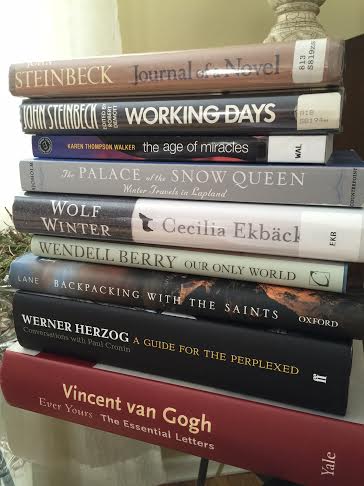
Stack of books


I’ve been out of town. A stack of books from the library and online were waiting when I got home.

The Steinbeck work journals for East of Eden and The Grapes of Wrath are recommended by Louise De Salvo in The Art of Slow Writing as essential if you’re writing a book-length work and want to learn about process.

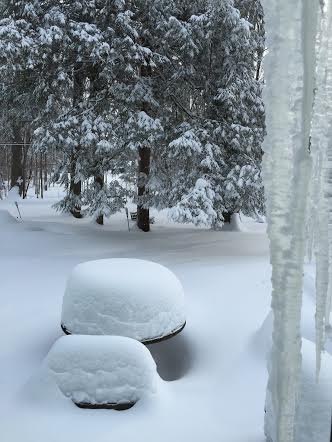
Deep snow in backyardThe Age of Miracles is this year’s selection for “If All of Rochester Read the Same Book.” We love to read through the deep winters in our part of the world, and this novel of catastrophe and survival will be on many a nightstand here. Why not try it along with us – I’ll be writing about this debut novel by Karen Thompson Walker soon.

The Palace of the Snow Queen: Winter Travels in Lapland, a memoir, and Wolf Winter, a novel. I want to know more about my Scandinavian roots; biography, memoir, and fiction are a great way to explore ancestry and heritage.

Wendell Berry’s Our Only World (ten essays), because Berry is one of our greatest prophets, writing about the clash between humanity and nature and how we must do better. He’s been called a modern-day Emerson or Thoreau.

Backpacking with the Saints, a travel narrative and spiritual memoir. Belden C. Lane’s take on Celtic, Catholic, Protestant, Buddhist, Hindu and Sufi Muslim writings as he treks the Ozarks and the American Southwest. The book jacket compares him to other lovers of the backcountry, including John Muir and Cheryl Strayed, whose memoir, Wild, was just released as a movie.

Werner Herzog: A Guide for the Perplexed, is an overdue Christmas gift for my photographer son. This newly published series of interviews with the filmmaker is so popular it’s been out of stock. I hope he finds it worth the wait.

No one writes about creating art with as much love and eloquence as Vincent Van Gogh.

More about these in upcoming posts at Books Can Save a Life.


The Bone Clocks

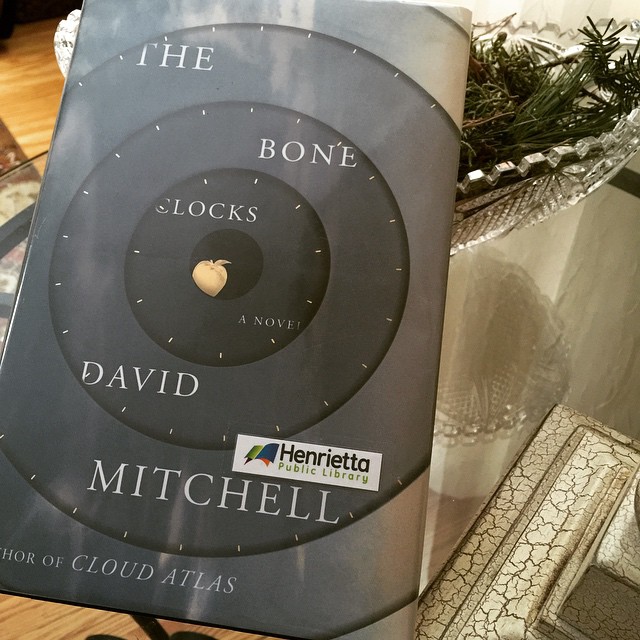
The Bone Clocks book cover


“It’s grief for the regions we deadlanded, the ice caps we melted, the Gulf Stream we redirected, the rivers we drained, the coasts we flooded, the lakes we choked with crap, the seas we killed, the species we drove to extinction, the pollinators we wiped out, the oil we squandered, the drugs we rendered impotent, the comforting liars we voted into office–all so we didn’t have to change our cozy lifestyles. People talk about the Endarkenment like our ancestors talked about the Black Death, as if it’s an act of God. But we summoned it, with every tank of oil we burned our way through. My generation were diners stuffing ourselves senseless at the Restaurant of the Earth’s Riches knowing–while denying–that we’d be doing a runner and leaving our grandchildren a tab that can never be paid.”   The Bone Clocks, David Mitchell

I debated whether or not to write a post about The Bone Clocks by David Mitchell. At least twice, I wasn’t even sure I wanted to finish reading it, but I’d already invested several hours in the book, so I kept on when the going got tough. In the end, I’m glad I finished The Bone Clocks. I think it’s worth writing about here, even though I don’t pretend to grasp its full meaning.

I’d picked up The Bone Clocks in the first place because it’s been called a genre-bending novel by a writer who’s reinventing fiction, so I wanted to find out what David Mitchell and his work is all about. It’s nearly impossible to summarize the plot of The Bone Clocks, which blends literary fiction with fantasy (not a genre I’m attracted to) and dystopian literature. There are six linked novella-type sections that take place in 1984, 1991, 2004, 2015, 2025, and 2043 (with flashbacks to medieval and other times) in settings as diverse as Ireland, New York, Iraq, England, Switzerland, Australia, and Iceland.

Among the half a dozen or so featured characters, apparently a couple of them have appeared in Mitchell’s past novels, including Cloud Atlas, none of which I’ve read. Holly Sykes is the highly appealing central character, and she is largely what kept me going when I wanted to stop, although I found many of the other characters arresting as well.

The fantasy thread features Horologists, a select group of immortal people battling the evil Anchorites, who suck the souls from people to stay alive. “A Horologist’s Labyrinth” is the section of the novel fully devoted to the final battle between the Horologists and the Anchorites–by far the most irritating part of the book, for me. I don’t like fantasy to begin with, and this section seemed to be poorly written, especially considering the brilliance of the rest of the book, although one critic pointed out we’re not to view it as serious fantasy, but rather a tongue-in-cheek portrayal.

I’m not even sure I understand why the fantasy element is present, though I know Mitchell sees it as central to his theme. The bone clocks are mortal and often foolish humans who inevitably age, decline, and die; they are contrasted with the brilliant, wise and immortal Horologists. I refer you to critics and reviewers in the mainstream publications who do a much better job of “figuring out” The Bone Clocks, especially if you’re interested in finding out more about the fantasy elements. Much of this aspect of the novel is simply over my head.

I’m not familiar with British and Irish slang from the 1980s, and so getting started was difficult–the first section depicts Holly as a runaway teenager from a working class English town. Despite all these difficulties, the The Bone Clocks marathon has a tremendous momentum, and for long sections I was riveted. Here, I want to focus on the dystopian final section of the book.

What an incredible life journey Holly Sykes has, but its end is devastating. Mitchell’s version of dystopia, while not especially original or inventive, is nonetheless disturbing. It is the time of the Endarkenment. Humanity is on its last legs. Holly knows one big storm is all it will take to finish off her rural Irish village. She’s living in poverty, with little food, minimal electricity and no internet, in a world ruled by the Chinese and a society that has all but disintegrated.

I read The Bone Clocks during a long, record-breaking deep freeze. Boston, where life seems to have stopped, is in dire straits: snow removal costs have gone over budget by millions, people can’t get to work, schools are closed, businesses are suffering, and the subway system is all but shut down.

We live in a country where many people do not believe in climate change or evolution or vaccines.

My Ohio hometown is a shadow of its former self, mired in poverty and crime. The governor boasts about balancing the state budget, but at the expense of towns starved for funds.

A member of my family is getting expensive medical treatment that, if not for insurance, would mean bankruptcy. And yet, many of our government leaders are determined to take affordable health insurance away from millions of poor and middle class families.

I went to a grocery store yesterday that had only two clerks at the check-out. At the dozen or so self-check-out stations, customers struggled with an automated system that doesn’t work. The store was crowded with people wanting to stock up during the bad weather but, according to the wonderful check-out clerk who helped me, the management would not call for extra help. God forbid this large grocery chain cut into its profits to gainfully employ a few more people or, at least, make sure the stores are adequately staffed.

Could we someday find ourselves in our own Endarkenment? Are we headed in that direction? In The Bone Clocks, when the Endarkenment came, it came fast.

The Bone Clocks isn’t an easy read. If you’re intrigued, if you like challenges, if you want a taste of cutting edge fiction by one of the world’s most highly acclaimed authors, then go for it.

Have you read The Bone Clocks? What do you think of dystopian fiction? Do you see parallels with our current state of affairs, or do you think that’s taking dystopian fiction too seriously?

By the way, you’ll notice a Henrietta Public Library sticker on the cover of The Bone Clocks in the photo above. I want to give a shout out to Henrietta Public Library, which is wonderful, and its dynamic director, Adrienne Furness, who was on the 2015 Caldecott Medal Selection Committee.

A Wolf Called Romeo

A Wolf Called Romeo book cover“It was one of those still days when you could hear snowdrifts collapsing in hisses, the sun so dazzling off the white-crusted ice that we seemed suspended on a cloud, bathed in light radiating from below. There we lay, three different species bound by a complex, often bitter history, taking simple comfort in the others’ presence, the sun’s warmth, and the passing of another winter.”   A Wolf Called Romeo, Nick Jans

This winter I wanted to be sure to write about a remarkable work of nonfiction that I read a few months ago, A Wolf Called Romeo by Nick Jans. A winter storm is moving in to our parts today, so it seemed a good opportunity to settle in and revisit this captivating story about a very unusual wolf who “courted” the town of Juneau, Alaska. Nick Jans has lived in Alaska for more than three decades and is a nature writer of the highest order. If you love wildlife, wolves, and dogs, you won’t want to miss this book, and you’ll likely want to read Jans’ other work as well.

No one has solved the mystery of why a black wolf wanted to make friends with Nick’s dogs and the dogs of the other townspeople who let their pets romp in the vast open spaces outside of Juneau. The black wolf was playful and unfailingly polite, chivalrous, almost courtly, which inspired Nick’s wife to call him Romeo. For half a dozen years or so, Romeo seemed to confine himself to an area of about seven square miles outside of Juneau, whereas wolves usually roam a territory of hundreds of square miles. Romeo spent long days with his domesticated companions, while keeping his distance from their human owners. He’d disappear for days at a time; at least once Romeo was spotted with a pack of wolves that passed through the area.

This got to be a complicated and controversial situation for the citizens of Juneau. Many of them grew to love Romeo and were fascinated by the rare opportunity to observe a wolf up close, while others felt wolves were to be hunted or should stay where they belonged, in the wild. Some worried Romeo might attack their pets. Rules had to be devised about how to behave around Romeo. For example, Romeo was not to be fed, so as to keep his hunting and survival skills sharp. People were advised to keep their distance from Romeo and avoid physical contact.

It’s hard to believe that at one time Nick Jans hunted and killed wolves, because he is so passionate about protecting Romeo. He recounts the history of his own relationship with wildlife, as well as the fraught relationship between humans and wolves as the American frontier was settled.

Nick observed Romeo closely for several years. He recorded his observations with the intention of writing this book which was ten years in the making. I found myself worrying along with Nick every time Romeo disappeared. For, of course, Romeo’s befriending of the town also left him vulnerable to aspects of civilization that are destructive to wildlife and nature.

This is an emotionally powerful read. Nick Jans reminds me of Barry Lopez, a nature writer I greatly admire. Here, though, Nick has made the story of the relationship between humans and the wild very personal. Romeo is fascinating and haunting, a loner caught between two worlds, not fully at home in either one of them. Thanks to Nick Jans, his story has touched those of us who may go a lifetime without seeing a wolf in the wild.

You can catch a glimpse of Romeo here.

Here is a wonderful site to find out about wolves, Wolf Song of Alaska.

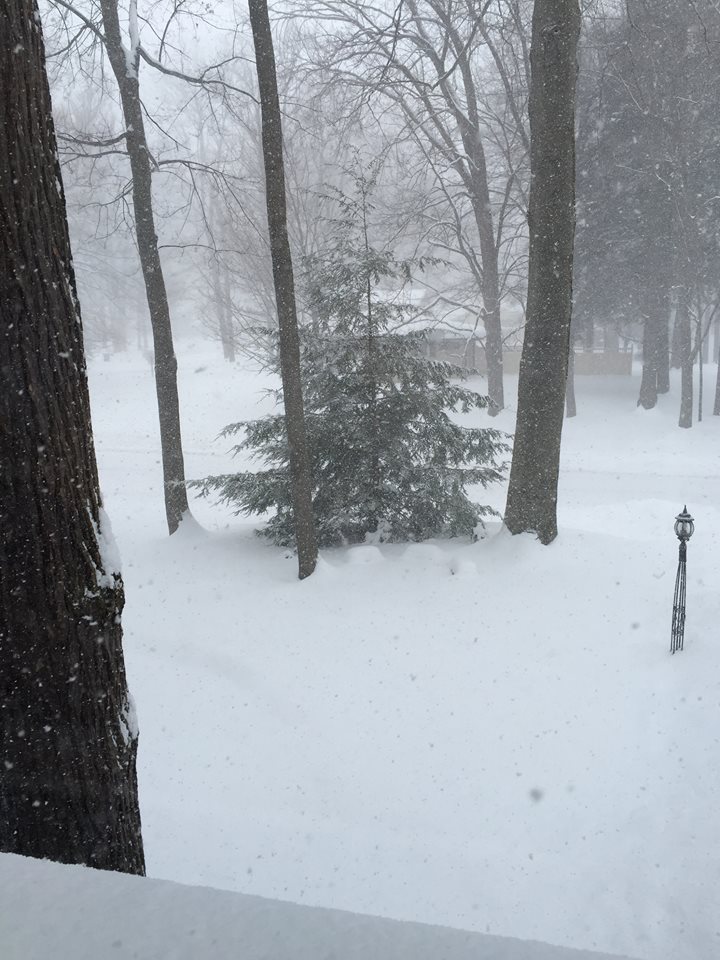
Norfolk pine in a snowstorm
A good day to read A Wolf Called Romeo


The Narrow Road to the Deep North

“On the bedside table by the living Buddha, now dead, was an old copy of Basho’s great travel journal The Narrow Road to the Deep North. Hashimoto opened it to a page marked with a dry blade of grass. Days and months are travellers of eternity, he read. So too the years that pass by.”   (Last book read before death by a WWII Japanese commander of the Thai-Burma Death Railway, in Richard Flanagan’s The Narrow Road to the Deep North)

The Narrow Road to the Deep North book coverRichard Flanagan’s father was one of nearly 3,000 Australian POWs who worked on what became known as the Thai-Burma Death Railway in World War II. Flanagan’s father survived. According to Wikipedia, estimates of the death toll are guesses: about 180,000 Asian civilians and 60,000 Allied POWs labored on the railway under inhuman conditions battling cholera, starvation, and beatings. Some 90,000 perished, including over 12,000 Allied POWs. Over 100 Japanese and Koreans were tried for war crimes, and 32 were sentenced to death.

I’m partial to WWII novels, but I don’t know much about the Pacific theater of the war, and next to nothing about the prisoners of war who worked on the Thai-Burma Railway. I’m so glad I read The Narrow Road to the Deep North and encountered Flanagan’s extraordinary writing, but do not attempt it unless you can stomach brutally explicit prose about hellish conditions.

An Australian surgeon, Dorrigo Evans, tries to save as many of the men under his command as he can, but his efforts are mostly futile. We see Dorrigo as a young boy in Tasmania, as a young soldier in an affair with his uncle’s wife who is the love of his life, as a prisoner of war, and as an older, successful, but deeply scarred surgeon and war hero.

There are several moving, intimate, stream-of-consciousness portrayals of other Australian POWs under Dorrigo’s command  as well. Especially riveting is a scene in which the Japanese commanders, cruel and relentless in their mission to get the railroad built, discuss the fine points of haiku. Flanagan follows these men after the war, too, those who managed to have others take the fall for their crimes, and their amazingly clear consciences after the war.

The Narrow Road to the Deep North won the Man Booker Prize and has received many excellent reviews. Michiko Kakutani of The New York Times  is more mixed in her review: she feels that Amy, Dorrigo’s lover, should have been excised from the book for the sake of unity and coherence; she describes Flanagan’s writing about the love affair as “treacly prose,” whereas I found many of these passages beautiful. I disagree with her assessment here.

Have you ever thoroughly loved a book or movie only to encounter a respected critic who points out how seriously deficient or flawed is the thing you absolutely love? At this link is an especially vicious review in the London Review of Books. Flanagan must have poured his heart and soul into writing about a terrible time that his father survived, and he spent years working on the novel. This negative review is not reasoned literary criticism that I value or trust, and I wonder what motivates the critic. Sometimes I think critics analyze so much creative work they become jaded, unable to approach a novel or movie in a fresh, unbiased way.

By the way, I don’t consider my blog posts to be book reviews or literary criticism. My intention is to write about how a book affects me, personally, or how I think it might affect you, the reader, or why it may be especially significant in some way. If I don’t feel a book is well written, or if it doesn’t speak to me in some strong way, I don’t write about it here.

I’ll leave you with a passage I especially love, about POWs newly home from the war:

“He brought the fish and chips to their table, then filled some small glass tumblers behind the counter with red wine and brought them out too. Then he sat with them. As they ate, he let them talk. When they flagged he talked of how such a winter meant it would be a good summer for apricots, yes….Then he started up about his own life….How people told him coming to his fish shop made them happy. He hoped that was true. I really do, he said. That’s a life….The old Greek made his own coffee for them – little cups, thick, black and sweet – and he gave them walnut pastries his daughter had made….The simple chairs felt easy, and the place, too, felt right, and the people felt good….”

The Narrow Road to the Deep North illustration


The Narrow Road to the Deep North book coverBasho’s The Narrow Road to the Deep North, written in the 17th century, is a classic work of haibun, which melds haiku with prose. It makes for excellent reading alongside Flanagan’s contemporary novel.

Have you ever encountered scathing criticism of writing that you love? How does it make you feel? Does it alter or influence your opinion of the work?


Digging Deep

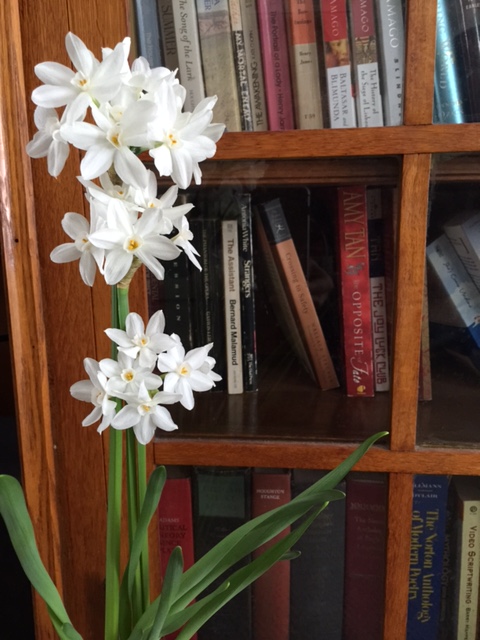
Narcissus, bookshelf
Taking this pic, I re-visited my long-ago college lit books on the bottom shelf: The Complete Pelican Shakespeare, The Norton Anthology of English Literature I and II, Victorian Poetry and Poetics, The Norton Anthology of Modern Poetry, Critical Theory Since Plato (oh, dear.) With many notes in the margins. Odd one out, a scriptwriting handbook. The “soil” of my literary leanings.


“I do believe that there’s something exquisitely powerful about taking something in nature and molding it with your own two hands. From the moment you dig up that first clump, you’re empowered because you immediately enter into collaboration with nature, and who better to be in collaboration with than the greatest force on earth?” Fran Sorin, Digging Deep


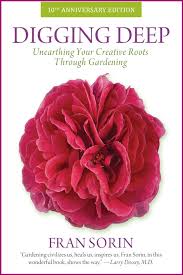
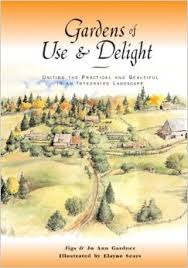
I have a delightful pairing to begin the new year: Digging Deep: Unearthing Your Creative Roots Through Gardening, the 10th anniversary edition by Fran Sorin; and Gardens of Use and Delight: Uniting the Practical and Beautiful in an Integrated Landscape, by Jigs and Jo Ann Gardnerpublished in 2002.

Digging Deep book coverYou don’t have to be a gardener to enjoy Fran’s book, though if you are, all the better. Fran says, “My  mission is to show new and experienced gardeners alike how they can use their gardens – be they rolling, manicured lawns or tiny, blank plots of land – as tools for their creative awakening. I believe from the depths of my heart that gardening can be one of the most profound ways to unearth the creative spirit buried within every one of us. Once you unleash this creative energy, you’ll be amazed at what happens in all areas of your life. You’ll begin to see how living creatively opens up new vistas in your imagination and new windows of opportunity in your life.”

I’m a new gardener, and gardening has become for me a pleasurable, relaxing complement to writing, perfect for getting my body moving outdoors in nature. As I write about growing up in a family flower shop, sowing and tending and reaping resurrect the fragrance of fresh blooms and damp soil, and many other sensory pleasures, from my childhood.

When I ran across Fran’s book online, I was intrigued with her melding of gardening and creativity. The first edition of Digging Deep was immensely popular, hence the 10th anniversary edition in 2014. I’m glad to have discovered it this time around. In addition to being a garden expert and deep ecologist, Fran is an ordained interfaith minister and a soul tending coach. I point this out because the deceptively simple Digging Deep is a profound and spiritual book that is part memoir, as Fran draws upon her own rich life experiences to tell the story of how she arrived at the wisdom she shares here.

I’ve found that to nurture a creative practice (mine is writing), it is good to have other creative outlets just for pleasure, quite different from your primary practice. These “low-stakes” pastimes give your mind and body a break from routine and stimulate your imagination by allowing you to play and experiment. This spirit of play permeates Fran’s book. Her chapters take you sequentially through the cyclical nature of gardening, and creativity: Imagining: The Spark of Creativity. Envisioning: Giving Shape to Your Dreams. Planning: Laying Down the Bones. Planting: Taking Action. Tending: The Act of Nurturing. Enjoying: Reaping What You Have Sown. Completing: Cycling Through the Season.

Here is a favorite passage from a section called “Appreciating”: “Savoring your garden brings more than just sensory pleasure, though – it fills your creative well. In the moments that you experience the reverie of simply being there without working or planning or doing anything other than just drinking it in, you can experience a heightened awareness that elevates your consciousness. Any expression of art, be it a Rembrandt or your own garden, reflects the best of humankind, and tapping into this wonder expands your creative capacity so you may in turn create even more art – more awareness, more inspiration, more aliveness. The cycle feeds itself, but only if you stop to smell those literal and proverbial roses.” (boldface is mine)

Fran includes some excellent gardening guidance and tips, but her book is not a gardening manual. Rather, her aim is impart a deeper wisdom, a kind of spiritual instruction about connection to soil and nature, to foster creative awakening.

Gardens of Use and Delight book coverJigs and Jo Ann Gardner’s Gardens of Use and Delight is about a remarkable couple who for thirty years taught themselves how to live off the land on a farm on remote, hardscrabble Cape Breton Island in Nova Scotia. (They now live on a smaller farm in upstate New York.) I wanted to pair it with Digging Deep because, although Jigs and Jo Ann are immensely practical people, they are deeply connected to their land and passionate about homesteading, which they portray as at once the functional task of reawakening fertility and abundance in the landscape and making it beautiful as well. The subtitle is Uniting the Practical and the Beautiful in an Integrated Landscape, and that is exactly what Jigs and Jo Ann did on their isolated farm, while also raising four children (and a few foster children for good measure.)

Gardens of Use and Delight, like Digging Deep, is part memoir. More of a how-to book than Fran’s, Gardens, for me, stands out because of Jigs and Jo Ann’s instinctively creative approach to seamlessly blending beauty and fertility as they rejuvenate and work their land. I will never rehabilitate an entire farm as they did, but in Jigs and Jo Ann’s book I find an approach to making my much smaller landscape both productive and beautiful. Jigs and Jo Ann remind me of Helen and Scott Nearing and their classic and influential The Good Life, although Helen and Scott were not concerned with aesthetics as are Jigs and Jo Ann. The Gardners view their land as an artist does a blank canvas, to be molded and planted with flowers, herbs, vegetables, fruits, shrubs, and trees.

You’ll find some recipes and homemade craft instructions, too, such as pressed flower cards, candied petals, herb salt, rose petal jelly, and skin freshener. Elayne Sears’ watercolor illustrations of the landscape, fruits, vegetables, flowers, and Jo Ann’s rustic farm kitchen and pantry are delightful – I’d love to have prints of them to hang in my kitchen.

I have read other titles by Jo Ann Gardner and hope to collect everything written by this talented, tenacious homesteading and gardening virtuoso.

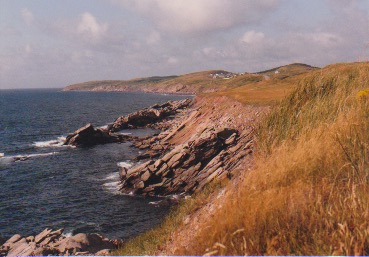
A very vintage photo of Cape Breton Island, from my honeymoon. Although I don't believe they were on the coast, Jigs and Jo Ann Snyder must have encountered land much like this when began to reclaim an old Nova Scotia farm.
A very vintage photo of Cape Breton Island, from my honeymoon. Although I don’t believe they were on the coast, Jigs and Jo Ann Gardner must have encountered land much like this when they began to reclaim an old Nova Scotia farm.


Slow Flowers Challenge

I wanted to also tell you about Debra Prinzing’s Slow Flower Challenge for 2015, which you can join at any time. Every day, once a week, once a month, or once a season, you can design and make a floral arrangement using slow flowers. If you don’t know what slow flowers are, click on the above link, or read my post about Debra’s book, Slow Flowers. (St. Lynn’s Press)

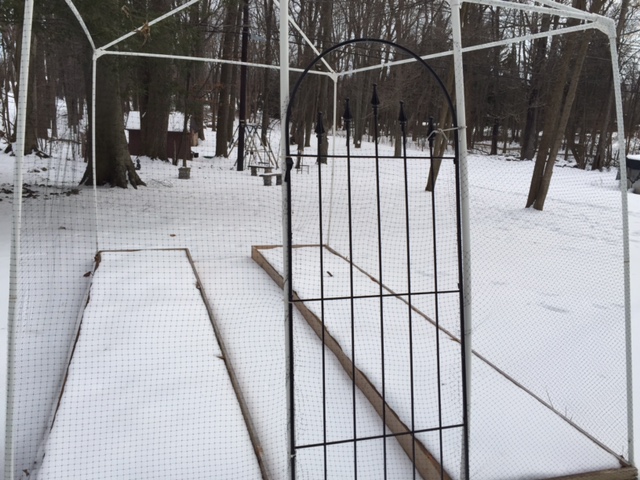
Raised beds covered with snow
Our blank slate


 Next up

More WW II fiction, a travel-to-the-ends-of-the-earth memoir, a wolf, Scandinavian literature, Little Golden Books, a favorite author visits Rome. Etc. Etc.