Arcadia, an American commune

I was so embarrassed and desperate to fit in. I didn’t tell anyone about the commune.   Rena Mundo Croshere, in the trailer for the documentary, American Commune

Arcadia book coverI’ve been reading Arcadia by Lauren Groff, a novel about a boy named Bit who grows up on a commune in western New York. The fictional story was inspired by The Farm, an intentional community in Tennessee that grew to become the largest commune in America in the 1970s. When I was describing Arcadia to a friend, she mentioned a documentary-in-the-making about The Farm produced by two sisters, Rena Mundo Croshere and Nadine Mundo, who were raised there.

I looked at the trailer, which is tantalizing. I’m looking forward to watching the full documentary, which is slated for release this year. I was especially taken with a moment when Rena Mundo Croshere describes abruptly leaving The Farm after over-population and a police raid caused a mass exodus of families. After a shot of flower children singing on the commune, you see a VW bus driving along a highway, then a TV ad for Barbie make-up, followed by a teenage Rena in her bedroom, with her voice-over saying she wanted to fit in so badly, she didn’t tell anyone about the commune. Moving off The Farm, with its lifestyle built on a vow of poverty, to Los Angeles and mainstream, materialistic America was, she says, like moving to another country.

This notion of hiding one’s true self and background resonates with me because I did something similar by not telling anyone about my mother’s mental illness when I was growing up. I can identify with this leading of a double life, of presenting one face to the public while hiding one’s true self and world of origin. For the same reason, I was drawn to the novel Arcadia, at once curious about what life was like inside a 1970s commune and about how the teenager, Bit, would adjust to living in urban New York after 14 years on a commune. Bit had never once seen the outside world – had never traveled to the “big cities” of Syracuse or Rochester, had never seen bathrooms as we know them with toilets and conventional indoor plumbing, had never been inside a grocery store or to public school.

Groff doesn’t glamorize the communal life but, in her view, completely abandoning the hippie cultural experiment isn’t the answer, either. I had thought Groff’s climax and conclusion would center on Bit’s adjustment to vastly different cultures, but she doesn’t end it there. She takes us into the future, to the year 2018 or so – a world of pandemics, climate change, and food shortages – implying that we need to take another look at these utopian social experiments that were, in many ways, ahead of their time.

In an interview included in the paperback edition of Arcadia, author Lauren Groff says, “In my research, I saw many 1960s counterculture idealists become, over time, obsessed with things like Peak Oil and gold and how to live off-grid, a kind of palpable belief that society is at the brink of failure. They’re not wrong. It’s hard to raise a child these days and not fear doom. This book was my argument with myself for hope.”

More about Arcadia to come in my next post.

Book Giveaway Winner

Lynne Favreau has won my Books Can Save a Life 1st anniversary book giveaway! You can catch her very funny blog here.

Quote by Lauren Groff from “A Conversation with Lauren Groff” in Arcadia, Lauren Groff, Hyperion, New York: 2012.

Quote by Rena Mundo Croshere in the trailer, American Commune, Mundo Films.

Children of mental illness, part 2

“…so we just took her home to wait for a bed in the good hospital, which was going to take a few days, according to him [the psychiatrist]. He said to keep a watch on her, remove all the knives, put sheets over the mirrors so she can’t see herself, because that would set her off. And of course, make sure she doesn’t kill herself, or anybody else.”  June, from Daughters of Madness, when she and her sister (ages 13 and 15) sought treatment for their mother in the 1980s.

Daughters of Madness book coverI’ve been reading Growing Up With a Schizophrenic Mother by Margaret J. Brown and Doris Parker Roberts, and Daughters of Madness by Susan Nathiel. After my last post, Children of Mental Illness, I was thrilled to hear from author Susan Nathiel. Susan tells me she will publish Sons of Madness this August.  There are fewer interviews in her forthcoming book than in Daughters of Madness because male volunteers were harder to find. Susan says, however, that the interviews included in her new book are excellent.  I’m glad to hear about this new publication, because there still isn’t a lot written about the experience of growing up with a seriously mentally ill parent.

When I was coming of age in the 1960s and 1970s, I thought I was the only daughter in the world who had a mother with schizophrenia. Many of the individuals interviewed in these books are baby boomers like me. Some of us had encounters with mental health professionals who were compassionate and helpful, but more often they were uninterested in helping children and teens with a mentally ill parent, unaware of their needs, or not permitted to help by the mentally ill parent or another adult family member.

Back then, there was no NAMI (National Alliance on Mental Illness). There were no support groups for families of the mentally ill, little in the way of books or educational materials about mental illness, and no Internet where you could plug in a keyword such as “schizophrenia” and retrieve information. Sometimes, I think that dearth of information and the fact that mental illness was kept secret by all concerned were the reasons I went into communications and later medical librarianship. I wanted a voice that could be heard, and I wanted to give people the vital health information they needed and deserved.

Thankfully, things have changed, though I don’t think they’ve changed enough. There are excellent mental health family services at the medical center where I work, and we librarians at the medical library often give information and educational materials to patients. One of our librarians specializes in providing mental health information to patients and families. But mental health care in our country still needs fixing; unfortunately, too many patients and families don’t get the services they need.

When I was a teenager, it didn’t occur to my mother’s mental health care providers that I might need to know her diagnosis. Now, when I give a patient or a family member health information, I feel I’m doing a little bit to validate their experiences and make their lives better. But I’m also making up for what I never got until quite late in the game. I’m saying to patients and their families: You matter. You need to know. You deserve the best information we can give you.

Book Giveaway

In celebration of my first anniversary as a blogger, I’m giving away a book to one lucky person who leaves a comment on any of my posts here at Books Can Save a Life in February. There are still a few days left to join the conversation and add your name to the drawing, so please do!

Quote from: Daughters of Madness: Growing Up and Older With a Mentally Ill Mother, Susan Nathiel. Praeger, Westport, Connecticut: 2007.

Children of mental illness, part 1

….what a courageous little girl she was…she kept me alive. I feel such pride in her…

These are the words of the daughter of a mother with serious mental illness looking back on her childhood in Growing Up With a Schizophrenic Mother, by Margaret J. Brown and Doris Parker Roberts.

Growiong Up With a Schizophrenic Mother book coverI never thought about it quite this way before, but I’m a member of a select group: adult children of a mother with schizophrenia.

There are more people who have a mother with schizophrenia than you might think –  millions, in fact – because often schizophrenia doesn’t manifest until after a woman has children.

But most of us believe we’re the only ones. No one else could possibly have had the bizarre, surreal childhoods we had. We believe this because we grew up in layers of isolation, self-imposed by ourselves and our families due to embarrassment, shame, and the illness itself, and imposed from the outside by others: extended family, our communities, and society.

We were rarely asked about what was going on with us and our families, though in most cases it was obvious there was something wrong. People didn’t want to hear about mental illness because it scared them and made them uncomfortable. If we did try to confide in someone, which was rare, we were explicitly told not to talk about it or made to feel the topic was inappropriate. Often, the mentally ill parent wanted nothing to do with others and drove everyone away.

I grew up in the 1950s, 60s, and 70s, when the stigma and silence surrounding mental illness were even more profound than it is today. Many of the adult children in the two books I’ve been reading are of my generation.

Growing Up With a Schizophrenic Mother, by Margaret J. Brown and Doris Parker Roberts (2000), and Daughters of Madness: Growing Up and Older with a Mentally Ill Mother by Susan Nathiel (2007), contain excerpts from in-depth interviews with women and men who grew up with a seriously mentally ill mother. At the time they were researching their book, authors Brown and Roberts found little about the effects of mentally ill parents on children in the psychiatric literature, though that is changing. Margaret Brown and Susan Nathiel grew up with mothers who suffered from schizophrenia and, like many with similar backgrounds, both became therapists. Nathiel and her father weathered decades of her mother’s schizophrenia but never once spoke about it with each other until Nathiel was in her fifties.

The authors concede these books may be skewed because they are the stories of high-functioning survivors, many who now have loving, stable families and successful careers as accountants, therapists, lawyers, and sales people. Those not so resilient are less likely to volunteer to speak about their pasts. Yet despite the measure of success achieved by the adult children in these books, in many cases the stories they tell can only be described as horror stories. The adult children themselves have an unshakeable, lifelong sense of loss and loneliness, and some do not even have a solid sense of their own selves.

One little girl, Naomi, learned to follow other children to school when she and her mother moved to a new neighborhood, as they often did, and enroll herself because there was no one else to do it. Other children learned how to cash welfare checks, go to the grocery store for food, and negotiate with landlords.

In the very worst of these stories, seriously mentally ill mothers tried to kill their children (by poisoning, turning on gas stove burners, parking on railroad tracks). Yet, in all of these instances, the children remained in the care of their mothers.

These extreme cases are rare, and it’s important to remember this was the mental illness speaking and not the true volition of the mentally ill mothers themselves.

Often, the parents divorced and the children lived alone with their ill mothers. In some cases, fathers tried to gain custody, but in decades past it was customary for mothers to have custody. In other cases, the fathers had serious psychological issues of their own or they chose to have little or no contact with the family.

I was fortunate for a number of reasons: my parents stayed together, we were stable financially, and my mother was relatively high-functioning. Though she could be hostile, frightening, and unpredictable (my siblings and I were routinely left alone with her), she was never violent in the way some of the mentally ill mothers described here were, and there was no physical abuse.

It was clear to extended family, friends, and neighbors that something was wrong with my mother, and if you were on the outside looking in I don’t see how you could be certain she wasn’t dangerous. (I found out years later my father discussed with his parents the possibility of us living with them.) Our family doctor, our minister, my aunts and uncles knew, but no one said anything to me about it.  As an older teenager, I turned to my aunt for some help, but throughout my childhood and adolescence I remember only two adults who initiated conversations about my mother: my piano teacher and my grandmother.daughtersofmadness

When I was ten or eleven, my teacher asked me if everything was alright at home. I was too embarrassed and too fearful of the consequences to confide in her, so I said everything was fine, though I know she didn’t believe me.

I had always considered my maternal grandmother to be my best friend. We were very close, and sometimes she’d spend the night, which I loved. But one night when she was visiting, my mother had a severe psychotic episode. My grandmother was so frightened and upset she called a friend to come and get her. “I’m not staying another minute in this house,” she said. My father wasn’t home. It was past midnight when I stood at the living room window and watched my grandmother drive away.

When I next saw my grandmother, she said, “I spoke with my doctor, and he said your mother could do harm to you kids.”

I didn’t know what I was supposed to do with that information; I was twelve.

When I was 19, I began to try and find help for my mother. (She had never seen a psychiatrist. There was nothing wrong with her, it was the world that was crazy.) I made an appointment with a social worker at the hospital nearby, which had a new psychiatric wing. It was my first encounter with the mental health system and, for the life of me, I can’t fathom why the social worker seemed irritated I had even made the appointment in the first place. She asked me several times if my mother was going through menopause. I didn’t know much about menopause, but I thought my mother’s behavior was awfully extreme for menopause. Finally, based on the cursory information I told her, the social worker told me not to do anything, because nothing could help my mother.

Ultimately, my mother was hospitalized for a time (that is another story), but no one else in our family was assessed or given counseling. In fact, I wasn’t told my mother’s diagnosis, and I felt I didn’t have the right to ask. I believe the mental health community was of little help to our family, and it failed my mother, too, in crucial ways.

A couple of years later when I was living in New York, I saw a therapist who urged me to talk with my mother’s psychiatrist about her diagnosis. After some badgering, the very reluctant Dr. M –  who said my mother had a right to privacy and confidentiality –  finally granted me an appointment. I’m not exaggerating when I say he looked like Freud himself. Dr. M was intimidating and formal, without an ounce of warmth or ease. He finally begrudged me my mother’s diagnosis. As far as he could tell, he said, she had paranoid schizophrenia.

This was in 1975. Today there are many compassionate and devoted mental health professionals, and there isn’t as much silence about mental illness as there used to be, but we have a long way to go. The mental health system is far from what it should be, and public stigma and denial are still pervasive. I’m sure there are children with seriously mentally ill parents living in situations similar to those I’ve described.

The problem of mental illness can’t be borne and solved by the families alone. They need our help.

Quote from Growing Up With a Schizophrenic Mother, by Margaret J. Brown and Doris Parker Roberts. McFarland & Company, Inc. Jefferson, N.C. 2000

First anniversary book giveaway

What one loves in childhood stays in the heart forever.   Mary Jo Putney

Snow-covered trees
After the storm.


Books Can Save a Life is a year old this month.

I’ve grown so fond of it here and of you who visit and comment. Meeting people from all over and re-connecting with friends and distant family  –  I never expected that.

Not to mention the beautifully conceived and produced blogs about books, writing, food, nature, gardening, travel, creativity, and other topics I’ve discovered, and the artistic geniuses behind them.

Books Can Save a Life is a lot like my backyard retreat, where I sit by our homemade pond after I walk or run. I always look forward to visiting Books to set down my thoughts and see who has stopped by.

To celebrate a year of Books, I’m having a book giveaway. By the end of February, leave a comment about a book you’re reading. a book you want to read, a book that’s becoming a movie, a book memory, or anything at all to do with reading, and I’ll put your name in a hat. (Actually, I use a rice bowl.) If I draw your name I’ll send you the book of your choice. If you can’t decide on a book, I’ll surprise you.

You might have noticed I’ve redecorated, too. I’ve chosen a new design theme in honor of the coming year and to signify a more expansive focus on topics beyond books. There’s so much I want to write about.

But you’ll still find plenty of books here.

Your comments and guest posts are what I absolutely love about this blog. Many of you spoke of books from your childhood that years later still evoke memories of family and loved ones, places you’ve been, and particular times in your lives. I think sometimes the very story or book we need comes along, or  somehow we’re led to find it.

Here are a a few comments from readers of Books this past year. Please keep them coming.

I can’t imagine my room without my personal bookcase, or a world without books. (Giuseppe)

It’s hard to put yourself in their places [The Hunger Games], living their lives and going through what they do daily in their “world,” but that’s what’s so great about books, they take you to different places and times through the amazing imagination of the authors. (Diana)

I find many so called adult novels pretentious. I want a story. I return, often, to what is classified as young adult literature, mostly because these are stories of life. Stories – in the true sense of the word. And, I can’t help but say that, years ago, I was saying to people, “Have you read the Harry Potter book?” And everyone said no. Then came that glorious day on the L in Chicago, traveling home from work, and I saw not one, not two, but six adults reading the book. I wanted to laugh out loud at the thought of those six people entering into another world…. (Donna)

Agatha Christie wrote a story without heroes; to me, that was heroic honesty.  Conversely, the inevitability of justice satisfied me. For all my contempt for two-faced authority, I still relished the idea of wrongdoers punished by divine oversight.  My sense of my own weakness as a child needed that reassurance. (Doug)

Cooking from Moosewood, even with its imperfections, was utopian. Funny how small, utopian practices can make you feel, despite the deepest contradictions, that summer is everlasting and life is good. (Judith)

….even the smallest person can step away from comfort and into challenge, that change is possible on scales small and large, that our efforts and intentions matter. The story reinforced for me that there are things in this world worth protecting–fellowship and love, food and conversation, adventure and courage, songs and stories. These are the things that sustain us when life is difficult, when we are hurt or afraid and have to be so much braver than we feel. (Adrienne)

Snow-covered bench

A WWII era classic American cookbook

canned goods

After my post about family cookbooks passed down through the generations, reader Deborah Brasket left a detailed comment I’ve highlighted in this guest post.

I like what Deborah has to say about one of her favorite cookbooks, published during World War II, because that was my parents’ era. Whenever I hear about Victory Gardens and rationing, I remember my mother telling me about how you couldn’t buy silk stockings back then, and how she and her siblings had to take turns tending the kitchen garden, and how there were no boys to go out with because they were all fighting overseas.

I think about my father in the Army in Europe, 1943. He missed his mother’s Italian cooking, and one cold November day while exploring Luxembourg he happened upon a tavern where there was an Italian wedding celebration. The family welcomed him with open arms and invited him to dinner the following day. It was my father’s last good meal before he was wounded at Cherbourg a few days later. He ate Army hospital rations for over a year while he recuperated.

Discovering book gems from the past is a pleasure quite different from cracking open a brand new book. I’m looking forward to tracking down a copy of Deborah’s family treasure.

Here’s what she had to say:

One of my favorite cookbooks was passed down to me from my mother: The Lily Wallace New American Cook Book, published in 1941. What I love about it is how it shows a whole different era of cooking “basics”. It has recipes for cooking frogs legs (3 recipes), grouse (3), rabbit (4), squirrel (2), turtle (2), snail (alas, 1) as well as other kinds of game (quail, partridge, venison, woodchuck, and pheasant.) It also has sections on preserving food, including canning, brining, and pickling.

My favorites are sections on: Ration Cooking, Saving Food for Victory, Saving Fuel, and Sugar Ration Cooking. The “Saving Food and Expense for Victory” chapter starts out:

“America may march to victory on its stomach. A nation’s morale and health depend greatly upon food. If the homemaker can do nothing else, she can wage an earnest battle for health and strength for her family in the kitchen, and thus contribute her share to ultimate victory on the military front.”

Another chapter I love is on menu planning, which includes sections on a Plan for a Liberal Diet ($3000 or over income) down to A Plan for a Restricted Diet for Emergency Use ($1000 or less annual income  – this one restricts meats mostly–Thursday’s dinner consists of whole-wheat chowder with carrots and potatoes, and bread; Saturday’s dinner consists of Hominy soup, stewed prunes, bread and butter. Yum.)

Deborah has sailed around the world, and she blogs about her journey, and nature, and writing at her beautiful site, Living at the Edge of the Wild. She writes fiction, essays, articles, poems and book reviews. You can read her work at http://www.djbrasket.com/.

Please tell us about your favorite family cookbook in the comments, or share a family cookbook story with us – send me an email at valoriegracehallinan@gmail.com.

Next up: I’ll be celebrating the first-year anniversary of Books Can Save a Life with an “open house” and a book giveaway.

Photo: Library of Congress

Bestsellers Tell What Possesses Us – Telegraph Avenue

This past fall and early winter there was a perfect storm of top authors publishing new books. I wanted to read a handful of them to see what possesses some of our best creative minds and our popular culture. I wanted to break out of old habits and venture to new places I wouldn’t normally find on my own.

I didn’t get to as many books as I’d planned, but I did read:

  • Flight Behavior, by Barbara Kingsolver
  • San Miguel, by T.C. Boyle
  • This Is How You Lose Her; and a previously published book, The Brief Wondrous Life of Oscar Wao, by Junot Diaz
  • Telegraph Avenue, by Michael Chabon
  • Sweet Tooth, by Ian McEwan

Most difficult of all was acclimating to the world of Telegraph Avenue. I almost gave up on it. I couldn’t keep Chabon’s characters straight, I was clueless about the endless blaxploitation and 1970s cultural allusions, even though that was my coming-of-age time, and I sometimes struggled with the rich, complex (and masterful) prose. The great librarian Nancy Pearl has a Rule of 50: Stop reading after 50 pages if you don’t like the book, and if you’re over 50 you can subtract your age from 100 and stop there. So I was well within my rights to stop before 50 pages, but I kept going with Telegraph Avenue, and it was worth it.

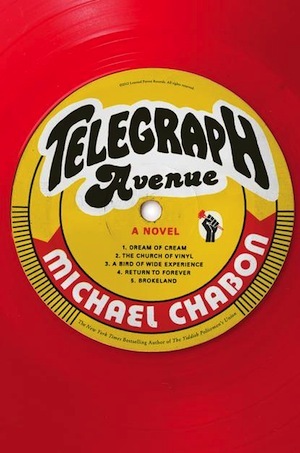
Telegraph Avenue book coverTo me, Telegraph Avenue and Junot Diaz’s books are similar in that I entered completely unfamiliar hearts, minds, and worlds. I’m unlikely to stop by a used record store in Oakland, California any time soon, or meet the kinds of characters (and I mean that in more than one sense of the word) who might hang out there.  In Telegraph Avenue, Archy (who is black) and Nat (who is white) are best friends, vinyl record shop business partners, and musicians struggling to make a living in a neighborhood that’s seen better days.

For one reason or another – race, ethnicity, gender, sexual orientation, changing times – the characters in Telegraph Avenue are outsiders or has-beens or both: former blaxploitation and martial arts stars, connoiseurs of soul and jazz and long-forgotten record albums, fine musicians in their own right. Many are regulars at Archy and Nat’s Brokeland Records, which reminded me of the bar in the TV show “Cheers.” I grew to like and care about these characters in large part because of their passion for music and devotion to their art. My godfather was a jazz pianist, and I dated a jazz musician. I remember how both lived and breathed jazz, in the same way Archy, Nat, and others do in Telegraph Avenue. Music shaped their lives, and when they were playing a gig, they had an aura of dignity and charisma others envied.

Yet, both my godfather and the musician I dated played the kind of jazz that was seen by many as antiquated in the 1960s and 70s when music was reinventing itself. There is the same sense of this passing away of art forms in Telegraph Avenue, and of people being rushed headlong into the future while trying to preserve what shouldn’t be lost.

If you’ve read Telegraph Avenue, what did you think? Please comment!

I’d like to give equal time to new, lesser known, and independent authors, so I plan in the coming months to read a sampling of fiction by some of these writers. If you have a book to suggest please do in the comments.

Peter Lake’s New Year

Contradictions, paradoxes, and strong waves of feeling were things that Peter Lake had long before learned to call his own, so he was not surprised to be surprised by the gentleness of Mouquin’s usually boisterous New Year’s Eve….it had been the same when the century had turned, when the celebrants had been unable to celebrate and could only stand in awe of history as it moved its massive weight…like the vault door of a central bank….despite a thousand bottles of champagne and a hundred years of anticipation, Mouquin’s had been as quiet as a church on the Fourth of July. Women had wept, and men had found it hard to hold back the tears. As the clockwork of the millennia moved a notch in front of their eyes, it had taken their thoughts from small things and reminded them of how vulnerable they were to time.     Winter’s Tale, by Mark Helprin

A friend reads this passage every New Year’s Eve.

Sometimes I think I moved upstate from New York City because I was looking for Lake of the Coheeries.

Winter deer
New Year visitors

Quote from Winter’s Tale, Mark Helprin, Harcourt Brace Jovanovich, New York: 1983.

Christmas comfort

For the first course of my Christmas dinner, there must be something hot and inspiring – a cup of what is to me quite the most marvelous and stimulating of soups ever created, a deep carnelian-clear and concentrated fish consommè, an essence of Mediterranean fish and shellfish made aromatic with leeks and tomatoes, fennel stalks, lemon peel, olive oil and white wine.  Elizabeth David, in Elizabeth David’s Christmas

Friday was the winter solstice, a typically cold, gray day in upstate New York. This year, barren of snow and darker than usual in spirit.

The 50-bell carillon in the Rush Rhees Library tower at the University of Rochester rang 26 times, followed by melodies children love: “Mr. Rogers Theme,” “It’s a Small World,” and others. In the medical center chapel that afternoon, we lit candles to brighten the longest night and welcome the lengthening days.

Giant evergreen treesSnow fell that evening. The next morning, in the woodsy part of our backyard, I saw two young white-tailed deer hopping nimbly over a fallen tree.

We need comfort food more than ever this year. On Christmas Eve, I’ll make a feast of four fishes, not quite keeping up with the feast of seven fishes traditionally prepared in seaside Mediterranean villages. Seven for the seven sacraments of the Catholic Church. As for what kinds of fish you’d find on the Christmas Eve table in villages of old, I imagine whatever the fishermen caught that day.

When we travel to Sicily we stay in Scopello, a small village by the sea. We hear the fishing boats heading out before sunrise. Later, we go to the market and look over the fresh catch. One day, on a trip several years ago, our boys were thrilled to see a magnificent six-foot swordfish on display.

This year, I thumbed through an old paperback cookbook my Sicilian father often consulted, The Art of Italian Cooking by Maria Lo Pinto, to plan our holiday menu. The pages are yellow and I’ve lost the back cover of this edition, which was the 40th printing. First published by Doubleday in 1948, the cookbook was picked up by Bantam in 1955. The Art of Italian Cooking cover

The Christmases of my life seem to fall into distinct phases. Do yours? The holidays of my childhood and adolescence I spent in my family’s floral shop surrounded by poinsettias, piles of fragrant evergreen boughs, and fresh flowers by the dozens.

Then came Christmases in New York. I remember the paper bags filled with warm chestnuts I bought from street vendors, the Salvation Army bells ringing along Fifth Avenue, and the department store window displays: Lord & Taylor, Saks Fifth Avenue, B. Altman, Macy’s. I’d buy a small Christmas tree and bring it home by taxi to my third floor walk-up.

On to upstate New York, and Christmases with my husband and two boys. Decorating the tree, watching the children dressed as angels and sheep in the Christmas pageant, waiting for Santa, leaving cookies and milk for him by the fireplace and a little something for the reindeer. One Christmas morning, the boys discovered a fresh hoof print pressed into the small bowl of oats.

Now, we wait for two young men to come home for the holidays. We have a wonderful time, and the holidays are over way too soon.

If you’d like, leave a Christmas memory in the comments below.

Quote from Elizabeth David’s Christmas, edited by Jill Norman. David R. Godine, Boston: 2008.

Evergreen photo by M. Hallinan

The most important thing

Prayer wheel

For three days I’ve been thinking about the families of the children who died in Newtown, Connecticut.

I’ve been thinking about what it’s like to be a parent.

Our first child was born prematurely on a bright, crisp autumn day. One minute I was lying in bed planning how I’d spend my Sunday, the next my husband and I were racing to the hospital. Our wee one seemed determined to make his appearance on planet earth right then and there on Interstate 90.

A few hours later – after a very short labor – we had a son.

I looked at him sleeping on his tummy in his isolette in the NICU. A scrunched-up bundle in a baby blanket with his little bottom in the air and a head of black Irish/Sicilian hair. Suddenly I knew I would sacrifice anything, even my life, for this new little person. It was like when you look at someone you’ve seen before and realize you’re in love – except it was much, much more than that.  For a moment my ego dissolved. I was no longer the center of my own little universe.

Book cover, Some Assembly Required
As displayed in Queen Anne Books, Seattle

A few years later, when I read Anne Lamott’s words in Operating Instructions, I thought: she has it exactly right. Last week, I came across the same passage again on one of my favorite blogs, and I planned to share the post and add my thoughts. Then Friday happened and Lamott’s words took on a greater urgency for me as I shopped at the market for Christmas cookies and decorations.

Before I got pregnant with Sam, I felt there wasn’t anything that could happen that would utterly destroy me. . . . Now there is something that could happen that I could not survive: I could lose Sam. I look down into his staggeringly lovely little face, and I can hardly breathe sometimes. He is all I have ever wanted, and my heart is so huge with love that I feel like it is about to go off. At the same time, I feel that he has completely ruined my life, because I didn’t used to care all that much.

I think that moments of great joy and great tragedy shock us out of the ordinary and awaken within us a singular intensity of compassion, good will, and love. The boundaries between us and them, between the self and the other, fall away, if only temporarily.

There will be plenty of time later to ask why and bicker and debate the meaning of Newtown and what can be done to stop it from happening again.

The most important thing now is to ride the great wave of love and compassion this tragedy has released into the world – for as long as it lasts –  and take care of our children, 27 heartbroken families, and each other.

Quote: Operating Instructions: A Journal of My Son’s First Year, Anne Lamott. Fawcett Columbine, New York: 1993.

Family cookbooks that become heirlooms

I asked my brother, John, to contribute to my series on favorite family cookbooks. I’ve tasted some of the recipes from the cookbook below, prepared by John. Fabulous, unpretentious Sicilian cooking, the kind we grew up with.
The Sicilian Gentleman's Cookbook book coverI often consult The Sicilian Gentleman’s Cookbook [by Don Baratta] when I want to do some Sicilian cooking. I think cooking becomes very personal, because we all have different tastes. I remember my dad describing different ways to make tomato sauce.  His mom, my grandmother, liked to make simple sauce. You cook down the tomatoes, add spices and, of course, garlic and onion, and you’re done….simple. But my grandfather had to have his sauce strained. Absolutely forbidden to have seeds and skin involved.
To me, The Sicilian Gentleman’s Cookbook is simple cooking. Just the way I imagine peasants cooked in Sicily, because they didn’t have much. They made do with what was available. I usually pull down the book for a quick idea and I go with what we have. Simple. I suggest the artichoke hearts with pasta, which is a family favorite when we get together with friends for Valentine’s Day. I also like the fish stew/soup recipe. It’s really a remarkable meal.
When we were visiting at Thanksgiving, I was browsing through the cookbook and found the Sicilian gentleman’s secret to losing weight: have a bowl of homemade soup every night for dinner. Sounds like a great idea for the long, cold winter nights to come. A hot bowl of homemade soup with a slice of fresh bread and a glass of Malbec or Beaujolais Nouveau, then a good book in front of the fire.
Elizabeth David’s literature of cookery
Italian Food book cover
John’s story got me thinking about one of my favorite Italian cookbooks – Elizabeth David’s Italian Food.  The recipes are somewhat antiquated and difficult to re-create, because you can’t always find the proper, authentic ingredients, but they’re mouthwatering all the same. David, who was British, raises food writing to a high art. This is a book you could read and enjoy by a winter fire every evening, without ever making a recipe.
It was difficult to choose an excerpt, the writing is so good, but here are two of my favorites:
It is worth noting that in the dining-cars of trains, where the food is neither notably good nor to everyone’s taste, a dish of uova al burro may always be ordered instead of the set meal and will be brought rapidly and with perfect amiability by the dining-car waiter. So browbeating are the attendants in certain French and English railway dining cars over this question of ordering eggs or sandwiches instead of the dull, expensive, six-course meal provided that I have thought the matter worth mentioning.
She’s talking about a bygone era that sounds wonderful to me. Here is a link to the dining car menus on Amtrak’s long-distance trains – they even serve meals on Christmas Day.
Here is David’s description of a Venetian fish market:
The colours of the peaches, cherries, and apricots, packed in boxes lined with sugar-bag blue paper matching the blue canvas trousers worn by the men unloading the gondolas, are reflected in the rose-red mullet and the orange vongole and cannestrelle which have been prised out of their shells and heaped into baskets….In Venice even ordinary sole and ugly great skate are striped with delicate lilac lights, the sardines shine like newly-minted silver coins, pink Venetian scampi are fat and fresh, infinitely enticing in the early dawn.
I’d like to continue this family cookbook series, so send me the titles of your favorite family cookbooks and I’ll list them here. If you have a story or anecdote about a particular cookbook, please send it along.
Barbara Kingsolver’s Flight Behavior goes to….
Darlene Niman, who owns and operates Out With a Friend, a senior companion service in New York City. She says one of the best books she’s read recently is That Summer in Sicily by Marlena De Blasi.
Quotes from:
Italian Food, Elizabeth David, Penguin Books, New York: 1987.
The Sicilian Gentleman’s Cookbook, 3rd Revised Edition, Don Baratta, Firefly Books, Buffalo: 2002.