Once the survivors are back on land, though, it’s still a man’s world.
Narrator Grace Winter is on trial for murder. In 1914, all the lawyers for the prosecution and the defense are men. The judge is a man. All the laws were written by men. The psychiatrist appointed to appraise Grace’s sanity and her true motives is, of course, a man.
Reading The Lifeboat and trying to imagine what the characters and the times were like, I recalled scenes from Titanic, the movie. I thought about Rose (Kate Winslet) being pressured by her mother to marry the wealthy son of a steel magnate to save her family from financial ruin.
Then there is Downton Abbey’sMary Crawley of the same time period, disinherited from the family fortune by a distant male cousin.
In fact, Grace is on the lifeboat in the first place because she was on her honeymoon voyage, having pulled off marrying the already-engaged banker Henry Winter to save herself from having to be a governess.
A seismic male-female battle occurs in The Lifeboat, but it is never really acknowledged or spoken of aloud. Some of the most revealing dialogue occurs in whispers among the desperate survivors.
We can see where the conversation about gender issues is at a century later by reading the provocative piece published in The Atlantic this past week. Written by Anne-Marie Slaughter, it’s called “Why Women Still Can’t Have It All” (not my first choice for a title.)
Slaughter quotes Facebook COO Sheryl Sandberg: “Women are not making it to the top. A hundred and ninety heads of state; nine are women. Of all the people in the world, 13 percent are women. In the corporate sector, [the share of] women at the top….tops out at 15, 16 percent.”
If you’re a man who ends up on Lifeboat 14 adrift in the Atlantic Ocean, you’d better play your cards right.
The women tend to fare better.
On this particular lifeboat, being a traditional male authority figure of the time (1914) will take you only so far. Whereas, if you get along with people, if you’re nurturing and supportive, if you’re a rock of strength and give people what they need, even though you’re a woman you can then manipulate them just a little to get them to do what you want…..
Charlotte Rogan’s The Lifeboat is the PERFECT book for reading groups and book clubs, especially those with both men and women, because you’re going to have great discussions about gender, the battle of the sexes, how men and women use each other…..the whole ball of wax when it comes to male/female relations.
And that’s just scratching the surface of this confounding book.
The Lifeboat is about morality – the difficult, impossible choices we make to survive, and how we justify those choices after the fact.
It’s the kind of book I want my family and friends to read so they can help me sort out who is right and who is wrong, which characters have the moral high ground and which ones don’t.
On page 16, at the end of the chapter entitled “Day One,” the narrator, Grace Winter, makes a statement I found morally repugnant. I don’t like this woman, I thought. In her place, I’d make a very different decision.
Or would I?
If you’re reading or have read The Lifeboat, what do you think it says about men and women? Are there particular incidents from the book you can’t get out of your mind? Does it leave you feeling morally confused? Please comment below. I’d love to hear from men and women!
Quote is from The Lifeboat, Charlotte Rogan, Little, Brown and Company, New York, 2012
Enchanted, I happily discovered Karen and her blog, Pen in Hand, as well.
Even better, Karen succinctly and eloquently sang the praises of The Plain Dealer, daily newspapers, and printed newspapers.
I’m all for electronic media and the creative flourishing and publishing opportunities now open to more people.
But Karen reminds us not to forget our daily newspapers and their talented, hardworking staffs. They are doing important work.
Some daily newspapers have disappeared, with more to go, I’m sure.
Journalism is changing like everything else, but we still need unbiased investigative reporting, long-form news and analysis, depth and breadth of content, and media everyone is comfortable with. (I believe a significant number of readers still prefer their news in print, and have not found or would not know how to go about finding comparable news online).
Most important, we need engaged readers and citizens who care and understand what vibrant journalism means to a healthy democracy.
If we let our daily newspapers go, we damn well better make sure we know what we are doing.
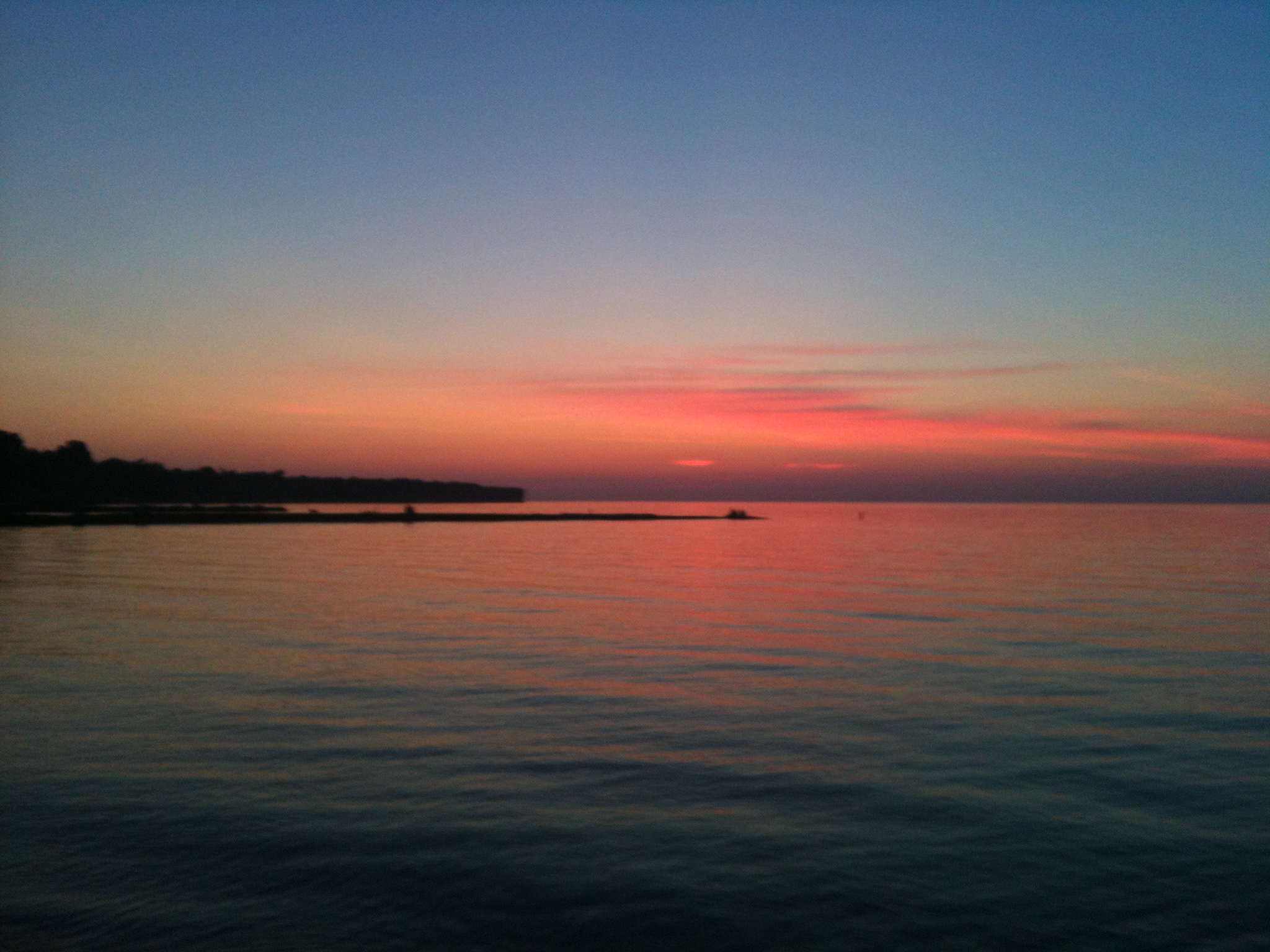
Bay Village view of Lake Erie at sunset. To the east, the Cleveland skyline glittered and fireworks blossomed over Lakewood.
(Full disclosure: a member of my family works for The Plain Dealer.)
In May, I happily stumbled on the secret to enlightenment when I attended the Medical Library Association (MLA) annual meeting in Seattle and vacationed with my family in the Cascades.
It all started with MLA speaker and best-selling author Steven Johnson, who told us about a theory he encountered while researching his latest book, Where Good Ideas Come From: The Natural History of Innovation. (Steven is a great speaker, not to mention that he reminds me of one of my favorite Downton Abbey characters.)
Some believe the 18th century’s Age of Enlightenment occurred, in part, when the middle class switched from alcohol to coffee and tea as their beverage of choice. With clean drinking water scarce, people drank ale or wine, even for breakfast. When coffee and tea imports became available, many switched from alcohol – a depressant – to caffeine, a stimulant.
Coffeehouses, where “ideas [could] spill from one mind to another,” became popular, according to Johnson. “The coffeehouse was a multidisciplinary space.” (So are libraries, he said, in a nod to his audience.) People from all walks of life who normally would not encounter one another engaged in “a diversity of conversations.”
So, coffee and tea led people to a kind of hyperactive exchange of ideas, which in turn led to innovation.
Johnson predicts that the internet and social media are a new kind of global, virtual coffeehouse spawning another great age of innovation.
I experienced coffee and coffeehouses on an entirely new level during my stay in Washington. In Rochester, New York, we don’t have drive-through espresso kiosks as in the Pacific Northwest. They are ubiquitous in the Seattle area, even on the edge of wilderness. Up in the Cascades, if you need a dentist, quick, or someone who knows how to repair a transmission, you may be out of luck – but you can almost always find a cup of coffee.
My theory is, there is so little sunshine people need the caffeine to keep going.
At any rate, I also noticed that the Pacific Northwest has thriving literary communities. People here really appreciate books, and they love coffee, and they love combining the two.
For me, the combination of exceptional coffee, great bookstores, access to the internet and, last but certainly not least, absolutely stunning scenery and fresh, mountain air, was so invigorating. I felt the ideas flowing. Like I was on the verge of my own personal enlightenment.
We spent several hours visiting The Elliott Bay Book Company, Seattle’s largest independent bookstore, which also has (of course) great coffee. Elliott Bay has a full roster of book signings and author readings, and a terrific blog. Here is what I bought there:
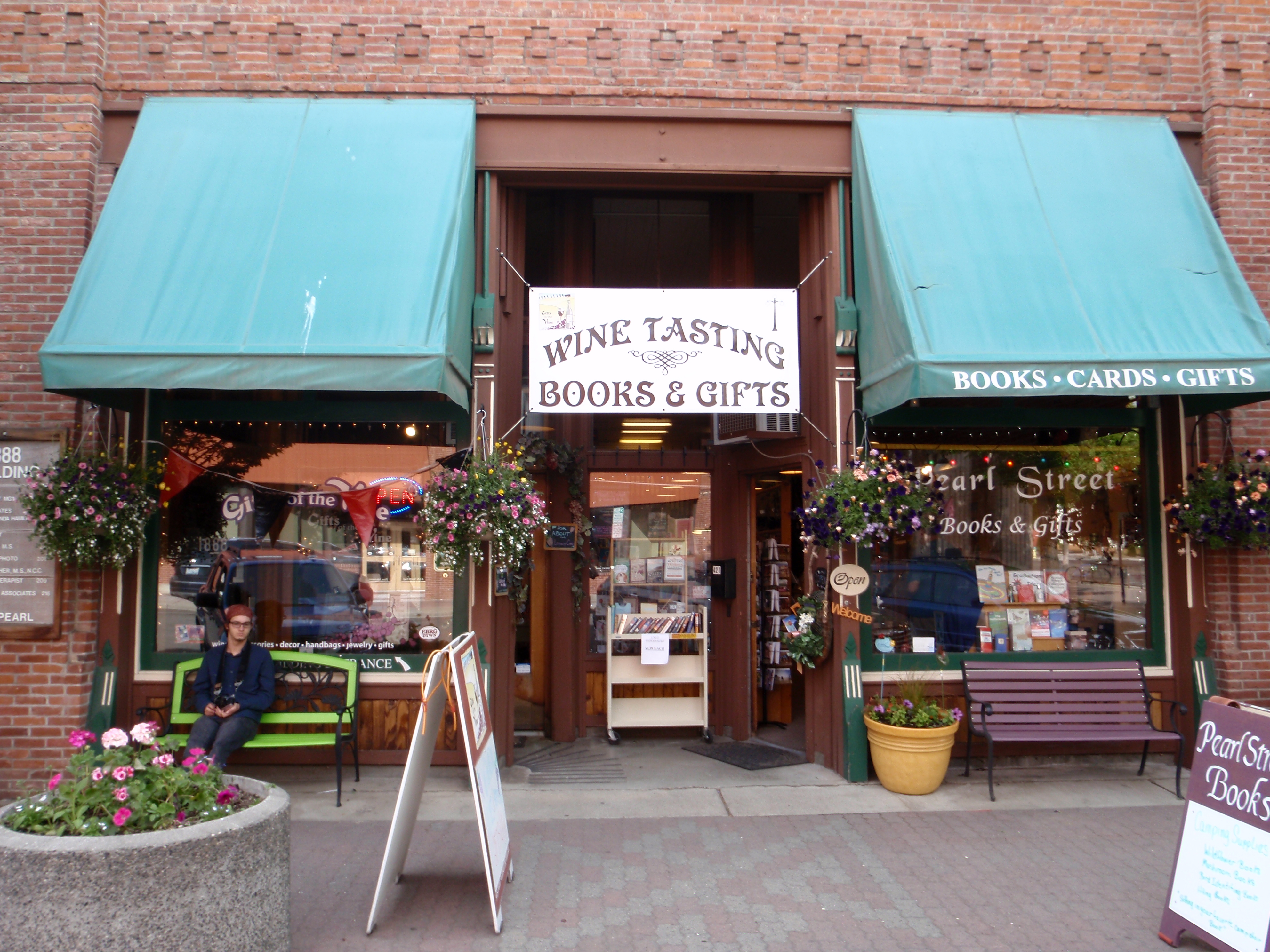
I wanted to see the high desert on the eastern side of the Cascades, so we drove to Ellensburg, WA, where we discovered the delightful Pearl Street Books & Gifts. Owner Michele Bradshaw is passionate about books and literature. She and I talked about our reading interests. Michele enjoys making recommendations, and it’s obvious she puts a lot of thought into creative, customer-responsive bookselling.
I liked the Magic Table, a display of enticing best-sellers and high quality fiction and nonfiction. Quality is apparent on every shelf and surface in the shop, where carefully chosen books are displayed cover side up. Michele has put together a number excellent book collections, including young adult, children’s, fiction, memoir/biography, and Pacific Northwest authors.
Pearl Street Books & Gifts also hosts 11 book clubs, a tea club, a knitting club, and yoga workouts.
While I was there, I bought:
The White Cascade: The Great Northern Railway Disaster and America’s Deadliest Avalanche, by Gary Krist
The Big Burn: Teddy Roosevelt and the Fire that Saved America, by Timothy Egan
Booklust to Go, by Nancy Pearl
Queen Anne Books
Climb, climb, climb Queen Anne Avenue in Seattle and you’ll be rewarded at the top of the hill with tree-lined streets and all manner of shops, including Queen Anne Books. On the shelves are literally hundreds of hand-written staff recommendations, the sign of a great bookstore. Here, Windee recommends Anne Lamott’s latest book about her new grandson, Some Assembly Required.
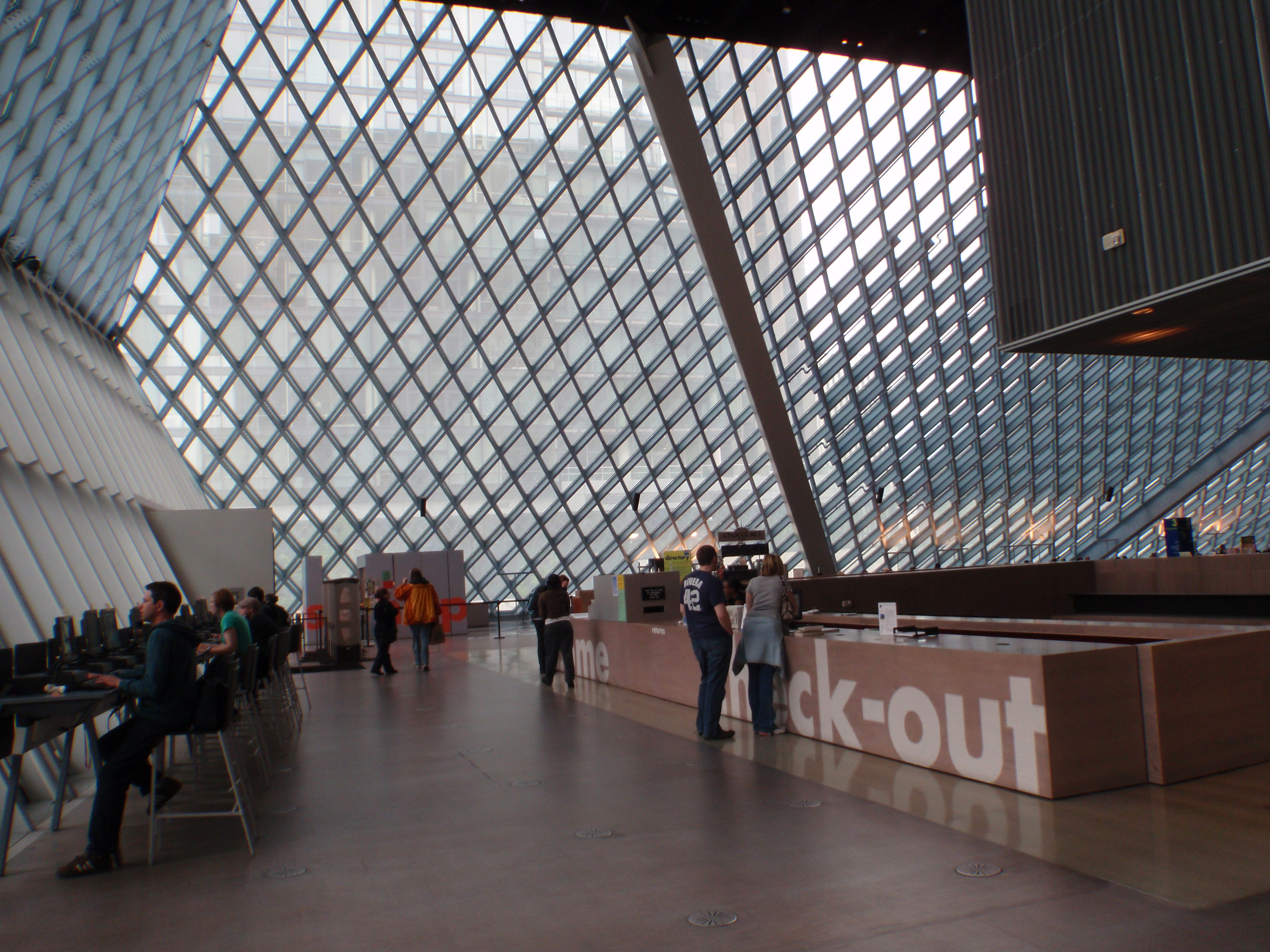
The Seattle Central Library, designed by Dutch architect Rem Koolhaas and a local architectural firm.
I had a great time this spring walking the Pacific Crest Trail with Cheryl Strayed (who has just inspired Oprah Winfrey to revive her book club!), sailing the waters off British Columbia with M. Wylie Blanchet and her children, clearing forest trails with Ana Maria Spagna, and observing life through the eyes of the characters in Denis Johnson’sTrain Dreams.
In June: The Lifeboat by Charlotte Rogan
“Today I shocked the lawyers, and it surprised me, the effect I could have on them.”
This is the opening line of The Lifeboat by Charlotte Rogan (first-time, best-selling novelist making her debut at age 57, wrote novels in secret for 25 years when the kids were at school), which I’ll be reading in June.
Highlights from the jacket copy: 1914. A bride on her honeymoon. Adrift on the Atlantic Ocean. Not enough to go around. A power struggle. Choosing sides.
Will you read it with me?
Quote from: The Lifeboat, Charlotte Rogan, Little, Brown and Company, New York, 2012.
If you want to read this treasure of a memoir you’ll have to do a bit of work. It’s out of print, so I ordered it from a used bookstore listed on Amazon. I love finding small packages on my doorstep from faraway bookstores. Blanchet and her five (FIVE!) children spent many summers on their 25-foot boat, the Caprice, exploring the British Columbia coast. This, after Blanchet’s husband had been lost at sea on the Caprice – only the boat was found.
Often, Blanchet followed the route of Captain Vancouver, who explored the waters in 1792. She read a copy of Vancouver’s diary to her children, and they tried to identify landmarks the sea captain had written about.
They followed no particular schedule except for being mindful of tides and weather, stopping when they pleased to explore little islands, hidden coves and beaches, and secluded inlets and bays that often didn’t show up on the map.
“We were very comfortable in the daytime with everything stowed away. The cockpit was covered, and had heavy canvas curtains that fastened down or could be rolled up. There was a folding table whose legs jammed tightly between the two bunks to steady it….We washed our dishes (one plate, one mug each) over the side of the boat; there was a little rope ladder that could be hung over the stern, and we used that when we went swimming.”
Her stories remind me of our many trips over the years rediscovering nature through the eyes of our children. This is the kind of book you’ll want to read aloud with children and grandchildren. Blanchet’s children were amazingly hardy and brave, often finding themselves with their intrepid mother doing things I couldn’t imagine doing with my children: crawling on a log suspended over rapids, exploring Native American burial grounds (in which bodies were “buried” dangling from trees in nets), making their way along a cliff in fog on a slippery, snowy mountaintop.
Few children today will have these kinds of adventures. Much of the wild, pristine country Blanchet wrote about in The Curve of Time has been developed. “I lighted a fire [on the beach] and piled it up with bark…We always carried a rack for broiling fish. Soon they were spluttering and browning over a perfect fire, which I raked over between two flat stones. We built it up with more driftwood…The Northern Lights were edging this way…and that way…across the northern sky – reaching above us – white and elusive, then retreating hurriedly down to the horizon.”
All photos were taken on Whidbey Island.
The quotes are from: The Curve of Time: The Classic Memoir of a Woman and Her Children Who Explored the Coastal Waters of the Pacific Northwest, M. Wylie Blanchet, Seal Press, Berkeley, CA, 1968.
After college, Spagna made a commitment to work on trail crews for the National Park Service in spring, summer, and fall, and to travel during the winter months. Eventually, she settled in Stehekin, Washington, a remote town in the northern Cascades, where she and her partner built their own house. I believe she still works the trail crews several months out of the year.
I tend to romanticize what it would be like to call such a place home. In her essays, Spagna captures the glamour and majesty of living surrounded by natural beauty, but she also writes about the never-ending challenges.
Ana Maria writes about how Republicans and Democrats, liberals and conservatives, tree huggers and loggers, religious fundamentalists and atheists get along (or don’t) in a small community.
There are the forest fires, flash floods, and avalanches. There are the costs incurred to keep residents of these areas safe from natural disasters, costs often borne by taxpayers who live in more populated areas.
It hadn’t occurred to me that precautions to prevent forest fires may cause the buildup of flammable, dense growth that could result in The Big One, a massive fire that destroys everything.
Spagna’s writing is important. She’s a voice from another world, the last bastions of nature, a voice whose wisdom we need to hear.
Here are some of my favorite quotes:
“I visited the Magic Kingdom thirty-seven times before I turned nineteen, and by then I craved something, anything, that would be the antithesis of Disney, the real thing. That’s what I found on the highway: places you can count on, places where in the morning without fail, there will be coffee at the gas station heading out of town….[and] people who….were honest, if quirky, and unexpectedly generous, and they lived an ethic that the land itself, no matter how pretty, can’t teach…..The Golden Rule.” “These places…wilderness areas, national parks – are supposed to transform us, make us new…..they do not continuously dispense spiritual wowness like a fountain….I stripped myself of everything to be out there–out there!–and the problem with being out there is that then it is not out there anymore. It is more like in here….you can’t be made new at home.”
Quotes are from Now Go Home: Wilderness, Belonging, and the Crosscut Saw, by Ana Maria Spagna, Oregon State University Press, Corvallis, 2004.
Cheryl Strayed, author of the memoir Wild, is otherwise known as Sugar, the advice columnist for The Rumpus, an online culture and literary magazine.
Cheryl had been writing the column anonymously until this past Valentine’s Day, when she “came out” just as her newly published memoir was rising to the top of the bestseller list.
The Rumpus is a clever, intelligent magazine. I’m a bit too old for it, or it’s a bit young for me, so I’m not a regular reader, nor do I follow Cheryl’s advice column (which is not your ordinary, everyday kind of advice column). But somewhere along the line, I came across a piece of wisdom I liked that Cheryl gave to a struggling young writer who’d sent a letter to Dear Sugar.
This bit of wisdom went viral and the people over at The Rumpus decided to put it on a mug. I ordered the mug and it came in the mail yesterday.
I’ve read all kinds of books about creativity and writing to keep my own writing going and because I’m fascinated by the creative process. A couple of pages on this site are devoted to books about writing and creativity, and I’ll be featuring some of these on Books Can Save a Life as time goes by.
But sometimes just a short, pithy, to-the-point kick in the pants is all I need.
So I’ve got my new mug sitting on my writing desk, ready to be filled with coffee or tea on a moment’s notice.
I would say this is Cheryl’s approach to writing, to walking, to life.
Wild is to be made into a movie starring Reese Witherspoon.
There is a fabulous interview with Cheryl over at Bookslut, but beware of spoilers. You may want to finish Wild first, before you read it.
Hey, is anyone reading Wild? If so, let us know what you think in the comments below.
I’m heading off to the land of Wild (the Pacific Northwest) later this week to attend a medical librarian conference with some of my colleagues (profoundly intelligent readers, all of them). Then some vacation time with family, where I’ll be reading other books with a Pacific Northwest theme, exploring Seattle (including The Elliott Bay Book Company), and the surrounding terrain. Watch for posts and pictures!
I used to read Where the Wild Things Are every day, sometimes more than once, to my son. It was his favorite book.
He was three, but he hadn’t yet left his terrible two’s when it came to temper tantrums. The first time we read the story, its wild (there’s no other word for it), authentic power seized us and didn’t let go until the last page. My son felt it, I felt it.
No matter how outlandish and dark the words and pictures, this story was about something very real to my son and me. Our arguments when I tried to discipline him and grew exasperated, his uncontrollable rage at being sent to time out – all of it was right there on the page. Another little boy and his mommy were doing THE EXACT SAME THING.
When I read, I had to roar my terrible roar and roll my terrible eyes. That was the very best part.
We wore that book out. Some of the pages tore and fell out. I still have our sons’ favorite books, but not Where the Wild Things Are. I looked for it this morning after I found out Maurice Sendak had passed away, but it wasn’t there. Must have been too tattered to keep.
Or maybe my son couldn’t bear to part with it and took it with him when he moved out on his own.
Thank you, Maurice Sendak.
It occurs to me I’ve written two blog posts in a row about books with “wild” in their titles. I think these authors are on to something when it comes to writing about human nature.
Do you have a Where the Wild Things Are memory? Children, grown children, mommies, daddies, anyone, please share in the comments.
I write this on the night of the supermoon, high in the sky outside my dining room window.
In her journal, Cheryl Strayed kept a list of the books she burned as she walked the Pacific Crest Trail: Dubliners by James Joyce; Lolita by Vladimir Nabokov; The Novel by James Michener; The Pacific Crest Trail, Volume 1: California and Volume 2: Oregon and Washington; plus a few more.
Every evening she’d make a campfire, tear out the pages she’d read that day, and feed them to the flames to lighten the load in her over-stuffed pack. I imagine her performing her nightly ritual, the words on paper turning to ash.
Cheryl carried one book the length of her trip: The Dream of a Common Language, by Adrienne Rich.
Reading Wild, I remember this stray fact: In college, I wrote my senior seminar English paper on Adrienne Rich’s Diving Into the Wreck. I’d like to find that old English paper so I can read it after all these years and see what I had to say about Rich’s poetry.
Reading Wild, I remember a vacation in Portland, Oregon to visit family. Our boys were six and nine at the time.
We decided to hike with my sister-in-law and her family along the lower elevations of Mount Hood in search of a waterfall whose name I can’t remember. The map posted at the trail head indicated the hike was a couple of miles. A manageable trip for young children, we thought. The day was hot and sunny, but we walked in the shade of a beautiful pine forest along an easy, well-cleared path.
When Cheryl began walking, her pack was so heavy she couldn’t lift it, and her brand new REI hiking boots were too small. Along the way, she shed many layers of skin from the pads of her feet and several toenails as well.
She’d walk a week without seeing anyone. She’d go days with a handful of change to her name until she reached a town where a supply pack (mailed by a friend) awaited, with necessities and two ten dollar bills to tide her over for the next couple hundred miles.
The day of our hike we walked. And walked. And walked some more. Until it got to be not so much fun anymore. Until the children were dragging, and the teenage cousin and her friend decided to go on ahead.
One of our boys (who shall remain nameless) grew cranky. The heat was intense and our water was running low. But we figured we were almost to the waterfall, so we kept going.
We walked another half hour, and then in a full meltdown, the thoroughly overheated and tired boy refused to go any further. We’d stopped next to a creek, and my husband took his handkerchief, dipped it in the ice-cold mountain water, and we took turns bathing our faces with it.
My in-laws decided to keep going with their children while we cooled off at the stream. Before long, I was ready to move on. My husband stayed behind with the tired one, cajoling him to take off his shoes and socks and wade in the stream.
Our original group had now split into four groups, which made me uneasy. Walking along holding my son’s hand, I hoped the path wouldn’t split off. What if we went the wrong way and got lost? We saw an older couple approaching as they headed back down the trail.
“Are we close to the waterfall?” I asked.
“You’re getting there. But you’ve a ways to go,” the man said. Not what I wanted to hear.
At the age of 26, with little preparation and no extreme hiking experience, Cheryl decided to hike the Pacific Crest Trail. She was grieving for her mother, who had died in her early forties a month after a cancer diagnosis, and Cheryl had been making a mess of her life ever since. She hoped the trip would save her in some way.
My son and I heard rushing water and felt a million invisible, blessedly cool droplets on our skin before we saw the waterfall. In the clearing ahead, ribbons of spray curved and tumbled down a wall of solid rock, like a bridal veil fluttering in a breeze. Instantly, the temperature dropped ten degrees. We were like parched plants coming back to life after a generous watering.
Everyone had arrived except for my husband and the tired one; they came along a few minutes later. In this peaceful and secluded Shangri La we stretched ourselves out on large, flat rocks and talked as the kids splashed about the stream looking for tadpoles.
Having walked 1100 miles, Cheryl ended her journey at the Bridge of the Gods spanning the Columbia River, which lay between Oregon and Washington.