My Name Is Lucy Barton

LucyBarton2


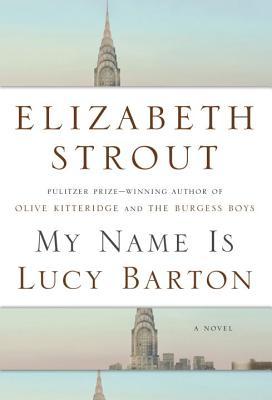
This is one of my favorite scenes in My Name is Lucy Barton, by Elizabeth Strout:

The narrator is in a writing workshop led by a famous author she admires:

“…through the open window a cat suddenly jumped into the room, right onto the large table. The cat was huge, and long; in my memory he may as well have been a small tiger. I jumped up with terrible fear, and Sarah Payne [the author/instructor] jumped up as well; terribly she jumped, she had been that frightened. And then the cat ran out through the door of the classroom. The psychoanalyst woman from California, who usually said very little, said that day to Sarah Payne, in a voice that was–to my ears–almost snide, ‘How long have you suffered from post-traumatic stress?’

And what I remember is the look on Sarah’s face. She hated this woman for saying that. She hated her. There was a silence long enough that people saw this on Sarah’s face, this is how I think of it anyway. Then the man who had lost his wife said, ‘Well, hey, that was a really big cat.’

After that, Sarah talked a lot to the class about judging people, and about coming to the page without judgment.”

I highly recommend My Name is Lucy Barton, which has been lavishly praised by reviewers and other book bloggers and was nominated for the Man Booker Prize.

It has a deceptively simple plot about a young mother in a Manhattan hospital visited by her difficult mother, who she hasn’t seen in years.

The two women are now worlds apart, estranged by distance, education, class, their difficult past, and their own inability to express love and emotion and speak in a direct way about their lives. The writing is powerful yet understated, and unsentimental.

Lucy, raised in rural midwestern poverty and abuse, has reinvented herself in New York City. When her mother visits, Lucy reflects on the harsh childhood and upbringing she never talks about in her new life except occasionally with therapists.

The premise of the novel sounds like a cliché, but this is a page-turner. There is an urgency to Lucy Barton’s story. Strout has a strong sense of what to tell, when to tell it, and what not to tell at all.

I especially like this review in The New York Times by Claire Messud. This is a great choice for book club reading.

Now that I’ve finally discovered Elizabeth Strout long after the rest of the reading world, (she won the Pulitzer Prize for Olive Kitteridge, which was made into a TV miniseries), I look forward to reading her other novels.

“Sarah Payne, the day she told us to go to the page without judgment, reminded us that we never knew, and never would know, what it would be like to understand another person fully.”

My End-of Summer Reading

Currently on my nightstand are books by authors who were previously chosen for If All of Rochester Reads the Same Book:

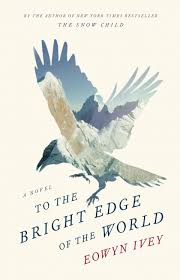
To The Bright Edge of the World.jpegTo the Bright Edge of the World, by Eowyn Ivey (because I loved The Snow Child)

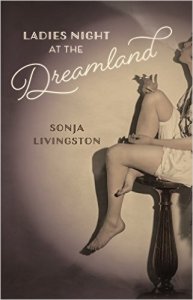
Ladies Night at the Dreamland, by Sonja Livingston (because I loved Ghostbread and Queen of the Fall, and because it’s about women, past and present, known and  unknown, in my neck of the woods)

I’m also reading:

The Art of X-Ray Reading: How the Secrets of 25 Great Works of Literature Will Improve Your Writing, by Ray Peter Clark

Clark mines great books, short stories, a poem or two, and a few movies for hidden treasures–the secret, powerful techniques of accomplished writers. Taking another look at some of these stories is fascinating: The Great Gatsby; Madame Bovary; A Visit from the Goon Squad; Lolita; A Farewell to Arms; The Bell Jar; Miss Lonelyhearts; “The Lottery”; “A Good Man Is Hard to Find”; “Notorious”; The Goldfinch; and Hiroshima, among others.

Ladies NightWhat have you read this summer that you love? Let us know by leaving a comment via the link in the left sidebar.


Going local: six Rochester storytellers

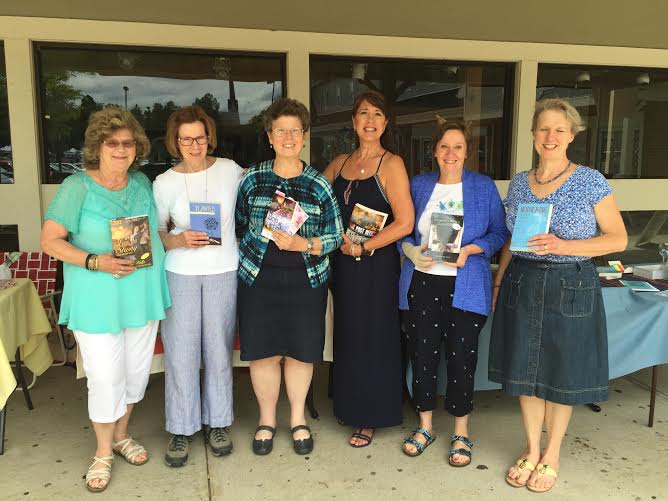
RochesterAuthorsLeft to right: Bev Lewis (writing as Beverly Wells); Kate Collier (writing as Katie O’Boyle & C.T. Collier); Ellen Hegarty (writing as Roz Murphy); Kim Cruise; Elizabeth Osta; Liz O’Toole

Historical romance & fiction, mystery & suspense, ghost stories & essays on motherhood

A couple of weeks ago I went to the Saturday farmer’s market, where quite unexpectedly I met six local authors. I’ve written before about the great small businesses in our town, and our pharmacy is one of them. Gift department manager Stefani Tadio supports and promotes the work of local artists and authors, and she organized this author/book event.

I enjoyed meeting and talking with Beverly, Kim, Roz, Katie, Elizabeth and Liz. I asked them about their writerly inspiration and research.

***

Historical Romance by Beverly Wells

Cowboy Kisses“I usually write long historical romance–mostly set in western America in the 1800’s, but I will also have a Medieval anthology coming out in the fall/winter and a civil war novel in the future, as well as a Canadian Mounted Police novel. I’ve also been included in anthologies and novellas.

As far as researching goes: first I investigate climate, terrain, foliage and fauna, foods, and items used at the time, types of lingo, and slang.

For example, in A COWBOY CELEBRATION, which is set in Wyoming in 1882, I had to make sure there were apples and what kinds, what the growing season would have been, and the ripeness and color of the apples hanging on the trees. Thank God for the internet, because it’s so much easier today than years ago doing research.

But my problem is, I get so wrapped up in research that I spend hours reading every tidbit and never use half of I read. I think that happens to a lot of us. But I love finding the answers!”

 ***

The Post Office by Kim Cruise

PO_Boxes_Kim_cruise“I started writing as a form of catharsis made necessary by having to watch my son suffer through drug addiction.  You see, books save lives in the writing, as well as in the reading of them. 

Shortly after I started writing The Post Office, my son was arrested on drug-related charges and ended up in a prison where he was not allowed to have books. He’s been an avid reader all his life; this was the very definition of cruel and unusual punishment.  So I started sending him my chapters, imbedded into letters, so he’d have something to read. He would edit them and make suggestions in the margins and mail them back. We had a flurry of mail going back and forth and I’ve not been as prolific since.   His one pencil became his most important possession while he suffered through his time there, and his proverbial fingerprints are all over my book.

My suspense novel features six characters, five of which are made up and one of whom is not –it’s me; putting my story and feelings into keystrokes, which turned into pages, then chapters, made it possible to function during some very dire times. I keep writing now that he is clean, to document his success and to let other mothers know that drug addiction can be survived. It’s my belief that it is very important to be talking about addiction; there are so many suffering from it, and even more people who suffer on the sidelines as I did and do; I hope that my efforts will help people to be comfortable with this conversation.”

 ***

Bob Book Ghost Stories by Roz Murphy

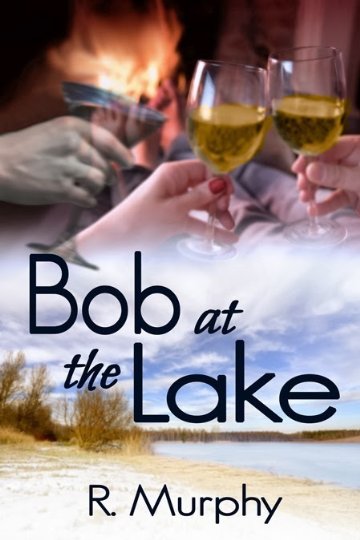
Bob at the LakeRoz Murphy’s Bob books [Bob at the Lake, Bob at the Plaza] narrate the screwball adventures of a crabby woman of a certain age, the kind grape grower who lives up the hill, and a martini-loving ghost.

“Since I’m the “crabby woman of a certain age” in this scenario, all I pretty much had to do was tell the story of Bob, my pain-in-the-butt martini-loving ghost, and our misadventures here in the Finger Lakes. I usually write early in the morning, while Bob is still nursing his hangover from the night before, since he’ll leave me alone for a couple of hours then.”

***

Lakeside Porches Romance Novels and Novellas by Katie O’Boyle

cover-steppinguptolove.jpg“In January 2012, my sister and brother-in-law invited me to celebrate the 90th birthday of a dear friend on the porch of Belhurst Castle for their famous Sunday Brunch. Watching the staff serve up incredible food and fuss over our friend made me wonder about their lives, their hopes and dreams. And wonder about the guests. And wonder about the visitors to the dining room and the spa. So many stories!

The idea for Lakeside Porches was born that sunny winter morning. That said, Tompkins Falls is not an actual city. Chestnut Lake is not Seneca or Canandaigua Lake or any of the Finger Lakes, although it has much in common with several of them. The Manse Inn and Spa is not Belhurst Castle, although the Belhurst may very well be one of the beautiful lakeside inns with a dining porch that serves lunch to the characters from my books.”

MysteryAnd just published: Planted: The Penningtons Investigate

It’s Monday of spring break when Professor Lyssa Pennington’s backyard garden project unearths a loaded revolver. With no record of violence at their address and no related cold case, the Tompkins Falls police have no interest. But the Penningtons and a friend with the State Police believe there’s a body somewhere. Whose? Where? And who pulled the trigger?

***


Jeremiah’s Hunger by Elizabeth Osta

jeremiahs-hunger-largeAt the height of the Irish famine of the 1840s, in a small town of Ahadallane, north of Cork City and south of Mallow, Jeremiah joins the rebels in the fight for Ireland’s freedom from British rule and learns firsthand the futility of violence. He and his best friend and brother-in-law, Father Michael Riordan disagree about the means to the end and ultimately take diverse paths when Michael is assigned to a parish in America.

Elizabeth took more than a dozen trips to Ireland to research Jeremiah’s Hunger, which is based on her own family history. Currently, she’s working on a memoir about her years in a convent with the Sisters of St. Joseph.

“My research has been chronologically driven.  For Jeremiah’s Hunger, I discovered genealogical records that led the way. For Saving Faith: A Convent Memoir, I am working with a distinct time period (1968-1977) so am able to explore those times historically, culturally, politically and cull the important and relevant facts.  Imagination for the historical fiction and memory for the memoir are key elements.”

 ***


Mothering: An Art of the Heart,  Elizabeth O’Toole (along with 8 more moms)

MotheringMothering: An Art of the Heart is a collection of short and engaging stories that celebrate family life, told by nine moms who want to share the wisdom and experience they gained in the process of raising their children. Each story highlights a specific idea or activity that may be used by the readers to enhance their families’ experience as their children grow.

This is not a text book or how-to manual, rather it is a forum where one set of mothers hopes to help another set of mothers by sharing “things that worked” in their families. There are 118 stories in all.

Becoming Wise

A quick post today….

IMG_2995In my last post I told you about the wonderful Browsers Bookshop I visited in Olympia. In addition to The Eagle Tree, by Ned Hayes, I picked up a copy of Becoming Wise: An Inquiry into the Mystery and Art of Living by Krista Tippett, who hosts and produces one of my favorite public radio programs/podcasts, On Being.

This book is a bit hard to describe, but I think you will like it if you wonder about the great spiritual and ethical questions of our time and enjoy hearing from some of our greatest contemporary thinkers – scientists, physicians, psychologists, poets, theologians, activists, etc.

This is essentially what Krista Tippett does on her radio program – engage in the art of conversation with them as they probe the meaning of life together – and in Becoming Wise she’s included highlights of some of these intriguing interviews, organized around the themes of Words, Flesh, Love, Faith and Hope.

The book jacket calls Becoming Wise a master class in living, curated by Krista Tippett. It left me feeling uplifted and hopeful, and I think it will leave you the same way.

Here are selected passages:

“I’m stretching my point only a bit when I say that in American life, every vision must begin and end in an economic argument in order to be heard, on urgent matters of human life: education, immigration, refugees, prisons, poverty, health care…

…we are bigger and wilder and more precious than numbers, more complex than any economic outcome or political prescription can describe.”  Krista Tippett

“Centering prayer, spiritual direction, retreats, and meditation sat quiet for centuries, largely reserved for “experts,” the cloistered, monks or nuns or dedicated oblates and pilgrims deep inside all of our traditions. Now, even as many Western monastic communities in their traditional forms are growing smaller…..their physical spaces for prayer and retreat are bursting to the seams with modern people retreating for rest and silence and centering. They are learning arts of contemplation to take back into their families and workplaces and communities and schools.” Krista Tippett

********

“…there is something deeply built into us that needs story itself. Story is such a source of nurture that we cannot become really true human beings for ourselves and for each other without story – and without finding ways in which to tell it, to share it, to create it…

Do we exist for some reason other than competing with China or finding the best possible technological advances? Are there some things that are even deeper that we are meant for, meant to be, meant to do, meant to achieve?” Vincent Harding

********

“We all come from a single source. Everything that lives has its genetic code written in the same alphabet. Unity creates diversity. So don’t think of one God, one truth, one way. Think of one God creating this extraordinary number of ways, the 6,800 languages that are actually spoken. Don’t think there’s only one language within which we can speak to God.”  Rabbi Lord Jonathan Sacks

********

“…anybody who travels know that you’re not really doing so in order to move around – you’re traveling in order to be moved. And what you’re seeing is not just the Grand Canyon or the Great Wall but some moods or intimations or places inside yourself that you never ordinarily see when you’re sleepwalking through your daily life.”  Pico Iyer


IMG_2987
An enticing sign in front of Browers Bookshop.


This post and my last have been a tribute to independent bookstores like Browers Bookshop. Many thanks to Browers for putting Becoming Wise where I could find it.

I picked up an interesting little booklet of two reprinted articles by Ann Patchett with an appendix listing some of her favorite books, called The Care and Feeding of an Independent Bookstore. In it she writes of her own bookstore, Parnassus Books and, by extension, all good bookstores.

“All my life I’ve been telling people what to read. Ask my family, ask my friends. It’s the habit of all passionate readers. When you read a book you love, the experience is not complete until you can turn around and say to someone else, ‘You have to read this book. You will love this book.'”

“Book by book, our customers vote against free overnight shipping in favor of a community of book lovers.”    Ann Patchett, The Care and Feeding of an Independent Bookstore


Secret Garden
My temporary secret garden on the Olympic Peninsula. The Strait is beyond the fence.


Do you have a favorite bookstore? Tell us about it.

My Favorite Things

….on the Olympic Peninsula….

We’re on vacation exploring the magnificent beauty of the Olympic Peninsula and getting to know Port Townsend, Sequim, Port Angeles, and Olympic National Park.

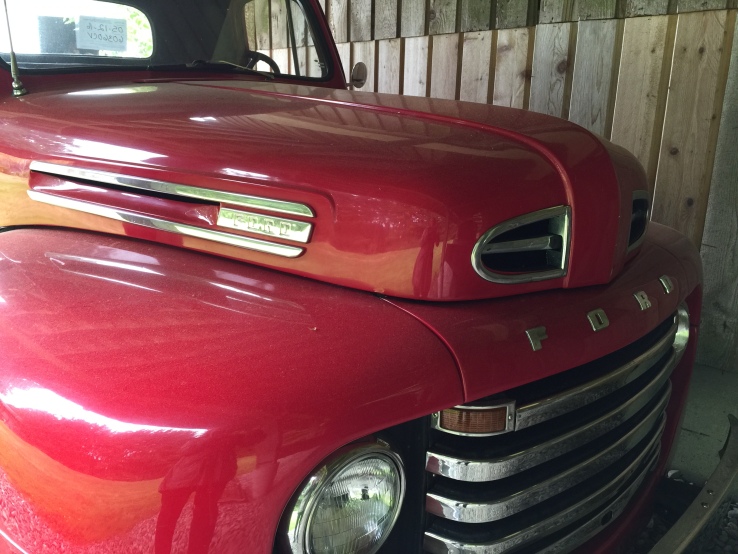
The airbnb  where we’re staying is on a cliff overlooking the Strait of Juan de Fuca. The octagonal structure in the photo below is where I’m writing this blog post.

IMG_3056.JPG

Our temporary home is a former barn that has been beautifully converted into a comfortable dwelling filled with Native American, Mexican, and Americana art, quilts, and rugs. I spent more than a few hours on airbnb looking for a place to stay, and my research paid off.

IMG_3033

There are lush gardens on the property and a tree farm across the road along with a view of the magnificent snow-covered Olympic Mountains. Sea in the backyard, mountains in the front yard.

IMG_3196

IMG_3171.JPG

IMG_3210.JPG

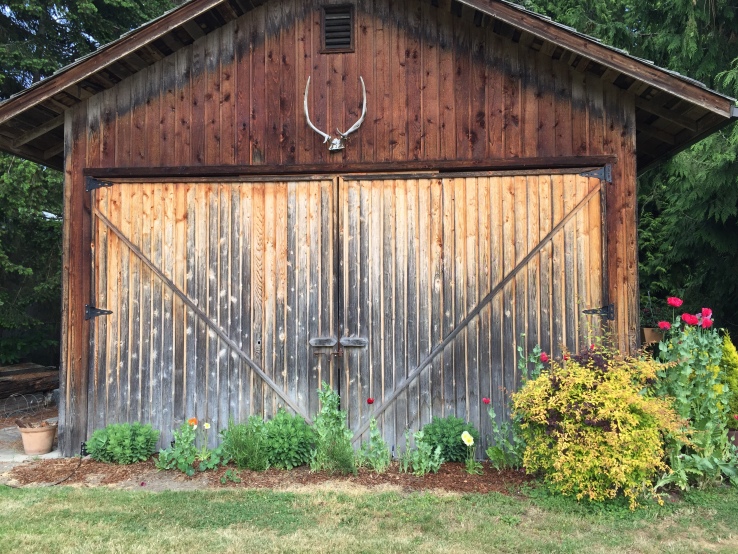
I love the weathered colors and textures of this old structure. It is a workshop/studio filled with fabrics – I believe one of the owners is a textile artist, and several of her quilts grace the walls where we’re staying.

IMG_3052

IMG_3053

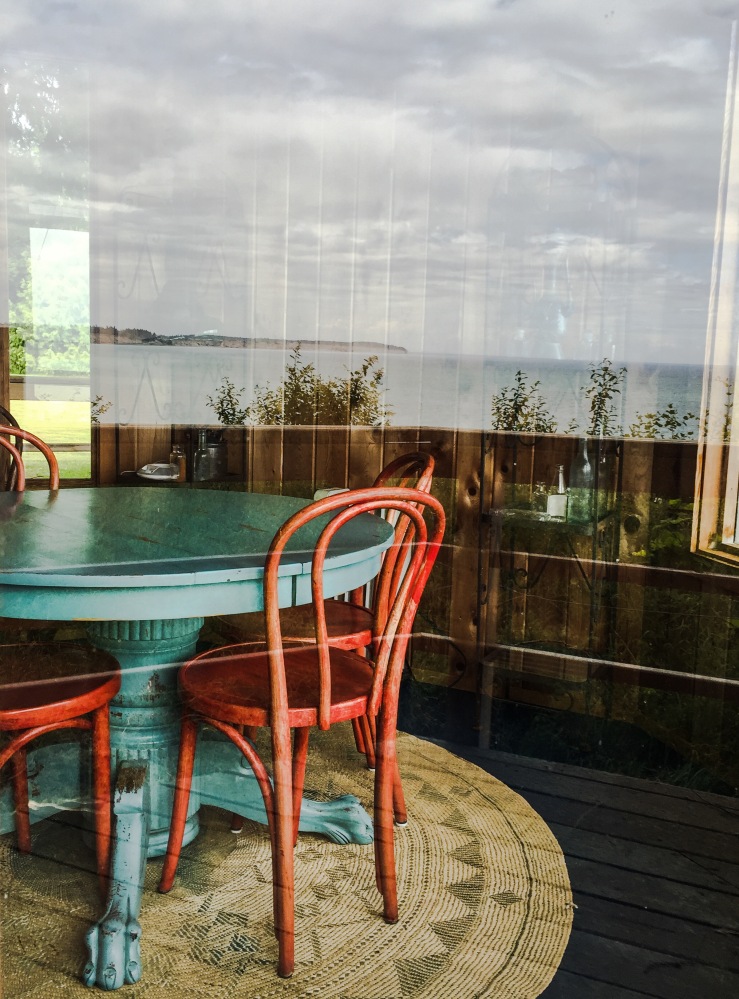
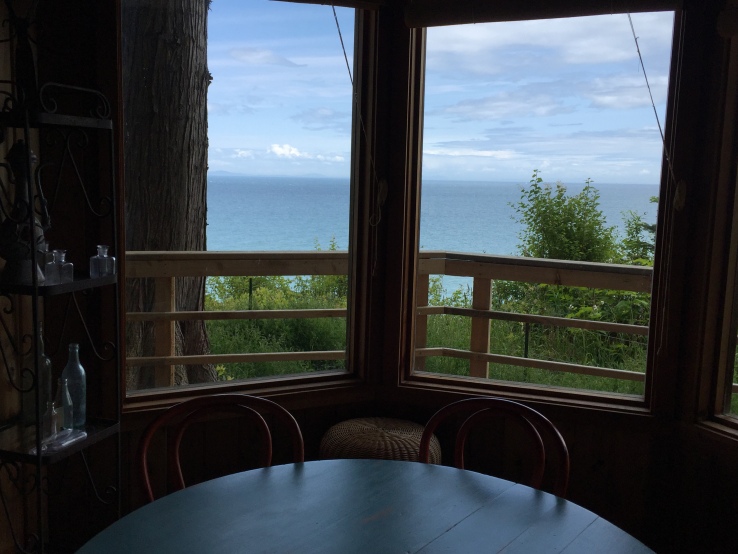
Below is the interior of the little octagonal retreat, which comes equipped with a heater and bookshelves. All you need is a mug of hot coffee or tea to feel right at home. You can see a reflection of the view in the top half of the photo.

Early this morning my husband saw two bald eagles perched on a tall, dead tree nearby. It had rained in the night, and the pond visible in the first photo was filled to overflowing.

IMG_3223.JPG

IMG_3109

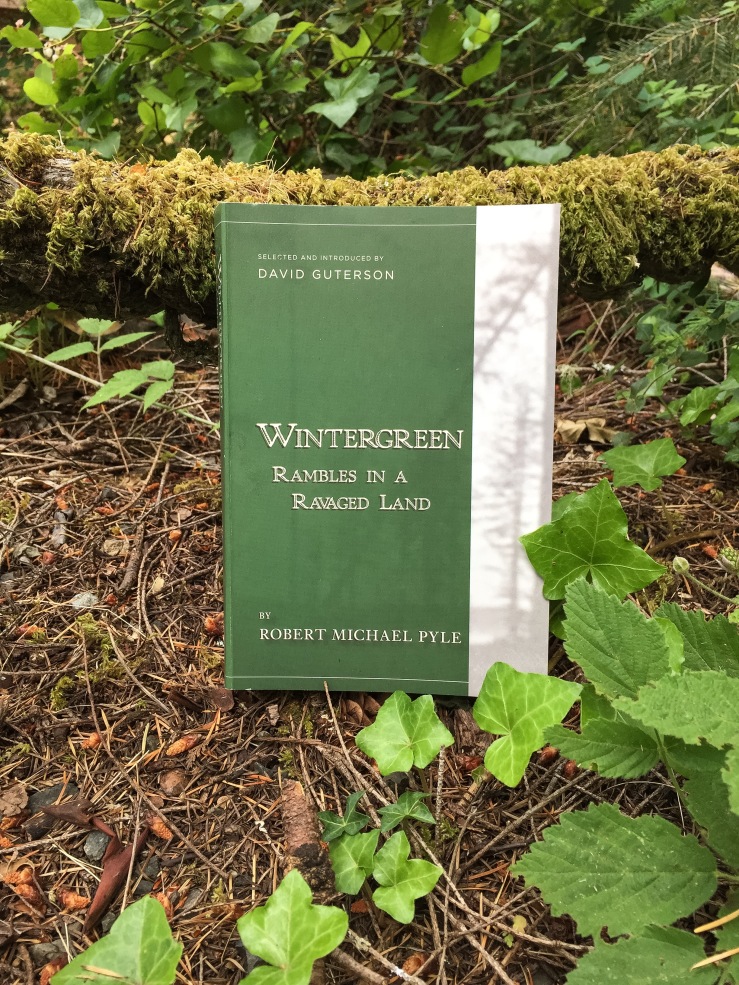
I’d started reading Braiding Sweetgrass back home, and I’m continuing to read it slowly, a chapter at a time. A good companion is Wintergreen: Rambles in a Ravaged Land by Robert Michael Pyle, who writes of the extensive logging that has stripped the Willapa Hills of southwestern Washington, where he has lived for thirty years.

I had the pleasure of meeting the author at the Wild Arts festival in Portland last fall. Note that there is an introduction by David Guterson in this edition. Robert Michael Pyle is a generous Santa Claus of a man who teaches every year at Fishtrap, a retreat for writers who are passionate about the West.

IMG_2894

IMG_2892.JPG

IMG_3201

More later. I’ll tell you about a wonderful indie bookshop I visited, its dynamic owner, the person I happened to run into there in a moment of serendipity, and the books I bought.

Have you been to the Olympic Peninsula? If so, what are your favorite spots? Can you recommend books or authors connected with this part of the world?


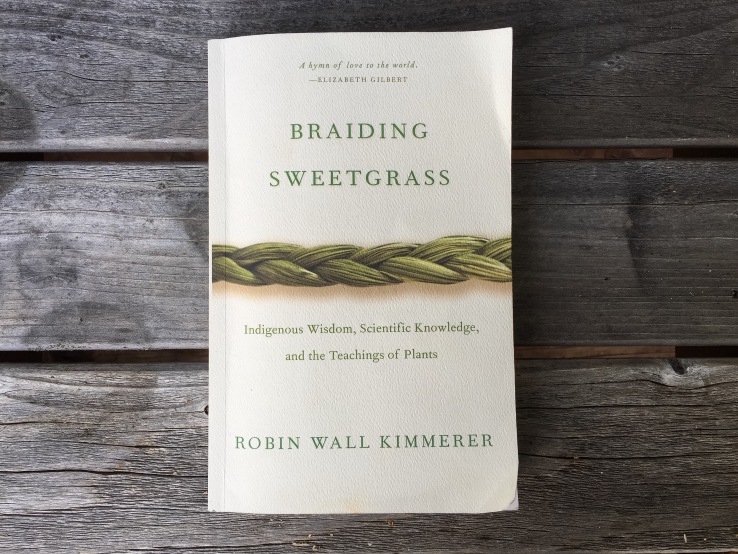
Braiding Sweetgrass

Braiding Sweetgrass cover

“Hold out your hands and let me lay upon them a sheaf of freshly picked sweetgrass, loose and flowing, like newly washed hair… Hold the bundle up to your nose. Find the fragrance of honeyed vanilla over the scent of river water and black earth and you understand its scientific name: Hierochloe odorata, meaning the fragrant, holy grass. In our language it is called wiingaashk, the sweet-smelling hair of Mother Earth. Breathe it in and you start to remember things you didn’t know you had forgotten.”   Robin Wall Kimmerer, Braiding Sweetgrass

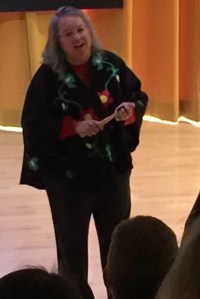
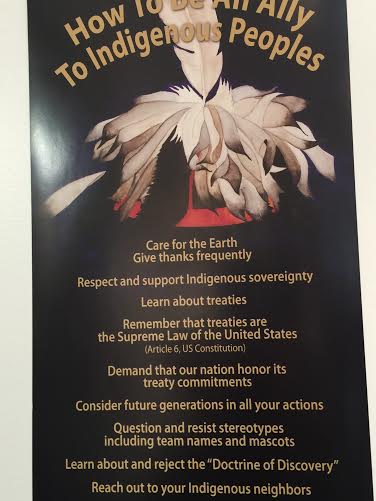
I’ve been working on my first podcast in a nature series, and as part of my research I visited Ganondagan, a cultural center and historic site that was the home of the Seneca Nation of the Iroquois Confederacy. It has an intriguing array of programs, from animal tracking to music to meditation to dance. Last Sunday, I heard Robin Wall Kimmerer speak about her book, Braiding Sweetgrass, which I highly recommend to anyone who cares about nature, the land, and saving the earth.

IMG_2842
Robin Wall Kimmerer leads us in a song to save the earth at Ganondagan

I first heard of Robin Kimmerer via Elizabeth Gilbert, who found the inspiration for her book, The Signature of All Things, when she read Gathering Moss by Kimmerer.

I’m about a quarter of the way through Braiding Sweetgrass. I’m loving the poetry of her writing as I take in the simple but profound indigenous wisdom Kimmerer is eager to pass on. It’s wisdom we as a culture have long overlooked and which may save us all, if we pay attention. Braiding Sweetgrass is a book to read slowly and savor.

Robin is a botanist, a professor of environmental biology, and a member of the Citizen Potawatomi Nation. She is descended from the Anishinabekwe of the New England region; in the forced Native American migration her people settled in Oklahoma.

There, her grandfather, by law, had to leave the reservation when he was nine years old to attend public school. At that point, their language and most of their indigenous wisdom was lost.

Robin has spent a good part of her adulthood reclaiming both as she also pursues the life of a botanist and university professor.


597px-Making_Sweet_Grass_Medicine

Making sweet grass medicine. © Ad Meskens / Wikimedia Commons

Here Robin expresses what she aimed for in writing Braiding Sweetgrass:

“I offer…a braid of stories meant to heal our relationship with the world. This braid is woven from three strands: indigenous ways of knowing, scientific knowledge, and the story of an Anishinabekwe scientist trying to bring them together in service to what matters most. It is an intertwining of science, spirit, and story – old stories and new ones that can be medicine for our broken relationship with earth, a pharmacopoeia of healing stories that allow us to imagine a different relationship, in which people and land are good medicine for each other.” 

I’ve still many pages to go, so I’ll write more once I finish the book. I’ll leave you with this:

“In the settler mind, land was property, real estate, capital or natural resources. But to our people, it was everything: identity, the connection to our ancestors, the home of our nonhuman kinfolk, our pharmacy, our library, the source of all that sustained us….It belonged to itself; it was a gift, not a commodity, so it could never be sold.”


Indigenous Peoples

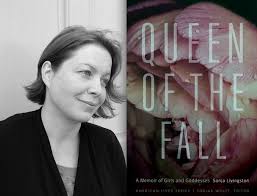
Sonja Livingston’s Queen of the Fall

Livingston“The Italian word for gypsy, zingaro, is perhaps a better word. [The word] “heart” is merely a convenience, a sort of shorthand for what’s contained within the cautious body–the spark that thrives on wonder, that which is flung wide or ratcheted shut until it seems all but sealed but remains open, if only just a touch; the thing that moves and changes even as we seek to know it, that which stalks and stalks but cannot be satisfied. Not fully. Not permanently. The part of us that continues to yearn, to try, and to dream, despite the fact that there’s a certain space within us incapable of being filled, and that learning to live with this is a part of our humanity. But what does the heart know? Zingaro cuore. So great are some hungers, so unrelenting, that whatever even halfway fills them must be tried–miniature orange trees and birdhouses and homemade ukuleles. What can we do but feed, then feed again, the tender shoots within us?    Sonja Livingston, Queen of the Fall: A Memoir of Girls and Goddesses (University of Nebraska Press)

If you want to read something different and magical, try  Queen of the Fall: A Memoir of Girls and Goddesses by Sonja Livingston.

This collection of linked essays, the 2016 choice for If All of Rochester Reads the Same Book sponsored by Writers & Books, is a wonderful example of how powerful and poetic the essay can be and how inventive the form.

(Despite the subtitle, this is a collection of essays–memoir-ish, rather than a true memoir.)

Sonja writes about how the term “essay” conjures visions of tedious school assignments. But the essay is actually an elastic form of literary exploration that can be novel and beautiful. If done well, an essay tantalizes, catching the reader up in an unfolding.

The author has dedicated Queen of the Fall to the memory of Judith Kitchen, a teacher and mentor who passed away in 2014. I wrote last week about how Sonja, who grew up in the Rochester area, took Judith Kitchen’s essay writing class at SUNY Brockport twice. (I took Judith’s class also, several years ago.) While she was enrolled in Judith’s classes, Sonja was inspired to give up her career as a school counselor and become a writer.

Her essays share the themes of womanhood, fertility, and poverty, which have been central to her own life–hence the term “memoir” in the book’s subtitle. Each essay stands on its own, but I found myself so captured by their momentum that I read several in one sitting, as though I were reading a novel or memoir.

When I was in graduate school at Syracuse University many years ago, two classmates and I made a documentary about rural poverty in New York State. I’d just moved here from New York City, and I loved the landscape of glacier-made Finger Lakes, deep gorges, and waterfalls. I had no idea that, hidden in all this rural beauty, many families lived in poverty.

Growing up in the 1980s and 1990s, Sonja Livingston, her mother, and her six siblings were among them. Though there were five fathers among the seven children, no father was present in their lives. They moved from place to place: a rural town, a Native American reservation, an urban slum in inner city Rochester.

In Queen of the Fall, (which refers to the apples Sonja and her siblings picked during a stint as farm workers), Livingston explores the lives of various women and girls, including the great suffragette Susan B. Anthony who lived in Rochester (“The Lady With the Alligator Purse”), the troubled young girls (and a boy) Sonja met as a school counselor (“One for Sorrow”), and the television character Ally McBeal  (“The Lonely Hunters.”) They are some of my favorite essays, as well as “World Without End,” “What the Body Wants,” and “The Last American Virgin.”

Livingston casts the lives of women, especially disadvantaged and/or obscure women, in a new and dignifying light. Throughout, Sonja weaves in moments from her life as a teen taking risks yet hoping to avoid pregnancy, as a woman confronting infertility, and as the aunt of a young, unmarried niece who finds herself pregnant.

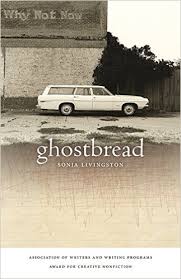
GhostbreadIf you’d like the full story of Sonja’s remarkable life as a backdrop to her essays in Queen of the Fall, you could read her remarkable 2009 memoir, Ghostbread, first. After devouring her essays, I found a copy of the memoir at my local library.

Sonja will have a newly published collection of essays this month that has been described as a hidden history of women’s lives: Ladies’ Night at the Dreamland. (I believe the Dreamland refers to Seabreeze, a Rochester amusement park.)

I’m looking forward to reading about little-known and obscure women from the area where I live–among them, a woman who crossed Niagara Falls on a tightrope, and the Fox sisters, who became well-known Spiritualists and mediums. Western and upstate New York has always been known for its progressive spirit and energetic spirituality, a hotbed of abolitionism, women’s rights, religiosity, spiritualism, and utopianism.

Declaration of SentimentsHere, for example, is a link to the Women’s Declaration of Sentiments, written and signed in 1848 in Seneca Falls, New York. It is inscribed on a wall there, and I remember being very moved on my visit several years ago.

From Livington’s upcoming book:

“Women understand how to overlook or wait until next time, can spend years holding their tongues in the face of the thing that most wants letting. No, I need no convincing of the strength of women, but it’s too often a matter of restraint. I do not often see us standing bold or brazen before a crowd. I do not mean to belittle cheerleaders and fashion models and television weather women—though theirs seems a case of the body going through a series of prescribed and pleasant motions. Where are our wild women? Those with open mouths and muscled legs, who flare and flame, whose actions shock, and whose bodies defy gravity, whose every step rivets the eye so that we can’t look away?”

Ladies Night

Remembering Judith Kitchen

Excavating a Life

Queen of the Fall book coverQueen of the Fall: A Memoir of Girls and Goddesses, is a collection of linked essays by Sonja Livingston and the If All of Rochester Reads the Same Book selection for 2016.

For the next few weeks, Sonja will be here for readings, signings and discussions at Writers & Books, local libraries, schools, colleges and bookstores.

Sonja is from the Rochester area, and divides her time between Rochester and the University of Memphis, where she teaches writing. The daughter of a single mother and one of seven children (with five different fathers), Sonya has also written a memoir, Ghostbread, about growing up in poverty in the Rochester slums and on the Tonawanda Reservation.

When I read the dedication page of Queen of the Fall, I was surprised and delighted to see this: “For my mothers, actual and acquired, and In memory of Judith Kitchen.

I wondered: Does Sonja look upon Judith as a mother figure, a kind of midwife who helped Sonja give birth to her own writing?

Yes, she does. So do I, and so do many in the Rochester community. I know Sonja does because, flipping through her essays, I found “Flight,” about the personal essay writing class taught by Judith that Sonja enrolled in many times.

I took the same class from Judith years ago, when I first began writing memoir and essay. Poet, novelist and essayist Judith Kitchen was a professor at SUNY Brockport at the time. She was married to the poet Stan Rubin, also on the Brockport faculty. Both were master teachers beloved by students and the literary community here.

I’d had to wait a semester to get a spot in Judith’s class. She generously added a slot or two beyond the designated maximum enrollment of twenty to accommodate those of us at the top of the waiting list. Judith didn’t have to let us non-matriculated students in, but she did. I think that she welcomed the diversity of backgrounds and generations, because it made for lively, rich discussion and, ultimately, more learning and better writing.

Our class was made up mostly of young people enrolled in the Creative Writing MA program. There were a few women getting mid-life master’s degrees in the class, too. I was in the small group of moms with kids and/or jobs, taking the course as continuing ed, trying to squeeze in the class time, plus the hours of writing and preparing critiques.

Oddly, I sat next to another mom with young children who also happened to be writing about having a mother with schizophrenia. I wasn’t sure I liked that so much, but on the other hand we “got” each other. We were of the same tribe and found our own experiences validated in each other’s writing.

HouseOnEcclesI remember those three-hour sessions every Tuesday evening, all of us crowded around a large conference table in an undersized room. Usually, two people were in the hot seat: the writer whose essay we were critiquing, and the student moderator leading the critique.

Being the moderator was nearly as stressful as having 20+ people deconstruct and critique your writing. Judith wanted us to practice and learn the art of critical reading and the art of leading a successful writing workshop. She knew the value of writers in community and that the best way to learn how to write is to learn from one other. So, in addition to our writing assignments, we were required to come to class prepared to intelligently discuss our classmates’ essays, having read them thoroughly and marked them with comments.

Judith was strict in her expectations, but she was also kind and nonjudgmental. This is crucial in a writing teacher, especially in a college setting where you have new, young writers grappling with their innermost secrets and shames and confessing them on the page, perhaps for the first time.

We wrote and shared funny essays, of course, and happy ones and contemplative ones. But in Judith’s class, I learned what it was like to be young and beautiful and anorexic in a dorm full of women with anorexia. I learned what it was like to have your dearest, life-long friend, the one who knew you better than anyone else, commit suicide. I learned what it was like to be secretly lesbian and have a Vietnam war veteran with undiagnosed PTSD for a father.

I wrote a couple of essays about my family, my mother, schizophrenia, and the boy I loved. I shared with the class stories I’d never told before and listened to their comments.

One classmate’s essay in particular has stayed with me all these years. He wrote about a long night of partying. Beer after beer, shot after shot. The girl he was madly in love with. (Who he was still madly in love with; it was all over every page and you could see it in his eyes as he listened to our comments.) The girl who didn’t know he was alive. The girl whose long blonde hair he pulled back and held as she vomited into a toilet.

I don’t think he was confident of his own potential and, for sure, he knew before we said anything that he hadn’t nailed it, this unrequited love he was trying to write about. I think this boy and his essay got to me because I had two sons on the young side of their teen years. I realized that I was old enough to be this writer’s mother, old enough to be the mother of all the young writers in the class. I knew that I would never hear about my own sons’ loves in this searing detail, because that is not what sons tell their mothers. I knew this boy’s mother would likely never hear the story her son was trying to tell us.

I wanted to offer him something helpful and constructive, but I was mystified. I, too, was finding that, when it came to writing about my own first love, I was at a loss. How do you write about love in a way that is not sentimental or cliche, but authentic, vivid, new?

In autobiographical writing, you need to learn how to methodically unearth your personal land mines without letting yourself go crazy all over again. Then, with focus, presence of mind, patience, and persistence, you teach yourself the craft of writing. Draft after draft, you learn how to spin your most intense life experiences and emotions into storytelling gold. It becomes not about you anymore. Your exquisitely cut but imperfect gem of a story (it will never be perfect), the only one like it in the world, is ultimately for the reader.

Maternal is the word I think of now to describe Judith Kitchen. The way she created a safe, nurturing, supportive place for new writers to learn how to do this.

In class, my comment to the boy writing about the girl he loved was only to say something that would help him feel some kinship in his struggle. I said I thought writing about love was one of the hardest things and I was trying to figure out how to do it, too. I told him his writing was, for me, authentic and deeply felt, and that I thought if he kept writing but didn’t try to force it, eventually it would become what it was supposed to be.

A few years after I took her class, Judith and her husband moved to Port Townsend, Washington, where they founded the Rainier Writing Workshop. It is a unique, 3-year low-residency program. Its focus is not on achieving heights of literary prowess or publication or prizes, but on helping students find for themselves a sustainable, lifelong writing practice. A worthy goal.

Judith passed away in 2014. Years after Judith left Rochester, there are a handful of writing groups that originated from her classes that are still going strong.

Next week: Sonja Livingston’s Queen of the Fall and Ghostbread.

Have you had a writing teacher or artistic mentor who has influenced you and helped you along on your creative path?

 

Wild Arts!

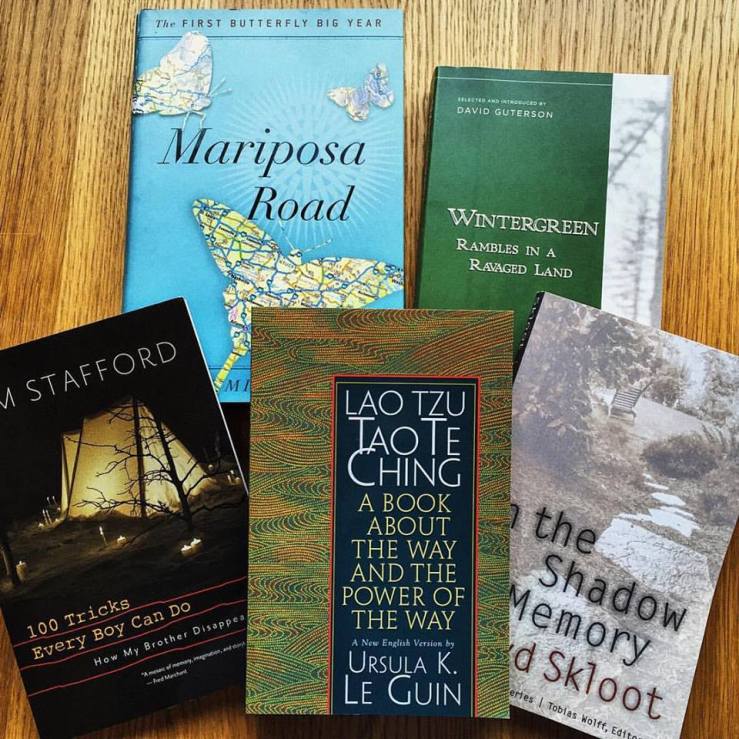
Five books
Books purchased at the Wild Arts Festival in Portland, signed in person by the authors.


Litmosphere: 1. the vast domain of the world’s readers and writers 2. a lively literary mood permeating the air ~ sign in Powell’s Books, Portland

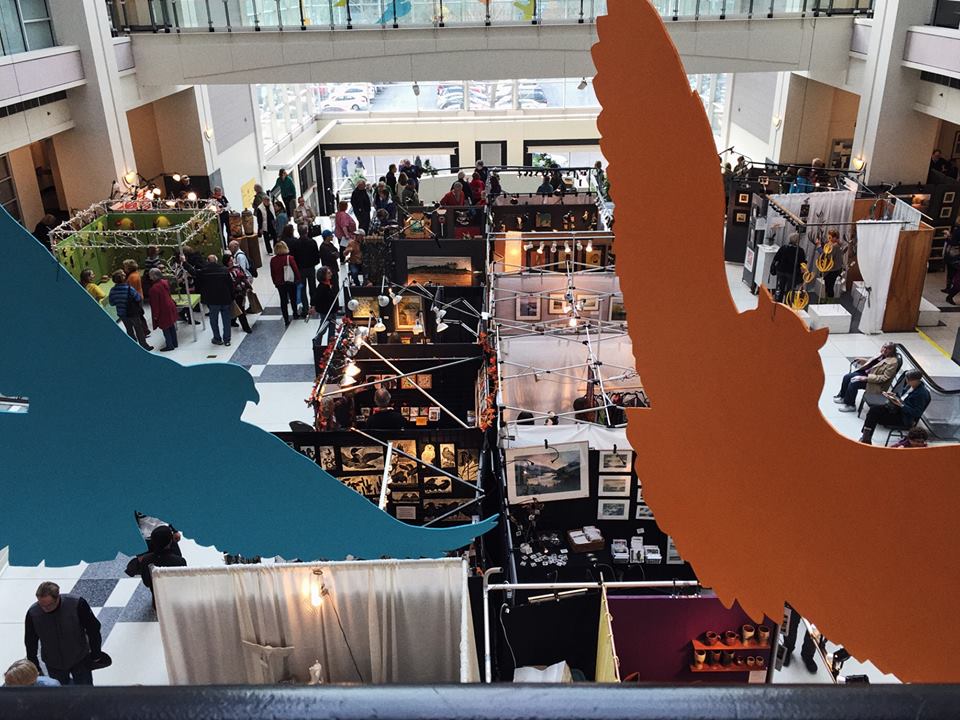
Wild Arts FestivalI love the literary scene in Portland. Our Thanksgiving visit there coincided with the annual Wild Arts Festival, a celebration of nature in art and books hosted by the Audubon Society of Portland in the old Montgomery Ward building, now known as Montgomery Park.

Walking into the festival, where hundreds of artists and authors were on hand, was like getting a gigantic embrace from the creative community.

I couldn’t decide among Ursula Le Guin’s many, many science fiction and fantasy books. In the end I chose her translation of Lao Tzu: Tao Te Ching: A Book About the Way and the Power of the Way, and she graciously signed a copy for me.

Next, we met Robert Michael Pyle, a jolly teddy bear of a man who spent no less than 15 minutes entertaining us with stories about how, in his Honda Civic with 345,000 miles on the odometer, he spent a year searching for as many of the 800 species of American butterflies as he could find. I could have spent hours listening to this man; instead I bought his memoir and travelogue, Mariposa Road, which he signed with, “May these far rambles on bright wings incite your own wild road trips!”

A dedicated ecologist and naturalist, Robert Michael Pyle has written nearly 20 books and is the co-editor of Nabokov’s Butterflies: Unpublished and Uncollected Writings. (The literary genius Vladimir Nabokov was a butterfly expert and had an extensive collection.)

I purchased another of Robert’s memoirs, Wintergreen: Rambles in a Ravaged Land, about Washington’s Willapa Hills, whose forests have been plundered by lumber companies. Robert lives on a farm in Grays River once owned by a Swedish immigrant. I’m descended from Swedes, who were attracted to the deep forests of the Pacific Northwest because it reminded them of home; I’d love to see Willapa country one day. Of course, Robert signed Wintergreen, too, with these words, together with a sketch of a snail: “May these moss murmurs and fern-words honor your own hills of home – and maybe urge you Northwesterly!”

I can’t say enough about Floyd Skloot and Kim Stafford. They are both poets, and they’ve both written memoirs. (Actually, they’ve both written more than one, and I look forward to reading all of them.)

Since I’m writing a memoir myself, I decided to go for the memoirs: In the Shadow of MemoryFloyd Skloot’s first memoir (part neuroscience and part autobiography about a virus that left Skloot disabled and bereft of memories) and 100 Tricks Every Boy Can Do: My Brother’s Disappearance by Kim Stafford (his brother committed suicide.)

Both of these generous writers spoke with me about their work and asked at great length about mine. Kim wanted to know the working title of my memoir and, when I told him, he gave me a writing assignment to try. As I did the exercise Kim recommended, I discovered that one particular word in the title is especially important to my memoir’s theme. It got me thinking about how I could bring out the theme more vividly as I revise.

The authors I spoke with at the Wild Arts Festival were incredibly kind and gracious. I had instant connections with these generous writers, who are among the best in America today. Don’t be shy at these kinds of events. Writers and artists are the most giving and engaged people you’ll ever meet.

Portland is a book-loving town, and as I walked around the neighborhoods with family, I noticed several Little Free Libraries. It’s also a poetry-loving town, and a couple of the homes I passed by had poems on display – including one by Kim Stafford’s father, the great poet William Stafford.

Slipped inside the Kim Stafford memoir I bought was the gift of a poem that begins, “The only heroic thing is to not be a hero.” I believe Kim borrowed this phrase from a poem by his father, William: “At the Un-National Monument Along the Canadian Border.”

Kim’s poem is called “A Few Words, Each Day,” and it includes this line: “The only heroic thing is to be a child of four…of fifteen…of forty…of eighty – trying with the heart and mind to listen to the self, each other, and the earth….”

Litmosphere definition sign in Powell's Books
We stopped by Powell’s Books for good measure, where I learned a new word.


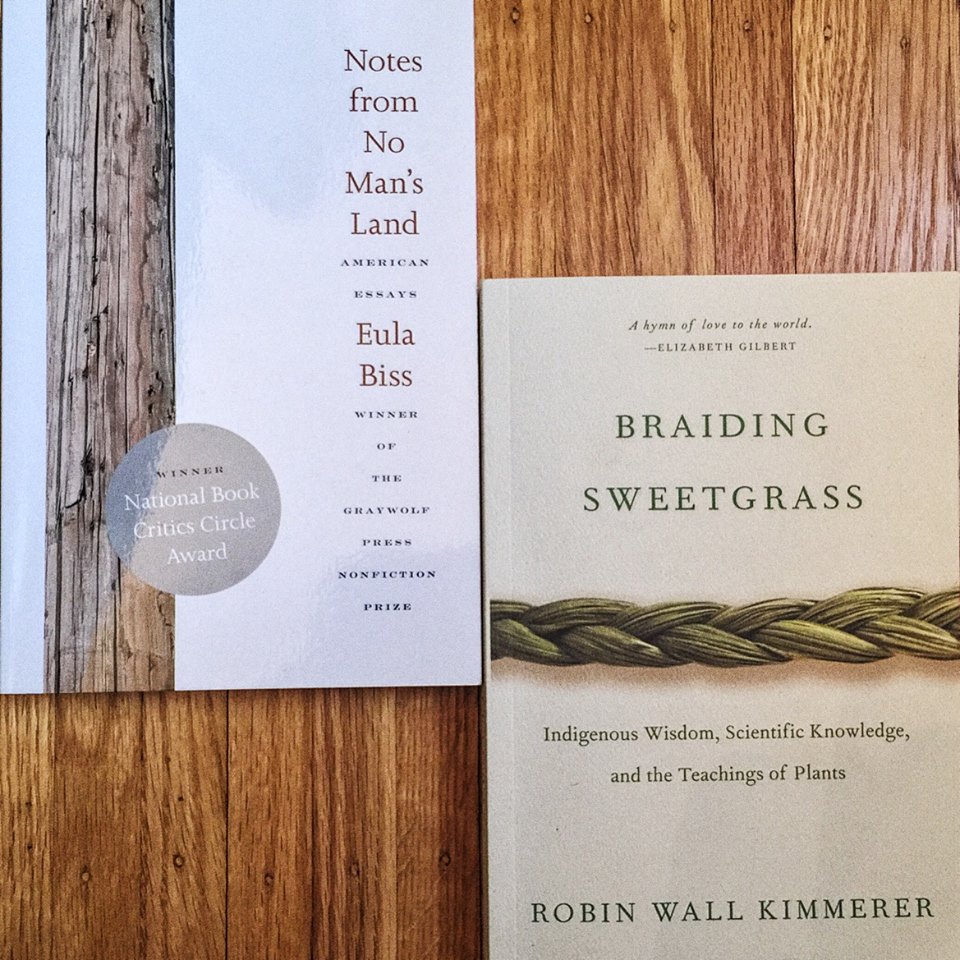
Books: Braiding Sweetgrass; Notes from No Man's Land
At Powell’s I bought Eula Biss’s collection of essays and the latest book by Robin Wall Kimmerer, who is a botanist and member of the Citizen Potawatoni Nation.


Northern spotted owl at the Wild Arts Festival


Kim Stafford: “That is my story.”


Bad Feminist? Good Feminist? Anti-Feminist?

Bad Feminist book cover“You think you are alone until you find books about girls like you. Salvation is certainly among the reasons I read. Reading and writing have always pulled me out of the darkest experiences in my life. Stories have given me a place in which to lose myself. They have allowed me to remember. They have allowed me to forget. They have allowed me to imagine different endings and better possible worlds.”  Roxane Gay, Bad Feminist

Where do I begin? It’s hard to know because Roxane Gay covers so much ground in her collection of essays, Bad Feminist. Her voice is unmistakable: hilarious, informed, opinionated, eloquent, vulnerable.

What a great read for a book club, especially if your club is diverse in terms of race, gender, political persuasion, and economic status. (Or are book clubs of such diversity scarce?) Oh, the discussions you’ll have.

Roxane Gay is a black woman, a feminist (a darn good one), a Ph.D and professor, a single woman of a certain weight, a liberal, a fan of reality TV and rap music, a best-selling novelist and author. She’s tired, because she does all these things – Roxane admits as much, but as one of those driven people she says she can’t stop.

She writes about all of this and more in her essays. Occasionally she leans toward the shrill, but mostly not – Roxane is very good at getting you to think while entertaining you at the same time. For certain, you won’t always agree with her, but you’ll have plenty to mull over.

Her writing is so, so timely in light of the discussions we’re having in this country about race. Roxane recounts movingly what it’s like to be the only female black professor in her academic department. She dissects her reactions to movies such as The Help and other depictions of race and racism in entertainment, discussions I found nuanced and enlightening, and sometimes difficult to take as I recognized myself in some of the attitudes she highlights.

I had chosen not to see The Help when it was released a few years ago, because I’d read an opinion piece by a black woman who said all the women in the movie who are racist are nasty, while all the women who are not racist are likable–when in fact it had been her experience that many people who were racist were the nicest people you’d ever meet.  Roxane highlights these and other kinds of stereotypical and overly-simplistic portrayals in a number of popular TV shows and movies.

As for feminism, Roxane writes honestly about personal trauma that in part has shaped her views. (I won’t go into that here, to avoid spoilers.) She addresses the sad state of affairs for women in the US, where women of reproductive age are finding it harder to obtain contraception, where politicians make outrageous statements about rape and other matters they don’t seem to understand. (Such as the infamous, women who are victims of “legitimate rape” rarely get pregnant.)

Recently Yahoo CEO Marissa Mayer took a lot of flak for criticizing feminism.  Yet look at what is happening in the tech world, with apparent widespread discrimination against women who are coming up in their careers. One would think things would be better for younger women but that doesn’t appear to be the case.

I have to admit that at one time I would not have considered myself a feminist, though not anymore, especially given that I’m startled by how much ground women have lost in this country. Being of a certain age, I’ve come to respect much more than I did what the first and second wave feminists accomplished for all of us. I’ve been concerned, too, when I’ve not heard more of an outcry from younger women over recent trends. So it’s a relief to read Roxane Gay’s take on all this.

Here are some of my favorite quotes from her essays:

“I embrace the label of bad feminist because I am human. I am messy. I’m not trying to be an example. I am not trying to be perfect. I am not trying to say I have all the answers. I am not trying to say I’m right. I am just trying—trying to support what I believe in, trying to do some good in this world, trying to make some noise with my writing while also being myself.”

And,

“We don’t all have to believe in the same feminism. Feminism can be pluralistic so long as we respect the different feminisms we carry with us, so long as we give enough of a damn to try to minimize the fractures among us.”

And,

“It’s hard not to feel humorless, as a woman and a feminist, to recognize misogyny in so many forms, some great and some small, and know you’re not imagining things. It’s hard to be told to lighten up because if you lighten up any more, you’re going to float the fuck away. The problem is not that one of these things is happening; it’s that they are all happening, concurrently and constantly.”

Did I say I think you should read Bad Feminist?

Have you read Bad Feminist? What did you think?

I’ve ordered a copy of Laudato Si’, Pope Francis’ encyclical on climate change. It is available from Amazon and other booksellers, and you can download the pdf at this link: Laudato Si’ . I’ll be writing about it here in late July, mostly from a secular perspective. Why don’t you read it with me – I welcome your thoughts, faith-based or otherwise.

Spring flowers and Colette, in Paris

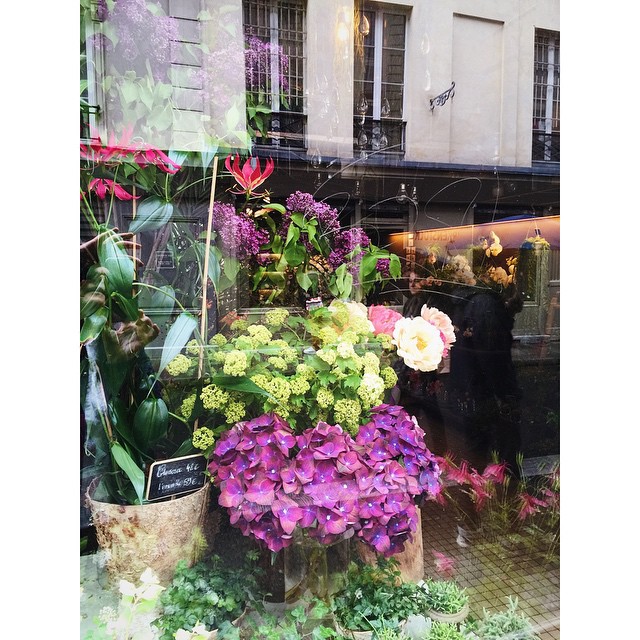
Floral shop window
“As noisy as Paris was in those days, it always had its unexpected moments of stillness. At Cours-la-Reine, between one and one-thirty in the afternoon, when the last trucks had reached their canteens, those who loved flowers and silence could savor a strange respite, a solitude in which the flowers seemed to recover from human curiosity.”

******************

We’ve been in Paris, where our son has been studying and working in industrial design. I had so much fun walking around this enchanting city which, among other treasures, has secret gardens galore, flower vendors and flower markets, and floral shops offering spring flowers, herbs, and foliage, all beautifully arranged and presented.

Flowers and Fruit book coverA few years ago I was browsing in a local used book shop when I discovered a volume of essays by Colette, Flowers and Fruit, first printed in the US in 1986.

Some of the essays were inspired by a Swiss publisher, who for a time sent Colette a bouquet of flowers once or twice a week so she could write sketches of those that inspired her.

Colette wrote one of the longer essays in this collection, “Flora and Pomona,” during the Nazi occupation. According to the collection’s editor, Colette conceived of the writing project to “keep the coal bin at 9, rue de Beaujolais well filled and pay the black-market prices for rabbit and cheese and chicken and other comestibles otherwise unavailable, even to much-loved novelists living in the Palais-Royal.”

At the time of its publication, some critics said factual errors, weak editing, and a less than adequate translation detracted from Flowers and Fruit. I find Colette’s writing challenging, so this isn’t the kind of book I’d read straight through. It’s a little treasure for floral enthusiasts that’s fun to browse when I want Colette’s unusual take on flowers.

We were lucky to be in Paris on May Day. This holiday’s signature flower is lily of the valley, one of my favorites. They were everywhere.

Here are some of my Paris floral photos paired with Colette’s thoughts on flowers and gardens:

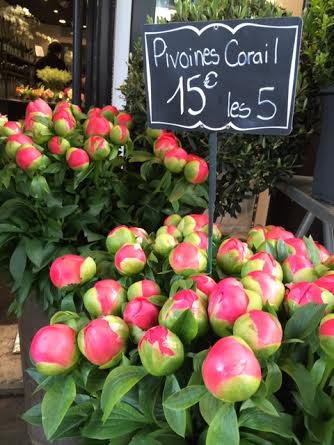
Peonies
“Garnet red, bright pink, sentimental pink, and three or four other carmine reds, they are the colors of good health and will delight me throughout the coming week.” (These peonies have not yet opened, which is when you should buy them.)
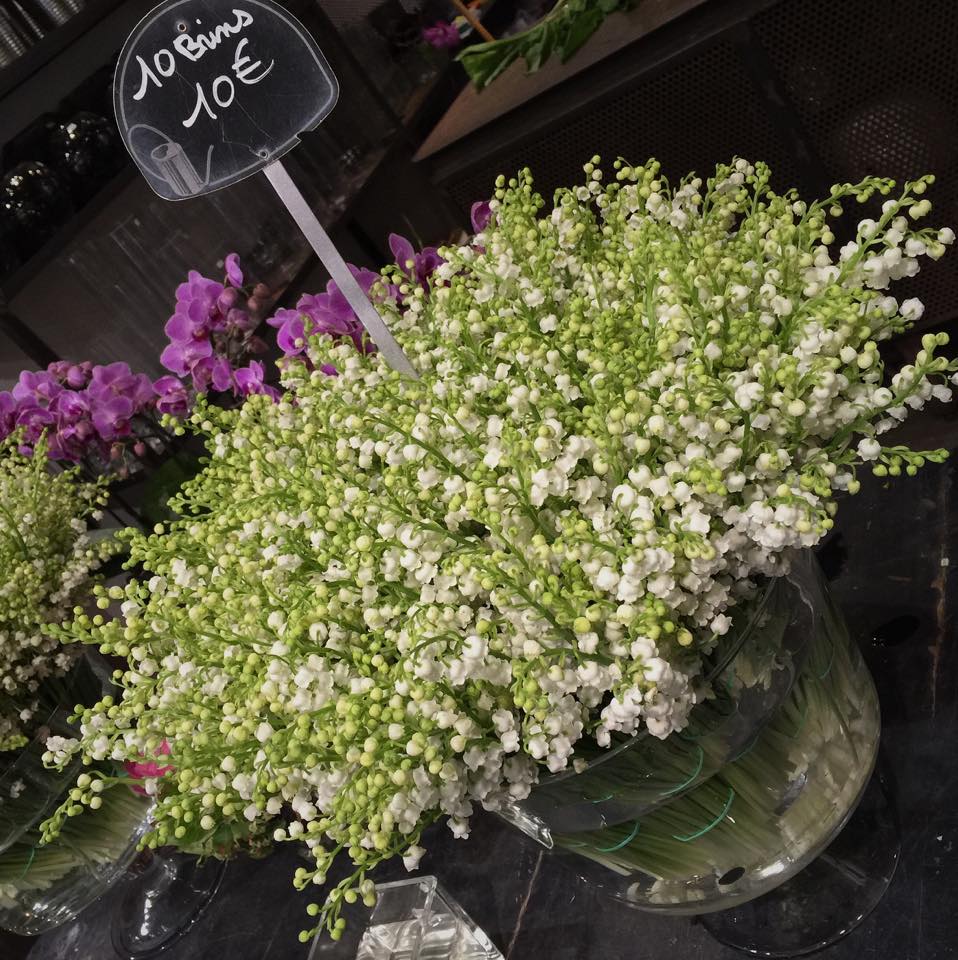
Lily of the valley
Lily of the valley is the May Day flower in Paris. “In spring, nearly an entire nation demands lily of the valley like bread.”
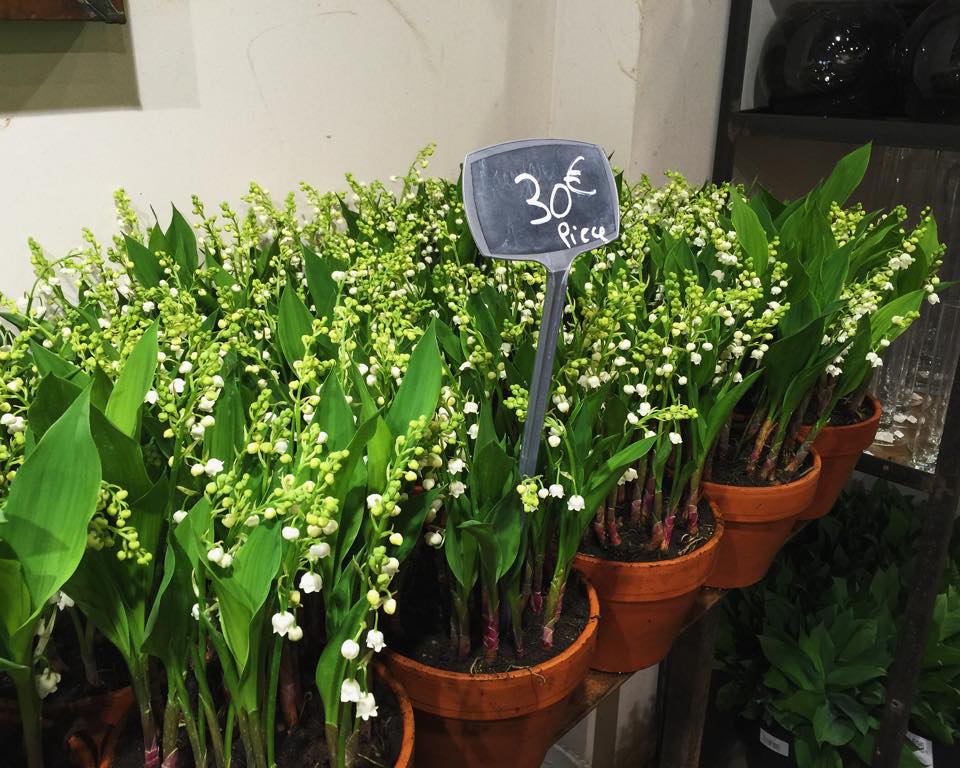
Pots of lily of the valley
“More than a flirtation, better than a superstition, almost a religion, the lily of the valley is celebrated on the first of May. Its cult stirs the Paris population to fever pitch…”
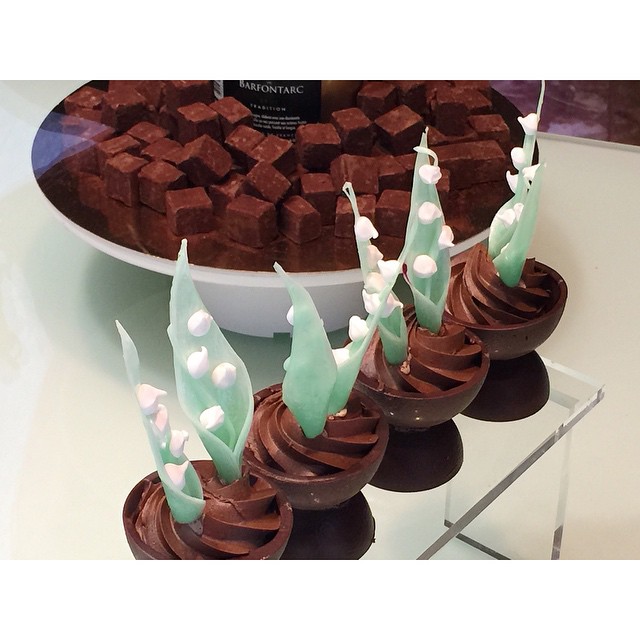
Chocolate & lily of the valley
You’ll find lily of the valley everywhere on May Day, even at the chocolatier. I saw these lovely desserts at Sylvain Mussy on Rue Bourg Tibourg.


Lily of the valley bouquet
My May Day bouquet. Lily of the valley, gloriosa lily (also known as fire lily or flame lily), and angel hair fern. “The true lily’s favorite soil is the kitchen garden’s, with tarragon, sorrel edgings, and purple garlic for neighbors.”
Flowers
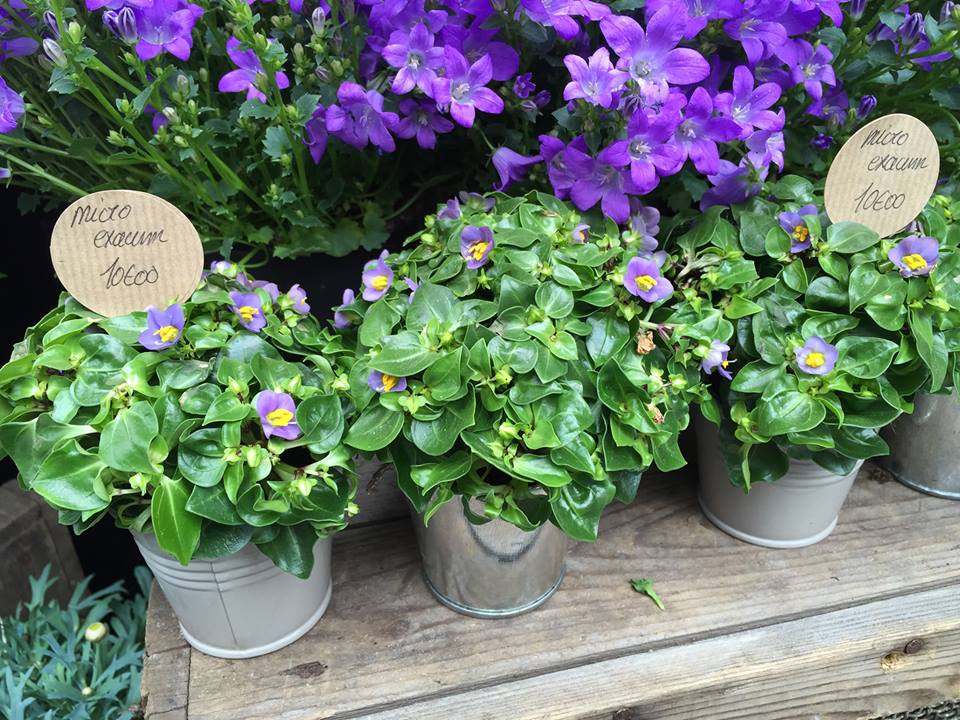
Campanula and Persian violets. “…the sleeve of blue-violet campanula that grows immoderately, framing the windows in a single rush and decking them with flowers all season long.”
Pink and white roses
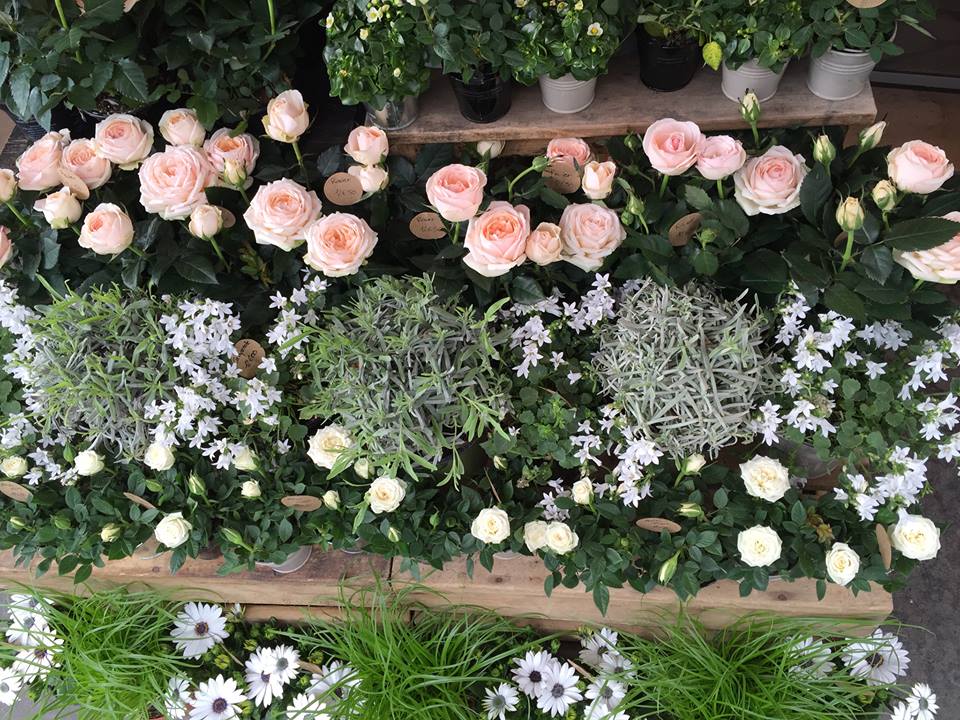
“Below my window, among the puddles of water, the bathing pigeons….we have old-fashioned, floriferous rosebushes that have survived both war and frost. Never have they failed to flower, and to flower again, and yet again before November.”
Stone figures on garden wall
There are many secret gardens hidden on the side streets of Paris, where the public is welcome.
Garden flowers
This one is Square Georges-Caïn on Rue Payenne. “Creating a garden takes us back to childhood imaginings.”
Paris street with plants, flowers
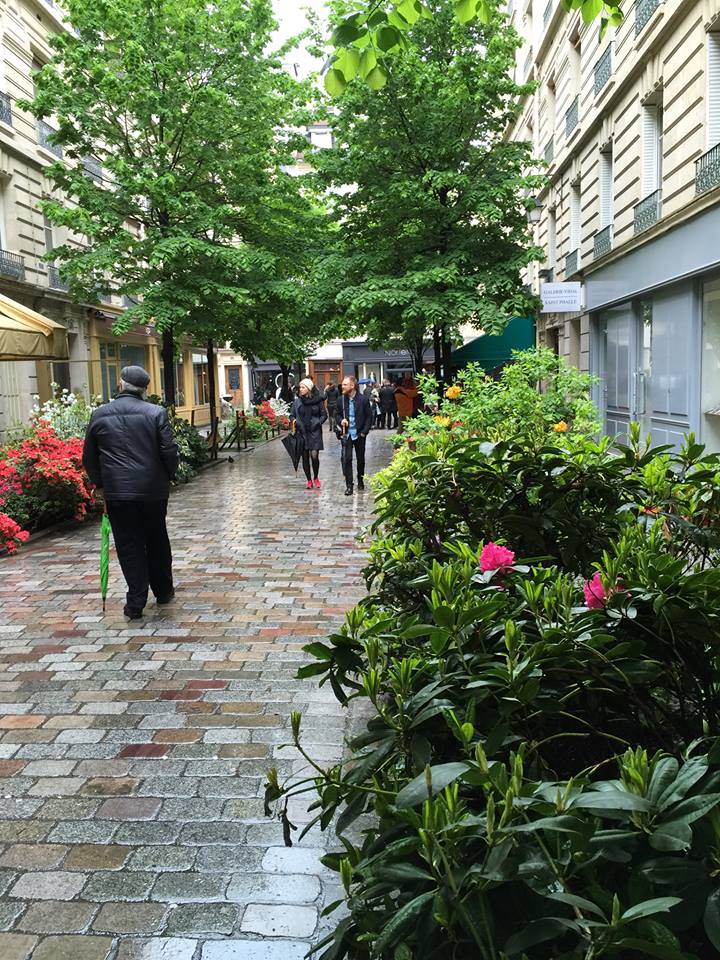
Some streets, like Rue du Trésor, are gardens, too.