Winter reading

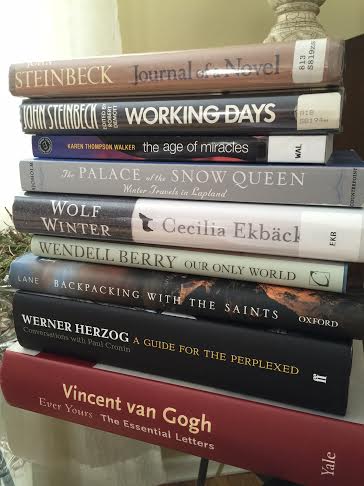
Stack of books


I’ve been out of town. A stack of books from the library and online were waiting when I got home.

The Steinbeck work journals for East of Eden and The Grapes of Wrath are recommended by Louise De Salvo in The Art of Slow Writing as essential if you’re writing a book-length work and want to learn about process.

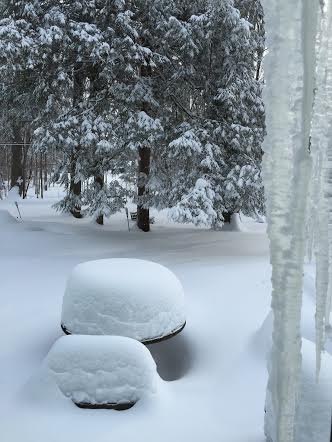
Deep snow in backyardThe Age of Miracles is this year’s selection for “If All of Rochester Read the Same Book.” We love to read through the deep winters in our part of the world, and this novel of catastrophe and survival will be on many a nightstand here. Why not try it along with us – I’ll be writing about this debut novel by Karen Thompson Walker soon.

The Palace of the Snow Queen: Winter Travels in Lapland, a memoir, and Wolf Winter, a novel. I want to know more about my Scandinavian roots; biography, memoir, and fiction are a great way to explore ancestry and heritage.

Wendell Berry’s Our Only World (ten essays), because Berry is one of our greatest prophets, writing about the clash between humanity and nature and how we must do better. He’s been called a modern-day Emerson or Thoreau.

Backpacking with the Saints, a travel narrative and spiritual memoir. Belden C. Lane’s take on Celtic, Catholic, Protestant, Buddhist, Hindu and Sufi Muslim writings as he treks the Ozarks and the American Southwest. The book jacket compares him to other lovers of the backcountry, including John Muir and Cheryl Strayed, whose memoir, Wild, was just released as a movie.

Werner Herzog: A Guide for the Perplexed, is an overdue Christmas gift for my photographer son. This newly published series of interviews with the filmmaker is so popular it’s been out of stock. I hope he finds it worth the wait.

No one writes about creating art with as much love and eloquence as Vincent Van Gogh.

More about these in upcoming posts at Books Can Save a Life.


The Empathy Exams

“It’s news if a woman feels terrible about herself in the world – anywhere, anytime, ever.”    Leslie Jamison, The Empathy Exams


At work when I need a break, I go for coffee in the atrium of the medical school. On the way, I pass by the learning labs, where occasionally I see people–young, middle-aged, and older, male and female–sitting in the hallway, waiting for their turn to go in.

They have a twinkle in their eye as though they know something you don’t. They’re psyched, as if prepared to give a performance. That’s because they’re medical actors, hired so medical students can practice their empathic patient interviewing and diagnostic skills.

The Empathy Exams book coverIn The Empathy Exams, author Leslie Jamison explains what a medical actor does. She knows because she’s been one herself:

“My job title is medical actor, which means I play sick. I get paid by the hour. Medical students guess my maladies….

Medical acting works like this: You get a script and a paper gown. You get $13.50 an hour. Our scripts are ten to twelve pages long. They outline what’s wrong with us–not just what hurts but how to express it. They tell us how much to give away, and when. We are supposed to unfurl the answers according to specific protocol. The scripts dig deep into our fictive lives: the ages of our children and the diseases of our parents, the names of our husbands’ real estate and graphic design firms…

My specialty case is Stephanie Phillips, a twenty-three-year-old who suffers from something called conversion disorder. She is grieving the death of her brother, and her grief has sublimated into seizures. Her disorder is news to me. I didn’t know you could convulse from sadness. She’s not supposed to know either. She’s not supposed to think the seizures have anything to do with what she’s lost.”

These are the first paragraphs of the first essay in The Empathy Exams, and they intrigued me for a number of reasons: Leslie’s compelling voice; her take on the ironies and subtleties of medical acting; and because I, too, had been nonplussed when, as a medical librarian, I learned about conversion disorder.

A couple of years ago an “outbreak” of conversion disorder (known as mass psychogenic illness) among a dozen or more high school girls in a nearby upstate New York town captured the attention of media around the world.  One after another, the girls succumbed to uncontrollable tics and verbal outbursts. They were besieged with requests for interviews. Their physicians advised them to avoid social media so the frenzy wouldn’t cause their symptoms to get worse. Some people thought the girls were faking their illness. Erin Brockovich (with lawsuits in mind) suspected environmental poisoning. At the medical center where I work, I was asked to track the news coverage. Neurologists wanted to see if there was a correlation between spikes in media attention and exacerbation of the girls’ symptoms.

No environmental cause was ever found. Eventually, most of the girls recovered. One journalist wrote a well researched investigative piece that pointed out the girls came from troubled families in a town devastated by unemployment. Many of the girls had recently experienced significant domestic trauma. Perhaps this trauma triggered their conversion disorder.

In her essays, Leslie is concerned about physical and emotional pain, what it means to empathize with those who suffer, how difficult this can be, and why it is important to have our pain acknowledged by others, given the fact that we’re so often quick to accuse people of succumbing to victimhood. I often think about this when I read reviews dismissive of memoirs as self-indulgent. I wonder if I’m playing the victim when I write about some of my own experiences. Ours is not an empathic culture.

Leslie writes about her own pain and that of others in various walks of life: those suffering from “phantom” illnesses; a man in federal prison for a minor crime; ultra-marathoners who push their bodies beyond reason; three teen-age boys accused of murder on the thinnest of evidence.

As I read, I began to think of the girls with conversion disorder in a more nuanced way and, yes, with greater emapthy. The media stories had reduced the girls to caricatures. Leslie’s essays got me thinking the girls hadn’t had their fair share of empathy (or good fortune) in their personal lives and certainly not during the sensationalistic coverage of their illness.

I’d just about finished reading The Empathy Exams when I read a New York Times article about the alleged rape of a college freshman, Anna, by two football players. After what seems to have been a staggeringly incompetent college “investigation,” the football players were cleared. Anna left school after she was harassed for making accusations against members of the football team, but she plans to return this fall. She doesn’t want to be defeated, and she wants to help other women on campus.

I couldn’t get this story out of my mind.  I mulled it over when I went to work out at our community center. The story has unleashed a firestorm, with accusations back and forth: between Anna and the football players, as well as among college officials, the district attorney’s office, and Anna’s legal counsel. Many of the kids–the football players, the fraternity members, the girls who went to the party – were drunk to the point of oblivion. (Anna, herself, was so drunk she doesn’t remember being raped – hence, some of the controversy – though others witnessed it and did nothing. One of Anna’s friends did help her, and other friends decided to call the police.) How can this self-destructive partying be fun for anyone, and why are students driven to do it?

If you believe the unbelievable numbers cited in this story–that 20 percent of college women are sexually assaulted–it does seem as though we are not paying attention to something important. That perhaps we need to start listening to a certain segment of the population, and listening with empathy.

After I finished exercising, I sat in the lounge overlooking the pool, watching moms and dads swimming with their children. I pulled out Leslie’s essays and read the final one, “Grand Unified Theory of Female Pain.” Leslie seemed to be speaking about Anna.

“It’s news if a woman feels terrible about herself in the world–anywhere, anytime, ever….

Sure, some news is bigger news than other news….But I don’t believe in a finite economy of empathy; I happen to think paying attention yields as much as it taxes. You learn to start seeing.

I think dismissing female pain as overly familiar or somehow out of date…masks deeper accusations: that suffering women are playing victim, going weak, or choosing self-indulgence over bravery. I think dismissing wounds offers a convenient excuse: no need to struggle with the listening or telling anymore.”

Leslie has much more to say, and her essays are far richer than I’ve captured here. I won’t share her most important insights, as much would be lost in the translation.

She’s a remarkable new writer.

Books at my door

Books at my doorDelancey book cover


If you like food writing combined with memoir, you will like Molly Wizenberg and her latest, Delancey: A Man, A Woman, A Restaurant, A Marriage. The restaurant is in Seattle. Her first book, A Homemade Life, is a bestseller.

Sicily book coverI bought Sicily: A Literary Guide for Travellers by Andrew and Suzanne Edwards for an upcoming trip – haven’t been there in seven years. Many of the greatest writers were drawn to this island.

Groundbreaking Food Gardens by Nikki Jabbour promises 73 plans that will change the way you grow your garden, such as: Slow Food Garden; Vintage Victory Garden; Edibles on a Patio; Heirloom Sampler; Formal Herb Garden; Eggs & Everything; and Living Walls.

Piazza, Carini
The piazza in Carini, Sicily, where my father was born

Cleveland was my home but I lost it

Go down and tell them what you’ve seen:

that the river burned and was not consumed.

“River on Fire” by David Lucas in Rust Belt Chic: The Cleveland Anthology

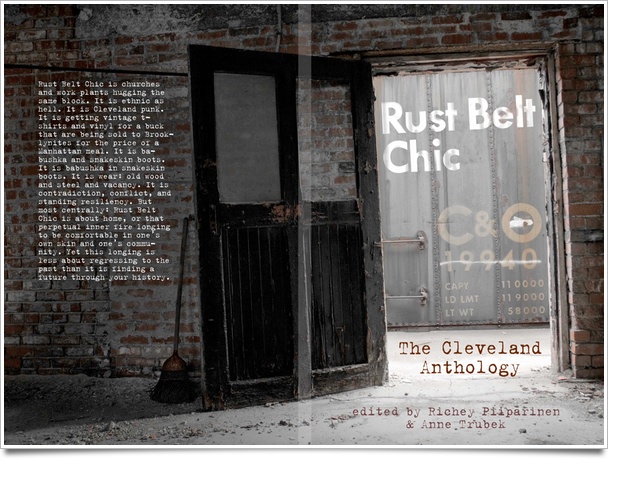
Rust Belt Chic cover photoI’ve been writing about the town where I grew up, how you can’t go home again and all that, and about my fraught relationship with Cleveland. This kind of ambivalence permeates Rust Belt Chic: The Cleveland Anthology, (published by the editors of the online magazine Belt) which I’ve been reading in between novels and book-length nonfiction. But all is not bleak – the collection includes a good share of essays by writers who unabashedly love Cleveland. The writing is excellent, the social commentary and history fascinating.

My childhood home just outside of Cleveland shared a driveway with our floral shop, where the locals bought their wedding and funeral flowers, Easter corsages and prom nosegays. We earned a good living in that small shop.

Those were prosperous times. I remember boarding a passenger ship docked on the dowtown shores of Lake Erie with my mother, some time in the late 1950s. We were going to visit my aunt, who lived in Michigan on the Detroit River, across from a mighty steel mill. This was no mere ferry we travelled on, but a big old steel ship; my memory of this seems outlandish to me now but, based on my cursory research, I presume we travelled on the SS Aquarama, a World War II troop carrier that was converted to a passenger ship after the war.

I loved going to my aunt’s house, where barges as big as factories floated past the backyard every day. Back then, Detroit and Cleveland were first-tier cities.

Today, Detroit is ranked first in the United States for poverty, and Cleveland is second.

As an adult, I moved to New York City, but eventually I settled and raised a family in another Rust Belt city on a lake (probably no coincidence). In Rochester, New York I worked for Kodak, for a time, but now the company is a shell of its former self. Rochester is ranked third in the US for poverty.

In 2008, my Ohio hometown was the epicenter of the mortgage crisis and still has not recovered. It has essentially become an extension of the blight that is East Cleveland. Homes have sold for as little as $1000 there. Other houses have been abandoned and stripped of their copper plumbing and aluminum siding. Many have been demolished.

Sometimes, I think about what it would be like to move back to Cleveland. I could host a book club for schoolchildren in the old flower shop. It would be a safe haven from the drugs in the vacant lot next door, the guns, the crime. We’d read poetry by Mary Oliver, who is from my hometown, and the novels of Toni Morrison, who is from Lorain. I’d give each child a book to take home.

But, of course, my life has long been elsewhere and I won’t move back. You can’t go home again and, besides, our house and the shop are (finally) about to be sold (fingers crossed).

Both optimists and pessimists write about Cleveland in this Rust Belt Chic anthology. (Rust Belt Chic anthologies of Detroit and Cincinnati have been published as well. Additional volumes are in the planning stages.) When it comes down to it, I’m essentially an optimist, because I don’t think things can get much worse, and I see a commitment to community and volunteerism among young people who choose to stay or settle in Rust Belt cities.

But I’m sad and bitter, too, when I think about what my childhood home has become. I feel shame, too, but I don’t mean I’m ashamed of where I’m from. I’m proud to be from Cleveland. Rather, I feel shame in the sense that we could have and should have done better in terms of taking care of our communities and each other.

What is the Rust Belt, and Rust Belt Chic? From the Cleveland Anthology

“What I’ve figured out, though, is that maybe I didn’t want baseball – I wanted Cleveland. I wanted to walk from the stadium past Tower City to my dad’s office parking lot at 11:34 pm after a Tribe game on a hot August night….ecstatic crowd walking outside the Gund, of guys in black sneakers and ladies with bra straps exposed and tans darker than the Cuyahoga in December….” Norene Malone

“I want to laugh when I hear that people are moving to Cleveland to practice their art. Then I want to spit in their faces….The first sign of the coming apocalypse is the art walk: the Typhoid Marys of gentrification. Developers show up, displaying all the sensitive charm of a multinational corporation….

All that beautiful decay, they seemed to say. Look at how wonderful this place used to be. Look how terrible it all was.”   Eric Anderson

“I was in love with Little Italy the moment I laid eyes on it, and still am, though it’s a long-distance thing now, with me pining away from the East Coast.”   Clare Malone

“But as Iraq fell apart on sectarian lines, Cleveland’s little Iraq fused closer together. I wasn’t authentic enough to intuit from last names and cities of origin which of our friends were Sunni and which were Shia, and for our purposes, the distinction was irrelevant.”   Huda Al-Marashi

“I have never, ever, met any single person of color with any great passion for this city.”   Jimi Izrael

“Rust Belt Chic is the opposite of Creative Class Chic. The latter [is] the globalization of hip and cool. Wondering how Pittsburgh can be more like Austin is an absurd enterprise and, ultimately, counterproductive. I want to visit the Cleveland of Harvey Pekar, not the Miami of LeBron James.”     Jim Russell

“The lips are gone. For years, they floated on an abutment at the base of the Detroit-Superior bridge in the Flats: a big pair of shiny red-enamel lips framing a mouthful of teeth….The lips first appeared sometime in the late 1970s, covering up an obscene tag someone had scrawled on the wall with an aerosol paint can. Below the lips was an equally mysterious signature announcing that this graffiti was the work of some so-called “Regional Art Terrorists.”    David C. Barnett

“Decades ago, Pekar’s work was already refuting the idea of the Rust Belt as a non-culture. Like today’s Rust Belt artists, he was fascinated by the city’s ethnic heritage, fluent in the history recorded in their grand architecture, obsessed with a sense of loss and ruin. But there’s one very important difference between him and his enthusiastic Rust Belt chic successors: Pekar’s view of Cleveland and the Rust Belt was almost entirely devoid of optimism.”  Erick Trickey

Mother and daughter in front of flower shop
Our flower shop, opening day


Note: The title for this post was inspired by a photograph on NewGeography.com.

The story of a happy marriage & the right to read

When Ann Patchett came home from school one day, there was a boy she’d never met in the kitchen. Turns out, he was one of four new step siblings. Her mother and his father had married, but they hadn’t yet told the six children who were now part of a blended family.

This Is the Story of a Happy Marriage book coverThis might be why Patchett likes to write novels about people from very different walks of life thrown together in extreme circumstances – such as in Bel Canto, my favorite novel of hers about terrorists, an opera singer, and political and business leaders in a hostage situation. (See also my post about State of Wonder.)

It may also have had something to do with why, for a long while, she’d been committed to staying single. Ann’s mother had twice divorced and her grandmother had divorced. In fact, divorce was scattered liberally throughout her family tree.

This is the Story of a Happy Marriage is a collection of Ann Patchett’s personal essays, one of them about her early divorce and her relationship with the man who eventually became her second husband. It’s an honest, personally revealing, and entrancing story about love and commitment.

Marriage is a metaphor for the many happy relationships in Ann’s life, including relationships with her writing, her bookstore, her grandmother, the strong and nurturing Catholic nuns where she went to school, and her dog. There are essays about all of this and more in Ann’s new book, a fine collection of meditations about life, love, and fulfillment.

I especially enjoyed Ann’s essay about writing, “The Getaway Car,” and those of you who write will like it as well. She is not of the school that everyone has one great novel in them, as a woman Ann met at a family reunion insisted. Ann usually has enough good sense to avoid such conversations, but this time she gave in.

“Does everyone have one great floral arrangement in them? One five-minute mile? One algebraic proof?”

“No,” the woman said. But everyone has one great novel in them “because we each have the story of our life to tell.”

Ann does not agree and writes about how difficult it is to convey what we know on paper. This is what she has to say about writing a novel:

“I make up a novel in my head…I don’t take notes or make outlines; I’m figuring things out, and all the while the book makes a breeze around my head like an oversized butterfly whose wings were cut from the rose windows in Notre Dame. This book I have not yet written one word of is a thing of indescribable beauty, unpredictable in its patterns, piercing in its color, so wild and loyal in its nature that my love for this book and my faith in it as I track its lazy flight, is the single perfect joy in my life…..

…I reach up and pluck the butterfly from the air. I take it from the region of my head and I press it down against my desk, and there, with my own hand, I kill it. It’s not that I want to kill it, but it’s the only way I can get something that is so three-dimensional onto the flat page….Imagine running over a butterfly with an SUV…What I’m left with is a dry husk of my friend, a broken body chipped, dismantled, and poorly reassembled. Dead. That’s my book……The journey from the head to the hand is perilous and lined with bodies.”

It stops most would-be writers cold.

Ann writes about the panic that set in when she sat down to write her first novel at a fine arts retreat, a story she’d been constructing in her imagination for a long while:

“Now that I was sitting still in front of a blank screen, I was appalled by all the things I hadn’t considered….until that minute I had never considered the actual narrative structure….what in the hell had I been doing all that time?”

She was tempted to throw out her idea altogether and start fresh, but an experienced writer told her to stay with her story.

“It was life-saving counsel,” Ann writes. “Without it, I could have spent the next seven months writing the first chapters of eighteen different novels, all of which I would have hated as much as I hated this one.”

There is another essay in the collection, “The Love Between the Two Women Is Not Normal,” that especially stands out for me. Ann had been best friends with Lucy Grealy, the acclaimed author of a memoir, “Autobiography of a Face.”  Lucy had cancer of the jaw at age nine and 38 reconstructive surgeries. She died of a drug overdose, and Ann wrote a book about their friendship, Truth and Beauty. The book had been assigned to the incoming freshman class at Clemson University in 2006, and Ann was invited to speak there at the beginning of the school year.

All was well until a Clemson alum, whose nieces and a nephew were students there, objected to the book assignment. “The book contains a very extensive list of over-the-top sexual and antireligious references…The explicit message that this sends to the students is that they are encouraged to find themselves sexually.”

A hue and cry ensued. Many angry parents wanted another book chosen and Ann’s invitation rescinded, while most of the students and Clemson’s administration supported Ann and the book selection. The Clemson alum held a press conference the day before Ann appeared, distributed copies of bad reviews of her book posted by Amazon readers, and took out a full-page ad in the local paper. The ad, among other things, accused Clemson of the sexual harassment of freshmen students and suggested the assigned reading of Truth and Beauty was insensitive because a Clemson student had recently been raped and murdered.

When the day came for an extremely nervous and alarmed Ann to speak in Clemson’s coliseum, there were protests, and the administration had arranged for her to have a bodyguard. 

Ann has included her Clemson speech, “The Right to Read,” in this collection of essays. Among other things, she said most of the freshmen students were old enough to vote and go to war and could make their own decisions about what to read and how they’d be influenced by it. She pointed out that if they had to be protected from Truth and Beauty, they’d most certainly need to be protected from Lolita and The Great Gatsby and Anna Karenina.

Weeks after her speech, it occurred to Ann many of the students in the audience had likely never read Tolstoy or F. Scott Fitzgerald or Nabokov, and so they probably hadn’t understood what she was talking about.

As for me, I’m disturbed every time I hear about a protest of this nature over a book. If Patchett’s Truth and Beauty can cause such a furor, we live in a frightening world indeed.

Joyce Maynard, Elizabeth Gilbert, George Saunders coming up

Been away for a bit while designer Nicole Bateman of The Pixel Boutique gives Books Can Save a Life a fresh, new look. (Thank you, Nicole!) But I’ve been reading, as always, and here’s what’s coming up:

After Her book coverAfter HerJoyce Maynard’s latest novel. Joyce has written several novels as well as the memoir, At Home in the World. After Her is loosely based on the true story of a serial killer who terrorized Northern California in the late 1970s.

Tenth of December – I don’t usually read short stories, but I’d heard so many wonderful things about George Saunders I had to pick up a copy of his latest collection when I saw it on our public library’s “Most Wanted” shelf. Besides, he teaches a stone’s throw away at Syracuse University – he’s someone I should know about.

Sons of MadnessI’ve written about Susan Nathiel’s excellent Daughters of Madness: Growing Up and Older With a Mentally Ill Mother, a collection of interviews with adult women. Sons of Madness: Growing Up and Older With a Mentally Ill Parent is a companion volume.

The Art of the Commonplace – I’ve always wanted to know what Wendell Berry is all about, so I’m reading his collection of agrarian essays.

Catching Fire, the second book in Suzanne Collins’ Hunger Games trilogy has been made into a movie and will be released November 22. I wrote about the first movie and book here, so I just have to check out the next installment.

The Signature of All Things book coverAnd last but not least, I can’t wait to dip into Elizabeth Gilbert’s latest novel, The Signature of All Things. Beautiful book jacket and end papers. The epigraph: “What life is, we know not. What life does, we know well.”  Lord Perceval

I’ll be back with a closer look at all of these.

Cheryl Strayed’s Wild changes lives

Pacific Coast beach, Oregon
Oregon coast (photo by Matt Hallinan)


One of my favorite columnists, Nicholas Kristof, wrote recently that Cheryl Strayed’s memoir, Wild, has inspired “hordes of young women” to hike the Pacific Crest Trail. 

Wild was one of the first books I wrote about on Books Can Save a Life. 

Strayed’s memoir has turned out to be not just a bestseller, but a transformational story that has given many women the courage to take enormous risks.

The other day I was reading an essay by Barry Lopez, “Landscape and Narrative.” He tells of visiting a small village in the Brooks Range of Alaska and listening to stories about animals and hunting. He says:

“The stories had renewed in me a sense of the purpose of my life.  This feeling, an inexplicable renewal of enthusiasm after storytelling, is familiar to many people. It does not seem to matter greatly what the subject is, as long as the context is intimate and the story is told for its own sake.”

Cheryl Strayed’s Wild has that kind of magic.

This summer Heather Anderson broke a record by backpacking the length of the Pacific Coast Trail, alone and without support, in 61 days.  It’s good to see women taking risks and feeling more at home in the world.

Columbia River
“Keep close to nature’s heart…and break clear away, once in a while, and climb a mountain or spend a week in the woods. Wash your spirit clean.” John Muir


Lopez quote: “Landscape and Narrative” in Crossing Open Ground by Barry Lopez, Vintage Books, 1989.

Still reading Barry Lopez

Stories…offer patterns of sound and association, of event and image. Suspended as listeners and readers in these patterns, we might reimagine our lives…As long as it took for me to see that a writer’s voice had to grow out of his own knowledge and desire, that it could not rise legitimately out of the privilege of race or gender or social rank, so did it take time to grasp the depth of cruelty inflicted upon all of us the moment voices are silenced, when for prejudicial reasons people are told their stories are not valuable, not useful.                    Barry Lopez

About This Life book coverIn the introduction to his essay collection About This Life: Journeys on the Threshold of Memory, Barry Lopez tells of meeting a man on a plane who asked what words of advice he could pass on to his teen-age daughter, who wanted to be a writer. This is what Lopez said:

She must read, and her choices should be whatever she is drawn to.

She should read the classics, too, but she’ll have to work harder to find stories of heroism, love, and our noblest values that are written by women.

Second, she must “become someone” and “speak to us from within those beliefs.”

Third, he advised that she “separate herself from the familiar.” After exploring other places and meeting a diversity of people, she`ll know why she loves the familiar and share this knowledge through her writing.

Early on, Lopez felt he was noticed, accepted, and rewarded as a writer in part because he was white, male, privileged and well educated. If you read his work, you’ll find he is keenly sensitive to the fact that many voices haven’t been heard because they are different or not within traditional circles of power. He thrives on traveling to the far corners of the earth and seeking these people out –  artists, artisans, farmers, naturalists, explorers who live close to the land, indigenous peoples, and others.

I was mesmerized by an essay in About This Life, “Effleurage: The Stroke of Fire.”  An Oregon potter and builder of a unique anagama kiln invites clay artists from around the world to fire their work. Jack doesn’t care about marketing or commercial success; he’s totally immersed in the process of making pottery out of materials from nature. Every three or four months, up to twenty artists bring their work to be fired in the Dragon Kiln.  Families, friends, even pets tag along. The firing goes around the clock for several days. Building the tremendous fire that heats the kiln is an art in and of itself. Different kinds of wood – black locust, maple, cherry, Lombardy poplar, red cedar – make different kinds of fires, and keeping the fire properly stoked is a community effort of like-minded artists who put aside their egos for the benefit of the group.

Lopez says you must become someone to write. I think he would agree the kiln designer and the clay artists are “becoming” through their life’s work, just as their clay pieces are forged in the fire. It’s a process that never ends. Even the clay pot continues to change, subtly, after the firing.

Crow and Weasel book coverOver and over, Lopez celebrates journeys into the unknown, strangers who become friends, coming home again, and the writing of the story. You see this in About This Life and in his fable, Crow and Weasel.

Recently, Lopez published a revelatory personal essay that has received a lot of attention, “Sliver of Sky,”  in Harper’s Magazine, about a period of sexual abuse he endured as a child. That Lopez waited until his seventies to write about this suggests how deeply confounding and wounding it was. The trauma and years of silence may explain in part Lopez’s empathy and compassion for others who were silenced for one reason or another. And no doubt it has contributed to his sense of mission as a writer.

I’ve written about years of being silent and feeling silenced by others because of my mother’s mental illness. I think that is partly why I didn’t make the commitment to becoming a writer when I was younger. How can you mature as a human being and as a writer when you can’t work with the very material that is woven into your identity?

If we’re silenced, we’re blocked. We don’t become our fullest selves. Diminished in what we are able to offer the world, the world will be diminished, too. It is in our bests interests to see that no one among us is silenced.

So I find reading Lopez to be a rare and important form of encouragement.

In an interview with Bill Moyers, Lopez says he’s viewed as a nature writer but, actually, he is writing about humanity.

“Every story is an act of trust between a writer and a reader; each story, in the end, is social. Whatever a writer sets down can harm or help the community of which he or she is a part.”

Quotes from: About This Life: Journeys on the Threshold of Memory, Barry Lopez, Vintage Books, New York: 1998.