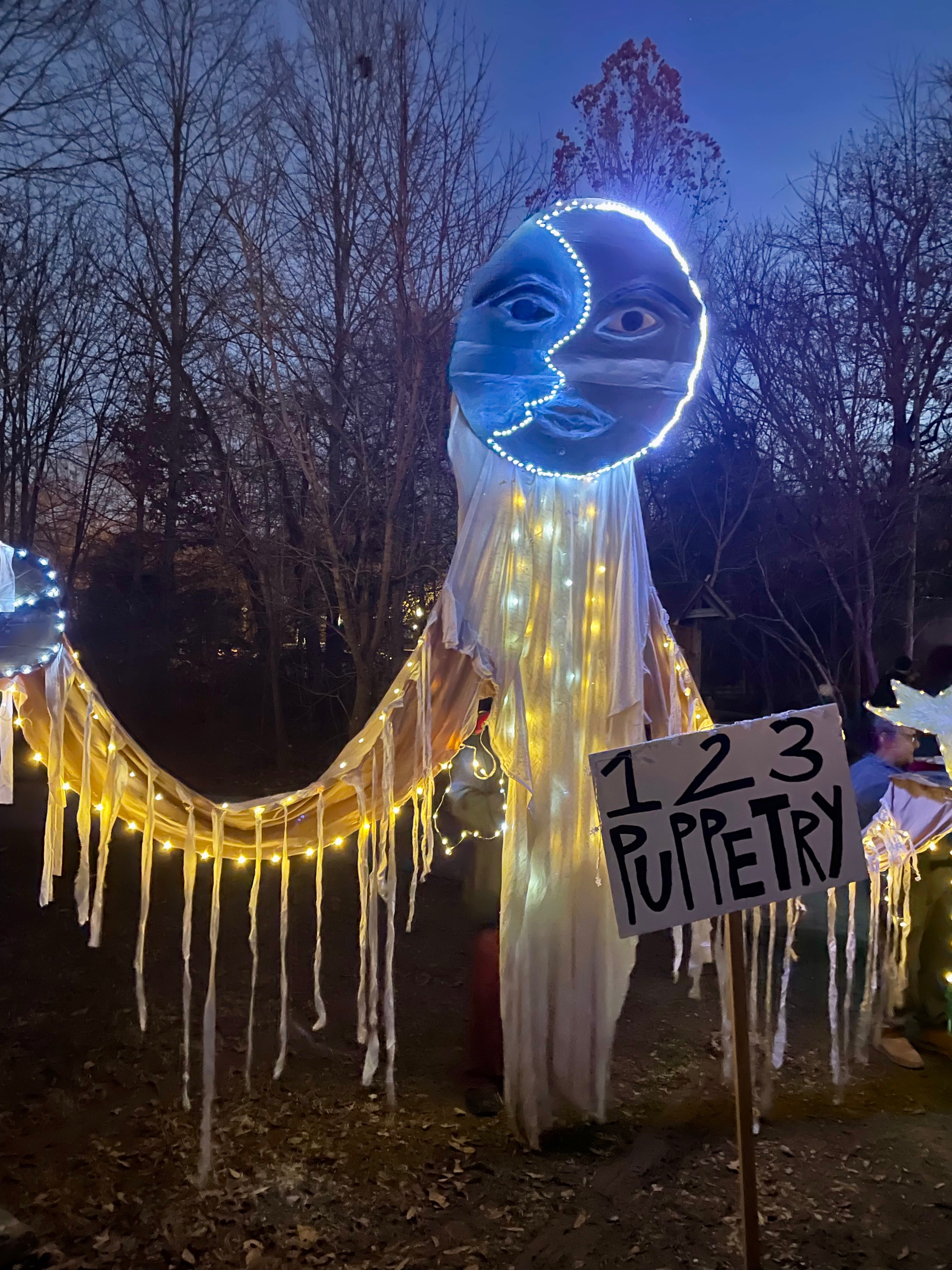
A highlight of the Winter Solstice Lantern Walk along the Eno River, NC, 2025.
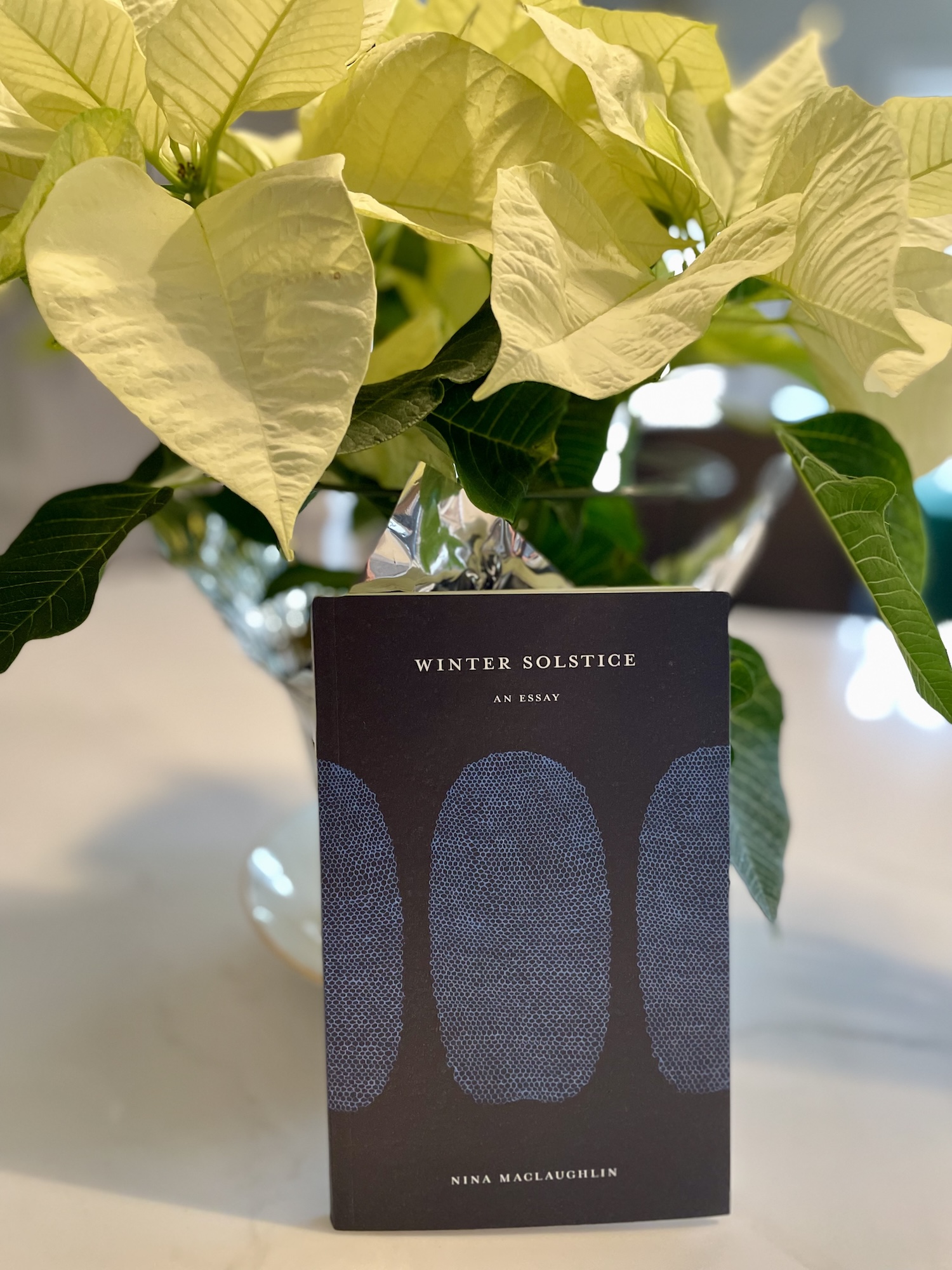
The fear is ancient and uncomplicated, part of our human-animal inheritance…will the darkness swallow me, will it swallow us all together? Nina MacLaughlin, Winter Solstice: An Essay
Happy New Year to my friends and readers!
Here is a post full of little treasures to light up your midwinter days and usher in the New Year.
Never in my life have I seen the winter solstice celebrated with so much exuberance. Last year, on our first winter solstice in Hillsborough, North Carolina, I assumed the annual lantern walk along the Eno River would be a quiet affair with a few dozen souls. Not at all. Thousands of people showed up with the most inventive homemade lanterns I’d ever seen.
Before you read past this paragraph, PLEASE click the link below to last year’s walk. It will put you in the mood for the rest of this post, which is full of all things Winter Solstice. In last year’s video, you’ll see drone footage of the magical riverside procession, an illuminated spiral, and beyond-belief lanterns, with a poetic narration by our town’s very own Poet Laureate, Amal Kassir. (YES, our town has a Poet Laureate. More about Amal at the end of this post.)
Here is the link. Please turn up your volume, enjoy, and then hop back over here:
I’ve sprinkled quotes from Nina MacLaughlin’s earthy, primal Winter Solstice essay throughout this post, because it speaks deeply to writer and mixed-media/book artist Suzi Banks Baum, who created and leads Advent Dark Journal. This is an immersion in art, writing, nature, and daily creative practice that I enjoy during the last six weeks of the year.
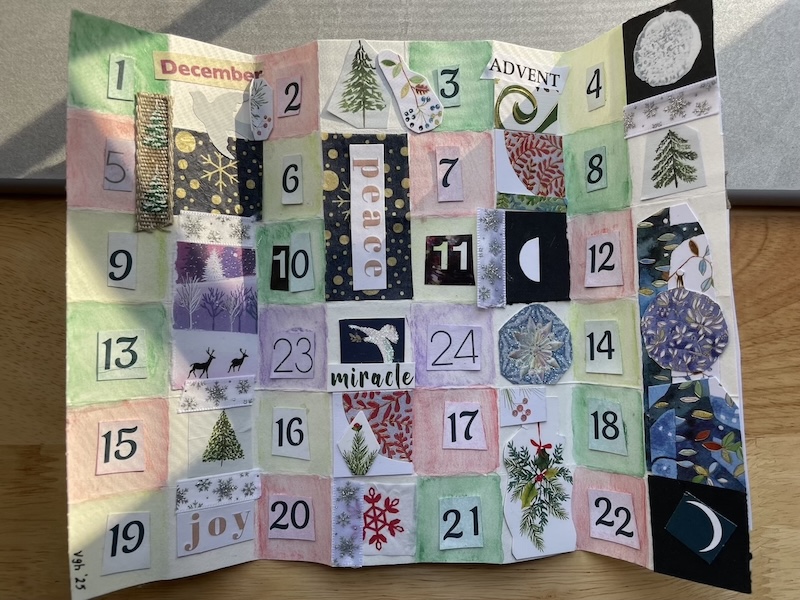
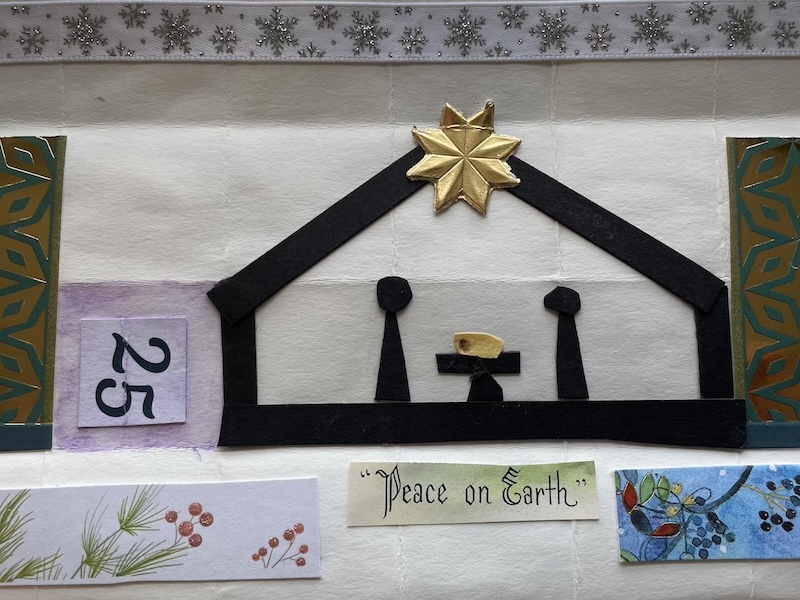
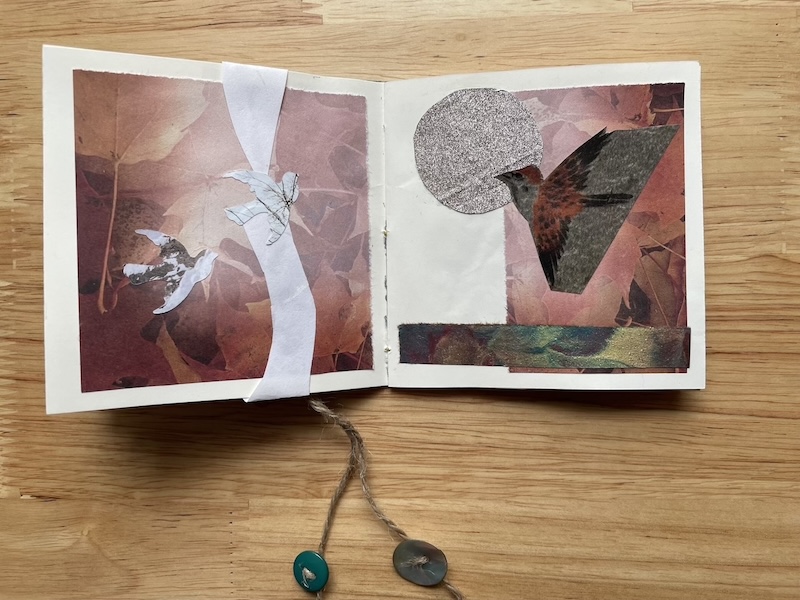
I’ll write more about Advent Dark Journal in an upcoming post, because Suzi and her creation are worth an in-depth look. For now, here is a glimpse of the small collage and art projects I’ve completed as part of this experience. You’ll see that my Advent calendar has a religious theme, but Advent Dark Journal is not centered around organized religion; rather, it is a “container” of rituals for participants to explore wherever our soulful arisings lead us during this sacred time of year.
“Advent Miracle”
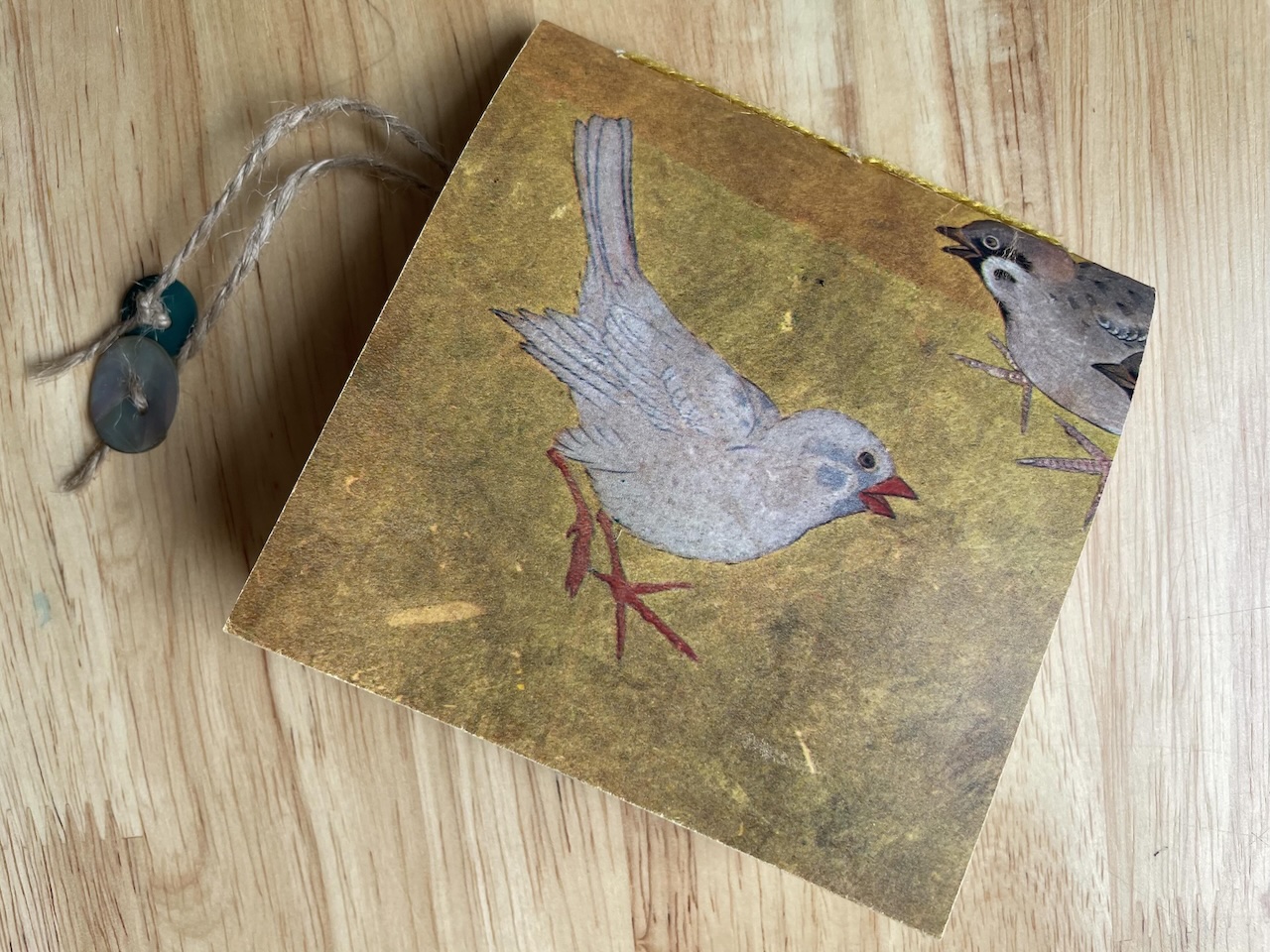
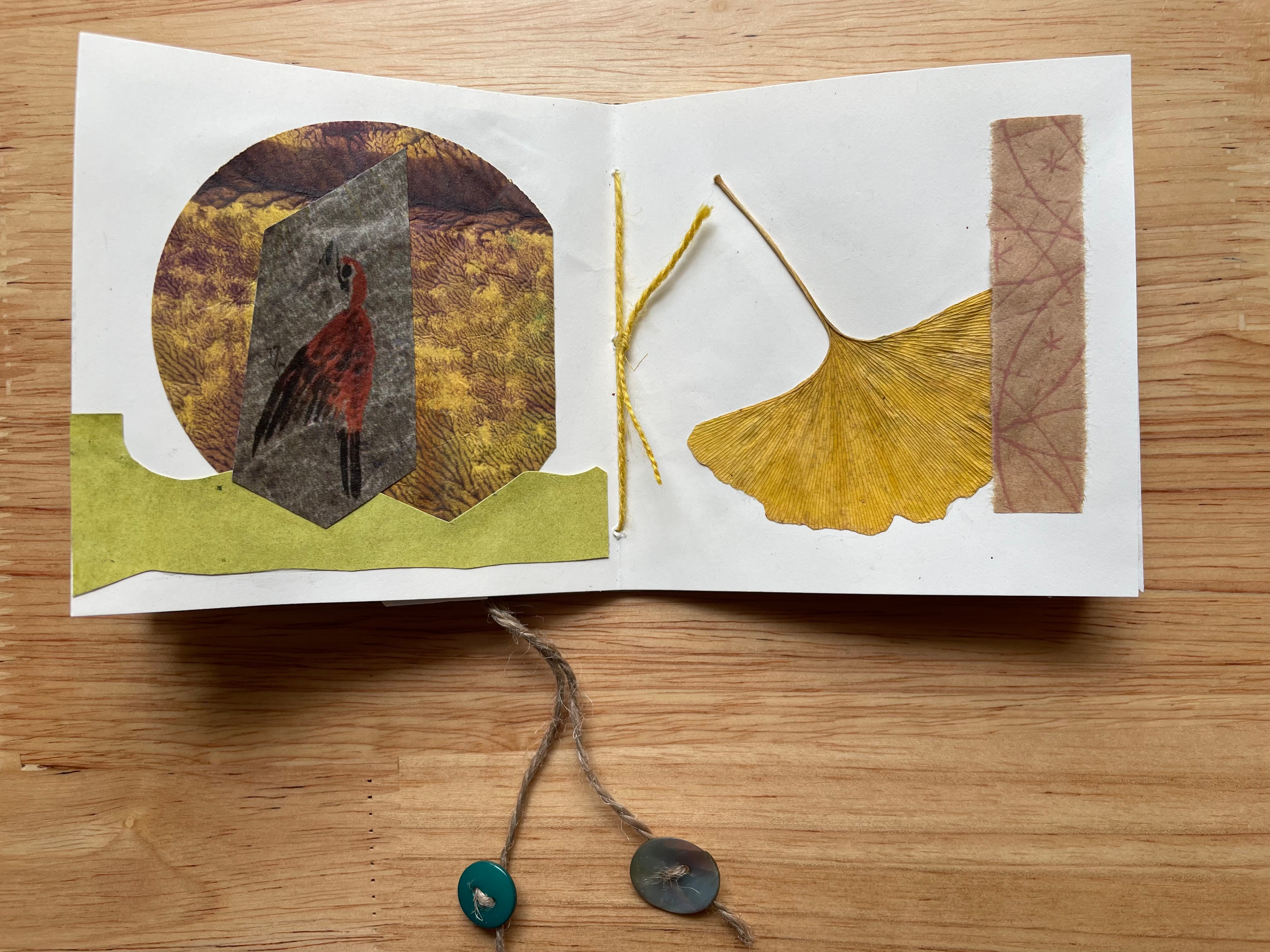
“Earth Holder”
These small, collaged journals and art pieces were sent off to friends – one in Australia – as soon as I completed them. In addition to the art we create in Advent Dark Journal, Suzi encourages us in new, transformational directions. Since I’ve become a regular in Suzi’s workshop, I’ve added a tradition our adult sons and partner enjoy when they visit for the holidays – a fireside Winter Solstice ritual. More about that in an upcoming post, but suffice it to say, Suzi has shown me how to weave a daily creative practice into my life in ways that promote my well-being and that of others in my life.
It is the animal in us that knows the dark. This season stirs that animal in us, and stirs the memories that live in all of us, submerged so deep, of the ancient dark, of a time before gods, before form and words and light….Winter reminds us: the dark was first.
…maybe death is all potential, a means of moving on. And on we go, absorbed into the wet warm belly of eternity, or the roaring big black void, back here as a robin or a wren, in dusted orbit around another planet’s moon, riding on the light. Winter Solstice
Nina MacLaughlin’s Winter Solstice is stellar writing, moody and mysterious. She reminds us of our primal, animal origins; ultimately, we are bound up in the life web and rhythms of the earth, whether we recognize this or not. I purchased Nina’s Summer Solstice essay as well, which I’ll read come summer.
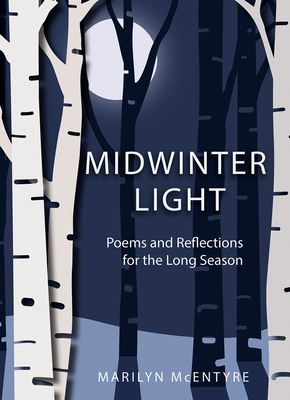
If you are interested in writing that is more traditional, something you can read in small bits alongside your daily journaling or meditation, I recommend Midwinter Light: Poems and Reflections for the Long Seasonby Marilyn McEntyre. Each day, she includes a poem with commentary that honors this dark season, when growth seems to stop but germinates unseen, to be manifested as the light returns.
“Winter makes us see differently. Noticing is rooted in desires so easily satisfied in spring we barely feel them—for color, for movement, for the sound of birds, and things that bloom. On a walk in midwinter, we experience solitude in a different key. We are surrounded by reminders of mortality and loss, by the absence of what is lush and vivid. We are clothed in layers and aware of our bodily needs in new ways. And the quiet, sometimes, is palpable. It is a good time for prayer: the veil between this dimension and the next seems to have thinned.” Marilyn McEntyre, Midwinter Light: Meditations for the Long Season
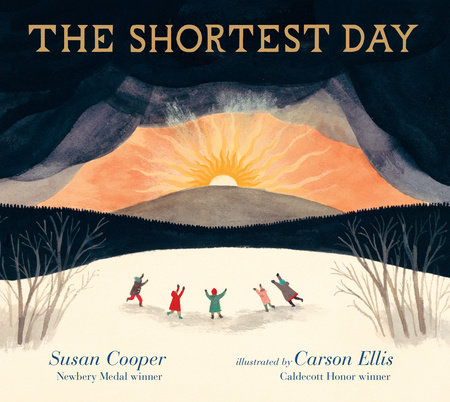
Finally, I discovered an excellent picture book with a poem by Susan Cooper and art by Carson Ellis. Both Susan and Carson have won the highest honors for children’s books, and this particular collaboration is special. Susan’s poem “The Shortest Day” is easy to find online. I encourage you to read it. I think you’ll find that Susan’s half-rhymes and cadence create an incantation that perfectly captures the magic and mystery of this dark season.
If you would like the perfect picture book for this time of year, for yourself, or as a gift, I suggest The Shortest Day, written by Newbery Medal winner Susan Cooper and illustrated by Caldecott Honor recipient Carson Ellis.
Happy New Year!
I will return in January with more about Advent Dark Journal, as well as commentary about a provocative documentary you won’t want to miss, especially if you are an avid reader and book-lover.
As Amal Kassir says in her winter solstice poem you may have listened to in the above-linked video, “It only gets brighter from here.”
By the way, PLEASE be sure to check out Amal Kassir’s website and watch her perform her heartbreaking poem, “Broken Arabic.” Her poetry collection, Scud Missile Blues, is available from Amazon. I encourage you to consider purchasing it. We need to support our young poets, and Amal is immensely talented. Just think of all the poems she has yet to give to the world!
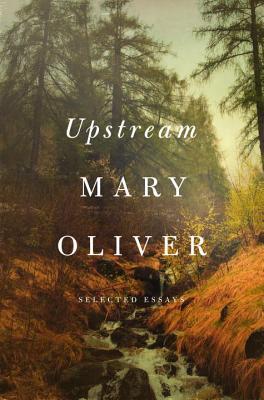
“The most regretful people on earth are those who felt the call to creative work, who felt their own creative power restive and uprising, and gave to it neither power nor time.”Upstream, by Mary Oliver
I’ve learned many things from America’s most beloved poet, with honoring one’s creative impulse being the most important, followed by: pay attention. She has shown us, through her poetry and essays, how to do both of these across the span of a long and fruitful life.
Her latest collection of essays, Upstream, (which contains both new and older work) is a look back at a life well lived, steeped in nature and literature. It has been on the New York Times Bestseller Nonfiction List for many weeks.
Oliver writes of the preoccupations and obsessions of the poets and thinkers that most influenced her, including Walt Whitman, William Wordsworth, Ralph Waldo Emerson, Edgar Allen Poe, and Percy Bysshe Shelley. You don’t have to like poetry to appreciate what she has to say about these fascinating writers.
I like those essays, but I love the more personal essays taken from daily life, my favorites being “Bird” and “Building the House.” I say personal, but Mary Oliver often shines a light on some miracle of nature – a wounded gull, or a female spider, or black bear – in a way that tells us much about her own life and her deepest beliefs.
If you have not yet read Mary Oliver, you could start by listening to a few of her most famous poems, such as “Wild Geese” and “The Summer Day” and “The Journey.”
Upstream is a beautiful little book for ringing out 2016, welcoming 2017, and reading on a cold winter’s night.
“I would say that there exist a thousand unbreakable links between each of us and everything else, and that our dignity and our chances are one. The farthest star and the mud at our feet are a family; and there is no decency or sense in honoring one thing, or a few things, and then closing the list. The pine tree, the leopard, the Platte River, and ourselves – we are at risk together, or we are on our way to a sustainable world together. We are each other’s destiny.”
Merry Christmas and Happy Holidays to all!
We’ve had this little birchbark canoe for many years.
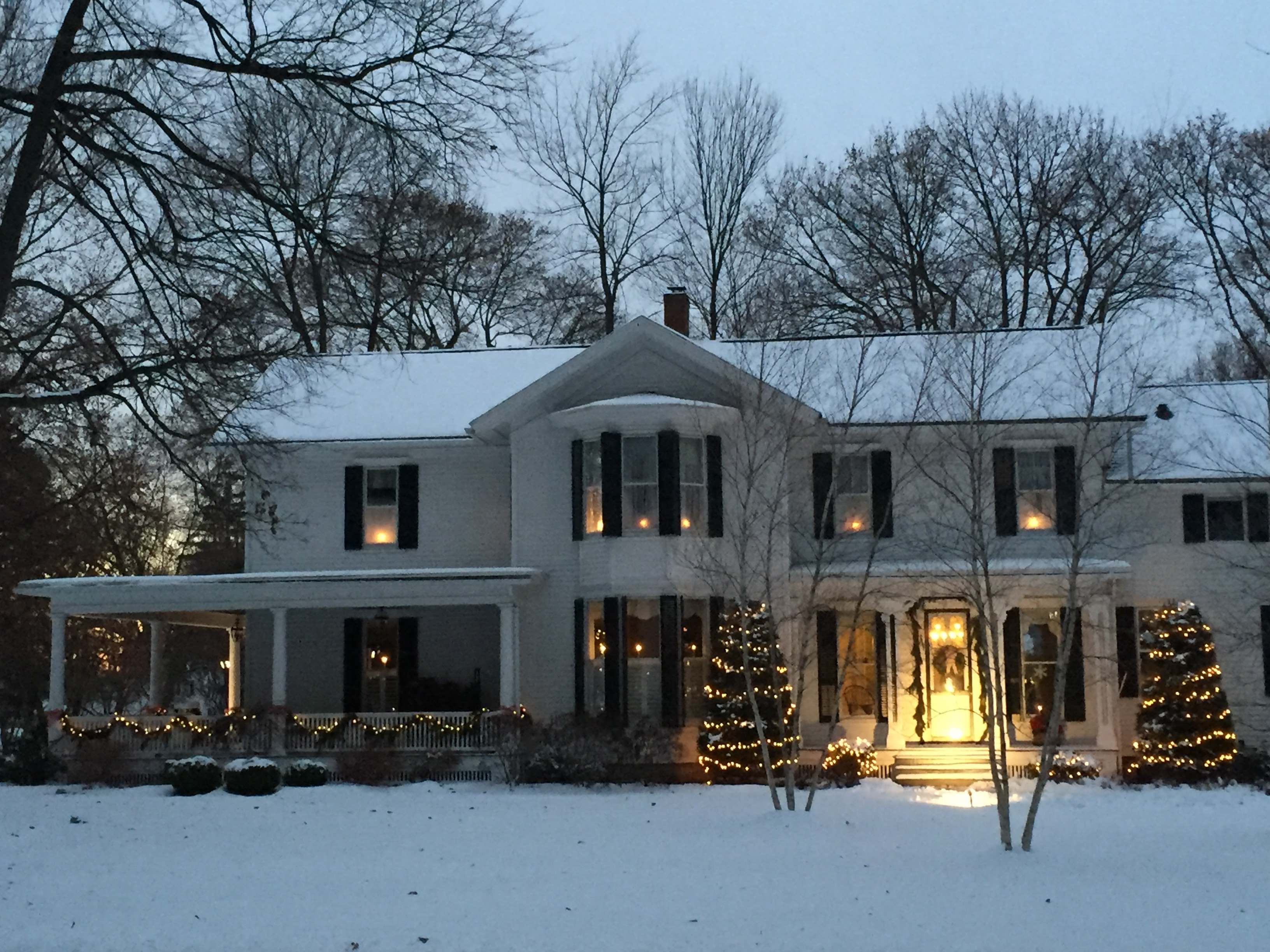
A favorite house in our village, vintage upstate New York.
In meditation class, our instructor read a poem by Rumi about welcoming all emotions as you would a house guest, even the negative ones, as they may be clearing you out for something else.
You can sample some of David Whyte’s poems on his beautiful, rich website. David leads groups on hiking tours in Italy, England, and Ireland, where he reads his poetry and visits artists, cooks, gardeners, farmers, and other creatives committed to their locales.
“Instructions for living a life: Pay attention. Be astonished. Tell about it.” – Mary Oliver
In my hometown near Cleveland, Ohio, there once was a girl who liked to play hooky from school. She’d walk in the woods and read poetry. Back then, my town still had some of its original rural flavor, with creeks, farmland, and forest where neighborhood kids could play for hours. Poetry and nature were the two things in the world the girl loved most.
When she was seventeen, the young woman got in her car and drove to the home of Edna St. Vincent Millay in upstate New York. The poet had died, but her sister, Norma, lived there. The young woman stayed for a time, helping Norma organize Millay’s papers and manuscripts, while she also wrote her own poetry.
Years later, when this same woman from Maple Heights, Ohio won the Pulitzer Prize for poetry in the 1980s, I didn’t pay much attention, even though I’d been an English major in college. I was working in New York City and had left my poetry reading days behind.
It wasn’t until I was in my forties and beginning to do some of my own writing that I thought I’d take a closer look at Mary Oliver, that girl from my hometown, to see what she was all about.
I hadn’t expected to be stunned. I mean, really. Why had I never read her poetry before?
I could describe Mary’s poetry with words like “powerful” and “transcendent” and “life-changing,” but those weak words wouldn’t do her poems justice. Let’s just say it was exactly the right time for Mary Oliver’s poems to enter my life. A lot of it had to do with my novice efforts as a creative writer and with believing in myself.
Mary Oliver grew up in a house just around the corner from where I did, though she left home around the time I was born. Our hometown went through especially hard times around 2008. A Cleveland neighborhood nearby was called ground zero in the mortgage disaster.
Some homes were abandoned, some torn down; wildflowers and weeds took over what used to be carefully tended lawns. Much of the wooded areas are now gone, but occasionally people spot deer, usually at dusk. The town has held its own, though; the people who live there have great spirit.
When I go back home to visit, sometimes I think of a girl skipping school, sitting cross-legged under a big, friendly tree in the once nearby woods, reading poetry.
*******************
New and Selected Poems, by Mary Oliver, published in 1992, includes poems from 1963 – 1991.

 “The most regretful people on earth are those who felt the call to creative work, who felt their own creative power restive and uprising, and gave to it neither power nor time.” Upstream, by Mary Oliver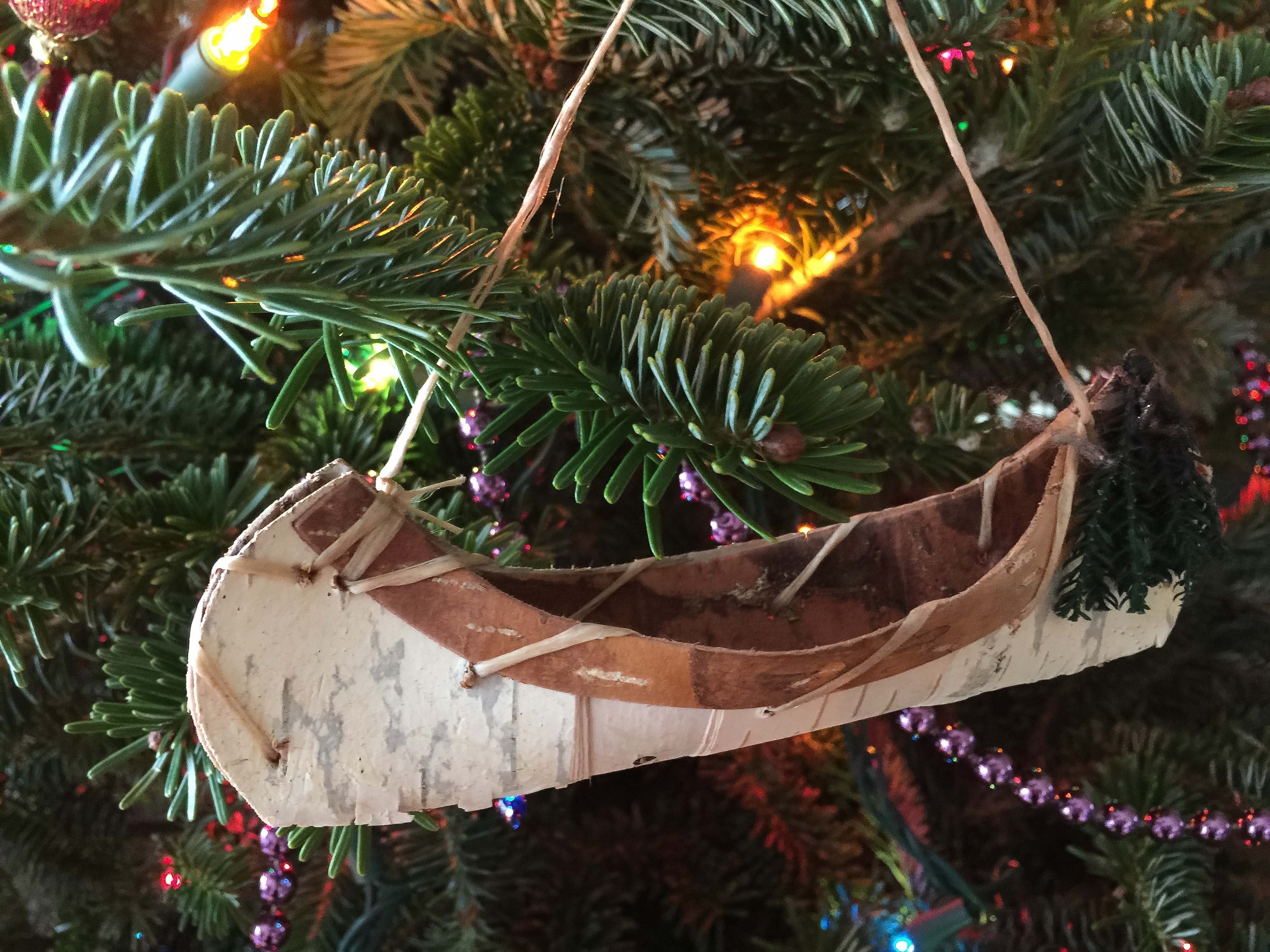


 New and Selected Poems, by Mary Oliver, published in 1992, includes poems from 1963 – 1991.
 Books Can Save A Life