The making of a first novel, When Things Go Missing

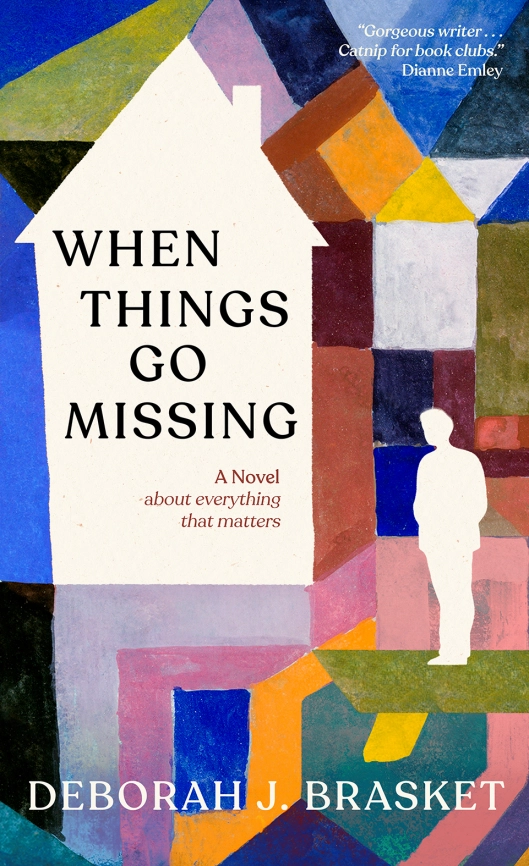
One of my favorite writers and bloggers, Deborah J. Brasket, will publish her first novel, When Things Go Missing, in just a few days! It’s a pleasure to participate in Deborah’s Book Blog Tour along with nine other bloggers. Please enjoy Deborah’s guest post below, and be sure to scroll to the end to find links to the other posts.

I hope you’ll leave comments here and on the other book blogger sites for a chance to win a free E-book with extra chapters of the novel! Here also is a link to my review of When Things Go Missing.

Here is what Deborah has to say about an important phase in the writing of her novel:

I thought I’d share something that I wrote six years ago about When Things Go Missing when it was still a novel-in-progress. At that time the working title of my novel was From the Far Ends of the Earth, and it was in the hands of an agent who was submitting it to publishers. This post shows how long and messy the road to publication can be and the choices writers must make along the way

Endings and Beginnings, A Writer’s Life

Well, I just finished rewriting the ending of my novel as requested by a publisher. We will see what they think.

Either way, I believe this new ending is stronger–-still hopeful, but less certain. More in keeping with the way things are for most of us when things we love go missing, or when struggling with our own demons and addictions.

I’ve decided something else too. Quite a few publishers wanted to see more of the missing mother in my story, yet I wasn’t willing to do that. It would have unraveled the very premise of my novel, which was, how do we cope when the center holding everything together falls apart? When the person upon which we most depend disappears?

I wanted the mother to be part of the puzzle, not a presence herself, but that “absent” presence we feel, even yearn for, but cannot quite pin down, and never really know for certain.

Do any of us ever, really, know our mothers? Don’t we only know them through our own often faulty and incomplete perceptions of them? What they’ve allowed us to see, or what we choose to believe? All knowledge is partial and open to revision. We may know the facts that lay before us. But do facts a person make?

Yet even while I’ve resisted the call to add the mother’s perspective to this novel, I can understand how a reader might want more of her, to hear about her journey as she travels away from her family and through South America. What does she learn as she discovers the world through the new lens of her photography? Does it lend insight into her past? Into herself as a mother and wife and now an artist? How does it shape her anew?  Where does it take her?

So I’m considering a “sequel” to From the Far Ends of the Earth, if we can call it that, since it will cover the same time-space as the first novel.

I think it might be fun to give the mother her own voice and space, to see what shaped her past and how her journey shapes her future.

It’s the thing I love most about writing, discovering what I never knew I knew before I began to write it, as if the words themselves are drawn from some inner well of insight or vision I never knew I had.

“We create ourselves out of our innermost intuitions,” so writes a sage.

I believe that. And I also believe our characters are created in much of the same way. I wonder if we all contain multiple characters within us that make themselves known to us through our writing? Or are we just writing our larger selves?

Perhaps all the selves of all the people we’ve come to know, to experience, in this wider world, once known, become part of us, at least partially?

I believe there is a collective consciousness that we tap into from time to time, and writers, perhaps, most of all.

Sometimes I don’t know where I end and another begins.

My son says I have boundary issues. No doubt he’s right.

When Things Go Missing BOOK BLOG TOUR

Below are the bloggers, authors, and book reviewers participating in this tour promoting When Things Go Missing. Participants will either be spotlighting the book, posting reviews, or interviewing the author.

GIVEAWAY

Please bookmark this and join us on the tour! Those who leave the most likes and comments on the participating sites will have a chance to win a free E-book PLUS extra chapters of the novel (which the author reluctantly had to cut.)

BOOK BLOG PARTICIPANTS

• Sep. 15 – Sally Cronin, Smorgasbord Blog Magazine – SPOTLIGHT

• Sep. 16 – Valorie Hallinan, Books Can Save a Life – INTERVIEW / GUEST POST

• Sep. 18 – Laura Bruno Lilly, Classical Guitarist/Composer – BOOK REVIEW

• Sept. 20 – Margaret Moon, Book Chat – AUTHOR INTERVIEW

• Sept. 21 – Luanne Castle, Poet/Author – BOOK REVIEW

• Sep. 23 – Dr. Vicki Atkinson, Therapist/Author – BOOK REVIEW

• Sep. 24 – Jacqui Murray, Author, Book Reviewer – BOOK REVIEW

• Sep. 25 – Liz Gauffreau, Poet/Author – SPOTLIGHT

• Sep. 26 – Wynne Leon, The Heart of the Matter Podcast – INTERVIEW

• Sep. 27 – Liz Dexter – Editor, Book Reviewer – BOOK REVIEW

When Things Go Missing will be published by Sea Stone Press September 22, 2025.

PRE-ORDER NOW

Amazon Bookshop Barnes & Noble

When Things Go Missing

“To all families who fall apart and struggle to find their way home again.”Deborah J. Brasket

What happens when a mother leaves her family?

Shopping list and coupons in hand, fifty-something Fran heads to the grocery store. But instead of shopping, she keeps driving – all the way to the California border, into Mexico, and beyond.

It is 1997. Fran will not be coming home anytime soon.

With deep pleasure, I bring Books Can Save a Life out of retirement to tell you about Deborah J. Brasket’s debut novel, When Things Go Missing. 

But first, let me say that I have been following Deborah’s blog, Writing on the Edge of the Wild, for many years on WordPress. (She now has a Substack version as well.) I have always found her insights about art, literature, truth, beauty, and the human dilemma to be evocative and profound. Truly, her blog has always stood apart from the rest. So it was with great anticipation that I powered up my Kindle and let Deborah’s story carry me away. 

We witness Fran’s confused, angry, and bereft family as they begin to navigate life on their own, on ground that has shifted dramatically. The family Fran leaves behind, like so many families, was already fractured – I would even say traumatized. Where do they go from here, when it feels like the end of life as they’ve known it?

Kay, an aspiring archeologist, receives periodic voice mails from her mother:

“She’s in mourning, she tells herself, mourning a mother she thought she knew who she now realizes she may never have truly known: A mother who always was the still center of comfort she could turn to in times like these, who is there no more. A mother who held her dysfunctional family together, a family she now fears will fall apart. The grief isn’t only about losing her mother but losing everything her mother represented: family, home, security, unconditional love. It’s like her mother’s absence blew a hole through the center of her universe, and everything is flying apart, including Kay. There’s nothing left to hold onto.”

To her son Cal, a heroin addict, Kay mails her mysterious photographs from various South American locations. As the mother of two adult sons, I was haunted by this passage, as I considered what it must have taken for Fran to let go of her son:

“…he gets sideswiped by this opposing flood of thoughts that gushes through his mind like his mother’s conscience. That’s how he sees it too – not his conscience but some uncomfortable and undesirable feeling that drifts in from his mother’s looks and sighs and follows him around like a fucking rain cloud. Hell, if she isn’t still doing it, even now when she’s disappeared.

He clears out a space on the bathroom mirror so he can look at himself, the image blurry in the wetness, surreal, with the steam all around, his face ringed by a bright halo of light. He thinks if he stares at this face ringed with light long enough, hard enough, deep enough, he might catch a glimmer of who the hell he really is or was supposed to be in another lifetime. Whatever it was, he knows it was good. Whatever could have been, whatever he blew away, it was all unbelievably good.”

Walter, Fran’s husband, a taciturn, sometimes volatile, father, gets Fran’s credit card bills: 

“He’s been taking care of Frannie since she graduated from high school and he got home from Vietnam….He never minded that she didn’t work. Why should she: He earned enough on his own…

He’s never tried to stop her before from doing anything she wanted. He just has to keep letting the rope out more, giving her as much lead as she needs, and then, when she’s ready, she’ll find her way home again. It’s what he tells himself, what he needs to believe to get through the day.”

We get a sense of the kind of wife and mother Fran was and is, as Kay, Cal, and Walter at first simply react to Fran’s abandonment. As each of them barely manages to keep going – largely on their own and isolated from one another – they begin to separate from the mother and wife bonds. They begin to individuate. We are witness to a trio of heroic journeys that unfolds in surprising and unexpected directions. 

When Things Go Missing will stay with you long after you’ve read the final page. To me, this is the mark of a powerful and authentic story, one that is so true for America and for our time. You may find yourself reflecting on your own life path, the choices you’ve made, and the choices that await you.  

What are our responsibilities as mothers, parents, and partners? 

Is there such a thing as the perfect mother? 

Are there limits to the bonds of love and family? How do these relationships change over time? Are they meant to be forever?

What are our responsibilities to our own self-actualization? When do we sacrifice our own desires and aspirations for the good of our families and communities?

How do we come to find our chosen families? Can they ever replace our families of origin? Is it possible to achieve a happy blend of the two?

As a longtime reader of Deborah Brasket’s work, I trust her wisdom and relish the grace and richness of her writing. When Things Go Missing is a beautiful unfolding – a tender, loving portrait of a family contending with grief, loss, and regret, while fully embracing all the joy that life can hold. 

I will close with the epigraph that opens When Things Go Missing: 

“I have loved thee with an everlasting love: therefore, with lovingkindness have I drawn thee.”Jeremiah 31:3

When Things Go Missing, an excellent book club choice, includes discussion questions. Publication date: September, 2025, Sea Stone Press.

When Things Go Missing is now available for pre-order at AmazonBookshop, and Barnes & Noble.

Books Can Save a Life


“When you’re in a place that is not your own among people not like you, your first impulse has to be respect. Even if you don’t understand, you have to show respect for what is technically called another epistemology, another way of knowing the world.”Barry Lopez

After nearly eight years of blogging at Books Can Save a Life, I’ll be taking a break to work on other writing projects and bookish activities. I’ll be back from time to time, though, when extraordinary books and literary happenings come along.

When I started Books Can Save a Life, I was thinking primarily about books saving lives personally and individually. Over the years, my reading has come to include books that I believe save lives in a much broader sense. Books have always been a way for me to understand the world, and I believe books can help us save value systems, democracies, species, and perhaps even humanity.

Bill McKibben, Barry Lopez, Richard Powers, Kim Stafford, Barbara Kingsolver, Terry Tempest Williams, Kathleen Dean Moore, and Mary Oliver are among the writers I’ve come to trust deeply. In his newest book, Falter, McKibben says we may have begun humanity’s endgame because of climate change, staggering inequality, and artificial intelligence. (Google has just announced it has achieved “quantum supremacy,” whatever that means.)

We don’t really know, of course. Barry Lopez recently said there is no place for despair and pessimism if we are to have the energy and wisdom for a massive course correction:

“The whole thing is on the line now. The entire meaning of the evolution of homo sapiens. We either show that our power of invention is tremendous or we show that the development of the imagination in the hominid line was maladaptive.” 

Horizon.jpg
“The whole book is about arriving at a position of impassioned embrace of all human beings.” – Barry Lopez

Barry’s latest book, Horizon, a culmination of his life as a world traveller and seeker, is a handful at over 500 pages. If you don’t want to take on the book, I encourage you to listen to this 15-minute interview with Lopez at Public Radio International’s Living on Earth. It is filled with transcendent words of wisdom I wish everyone could hear.

All of us can work toward a more humanitarian culture and learn to take better better care of the earth. We’ve reached an inflection point in human history, and it’s our destiny to do the important work we’re each called to do. Reading can fortify us.

I’ve enjoyed sharing my reading journey with you.

“You can call it global climate change, you can call it the disintegration of democratic forms of government….the need to attack this issue, to me, is like one of the great voyages that we now have to choose to make, to move into unknown territory, into uncharted lands….My hope is that people will say, ‘We’re in trouble. What is going to be the vessel on which we sail?’  And, maybe more importantly, ‘Who is going to be the navigator?'” Barry Lopez


HecetaHeat.JPG
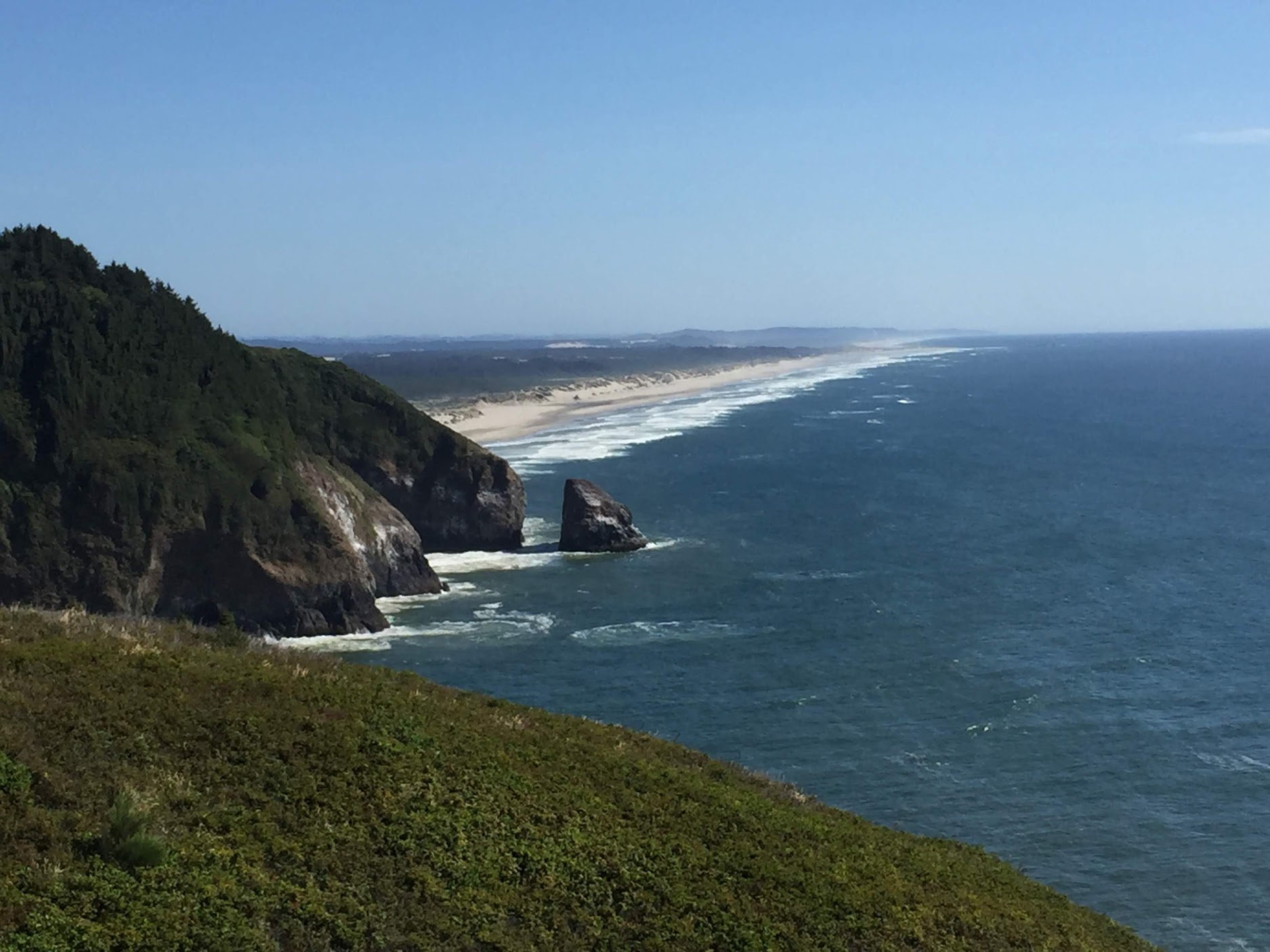
Oregon coast


The Library Book

“Members of the German Student Union carried out the book burning with enthusiasm. At Opera Square, the students formed a human chain, passed the books from hand to hand, and then cast them into a pile. Estimates of the number of books in the bonfire pile range from twenty-five thousand to ninety thousand. As each book was thrown in, a student announced the reason this particular book was being ‘sentenced to death.’ The reasons were stated like criminal charges. …The Feuersprüche [Fire Incantations] had a party atmosphere with dancing, singing, and live music. At midnight, [May 10, 1933] Goebbels appeared and gave a raving discourse known as the Fire Speech. That same night, similar events were held in Munich, Dresden, Frankfurt, and Breslau….” The Library Book, by Susan Orlean

Calling all book and library lovers and their friends! (Especially print book lovers.) If you’re looking for a last-minute Christmas gift for the reader on your list, stop by your local bookstore and pick up a copy of The Library Book.

While she was writing The Library Book, author Susan Orlean lit a match and burned one of her tattered old paperbacks – just to see what it felt like to burn a sacred object and how easily a book could be set alight. It didn’t feel good, she said, but it was easy to burn once the book reached 451 degrees, the temperature at which paper burns: Fahrenheit 451 vanished in a small conflagration. 

One of the most riveting parts of The Library Book is Orlean’s description of the 1933 Nazi-instigated book burnings in 34 university towns and cities, conducted in part by a minority of college students who called themselves the German Student Union. I’d always imagined small bonfires sacrificing a few hundred books. Maybe because I find book burning incomprehensible, I never conceived of the vast numbers burned – up to 90,000 in one fire! –  or the live music, enthusiastic crowds, and tragic number of libraries destroyed in World War II and other wars, both deliberately and collaterally.

“Books are a sort of cultural DNA, the code for who, as a society, we are, and what we know. All the wonders and failures, all the champions and villains, all the legends and ideas and revelations of a culture last forever in its books. Destroying those books is a way of saying that the culture itself no longer exists; its history has disappeared; the continuity between its past and its future is ruptured. Taking books away from a culture is to take away its shared memory. It’s like taking away the ability to remember your dreams. Destroying a culture’s books is sentencing it to something worse than death: it is sentencing it to seem as if it never lived.” 

Susan Orlean is one of the most brilliant contemporary American writers of nonfiction. She writes for The New Yorker and has authored many books; I’ve read only one other: the quirky The Orchid Thief: A True Story of Beauty and Obsession, which was made into the movie Adaptation (starring Meryl Street, Nicolas Cage, and Chris Cooper.) The book is strange and marvelous, and the movie is even stranger – perhaps not to everyone’s taste. If you love books, though, you’ll find The Library Book more accessible yet equally as passionate. Orlean is a book-lover from way back and writes movingly about her childhood library visits with her mother, who always said that if she’d had a career, she would have been a librarian.

Susan’s private book burning and those of the Germans echo and deepen The Library Book’s central plot, which involves the tragic burning of the Los Angeles Public Library in 1986. It burned for seven hours; over 400,000 books were destroyed and 700,000 more damaged. No one is sure whether the fire was arson or an accident. The prime suspect, Harry Peak, a compulsive but likable liar and something of a tragic figure, changed his story every time he was questioned by the police. Woven into the story of the burning and resurrection of the LA Public Library is Orlean’s love letter to books, reading, libraries, and librarians.

Susan writes of her own motivation to write, one of the most eloquent and true statements I’ve ever read about why someone would devote oneself to this painstaking labor:

“I fear not just that I, personally, will be forgotten, but that we are all doomed to being forgotten – that the sum of life is ultimately nothing; that we experience joy and disappointment and aches and delights and loss, make our little mark on the world, and then we vanish, and the mark is erased, and it is as if we never existed…..But if something you learn or observe or imagine can be set down and saved, and if you can see your life reflected in previous lives, and can imagine it reflected in subsequent ones, you can begin to discover order and harmony. You know that you are part of a larger story that has shape and purpose – a tangible, familiar past and a constantly refreshed future. We are all whispering in a tin can on a string, but we are heard, so we whisper the message into the next tin can and the next string. Writing a book, just like building a library, is an act of sheer defiance. It is a declaration that you believe in the persistence of memory.” 

Isn’t this why we haunt libraries and bookstores, to find those singular voices, many from the past, that for whatever reason speak to us so personally and vividly?

“You don’t need to take a book off a shelf to know there is a voice inside that is waiting to speak to you, and behind that was someone who truly believed that if he or she spoke, someone would listen. It was that affirmation that always amazed me. Even the oddest, most peculiar book was written with that kind of courage — the writer’s belief that someone would find his or her book important to read. I was struck by how precious and foolish and brave that belief is, and how necessary, and how full of hope it is to collect these books and manuscripts and preserve them. It declares that stories matter, and so does every effort to create something that connects us to one another, and to our past, and to what is still to come.” 

Like Susan, I’d never heard about this:

“In Senegal, the polite expression for saying someone died is to say his or her library has burned. When I first heard the phrase, I didn’t understand it, but over time I came to realize it was perfect. Our minds and souls contain volumes inscribed by our experiences and emotions; each individual’s consciousness is a collection of memories we’ve cataloged and stored inside us, a private library of a life lived. It is something that no one else can entirely share, one that burns down and disappears when we die. But if you can take something from that internal collection and share it – with one person or with the larger world – on the page or in a story recited – it takes on a life of its own.”

These excerpts don’t even begin to address Orlean’s fine chapters about libraries,  librarians, their history, and their future. Having been a book editor and a (medical/academic) librarian, I’ve heard more than once from people who are quite sure  books will disappear and that we no longer need libraries. To them, I’d say: fake news, conspiracy theories and the disruption of democracy. I’d point them to these and many, many other links:

Helsinki’s New Library

Seoul, Korea’s newest library

Dr. Google is a liar

Free Narcan to libraries

The New York Public Library website – check out the education and research pages alone

The Revenge of Analog: Real Things and Why They Matter

I leave you with this arresting image from The Library Book, which takes place around the clock in my hometown of Cleveland:

“The lobby of the OverDrive headquarters [in Cleveland] is huge and high. A ten-foot-square screen that displays a world map dominates the center of the lobby. Every few seconds, a bubble pops up from somewhere on the map, showing the name of the library and the title of the book that had just been borrowed. The screen is mesmerizing. If you stand there for a few minutes, you will see that someone at a small library in Arles, France, has just checked out L’Instant présent by Guillaume Musso; that someone in Boulder, Colorado, has borrowed Harry Potter and the Cursed Child by J.K. Rowling; and that in Mexico City, someone has claimed a copy of El cuerpo en que nací by Guadalupe Nettel. It feels like you’re watching a real-time thought map of the world.”

By the way, the American Library Association maintains yearly lists of books that have been challenged, restricted, removed, or banned.

Up next: My best read of 2018 – a fat volume of fiction several inches thick, with a cover that is a work of art. Wondrous and important.


IMG_8224
Merry Christmas and Happy New Year! I hope you find some good books under the tree. Woodblock prints by @blueberry_hills.


Going West and my year of nonfiction

454C03D1-1965-4989-BD59-14E61340B4C3.JPEG
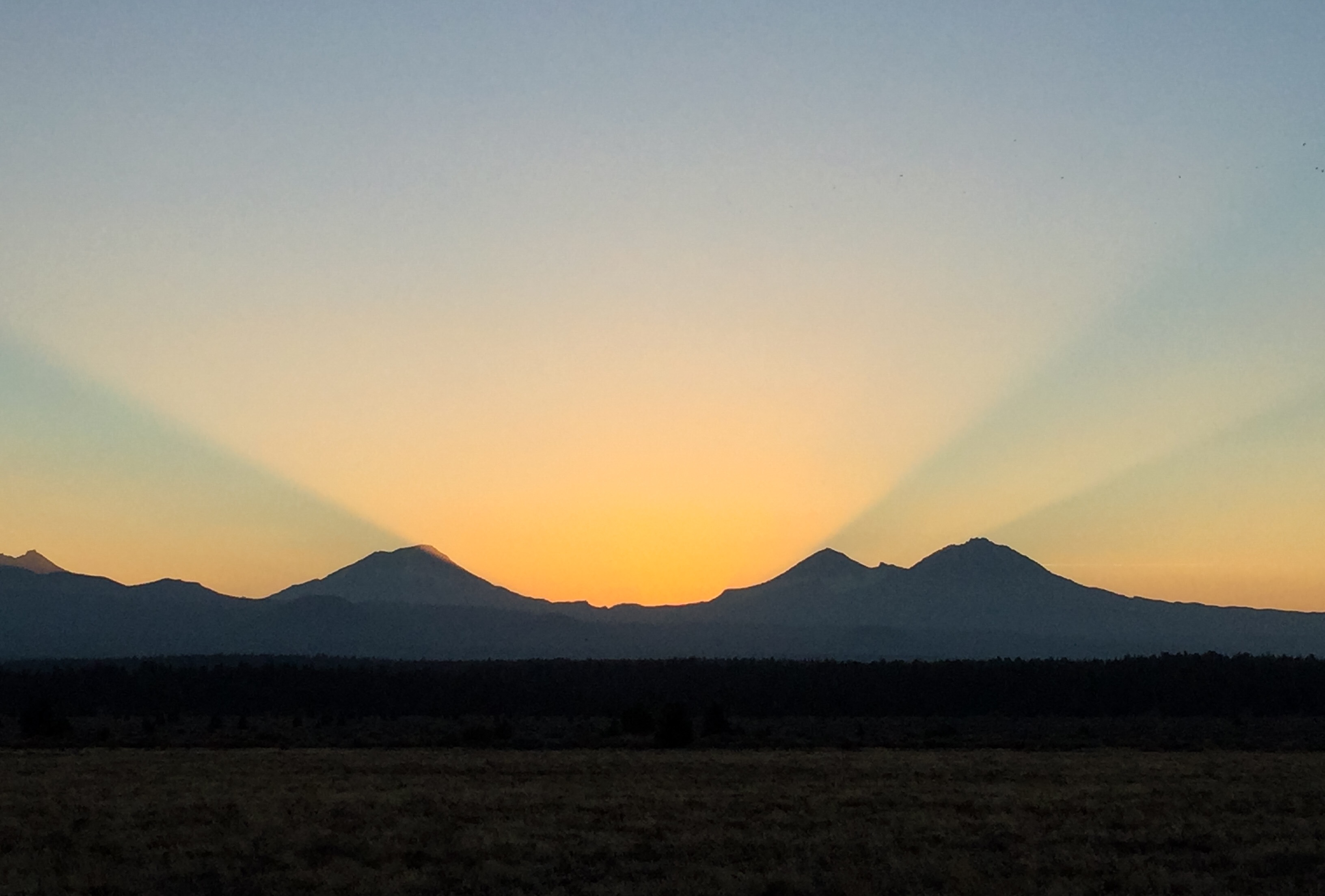
Three Sisters and a golden bowl of sun 


Nonfiction November, a month-long book blogger celebration, just happens to coincide with an anniversary: one year ago my husband and I left our long-time upstate New York home and set out for the Pacific Northwest, not sure where we’d ultimately land.

And now we’re studying permaculture and Oregon’s eco-regions and learning how to take care of horses (maybe alpaca, too) on 4 1/2 acres in a small town near Bend.

On our cross-country trip, by car and train, my reading didn’t stop, of course. Does it ever? It was so much fun to curl up with a good book in a sleeper car and look up now and then to see western horizons that were completely new to me.

Book Blogger Kim @ Sophisticated Dorkiness poses these questions about what we’ve read in the way of nonfiction in 2018:

What was your favorite nonfiction read of the year?

I can never pick just one favorite book. Here are four that stand out:

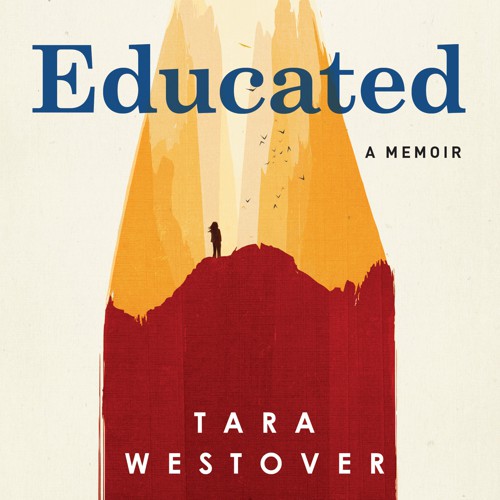
EducatedEducated. This is an extraordinary memoir by Tara Westover, who grew up in a family of survivalists in Idaho. Tara wasn’t allowed to attend public school, but she wasn’t home schooled either. Denied an education, she managed to gain admission to Brigham Young, and from there Harvard and then Cambridge University in England, where she received a Ph.D in history

Tara’s interior journey is just as fascinating as her outward journey from backwoods Idaho to the halls of scholarly erudition; and from fundamentalism, a dangerous brother’s physical abuse, and parental mental illness to the cultural mainstream. As we come of age, we construct a self. Tara’s coming of age was a kind of trial by fire.

Educated has proven to be a controversial memoir. Tara’s parents, through their lawyer, have said that Tara’s portrayal of the family is largely false. Memoirs can be a minefield for writers and their families.

GreatTideRisingGreat Tide Rising: Toward Clarity and Moral Courage in a Time of Climate Change. It was an honor to correspond with Kathleen Dean Moore this year, read two or three of her fine and important books, and enjoy a writer’s residency at the H.J. Andrews Experimental Forest, where she helped establish the Long-Term Ecological Reflections Program. The title of Great Tide Rising says it all. Every literate person on the planet who has access to books should read it.
The Wilderness Warrior: Theodore Roosevelt and the Crusade for America, by Douglas Brinkley. The time is ripe for another Roosevelt. Are you planning to vote in the mid-term elections?

Ten Arguments for Deleting Your Social Media Accounts Right Now. Jaron Lanier is a brilliant humanist who believes our unhealthy, manipulative culture of technology and screens is robbing us of our free will. The solutions aren’t technological, he says, but humanitarian. (He is not against social media per se, but how it currently operates.)

In the months since I’ve read his book, the title seems even more urgent. The internet, and even social media, have greatly enhanced my life, but the bad currently outweighs the good. If I could, I’d withdraw from the online world completely, at least for a while. As it is, I’m trying to limit my Facebook time to when I have a new Books Can Save a Life post. I post on Instagram less frequently these days.

Do you have a particular topic you’ve been attracted to more this year?

It’s more like a continuation of my interest in the best nature and ecological writing, given our current challenges. Maybe what’s different this year is realizing I’m attracted to nonfiction and fiction with a strong humanitarian bent and a vision for how we might bring about a better future.

Now’s the time when everyone needs to be talking about climate change and deciding what we, personally, are going to do about it. It’s more important than ever to support our libraries, librarians, teachers, and schools. We can support our best journalists, newspapers, and news outlets, as well.

When we’re online, when passing on a link, we can make sure it’s a credible source first. We can be savvy and discerning, do some digging, and read between the lines.

It takes time to become a truly literate citizen these days – to understand exactly what we’re consuming online, how it might be manipulating us, and how to contribute to online conversations responsibly, in an informed way.

Spending time with good – and great – books can help!

Nonfiction November is being hosted by some excellent book bloggers. I’ve long enjoyed Kim (Sophisticated Dorkiness) and Katie’s (Doing Dewey) excellent commentary and wide-ranging knowledge about what’s being published, and I’m looking forward to exploring Julie, Sarah, and Rennie’s blogs.  Stop by and visit Kim @ Sophisticated Dorkiness, Julie (JulzReads), Sarah (Sarah’s Book Shelves), Katie (Doing Dewey), and Rennie (What’s Nonfiction).

What’s the best nonfiction you’ve read this year? Let us know in the comments.

Old Florida

SpanishMoss

Savannah, Georgia

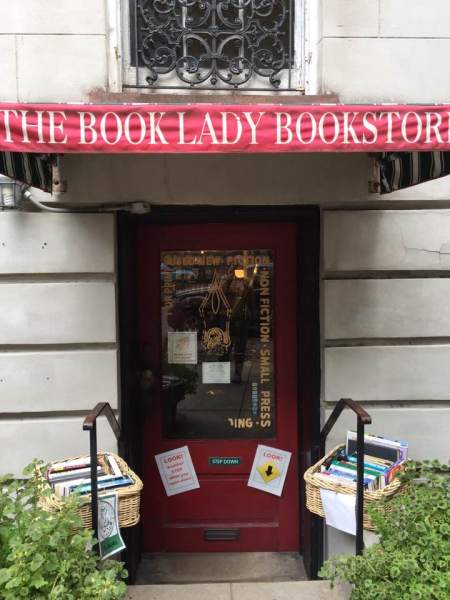
BookLadyOn our road trip across the US (south to Florida, then west to Tucson, Arizona, then north to Portland, Oregon) we spent nearly two weeks visiting family in the St. Petersburg area. Along the way, we stopped in Savannah, Georgia, my first time in that lovely city. An afternoon wasn’t nearly long enough, but we did visit The Book Lady Bookstore on East Liberty Street.
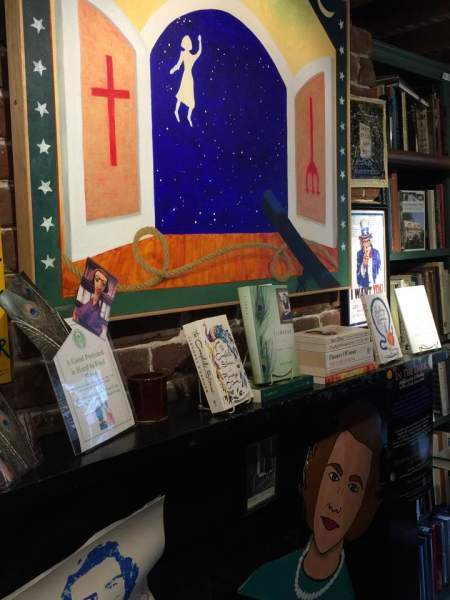
They had a display devoted to the Catholic writer Flannery O’Connor, who lived most of her life in Milledgeville, Georgia, where she raised peacocks and wrote short stories and novels. Her shocking story, “A Good Man Is Hard to Find,” is taught in many high school English classes. If you haven’t read it, it’s well worth your time, I promise you. I’ve never forgotten that story, although I’m not a fan of O’Connor’s novels – her protagonists, obsessed with working out their salvation, are too strange for me.

FlanneryOconnor
A Flannery O’Connor display at The Book Lady

But seeing the display called up memories and reminded me how much I enjoyed her collection of letters, The Habit of Being. Many years ago, when I lived in New York City, the assistant rector of the Episcopal church I attended taught a class on Flannery O’Connor. Fleming, our rector, who was from the South, led us in reading her stories and letters, and I was extra thrilled because The New Yorker writer, Joseph Mitchell,  a Southerner himself, was in the class, too.

St. Petersburg

There are many things about Florida that I love, but I’m allergic to all the over-development and the acres of generic condos and shopping centers. There is plenty to do near the beautiful St. Pete waterfront though, and when our sons came down we enjoyed some of the shops and restaurants. (They enjoyed the music and night life, too.) We bought red snapper, grouper, and shrimp from a local fish market that had dozens of ice chests overflowing with fresh catches, and our sons did the cooking.

In Florida, I always look hard for bits of nature and local culture, so I was extra happy when we rented a sweet little apartment in a hidden alley in one of the older St. Petersburg neighborhoods. Some of the streets are cobblestone and lined SleepingPorchwith adorable Old Florida bungalows, many being renovated. Even though most of the windows of our airbnb were painted shut, we had air conditioning, and two large windows in the sleeping porch let in breezes from Tampa Bay two blocks away.
In the yard, I found lots of angel hair fern. We used to add this delicate bit of greenery to the roses we sold by the dozen in my family’s flower shop in Ohio.

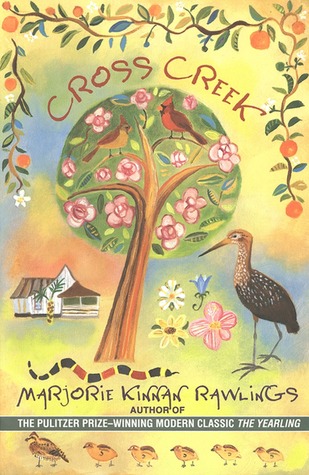
This part of Florida reminds me of one of my favorite books growing up, The Yearling, by Marjorie Kinnan Rawlings. Years later, I discovered, and loved, Marjorie’s memoir, Cross Creek. (There is a Cross Creek Cookery book, too.)

AngelHair
I love angel hair fern.

The ‘burbs

We had many happy visits with extended family in the St. Pete suburbs after we left our airbnb.  We walked in the neighborhood every day. It was warm and humid, with occasional light rain that felt wonderful.

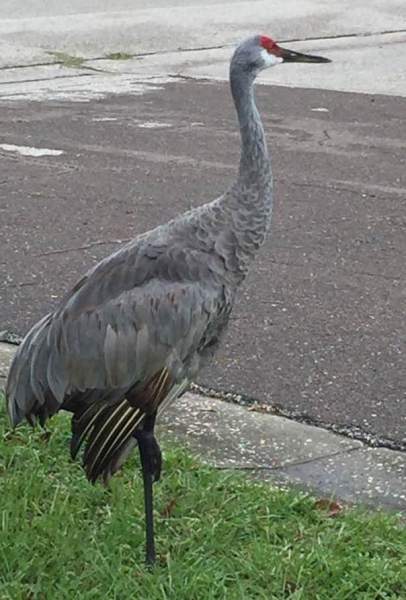
SandhillCrane
A sandhill crane waits for a bus

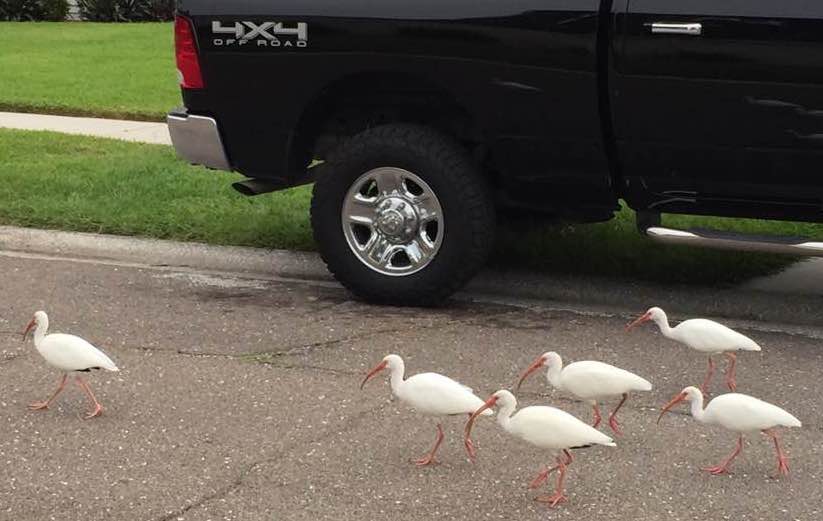
Ibis
Ibis, following their leader

AfterRain
After the rain

BigLeaves
They grow them big,

Garden
My sister-in-law has a kitchen garden with herbs and veggies, including plenty of Thai basil.

We passed by this wind sculpture on our walk every day:

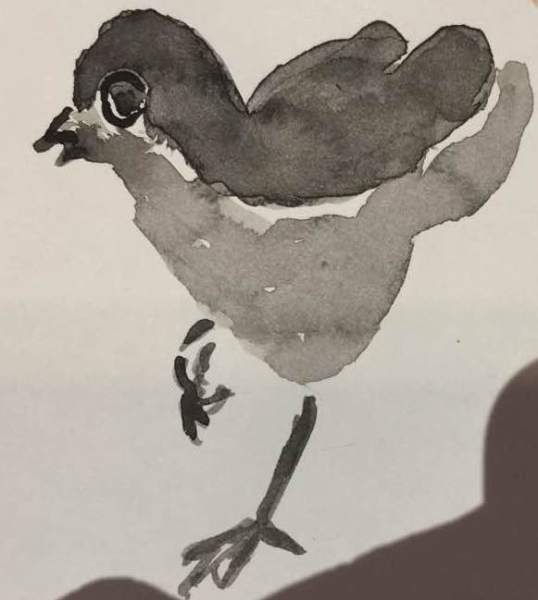
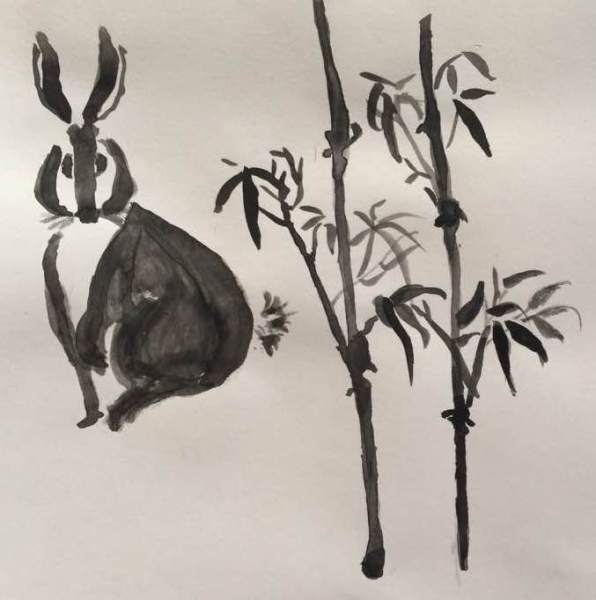
In the evenings, my niece, my sister-in-law and her mother, and I tried Chinese brush painting for the first time. We taught ourselves how to grind the ink, which is pressed into sticks and colorful rectangles, and mix it with water in an ink stone. Then we practiced brush strokes and painted our first, simple pictures. It was fun!

Chick
My attempt to paint a chick

RabbitBamboo
My sister-in-law’s mother made a beautiful rabbit and this beautiful bamboo.

The Panhandle

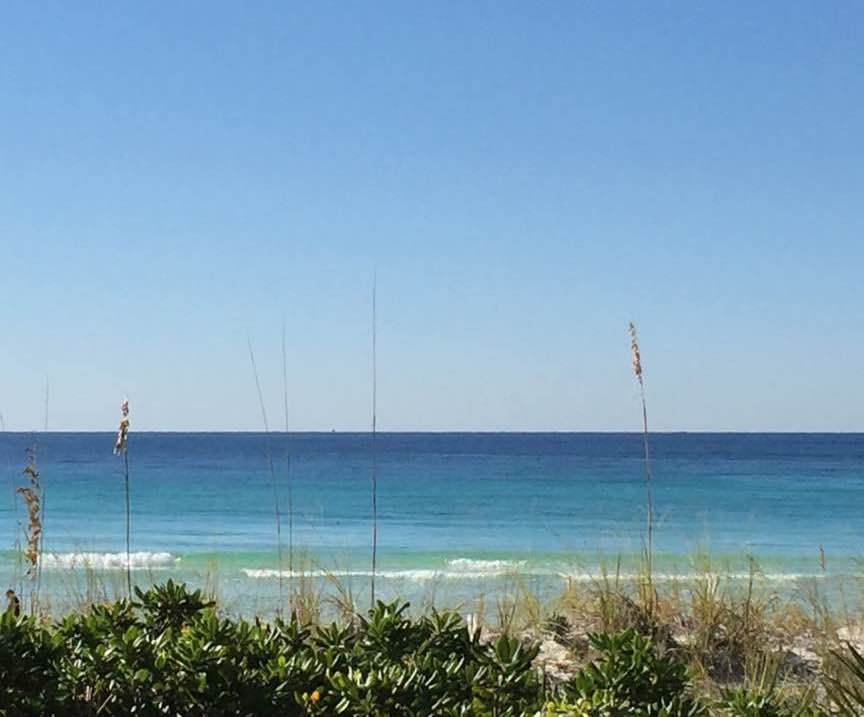
Eventually, it was time to say goodbye to family and move on to the Florida panhandle and points west along our Deep South route. We stayed in Destin, our final visit in Florida, which had a lovely beach that we had almost to ourselves. It was beside a sea turtle breeding ground and state park, and there was a hidden garden teeming with Monarch butterflies.

DestinBeach
Destin, Florida. There are military bases in nearby Pensacola, so we heard jets taking off from time to time.

Monarch
In a garden on the beach in Destin, there were hundreds of monarch butterflies.

Tracks
Places to go….

DestinSunrise
Sunrise, Destin, Florida. (Photo by J. Hallinan, who gets up much earlier than I do.)

TheYearling
Marjorie Kinnan Rawlings’ classic coming-of-age story, set in backwoods Florida, 1930s

CrossCreek
Her memoir.

TheHabitofBeing
Flannery was a great writer of letters.

The Invention of Nature
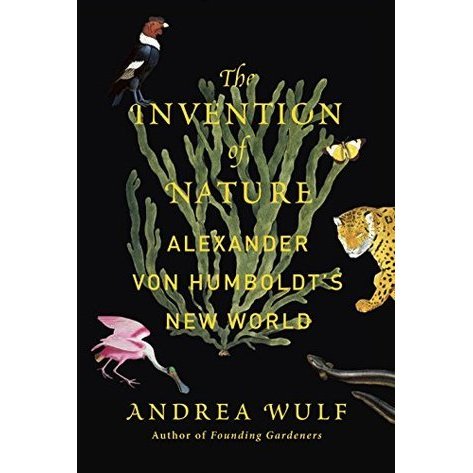
This is what I’ve been reading on the road. It’s wonderful! More about it later…

Coming up: Mobile, Alabama and New Orleans

Traveling, immersing in nature, visiting bookstores. Do these experiences call up memories of books read long ago?

2016 Favorite Books & Posts

img_4093
Under the tree this year


Several of my favorite books read this year were published in 2016. My top read, a memoir, was first published in Germany in 1938.

You’ll see plenty of memoirs on my list. Almost all the fiction is historical. Two are set in the northern Arctic regions.

Why I Write Memoir was by far my most popular post in 2016.

My Most Unusual & Memorable Read in 2016

A Woman in the Polar Nightby Christiane Ritter (memoir)

Favorite Fiction Read in 2016

To the Bright Edge#1 To the Bright Edge of the World, by Eowyn Ivey

#2 News of the World, by Paulette Jiles

#3 Do Not Say We Have Nothing, by Madeleine Thien (not yet reviewed on Books Can Save A Life)

#4 My Name Is Lucy Barton, by Elizabeth Strout 

Favorite Memoirs Read in 2016

#1 Lab Girlby Hope Jahren

#2 Ghostbread, by Sonja Livingston

#3 The Beautiful Struggle, by Ta-Nahesi Coates

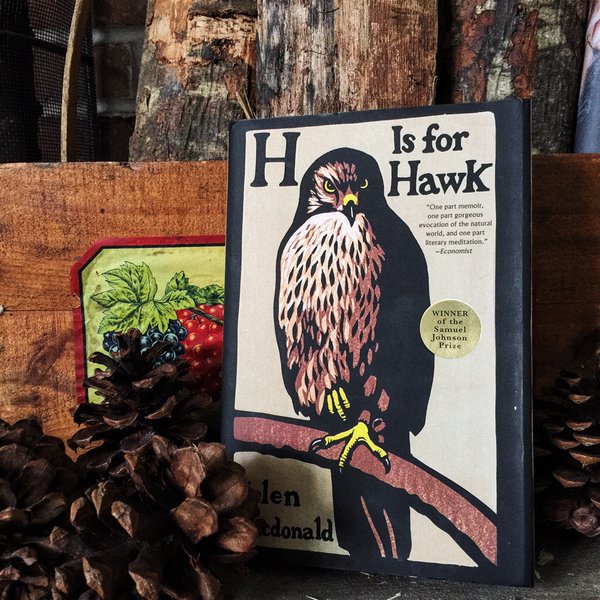
#4 H Is for Hawk, by Helen Macdonald

Favorite Nonfiction Read in 2016

67 Shots#1 67 Shots: Kent State and the End of American Innocence, by Howard Means

#2 The Road to Character, by David Brooks (not reviewed on Books Can Save A Life)

Favorite Author New to Me

Sonja Livingston (Ladies Night at the Dreamland; Queen of the Fall; Ghostbread)

MOST POPULAR BOOKS CAN SAVE A LIFE POSTS, 2016

#1 Why I Write Memoir

#2 A Mother’s Reckoning: Living in the Aftermath of Tragedy, by Sue Klebold (memoir)

Also popular

When Breath Becomes Air, by Paul Kalanithi (memoir)

The Cancer Survivor’s Garden Companion, by Jenny Peterson

MOST POPULAR BOOKS CAN SAVE A LIFE POSTS OF ALL TIME

Daughters of Madness book cover#1 Meeting the Dark Matter of Mental Illness

#2 Reading Junot Diaz

#3 Do Genes Shape Our Mental Health?

#4 Children of Mental Illness, Part I

What were your favorite books read in 2016, and what is on your list for 2017?

My Favorite Things

BuddhaEdited

Our backyard pond. If you’d like to listen to a story about this special place, please click on this link: “Water Bewitched.”


Not long ago, I wrote about podcasts being one of my favorite things and how I was in the midst of creating one myself. My audio essay about home, “Water Bewitched,” is now finished and up on Terrain.org: A Journal of the Built + Natural Environments.

(Technically, it isn’t a podcast because you can’t subscribe to get new episodes. You can, however, subscribe to Terrain.org, in which case the next essay in my audio series will be emailed to you.)

It’s been a difficult week here in the US, and if the news has been getting to you like it has me, I hope you’ll take a restorative six minutes and listen to my little story. It’s the first in a series called From Where I Stand, in which I’ll explore our connection to the places we call home.

Please let me know what you think in the comments here or on the Terrain.org site, and share the link with your friends.

I’m honored to have my work on Terrain.org, which has great fiction, nonfiction, poetry, videos, interviews, articles, and other fabulous content.

IMG_2983Speaking of podcasts, I recently discovered a great book podcast, WSIRN, which stands for What Should I Read Next, with Anne Bogel. You can subscribe to it on iTunes.  I love this series, especially What Should I Read Next Podcast #28, which features Browsers Bookshop owner Andrea Y. Griffith.

Some of you may recall that I wandered into Andrea’s bookstore when we were vacationing in the Pacific Northwest. Olympia is lucky to have Andrea and such a finely curated bookstore. On the podcast, Andrea talks about how she came to own Browsers Bookshop, what she’s been reading that she loves, what she’s read that she hasn’t loved (I whole-heartedly agree with her choice on the latter), and what’s she’s craving to read.

And last, but certainly not least, there is this. I wish Choir!Choir!Choir! would come to my town.

What are you reading or listening to this summer? Any 5-star recommendations?

My Favorite Things


Tulips in Orange


Books, writing, creativity, cool media and other delights….

  • Walking book clubs. Did you know these existed? Here are a couple in the UK hosted by two book bloggers who write fabulous reviews: Emily’s Walking Book Club with Daunt Books – turns out the one and only time I’ve been in London we went to Daunt Books, where we browsed for over an hour. Wish I’d known about Emily then, I’d have tried to connect with her; and  The Northern Reader – see also her Flower Power if you love gardening, flowers and nature lit.
  • Book spine poetry. A few weeks back in honor of April being National Poetry Month, I wrote some book spine poetry and asked readers to share theirs. Here is what Naomi at Consumed by Ink came up with. I love her little poems. Try it yourself, and if you’ve created book spine poetry you like, please share in the comments.
  • A good book. My favorite book bloggers always give me titles to add to my to-read list. I love this review of Hill by the French writer Jean Giono that Melissa wrote at The Bookbinder’s Daughter.
  • Instagram flat lays. I’ve been messing around with photography lately, teaching myself to do still lifes of books, flowers, and whatnot, and posting some of it on Instagram. I adore Cristina Coli’s floral work on IG, and enjoyed her “A Day of Creative Connection” blog post recently.

Have a great week!

litricity: a potent form of energy generated by great literature – – from Powell’s Compendium of Readerly Terms

April Lit
The Country Diary of an Edwardian Lady, by Edith Holden. First entry, January 1, 1906.


The Storied Life of A.J. Fikry

“I do not like postmodernism, postapocalyptic settings, postmortem narrators, or magic realism….I do not like genre mash-ups a la the literary detective novel or the literary fantasy. Literary should be literary, and genre should be genre, and crossbreeding rarely results in anything satisfying. I do not like children’s books, especially ones with orphans, and I prefer not to clutter my shelves with young adult. I do not like anything over four hundred pages or under one hundred fifty pages. I am repulsed by ghostwritten novels by reality television stars, celebrity picture books, sports memoirs, movie tie-in editions, novelty items, and – I imagine this goes without saying – vampires. I rarely stock debuts, chick lit, poetry, or translation….Above all…I find slim literary memoirs about little old men whose little old wives have died from cancer to be absolutely intolerable.”   A.J. Fikry, bookseller, in The Storied Life of A.J. Fikry

The Storied Life of A.J. Fikry bookcover

This is a quick, funny, sweet read about a bookseller who is down on his luck and turning quite bitter in his middle age. It’s a tribute to booksellers, book lovers, beloved authors, and their stories.  A Good Man is Hard to Find” (Flannery O’Conner), Lamb to the Slaughter” (Roald Dahl), The Diamond as Big as the Ritz” (F. Scott Fitzgerald), The Tell-Tale Heart” (Edgar Allen Poe), Ironhead” (Aimee Bender), What We Talk About When We Talk About Love” (Raymond Carver), Infinite Jest (David Foster Wallace), and many others have little parts to play in Gabrielle Zevin’s clever story.

After something good follows the tragic turn in A.J.’s life, he begins to change.

He’s inspired to write pithy little reviews for someone he loves. This is what he has to say about A Good Man is Hard to Find”  – 

“It’s Amy’s favorite. (She always seems so sweet on the surface, no?)…When she told me it was her favorite, it suggested to me strange and wonderful things about her character that I had not guessed, dark places that I might like to visit.”

You can tell a lot about a person by the books she loves.