Winners of the Literary Blog Hop Are…

Lynne Clark at Two Reads and Marie Stone are the Literary Blog Hop winners at Books Can Save a Life. Many thanks to Judith at Leeswammes for hosting this great event, and for all of you who stopped by to share what you’ve been reading.

The Signature of All Things book coverI’ll be sending Elizabeth Gilbert’s The Signature of All Things to Lynne.

We Are Water book coverAnd to Marie, We Are Water by Wally Lamb.

Here is the list of tantalizing books you shared:

Back When We Were Grown-Ups, by Anne Tyler

The Luminaries, by Eleanor Catton

Forever, by Pete Hammill

Gone Girl, by Gillian Flynn

Netherland, by Joseph O’Neill

Dreams of Joy, by Lisa See

The Kite Runner; A Thousand Splendid Suns; And The Mountains Echoed, by Khaled Hosseini

Dept. of Speculation, by Jenny Offill

Easy: Burial Rites, by Hannah Kent

Good Bones and Simple Murders, by Margaret Atwood

The Fault in Our Stars, by John Green

I Am Livia, by Phyllis T. Smith

The Goldfinch, by Donna Tartt

Dr. Sleep, by Stephen King

NOS4A2, by Joe Hill

Written in Red, by Ann Bishop

The Great Gatsby, by F. Scott Fitzgerald

The Dovekeepers, by Alice Hoffman

The Book Thief, by Markus Zusak

Life After Life, by Kate Atkinson

Mansfield Park, by Jane Austen

Wuthering Heights, by Emily Bronte

Dear Life, by Alice Munro

Dark Triumph, by Robin LaFevers

We Have Always Lived in the Castle, by Shirley Jackson

We Are Water, by Wally Lamb

The Snow Child, by Eowyn Ivey

In the Garden of the Beast, by Erik Larson

Under the Wide and Starry Sky, by Nancy Horan

The Kabbalist, by Yoran Katz

The Dog Boy, by Eva Hornung

Dinner With Lenny, by Jonathan Cott

Isolation Door, by Anish Majumdar

The Count of Monte Cristo, by Alexandre Dumas

The Rosie Project, by Graeme Simsion

The Constellation of Vital Phenomena, by Anthony Marra

One Thousand Gifts, by Ann Voskamp

Standing in the Rainbow; The All-Girl Filling Station’s Last Reunion; Can’t Wait to Get to Heaven, by Fannie Flagg

Solomon the Peacemaker, by Hunter Welles

Once We Were Brothers, by Ronald H. Balson

The story of a happy marriage & the right to read

When Ann Patchett came home from school one day, there was a boy she’d never met in the kitchen. Turns out, he was one of four new step siblings. Her mother and his father had married, but they hadn’t yet told the six children who were now part of a blended family.

This Is the Story of a Happy Marriage book coverThis might be why Patchett likes to write novels about people from very different walks of life thrown together in extreme circumstances – such as in Bel Canto, my favorite novel of hers about terrorists, an opera singer, and political and business leaders in a hostage situation. (See also my post about State of Wonder.)

It may also have had something to do with why, for a long while, she’d been committed to staying single. Ann’s mother had twice divorced and her grandmother had divorced. In fact, divorce was scattered liberally throughout her family tree.

This is the Story of a Happy Marriage is a collection of Ann Patchett’s personal essays, one of them about her early divorce and her relationship with the man who eventually became her second husband. It’s an honest, personally revealing, and entrancing story about love and commitment.

Marriage is a metaphor for the many happy relationships in Ann’s life, including relationships with her writing, her bookstore, her grandmother, the strong and nurturing Catholic nuns where she went to school, and her dog. There are essays about all of this and more in Ann’s new book, a fine collection of meditations about life, love, and fulfillment.

I especially enjoyed Ann’s essay about writing, “The Getaway Car,” and those of you who write will like it as well. She is not of the school that everyone has one great novel in them, as a woman Ann met at a family reunion insisted. Ann usually has enough good sense to avoid such conversations, but this time she gave in.

“Does everyone have one great floral arrangement in them? One five-minute mile? One algebraic proof?”

“No,” the woman said. But everyone has one great novel in them “because we each have the story of our life to tell.”

Ann does not agree and writes about how difficult it is to convey what we know on paper. This is what she has to say about writing a novel:

“I make up a novel in my head…I don’t take notes or make outlines; I’m figuring things out, and all the while the book makes a breeze around my head like an oversized butterfly whose wings were cut from the rose windows in Notre Dame. This book I have not yet written one word of is a thing of indescribable beauty, unpredictable in its patterns, piercing in its color, so wild and loyal in its nature that my love for this book and my faith in it as I track its lazy flight, is the single perfect joy in my life…..

…I reach up and pluck the butterfly from the air. I take it from the region of my head and I press it down against my desk, and there, with my own hand, I kill it. It’s not that I want to kill it, but it’s the only way I can get something that is so three-dimensional onto the flat page….Imagine running over a butterfly with an SUV…What I’m left with is a dry husk of my friend, a broken body chipped, dismantled, and poorly reassembled. Dead. That’s my book……The journey from the head to the hand is perilous and lined with bodies.”

It stops most would-be writers cold.

Ann writes about the panic that set in when she sat down to write her first novel at a fine arts retreat, a story she’d been constructing in her imagination for a long while:

“Now that I was sitting still in front of a blank screen, I was appalled by all the things I hadn’t considered….until that minute I had never considered the actual narrative structure….what in the hell had I been doing all that time?”

She was tempted to throw out her idea altogether and start fresh, but an experienced writer told her to stay with her story.

“It was life-saving counsel,” Ann writes. “Without it, I could have spent the next seven months writing the first chapters of eighteen different novels, all of which I would have hated as much as I hated this one.”

There is another essay in the collection, “The Love Between the Two Women Is Not Normal,” that especially stands out for me. Ann had been best friends with Lucy Grealy, the acclaimed author of a memoir, “Autobiography of a Face.”  Lucy had cancer of the jaw at age nine and 38 reconstructive surgeries. She died of a drug overdose, and Ann wrote a book about their friendship, Truth and Beauty. The book had been assigned to the incoming freshman class at Clemson University in 2006, and Ann was invited to speak there at the beginning of the school year.

All was well until a Clemson alum, whose nieces and a nephew were students there, objected to the book assignment. “The book contains a very extensive list of over-the-top sexual and antireligious references…The explicit message that this sends to the students is that they are encouraged to find themselves sexually.”

A hue and cry ensued. Many angry parents wanted another book chosen and Ann’s invitation rescinded, while most of the students and Clemson’s administration supported Ann and the book selection. The Clemson alum held a press conference the day before Ann appeared, distributed copies of bad reviews of her book posted by Amazon readers, and took out a full-page ad in the local paper. The ad, among other things, accused Clemson of the sexual harassment of freshmen students and suggested the assigned reading of Truth and Beauty was insensitive because a Clemson student had recently been raped and murdered.

When the day came for an extremely nervous and alarmed Ann to speak in Clemson’s coliseum, there were protests, and the administration had arranged for her to have a bodyguard. 

Ann has included her Clemson speech, “The Right to Read,” in this collection of essays. Among other things, she said most of the freshmen students were old enough to vote and go to war and could make their own decisions about what to read and how they’d be influenced by it. She pointed out that if they had to be protected from Truth and Beauty, they’d most certainly need to be protected from Lolita and The Great Gatsby and Anna Karenina.

Weeks after her speech, it occurred to Ann many of the students in the audience had likely never read Tolstoy or F. Scott Fitzgerald or Nabokov, and so they probably hadn’t understood what she was talking about.

As for me, I’m disturbed every time I hear about a protest of this nature over a book. If Patchett’s Truth and Beauty can cause such a furor, we live in a frightening world indeed.

Books to read in 2014

Here’s my to-read list for 2014. It’s incomplete, always changing, and I’m sure I won’t get to all of these, not by a long shot, but it’s a convenient list when I’m choosing my next book. You may see a few of them featured on Books Can Save a Life. I’ve included titles that will be published in 2014, so you won’t find all of them on the shelves yet.

If you have enticing choices on your list, please share them in the comments!

Watch for my book giveaway in February to celebrate the second anniversary of Books Can Save a Life.

FICTION
The Snow Queen book cover

The Snow Child, by Eowyn Ivey    “If All of Rochester Read the Same Book,” 2014

The Goldfinch, by Donna Tartt

Someone, by Alice McDermott

Carthage, by Joyce Carol Oates

Arctic Summer, by Damon Galgut

The Unknowns, by Gabriel Roth

The Circle, by David Eggers

Colorless Tsukuru Tazaki and His Years of Pilgrimage, by Haruki Murakami

The Signature of All Things, by Elizabeth Gilbert

Life After Life, by Kate Atkinson

How Should a Person Be? by Sheila Heti

The Paying Guests, by Sarah Waters

And Then We Came to the End; The Unnamed; To Rise Again at a Decent Hour, by Joshua Ferris

Orfeo, by Richard Powers

Never Go Back, by Lee Child

The Language of Flowers, by Vanessa Diffenbaugh

The Snow Queen, by Michael Cunningham

The Bone Clocks, by David Mitchell

The Interestings, by Meg Wolitzer

The Luminaries, by Eleanor Catton

Lila, by Marilynne Robinson

By Blood, Ellen Ullman

Canada, by Richard Ford

In Sunlight and in Shadow; and Winter’s Tale, by Mark Helprin

The Cuckoo’s Calling, by Robert Galbraith (J.K. Rowling) and Untitled (2014)

The Woman Who Lost Her Soul, by Bob Shacochis

Off Course, by Michelle Huneven

Gone Girl; Dark Places, by Gillian Flynn (movies in 2014)

Wolf Hall, by Hilary Mantel (Best book of the 21st century, according to Elizabeth Gilbert)

****************

IN TRANSLATION

My Struggle, Books 1, 2, 3 by Karl Ove Knausgaard (Norwegian)

Treasure Hunt; The Dance of the Seagull by Andrea Camilleri (Sicilian)

Story of a New Name, by Elena Ferrante (Italian)

YOUNG ADULT

Son book cover

The Giver Quartet Series (including Son), by Lois Lowry

Divergent Series, by Veronica Roth

Mockingjay, by Suzanne Collins

The Fault in Our Stars, by John Green

*************************

MEMOIR

Wave book cover

Men We Reaped, by Jessamyn Ward

Still Writing, by Dani Shapiro

This Is the Story of a Happy Marriage, by Ann Patchett

Wave, by  Sonali Deraniyagala

Intensive Care: A Doctor’s Journey; and Medicine in Translation: Journeys with My Patients, by Danielle Ofri

**************

NONFICTION
Five Days at Memorial book cover

Big Data: A Revolution that Will Transform How We Live, Work, and Think, by Victor Mayer-Schonberger and Kenneth Cukier

Who Owns the Future? by Jaron Lanier

The Burglary: The Discovery of J. Edgar Hoover’s Secret FBI, by Betty Medsger

Thank You for Your Service, by David Finkel

Five Days at Memorial: Life and Death in a Storm-Ravaged Hospital, by Sheri Fink

What Doctors Feel: How Emotions Affect the Practice of Medicine, by Danielle Ofri

Manson: The Life and Times of Charles Manson, by Jeff Guinn

The Unwinding: An Inner History of the New America, by George Packer

Margaret Fuller: A New American Life, by Megan Marshall

The Skies Belong to Us: Love and Terror in the Golden Age of Hijacking, by Brendan I. Koerner

The Gorgeous Nothings: Emily Dickinson’s Envelope Poems

Stalking the Divine, by Kristin Ohlson

Sons of Madness: Growing Up and Older with a Mentally Ill Parent, by Susan Nathiel

Is There No Place on Earth for Me? by Susan Sheehan

Dear Genius: The Letters of Ursula Nordstrom, by Leonard S. Marcus

On the fifth day of Christmas: The Quivering Pen

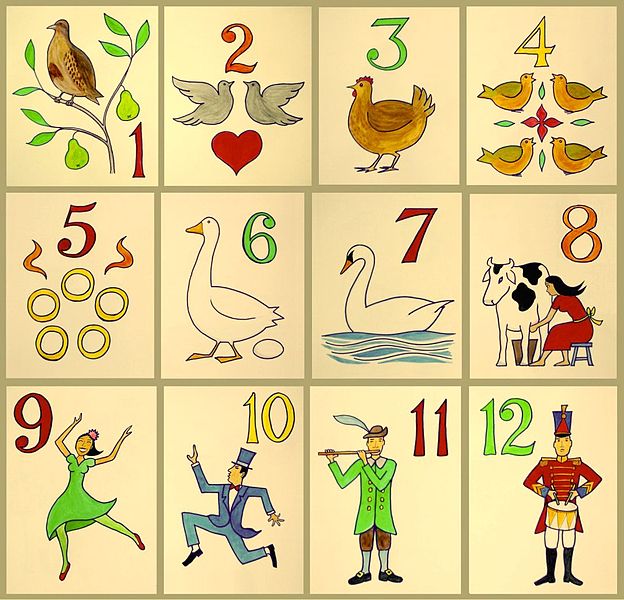
12 Days of Christmas

The Quivering Pen has been my happiest blog discovery of late. It’s a rich, beautifully written site about books, writing, and the literary life by David Abrams, a former Army journalist and author of The Fobbit, a comic novel about the Iraq War.

David is an expansive, passionate reader who writes eloquently about new, backlist, classic, and “lost gem” titles. You’ll find unusual and off-the-beaten-path books to add to your to-read list, and if you’re a writer, you’ll appreciate David’s generous sharing of his own journey and the wisdom of other writers.

I’m looking forward to reading David’s enticing backlist of posts. Among other attractions, he features Trailer Park Tuesday (new book trailers), Friday Freebie (a book giveaway), Sunday Sentence (the best sentences he’s read that week), My First Time (writers talk about virgin experiences in their writing and publishing careers), and Bookstore of the Month.

The Twelve Days of Christmas Song Poster by Xavier-Romero Frias is licensed under CC BY-SA 3.0.

The Book Thief

“They say that war is death’s best friend, but I must offer you a different point of view on that one. To me, war is like the new boss who expects the impossible. He stands over your shoulder repeating one thing, incessantly: ‘Get it done, get it done.’ So you work harder. You get the job done. The boss, however, does not thank you. He asks for more.”       Death, in The Book Thief

The Book Thief book cover

Death is the narrator in The Book Thief, a young adult book about a German family during World War II that has a huge adult readership as well. It is one book not to be missed. The writing is outstanding. Published in 2005, The Book Thief won countless awards and honors, and has become a classic in YA fiction.

I recently reread the book before I saw the movie. I think the screen adaptation is a good one, although some viewers found it tame, and subtleties of the text can’t be captured on the screen. For example, Max, who is Jewish and hiding out in the home of Liesel and her foster parents, paints over every page of a copy of Mein Kampf and creates his own book, with illustrations. Max’s book is embedded within the pages of The Book Thief, and on the pages of Max’s book you can see faint traces of Hitler’s words.  One of the pages in Max’s book is a drawing of a girl and a boy holding hands and standing on a pile of bodies. Inscribed on the sun that shines down on them is a swastika, and the girl is saying, “Isn’t it a lovely day?”

The author, Markus Zusack, uses the written word as a thematic motif. While the Germans burn books thought to be subversive, Liesel and Hans write words on the wall of their basement as Liesel learns to read, and Liesel steals a book whenever she has the chance, in defiance of the Nazis. Liesel then begins to write her own book in order to make sense of the world’s chaos and carnage.

I do think the movie captured the essence of the story, and it is well cast, especially Sophie Nélisse as Liesel Meminger and Geoffrey Rush as Hans, her foster father. Death is the narrator in the movie, as he is in the book, and in both he is an unsettling storyteller who confesses he is haunted by humans. Of course, in addition to being the narrator, Death has a starring role in the plot as well.

My father was wounded in the war, just inside the German border. Occasionally, my mother spoke of her family’s Victory Garden, the rationing of meat and gasoline, and the “man shortage.”  I was born ten years after the war ended. As an adult, I eventually began to understand how the world turned upside down by war cast long shadows over my parents’ generation.

Have you seen the movie or read The Book Thief? What did you think?

If you want to be lifted up, read Kent Haruf

Benediction book coverShe looked at the two old brothers….

I want you to think about taking this girl in.

They stared at her.

You’re fooling, Harold said.

No, Maggie said. I am not.

They were dumbfounded. They looked at her, regarding her as if she might be dangerous. Then they peered into the palms of their thick callused hands spread out before them on the kitchen table and lastly they looked out the window toward the leafless and stunted elm trees.    

                                                                             Plainsong, by Kent Haruf

Yesterday I finished reading Kent Haruf’s new novel, Benediction, about an elderly hardware store owner, Dad Lewis, dying of cancer.  I realized it was three years to the day since my father passed away from cancer. More than a coincidence, probably. I imagine something unconscious was at play. But I would have read this book eventually, no matter what, because I read everything Haruf writes.

My devotion to Haruf began when I read Plainsong, which he published in 1999. One of Haruf’s critics describes Haruf’s work as “exalted.” If you want to be exalted, get a copy of  Plainsong or Eventide or Benediction and drop into the lives of the folks who live on the dry plains in the fictional town of Holt, Colorado.

Haruf writes about goodhearted people way off the beaten path trying to do the right thing. His prose is entrancing, deceptively simple, powerful. You may begin to be lulled by the humanity Haruf captures on the page, but before you get to feeling incredulous he hits you with some dark reality: bigotry, abuse, cruelty, abandonment, addiction.

I was surprised Haruf said in an interview one of the books that most influenced him as a writer was Ernest Hemingway’s The Sun Also Rises, a novel that underwhelmed me both times I read it. But in Haruf’s plain, spare prose I can see Hemingway’s legacy. And it reinforces my interest in how what we read speaks to us, personally. That’s going to be different for everyone.

Benediction is a beautiful book, but an especially quiet and somber one. If you want to sample a novel by Haruf, I suggest you begin with Plainsong, which has more action and a greater diversity of intriguing characters, followed by Eventide and then Benediction. All are set in Holt, in eastern Colorado. Plainsong and Eventide are companion novels that feature the same cast, while Benediction introduces a new set of characters. I suspect Haruf may continue their stories in a future novel.

In Benediction, an eighty-year-old woman, two sixty-year-old women, and an eight-year-old girl skinny-dip on a hot afternoon in a muddy water trough for cattle. Cool and refreshed, they lie down under a tree in their thin, sleeveless cotton dresses to take a nap. Somehow, Haruf makes this scene riveting. It is emblematic of his writing.

Two of my favorite characters in all of fiction are Plainsong’s rough-hewn cattle ranchers Harold and Raymond McPheron, who take in Victoria Roubideaux, a homeless, pregnant teenager. They are so sweet, and clueless to the point of hilarity. One of the funniest scenes I’ve ever read is their visit to the ob-gyn with Victoria.

As much as I enjoyed Benediction, the McPheron brothers from Plainsong and Eventide will always be in my heart.

Plainsong book coverRaymond, you’re my brother. But you’re getting flat unruly and difficult to abide. And I’ll say one thing more.

What?

This ain’t going to be no goddam Sunday school picnic.

No, it ain’t, Raymond said. But I don’t recall you ever attending Sunday school either.

Quotes from Plainsong, Kent Haruf. Vintage Books, New York: 1999.

BY KENT HARUF:

Plainsong

Eventide

Benediction

The Tie That Binds

Where You Once Belonged

Still reading Barry Lopez

Stories…offer patterns of sound and association, of event and image. Suspended as listeners and readers in these patterns, we might reimagine our lives…As long as it took for me to see that a writer’s voice had to grow out of his own knowledge and desire, that it could not rise legitimately out of the privilege of race or gender or social rank, so did it take time to grasp the depth of cruelty inflicted upon all of us the moment voices are silenced, when for prejudicial reasons people are told their stories are not valuable, not useful.                    Barry Lopez

About This Life book coverIn the introduction to his essay collection About This Life: Journeys on the Threshold of Memory, Barry Lopez tells of meeting a man on a plane who asked what words of advice he could pass on to his teen-age daughter, who wanted to be a writer. This is what Lopez said:

She must read, and her choices should be whatever she is drawn to.

She should read the classics, too, but she’ll have to work harder to find stories of heroism, love, and our noblest values that are written by women.

Second, she must “become someone” and “speak to us from within those beliefs.”

Third, he advised that she “separate herself from the familiar.” After exploring other places and meeting a diversity of people, she`ll know why she loves the familiar and share this knowledge through her writing.

Early on, Lopez felt he was noticed, accepted, and rewarded as a writer in part because he was white, male, privileged and well educated. If you read his work, you’ll find he is keenly sensitive to the fact that many voices haven’t been heard because they are different or not within traditional circles of power. He thrives on traveling to the far corners of the earth and seeking these people out –  artists, artisans, farmers, naturalists, explorers who live close to the land, indigenous peoples, and others.

I was mesmerized by an essay in About This Life, “Effleurage: The Stroke of Fire.”  An Oregon potter and builder of a unique anagama kiln invites clay artists from around the world to fire their work. Jack doesn’t care about marketing or commercial success; he’s totally immersed in the process of making pottery out of materials from nature. Every three or four months, up to twenty artists bring their work to be fired in the Dragon Kiln.  Families, friends, even pets tag along. The firing goes around the clock for several days. Building the tremendous fire that heats the kiln is an art in and of itself. Different kinds of wood – black locust, maple, cherry, Lombardy poplar, red cedar – make different kinds of fires, and keeping the fire properly stoked is a community effort of like-minded artists who put aside their egos for the benefit of the group.

Lopez says you must become someone to write. I think he would agree the kiln designer and the clay artists are “becoming” through their life’s work, just as their clay pieces are forged in the fire. It’s a process that never ends. Even the clay pot continues to change, subtly, after the firing.

Crow and Weasel book coverOver and over, Lopez celebrates journeys into the unknown, strangers who become friends, coming home again, and the writing of the story. You see this in About This Life and in his fable, Crow and Weasel.

Recently, Lopez published a revelatory personal essay that has received a lot of attention, “Sliver of Sky,”  in Harper’s Magazine, about a period of sexual abuse he endured as a child. That Lopez waited until his seventies to write about this suggests how deeply confounding and wounding it was. The trauma and years of silence may explain in part Lopez’s empathy and compassion for others who were silenced for one reason or another. And no doubt it has contributed to his sense of mission as a writer.

I’ve written about years of being silent and feeling silenced by others because of my mother’s mental illness. I think that is partly why I didn’t make the commitment to becoming a writer when I was younger. How can you mature as a human being and as a writer when you can’t work with the very material that is woven into your identity?

If we’re silenced, we’re blocked. We don’t become our fullest selves. Diminished in what we are able to offer the world, the world will be diminished, too. It is in our bests interests to see that no one among us is silenced.

So I find reading Lopez to be a rare and important form of encouragement.

In an interview with Bill Moyers, Lopez says he’s viewed as a nature writer but, actually, he is writing about humanity.

“Every story is an act of trust between a writer and a reader; each story, in the end, is social. Whatever a writer sets down can harm or help the community of which he or she is a part.”

Quotes from: About This Life: Journeys on the Threshold of Memory, Barry Lopez, Vintage Books, New York: 1998.

First anniversary book giveaway

What one loves in childhood stays in the heart forever.   Mary Jo Putney

Snow-covered trees
After the storm.


Books Can Save a Life is a year old this month.

I’ve grown so fond of it here and of you who visit and comment. Meeting people from all over and re-connecting with friends and distant family  –  I never expected that.

Not to mention the beautifully conceived and produced blogs about books, writing, food, nature, gardening, travel, creativity, and other topics I’ve discovered, and the artistic geniuses behind them.

Books Can Save a Life is a lot like my backyard retreat, where I sit by our homemade pond after I walk or run. I always look forward to visiting Books to set down my thoughts and see who has stopped by.

To celebrate a year of Books, I’m having a book giveaway. By the end of February, leave a comment about a book you’re reading. a book you want to read, a book that’s becoming a movie, a book memory, or anything at all to do with reading, and I’ll put your name in a hat. (Actually, I use a rice bowl.) If I draw your name I’ll send you the book of your choice. If you can’t decide on a book, I’ll surprise you.

You might have noticed I’ve redecorated, too. I’ve chosen a new design theme in honor of the coming year and to signify a more expansive focus on topics beyond books. There’s so much I want to write about.

But you’ll still find plenty of books here.

Your comments and guest posts are what I absolutely love about this blog. Many of you spoke of books from your childhood that years later still evoke memories of family and loved ones, places you’ve been, and particular times in your lives. I think sometimes the very story or book we need comes along, or  somehow we’re led to find it.

Here are a a few comments from readers of Books this past year. Please keep them coming.

I can’t imagine my room without my personal bookcase, or a world without books. (Giuseppe)

It’s hard to put yourself in their places [The Hunger Games], living their lives and going through what they do daily in their “world,” but that’s what’s so great about books, they take you to different places and times through the amazing imagination of the authors. (Diana)

I find many so called adult novels pretentious. I want a story. I return, often, to what is classified as young adult literature, mostly because these are stories of life. Stories – in the true sense of the word. And, I can’t help but say that, years ago, I was saying to people, “Have you read the Harry Potter book?” And everyone said no. Then came that glorious day on the L in Chicago, traveling home from work, and I saw not one, not two, but six adults reading the book. I wanted to laugh out loud at the thought of those six people entering into another world…. (Donna)

Agatha Christie wrote a story without heroes; to me, that was heroic honesty.  Conversely, the inevitability of justice satisfied me. For all my contempt for two-faced authority, I still relished the idea of wrongdoers punished by divine oversight.  My sense of my own weakness as a child needed that reassurance. (Doug)

Cooking from Moosewood, even with its imperfections, was utopian. Funny how small, utopian practices can make you feel, despite the deepest contradictions, that summer is everlasting and life is good. (Judith)

….even the smallest person can step away from comfort and into challenge, that change is possible on scales small and large, that our efforts and intentions matter. The story reinforced for me that there are things in this world worth protecting–fellowship and love, food and conversation, adventure and courage, songs and stories. These are the things that sustain us when life is difficult, when we are hurt or afraid and have to be so much braver than we feel. (Adrienne)

Snow-covered bench

Enter my book giveaway: Kingsolver’s Flight Behavior

Been traveling for the Thanksgiving holidays and forgot to mention here at Books Can Save a Life that I’m giving away a free copy of Barbara Kingsolver’s Flight Behavior.

Flight Behavior book coverAll you need to do for a chance to win the book is check out my recent post, Now is the time to read Kingsolver’s Flight Behavior, and leave a comment about where you stand on climate change, or if you think a work of fiction such as Kingsolver’s can make a difference one way or the other.

I’m extending the deadline to December 3, when I’ll put the names of all who comment in a hat and draw the lucky winner.

I read an essay the other day in which the author mused that perhaps New York City will no longer exist in a hundred years. Or it will be located in Westchester County.

What do you think?

I welcome all thoughts and opinions (as long as we’re friendly and polite!)

So, comment away, please!

Reading Junot Diaz

This Is How You Lose Her book coverYou ask yourself why you’re reading This Is How You Lose Her, the short story collection by Junot Diaz. How could you possibly relate to Yunior, the irreverent, hard-drinking Dominican-born narrator and serial cheater of the most extreme sort?

You write this post in second person point of view, as Diaz does in his short story, “A Cheater’s Guide to Love,” just to try it on for size.

You read that Yunior cheated on the love of his life with no less than 50 women over six years. And then she found out.

Diaz writes, “You claim you’re a sex addict and start attending meetings. You blame your father. You blame your mother. You blame the patriarchy. You blame Santo Domingo. You find a therapist. You cancel your Facebook. You give her the passwords to all your e-mail accounts. You start taking salsa classes like you always swore you would so that the two of you could dance together.”

Yunior’s ex-fiancee assembles all the damning evidence (emails, photos, etc.) in an album (the Doomsday Book) and sends it to Yunior with a note: For your next book.

You think: This is one funny writer.

The writing is so musical and overflowing with Spanish, maybe you can brush up on the language: blanquita, moreno, salcedeña, sucio, cuero. Then you realize some of the words are made up, and others are words you’re not likely to use any time soon.

Yunior’s suffering seems to know no bounds, as if he’s channeling all the deprivation of his poor, difficult, immigrant life  (which the other stories in this collection portray) into mourning his lost love.

Yunior becomes a professor of fiction in Boston. Having grown up in Santo Domingo and New York City, he has a hard time in New England: “White people pull up at traffic lights and scream at you with a hideous rage, like you nearly ran over their mothers….Security follows you in stores and every time you step on Harvard property you’re asked for ID.”

Yunior visits the Dominican Republic with his friend, Eric, to see Eric’s presumed love child; the child and mother live in the Nadalands, where Yunior’s father was born and where his ex-fiancee is from. Mud, shanties, no running water or electricity, raw sewage.

You remember the volunteer work your family did in Nicaragua – you’ve only seen that kind of poverty once and, after a few days, you could return to your comfortable home in America.

You know Diaz’s  fiction is partly autobiographical and you wonder which parts are true, which are made up. You find the second person point of view can be confusing: Does the “you” refer to Yunior, or to the author himself? Sometimes you think the “you” refers to you, the reader, because by now you’ve become so invested in Yunior you find yourself beginning to understand and identify with him.

There is that moment of self-reckoning when Yunior has to face what he has done. You agree with Yunior’s assessment of the half-life of love.

You think: this blurring of boundaries between author, narrator, reader – maybe that’s the point.

If you’ve read this book, please comment!

Quotes from This Is How You Lose Her, Junot Diaz, Riverhead Books, New York: 2012.