H Is for Hawk

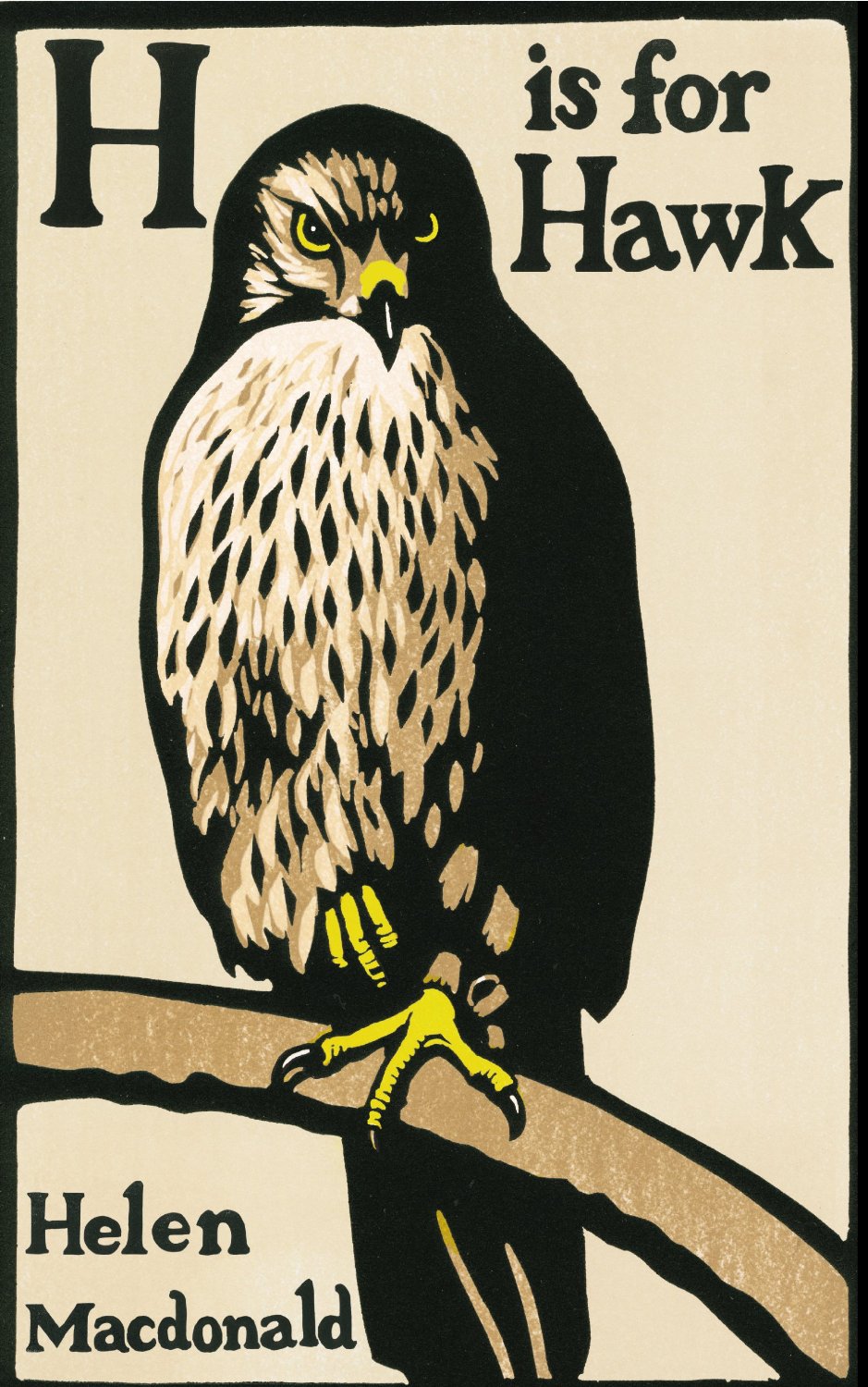
H is for Hawk

“….her feet were gnarled and dusty, her eyes a deep, fiery orange, and she was beautiful. Beautiful like a granite cliff or a thunder-cloud. She completely filled the room. She had a massive back of sun-bleached grey feathers, was as muscled as a pit bull, and intimidating as hell….”  H is for Hawk, by Helen Macdonald

Helen Macdonald’s reaction to her father dying suddenly was to embark on the extraordinarily difficult task of training a goshawk, one of nature’s fiercest and most ruthless predators.

Goshawks are cold-hearted, lifelong loners with no social instincts whatsoever. They bond with no one, not the goshawk they mate with, not other goshawks, not any human who wants to train them. You can’t look them in the eye, either, because if you do they might attack you.

Goshawks don’t respond to punishment. The only way to train a goshawk is to be submissive and patient, eyes cast down at all times. Tim Gallagher, in a review of H Is for Hawk, likens this to being a kind of monk. It is not a part-time thing. Training a goshawk is all-consuming. It takes over your life.

Helen writes about the hawk she is training, whom she names Mabel:

“Everything about the hawk is tuned and turned to hunt and kill. Yesterday I discovered that when I suck air through my teeth and make a squeaking noise like an injured rabbit, all the tendons in her toes instantaneously contract, driving her talons into the glove with terrible, crushing force. This killing grip is an old, deep pattern in her brain, an innate response that hasn’t yet found the stimulus meant to release it. Because other sounds provoke it: door hinges, squealing breaks, bicycles with unoiled wheels – and on the second afternoon, Joan Sutherland singing an aria on the radio. Ow. I laughed out loud at that. Stimulus: opera. Response: kill.”

Two goshawks
Goshawk. Rare Book Division, New York Public Library


Helen’s father was a prominent photographer, Alisdair Macdonald, and the two were close. When she was a child, they spent many days roaming the countryside as Alisdair indulged his passion for airplanes and Helen her growing passion for birds.

After Alisdair died, Helen wanted a distraction from her grief, something deeply immersive and challenging. In this respect, H Is for Hawk is unlike other memoirs. There isn’t a lot about Helen’s father or her relationship with him, or about Helen’s feelings of sadness and loss, per se. These are subsumed into an arresting narrative of Helen’s struggle to achieve what seems to be impossible as she grapples with her grief.

As Helen comes to understand, “Shocking loss isn’t to be shared, no matter how hard you try.”

Helen was, in fact, an experienced falconer, but she’d never taken on a goshawk before. She brought along a companion in her unusual undertaking: T. H. White’s, The Goshawk, White’s account of his own experience training a goshawk in the 1930s. (Remember T.H. White’s The Sword in the Stone, The Once and Future King, and other tales of Arthurian legend? Even if you didn’t read the books, you’ve probably seen the movie/musical Camelot and the Disney version of The Sword in the Stone.)

This weaving of T.H. White’s experiences into Helen’s narrative is fascinating; White, who was gay in a culture and time when this was unacceptable, was grappling with his own loss and inner darkness. Helen writes,

“It took me a long time to realise how many of our classic books on animals were by gay writers who wrote of their relationships with animals in lieu of human loves of which they could not speak.”

And this:

“….White wrote one of the saddest sentences I have ever read: ‘Falling in love is a desolating experience, but not when it is with a countryside.’ He could not imagine a human love returned. He had to displace his desires onto the landscape, that great, blank green field that cannot love you back, but cannot hurt you either.”

Helen’s immersion with Mabel, her goshawk, is harrowing. She holds nothing back in the struggle, and she holds nothing back from her reader.

Ultimately, Helen has to confront her obsession with the goshawk and her nearly complete withdrawal from friends and family. Where does obsession end and madness begin?

Before you read H Is for Hawk, I highly recommend that you read this fascinating review by Tim Gallagher at the Cornell Lab of Ornithology All About Birds site. Gallagher puts the human-training-a-goshawk challenge into context, and I think it will pique your interest. Not knowing a raptor from a falcon from a hawk myself, I wish I’d read this review first. And I’ve a soft spot in my heart for the Cornell Lab of Ornithology and the good work they do. We live not far from there, and I’ve seen at least one of their research sites in the Finger Lakes countryside.

Read H Is for Hawk if you want a different kind of memoir that demands to be read slowly, one word, one phrase, one sentence at a time. If you’re willing and want to slow down and immerse in another world entirely.

I expect I’ll read H Is for Hawk once or twice more down the road, as I simply couldn’t take it all in the first time through. If I’ve painted a rather dark picture of this unusual memoir, there is light and wisdom gained, too:

“There is a time in life when you expect the world to be always full of new things. And then comes a day when you realise that is not how it will be at all. You see that life will become a thing made of holes. Absences. Losses. Things that were there and are no longer. And you realise, too, that you have to grow around and between the gaps, […]”

Have  you read H Is for Hawk? What did you think? Are there similar books you might recommend?
Excavating a Life

Momphotos-18This is a happy coincidence: I’m starting a new, ongoing theme here at Books Can Save a Life (in addition to my usual book posts) called Excavating a Life on my fourth anniversary, to the day, of blogging.

Excavating a Life will be my informal, occasional, online creative journal: notes and jottings about the writing life as I try to finish this exhilarating and confounding marathon of writing a memoir, which I’m aiming to complete in 2016.

I hope these musings will speak to you who are immersed in a creative endeavor, or inspire you to begin one, and that you’ll share the challenges and high points of your own journey.

For those who follow me primarily for books, I’ll often highlight an author or work that has taught me something about pursuing a writing or creative practice with intention–so books will be a big part of Excavating a Life, too.

For instance, you’ll see a lot of Vincent Van Gogh here. I’m not a painter by any means, never learned to draw (though I’m making attempts to keep a nature journal), but I find Van Gogh’s letters an endless source of inspiration; I have three collections of them.

Here is a nugget of wisdom from Van Gogh. And it doesn’t just apply to painting (or writing) does it?

Vincent
“If a peasant painting smells of bacon, smoke, potato steam–fine–that’s not unhealthy–if a stable smells of manure–very well, that’s what a stable’s for….Painting peasant life is a serious thing…”  Vincent Van Gogh: Ever Yours, The Essential Letters, Yale University Press 2014


I’m thrilled to acknowledge and thank my longtime friend and writing coach extraordinaire, Debra Marrs, who presented this gift of an idea for Excavating a Life when we met up a couple of times in Florida for afternoon tea and some fabulous Cuban food. We were in Florida to spend holiday time with family–a Christmas quite different from our usual upstate New York kind.

Thanks to my sister- and brother-in law, who have the perfect guest quarters, I started off the year with a week of intensive writing. During my mini-retreat, I was able to add 10,000 words to my memoir–not quite my goal of 13,000, but good enough.

Temple
Wat Mongkolrata Temple

My sister-in law, who is from Thailand, took us to the local Buddhist temple, where I meditated and enjoyed the beautiful surroundings. It was a unique blend of spiritualities for me this mid-winter. That, and a change of scene, did wonders for my writing.

Before I close, here is one more tidbit. Have you ever heard of the Helsinki Bus Station Theory of creativity? I hadn’t, but apparently it is well known among many photographers. I found out about it yesterday. I love it and agree with it. Don’t get off that #!?&! bus. And remember, in the first stages of a project, feedback from others or your own emotions “aren’t a reliable indication of how you’re doing.”

Orchids
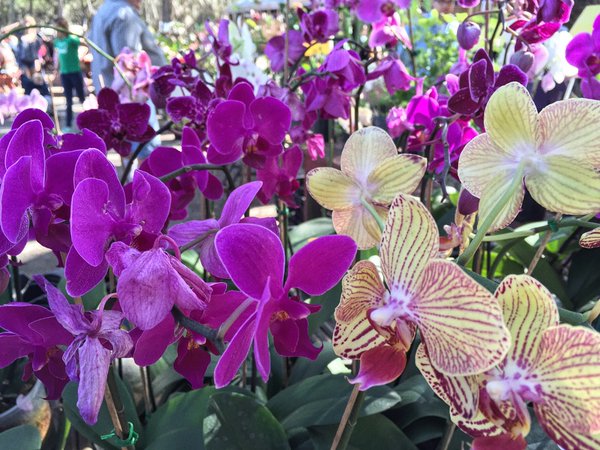
A different Christmas this year: orchids instead of evergreen. My niece said these look like butterflies, and I agree.


Are you immersed in bringing something to fruition? Or would you like to be? It could be anything: writing a book, building a stone wall, starting a business, learning to knit, climbing all the Adirondack mountain peaks, whatever. What’s your biggest creative challenge at the moment?

Journal
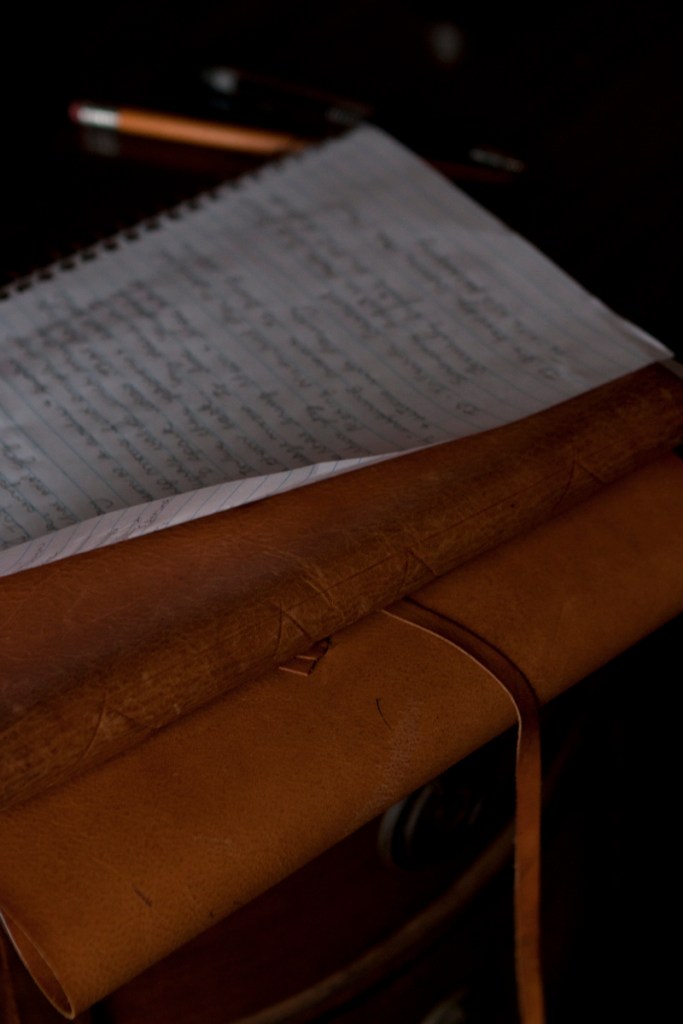
I bought this well worn leather journal cover in Florence years ago.


Shop local for Christmas

Corner Bookstore

shelf-sacrifice n: to selflessly give away a book from one’s personal library for another person’s benefit – Powell’s Compendium of Readerly Terms

In our village on the Erie Canal, we have a number of small nonprofit businesses run by volunteers, including a craft shop, a second-hand tool thrift store, and The Corner Bookstore with used and collectible books. All donate their profits to good causes. The bookstore proceeds support programs at our public library.

I love shopping at these small businesses. (The tool shop not as much, but we did buy an old-fashioned push lawn mower there. When my brother-in-law visited us a few years back, we lost him for a couple of hours, only to find him browsing in the tool shop.)

A number of clothing consignment shops are scattered around our village as well. I’ve been thinking about challenging myself this year to buy exclusively (or almost) from stores I can walk or bike to. Our farmer’s market runs from May to November, so it wouldn’t be difficult to purchase a good portion of our fruits and vegetables there, supplemented by our small backyard garden. (Our town has a community garden, too.)

Shelf-sacrifice is what The Corner Bookstore is all about. It’s an elfin wonderland of used and vintage books lovingly displayed in diminutive groupings: children’s books, poetry, graphic novels, history, fiction, local authors, and more.

Vintage Children's Books

The cookbook section has used cookbooks nestled in gift baskets along with vintage ice cream sundae glasses, martini glasses, and miniature ceramic casserole dishes. I found a blank recipe album with Bible verses and beautiful cover art in pristine condition. For my son, I found a Vietnamese cookbook – he loves Asian food.

Cookbooks

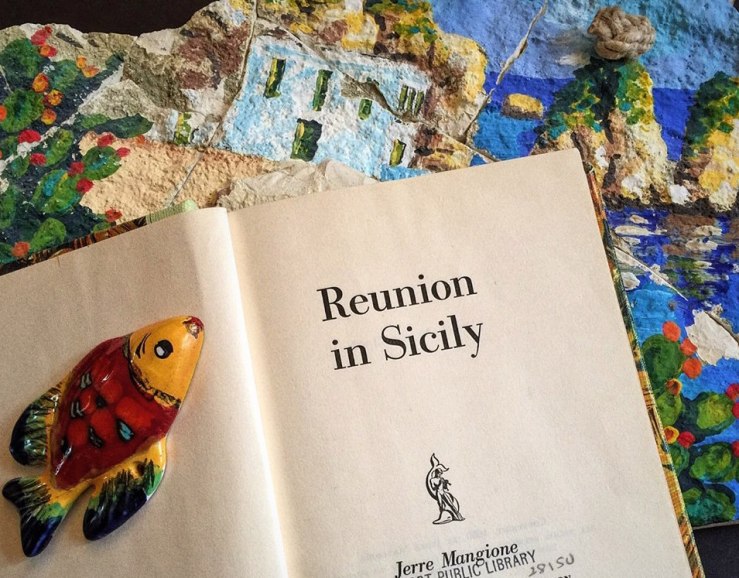
In the local authors bookcase, I spotted Reunion in Sicily by Jerre Mangione, a scholar of the Sicilian-American experience, according to Wikipedia. Jerre is the uncle of jazz musicians Chuck and Gap Mangione, who are from Rochester. Flipping through the pages of the book, which was published in 1950, I saw that the author visited Sicily in 1936 when Mussolini and the Fascists were in power. Mangione was watched closely by the police and interrogated more than once as to the purpose of his visit.

Reunion in Sicily

Mangione was awarded a Guggenheim Fellowship after WWII so he could return to Sicily to learn more about Italian politics and culture of the times. Reunion in Sicily is not listed in his Wikipedia entry; I’m interested to see what I can learn from the book. My father was Sicilian-American and a WWII veteran with extended family in the Old Country. The war, of course, essentially split Italian and Italian-American families in two, at least for a time.

Another great find was The Fragrant Garden, a beautifully slipcased anthology of garden writing and art, the kind of book you can display open on a small easel. When I noticed the subtitle, Penhaligon’s Scented Treasury of Verse and Prose, I realized that a faint floral scent emanated from its pages. Upon reading the prologue I discovered that, indeed, the endpapers are scented with Penhaligon’s Gardenia perfume. Gardenia is one of my all-time favorite floral scents; I had a gardenia in my bridal bouquet.

Fragrant Garden.jpg

The volume was edited by Sheila Pickles (check out her Goodreads Page) and published in 1992. Never having heard of Penhaligon’s, I had to look that up, too. It was established in London in the late 1800s. There are shops in the US, but wouldn’t it be wonderful to visit the London shop? They have a blog, and here is an enticingly sensuous excerpt from it about the men’s perfume Endymion:

“….a complex blend of sophisticated scents, it opens with the orangy warmth of bergamot and mandarin wrapped in delicate lavender and sage. The dark coffee heart is rich and powerful giving way to the spicy velvet base of creamy nutmeg, vetiver, cardamom and a hint of leather. It is strong and romantic and very masculine.”

I’ve never heard of vetiver, have you? I had to look that up, too.

Wasn’t that fun? All this from a Christmas shopping trip to The Corner Bookstore.

Christmas lights.jpg

Don’t overlook the independent bookstores and shops near you as you go about your holiday shopping. It’s a good way to support your local economy, and you’re much more likely to find unique gifts and treasures.

Do you have any independent bookstores that you like in your town?

Library window with Erie Canal mural
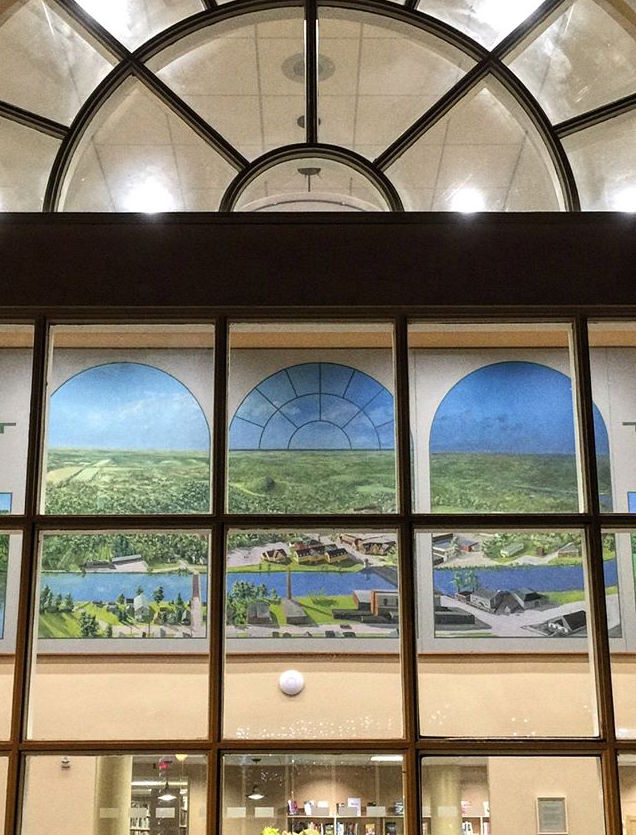
Our public library on the Erie Canal was recently renovated. Since 1938, it has boasted this mural by Carl W. Peters, created as part of Rochester’s WPA Murals project.
Lift Bridge
Our one-of-a-kind lift bridge spans the Erie Canal. It is an irregular decagon (10 sides), no two angles in the bridge are the same and no corners on the bridge are square. It is lifted by a 40 hp electric motor. When the kids were little they loved watching the bridge being lifted so boats could pass through.


Wild Arts!

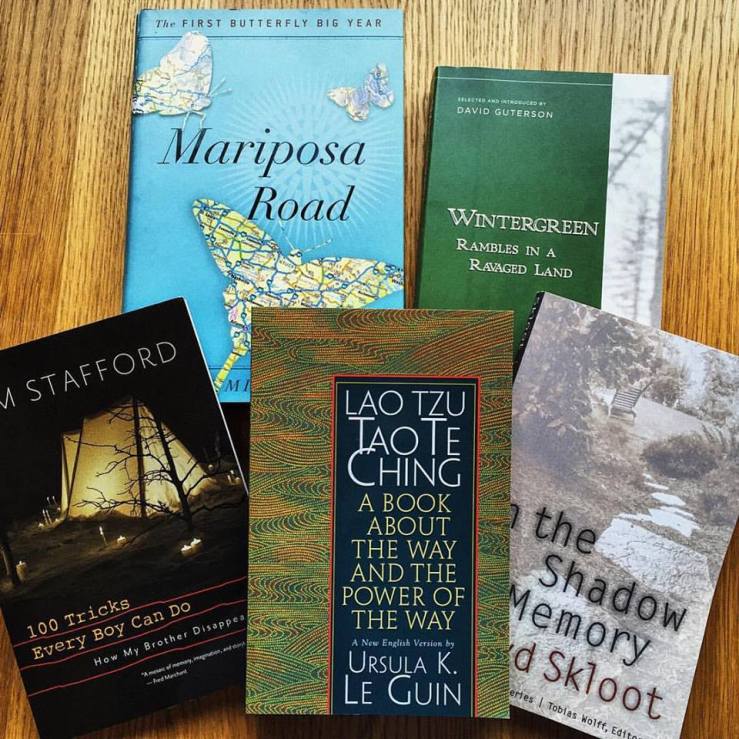
Five books
Books purchased at the Wild Arts Festival in Portland, signed in person by the authors.


Litmosphere: 1. the vast domain of the world’s readers and writers 2. a lively literary mood permeating the air ~ sign in Powell’s Books, Portland

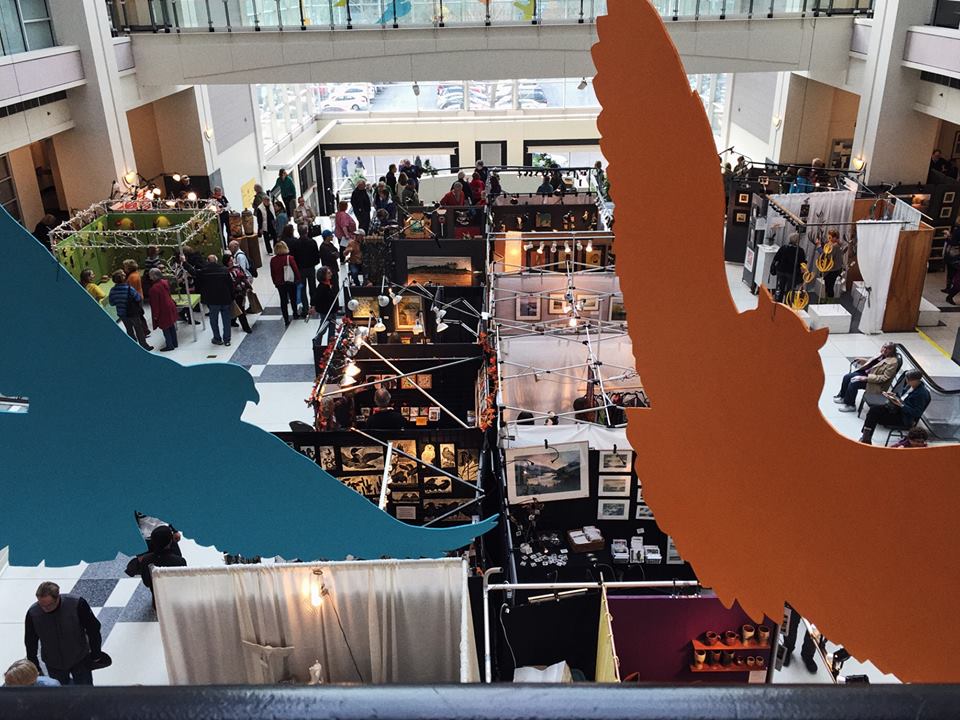
Wild Arts FestivalI love the literary scene in Portland. Our Thanksgiving visit there coincided with the annual Wild Arts Festival, a celebration of nature in art and books hosted by the Audubon Society of Portland in the old Montgomery Ward building, now known as Montgomery Park.

Walking into the festival, where hundreds of artists and authors were on hand, was like getting a gigantic embrace from the creative community.

I couldn’t decide among Ursula Le Guin’s many, many science fiction and fantasy books. In the end I chose her translation of Lao Tzu: Tao Te Ching: A Book About the Way and the Power of the Way, and she graciously signed a copy for me.

Next, we met Robert Michael Pyle, a jolly teddy bear of a man who spent no less than 15 minutes entertaining us with stories about how, in his Honda Civic with 345,000 miles on the odometer, he spent a year searching for as many of the 800 species of American butterflies as he could find. I could have spent hours listening to this man; instead I bought his memoir and travelogue, Mariposa Road, which he signed with, “May these far rambles on bright wings incite your own wild road trips!”

A dedicated ecologist and naturalist, Robert Michael Pyle has written nearly 20 books and is the co-editor of Nabokov’s Butterflies: Unpublished and Uncollected Writings. (The literary genius Vladimir Nabokov was a butterfly expert and had an extensive collection.)

I purchased another of Robert’s memoirs, Wintergreen: Rambles in a Ravaged Land, about Washington’s Willapa Hills, whose forests have been plundered by lumber companies. Robert lives on a farm in Grays River once owned by a Swedish immigrant. I’m descended from Swedes, who were attracted to the deep forests of the Pacific Northwest because it reminded them of home; I’d love to see Willapa country one day. Of course, Robert signed Wintergreen, too, with these words, together with a sketch of a snail: “May these moss murmurs and fern-words honor your own hills of home – and maybe urge you Northwesterly!”

I can’t say enough about Floyd Skloot and Kim Stafford. They are both poets, and they’ve both written memoirs. (Actually, they’ve both written more than one, and I look forward to reading all of them.)

Since I’m writing a memoir myself, I decided to go for the memoirs: In the Shadow of MemoryFloyd Skloot’s first memoir (part neuroscience and part autobiography about a virus that left Skloot disabled and bereft of memories) and 100 Tricks Every Boy Can Do: My Brother’s Disappearance by Kim Stafford (his brother committed suicide.)

Both of these generous writers spoke with me about their work and asked at great length about mine. Kim wanted to know the working title of my memoir and, when I told him, he gave me a writing assignment to try. As I did the exercise Kim recommended, I discovered that one particular word in the title is especially important to my memoir’s theme. It got me thinking about how I could bring out the theme more vividly as I revise.

The authors I spoke with at the Wild Arts Festival were incredibly kind and gracious. I had instant connections with these generous writers, who are among the best in America today. Don’t be shy at these kinds of events. Writers and artists are the most giving and engaged people you’ll ever meet.

Portland is a book-loving town, and as I walked around the neighborhoods with family, I noticed several Little Free Libraries. It’s also a poetry-loving town, and a couple of the homes I passed by had poems on display – including one by Kim Stafford’s father, the great poet William Stafford.

Slipped inside the Kim Stafford memoir I bought was the gift of a poem that begins, “The only heroic thing is to not be a hero.” I believe Kim borrowed this phrase from a poem by his father, William: “At the Un-National Monument Along the Canadian Border.”

Kim’s poem is called “A Few Words, Each Day,” and it includes this line: “The only heroic thing is to be a child of four…of fifteen…of forty…of eighty – trying with the heart and mind to listen to the self, each other, and the earth….”

Litmosphere definition sign in Powell's Books
We stopped by Powell’s Books for good measure, where I learned a new word.


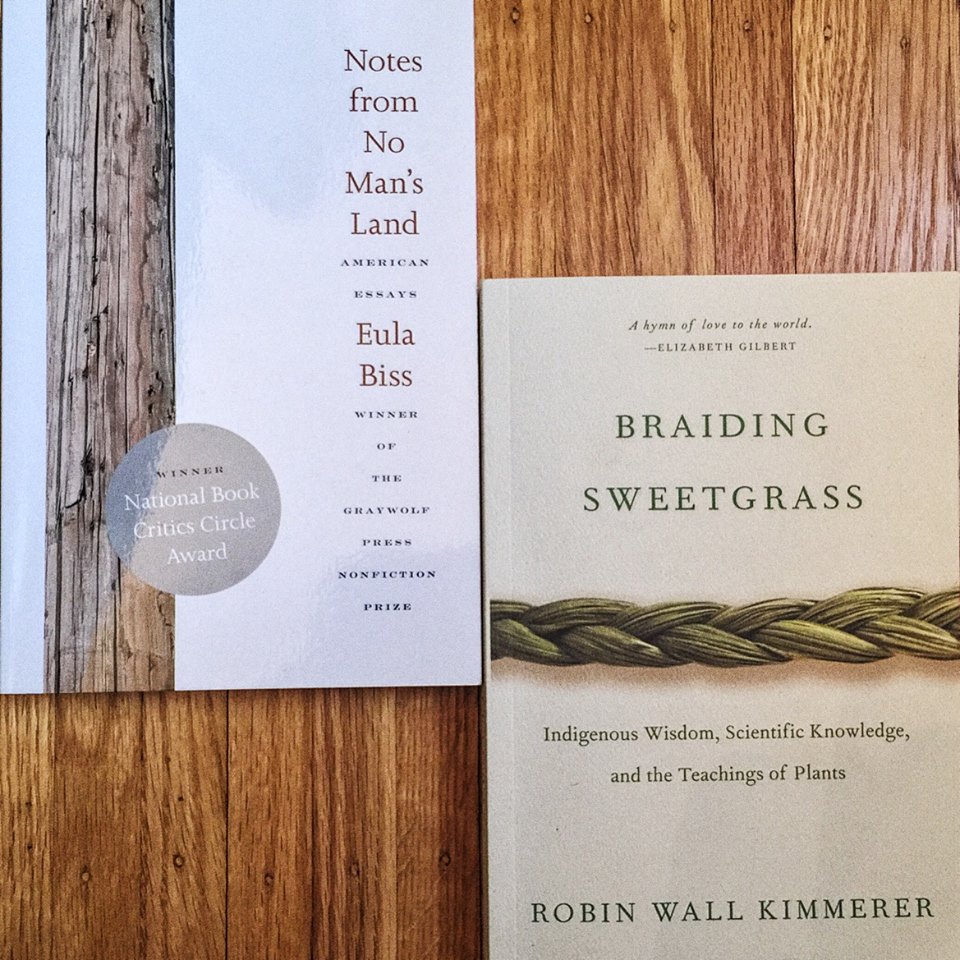
Books: Braiding Sweetgrass; Notes from No Man's Land
At Powell’s I bought Eula Biss’s collection of essays and the latest book by Robin Wall Kimmerer, who is a botanist and member of the Citizen Potawatoni Nation.


Northern spotted owl at the Wild Arts Festival


Kim Stafford: “That is my story.”


The Collapse of Western Civilization (in 50 pages)

WesternCivilization“The year 2009 is viewed as ‘the last best chance’ the Western world had to save itself…”

The Collapse of Western Civilization is a disturbing 50-page work of fiction that reads with the authority of nonfiction.

In the Second People’s Republic of China in the year 2393, a scholar writes an account the Great Collapse of 2093, brought about by failure to take action on climate change.

Pair it with CCR’s Bad Moon Rising; you can read it in an hour or two.

The book came about when co-author Naomi Oreskes, a geologist and historian who teaches at Harvard, reviewed the scholarly literature on climate change to see if indeed there was a lack of consensus among scientists, as is often claimed.

After looking at 1,000 peer-reviewed articles, she concluded that in fact scientists do agree that a high concentration of greenhouse gas is causing climate change.

When Oreskes published her findings in Science, she was championed by the likes of Al Gore. At the same time, to her astonishment, she began receiving hate mail. As she said in an interview, articles published in the scholarly literature are typically ignored by the public.

She and coauthor Eric Conway hoped a work of fiction that remained true to the facts of science might change opinions. Conway is a fan of science fiction and has been especially influenced by Frank Herbert’s Dune and Kim Stanley Robinson’s trilogies about Mars and climate change.

It’s unsettling to read about ideas and ways of life that we take for granted portrayed as extreme short-sightedness, self-delusion, and magical thinking.  The Collapse of Western Civilization will give you a jolt. It’s a quick, page-turning read to put you in a receptive frame of mind when the UN/Paris Climate Change Conference begins on November 30.

Here are some excerpts:

“There is no need to rehearse the details of the human tragedy that occurred; every schoolchild knows of the terrible suffering. Suffice it to say that total losses – social, cultural, economic, and demographic – were greater than any in recorded human history. Survivors’ accounts make clear that many thought the end of the human race was near.”

“At the time, most countries still used the archaic concept of a gross domestic product, a measure of consumption, rather than the Bhutanian concept of gross domestic happiness to evaluate well-being in a state.”

“…survivors in northern inland regions of Europe, Asia, and North America, as well as inland and high-altitude regions of South America, were able to regroup and rebuild. The human populations of Australia and Africa, of course, were wiped out.”

Commonly used terms that we don’t question are cast as old-fashioned and obsolete in the Lexicon of Archaic Terms at the end of the book:

“capitalism: ….One popular notion about capitalism of the period was that it operated through a process of creative destruction. Ultimately, capitalism was paralyzed in the face of the rapid climate destabilization it drove, destroying itself.”

“invisible hand: A form of magical thinking, popularized in the eighteenth century, that economic markets in a capitalist system were “balanced” by the actions of an unseen, immaterial power, which both ensured that markets functioned efficiently and that they would address human needs. Belief in the invisible hand….formed a kind of quasi-religious foundation for capitalism.”

“Period of the Penumbra: the shadow of anti-intellectualism that fell over the once-Enlightened techno-scientific nations of the Western world during the second half of the twentieth century, preventing them from acting on the scientific knowledge available at the time and condemning their successors to the inundation and desertification of the late twenty-first and twenty-second centuries.”

Coming Back to Life book coverFor an antidote to all the doom, read Joanna Macy‘s books, Coming Back to Life and Active Hope: How to Face the Mess We’re In Without Going Crazy. See also her short film, Joanna Macy and The Great Turning, about civilization’s shift from industrial growth to sustainability.

Have you read any good books about climate change? Are you planning to follow upcoming events related to the UN Conference on Climate Change? Are there local activities planned for your area?

Nine books that can (help) save the planet

Laudato Si books

It still amazes me that there has not been more discussion of climate change in the media in the United States, nor have the presidential candidates said much. But we seem, finally, to have turned a corner; more people are paying attention.

Recently, stories have been published about Exxon’s alleged campaign of climate change disinformation and denial, while another industry leader has pledged to be carbon neutral by 2030. This week’s Hurricane Patricia was the strongest hurricane ever recorded at sea, while climate scientists expect 2015 to be the hottest year on record. I’ve a son living temporarily in southern California, and I just read that mosquitos carrying dengue, chikungunya, and yellow fever have arrived. Scientists believe they are rapidly reproducing in part because of the drought.

Countries around the world are preparing for the 2015 UN Conference on Climate Change to be held in Paris November 30 – December 11. There will be climate marches in major cities around the world on November 28 and 29 and a Mass Mobilization and Civil Disobedience Action in Paris on December 12.

When Pope Francis visited the United States in September, he spoke to Congress, the United Nations, and other groups about the need for action on climate change, framing it as the greatest moral issue of our time. His climate change encyclical, Laudato Si’: On Care for Our Common Home, calls for the world to adopt an integrated ecology that combines eco-justice, which understands the earth has limits, with social justice, which recognizes that the poor are the hardest hit by the ravages of climate change.

The Pope calls for “a revolution of tenderness, a revolution of the heart” in regards to the earth and the earth’s poor.

The Huffington Post article at this link is a brief and excellent introduction to the concept of integral ecology. The author of the article, a former NASA researcher, says: “The fates of all peoples are linked, and they are linked ultimately to the fate of the earth. What befalls the earth befalls us all.”

Here is a link to the Buddhist perspective on climate change: A Buddhist Declaration on Climate Change

If you will be following the UN Conference on Climate Change and would like to do some reading beforehand, here are eight more of my favorite fiction and nonfiction titles that are relevant:

Arcadia book coverArcadia, by Lauren Goff

Flight Behavior, by Barbara Kingsolver

The Collapse of Western Civilization, by Naomi Oreskes and Eric M. Conway (See my next blog post about this fascinating fictitious “report,” written in 2393 from the Second People’s Republic of China, chronicling reasons for the collapse of western culture.)

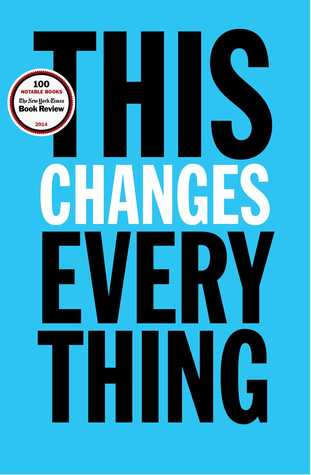
This Changes Everything, by Naomi Klein

The Sixth Extinction, by Elizabeth Kolbert

The Great Disruption, by Paul Gilding

The End of Nature, by Bill McKibben

The Only Kayak, by Kim Heacox

And if you are an earth and nature lover, you absolutely must acquaint yourselves with these writers if you haven’t already:

Wendell Berry (essays and poetry); Mary Oliver (poetry); Barry Lopez (See “The Case for Going Uncivilized.”)

This Changes Everything book cover

Pope Francis spoke with great passion and love about families during his visit to the US. There are many parallels between our nuclear families and the family composed of all creatures on mother earth, aren’t there?

Are you planning to participate in any climate change events before or during the UN Climate Change Conference? Do you belong to a climate change group? If you’ve read other good books about the topic, please let us know in the comments.

If you believe we need to act to prevent disastrous climate change, please share this post on your favorite social media.


“I wish to address every living person on this planet.”

“I urgently appeal, then, for a new dialogue about how we are shaping the future of our planet. We need a conversation that includes everyone, since the environmental challenge we are undergoing, and its human roots, concern and affect us all.”    Pope Francis, Laudato Si’: On Care for Our Common Home

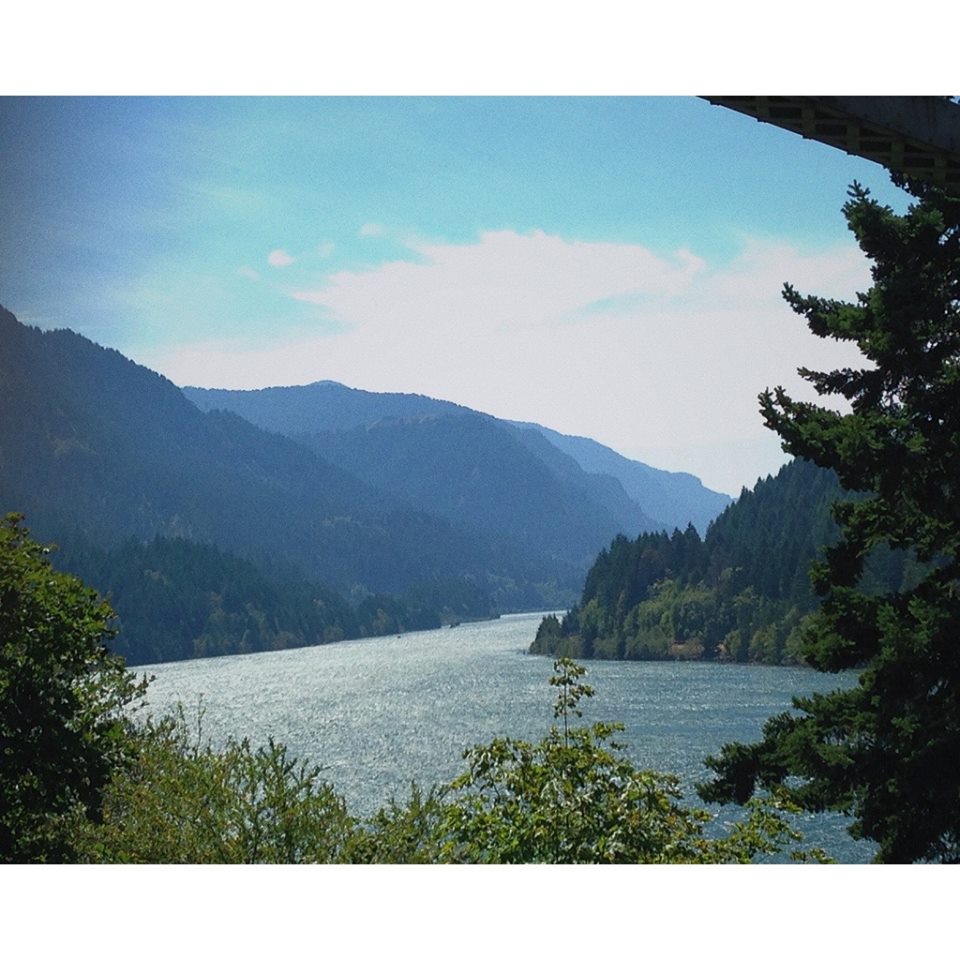
Columbia River Gorge
(Columbia Gorge) “If we acknowledge the value and fragility of nature and, at the same time, our God-given abilities, we can finally leave behind the modern myth of unlimited material progress.” Pope Francis

Pope Francis will visit the United States September 22 – 27 and will no doubt speak about climate change.

His recently published encyclical on the environment and human ecology can be downloaded for free or ordered at this link: Laudato Si’: On Care for Our Common Home.

I believe Laudato Si’ will prove to be one of the most important documents of our time. It is a stirring, eloquent, and direct call to action.

I’ll be featuring it here on Books Can Save a Life during the pope’s visit. I hope you’ll read it along with me and join in our discussion. I welcome both secular and faith-based perspectives.

On Care for Our Common Home is urgent and wide-ranging; you may be surprised at the topics addressed as the pope seeks to show how our values and our actions have far-reaching implications for humanity and for the planet.

Here are some excerpts to get us started:

“…the earth herself, burdened and laid waste, is among the most abandoned and maltreated of our poor…”

“The poverty and austerity of Saint Francis were no mere veneer of asceticism, but something much more radical: a refusal to turn reality into an object simply to be used and controlled.”

“The earth, our home, is beginning to look more and more like an immense pile of filth.”

“…access to safe drinkable water is a basic and universal human right, since it is essential to human survival and, as such, is a condition for the exercise of other human rights. Our world has a grave social debt towards the poor who lack access to drinking water, because they are denied the right to a life consistent with their inalienable dignity.”

“We seem to think that we can substitute an irreplaceable and irretrievable beauty with something which we have created ourselves.”

“We were not meant to be inundated by cement, asphalt, glass and metal, and deprived of physical contact with nature.”

“…when media and the digital world become omnipresent, their influence can stop people from learning how to live wisely, to think deeply and to love generously…True wisdom, as the fruit of self-examination, dialogue and generous encounter between persons, is not acquired by a mere accumulation of data which eventually leads to overload and confusion, a sort of mental pollution….Today’s media….shield us from direct contact with the pain, the fears and the joys of others and the complexity of their personal experiences….alongside the exciting possibilities offered by these media, a deep and melancholic dissatisfaction with interpersonal relations, or a harmful sense of isolation, can also arise.”

Please share this post on social media and leave a comment. Will you be watching and listening to Pope Francis? Have you read, or read about, Laudato Si’? Do you agree that it may prove to be one of the most important documents of our time?

Laudato Si' books

Bad Feminist? Good Feminist? Anti-Feminist?

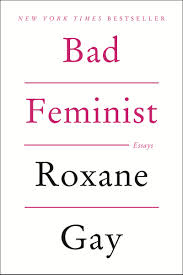
Bad Feminist book cover“You think you are alone until you find books about girls like you. Salvation is certainly among the reasons I read. Reading and writing have always pulled me out of the darkest experiences in my life. Stories have given me a place in which to lose myself. They have allowed me to remember. They have allowed me to forget. They have allowed me to imagine different endings and better possible worlds.”  Roxane Gay, Bad Feminist

Where do I begin? It’s hard to know because Roxane Gay covers so much ground in her collection of essays, Bad Feminist. Her voice is unmistakable: hilarious, informed, opinionated, eloquent, vulnerable.

What a great read for a book club, especially if your club is diverse in terms of race, gender, political persuasion, and economic status. (Or are book clubs of such diversity scarce?) Oh, the discussions you’ll have.

Roxane Gay is a black woman, a feminist (a darn good one), a Ph.D and professor, a single woman of a certain weight, a liberal, a fan of reality TV and rap music, a best-selling novelist and author. She’s tired, because she does all these things – Roxane admits as much, but as one of those driven people she says she can’t stop.

She writes about all of this and more in her essays. Occasionally she leans toward the shrill, but mostly not – Roxane is very good at getting you to think while entertaining you at the same time. For certain, you won’t always agree with her, but you’ll have plenty to mull over.

Her writing is so, so timely in light of the discussions we’re having in this country about race. Roxane recounts movingly what it’s like to be the only female black professor in her academic department. She dissects her reactions to movies such as The Help and other depictions of race and racism in entertainment, discussions I found nuanced and enlightening, and sometimes difficult to take as I recognized myself in some of the attitudes she highlights.

I had chosen not to see The Help when it was released a few years ago, because I’d read an opinion piece by a black woman who said all the women in the movie who are racist are nasty, while all the women who are not racist are likable–when in fact it had been her experience that many people who were racist were the nicest people you’d ever meet.  Roxane highlights these and other kinds of stereotypical and overly-simplistic portrayals in a number of popular TV shows and movies.

As for feminism, Roxane writes honestly about personal trauma that in part has shaped her views. (I won’t go into that here, to avoid spoilers.) She addresses the sad state of affairs for women in the US, where women of reproductive age are finding it harder to obtain contraception, where politicians make outrageous statements about rape and other matters they don’t seem to understand. (Such as the infamous, women who are victims of “legitimate rape” rarely get pregnant.)

Recently Yahoo CEO Marissa Mayer took a lot of flak for criticizing feminism.  Yet look at what is happening in the tech world, with apparent widespread discrimination against women who are coming up in their careers. One would think things would be better for younger women but that doesn’t appear to be the case.

I have to admit that at one time I would not have considered myself a feminist, though not anymore, especially given that I’m startled by how much ground women have lost in this country. Being of a certain age, I’ve come to respect much more than I did what the first and second wave feminists accomplished for all of us. I’ve been concerned, too, when I’ve not heard more of an outcry from younger women over recent trends. So it’s a relief to read Roxane Gay’s take on all this.

Here are some of my favorite quotes from her essays:

“I embrace the label of bad feminist because I am human. I am messy. I’m not trying to be an example. I am not trying to be perfect. I am not trying to say I have all the answers. I am not trying to say I’m right. I am just trying—trying to support what I believe in, trying to do some good in this world, trying to make some noise with my writing while also being myself.”

And,

“We don’t all have to believe in the same feminism. Feminism can be pluralistic so long as we respect the different feminisms we carry with us, so long as we give enough of a damn to try to minimize the fractures among us.”

And,

“It’s hard not to feel humorless, as a woman and a feminist, to recognize misogyny in so many forms, some great and some small, and know you’re not imagining things. It’s hard to be told to lighten up because if you lighten up any more, you’re going to float the fuck away. The problem is not that one of these things is happening; it’s that they are all happening, concurrently and constantly.”

Did I say I think you should read Bad Feminist?

Have you read Bad Feminist? What did you think?

I’ve ordered a copy of Laudato Si’, Pope Francis’ encyclical on climate change. It is available from Amazon and other booksellers, and you can download the pdf at this link: Laudato Si’ . I’ll be writing about it here in late July, mostly from a secular perspective. Why don’t you read it with me – I welcome your thoughts, faith-based or otherwise.

Rhythm of the Wild by Kim Heacox

“Looking back, I see now that Denali did more than charm me that first summer; it saved me. The whole damn place beguiled me and believed in me when I didn’t believe in myself. Call me crazy or blessed or crazy blessed. But I swear that again and again Denali has done this–made me buckle down and find inspiration and become the free man I am today.”   Kim Heacox, Rhythm of the Wild: A Life Inspired by Alaska’s Denali National Park

Rhythm of the Wild book cover

“What you hold, dear reader, is a story of love and hope, equal parts natural history, human history, personal narrative, and conservation polemic. I make no attempt to be a neutral journalist, a rare bird in today’s corporate culture. I’m a story teller.”

At the moment, Alaska is burning, and I’d love to hear Kim Heacox’s thoughts about this. I recently finished reading his new book, Rhythm of the Wild: A Life Inspired by Alaska’s Denali National Park, and I liked it so much I bought a copy of his first memoir about Alaska, The Only Kayak, and liked that one too.

Denali Mountain
Denali. Wikipedia.

I’ve tried to persuade my husband to read the latter book, as he’s a kayaker and a Beatles lover, as Heacox is. I believe Heacox and J. are kindred spirits, but so far no luck, J. hasn’t picked up the book–he’s not a particularly avid reader. However, he has been to Alaska, while I have not, so I think that counts for more than reading two books about Alaska.

Kim Heacox is an award-winning writer (with four books for National Geographic to his credit), a photographer, a speaker, a conservationist, and a lover of Alaska and Denali. (Denali, the mountain, which is the highest in North America, and Denali National Park.)


Grizzly bear
Grizzly bear. NPS photo.

He and his wife, Melanie, have resided in Alaska for over thirty years; they are two remarkable people who have devoted their lives to educating others about the inestimable value of our wilderness areas. Heacox writes in a very personal way about Alaska and Denali, weaving together his own wilderness stories with coming of age in the Northwest during the 1960s and 70s. I admire him for many reasons, among them his talent for lyrical writing and his willingness to be vulnerable as he shares his love for the wilderness that is Alaska.

As I read, I began to feel sorry for the tourists Heacox describes who find their way to Denali but after a few short days must return to their Dilbert cubicle lives in cities and suburbs. Then I realized that has been much of my life, too. Heacox paints such a compelling picture of Alaska he made me feel deprived for never having experienced this wild, remote place.

Heacox recounts his fascination with the Beatles and their reinvention of music – from an early age he identified with outsiders and challengers of the status quo. Naturally, he’s been deeply influenced by “outsider” environmentalists as well, including  Edward Abbey and Adolph Murie. He writes about their legacies in Rhythm of the Wild.

Those of you who follow my blog know I’m a fan of Barry Lopez and Wendell Berry and other influential writers who care about nature and wilderness. I’ll look for more writing by Kim Heacox in the future. I consider him an important addition to my nature and conservation bookshelf. He’s the kind of writer we should be reading if we want to protect our national parks and take climate change seriously.

Here are a few enticing samples of this singular voice in Rhythm of the Wild:

“Years ago in a cowboy cafe in Moab, Utah, I met a nine-fingered guitarist who poured Tobasco on his scrambled eggs and told me matter-of-factly that Utah was nice, Montana too. And of course, Colorado. But any serious student of spirituality and the American landscape must one day address his relationship with Alaska, and once in Alaska, he must confront Denali, the heart of the state, the state of the heart….by Denali he meant both the mountain and the national park.”

Great Horned Owls
Great Horned Owls. NPS photo.

“Denali is what America was; it’s the old and new, the real and ideal, the wild earth working itself into us on days stormy and calm, brutal and beautiful, unforgiving and blessed. It’s where we came from, long before television and designer coffee, even agriculture itself. Before we lost our way and granted ourselves dominion over all living things, before our modern, paradoxical definitions of progress and prosperity, and too much stuff; it’s the lean, mean, primal place buried in our bones no matter how much we might deny it, no matter how fancy our homes, how busy our routines, how cherished our myths. Denali resides in each of us as the deep quiet, the profound moment, the essence of discovery. It offers a chance to find our proper size in this world.”

The publisher of Rhythm of the Wild kindly provided me with an Advanced Reader’s Copy (ARC).

I’ve ordered a copy of Laudato Si’, Pope Francis’ encyclical on climate change. It is available from Amazon and other booksellers, and you can download the pdf at this link: Laudato Si’ . I’ll be writing about it here in late July, primarily from a secular perspective. Why don’t you read it with me – I welcome your thoughts.

Northern Lights and trees

Summer book giveaway

Guess book & flower

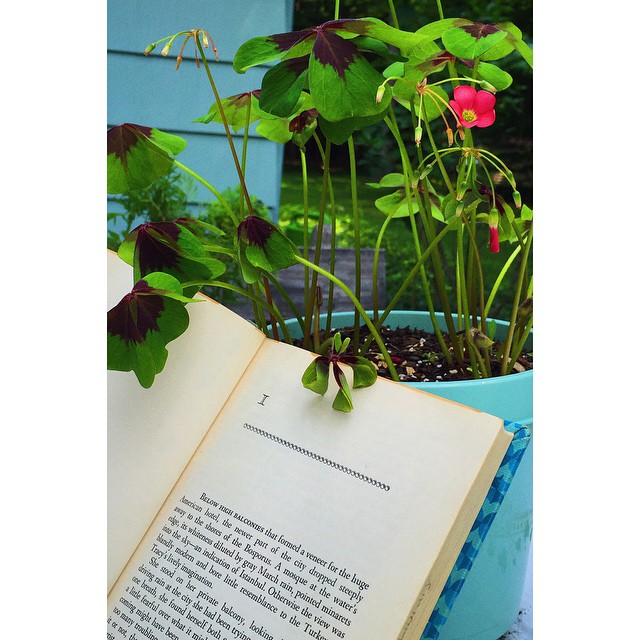
Guess the book (hint: gothic romance) and/or the flower for a chance to win a book or a package of seeds. You don’t have to get the correct answer to win. Ends Wednesday, June 24, midnight EST.

Here are a few of the books I’ll be reading and writing about this summer:

How to Be Both, by Ali Smith

Laudato Si: Praise Be to You, On Care for Our Common Home, by Pope Francis

H Is for Hawk book coverH Is for Hawk, by Helen Macdonald

Bad Feminist, by Roxane Gray

Smile of a Midsummer Night: A Picture of Sweden, by Lars Gustafsson & Agneta Blomqvist

Rhythm of the Wild, by Kim Heacox

How Should a Person Be? by Sheila Heti

The Collapse of Western Civilization, by Naomi Oreskes & Eric M. Conway

Everything I Never Told You, by Celeste Ng

Laudato Si books