Modiano’s elusive Paris: what my father never saw

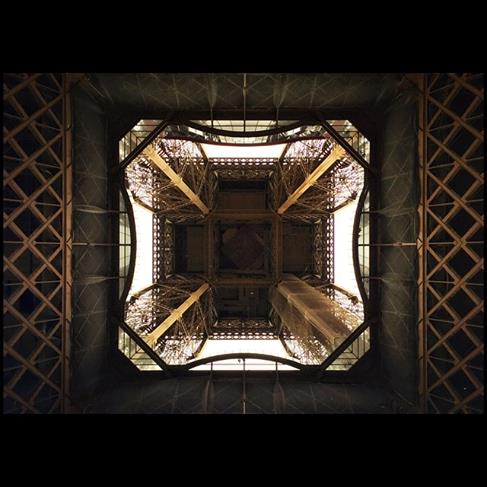
Eiffel Tower
La tour Eiffel. (Photo by A. Hallinan)

“Tell all the truth but tell it slant–“ Emily Dickinson

If you dislike ambiguity and prefer straightforward plots, you may become impatient with Patrick Modiano’s inconclusive and sometimes maddening quests. In his stories of Paris during and after the Occupation, the “missing” person in question is never found; the mystery of his or her identity is never solved.

Modiano tells the truth–what little of it he knows–but he tells it slant.

Reading is a way for me to immerse myself in other times and places, and on our recent trip to France, I wanted to see the country through the lens of World War II, when my father was a soldier there. So I brought along Irène Némirovsky (I wrote about Suite Française in my last post) and Patrick Modiano’s The Search Warrant (published as Dora Bruder in Europe). Coincidentally, my son had just read three novellas by Modiano: Afterimage, Suspended Sentences, and Flowers of Ruin, so I read them, too. (These are published in one volume entitled Suspended Sentences.)

I was thinking about my father, who passed away five years ago, and musing about events in 1940s Europe that may soon be all but forgotten. Once I became accustomed to Modiano’s method and spirit of storytelling, I could appreciate the author’s preoccupation with identity and memory, and his attempts to reconstruct and understand the past.

Even as I explored the Jewish quarter of Le Marais, where we stayed, and conjured up the WWII Paris I’ve seen in movies, I realized that a new story is playing out in France, making my father’s time seem even more remote. We passed by many military personnel armed with automatic weapons guarding Parisian monuments, temples, churches, and other sites in the wake of January’s Charlie Hebdo attack.

My father never got the chance to explore Europe as he’d hoped. He’d been fascinated by France and Luxembourg (where he spent the weekend in training before he was wounded in the Battle of Metz in 1944), and he’d planned to visit Sicily, where he was born. Instead, he was shipped out to Liverpool after he was injured, and then back to America, where he spent over a year in recovery. Though he did visit Sicily later in life, my father never returned to France. Suspended Sentences book cover

I found myself imagining what he might have thought if he’d seen Notre Dame (he was awed by cathedrals) or tasted Parisian escargot (which he would have relished) or strolled across the many old bridges spanning the Seine.

During our drive to Metz, I looked out over the French countryside and along the Moselle River, thinking that perhaps my father had been injured in one of the passing fields or forest groves.

In The Search Warrant, Modiano is obsessed with reconstructing the life of a young Jewish girl who died at Auschwitz. In a 1941 Parisian newspaper, he’d discovered an ad placed by the parents of Dora Bruder, asking for information about the whereabouts of Dora, who had run away from her convent school. It’s as if Modiano can’t accept that someone–that so many, in fact–could live lives so brief and obscure and die such senseless deaths, as they did in the war.

The Search Warrant fuses nonfiction (the facts he unearths about Dora Bruder) with memoir (Modiano’s autobiographical speculations about his father during the Occupation) and fiction. As I read, sometimes I couldn’t separate truth from fiction.
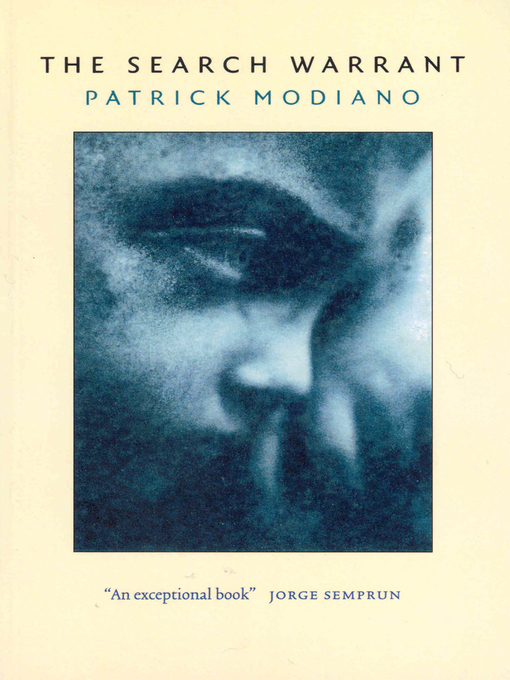
The Search Warrant book coverInterrupting the narrative flow are lengthy lists of the names and last known addresses of people deported to concentration camps. Modiano seems compelled to show his readers the documentation and proof behind any fact he asserts about Dora. He meticulously describes the Paris neighborhoods that he wanders in, too: the old, timeworn urban landscapes and the bland contemporary ones that have replaced them.

Such lists and geographical minutia also appear in Modiano’s three novellas. Each story portrays a protagonist searching for a person he’s lost touch with long ago or seeking to understand some incident from the past.

Before I started the three novellas, I read the editor’s introduction to see if I could better understand what Modiano was trying to do with his stories. I learned that his mother had been an actress and was often absent during his childhood, while his estranged father paid little attention to Modiano and his younger brother. Modiano surmises that his father was a black market smuggler and somehow aligned with French Nazi collaborators. Another heartbreaking autobiographical fact is that Modiano’s beloved brother, Rudy, died from an illness when they were young. Modiano’s obsessive search for Dora Bruder is emblematic of Modiano’s search for his lost family, and for a pre-war Paris that no longer exists.

Patrick Modiano won the Nobel Prize in 2014.

From Flowers of Ruin:

“Little by little, that man melted into the wall. Or else the rain, from falling on him so heavily, had dissolved him, the way water dilutes a fresco that hasn’t had time to dry properly. As hard as I pressed my forehead against the glass and peered at the dark gray wall, no trace of him remained. He had vanished in that sudden way that I’d later noticed in other people, like my father, which leaves you so puzzled that you have no choice but to look for proofs and clues to convince yourself these people had really existed.”
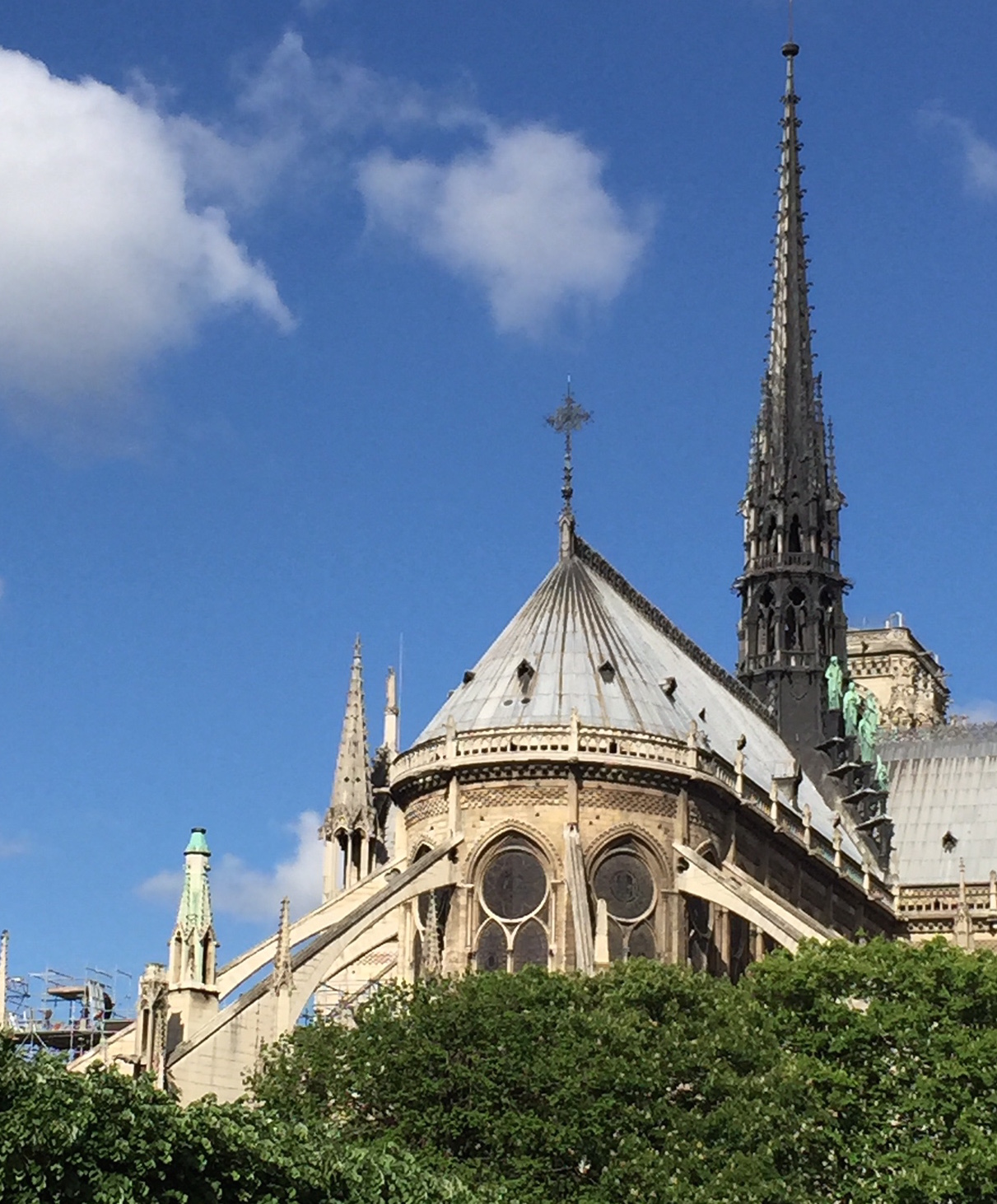
Notre Dame
Notre Dame
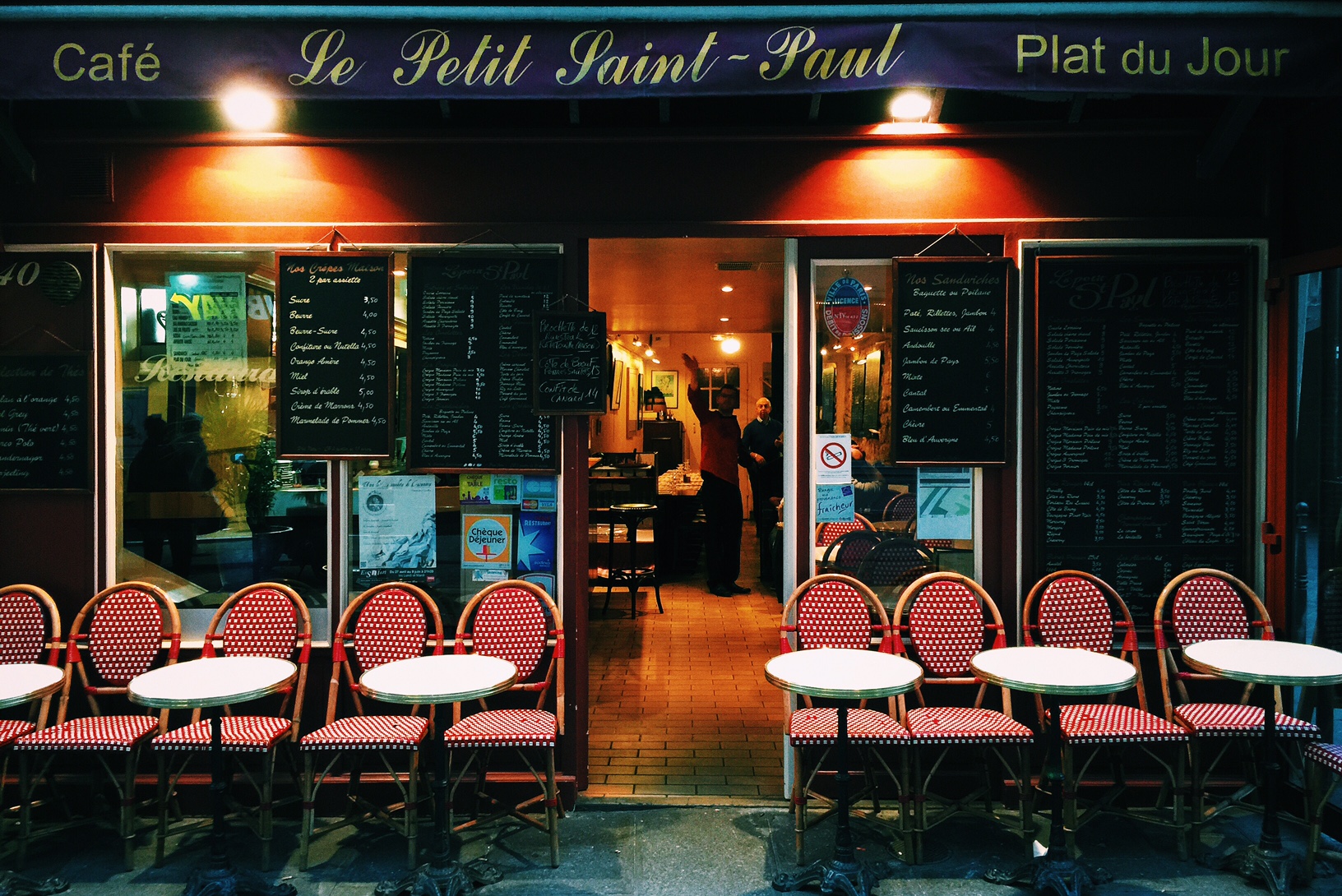
Cafe in Paris
Where to eat….they all look so good. Can you see the maître d’ beckoning?
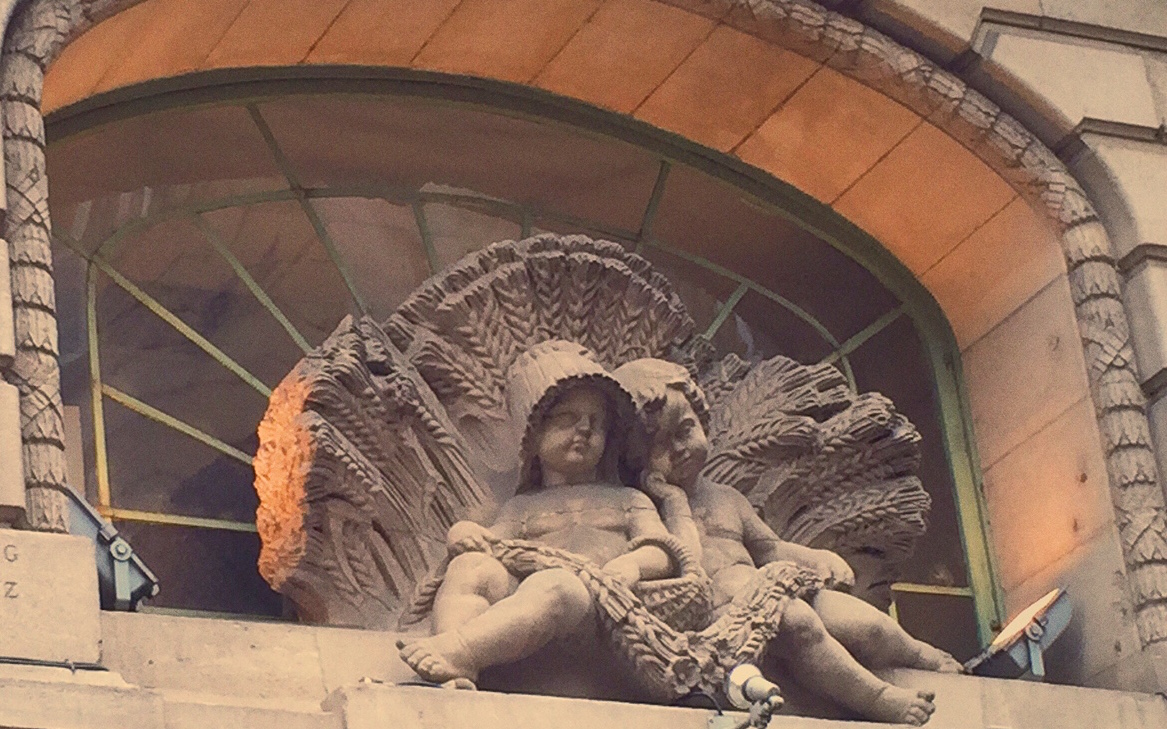
Stone carving of two children
Children on a street corner in France.

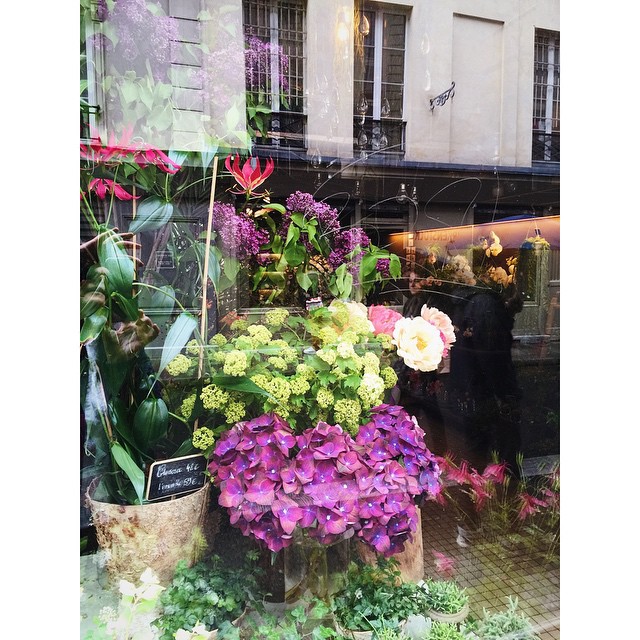
Spring flowers and Colette, in Paris

Floral shop window
“As noisy as Paris was in those days, it always had its unexpected moments of stillness. At Cours-la-Reine, between one and one-thirty in the afternoon, when the last trucks had reached their canteens, those who loved flowers and silence could savor a strange respite, a solitude in which the flowers seemed to recover from human curiosity.”

******************

We’ve been in Paris, where our son has been studying and working in industrial design. I had so much fun walking around this enchanting city which, among other treasures, has secret gardens galore, flower vendors and flower markets, and floral shops offering spring flowers, herbs, and foliage, all beautifully arranged and presented.

Flowers and Fruit book coverA few years ago I was browsing in a local used book shop when I discovered a volume of essays by Colette, Flowers and Fruit, first printed in the US in 1986.

Some of the essays were inspired by a Swiss publisher, who for a time sent Colette a bouquet of flowers once or twice a week so she could write sketches of those that inspired her.

Colette wrote one of the longer essays in this collection, “Flora and Pomona,” during the Nazi occupation. According to the collection’s editor, Colette conceived of the writing project to “keep the coal bin at 9, rue de Beaujolais well filled and pay the black-market prices for rabbit and cheese and chicken and other comestibles otherwise unavailable, even to much-loved novelists living in the Palais-Royal.”

At the time of its publication, some critics said factual errors, weak editing, and a less than adequate translation detracted from Flowers and Fruit. I find Colette’s writing challenging, so this isn’t the kind of book I’d read straight through. It’s a little treasure for floral enthusiasts that’s fun to browse when I want Colette’s unusual take on flowers.

We were lucky to be in Paris on May Day. This holiday’s signature flower is lily of the valley, one of my favorites. They were everywhere.

Here are some of my Paris floral photos paired with Colette’s thoughts on flowers and gardens:

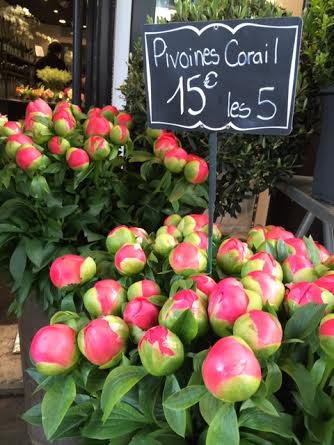
Peonies
“Garnet red, bright pink, sentimental pink, and three or four other carmine reds, they are the colors of good health and will delight me throughout the coming week.” (These peonies have not yet opened, which is when you should buy them.)
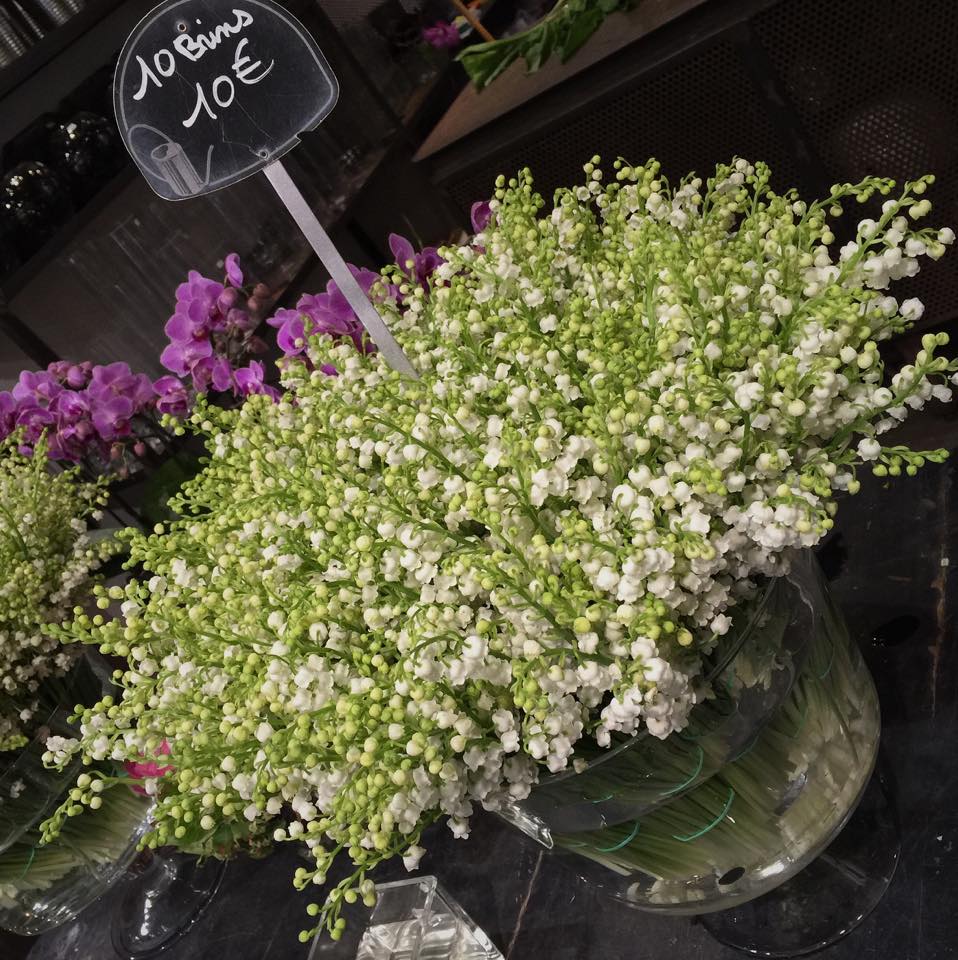
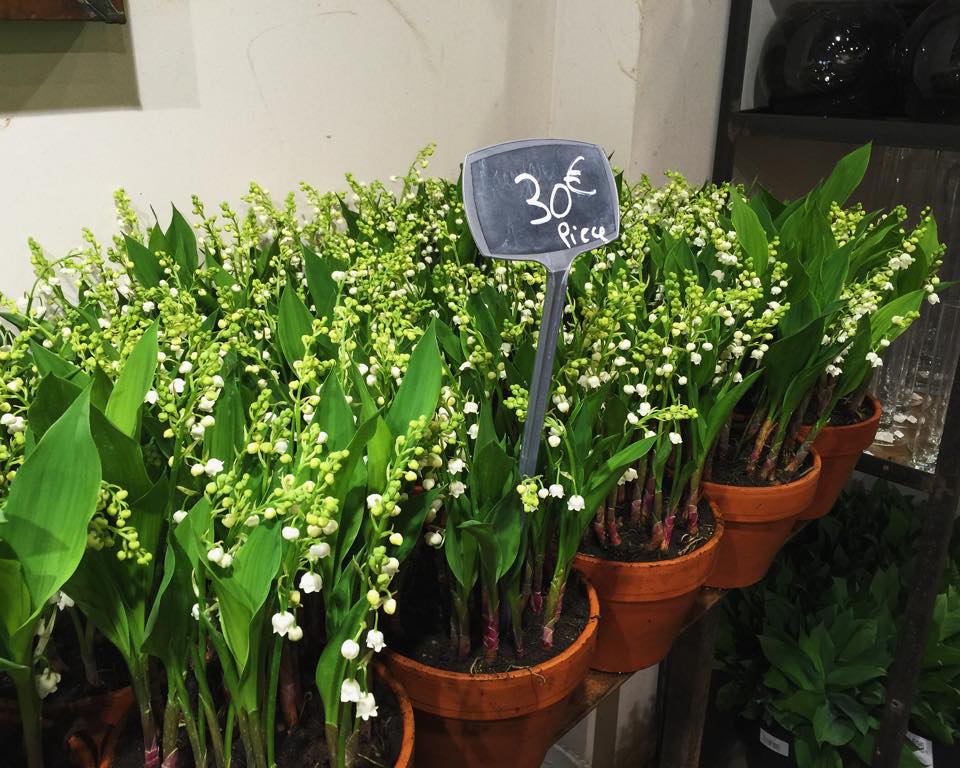
Lily of the valley
Lily of the valley is the May Day flower in Paris. “In spring, nearly an entire nation demands lily of the valley like bread.”
Pots of lily of the valley
“More than a flirtation, better than a superstition, almost a religion, the lily of the valley is celebrated on the first of May. Its cult stirs the Paris population to fever pitch…”
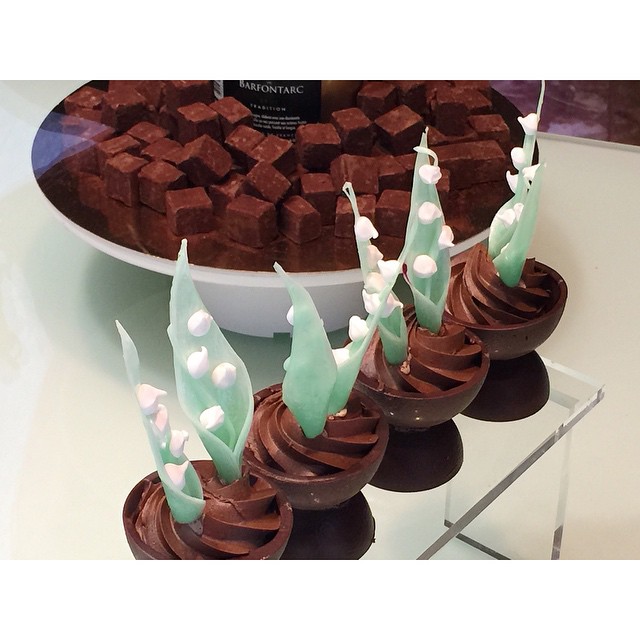
Chocolate & lily of the valley
You’ll find lily of the valley everywhere on May Day, even at the chocolatier. I saw these lovely desserts at Sylvain Mussy on Rue Bourg Tibourg.


Lily of the valley bouquet
My May Day bouquet. Lily of the valley, gloriosa lily (also known as fire lily or flame lily), and angel hair fern. “The true lily’s favorite soil is the kitchen garden’s, with tarragon, sorrel edgings, and purple garlic for neighbors.”
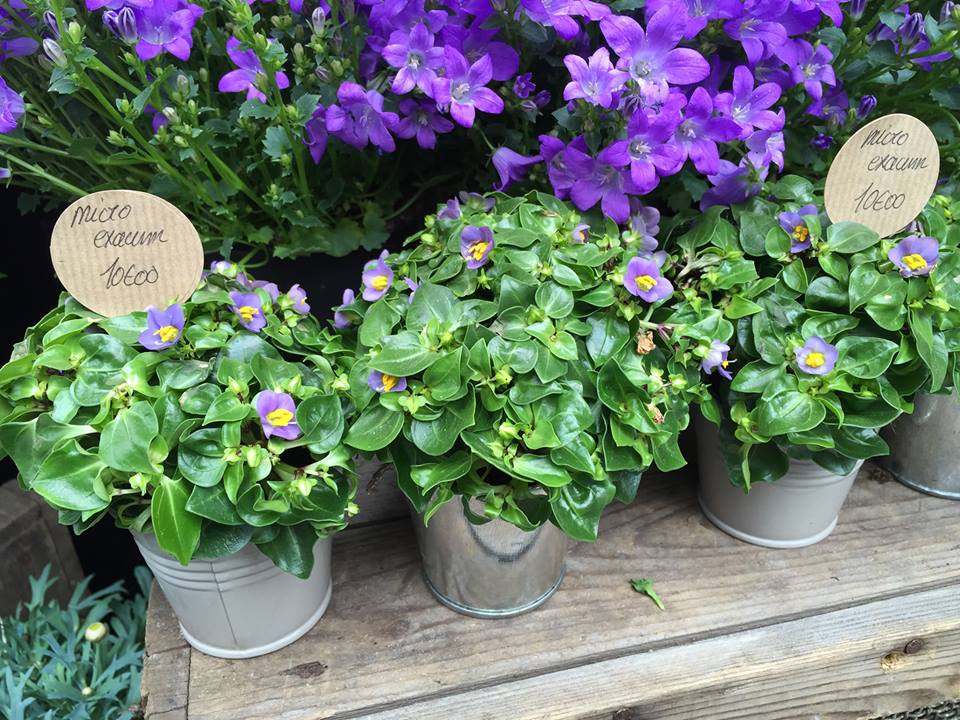
Flowers
Campanula and Persian violets. “…the sleeve of blue-violet campanula that grows immoderately, framing the windows in a single rush and decking them with flowers all season long.”
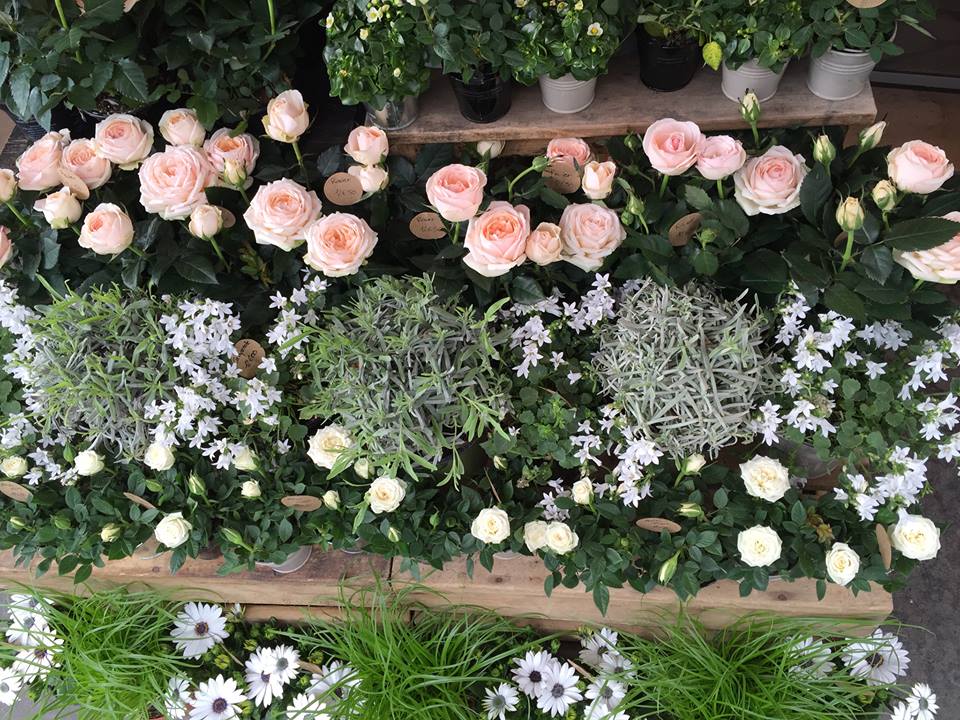
Pink and white roses
“Below my window, among the puddles of water, the bathing pigeons….we have old-fashioned, floriferous rosebushes that have survived both war and frost. Never have they failed to flower, and to flower again, and yet again before November.”
Stone figures on garden wall
There are many secret gardens hidden on the side streets of Paris, where the public is welcome.
Garden flowers
This one is Square Georges-Caïn on Rue Payenne. “Creating a garden takes us back to childhood imaginings.”
Paris street with plants, flowers
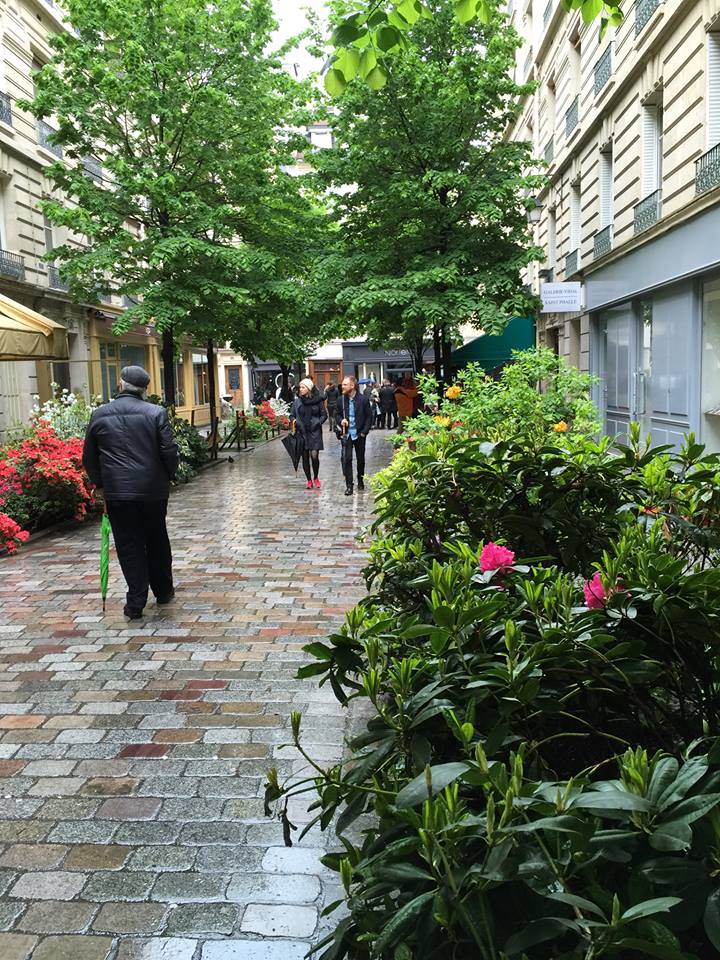
Some streets, like Rue du Trésor, are gardens, too.

Packing for Paris

Books

I try to make my traveling adventures reading adventures, too. We’re headed to Paris to see our son, with a two-day stop in London, my first visit to both cities.

Then we’ll go to Metz, France for a couple of days, with a road trip to Luxembourg City. In World War II, my father fought in the battle of Metz, and we think we’ve figured out approximately where he was wounded (on November 14, 1944). So we’ll investigate and see what we find.

My father spent a weekend in Luxembourg City just before the battle and had an interesting story to tell about that, which I’ll share in an upcoming post.

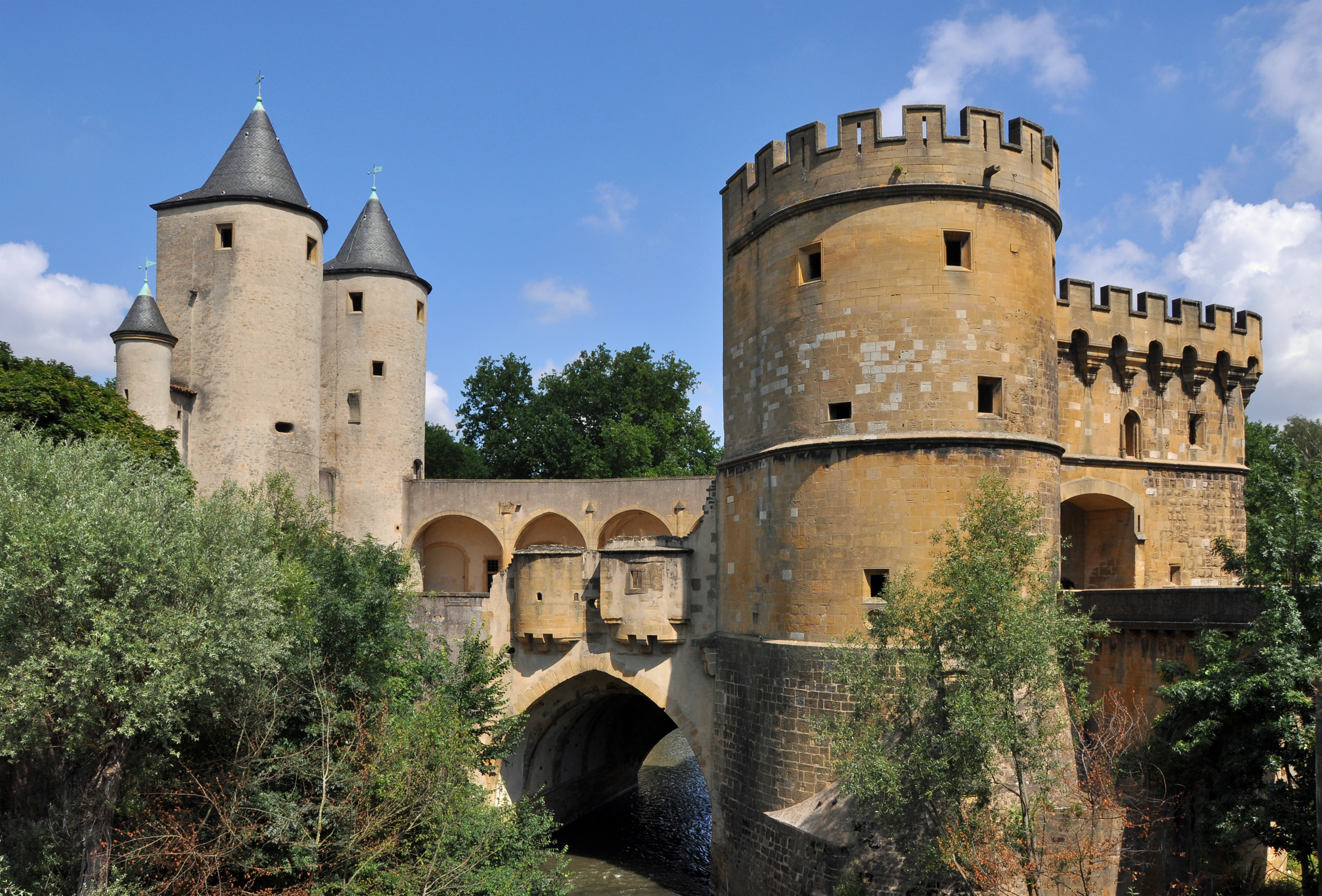
Metz
Metz, France (Wikipedia)
Luxembourg City
Luxembourg City (Wikipedia)

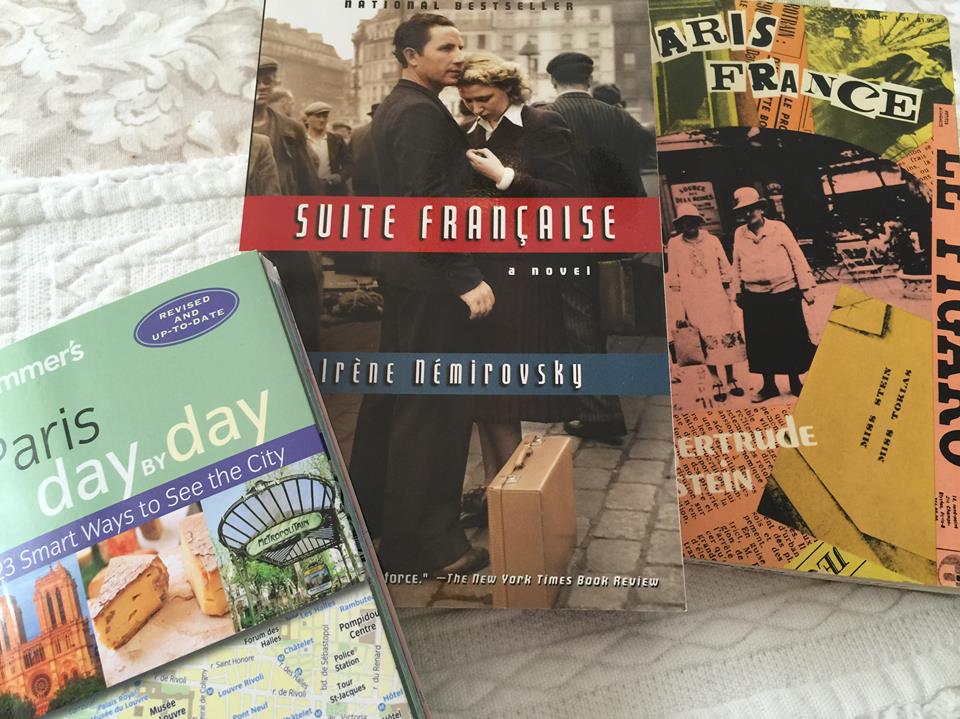
Besides Gertrude Stein, Irene Nemirovsky and our trusty travel guides, I’m bringing Henry Miller and Ernest Hemingway. (No books related to London because I won’t be able to contain myself in the bookstores.)

Tropic of Cancer book cover
One of the most banned books in history

A Movable Feast Book Cover

I’ll share my impressions, literary and otherwise, in upcoming posts.

Which books or authors would you recommend to a reader visiting France? Please comment!

On Reading the Tough Stuff

The Gorgeous Nothings book coverThis week I’m passing along a few of my favorite bloggers, people who have important things to say and they say it well.

I’ve recently become a follower of Book Guy Reviews, written by James Neenan, a Denver high school English teacher. I love what he says about reading difficult books.

On Reading the Tough Stuff

Writing (and reading) can be dangerous

I wanted to share a post I love written by Valerie Davies of New Zealand, an accomplished writer and journalist who left blogging for a while and has now returned, to the great pleasure of her many followers.

David Copperfield book cover

Valerie writes about reading aloud to your children in front of the fire or under the covers on a cold winter night….David Copperfield (Did you read it at a young, impressionable time in your life?)….a Queen who couldn’t stop reading….what Stephen King says about writing truthfully….the dangers of reading and writing….what some brave bloggers are doing….and for good measure, a recipe.

Click on the link below to read Valerie’s post:

The dangers of words.

The Uncommon Reader book cover

This Changes Everything

“…only mass social movements can save us now.”  Naomi Klein, This Changes Everything: Capitalism vs. The Climate

This Changes Everything book cover
Notice the cover. No author, no subtitle. One clear message.

 “….this impossibly thin blue curve keeps everything alive beneath it.”  Reid Wiseman, #spacetweets.  

For starters, take two and a half minutes to watch astronaut Reid Wiseman’s video, “A Photo I Love,” and then come back here. You’ll see a new view of Italy (some of you know how much I love Italy). Notice in particular Reid’s photo of the earth’s atmosphere, “….so blue, so incredibly thin….” and Reid’s tweets (#spacetweets).

I wanted to begin on an upbeat note, hence Reid’s video of “watching our earth be alive” that so vividly highlights what the stakes are when it comes to the climate debate. It’s not that Canadian journalist Naomi Klein doesn’t offer hope in her latest book, This Changes Everything. Certainly, she does, but this is a read with plenty of emotional lows before you get to the highs.

This Changes Everything is proving to be enormously influential as well as controversial. If I read her correctly, Klein does not advocate a dismantling of capitalism, but her book is indeed a polemic against the extreme version of capitalism that pervades much of the world today. Her message is that the earth cannot possibly continue to sustain a world economy based on unlimited growth and the endless extraction of resources. We need to change course to keep the earth’s warming under two degrees Celsius (this is according to many climate scientists, who also maintain that a warming of four degrees Celsius would be catastrophic). We need to act now, on a massive scale.

If you care deeply about climate change, I highly recommend putting This Changes Everything at the top of your to-read list. There is so much I don’t know about this huge topic. Though I’ve been against fracking (recently outlawed here in New York), I didn’t know much about it, and I knew absolutely nothing of Canada’s tar sands project and its devastations. Klein brought me up to date on all of this, as well as the current climate change activist scene. She synthesized an enormous amount of research, which makes for slow reading at times, but it’s worth it if you want the big picture.

Here are some things I learned that surprised me:

  • We’ve come a long way with alternative energy technologies. It seems like a no-brainer – if we can meet our energy needs at very little cost using solar, wind, and other technologies, why would we continue using expensive and dirty fossil fuels?
  • Native Americans and indigenous populations around the world are winning important victories against the fossil fuel industry, more so than activists in the mainstream. In Canada and the US, for example, some of these groups, by treaty, retain rights to their land, including the right to make a living from it. The courts have, in many cases, upheld these rights, effectively blocking or delaying extraction projects. These delays have given alternative energy technologies time to develop.
  • Though it’s important for developed countries to convert to clean energy, it’s crucial that we help developing countries turn to clean energy, too–otherwise we’ll never be able to stop global warming. Klein and others maintain that, since developed countries have grown wealthy from fossil fuels, we have a responsibility to help developing countries pay for their energy infrastructures.

A New York Times review called This Changes Everything “…the most momentous and contentious book since Silent Spring,” and “…a book of such ambition and consequence it is almost unreviewable.”

This Changes Everything is absolutely a book that can save lives.

Have you read This Changes Everything? Do you recommend other important books about this topic? If so, please do in the comments. And if you care about climate change, I hope you’ll share this post.

Scopello sunset
What we don’t want to lose. View of Zingaro Nature Preserve in Sicily. (Photo by A. Hallinan)

The Herb Lover’s Spa Book

Herb Lovers Spa Book


“Dear Reader – I write this because I love a garden that gives back. Flowers, fragrance, flavor…all of it. A true giving-garden is filled with herbs. Discover them. Grab a leaf, rub it, hold it to your nose and breathe in. Voila! That plain, leafy plant becomes so much more when you learn ways to use it. This is what I share with you.” Sue Goetz, The Herb Lover’s Spa Book

Herbal spa ingredientsIn the middle of a hard winter I couldn’t ask for a better pick-me-up than The Herb Lover’s Spa Book by Sue Goetz, just published by St. Lynn’s Press. This is a little gem of a book. Looking at the photos and skimming through the recipes for facial steams and oatmeal soaks and lavender heat pillows while the snow fell outside my window was a spa experience in and of itself.

I grow the standard kitchen garden herbs and I love cooking with them. Now Sue Goetz has inspired me to try out recipes for herbal preparations that heal, sooth, relax, and refresh. I’d been making a list of seeds to order for this year’s garden, and I’ll have to expand it to include new-to-me herbs like lemon balm and lemon verbena, scented geranium and camomile. I want to try the recipes and the end products myself, of course, and if all goes well, when holiday time rolls around I’ll have homegrown, handmade gifts to give family and friends.

A well-known garden designer, writer, and speaker from Washington State, Sue Goetz packs a lot of information into this little book, and her passion for using herbs in the home for pleasurable and nurturing spa experiences shines on every page.

The Herb Lover’s Spa Book has three parts: Surround, Grow, and Create.

Surround

You can enjoy the herbal preparations you’ll learn to make in this book in your very own private spa. Sue shows how you can create a retreat in your own home, indoors or outdoors, where you can read, relax, soak, sleep, or meditate. She suggests designs, colors, and textures conducive to rest and relaxation, whether in a garden or in a favorite indoor space.

Grow

You’ll find information about nineteen of the most common and popular herbs used for skin treatments and teas and infusions, including lavender, hops, dandelion, eucalyptus, sage, parsley, witch hazel, and thyme. Sue includes growing tips, healing properties, and suitable varieties for each herb, a list of seasonal herb garden tasks, and tips for harvesting and preserving.

Create

Lavender and herbal spa ingredientsIn addition to over 50 herbal recipes, Sue provides information about sourcing and working with common ingredients and materials such as beeswax, baking soda, essential oils, epsom salt, ginger root and jojoba oil.

I loved leafing through the recipes. I didn’t know there are so many varieties of bath brews, each with its own effects. For a relaxing bath you can use chamomile, hops, and lavender. For a stimulating bath, try eucalyptus, lemon balm, mint, rosemary, sage, or thyme. For a healing bath, use calendula, lavender, lemon verbena, parsley, or spearmint.

First on my list of recipes I’d like to try is the Inspiration Bath. When you want to get your creativity flowing, put some calendula petals in a muslin sachet or directly into a warm bath, and add 6 drops each of lavender essential oil and rose essential oil.

Scroll down to the bottom of this post to see the complete recipe for Sue’s Basic Bath Brew. Other tempting concoctions: Peppermint Foot Soak, Midsummer’s Eve Floral Garden Water, Dusty Rose Body Powder, Winter Warming Steam, Chamomile Eye Soothers, Rosewater Cream, and Floral Water Skin Brightener.

Jars of herbal preparationsSue includes fascinating tidbits about historical aspects of the spa experience and herbal pharmacopoeia. I’d never heard of a stillroom, for example – a special room in homes of the early American colonies set aside to prepare household products from the garden. Sue says the lost art of the stillroom is coming back, and she encourages us to find a special space in our modern homes where we can store ingredients and experiment with herbal remedies.

I like that a glossary of commonly used terms is included at the end of the book, as well as a list of resources, including places to purchase herbs, oils, packaging materials, plants, and seeds.

I’m so impressed with St. Lynn’s collection of how-to gardening books. I’ve written about a couple of other St. Lynn’s titles here at Books Can Save a Life: Debra Prinzing’s  Slow Flowers and Nancy Ross Hugo’s  Windowsill Art.

Tea and teacupI have a soft spot in my heart for small, inspired publishers with a strong sense of values and a well defined mission – I was an editor for such a publisher eons ago at the beginning of my career. I like St. Lynn’s because they make gardening so inviting and accessible to those of us who are beginners, and because they are strongly committed to ecology and our planet.

Make yourself a cup of tea and browse some of their other titles. (And if you want to know who St. Lynn is, click here.)

Bath Brew recipe
One of many tempting recipes in Sue Goetz’s The Herb Lover’s Spa Book


Do you make herbal preparations from your garden? If so, I’d love to hear about them, as well as books you recommend for those of us who want to learn more. 


John Steinbeck and Slow Writing

Clock, family photo

June 17, 1938

“Hope my nerves aren’t weak because they have a long haul ahead….Begin the detailed description of the family I am to live with for four months. Must take time in the description, detail, detail, looks, clothes, gestures. Ma very important. Uncle John important. Pa very. In fact all of them are important. Got to take it slowly. I don’t care how long it is. We have to know these people. Know their looks and nature. Must.”  Working Days: The Journals of The Grapes of Wrath, 1938 – 1941, John Steinbeck

The Art of Slow Writing book coverI’ve just finished reading Louise DeSalvo’s wonderful The Art of Slow Writing.  I like slow cooking, slow cities, slow flowers, and slow living, so of course I had to see what slow writing is all about.

In her book, Louise looks closely at every stage of the writing process and what it takes to achieve our best work.

Slow down, she recommends. Good writing cannot be rushed.

Slow writing is not a new trend: the best writers have always been slow writers.

Zadie Smith, Elizabeth Gilbert, Jo Ann Beard, Virginia Woolf, Michael Chabon, Henry Miller, D.H. Lawrence, Jeffrey Eugenides, Ian McEwan – DeSalvo synthesizes the wisdom of these and many other writers who have spoken frankly about what it takes to go deep into our creative process to achieve stellar writing.

Louise shows us her writing process, too (she has published several memoirs and other books), and shares anecdotes about getting stuck and how she eventually found a path forward.

Working Days book coverFor those of us writing a memoir or other book-length work, De Salvo recommends studying Steinbeck’s two published writing journals: Working Days: The Journals of the Grapes of Wrath and Journal of a Novel: The East of Eden Letters. She encourages us to keep our own writing journals, too, for long projects.

I’ve begun skimming Working Days. Notice in the opening quote above that John Steinbeck reminds himself to take it slowly, and give each character his or her due.

It’s surprising to see how lost Steinbeck sometimes felt and how he used his writing journal to keep himself going. Here are more excerpts:

September 7, 1938

“I’m afraid this book is going to pieces. If it does, I do too. I’ve wanted so badly for it to be good….if only I wouldn’t take this book so seriously. It is just a book after all, and a book is very dead in a very short time. I’ll be dead in a very short time too. [Steinbeck would live another 30 years.] So the hell with it….I must go on. I can’t stop…..How did I ever get started on this writing business anyway? To work.”

January 29, 1941

There are so many things to go into this book. An astonishing number of things. But I’ll get them all in if I just relax and get them in day by day and only worry about the 2000 words of each day’s work. That’s the only way to do it, I have found. But damn it, I have to learn it over again every time.

January 30, 1941

My head is a grey cloud in which colors drift about and images half-form. I’m bludgeoned and feel beaten by many little things. And I can’t figure answers to them. Maybe some people think clearly all the time and make nice decisions. I don’t know. But I feel very lost and lonely. 

The Grapes of Wrath book coverThe Grapes of Wrath won the Pulitzer Prize in 1940, and contributed to Steinbeck’s winning the Nobel Prize in 1962.

It has stirred up a great deal of controversy, too. According to Robert Demott, editor of Working Days, The Grapes of Wrath has been “banned repeatedly by school boards and libraries, and denounced by right-wing ministers, corporate farmers, and politicians as immoral, degrading, and untruthful.”

A Free Roundtable with Louise DeSalvo

If you’re interested in finding out more about stages of the writing process and how to begin and successfully complete a book-length work, consider registering for the National Association of Memoir Writers free Roundtable (teleconference) with Louise DeSalvo on Thursday, March 5 at 7 pm EST, 4 pm PST. I’ll be in the audience.

Winter reading

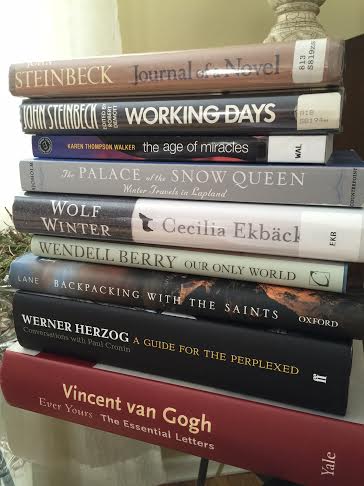
Stack of books


I’ve been out of town. A stack of books from the library and online were waiting when I got home.

The Steinbeck work journals for East of Eden and The Grapes of Wrath are recommended by Louise De Salvo in The Art of Slow Writing as essential if you’re writing a book-length work and want to learn about process.

Deep snow in backyardThe Age of Miracles is this year’s selection for “If All of Rochester Read the Same Book.” We love to read through the deep winters in our part of the world, and this novel of catastrophe and survival will be on many a nightstand here. Why not try it along with us – I’ll be writing about this debut novel by Karen Thompson Walker soon.

The Palace of the Snow Queen: Winter Travels in Lapland, a memoir, and Wolf Winter, a novel. I want to know more about my Scandinavian roots; biography, memoir, and fiction are a great way to explore ancestry and heritage.

Wendell Berry’s Our Only World (ten essays), because Berry is one of our greatest prophets, writing about the clash between humanity and nature and how we must do better. He’s been called a modern-day Emerson or Thoreau.

Backpacking with the Saints, a travel narrative and spiritual memoir. Belden C. Lane’s take on Celtic, Catholic, Protestant, Buddhist, Hindu and Sufi Muslim writings as he treks the Ozarks and the American Southwest. The book jacket compares him to other lovers of the backcountry, including John Muir and Cheryl Strayed, whose memoir, Wild, was just released as a movie.

Werner Herzog: A Guide for the Perplexed, is an overdue Christmas gift for my photographer son. This newly published series of interviews with the filmmaker is so popular it’s been out of stock. I hope he finds it worth the wait.

No one writes about creating art with as much love and eloquence as Vincent Van Gogh.

More about these in upcoming posts at Books Can Save a Life.


A Wolf Called Romeo

A Wolf Called Romeo book cover“It was one of those still days when you could hear snowdrifts collapsing in hisses, the sun so dazzling off the white-crusted ice that we seemed suspended on a cloud, bathed in light radiating from below. There we lay, three different species bound by a complex, often bitter history, taking simple comfort in the others’ presence, the sun’s warmth, and the passing of another winter.”   A Wolf Called Romeo, Nick Jans

This winter I wanted to be sure to write about a remarkable work of nonfiction that I read a few months ago, A Wolf Called Romeo by Nick Jans. A winter storm is moving in to our parts today, so it seemed a good opportunity to settle in and revisit this captivating story about a very unusual wolf who “courted” the town of Juneau, Alaska. Nick Jans has lived in Alaska for more than three decades and is a nature writer of the highest order. If you love wildlife, wolves, and dogs, you won’t want to miss this book, and you’ll likely want to read Jans’ other work as well.

No one has solved the mystery of why a black wolf wanted to make friends with Nick’s dogs and the dogs of the other townspeople who let their pets romp in the vast open spaces outside of Juneau. The black wolf was playful and unfailingly polite, chivalrous, almost courtly, which inspired Nick’s wife to call him Romeo. For half a dozen years or so, Romeo seemed to confine himself to an area of about seven square miles outside of Juneau, whereas wolves usually roam a territory of hundreds of square miles. Romeo spent long days with his domesticated companions, while keeping his distance from their human owners. He’d disappear for days at a time; at least once Romeo was spotted with a pack of wolves that passed through the area.

This got to be a complicated and controversial situation for the citizens of Juneau. Many of them grew to love Romeo and were fascinated by the rare opportunity to observe a wolf up close, while others felt wolves were to be hunted or should stay where they belonged, in the wild. Some worried Romeo might attack their pets. Rules had to be devised about how to behave around Romeo. For example, Romeo was not to be fed, so as to keep his hunting and survival skills sharp. People were advised to keep their distance from Romeo and avoid physical contact.

It’s hard to believe that at one time Nick Jans hunted and killed wolves, because he is so passionate about protecting Romeo. He recounts the history of his own relationship with wildlife, as well as the fraught relationship between humans and wolves as the American frontier was settled.

Nick observed Romeo closely for several years. He recorded his observations with the intention of writing this book which was ten years in the making. I found myself worrying along with Nick every time Romeo disappeared. For, of course, Romeo’s befriending of the town also left him vulnerable to aspects of civilization that are destructive to wildlife and nature.

This is an emotionally powerful read. Nick Jans reminds me of Barry Lopez, a nature writer I greatly admire. Here, though, Nick has made the story of the relationship between humans and the wild very personal. Romeo is fascinating and haunting, a loner caught between two worlds, not fully at home in either one of them. Thanks to Nick Jans, his story has touched those of us who may go a lifetime without seeing a wolf in the wild.

You can catch a glimpse of Romeo here.

Here is a wonderful site to find out about wolves, Wolf Song of Alaska.

Norfolk pine in a snowstorm
A good day to read A Wolf Called Romeo