To the Bright Edge of the World

To the Bright Edge

Lieut. Col. Allen Forrester, June 25, 1885:

“Pruitt keeps shouting above the storm–Do you feel that? Can’t you feel that?

What he says makes no sense. He says there are hands on him. Something pulls at him. He says he has to run. I have warned him to stay put.

(undated entry)

My dearest Sophie. I pray you will read this. You are first and last to me.

I do not know if we will survive the night. They are all around us. They scream and cry so that it is hard to think to put these words on the page.

You must know that I love you.

I am not afraid of death but instead of the passage from here to oblivion, of being aware of its coming. I would rather have been run through with a spear than face this long dread.”

Eowyn Ivey’s novel, To the Bright Edge of the World, is truly a standout for me, a cut above the rest.

Many of you know that I’m partial to nature and wilderness stories, especially historical ones. To the Bright Edge of the World reminds me of one of my all-time favorite novels, Voyage of the Narwhal by Andrea Barrett. The novel and short stories of Anthony Doerr come to mind as well when I read Eowyn Ivey’s writing, which is lyrical and replete with exquisite detail. A Woman in the Polar Night by Christiane Ritter is another fine book, a memoir, in the same vein.

“I fell in love with this book; it captured both my head and my heart, completely and utterly.” – Jane, Beyond Eden Rock.  — I was browsing on Goodreads and found Jane’s endorsement of To the Bright Edge of the World. Her words spoke to me because they are my sentiments about the novel, too, and I couldn’t have said it better.

I loved Eowyn Ivey’s first novel, The Snow Child, which was selected for If All of Rochester Reads the Same Book in 2014. Like The Snow Child, To the Bright Edge of the World takes place in Ivey’s native Alaska. It’s a great love story, a  wilderness tale of a hero and heroine’s quests infused with magical realism, and a flawlessly researched portrayal of 19th century Alaska.

Lieutenant Colonel Allen Forrester must lead a dangerous, seemingly impossible expedition through the fictitious Wolverine River Valley deep in the Alaskan wilds of 1885, a journey no one has ever survived. His pregnant wife, Sophie Forrester, stays behind in Vancouver Barracks, destined to have adventures and heartbreaks of her own.

Ivey has cleverly constructed the narrative entirely from letters, journals, diaries, newspaper articles, military reports, photographs, and other documents.

We, the readers, are privy to the contemporary correspondence between Walter Forrester, Allen Forrester’s great nephew, and Joshua Sloan, who is part Native American and curator of the Alpine Historical Museum in Alaska. Walter sends his great uncle’s papers to Joshua in the hopes that he’ll display and archive them for safekeeping. As Joshua makes his way through the journals, diaries, and letters, he and Walter piece together Allen and Sophie’s stories, fill in the gaps, and reflect on their own lives.

As always, Ivey’s descriptions of geography and landscape take us vividly to long-ago Alaska:

“The canyon bound the Wolverine so that when, over the course of the winter, the ice moved, it crumpled violently. Great blocks three feet thick & as much as twenty feet high had been torn asunder & turned sideways. It seemed an impassable range of buckles & ridges & upended slabs of ice pressed up against the canyon walls, which are vertical rock the color of lead.”

Here are Sophie’s words as she undergoes her own dark night of the soul:

Sophie Forrester, Vancouver Barracks, April 26, 1885:

“…it continued its steady and hard rapping, and the sound became more and more horrible…The raven stopped its knocking and cocked an eye toward me.

I then noticed something most peculiar….A bird’s eye ought to be flattened in shape, with a dark iris surrounded by a dark-gray sclera, and entirely unmoving in its socket. Yet this eye was round, with white sclera, and it rotated about in the socket. It looked nothing like a bird’s eye, but rather that of a mammal. More to the point, a human.” 


nypl.digitalcollections.510d47e1-2a08-a3d9-e040-e00a18064a99.001.w
A raven shape shifts into a trickster who brings Allen and Sophie good fortune and sorrow.

The New York Public Library. (1849). Raven.

nypl.digitalcollections.510d47e1-29f2-a3d9-e040-e00a18064a99.001.w
Sophie Forrester teaches herself the art of photographing birds. Her descriptions of the technical and creative challenges are beautifully rendered, and inspiring.

The New York Public Library. (1901 – 1914).Horned And Tufted Puffins.


nypl.digitalcollections.510d47e1-1af4-a3d9-e040-e00a18064a99.001.w
Allen Forrester’s darker mission is to assess tribal threats to US expansion in Alaska, even as native tribes give life-saving aid to Forrester and his men. The author weaves Native American myths into the plot. These fierce stories blur the line between humans, animals and nature. In the end, the hard wisdom of the stories so valued by indigenous people seems far truer than the scientific knowledge possessed by “civilized” people.

The New York Public Library. (1869-04). Indian summer encampment.


Have you read To the Bright Edge of the World or The Snow Child? What did you think? Can you recommend similar historical books about nature, travel, and adventure, fiction or nonfiction? Click on the comments link in the left sidebar and let us know.

What does Tribe (the book and the noun) have to do with family reunions? I’ll be writing about that in my next post…

Off the Beaten Path: De Potter’s Grand Tour


De Potter's Grand Tour

“She is fascinated but not dismayed to discover that she has forgotten so much.

Is she really the same woman who celebrated Easter 1889 in Athens and walked up to the Acropolis with her husband?

Who spent a ‘most interesting day viewing the cisterns of Carthage’ with Victor and Armand in 1896?

Who once wrote on her anniversary in 1900, in an apartment on 97 rue de la Pompe in Paris, ‘In afternoon we went to Exp. and up the Trocadéro tower, then to Élysée Palace Hotel, saw King Leopold come in. In evening at dinner we ordered St. Honoré and champagne. M. Guerrier got up and improvised a poem and there was much gaiety and good humor. Armand gave me a gold watch charm’?”  De Potter’s Grand Tour,  Joanna Scott

This much, we know: In 1905, Joanna Scott’s great grandfather disappeared while on board a ship off the coast of Greece. A collector of ancient Egyptian art (some of it is at the Brooklyn Museum) and a world tour guide, he was at his wit’s end, hounded by creditors and litigators.

The question is: Did he commit suicide? Was he pushed overboard? Or, did he fake his own death and assume a new identity, leaving behind his beloved wife, Aimée, and his son?

How would you like to inherit that family mystery?

Joanna Scott did, in the form of Armand’s letters, postcards, photos, and documents, and the multi-volume journal of his wife, Aimée. This treasure trove had been sitting in a steamer trunk in Scott’s mother’s storage unit for years, until one day they unearthed it while searching for a diploma.

Intrigued, Scott threw herself into research and began writing a nonfiction account of Armand de Potter’s life. Ultimately, that proved too confining: Scott discovered that the mysterious and elusive Armand wasn’t who he said he was, and no one knew, not even his wife. So Scott switched to fiction, which gave her more freedom to suppose and imagine.

I read this novel ages ago and never got around to posting about it, but the book has stayed with me all this time. It’s not for everyone–Joanna Scott is a celebrated writer, but this particular novel didn’t garner the best of reviews.


To Travel.jpeg
A photo of Armand de Potter, the author’s great grandfather, walking away from the camera. He was, indeed, a mysterious figure.


I, on the other hand, loved it. I loved the larger-than-life way Armand and Aimée lived traveling all over the world leading their educational tours. Armand was an autodidact who pretended to be descended from Belgian royalty and more educated than he was. Nonetheless, as Scott portrays him, he was a scholar and a lover of the world with a passion for sharing that love with the people who signed up for his tours.

“To travel is to live,” Armand de Potter wrote in one of the documents Scott found in the steamer trunk.

His tour company went to these places: Algeria, Austria, Belgium, Czech Republic, Egypt, England, France, Germany, Gibralter, Greece, Hong Kong, Hungary, India, Italy, Japan, Malaysia, Monaco, Netherlands, Romania, Scotland, Singapore, Spain, Sri Lanka, Switzerland, Tunisia, Turkey, various locations in the US, and Yemen.

Some time in the late 1800s, Armand also wrote this prescient and hopeful passage: “The incalculable benefits of foreign travel can only be half told by our children….They will be appreciated by their sons and daughters, at a time when travel will have made the world very small and the human race what it is destined to be–one great fraternity.”

If you’re an armchair traveler, if you love history, and if you want an unusual story, I think you might like De Potter’s Grand Tour.

I enjoy Joanna Scott’s novels a great deal. One of my all-time favorites is Liberation, which takes place in Sicily, one of my favorite places in the world, during World War II. Scott is a much loved Professor of English here at the University of Rochester.

Speaking of family history, I’m off to a family reunion next week, where we’ll be reading a book loosely connected with a couple of the more colorful family members. I’ll tell you about it when I return.

I’ll leave you with what Armand de Potter had to say about good books (I would also add “women” of course):

“In the most beautiful books, great men speak with us, they give their most precious thoughts, and pour their soul into ours. Let us thank God for the creation of books. They are the voices of those that are far and of those that are dead; they make us heirs of the intellectual life of the past ages. Books furnish to all those who will use them with sincerity the society, the spiritual presences of the best and the greatest men.”


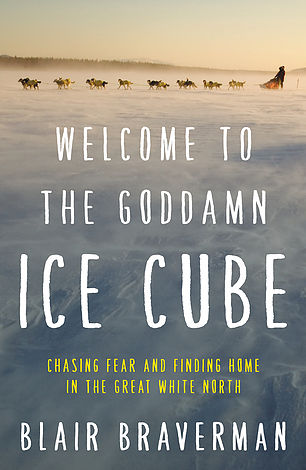
Welcome to the Goddamn Ice Cube

WelcomeToTheIceCube

“For all its occasional monotony, driving a dogsled never let my mind wander. It was an overwhelmingly physical experience: the cold, the shifting runners, the wandering trail. It made my mind shallower. There was the brushing sound of snow under the sled. There were the dogs, the beautiful dogs, running, and I could spend hours watching the changing, hypnotic rhythms of their back legs punching up and down. Occasionally I talked to them, and then I’d drift off in midsentence and recall the rest of my thoughts minutes later. Or else I’d run up a hill, or fix a tangle, or scooter my feet to keep warm. It didn’t matter. I was still just driving dogs.”

Blair Braverman sent me an advance copy of her just-published memoir, Welcome to the Goddamn Ice Cube: Chasing Fear and Finding Home in the Great White North.

I’m so glad she did, and not just because it was great reading in the middle of a hot July. This is an exquisitely written coming of age story about Blair’s love affair with the North, focusing especially on her stays in Norway, where she set up a small museum, learned to drive sled dogs, and befriended a town; and her stint as a tour guide on a glacier in Alaska.

I loved reading about Blair’s adventures, and her depictions of nature and the wild are so well done. But for me the heart of the story was her relationship with the folks in a northern Norwegian town, Mortenhals, especially a sixties-something shopkeeper, Arild, who becomes a beloved friend and Blair’s Norwegian “father.”

There is a dark theme that motivates Blair to make her way in the North that is just as strong as her love of the harsh and beautiful land, but this is not really a memoir about trauma: there is so much more light than shadow.

Raised in California, Blair had a clear calling for the North, but one of her first stays in Norway had an unfortunate twist. As a 16-year-old exchange student, she didn’t feel safe around the strange, sexually threatening father of the family she was placed with. Her subsequent journeys North become, in part, a way for Blair to prove to herself she could be tough and strong in a world where women are often vulnerable to physically threatening men.

If you are a fan of autobiographical writing, you’ll appreciate the quiet, intimate scenes of small town life just as much, if not more, as Blair’s adventures out in the elements. I marveled at the skill with which Blair rendered scene after scene, and found myself deconstructing long passages so I could capture some of her magic in my writing.

Blair is now a dogsledder in northern Wisconsin and training to race the Iditerod in 2019. She’ll have lots more to write about, which is great for us readers who love top-notch memoirs and nature writing.

Here’s a 9-minute look at what it’s like to run a 100-mile dogsled race.


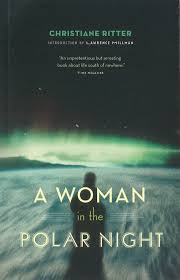
A Woman in the Polar Night

Polar Night“Meanwhile the world out of doors falls into deepest night. The mountains are no more than white shadows, the sea no more than a black shadow – until that too dissolves away. And then everything is dead.
In this pitch darkness we cannot move far from the hut. I make the smallest possible turns around the hut – all that is left of my walks. When it is not snowing we spend hours outside the hut chopping and sawing wood by the light of the hurricane lamp….

The wind that, rising and falling, lasts for days, is in fact our last link with the reality of the world…”  Christiane Ritter, A Woman in the Polar Night

A Woman in the Polar Night is an astounding memoir by Austrian artist Christiane Ritter who, in 1933, joined her scientist and hunter-trapper husband, Hermann, on the remote island of Spitsbergen 400 miles off the coast of Norway.

If you love memoirs of travel, adventure and, especially, nature, I highly recommend A Woman in the Polar Night. This is an extraordinary book written in poetic, painterly prose by a woman with a fearless spirit who was profoundly moved and changed by her year in the Arctic.

Christiane writes brilliantly about the beauty of Spitsbergen and also its terror. She thrived on Spitsbergen, but during both the darkest and the brightest stretches of her polar immersion she approached the edges of madness. As anyone might.

She writes of a terrifying two weeks spent alone in a fierce snowstorm. The hut was buried completely except for the stovepipe attached to the roof. Christiane’s husband and their companion, Karl, had gone on a hunting trip, and she was left alone with the darkness, snow, and raging wind.

She survived the storm and isolation. But when a full moon finally broke the long darkness, Christiane became moonstruck:

“It is full moon. No European can have any idea of what this means on the smooth frozen surface of the earth. It is as though we were dissolving in moonlight…. One’s entire consciousness is penetrated by the brightness; it is as though we were being drawn into the moon itself…..

Neither the walls of the hut nor the roof of snow can dispel my fancy that I am moonlight myself.”

Fearing Christiane had rar, a strangeness that befalls some who winter in polar regions, Hermann and Karl kept Christiane in the hut, so she wouldn’t succumb to ishavet kaller – meaning “the Arctic calls” – which can drive a person to throw herself into the sea.

“Surrounded by this boundless deadness and rigidity of everything physical, one’s living senses begin slowly to go their own way. More frequently and more brightly as the winter is prolonged, a strange light spreads before the inner eye, a remote and yet familiar vision. It is as though here, in this apartness, we develop a particularly sharp awareness of the mighty laws of the spirit, of the unfathomable gulf between human magnitudes and eternal truth. Outside of time, everything is annihilated. The imprisoned senses circle in the past, in a scene without spatial dimensions, a play in which time stands still.

Often I see the flowers and trees of the distant sun world, but I do not see them as I used to see them. They are glowing with color and piercingly beautiful. Their most secret meaning lives in their growth and their color.”

Dutch Whalers Spitzbergen.jpg

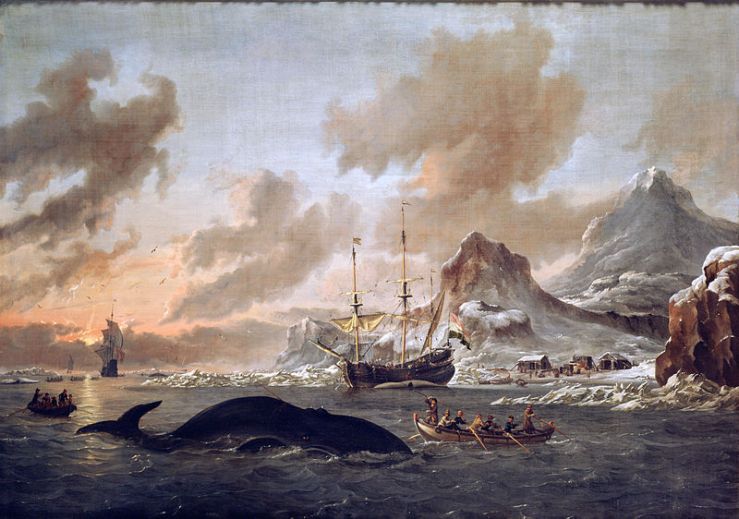
Dutch Whalers near Spitsbergen. By Abraham Storck – Stichting Rijksmuseum het Zuiderzeemuseum. 022296, Public Domain, https://commons.wikimedia.org/w/index.php?curid=5040261

Christiane writes of bear-hunting with Hermann and Karl in a “gigantic wilderness of ice”:

“We are in the middle of the bear kingdom. All my fear of bears has vanished. As in a dream I go on through the splendid strange world.

How quiet it is here. The sun shines on a soundless scene. The magical hues of the soft shadows glow deeply. Everything belongs together here, even the bear tracks in the deep snow, which show with what peace of mind the animals have gone on their way. Everything breathes the same serenity. It is as though a current of the most holy and perfect peace were streaming through all the landscape.

I feel that I am close to the essence of all nature. I can see its paths interlacing and still running alongside each other in accordance with eternal laws. I divine the ultimate salvation before which all human reasoning dissolves into nothing.”

nypl.digitalcollections.510d47e1-29ed-a3d9-e040-e00a18064a99.001.w
Ptarmigan was part of Christiane’s Spitsbergen diet. The New York Public Library Digital Collections.

The memoir’s conclusion is triumphant and sad. Christiane must finally leave the island, forever changed and knowing she will never return. She doesn’t reveal she has an infant daughter at home in Austria until nearly the end of her memoir, a startling bit of information that for me highlighted what an unusual couple the Ritters were.

I was curious about what it was like for Christiane to return to civilization and wished for an epilogue (there is none), but on the other hand I wasn’t sure I wanted to know. On top of having to re-integrate into society, Christiane returned to Austria as Europe neared the onset of World War II.

I found a 1954 edition of Christiane’s memoir at the local library, illustrated with line drawings by the author. You may want to look for the University of Alaska Press edition, published in 2010, which includes a preface with biographical information about the Ritters. It may satisfy some of the inevitable curiosity you’ll have about how the lives of this remarkable couple played out.

Christiane wrote, “You must have gazed on the deadness of all things to grasp their livingness.”

It seems to me her memoir is a remarkable example of someone whose extreme adventure pushed her into completely letting go of her ego and recognizing that we don’t have dominion over nature; we are instead part of nature itself. I think the world would be a much better place if we could all come to know this.

What We're Fighting for NowSo it was especially sad to read the excellent book I picked up next, What We’re Fighting for Now Is Each Other: Dispatches from the Front Lines of Climate Justice by Wen Stephenson, which makes clear that humanity hasn’t learned what Christiane Ritter learned. This book is depressing but empowering at the same time.

Stephenson reports that many climate scientists now believe climate catastrophe is inevitable.

He explains the term “climate justice” and how it is different from climate activism and environmentalism. Many have come to realize that climate change is the moral and spiritual issue of our time, inseparable from social justice and equality. The poor and disadvantaged will suffer the most from climate disruptions, as we’ve already seen in places like New Orleans and in countries around the world.

Stephenson lives near Walden Pond in Massachusetts, and he looks at climate justice through the lens of Henry David Thoreau‘s principles of civil disobedience. He likens climate justice to the social justice struggles of abolitionism and civil rights.

Stephenson writes about how he came to leave his career in mainstream journalism to immerse in climate justice, and it’s fascinating to read his interviews with others devoted to the cause as they explain the spiritual and other motives that drive them.

Most are young, some got their start in the Occupy movement, others are evangelicals, Quakers, atheists, community organizers, and grandparents. Many of them have come to believe that the way to survive climate change is to build strong, local communities where people trust and look after each other.

I couldn’t get out of my mind a young woman Stephenson interviewed, Grace Ann Cagle, who said she’d much rather be on a farm having babies than on the front lines of climate justice. Grace took part in the Texas Tar Sands blockade. 

“She’d been up in the trees for about a week, in late September, 2012….Sure enough, TransCanada’s machines came up from the south.

‘They came over the creek….They had a feller buncher – it grabs the trees, cuts them, and throws them. And as they cross the creek, they’re coming like ten feet, twenty feet away from me, practically at the base of my tree – and I thought they were going to kill me….Why would they care about me? And so I jumped onto this traverse rope, and I’m dangling there, wearing all black with a mask on my face, screaming, Go away! Get out of here! They stopped their machines…..I spent like six hours dangling there, in a harness, because I could protect two trees at once….'” 

How sad that, since Christiane Ritter’s time, we’ve come to this.

Read A Woman in the Polar Night to be transported and to understand what we’re losing. Then, if you want to consider what your role might be in the greatest battle of our time, you could follow the memoir with What We’re Fighting for Now Is Each Other: Dispatches from the Front Lines of Climate Justice.


Closing 2015 with The Story of the Lost Child

Little girl statue edited
Little girl at Casa Guidi


Opening 2016 with a poem

I ended 2015 reading Elena Ferrante’s fourth and final Neapolitan novel, The Story of the Lost Child, and this first week of 2016, a poem of mine, “At Casa Guidi,” was published in Loveliest Magazine.

Italy. Children. Creativity. I hadn’t planned this, but the poem and Ferrante’s novel have these in common. (The similarities end there – Elena Ferrante is a world-renowned author; I’m a novice poet.)

First, the poem. Some years ago I traveled to Florence with my sister-in-law, and we visited Casa Guidi, the home of Elizabeth Barrett Browning and Robert Browning in the Oltrarno quarter, where many artists and writers lived. Later, recalling our visit, I was inspired to write “At Casa Guidi.”

Loveliest Magazine, a new venue “for storytelling and togetherness,” caught my eye when I read the words “slow-lifestyle” and “literary” to describe its cross-genre purpose. That’s me, for sure, so I thought my poetry might be a good fit. Beautifully written and produced independent literary and lifestyle publications such as Loveliest often look for good fiction, poetry, and essays; if you’d like to see your work published consider submitting to these in addition to traditional literary journals.


Little boy statue edited
Little boy at Casa Guidi


If you are ever in Florence, be sure to visit this quieter part of the city, the Oltrarno, which literally means “beyond the Arno River.” In addition to the must-see attractions and many great works of art, Oltrarno streets are lined with stationery stores featuring the things writers love: Italian-made note papers and leather journals, ornate fountain pens, inks in every shade and color. When I was there, I bought a small, leather-bound copy of Sonnets from the Portuguese, and my sister-in-law bought a print of Leonardo Da Vinci’s Last Supper.

Closing 2015 with Elena Ferrante

I’ve written about Elena Ferrante’s Neapolitan novels in a previous post.  The Story of the Lost Child is Ferrante’s fourth and final novel in her Neapolitan series. The books are a probing look at the inner life of a writer; a family saga; a soap opera; a history of Italian feminism, culture and politics; and more.

So much has been said about these singular, internationally bestselling novels and their mysterious author, who publishes under a pseudonym, that I’ll simply add my thoughts here. (That we don’t know the identity of the author adds to the power of her work, in my opinion.)

If you look at the book covers you’ll see dreamy, idealized illustrations that are misleading: the story of the lifelong friendship between Lila and Elena, born in Naples just after World War II, can often be raw, brutally honest, and bleak. The book covers belie the content, but perhaps that was intentional, as if to say: think again if you expect a story filled with roses and happy endings….

I wouldn’t say I was always entertained by the books, because they can be relentless in their depiction of Napoli poverty and the battle between the sexes in an era when feminism blossomed. But, as many readers do, I became obsessed with Lila and Elena and had to keep on reading to see what became of them.

  • Ferrante’s work is especially meaningful to me because my father was Sicilian. Now I better understand the values, traditions, and struggles of my Italian ancestors and how these may have had an impact on my own childhood. The cultural history of Italy and its focus on family reminded me of one of my favorite Italian movies, The Best of Youth. Although I have not yet read My Struggle by Karl Ove Knausgard, it sounds as though Ferrante’s penetrating look at the psychology of growing up and growing older may have similarities with Knausgard’s autobiographical series.
  • As a writer, I was especially taken with Elena’s love/jealousy/hatred of her friend, Lila. Though Elena was the outwardly successful one, with several novels published and lauded as a scholar of literature and culture, she always believed Lila was the more talented of the two, the one with wildness, fire, and true originality.  It’s often a struggle when I write to break out of my safe, everyday self and give creativity free reign. The genius of the Neapolitan novels is that Elena and Lila’s story can be read as the author’s own creative struggle with a psyche split in two.


IMG_2446


Elena and her friend, Lila, are strong women, survivors. Here is Elena during the earthquake in Naples, 1980:

“I felt that fear in me could not put down roots, and even the lava, the fiery stream of melting matter settled in my mind in orderly sentences, a pavement of black stones like the streets of Naples, where I was always and no matter what at the center. Everything that struck me–my studies, books, Franco, Pietro, the children, Nino, the earthquake–would pass, and I, whatever I among those I was accumulating, I would remain firm.”  – The Story of the Lost Child by Elena Ferrante


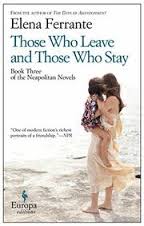
My Brilliant Friend book coverThe Story of a New Name book coverThose Who Leave and Those Who Stay book cover

Wild Arts!

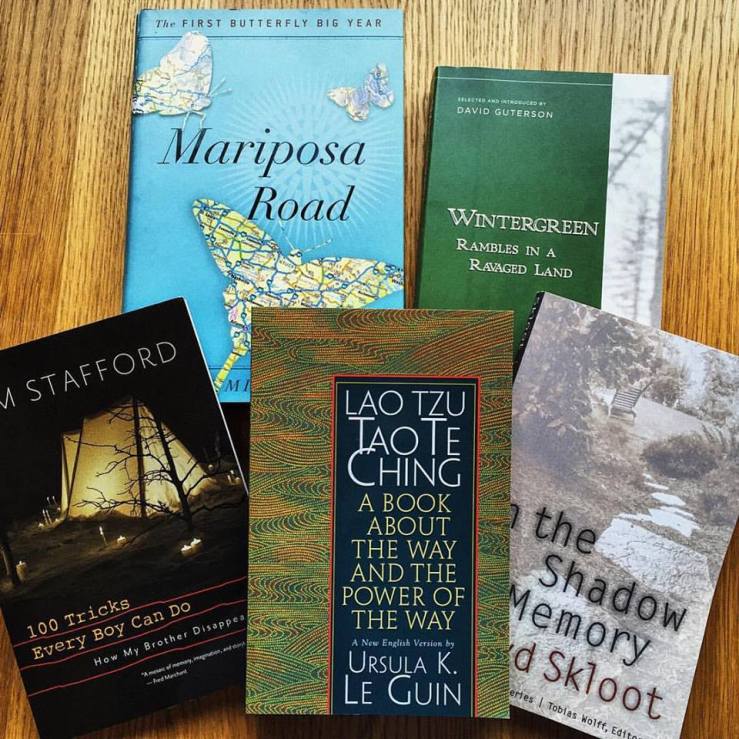
Five books
Books purchased at the Wild Arts Festival in Portland, signed in person by the authors.


Litmosphere: 1. the vast domain of the world’s readers and writers 2. a lively literary mood permeating the air ~ sign in Powell’s Books, Portland

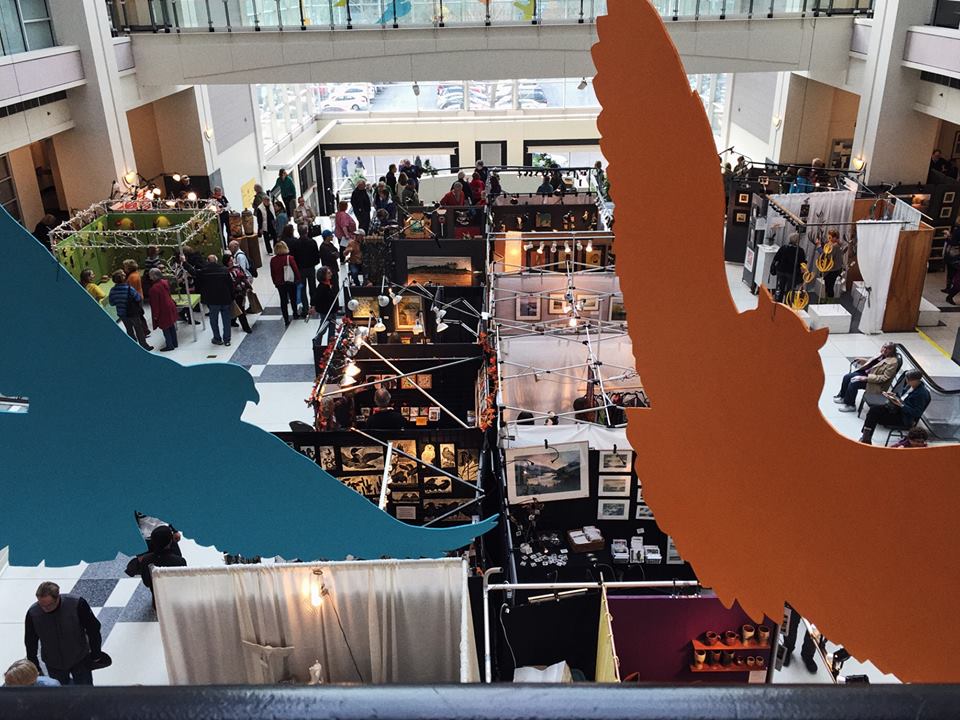
Wild Arts FestivalI love the literary scene in Portland. Our Thanksgiving visit there coincided with the annual Wild Arts Festival, a celebration of nature in art and books hosted by the Audubon Society of Portland in the old Montgomery Ward building, now known as Montgomery Park.

Walking into the festival, where hundreds of artists and authors were on hand, was like getting a gigantic embrace from the creative community.

I couldn’t decide among Ursula Le Guin’s many, many science fiction and fantasy books. In the end I chose her translation of Lao Tzu: Tao Te Ching: A Book About the Way and the Power of the Way, and she graciously signed a copy for me.

Next, we met Robert Michael Pyle, a jolly teddy bear of a man who spent no less than 15 minutes entertaining us with stories about how, in his Honda Civic with 345,000 miles on the odometer, he spent a year searching for as many of the 800 species of American butterflies as he could find. I could have spent hours listening to this man; instead I bought his memoir and travelogue, Mariposa Road, which he signed with, “May these far rambles on bright wings incite your own wild road trips!”

A dedicated ecologist and naturalist, Robert Michael Pyle has written nearly 20 books and is the co-editor of Nabokov’s Butterflies: Unpublished and Uncollected Writings. (The literary genius Vladimir Nabokov was a butterfly expert and had an extensive collection.)

I purchased another of Robert’s memoirs, Wintergreen: Rambles in a Ravaged Land, about Washington’s Willapa Hills, whose forests have been plundered by lumber companies. Robert lives on a farm in Grays River once owned by a Swedish immigrant. I’m descended from Swedes, who were attracted to the deep forests of the Pacific Northwest because it reminded them of home; I’d love to see Willapa country one day. Of course, Robert signed Wintergreen, too, with these words, together with a sketch of a snail: “May these moss murmurs and fern-words honor your own hills of home – and maybe urge you Northwesterly!”

I can’t say enough about Floyd Skloot and Kim Stafford. They are both poets, and they’ve both written memoirs. (Actually, they’ve both written more than one, and I look forward to reading all of them.)

Since I’m writing a memoir myself, I decided to go for the memoirs: In the Shadow of MemoryFloyd Skloot’s first memoir (part neuroscience and part autobiography about a virus that left Skloot disabled and bereft of memories) and 100 Tricks Every Boy Can Do: My Brother’s Disappearance by Kim Stafford (his brother committed suicide.)

Both of these generous writers spoke with me about their work and asked at great length about mine. Kim wanted to know the working title of my memoir and, when I told him, he gave me a writing assignment to try. As I did the exercise Kim recommended, I discovered that one particular word in the title is especially important to my memoir’s theme. It got me thinking about how I could bring out the theme more vividly as I revise.

The authors I spoke with at the Wild Arts Festival were incredibly kind and gracious. I had instant connections with these generous writers, who are among the best in America today. Don’t be shy at these kinds of events. Writers and artists are the most giving and engaged people you’ll ever meet.

Portland is a book-loving town, and as I walked around the neighborhoods with family, I noticed several Little Free Libraries. It’s also a poetry-loving town, and a couple of the homes I passed by had poems on display – including one by Kim Stafford’s father, the great poet William Stafford.

Slipped inside the Kim Stafford memoir I bought was the gift of a poem that begins, “The only heroic thing is to not be a hero.” I believe Kim borrowed this phrase from a poem by his father, William: “At the Un-National Monument Along the Canadian Border.”

Kim’s poem is called “A Few Words, Each Day,” and it includes this line: “The only heroic thing is to be a child of four…of fifteen…of forty…of eighty – trying with the heart and mind to listen to the self, each other, and the earth….”

Litmosphere definition sign in Powell's Books
We stopped by Powell’s Books for good measure, where I learned a new word.


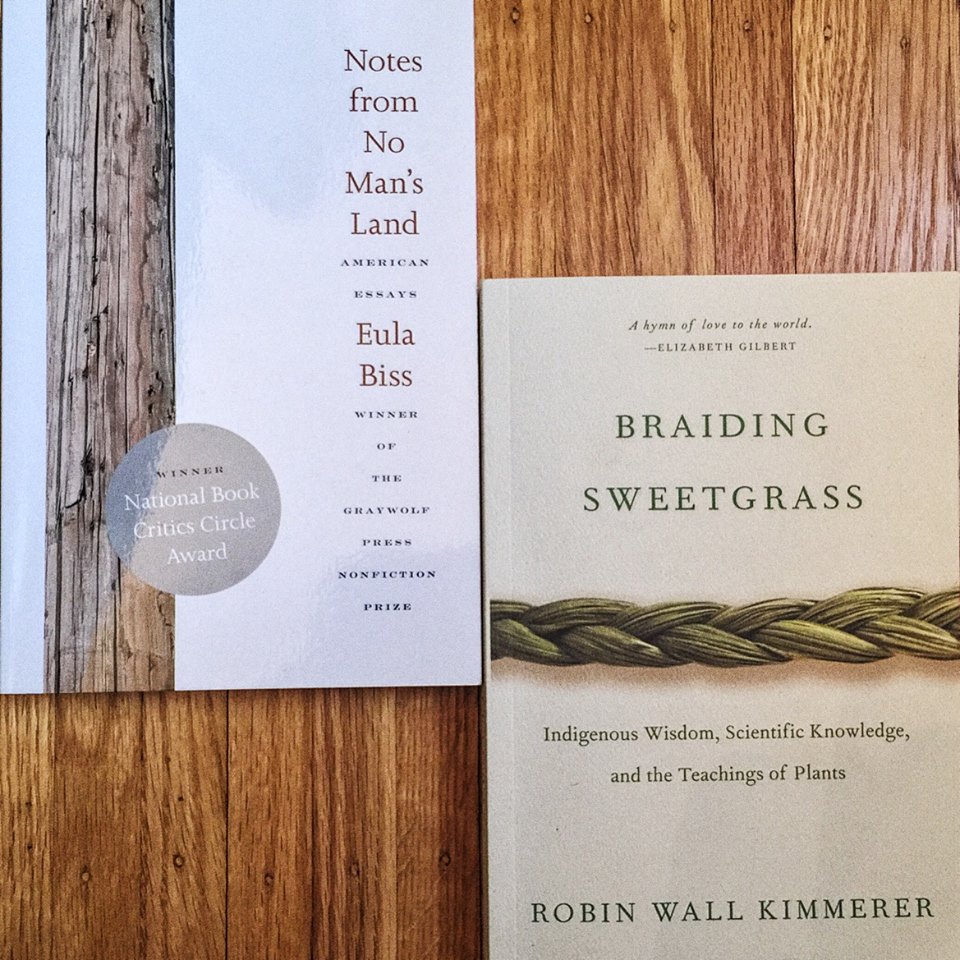
Books: Braiding Sweetgrass; Notes from No Man's Land
At Powell’s I bought Eula Biss’s collection of essays and the latest book by Robin Wall Kimmerer, who is a botanist and member of the Citizen Potawatoni Nation.


Northern spotted owl at the Wild Arts Festival


Kim Stafford: “That is my story.”


Rhythm of the Wild by Kim Heacox

“Looking back, I see now that Denali did more than charm me that first summer; it saved me. The whole damn place beguiled me and believed in me when I didn’t believe in myself. Call me crazy or blessed or crazy blessed. But I swear that again and again Denali has done this–made me buckle down and find inspiration and become the free man I am today.”   Kim Heacox, Rhythm of the Wild: A Life Inspired by Alaska’s Denali National Park

Rhythm of the Wild book cover

“What you hold, dear reader, is a story of love and hope, equal parts natural history, human history, personal narrative, and conservation polemic. I make no attempt to be a neutral journalist, a rare bird in today’s corporate culture. I’m a story teller.”

At the moment, Alaska is burning, and I’d love to hear Kim Heacox’s thoughts about this. I recently finished reading his new book, Rhythm of the Wild: A Life Inspired by Alaska’s Denali National Park, and I liked it so much I bought a copy of his first memoir about Alaska, The Only Kayak, and liked that one too.

Denali Mountain
Denali. Wikipedia.

I’ve tried to persuade my husband to read the latter book, as he’s a kayaker and a Beatles lover, as Heacox is. I believe Heacox and J. are kindred spirits, but so far no luck, J. hasn’t picked up the book–he’s not a particularly avid reader. However, he has been to Alaska, while I have not, so I think that counts for more than reading two books about Alaska.

Kim Heacox is an award-winning writer (with four books for National Geographic to his credit), a photographer, a speaker, a conservationist, and a lover of Alaska and Denali. (Denali, the mountain, which is the highest in North America, and Denali National Park.)


Grizzly bear
Grizzly bear. NPS photo.

He and his wife, Melanie, have resided in Alaska for over thirty years; they are two remarkable people who have devoted their lives to educating others about the inestimable value of our wilderness areas. Heacox writes in a very personal way about Alaska and Denali, weaving together his own wilderness stories with coming of age in the Northwest during the 1960s and 70s. I admire him for many reasons, among them his talent for lyrical writing and his willingness to be vulnerable as he shares his love for the wilderness that is Alaska.

As I read, I began to feel sorry for the tourists Heacox describes who find their way to Denali but after a few short days must return to their Dilbert cubicle lives in cities and suburbs. Then I realized that has been much of my life, too. Heacox paints such a compelling picture of Alaska he made me feel deprived for never having experienced this wild, remote place.

Heacox recounts his fascination with the Beatles and their reinvention of music – from an early age he identified with outsiders and challengers of the status quo. Naturally, he’s been deeply influenced by “outsider” environmentalists as well, including  Edward Abbey and Adolph Murie. He writes about their legacies in Rhythm of the Wild.

Those of you who follow my blog know I’m a fan of Barry Lopez and Wendell Berry and other influential writers who care about nature and wilderness. I’ll look for more writing by Kim Heacox in the future. I consider him an important addition to my nature and conservation bookshelf. He’s the kind of writer we should be reading if we want to protect our national parks and take climate change seriously.

Here are a few enticing samples of this singular voice in Rhythm of the Wild:

“Years ago in a cowboy cafe in Moab, Utah, I met a nine-fingered guitarist who poured Tobasco on his scrambled eggs and told me matter-of-factly that Utah was nice, Montana too. And of course, Colorado. But any serious student of spirituality and the American landscape must one day address his relationship with Alaska, and once in Alaska, he must confront Denali, the heart of the state, the state of the heart….by Denali he meant both the mountain and the national park.”

Great Horned Owls
Great Horned Owls. NPS photo.

“Denali is what America was; it’s the old and new, the real and ideal, the wild earth working itself into us on days stormy and calm, brutal and beautiful, unforgiving and blessed. It’s where we came from, long before television and designer coffee, even agriculture itself. Before we lost our way and granted ourselves dominion over all living things, before our modern, paradoxical definitions of progress and prosperity, and too much stuff; it’s the lean, mean, primal place buried in our bones no matter how much we might deny it, no matter how fancy our homes, how busy our routines, how cherished our myths. Denali resides in each of us as the deep quiet, the profound moment, the essence of discovery. It offers a chance to find our proper size in this world.”

The publisher of Rhythm of the Wild kindly provided me with an Advanced Reader’s Copy (ARC).

I’ve ordered a copy of Laudato Si’, Pope Francis’ encyclical on climate change. It is available from Amazon and other booksellers, and you can download the pdf at this link: Laudato Si’ . I’ll be writing about it here in late July, primarily from a secular perspective. Why don’t you read it with me – I welcome your thoughts.

Northern Lights and trees

Summer book giveaway

Guess book & flower

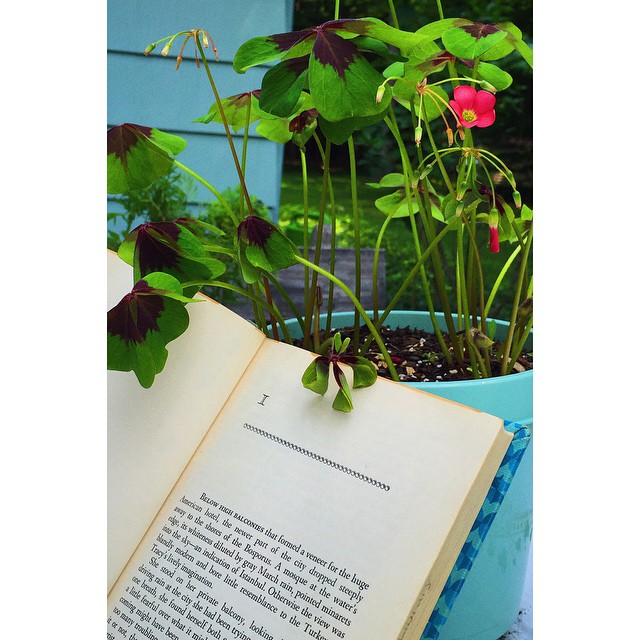
Guess the book (hint: gothic romance) and/or the flower for a chance to win a book or a package of seeds. You don’t have to get the correct answer to win. Ends Wednesday, June 24, midnight EST.

Here are a few of the books I’ll be reading and writing about this summer:

How to Be Both, by Ali Smith

Laudato Si: Praise Be to You, On Care for Our Common Home, by Pope Francis

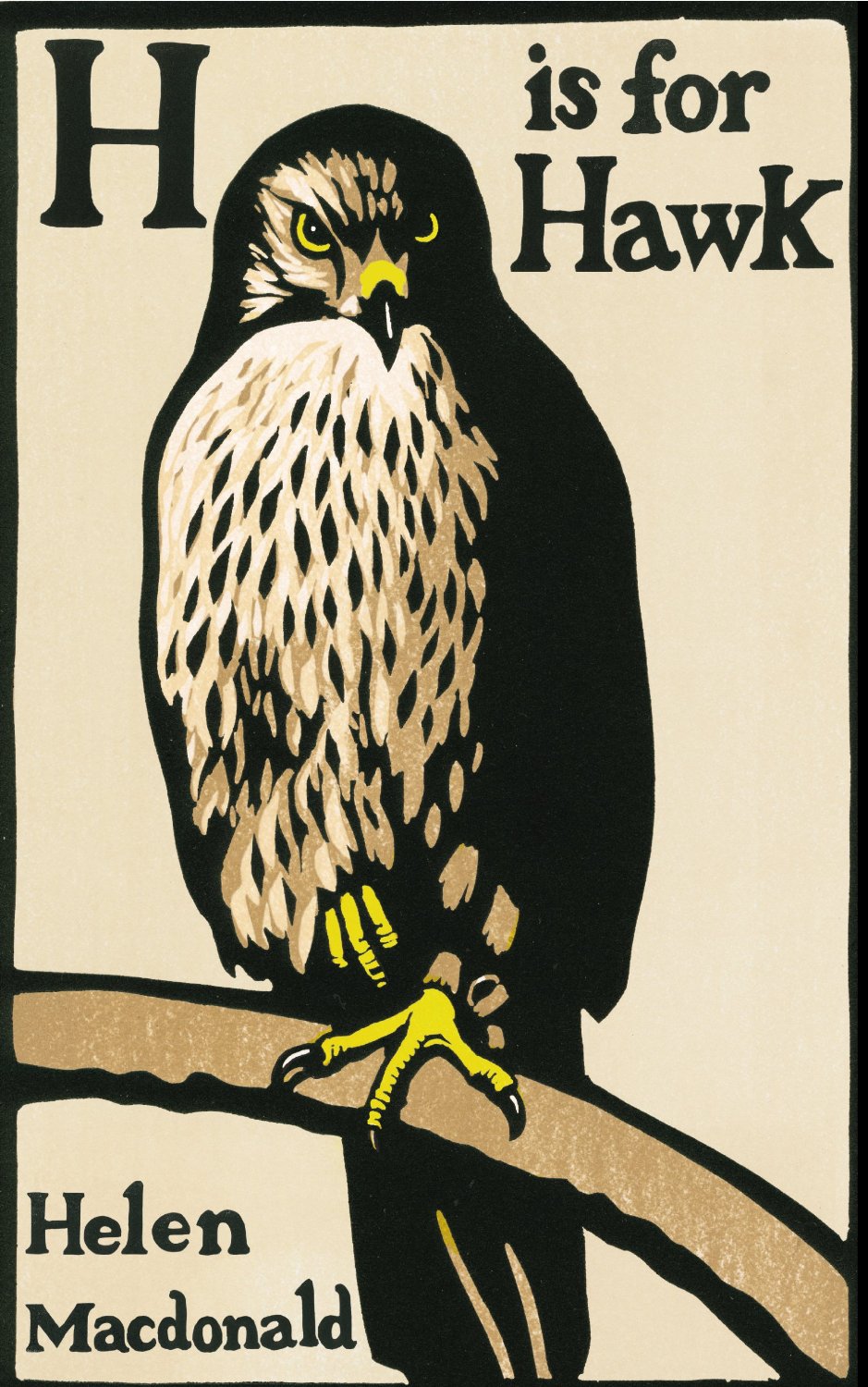
H Is for Hawk book coverH Is for Hawk, by Helen Macdonald

Bad Feminist, by Roxane Gray

Smile of a Midsummer Night: A Picture of Sweden, by Lars Gustafsson & Agneta Blomqvist

Rhythm of the Wild, by Kim Heacox

How Should a Person Be? by Sheila Heti

The Collapse of Western Civilization, by Naomi Oreskes & Eric M. Conway

Everything I Never Told You, by Celeste Ng

Laudato Si books

Modiano’s elusive Paris: what my father never saw

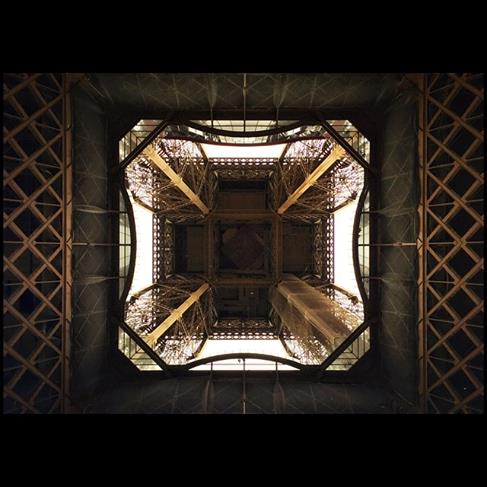
Eiffel Tower
La tour Eiffel. (Photo by A. Hallinan)

“Tell all the truth but tell it slant–“ Emily Dickinson

If you dislike ambiguity and prefer straightforward plots, you may become impatient with Patrick Modiano’s inconclusive and sometimes maddening quests. In his stories of Paris during and after the Occupation, the “missing” person in question is never found; the mystery of his or her identity is never solved.

Modiano tells the truth–what little of it he knows–but he tells it slant.

Reading is a way for me to immerse myself in other times and places, and on our recent trip to France, I wanted to see the country through the lens of World War II, when my father was a soldier there. So I brought along Irène Némirovsky (I wrote about Suite Française in my last post) and Patrick Modiano’s The Search Warrant (published as Dora Bruder in Europe). Coincidentally, my son had just read three novellas by Modiano: Afterimage, Suspended Sentences, and Flowers of Ruin, so I read them, too. (These are published in one volume entitled Suspended Sentences.)

I was thinking about my father, who passed away five years ago, and musing about events in 1940s Europe that may soon be all but forgotten. Once I became accustomed to Modiano’s method and spirit of storytelling, I could appreciate the author’s preoccupation with identity and memory, and his attempts to reconstruct and understand the past.

Even as I explored the Jewish quarter of Le Marais, where we stayed, and conjured up the WWII Paris I’ve seen in movies, I realized that a new story is playing out in France, making my father’s time seem even more remote. We passed by many military personnel armed with automatic weapons guarding Parisian monuments, temples, churches, and other sites in the wake of January’s Charlie Hebdo attack.

My father never got the chance to explore Europe as he’d hoped. He’d been fascinated by France and Luxembourg (where he spent the weekend in training before he was wounded in the Battle of Metz in 1944), and he’d planned to visit Sicily, where he was born. Instead, he was shipped out to Liverpool after he was injured, and then back to America, where he spent over a year in recovery. Though he did visit Sicily later in life, my father never returned to France. Suspended Sentences book cover

I found myself imagining what he might have thought if he’d seen Notre Dame (he was awed by cathedrals) or tasted Parisian escargot (which he would have relished) or strolled across the many old bridges spanning the Seine.

During our drive to Metz, I looked out over the French countryside and along the Moselle River, thinking that perhaps my father had been injured in one of the passing fields or forest groves.

In The Search Warrant, Modiano is obsessed with reconstructing the life of a young Jewish girl who died at Auschwitz. In a 1941 Parisian newspaper, he’d discovered an ad placed by the parents of Dora Bruder, asking for information about the whereabouts of Dora, who had run away from her convent school. It’s as if Modiano can’t accept that someone–that so many, in fact–could live lives so brief and obscure and die such senseless deaths, as they did in the war.

The Search Warrant fuses nonfiction (the facts he unearths about Dora Bruder) with memoir (Modiano’s autobiographical speculations about his father during the Occupation) and fiction. As I read, sometimes I couldn’t separate truth from fiction.

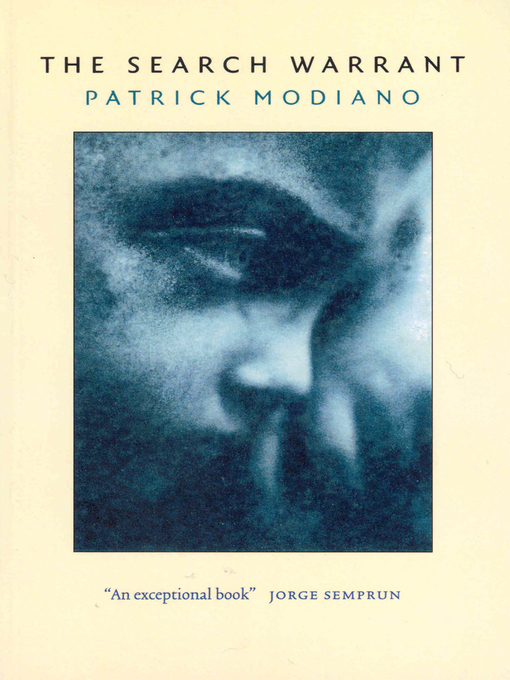
The Search Warrant book coverInterrupting the narrative flow are lengthy lists of the names and last known addresses of people deported to concentration camps. Modiano seems compelled to show his readers the documentation and proof behind any fact he asserts about Dora. He meticulously describes the Paris neighborhoods that he wanders in, too: the old, timeworn urban landscapes and the bland contemporary ones that have replaced them.

Such lists and geographical minutia also appear in Modiano’s three novellas. Each story portrays a protagonist searching for a person he’s lost touch with long ago or seeking to understand some incident from the past.

Before I started the three novellas, I read the editor’s introduction to see if I could better understand what Modiano was trying to do with his stories. I learned that his mother had been an actress and was often absent during his childhood, while his estranged father paid little attention to Modiano and his younger brother. Modiano surmises that his father was a black market smuggler and somehow aligned with French Nazi collaborators. Another heartbreaking autobiographical fact is that Modiano’s beloved brother, Rudy, died from an illness when they were young. Modiano’s obsessive search for Dora Bruder is emblematic of Modiano’s search for his lost family, and for a pre-war Paris that no longer exists.

Patrick Modiano won the Nobel Prize in 2014.

From Flowers of Ruin:

“Little by little, that man melted into the wall. Or else the rain, from falling on him so heavily, had dissolved him, the way water dilutes a fresco that hasn’t had time to dry properly. As hard as I pressed my forehead against the glass and peered at the dark gray wall, no trace of him remained. He had vanished in that sudden way that I’d later noticed in other people, like my father, which leaves you so puzzled that you have no choice but to look for proofs and clues to convince yourself these people had really existed.”

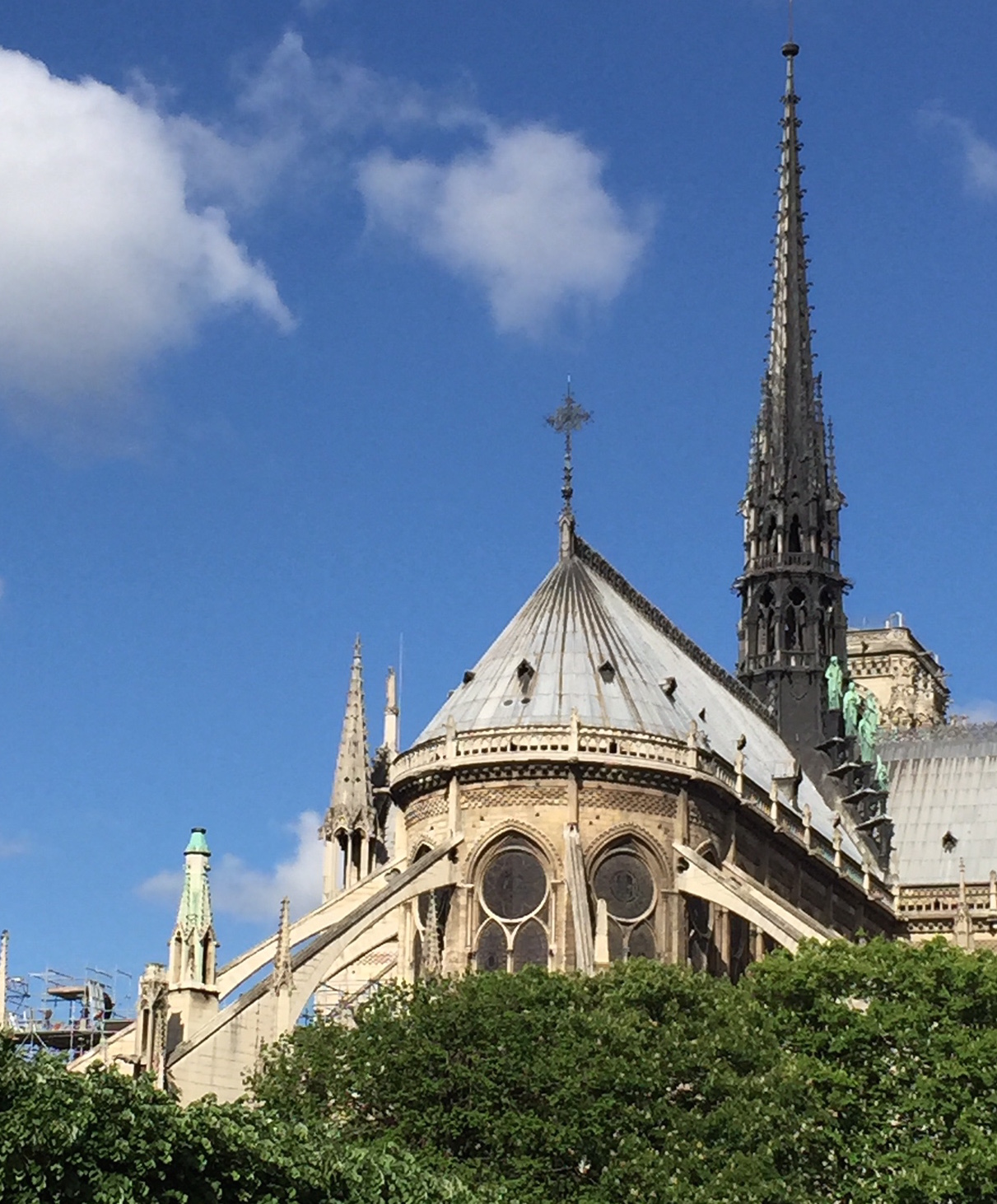
Notre Dame
Notre Dame
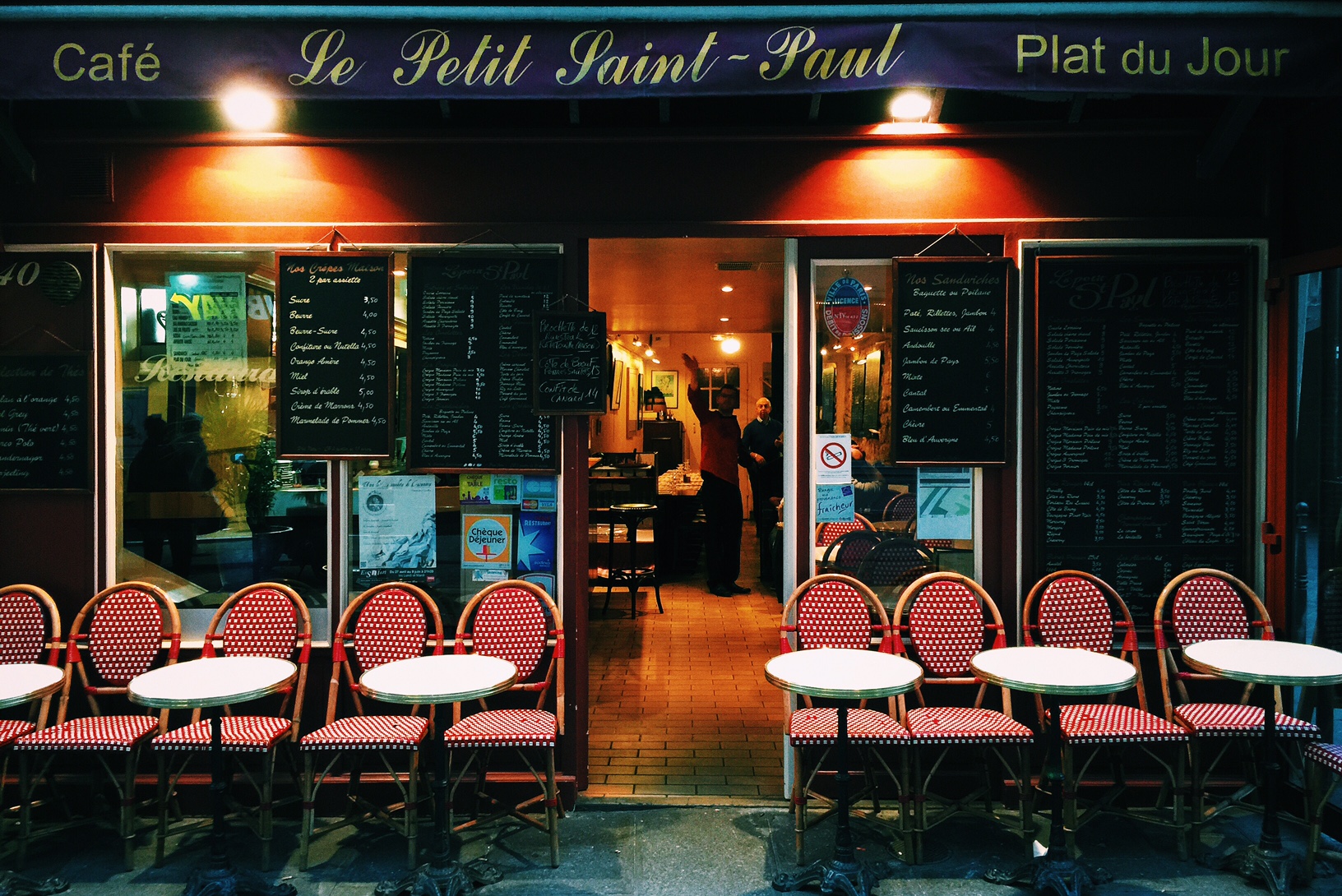
Cafe in Paris
Where to eat….they all look so good. Can you see the maître d’ beckoning?
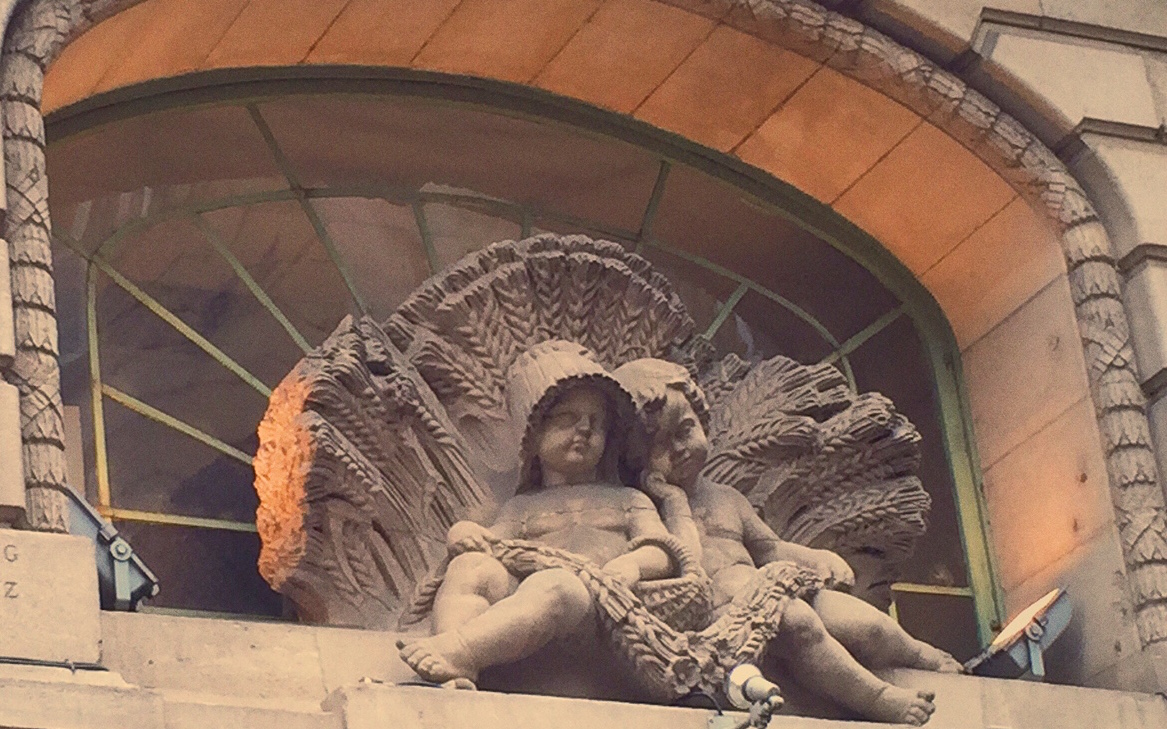
Stone carving of two children
Children on a street corner in France.

Spring flowers and Colette, in Paris

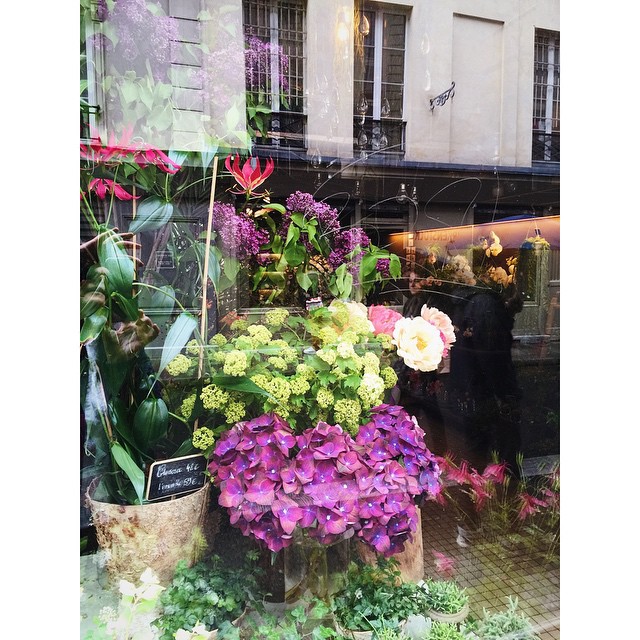
Floral shop window
“As noisy as Paris was in those days, it always had its unexpected moments of stillness. At Cours-la-Reine, between one and one-thirty in the afternoon, when the last trucks had reached their canteens, those who loved flowers and silence could savor a strange respite, a solitude in which the flowers seemed to recover from human curiosity.”

******************

We’ve been in Paris, where our son has been studying and working in industrial design. I had so much fun walking around this enchanting city which, among other treasures, has secret gardens galore, flower vendors and flower markets, and floral shops offering spring flowers, herbs, and foliage, all beautifully arranged and presented.

Flowers and Fruit book coverA few years ago I was browsing in a local used book shop when I discovered a volume of essays by Colette, Flowers and Fruit, first printed in the US in 1986.

Some of the essays were inspired by a Swiss publisher, who for a time sent Colette a bouquet of flowers once or twice a week so she could write sketches of those that inspired her.

Colette wrote one of the longer essays in this collection, “Flora and Pomona,” during the Nazi occupation. According to the collection’s editor, Colette conceived of the writing project to “keep the coal bin at 9, rue de Beaujolais well filled and pay the black-market prices for rabbit and cheese and chicken and other comestibles otherwise unavailable, even to much-loved novelists living in the Palais-Royal.”

At the time of its publication, some critics said factual errors, weak editing, and a less than adequate translation detracted from Flowers and Fruit. I find Colette’s writing challenging, so this isn’t the kind of book I’d read straight through. It’s a little treasure for floral enthusiasts that’s fun to browse when I want Colette’s unusual take on flowers.

We were lucky to be in Paris on May Day. This holiday’s signature flower is lily of the valley, one of my favorites. They were everywhere.

Here are some of my Paris floral photos paired with Colette’s thoughts on flowers and gardens:

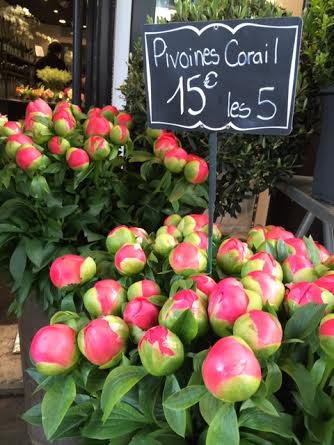
Peonies
“Garnet red, bright pink, sentimental pink, and three or four other carmine reds, they are the colors of good health and will delight me throughout the coming week.” (These peonies have not yet opened, which is when you should buy them.)
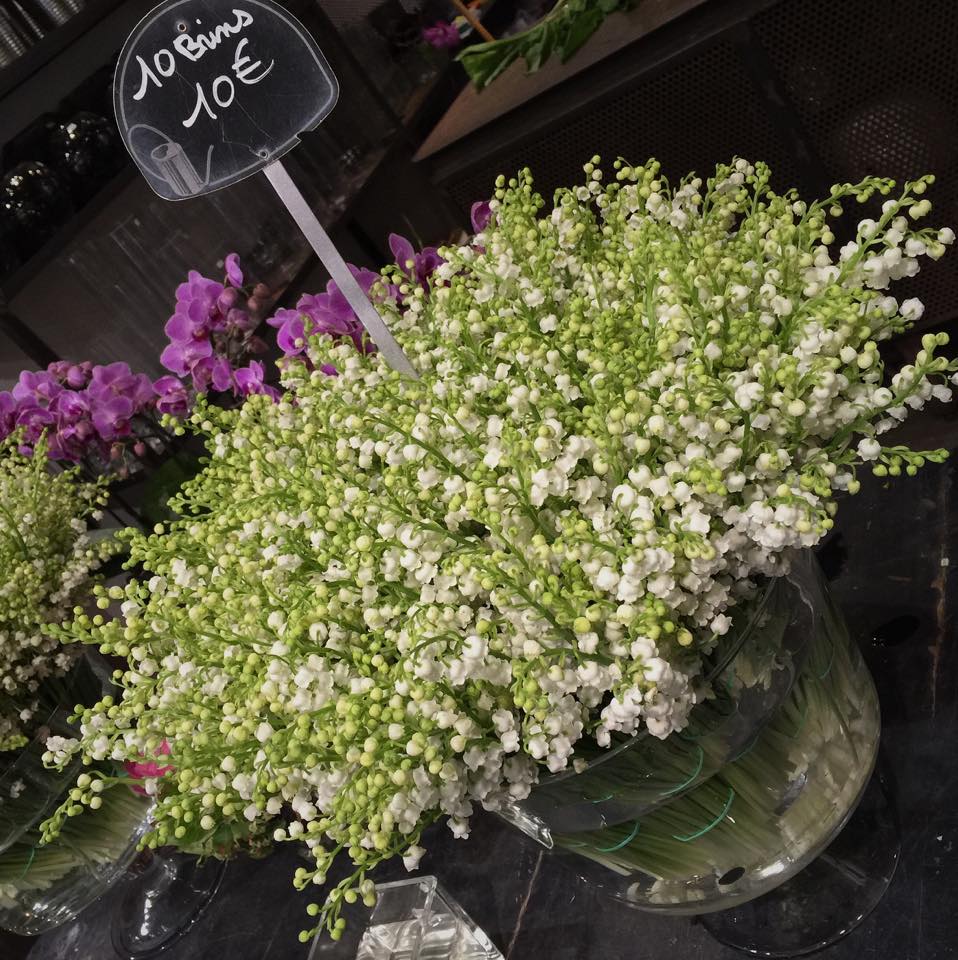
Lily of the valley
Lily of the valley is the May Day flower in Paris. “In spring, nearly an entire nation demands lily of the valley like bread.”
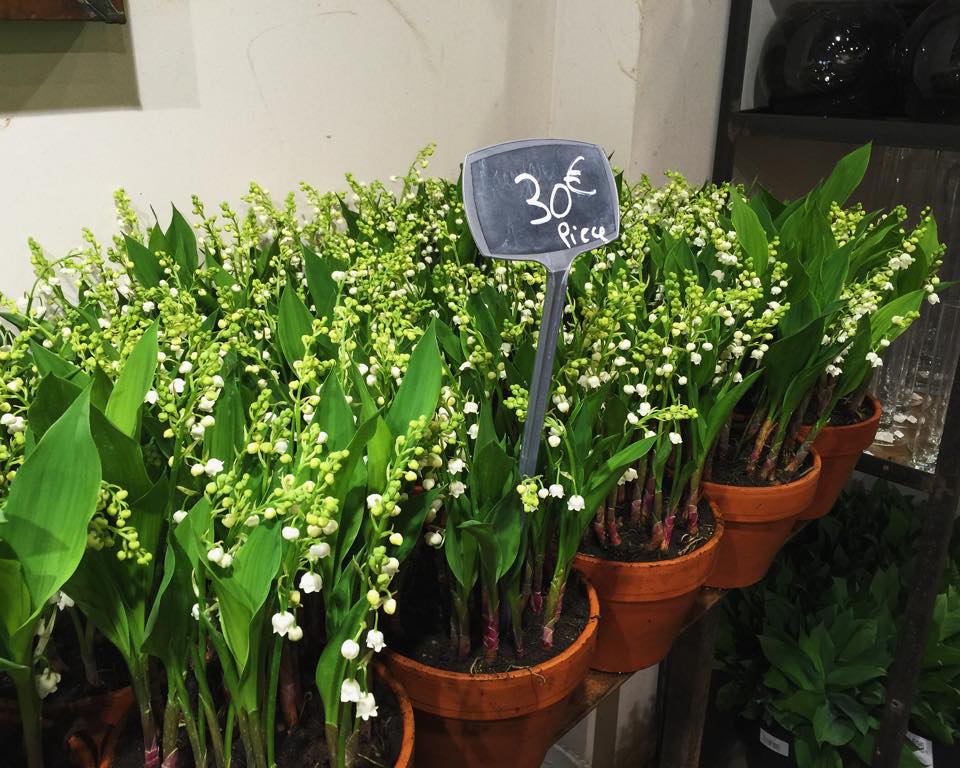
Pots of lily of the valley
“More than a flirtation, better than a superstition, almost a religion, the lily of the valley is celebrated on the first of May. Its cult stirs the Paris population to fever pitch…”
Chocolate & lily of the valley
You’ll find lily of the valley everywhere on May Day, even at the chocolatier. I saw these lovely desserts at Sylvain Mussy on Rue Bourg Tibourg.


Lily of the valley bouquet
My May Day bouquet. Lily of the valley, gloriosa lily (also known as fire lily or flame lily), and angel hair fern. “The true lily’s favorite soil is the kitchen garden’s, with tarragon, sorrel edgings, and purple garlic for neighbors.”
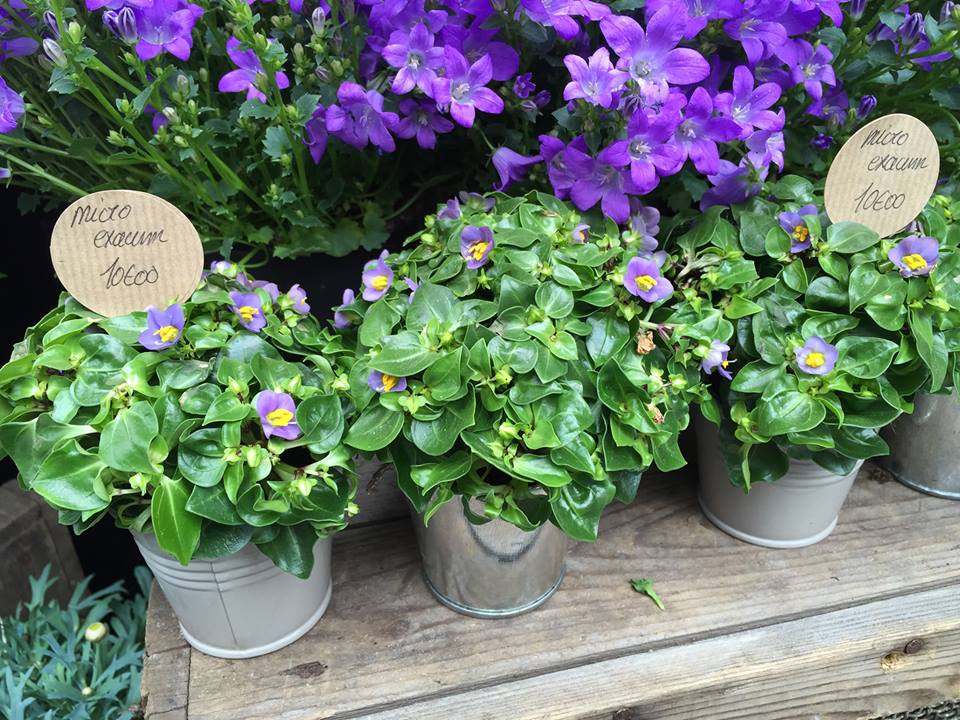
Flowers
Campanula and Persian violets. “…the sleeve of blue-violet campanula that grows immoderately, framing the windows in a single rush and decking them with flowers all season long.”
Pink and white roses
“Below my window, among the puddles of water, the bathing pigeons….we have old-fashioned, floriferous rosebushes that have survived both war and frost. Never have they failed to flower, and to flower again, and yet again before November.”
Stone figures on garden wall
There are many secret gardens hidden on the side streets of Paris, where the public is welcome.
Garden flowers
This one is Square Georges-Caïn on Rue Payenne. “Creating a garden takes us back to childhood imaginings.”
Paris street with plants, flowers
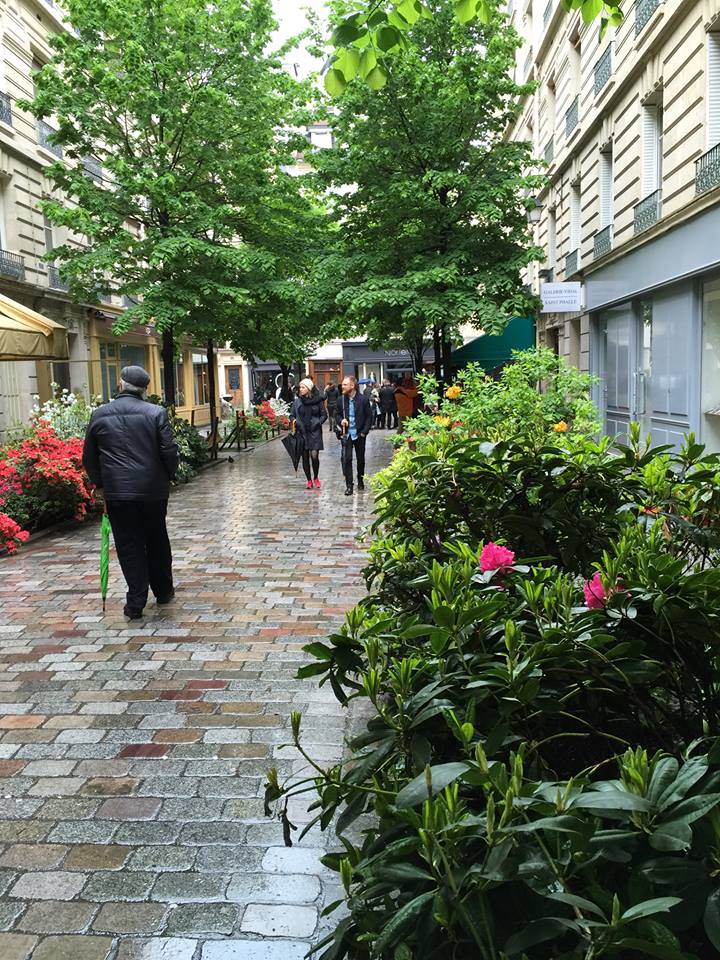
Some streets, like Rue du Trésor, are gardens, too.