Summer day meditation, week 4

water lily
I found this in the backyard pond this morning.

In meditation class, our instructor read a poem by Rumi about welcoming all emotions as you would a house guest, even the negative ones, as they may be clearing you out for something else.

Also a poem by Derek Walcott about loving again the stranger who was yourself, published in David Whyte’s book, The Heart Aroused: Poetry and the Preservation of the Soul in Corporate America. For a time, David Whyte was a visiting poet at a major corporation. I’ve never read a book quite like it.

You can sample some of David Whyte’s poems on his beautiful, rich website. David leads groups on hiking tours in Italy, England, and Ireland, where he reads his poetry and visits artists, cooks, gardeners, farmers, and other creatives committed to their locales.

What genetic tests tell us about our health

Chromosome 4
Genome Management Information System, Oak Ridge National Laboratory

I am what I do with the beautiful information that has flowed through millions of years through billions of organisms and has, now, finally been entrusted to me.    Lone Frank

Genetic tests for consumers now cost as little as $99.

Send in a sample of your DNA (usually a swab of saliva) and you’ll be notified of the results by mail, email, or online. (In some states, such as New York, genetic tests must be requested by a physician.)

Science journalist Lone Frank purchased a genetic test kit and sent in her sample of saliva. In My Beautiful Genome, she describes going online and finding out her risk for Alzheimer’s, glaucoma, asthma, gallstones, arteriosclerosis, and other conditions.

Breast cancer is Lone’s number one concern; her mother and maternal grandmother died relatively young from it. At first, she’s relieved, because the test says she has a 7.7 percent risk for breast cancer, lower than a woman’s average risk of 12%.

But when Lone interviews the founder of the genetic testing company, he advises her to get a BRCA gene test because of her family history. Mutations in these genes can mean up to an 80% risk for breast cancer.

When Lone tries to get a BRCA test, she’s turned down, because the testers want evidence of breast cancer in her family going back one more generation, and Lone doesn’t have that information. Nonetheless, she manages to convince them to give her the test.

I’ll permit myself one spoiler and tell you Lone doesn’t have the BRCA genes. She’s tremendously relieved, of course – between that and her lower-than-average 7.7 % risk, maybe the genetic roll-of-the-dice is in her favor.

Not so fast.

The genetic counselor tells Lone that, because both her mother and grandmother died of breast cancer, there could be another risk factor at play – a genetic anomaly for breast cancer that hasn’t been discovered yet.

Let’s say another genetic risk factor for breast cancer comes to light and Lone has it. That would mean her risk rating would increase from 7.7% to something much higher.

The risk ratings from consumer genetic testing are based on limited information, because there is so much we don’t know yet about the human genome and disease. As more of the human genome is decoded, people’s risk ratings change.

The fact of the matter is, every human has over 20,000 genes, and consumer genetic tests examine only a handful of them.

So, just how useful are these tests?

I asked my general practitioner, an excellent physician, what he thinks of direct-to-consumer genetic tests. He’s not enthusiastic.  They yield information that’s incomplete, possibly inaccurate, and worrying. He believes specific genetic tests for specific conditions – the kind of test you’d obtain after a discussion with your health care provider – can be useful, but only if you’re prepared to act on the information. A woman may get a BRCA test, for example, with the intention of having a double mastectomy if the results are not in her favor.

I’m not going to be asking him to request a genetic profile for me anytime soon. When I first began reading My Beautiful Genome, I considered it, but I’m not convinced I’ll learn anything useful, I’ll wonder about accuracy and, depending on the results, I’ll probably worry.

There are lots of other drawbacks, too, which Lone discusses in her book. But she gives equal time to the potential benefits of genetic testing, and writes about what is being done on the cutting edge. Some of what she has to say sounds like science fiction, but it’s really happening.

Lone Frank wants very much to know her own genome; I’ve decided to postpone exploring my own DNA for health reasons until more is known. If and when I do, I’d want to discuss the results with a genetic counselor or other qualified expert.

Still, I’m excited about the prospect of someday knowing something about my own genetic code. I hope that day isn’t too far away.

And if I ever have the opportunity to participate in a research study about the genetics of something I care about – schizophrenia, for example – I’d volunteer in a heartbeat.

Would you choose to explore your DNA with a genetic test? Have you already been tested? What do you think of consumer genetic tests? Please share your thoughts in the comments below.

Would I have my DNA analyzed for ancestry? That’s another story. In my next and last post about My Beautiful Genome, I’ll write about what Lone learned about her genetic roots.

Summer day meditation, week 3

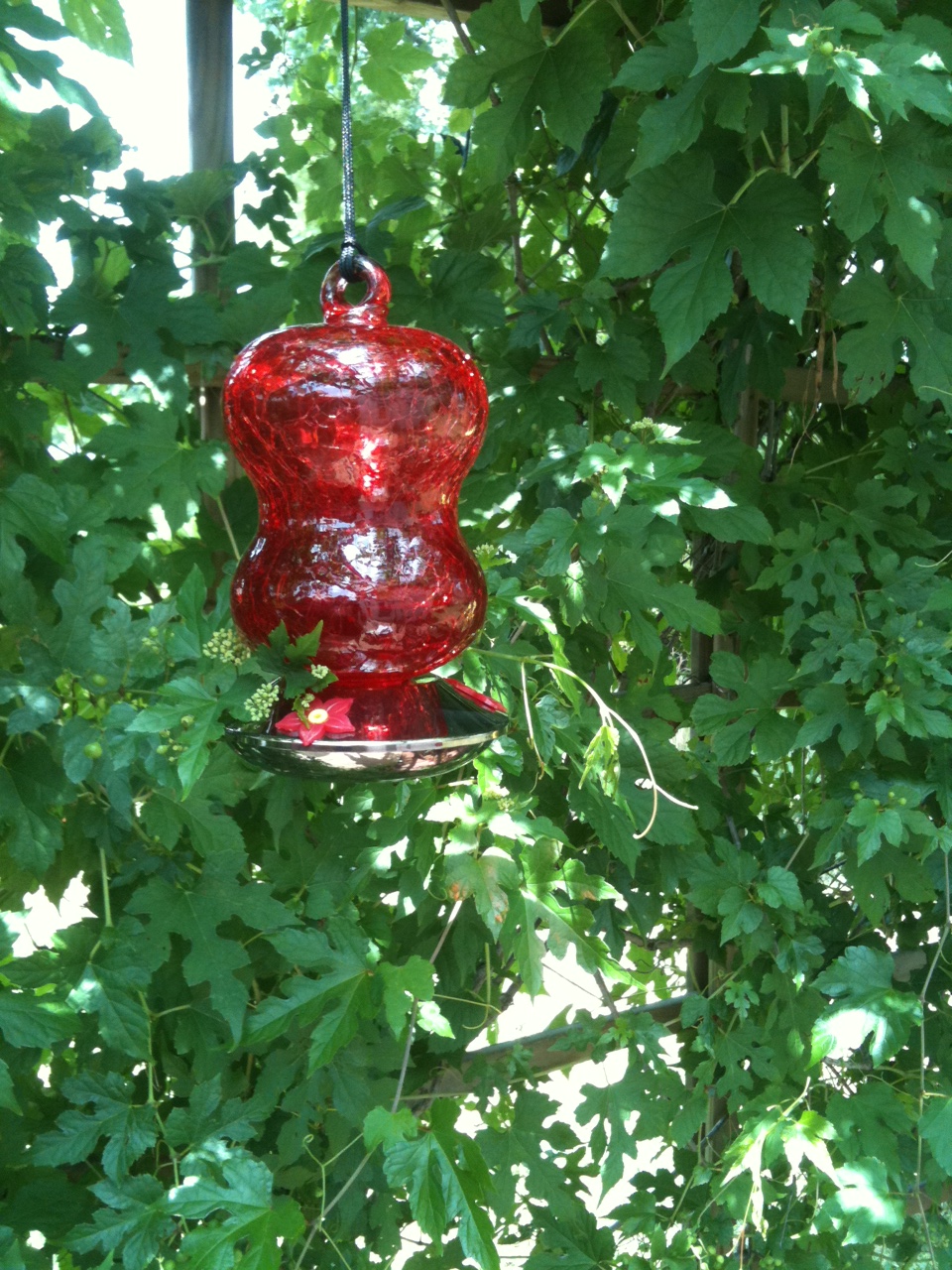
pergola, hummingbird feeder
Under the pergola

A moment of pleasure: Sitting under the pergola at my brother’s house outside of Cleveland. Taking in the Cleveland-ness of being here.

I can’t really explain this. Something in the air has a distinctive quality, maybe the humidity and the heat of Ohio, and it takes me back to summers growing up here: listening to the Beatles on my transistor radio (WIXY 1260), swimming with my friend, Nena, at Stafford Park, play-by-play of the Indians’ baseball game always in the background….

In meditation class this week, our teacher read Wild Geese by Mary Oliver, who is from my hometown.

Do genes shape our mental health?

mybeautifulgenome

“I want to know what it feels like to have a close encounter with my DNA, this invisible, digital self that lies curled up like a fetus in every single cell of my body.”  – Lone Frank

When asked by the researcher if she has first-degree relatives with mental health problems, Lone Frank says yes.

Asked which ones, Lone says: all of them.

Depression, multiple suicides, bipolar disorder, alcoholism. With mordant humor, Lone Frank describes her family history. She’s forthcoming about her own three episodes of depression, then lies to the researcher about how many drinks she has each week. Fourteen glasses of red wine, for the health benefits. (But it’s really closer to twenty drinks or more. At least, that’s what she tells the reader.)

Lone, a Danish science journalist with a PH.D. in neurobiology, volunteered to take part in a major research project to study the connection between personality, an inclination toward depression, and specific genes.

In My Beautiful Genome: Exploring My Genetic Future One Quirk at a Time, she takes us along as she undergoes genetic testing, completes questionnaires and personality tests, and talks with multiple experts who interpret the results. Along the way she grapples with many questions.

Does she, indeed, have genes that predispose her to depression?

How does the environment factor in, as well as her upbringing and her own free will to pull herself out of depression and make cognitive and lifestyle changes to prevent it?

Does she unwittingly contribute to her own dark moods and temperament by building her own, unique environment – under the influence of her genes – that is conducive to depression?

On the other hand, does she possess certain genes or genetic variations that give rise to traits that help her excel in certain areas?

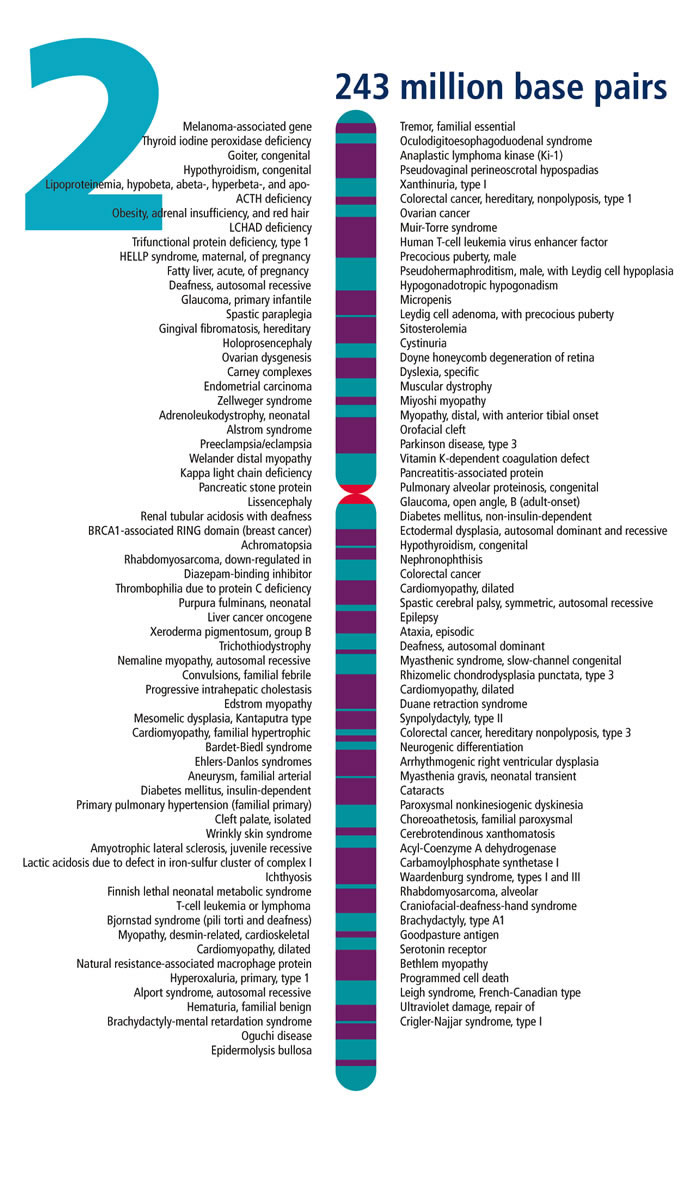
Chromosome 2
Chromosome 2 (click twice for larger image)
Genome Management Information System, Oak Ridge National Laboratory
Human Chromosomes from “Human Genome Landmarks: Selected Genes, Traits, and Disorders” Poster, 2002. (Gene Gateway)

Do some genetic variations mitigate the effects of others?

Are there “good” and “bad,” “healthy” and “unhealthy” genetic variations, or simply variations that lead to different outcomes depending on one’s circumstances?

I won’t give away what Lone discovers, but she finds out a lot and, in the end, concludes the information is enormously helpful.

Let me stress that the average lay person could not mine their own genome for this information the way Lone did. Because she’s a journalist with a doctorate in neurobiology, she had access to sophisticated genetic tests and, more importantly, to experts who could interpret the results and how they might affect her personality and behavior.

Nonetheless, mining Lone’s genome with her is a glimpse into what may be possible for all of us, eventually, if we want it.

How much would you want to know about your genes and how they might shape your personality and behavior? Please share your thoughts in the comments.

Coming up, what Lone’s DNA reveals about her future health.

Quote from My Beautiful Genome: Exploring My Genetic Future One Gene at a Time, by Lone Frank, Oneworld Publications, Oxford, 2011.

Summer morning meditation, week 2

Pond with Buddha
Meditation at the pond, 7:30 am.

For my mindfulness meditation class, this week we are to record one pleasurable moment each day.  Here are two:

Friday morning: helping a medical student find information about adolescent health. Enjoying her youth, beauty, enthusiasm, the unfolding of her potential. She will help many people.

Saturday morning: visiting the backyard pond, enjoying the coolness.

I’m thinking that a great book to read, lying in the hammock next to the pond, would be The Narrow Road to the Deep North, by Matsuo Basho.

Please share your recent moments of pleasure in the comments.

Meeting the dark matter of mental illness

mybeautifulgenome

In the first pages of Lone Frank’s My Beautiful Genome, I discovered that what has always been a mystery is indeed still a mystery.

In a previous post, I talked about my mother’s schizophrenia, and how that had been a factor in whether or not my husband and I would have children.

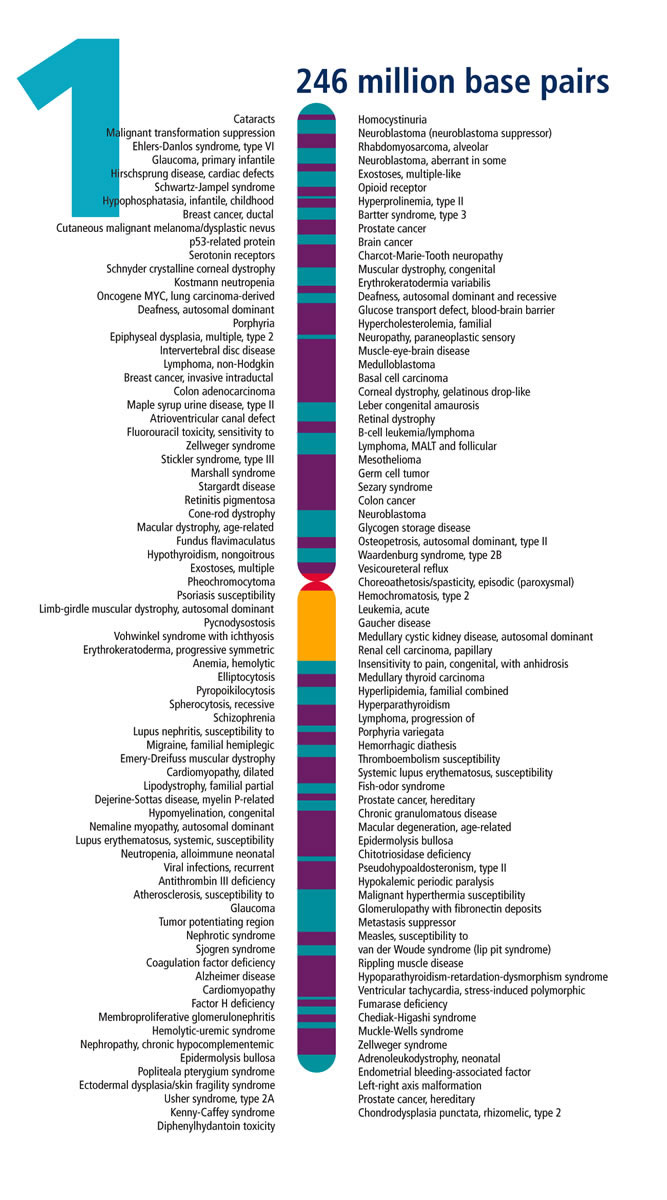
Chromosome 1
Chromosome 1 (click for larger image)
Genome Management Information System, Oak Ridge National Laboratory
Human Chromosomes from “Human Genome Landmarks: Selected Genes, Traits, and Disorders” Poster, 2002. (Gene Gateway)

Lone tracked down the curmudgeonly and controversial James Watson (who, with Francis Crick, discovered the chemical structure of DNA in 1953) and, among other things, they discussed the heritability of schizophrenia.  Watson’s son has schizophrenia.

After several major studies involving some 50,000 patients, next to nothing is known about the heritability of schizophrenia.

No particular genes were found to be associated with schizophrenia (except in a very small percentage of cases), and the few genetic links found were not the same genes in all patients.

This is known as missing heritability. Lone Frank calls it the “dark matter” of the genome.

Watson and others theorize that the cause of schizophrenia and other diseases and conditions for which there is no obvious genetic inheritance may be due to rare variants – genetic changes not inherited from the parents, but which occur spontaneously in the afflicted person.

With a kind of despair, Watson said it may be ten years before the genetics behind serious psychiatric illness is better understood. This knowledge won’t help his son, of course. But, as Watson says, many people are suffering.

I would like to see the suffering of schizophrenia end, too.

Of course, Watson is a scientist, and he wants to know. So do I. Ten years doesn’t sound long to me, considering I’ve been living with this mystery for nearly fifty years.

This may be an illusion, but if I could better understand the dark matter of my mother’s life, perhaps it would be a comfort. We all want to make sense of our suffering.

I think My Beautiful Genome may be one of the most important books I’ll ever read in my adult life. For me, it’s personal, but it’s personal for all of us.  Genetics is giving us (and our children) powerful information humans have never had before.

Do you want to know what the new genetics could mean for your future health or the health of your children and grandchildren? What can genetics tell us about mental illness? How will knowing our own genome influence our romantic relationships and how we choose the person with whom we’ll have children?

Lone Frank wanted to know the answers to these and other questions. In future posts, I’ll tell you a little bit about what she found out.

Exploring Genetics 

Check out Cold Spring Harbor Laboratory’s DNA Learning Center.

Summer evening meditation, week 1

Tonight I attended the first of five mindfulness-based stress reduction classes, which include instruction in meditation. Four years ago, I took a similar series of classes; this summer I hope to renew and re-commit to my meditation practice.

We followed our breath for several minutes. We ate a raisin, mindfully. We practiced the body scan (progressive relaxation of each part of the body, preferably while lying down.) I thought I was totally relaxed, lying on my yoga mat on the hardwood floor. But when our instructor read Mary Oliver’s poem, “The Summer Day,” I found myself lying in a field of grass, giving myself up to it as if I were a kid.

That was my second encounter with Mary Oliver today. The first occurred in my wanderings around the Internet, where I found out she will publish a new book of poems this fall, “A Thousand Mornings.”

When I came home from class, my son had just arrived with fresh-picked raspberries. I ate some with whipped cream. Mindfully, of course.

raspberries
Image by madlyinlovewithlife     Creative Commons 2.0

She wanted to decode her beautiful, quirky genome

…we are each of us temporary depositories of information that has an almost eternal life, and which is passed on and on and on…           Lone Frank, My Beautiful Genome

Staring at the luminous model of the strand of DNA on my computer screen, a sculpture of great beauty, perfect function, and masterful design, I wondered. Who is the designer? And is this a question that even makes sense?

I say perfect function but, when it isn’t perfect, there can be disease, pain, suffering. Or simply quirkiness that doesn’t amount to much, just makes you a little different – a bit of rheumatism in your right big toe, for example, so you can’t wear high heels.

My medical librarian colleagues and I were learning how to search the data generated from the Human Genome Project and other ongoing genetics-based research. Our instructor, a bioinformatics librarian with a PH.D. in molecular biology and years of research under her belt, showed us how to look up the gene associated with cystic fibrosis in humans. We found a map of the gene’s location on a specific chromosome and links to places where you can order a clone of the DNA for research.

And over the course of the two-day class, our instructor, who is also a storyteller, told us the tale of research into the human genome, the explosion of data that’s resulted in a very short time, and how far we’ve yet to go.

My Beautiful Genome book coverA few months later, I discovered Lone Frank’s My Beautiful Genome: Exposing Our Genetic Future, One Quirk at a Time and added it to my reading list. Over the next weeks, I’ll be reading and discussing it on Books Can Save a Life as I decide whether or not to explore my own beautiful, quirky genome. I’m reasonably certain I will explore my genome unless I’m persuaded otherwise. It’s not a matter of if, but when. There is so much turmoil and confusion surrounding consumer-based genetic testing, I may wait until things settle down a bit.

The lure of this kind of knowledge – the secret of my own, one-of-a-kind, unlike-no-other-in-the-history-of-the-world genetic makeup – is something I don’t think I can resist for long, though.

As with everyone else, it’s personal.

My genetic make-up was of special concern years ago when my husband and I were deciding whether to have children. We’d gone to a genetic counselor to find out the chances of our children inheriting my mother’s schizophrenia. Fortunately, they were quite low. The counselor could tell us this by simply taking a family history and looking at the heritability data of the grandchildren of people with schizophrenia.

More recently, I was curious to know what the Human Genome Project and other research has revealed about the heritability of schizophrenia, and what a look at my signature genome might tell me. I’ll be exploring that, among other things, as I make my way through My Beautiful Genome.

Possessing this kind of personal genetic knowledge will become commonplace, I believe, and learning how to live with it ethically, in a way that will benefit humanity, will be one of the great adventures of our time.

Do you think we’re overreaching, like the mythic Prometheus? Wanting to know more than is good for us and we can responsibly handle? Please comment if you have thoughts about this.

Mindfulness Meditation

In My Beautiful Genome, Lone Frank talks about how everything we perceive is filtered through our brains, which are influenced by our genes, and how our behavior may be genetically determined. I just happen to be starting a mindfulness meditation class that will take place over the next several weeks. It will be my second time through this type of meditation instruction, a refresher that will bolster the meditation practice I began five years ago. So, while I read My Beautiful Genome,  I’ll also be highlighting some of my favorite books about meditation. If you’ve tried meditation yourself or have a practice, please join in the discussion.

Quote from My Beautiful Genome: Exposing Our Genetic Future, One Quirk at a Time, by Lone Frank, Oneworld Publications, 2011.

She read The Lord of the Rings and said what you’re not supposed to say to get the job

…everyone deserves these chances, moments when something pierces the everyday and points a path toward health and wholeness, toward growth and adventure and change.   – Adrienne Furness

In February, when we began talking about The Hunger Games (the book and the movie), I asked readers to share books that affected them in a profound way when they were growing up.

A couple of people said The Lord of the Rings trilogy had been an unforgettable and transformative reading experience. I considered writing about J. R. Tolkien’s trilogy on Books Can Save a Life, but I knew I couldn’t do his books justice. I’d read Tolkien when I was young, but for whatever reason his fantasy novels didn’t speak to me in the way they have to countless other readers.

Then the other day I visited a favorite blog, What Adrienne Thinks About That, authored by a librarian friend, Adrienne Furness. Adrienne is a superb librarian and a superb writer. Anyone, child or adult, who walks into her library is very lucky indeed. She has just become director of the Henrietta Public Library, and there’s a story behind how that came about.

Adrienne graciously agreed to let me re-post her story:

When I went on my interview, the hiring committee asked me why I became a librarian. For many years now, people who give advice on these matters have been telling librarians not to answer this question, “Because I love to read.”

But I answered this question the same way I’ve answered it in every single job interview I’ve ever gone on. I told the truth.

I became a librarian because I love to read.

The Fellowship of the RingI tell this story often because it was a moment that’s defined my life: I read The Lord of the Rings for the first time when I was in the fifth grade. I got to the end and was overwhelmed by the sadness of the story being over, and so I got my copy of The Fellowship of the Ring and read the whole trilogy again.

I’ve reread the series more times than I can count. My love for these books has nothing to do with elves or magic or swords, although those things are all fine, as far as I’m concerned. What makes me return to this story again and again, though, is the notion of life as a quest. My fifth grade self couldn’t have articulated what she found in those books, but I know now that I needed to see that even the smallest person can step away from comfort and into challenge, that change is possible on scales small and large, that our efforts and intentions matter. The story reinforced for me that there are things in this world worth protecting–fellowship and love, food and conversation, adventure and courage, songs and stories. These are the things that sustain us when life is difficult, when we are hurt or afraid and have to be so much braver than we feel.

These books told me to find people who value the things I do and to treasure them, because they are essential. That’s a lesson that led me from fifth grade straight to this moment when I’m sitting here writing this to you.

I’ll never know how many lives have changed because of a book I made sure was on the shelf or something I helped someone find, but I’ll spend my last couple weeks at WPL watching children check out stacks of books, knowing that some of them will find something that will still matter to them when they’re adults trying to figure out this world that defies understanding.

I became a librarian because everyone deserves these chances,  moments when something pierces the everyday and points a path toward health and wholeness, toward growth and adventure and change.

I believe we all get to write our own stories. When I was in fifth grade, I decided my story was going to be a little epic.

I like the way that’s working out so far.

About Adrienne

Henrietta Public Library’s newly appointed director, Adrienne Furness, was formerly head of the Children’s Department at the Webster Public Library in Webster, NY, where she managed over $100,000 in grants focused on providing better services to homeschoolers in Monroe County, expanding the reach of storytimes and other literature-based programs, and creating a space for tweens in the Children’s Room.

Adrienne is the author of Helping Homeschoolers in the Library, ALA Editions, 2008. She has taught library staff all over the country about working with homeschoolers, and has published articles in Library Journal, School Library Journal, Public Libraries, Children and Libraries, and AudioFile Magazine.

Share your book stories

If you’d like to share a story about a book that is special to you, send an email to valoriegracehallinan[at]gmail[dot]com with the subject line: My Book Story. Please include a post of about 500 words or less in the body of the email or an idea/book you’re interested in writing about.

What my best friend never told me

…he had doubts, like me, about who he was.

Korean mother and child
Nena (Ho Mi Hyung) and her Korean mother,  Ho Soon Ja, 1956

After I asked readers to share stories about books that have made a difference in their lives, I was thrilled to hear from my best friend from childhood.

Nena Adams Benhoff and I go way back.  We shared Nancy Drew books. We played piano duets and went to Brownie meetings together. We were in Mrs. Ryan’s kindergarten class of 1960 at Broadway Elementary School. Nena’s first job was in my family’s flower shop, where my father taught her floral design.

Sometimes I was a little jealous of Nena, because she was something of a celebrity in our town.

But even best friends don’t tell each other everything, and I didn’t know the whole story.

So when she sent this guest post, I was amazed. I’m still getting to know my best friend after all these years.

Here is Nena’s story.

I was born in South Korea and adopted by an American family when I was 15 months old. In my new hometown, it was a newsworthy occasion because foreign country adoptions were unheard of in the 1950s. Articles were printed in the Cleveland Press, The Plain Dealer, and the local papers. My life story was known to just about everyone in our town.

When I started school, my teachers always spoke about how wonderful it was that I, a poor little Korean orphan, was given a chance to grow up in the United States. I was expected to bring in my Korean clothes to share with the class and talk about Korea. Now, I had no memories of Korea, I wasn’t even walking when I arrived, so I really didn’t have anything to share. Only half Korean, I thought I looked more Italian than Asian. Everyone thought I should think and act Korean, when I looked and thought, “American.”

I was confused about myself and my place in the world.

When I was about thirteen, a librarian recommended a book to read.

That book was The New Year by Pearl S. Buck, the story of a mixed race boy, half Korean and half Caucasian, who was brought to the United States by his birth father’s wife at the age of ten. While his story was not at all like mine, he had doubts, like me, about who he was. In Korea he was considered American, while in the United States he was considered Korean. Pearl Buck explained about mixed race children being like “bridge organisms,” not wholly of one world or another, but joining the best attributes of both.

After reading The New Year, I must admit I was thinking quite highly of myself, as being better than anyone!

But after a short time, I came back to reality, and started the journey of just becoming myself.

Nena Adams Benhoff has been a floral designer for over forty years. She lives in Oklahoma City.

The New Year is out of print but available from used booksellers and libraries.

About Pearl S. Buck

Pearl S. Buck won the Nobel Prize in Literature in 1938 and the Pulitzer Prize, among other high honors and awards. She published dozens of novels, as well as short stories, biographies, and other nonfiction.

Visit Book Tips – Pearl S. Buck on the official site of the Nobel Prize to see comments by readers of Pearl Buck’s books, and to comment on your favorite books by Nobel Prize winners.

Share your book stories

If you’d like to share a story about a book that is special to you, send an email to valoriegracehallinan[at]gmail[dot]com with the subject line: My Book Story. Please include a post of about 500 words or less in the body of the email or an idea/book you’re interested in writing about.