

“Reusing something instead of immediately discarding it, when done for the right reasons, can be an act of love which expresses our own dignity.” Laudato Si’: On Care for Our Common Home, an encyclical letter by Pope Francis, 2015
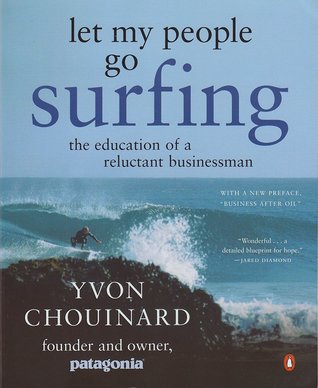 It was great timing: I finished Let My People Go Surfing: The Education of a Reluctant Businessman just when Nicholas Kristof published his op-ed column, ” “Is the Business World All About Greed?”
I think this is going to be one of my favorite nonfiction reads of 2018.
Our industrial/product designer son Matt gave us Let My People Go Surfing for Christmas. Written by Yvon Chouinard, rock climber, environmentalist, and founder of Patagonia, as a manual for his employees in 2006, Let My People Go Surfing is immensely popular among lay readers. It’s been translated into many languages and is required reading at many business schools.
Now 80 years old, Yvon revised his book in 2016, with a new preface by Naomi Klein, author of This Changes Everything.
If the ways of the world have been getting you down, you might want to pick up this book. You don’t have to be in business, or planning to start your own business, or interested in extreme sports to appreciate and enjoy Let My People Go Surfing. You don’t have to be a customer of Patagonia, either. I’ve never bought anything from Patagonia. But I enjoyed Yvon’s story of how he almost accidentally started his company to meet a particular need in a specialized market. He and his friends and first employees ended up doing so in an ethical way, while carving out a business model that challenges our culture of limitless consumption. They were ahead of their time.
The books is an inspiring life story and an eloquent articulation of a business ethic and approach to life we’ll all need to adopt if we and the planet are to survive and flourish.
“My company, Patagonia, Inc., is an experiment. It exists to put into action those recommendations that all the doomsday books on the health of our home planet say we must do immediately to avoid the certain destruction of nature and collapse of our civilization.”
Yvon Chouinard and his friends just wanted to go mountain climbing. They enjoyed reading the transcendental writers – Emerson, Thoreau, and John Muir – and they learned from these authors that when you visit the wilderness, it’s best to leave no trace upon leaving.
But they were doing multi-day ascents in places like Yosemite and using “soft” European-made pitons, which were secured in the rock as they climbed and then left behind. Hundreds of pitons were required to complete a climb, and when a climber was finished, the rock walls were littered and defaced.
In 1957, Yvon bought a forge and some equipment and taught himself blacksmithing. He and his father converted an old chicken coop in their Burbank backyard into a blacksmith shop, and Yvon began making climbing hardware for himself and his friends. Yvon developed a stronger piton that could be used over and over again and placed in existing cracks in the rock. When a climber completed a climb using Yvon’s pitons, the rocks left behind were clean.
Yvon worked in his shop in the winter, and spent the rest of the year in Yosemite, Wyoming, Canada, and the Alps climbing (when he wasn’t surfing), while selling his equipment from the back of his car. Things took off from there.
“I’ve been a businessman for almost fifty years. It’s as difficult for me to say those words as it is for someone to admit being an alcoholic or a lawyer. I’ve never respected the profession. It’s business that has to take the majority of the blame for being the enemy of nature, for destroying native cultures, for taking from the poor and giving to the rich, and for poisoning the earth with the effluent from its factories. Yet business can produce food, cure disease, control population, employ people, and generally enrich our lives. And it can do these good things and make a profit without losing its soul. That’s what this book is about.”
Much of Patagonia’s story is told in chapters that focus on the company’s philosophies: Product Design Philosophy, Production Philosophy, Human Resource Philosophy, Environmental Philosophy, etc. The book ends with an eloquent call to action, “Turn Around and Take a Step Forward.”
Here are themes and stories in Let My People Go Surfing I especially enjoyed:
- How Patagonia came into its own over many years, forging a distinctive identity and set of values, and successfully cultivating a loyal niche market.
- How Patagonia expanded into outdoor clothing and made the extremely difficult transition to using only organic cotton, which entailed searching out suppliers and learning alongside them.
- How Patagonia was the first company to formally use the principals of industrial design to make clothing. I’ve learned a little about this from our industrial designer son, who was initially inspired by the simple, elegant design of Apple products. “…the function of an object should determine its design and materials….Function must dictate form….The functionally driven design is usually minimalist…Complexity is often a sure sign that the functional needs have not been solved.”
- Patagonia clothes are guaranteed for life. The company offers repair services, publishes free repair guides and videos for customers, and encourages customers to recycle and re-gift used clothing.
- Patagonia values personal and family time highly. They have a “Let My People Go Surfing” flextime policy and a world-renowned onsite child care (Great Pacific Child Development Center). New mothers have 16 weeks fully paid and 4 weeks unpaid leave, and new fathers have 12 weeks fully paid leave.
- (I worked in hospital public relations when our boys were very young, and I had two weeks of vacation a year. One of those weeks, a reservation snafu meant we spent seven days cramped in the same condo with two or three other families with babies and young children. I was exhausted when I returned to work. As a mother, I found just 14 days of vacation a year personally unsustainable. I think it isn’t sustainable for people who aren’t parents, too. I hope the rarefied Patagonia work culture becomes more common in the American workplace. If we let go of our relentless focus on productivity and stock value, and if more women were leaders in business, I believe things would be different.)
- The first CEO of Patagonia was a woman, Kristine McDivitt Tompkins. Many years ago she left Patagonia and moved to Chile with her husband. This is what they have done with their lives, just published in The New York Times: “Protecting Wilderness As an Act of Democracy.”
Yvon Chouinard is a refreshingly practical, straightforward guy who has lived life to the fullest and wants to get a message out to the world. He fully admits no company is perfect, least of all Patagonia. It hasn’t managed to fully live the values it embraces. He says he’s doubtful we’ll be able to pull out of the mess we’re in. He takes the Buddhist view and seems able to detach himself from the idea that perhaps we humans as a species will run our course and die out. This hasn’t meant, though, that he thinks we should give up trying.
“Despite a near-universal consensus among scientists that we are on the brink of an environmental collapse, our society lacks the will to take action. We’re collectively paralyzed by apathy, inertia, or lack of imagination. Patagonia exists to challenge conventional wisdom and present a new style of responsible business. We believe the accepted model of capitalism that necessitates endless growth and deserves the blame for the destruction of nature must be displaced. Patagonia and its two thousand employees have the means and the will to prove to the rest of the business world that doing the right thing makes for a good and profitable business.”
If there is hope for us, it will be because of leaders and thinkers like Yvon Chouinard who got their start during the Beat and hippie heydays, and even more so because of the millennial leaders and thinkers coming into their own now who are refusing to succumb to apathy, inertia, or lack of imagination.
As Nicholas Kristof says in his op-ed piece, millennials want to work for ethical, socially responsible companies. They want to make a difference in the world. (And, he points out that investment companies like BlackRock are looking to invest in companies aiming to make “a positive contribution to society.”)
We, as customers, have a responsibility, too.
“The Zen master would say if you want to change government, you have to aim at changing corporations, and if you want to change corporations, you first have to change the consumers. Whoa, wait a minute! The consumer? That’s me. You mean I’m the one who has to change?” – Yvon Chouinard



































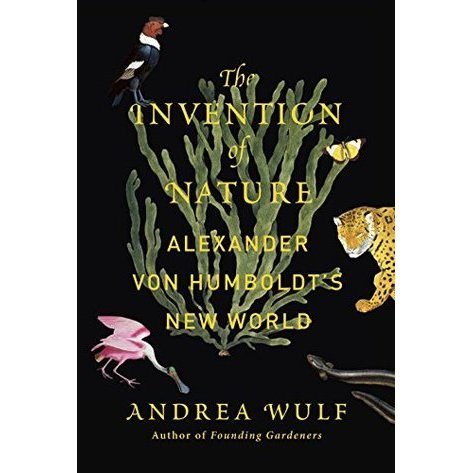 The German scientist and naturalist Alexander von Humboldt has been largely forgotten, even though he was an international “rock star” of his time, and even though many parks, lakes, mountains, towns, and counties in the US are named after him. Andrea Wulf’s biography, published in 2015, has resurrected his legacy and spirit. Her book won the James Wright Award for Nature Writing, the Royal Geographical Society Ness Award, and many others, and it was named a best book of the year by many newspapers and publications.







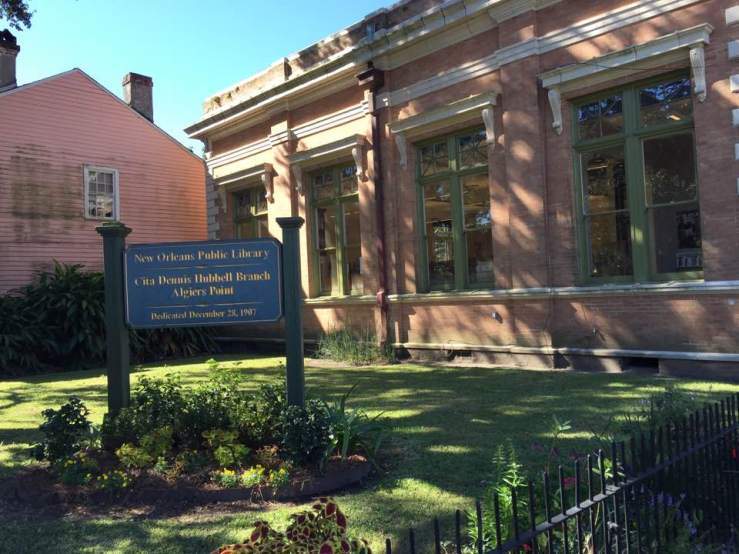




 On our road trip across the US (south to Florida, then west to Tucson, Arizona, then north to Portland, Oregon) we spent nearly two weeks visiting family in the St. Petersburg area. Along the way, we stopped in Savannah, Georgia, my first time in that lovely city. An afternoon wasn’t nearly long enough, but we did visit
 with adorable Old Florida bungalows, many being renovated. Even though most of the windows of our airbnb were painted shut, we had air conditioning, and two large windows in the sleeping porch let in breezes from Tampa Bay two blocks away.









 Books Can Save A Life