Read Harder 2016

Have you heard about Bookriot’s Read Harder Challenge?

I thought it would be interesting to see which books I’ve read in these categories, since Ann Patchett just wrote about her own progress in making her way through the list.

I’d love to hear what you’ve been reading, too, so let us know in the comments. Book suggestions are appreciated and welcome, especially for those categories I’ve left blank.

commonwealthBy the way, Ann just released her new novel, Commonwealth. Many of you know she’s one of my favorite novelists, so I’ll be sure to get my hands on it as soon as I can.

True story, when Ann was a girl, one morning she woke up to find kids she didn’t know in the kitchen. Turned out, her mother had gotten remarried, and these were her new half siblings.

Ann has translated some of that strange family experience into a novel that isn’t, literally, a true story, but that I imagine has plenty of emotional truth, as writers of fiction often say about their work.

If you’re looking for other suggestions, check out the New York Public Library’s Read Harder recommendations. See also the reader-generated lists on Goodreads.

If I’ve left the category blank, it means I haven’t read that category and don’t have any particular suggestions. If you do, please let us know.

BOOKRIOT’S READ HARDER CHALLENGE 2016

Read a horror book

Read a nonfiction book about science: Lab Girl, by Hope Jahren. (I’m reading it now). It has gotten excellent reviews, a memoir about a female scientist. It’s an eye opener, in part about what women in science are (still) up against, but there’s a lot more to this memoir about a woman passionate about plants.

I just borrowed Half-Earth: Our Planet’s Fight for Life, by Edward O. Wilson from the library. Nearing the end of his life, Wilson felt compelled to sound the alarm once more. He proposes that we devote half the surface of the earth to nature.

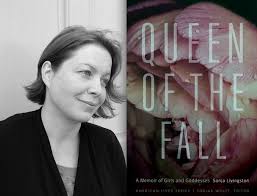
Queen of the Fall book coverRead a collection of essays: Queen of the Fall, by Sonja Livingston; and Why We Write About Ourselves, edited by Meredith Maran.

Read a book out loud to someone else: The Harry Potter series; The Giver; and Hatchet. Not this year, but when our sons were growing up, these were unforgettable read alouds. Harry Potter is especially captivating read deep in the woods at night when you’re camping.

Read a middle grade novel: see above, none this year for me.

Read a biography (not memoir or autobiography): Charlotte Bronté: A Fiery Heart, by Claire Harmon is on my to-read list. See the feminist category below.

The Buried Giant by Kazuo IshiguroRead a dystopian or post-apocalyptic novel: The Buried Giant by Kazuo Ishiguro, and Find Me, by Laura Van Den Berg. I read everything by Ishiguro. The latter novel by Van Den Berg was well reviewed and is excellent, though it didn’t really speak to me.

Read a book originally published in the decade you were born: I’ve been wanting to re-read Australian Neville Shute’s chilling dystopian novel, On the Beach. His  A Town Like Alice blew me away in 1981 as a 5-hour Masterpiece Theatre production, and I would love to watch it again. (It’s only available on VHS.) I don’t believe I ever read the book.

Listen to an audiobook that has won an Audie Award: 

The Bully Pulpit: Theodore Roosevelt, William Howard Taft, and the Golden Age of Journalism, by Dorothy Kearns Goodwin. OK, I haven’t read this book or even listened to it, but I gave it as a gift to a friend who loves Teddy Roosevelt. It won an Audie in 2015 for the best History/Biography category. This would qualify for the over 500 pages category, too, which is reason enough to listen to the audio version. I should read this or listen to it, considering that I believe journalism today is in a sorry state.

There is an Audie Classic Category, which I didn’t know about but just may entice me to finally start listening to audio books. Here’s a suggestion that sounds intriguing, also an Audie award winner: The New York Stories by John O’Hara.

I will try audio books soon, but I resist them. I don’t want to constantly fill my head with media, I need plenty of silence to think and to let my own writing germinate.

I’ve read and hear often that print books will disappear. Some people announce this with a great deal of glee, and I don’t understand why. Can we have both? Why does it seem to make some people happy that print books may disappear?
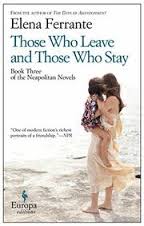
Those Who Leave and Those Who Stay book coverRead a book over 500 pages long: Elena Ferrante’s Neapolitan Novels. I’m counting this as a long read, even though there are four in the series. Had a great discussion about these books in a book club attended by many Italian-American women. One day I’ll read her other novels, which I’ve heard are rather devastating.

Read a book under 100 pages: Tribeby Sebastian Junger. (130 pages, close enough)

Read a book by or about a person that identifies as transgender: Middlesex, by Jeffrey Eugenides, one of my favorites. Read this a few years back, superb.

Read a book that is set in the Middle East

Read a book that is by an author from Southeast Asia

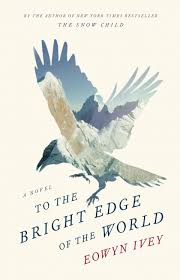
To the Bright EdgeRead a book of historical fiction set before 1900: To the Bright Edge of the World by Eown Ivey; De Potter’s Grand Tour, by Joanna Scott.

Read the first book in a series by a person of color: Not a series, but this year I read and loved Ta-Nehisi Coates’ Between the World and Me, and his memoir, The Beautiful Struggle. 

Read a non-superhero comic that debuted in the last three years: This book is older than three years–I picked up Fun Home: A Family Tragicomic, by Alison Bechdel, but didn’t finish it. I may get back to it someday. It’s becoming a classic.

Read a book that was adapted into a movie, then watch the movie. Debate which is better:

I did see the movie, Brooklyn, by Colm Toibin, but didn’t read the book, don’t plan to. The movie was pretty good, mostly because of the acting, otherwise predictable.

I also saw this year the movie Carol based on the novel, The Price of Salt, by Patricia Highsmith. I thought it was excellent, haven’t read the novel. I was flabbergasted when someone I know said the main character in the movie was a predator. That is not how I interpreted the character in this movie about a lesbian relationship in the 1950s. I saw her as sympathetic. If anyone else has seen the movie and can comment, I’d love to hear your thoughts. I felt the predator comment revealed perhaps unconscious LGTBQ bias; but then again, Highsmith’s novels have disturbing characters. Perhaps the actual novel was darker, and some of that came through in the movie?

Read a nonfiction book about feminism or dealing with feminist themes:

My Life on the Road, by Gloria Steinem is a big bio this year, though I haven’t read it. I HAVE read, this year, and in the case of Bronté’s novel, many years in the past:  Jane Eyre’s Sisters, by Jody Gentian Bower and Jane Eyre. These, because my memoir has a Jane Eyre theme. Last year I read Bad Feminist by Roxane Gay. Fabulous.

Read a book about religion (fiction or nonfiction): After Buddhism, by Stephen Batchelor. (On my to-read list)
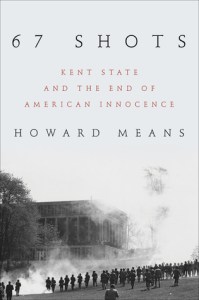
67 ShotsRead a book about politics, in your country or another (fiction or nonfiction): 67 Shots: Kent State and the End of American Innocence, by Howard MeansThis one is personally meaningful.

Read a food memoir: On my to-read list is Blue Plate Special by Kate Christensen. Classics I love are Laurie Colwin’s food memoirs. Elizabeth David was a superb food writer, though her books aren’t really memoirs. Ruth Reichl has come out with a new food memoir this year that I haven’t read, My Kitchen Life: 136 Recipes that Changed My Life.

Read a play

Read a book with a main character that has a mental illness:  A Common Struggle, by Patrick J. Kennedy. This is a memoir. I also read the riveting memoir, A Mother’s Reckoning. The Eagle Tree by Ned Hayes is fiction, and it’s absolutely great.

Here’s a smidgen of The Masterpiece Theatre version of A Town Like Alice.

Have you read any books in these categories, or do you have any suggestions? Are you following the Read Harder challenge? Let us know in the comments.

To the Bright Edge of the World

To the Bright Edge

Lieut. Col. Allen Forrester, June 25, 1885:

“Pruitt keeps shouting above the storm–Do you feel that? Can’t you feel that?

What he says makes no sense. He says there are hands on him. Something pulls at him. He says he has to run. I have warned him to stay put.

(undated entry)

My dearest Sophie. I pray you will read this. You are first and last to me.

I do not know if we will survive the night. They are all around us. They scream and cry so that it is hard to think to put these words on the page.

You must know that I love you.

I am not afraid of death but instead of the passage from here to oblivion, of being aware of its coming. I would rather have been run through with a spear than face this long dread.”

Eowyn Ivey’s novel, To the Bright Edge of the World, is truly a standout for me, a cut above the rest.

Many of you know that I’m partial to nature and wilderness stories, especially historical ones. To the Bright Edge of the World reminds me of one of my all-time favorite novels, Voyage of the Narwhal by Andrea Barrett. The novel and short stories of Anthony Doerr come to mind as well when I read Eowyn Ivey’s writing, which is lyrical and replete with exquisite detail. A Woman in the Polar Night by Christiane Ritter is another fine book, a memoir, in the same vein.

“I fell in love with this book; it captured both my head and my heart, completely and utterly.” – Jane, Beyond Eden Rock.  — I was browsing on Goodreads and found Jane’s endorsement of To the Bright Edge of the World. Her words spoke to me because they are my sentiments about the novel, too, and I couldn’t have said it better.

I loved Eowyn Ivey’s first novel, The Snow Child, which was selected for If All of Rochester Reads the Same Book in 2014. Like The Snow Child, To the Bright Edge of the World takes place in Ivey’s native Alaska. It’s a great love story, a  wilderness tale of a hero and heroine’s quests infused with magical realism, and a flawlessly researched portrayal of 19th century Alaska.

Lieutenant Colonel Allen Forrester must lead a dangerous, seemingly impossible expedition through the fictitious Wolverine River Valley deep in the Alaskan wilds of 1885, a journey no one has ever survived. His pregnant wife, Sophie Forrester, stays behind in Vancouver Barracks, destined to have adventures and heartbreaks of her own.

Ivey has cleverly constructed the narrative entirely from letters, journals, diaries, newspaper articles, military reports, photographs, and other documents.

We, the readers, are privy to the contemporary correspondence between Walter Forrester, Allen Forrester’s great nephew, and Joshua Sloan, who is part Native American and curator of the Alpine Historical Museum in Alaska. Walter sends his great uncle’s papers to Joshua in the hopes that he’ll display and archive them for safekeeping. As Joshua makes his way through the journals, diaries, and letters, he and Walter piece together Allen and Sophie’s stories, fill in the gaps, and reflect on their own lives.

As always, Ivey’s descriptions of geography and landscape take us vividly to long-ago Alaska:

“The canyon bound the Wolverine so that when, over the course of the winter, the ice moved, it crumpled violently. Great blocks three feet thick & as much as twenty feet high had been torn asunder & turned sideways. It seemed an impassable range of buckles & ridges & upended slabs of ice pressed up against the canyon walls, which are vertical rock the color of lead.”

Here are Sophie’s words as she undergoes her own dark night of the soul:

Sophie Forrester, Vancouver Barracks, April 26, 1885:

“…it continued its steady and hard rapping, and the sound became more and more horrible…The raven stopped its knocking and cocked an eye toward me.

I then noticed something most peculiar….A bird’s eye ought to be flattened in shape, with a dark iris surrounded by a dark-gray sclera, and entirely unmoving in its socket. Yet this eye was round, with white sclera, and it rotated about in the socket. It looked nothing like a bird’s eye, but rather that of a mammal. More to the point, a human.” 


nypl.digitalcollections.510d47e1-2a08-a3d9-e040-e00a18064a99.001.w
A raven shape shifts into a trickster who brings Allen and Sophie good fortune and sorrow.

The New York Public Library. (1849). Raven.

nypl.digitalcollections.510d47e1-29f2-a3d9-e040-e00a18064a99.001.w
Sophie Forrester teaches herself the art of photographing birds. Her descriptions of the technical and creative challenges are beautifully rendered, and inspiring.

The New York Public Library. (1901 – 1914).Horned And Tufted Puffins.


nypl.digitalcollections.510d47e1-1af4-a3d9-e040-e00a18064a99.001.w
Allen Forrester’s darker mission is to assess tribal threats to US expansion in Alaska, even as native tribes give life-saving aid to Forrester and his men. The author weaves Native American myths into the plot. These fierce stories blur the line between humans, animals and nature. In the end, the hard wisdom of the stories so valued by indigenous people seems far truer than the scientific knowledge possessed by “civilized” people.

The New York Public Library. (1869-04). Indian summer encampment.


Have you read To the Bright Edge of the World or The Snow Child? What did you think? Can you recommend similar historical books about nature, travel, and adventure, fiction or nonfiction? Click on the comments link in the left sidebar and let us know.

What does Tribe (the book and the noun) have to do with family reunions? I’ll be writing about that in my next post…

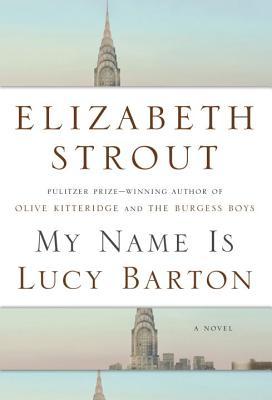
My Name Is Lucy Barton

LucyBarton2


This is one of my favorite scenes in My Name is Lucy Barton, by Elizabeth Strout:

The narrator is in a writing workshop led by a famous author she admires:

“…through the open window a cat suddenly jumped into the room, right onto the large table. The cat was huge, and long; in my memory he may as well have been a small tiger. I jumped up with terrible fear, and Sarah Payne [the author/instructor] jumped up as well; terribly she jumped, she had been that frightened. And then the cat ran out through the door of the classroom. The psychoanalyst woman from California, who usually said very little, said that day to Sarah Payne, in a voice that was–to my ears–almost snide, ‘How long have you suffered from post-traumatic stress?’

And what I remember is the look on Sarah’s face. She hated this woman for saying that. She hated her. There was a silence long enough that people saw this on Sarah’s face, this is how I think of it anyway. Then the man who had lost his wife said, ‘Well, hey, that was a really big cat.’

After that, Sarah talked a lot to the class about judging people, and about coming to the page without judgment.”

I highly recommend My Name is Lucy Barton, which has been lavishly praised by reviewers and other book bloggers and was nominated for the Man Booker Prize.

It has a deceptively simple plot about a young mother in a Manhattan hospital visited by her difficult mother, who she hasn’t seen in years.

The two women are now worlds apart, estranged by distance, education, class, their difficult past, and their own inability to express love and emotion and speak in a direct way about their lives. The writing is powerful yet understated, and unsentimental.

Lucy, raised in rural midwestern poverty and abuse, has reinvented herself in New York City. When her mother visits, Lucy reflects on the harsh childhood and upbringing she never talks about in her new life except occasionally with therapists.

The premise of the novel sounds like a cliché, but this is a page-turner. There is an urgency to Lucy Barton’s story. Strout has a strong sense of what to tell, when to tell it, and what not to tell at all.

I especially like this review in The New York Times by Claire Messud. This is a great choice for book club reading.

Now that I’ve finally discovered Elizabeth Strout long after the rest of the reading world, (she won the Pulitzer Prize for Olive Kitteridge, which was made into a TV miniseries), I look forward to reading her other novels.

“Sarah Payne, the day she told us to go to the page without judgment, reminded us that we never knew, and never would know, what it would be like to understand another person fully.”

My End-of Summer Reading

Currently on my nightstand are books by authors who were previously chosen for If All of Rochester Reads the Same Book:

To The Bright Edge of the World.jpegTo the Bright Edge of the World, by Eowyn Ivey (because I loved The Snow Child)

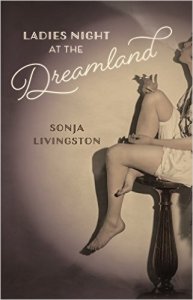
Ladies Night at the Dreamland, by Sonja Livingston (because I loved Ghostbread and Queen of the Fall, and because it’s about women, past and present, known and  unknown, in my neck of the woods)

I’m also reading:

The Art of X-Ray Reading: How the Secrets of 25 Great Works of Literature Will Improve Your Writing, by Ray Peter Clark

Clark mines great books, short stories, a poem or two, and a few movies for hidden treasures–the secret, powerful techniques of accomplished writers. Taking another look at some of these stories is fascinating: The Great Gatsby; Madame Bovary; A Visit from the Goon Squad; Lolita; A Farewell to Arms; The Bell Jar; Miss Lonelyhearts; “The Lottery”; “A Good Man Is Hard to Find”; “Notorious”; The Goldfinch; and Hiroshima, among others.

Ladies NightWhat have you read this summer that you love? Let us know by leaving a comment via the link in the left sidebar.

 

Off the Beaten Path: De Potter’s Grand Tour


De Potter's Grand Tour

“She is fascinated but not dismayed to discover that she has forgotten so much.

Is she really the same woman who celebrated Easter 1889 in Athens and walked up to the Acropolis with her husband?

Who spent a ‘most interesting day viewing the cisterns of Carthage’ with Victor and Armand in 1896?

Who once wrote on her anniversary in 1900, in an apartment on 97 rue de la Pompe in Paris, ‘In afternoon we went to Exp. and up the Trocadéro tower, then to Élysée Palace Hotel, saw King Leopold come in. In evening at dinner we ordered St. Honoré and champagne. M. Guerrier got up and improvised a poem and there was much gaiety and good humor. Armand gave me a gold watch charm’?”  De Potter’s Grand Tour,  Joanna Scott

This much, we know: In 1905, Joanna Scott’s great grandfather disappeared while on board a ship off the coast of Greece. A collector of ancient Egyptian art (some of it is at the Brooklyn Museum) and a world tour guide, he was at his wit’s end, hounded by creditors and litigators.

The question is: Did he commit suicide? Was he pushed overboard? Or, did he fake his own death and assume a new identity, leaving behind his beloved wife, Aimée, and his son?

How would you like to inherit that family mystery?

Joanna Scott did, in the form of Armand’s letters, postcards, photos, and documents, and the multi-volume journal of his wife, Aimée. This treasure trove had been sitting in a steamer trunk in Scott’s mother’s storage unit for years, until one day they unearthed it while searching for a diploma.

Intrigued, Scott threw herself into research and began writing a nonfiction account of Armand de Potter’s life. Ultimately, that proved too confining: Scott discovered that the mysterious and elusive Armand wasn’t who he said he was, and no one knew, not even his wife. So Scott switched to fiction, which gave her more freedom to suppose and imagine.

I read this novel ages ago and never got around to posting about it, but the book has stayed with me all this time. It’s not for everyone–Joanna Scott is a celebrated writer, but this particular novel didn’t garner the best of reviews.


To Travel.jpeg
A photo of Armand de Potter, the author’s great grandfather, walking away from the camera. He was, indeed, a mysterious figure.


I, on the other hand, loved it. I loved the larger-than-life way Armand and Aimée lived traveling all over the world leading their educational tours. Armand was an autodidact who pretended to be descended from Belgian royalty and more educated than he was. Nonetheless, as Scott portrays him, he was a scholar and a lover of the world with a passion for sharing that love with the people who signed up for his tours.

“To travel is to live,” Armand de Potter wrote in one of the documents Scott found in the steamer trunk.

His tour company went to these places: Algeria, Austria, Belgium, Czech Republic, Egypt, England, France, Germany, Gibralter, Greece, Hong Kong, Hungary, India, Italy, Japan, Malaysia, Monaco, Netherlands, Romania, Scotland, Singapore, Spain, Sri Lanka, Switzerland, Tunisia, Turkey, various locations in the US, and Yemen.

Some time in the late 1800s, Armand also wrote this prescient and hopeful passage: “The incalculable benefits of foreign travel can only be half told by our children….They will be appreciated by their sons and daughters, at a time when travel will have made the world very small and the human race what it is destined to be–one great fraternity.”

If you’re an armchair traveler, if you love history, and if you want an unusual story, I think you might like De Potter’s Grand Tour.

I enjoy Joanna Scott’s novels a great deal. One of my all-time favorites is Liberation, which takes place in Sicily, one of my favorite places in the world, during World War II. Scott is a much loved Professor of English here at the University of Rochester.

Speaking of family history, I’m off to a family reunion next week, where we’ll be reading a book loosely connected with a couple of the more colorful family members. I’ll tell you about it when I return.

I’ll leave you with what Armand de Potter had to say about good books (I would also add “women” of course):

“In the most beautiful books, great men speak with us, they give their most precious thoughts, and pour their soul into ours. Let us thank God for the creation of books. They are the voices of those that are far and of those that are dead; they make us heirs of the intellectual life of the past ages. Books furnish to all those who will use them with sincerity the society, the spiritual presences of the best and the greatest men.”


Going local: six Rochester storytellers

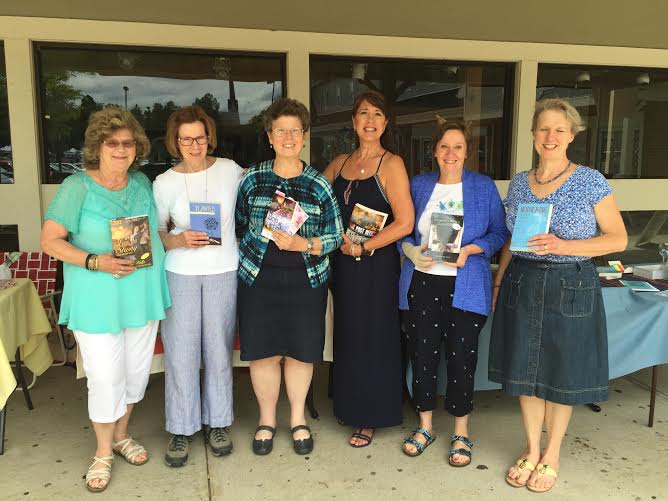
RochesterAuthorsLeft to right: Bev Lewis (writing as Beverly Wells); Kate Collier (writing as Katie O’Boyle & C.T. Collier); Ellen Hegarty (writing as Roz Murphy); Kim Cruise; Elizabeth Osta; Liz O’Toole

Historical romance & fiction, mystery & suspense, ghost stories & essays on motherhood

A couple of weeks ago I went to the Saturday farmer’s market, where quite unexpectedly I met six local authors. I’ve written before about the great small businesses in our town, and our pharmacy is one of them. Gift department manager Stefani Tadio supports and promotes the work of local artists and authors, and she organized this author/book event.

I enjoyed meeting and talking with Beverly, Kim, Roz, Katie, Elizabeth and Liz. I asked them about their writerly inspiration and research.

***

Historical Romance by Beverly Wells

Cowboy Kisses“I usually write long historical romance–mostly set in western America in the 1800’s, but I will also have a Medieval anthology coming out in the fall/winter and a civil war novel in the future, as well as a Canadian Mounted Police novel. I’ve also been included in anthologies and novellas.

As far as researching goes: first I investigate climate, terrain, foliage and fauna, foods, and items used at the time, types of lingo, and slang.

For example, in A COWBOY CELEBRATION, which is set in Wyoming in 1882, I had to make sure there were apples and what kinds, what the growing season would have been, and the ripeness and color of the apples hanging on the trees. Thank God for the internet, because it’s so much easier today than years ago doing research.

But my problem is, I get so wrapped up in research that I spend hours reading every tidbit and never use half of I read. I think that happens to a lot of us. But I love finding the answers!”

 ***

The Post Office by Kim Cruise

PO_Boxes_Kim_cruise“I started writing as a form of catharsis made necessary by having to watch my son suffer through drug addiction.  You see, books save lives in the writing, as well as in the reading of them. 
Shortly after I started writing The Post Office, my son was arrested on drug-related charges and ended up in a prison where he was not allowed to have books. He’s been an avid reader all his life; this was the very definition of cruel and unusual punishment.  So I started sending him my chapters, imbedded into letters, so he’d have something to read. He would edit them and make suggestions in the margins and mail them back. We had a flurry of mail going back and forth and I’ve not been as prolific since.   His one pencil became his most important possession while he suffered through his time there, and his proverbial fingerprints are all over my book.

My suspense novel features six characters, five of which are made up and one of whom is not –it’s me; putting my story and feelings into keystrokes, which turned into pages, then chapters, made it possible to function during some very dire times. I keep writing now that he is clean, to document his success and to let other mothers know that drug addiction can be survived. It’s my belief that it is very important to be talking about addiction; there are so many suffering from it, and even more people who suffer on the sidelines as I did and do; I hope that my efforts will help people to be comfortable with this conversation.”

 ***

Bob Book Ghost Stories by Roz Murphy

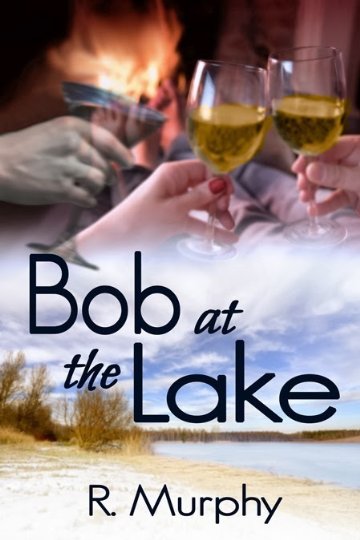
Bob at the LakeRoz Murphy’s Bob books [Bob at the Lake, Bob at the Plaza] narrate the screwball adventures of a crabby woman of a certain age, the kind grape grower who lives up the hill, and a martini-loving ghost.

“Since I’m the “crabby woman of a certain age” in this scenario, all I pretty much had to do was tell the story of Bob, my pain-in-the-butt martini-loving ghost, and our misadventures here in the Finger Lakes. I usually write early in the morning, while Bob is still nursing his hangover from the night before, since he’ll leave me alone for a couple of hours then.”

***

Lakeside Porches Romance Novels and Novellas by Katie O’Boyle

cover-steppinguptolove.jpg“In January 2012, my sister and brother-in-law invited me to celebrate the 90th birthday of a dear friend on the porch of Belhurst Castle for their famous Sunday Brunch. Watching the staff serve up incredible food and fuss over our friend made me wonder about their lives, their hopes and dreams. And wonder about the guests. And wonder about the visitors to the dining room and the spa. So many stories!

The idea for Lakeside Porches was born that sunny winter morning. That said, Tompkins Falls is not an actual city. Chestnut Lake is not Seneca or Canandaigua Lake or any of the Finger Lakes, although it has much in common with several of them. The Manse Inn and Spa is not Belhurst Castle, although the Belhurst may very well be one of the beautiful lakeside inns with a dining porch that serves lunch to the characters from my books.”

MysteryAnd just published: Planted: The Penningtons Investigate

It’s Monday of spring break when Professor Lyssa Pennington’s backyard garden project unearths a loaded revolver. With no record of violence at their address and no related cold case, the Tompkins Falls police have no interest. But the Penningtons and a friend with the State Police believe there’s a body somewhere. Whose? Where? And who pulled the trigger?

***


Jeremiah’s Hunger by Elizabeth Osta

jeremiahs-hunger-largeAt the height of the Irish famine of the 1840s, in a small town of Ahadallane, north of Cork City and south of Mallow, Jeremiah joins the rebels in the fight for Ireland’s freedom from British rule and learns firsthand the futility of violence. He and his best friend and brother-in-law, Father Michael Riordan disagree about the means to the end and ultimately take diverse paths when Michael is assigned to a parish in America.

Elizabeth took more than a dozen trips to Ireland to research Jeremiah’s Hunger, which is based on her own family history. Currently, she’s working on a memoir about her years in a convent with the Sisters of St. Joseph.

“My research has been chronologically driven.  For Jeremiah’s Hunger, I discovered genealogical records that led the way. For Saving Faith: A Convent Memoir, I am working with a distinct time period (1968-1977) so am able to explore those times historically, culturally, politically and cull the important and relevant facts.  Imagination for the historical fiction and memory for the memoir are key elements.”

 ***


Mothering: An Art of the Heart,  Elizabeth O’Toole (along with 8 more moms)

MotheringMothering: An Art of the Heart is a collection of short and engaging stories that celebrate family life, told by nine moms who want to share the wisdom and experience they gained in the process of raising their children. Each story highlights a specific idea or activity that may be used by the readers to enhance their families’ experience as their children grow.

This is not a text book or how-to manual, rather it is a forum where one set of mothers hopes to help another set of mothers by sharing “things that worked” in their families. There are 118 stories in all.

The Eagle Tree


IMG_2983
Browsers Bookshop in Olympia.

We spent part of our recent Pacific Northwest vacation in Olympia.

I know exactly one person who lives there, but she doesn’t know me – the artist Nikki McClure, whose work I admire.

We were exploring the center of town, when I spotted Browsers Bookshop, and of course we had to go in. About three minutes later, Nikki McClure walked in. She was there to sign copies of her most recent book, Waiting for High Tide.

But it gets weirder than that. After I finished browsing and had chosen a couple of books, I introduced myself to the bookstore owner, Andrea Y. Griffith. Turns out, Andrea knew my name. We are both former medical librarians, and apparently a few years back I edited an article she wrote for a Medical Library Association conference.

Waiting for High Tide
Nikki McClure’s latest book

I love Andrea’s bookstore, which has been in business since 1935. Andrea and her husband recently bought the shop and are reviving it. She’s doing a terrific job. I enjoyed browsing the store; I saw many new and intriguing titles I’m unfamiliar with, and she had an excellent selection of titles about the Pacific Northwest and nature, as well as other categories. I could tell immediately that the book selections are carefully curated – that’s of course what you can expect from a librarian.

I encourage you to read a bit about what Browers Bookshop is all about here.

IMG_2994I purchased the young adult book The Eagle Tree by Ned Hayes, who is from Olympia, as well as another book I’ll tell you about in my next post. The artwork on the cover of The Eagle Tree pulled me in, and since I’d been awed by the massive and venerable old trees we were seeing in Olympic National Park, I thought the book would be a good traveling companion.
It’s about a 14-year-old boy, March Wong, who is on the autism spectrum and obsessed with trees. Written in first person from the viewpoint of March, the novel often reads like encyclopedia entries because that is how March expresses himself, so you have to be fascinated by trees to bond with this book. I took to it immediately, as have many other readers, although there are some readers on Goodreads who disliked it for this reason.

I loved learning about the ecosystem of trees and watching March become willing and able to connect to other people as he tries to save the Eagle Tree, a monolithic Ponderosa Pine, from being cut down. Even though the tone can be factual and didactic, it’s really more expressive and lyrical than anything else, which is a tribute to Ned Hayes’ fine writing. I highly recommend this book to young adults, and their parents.

I was impressed when I saw that an author’s talk sponsored by Browsers Bookshop featured local actors performing scenes from The Eagle Tree. This is an independent bookstore that goes above and beyond to enrich the community and promote local authors.

Here is some of what March Wong has to say:

“I do not like this idea that we have begun to kill off—at great velocity and accelerating speed—all of the things that sustain us. I didn’t like it at all when I first thought of it, but most people around me do not seem that disturbed by it, even though the knowledge of this is obvious and readily available to anyone who looks up trees on the Internet. At least, no one seems bothered, because no one has taken action to amend it. So they must not care. That is the only explanation I can think of for the lack of reaction to this fact.”

IMG_3252
In Olympic National Forest

“Most of the trees are already dying. All across North America from Mexico to Alaska, forests are dying. Seventy thousand square miles of forest—that’s as much land as all of the state of Washington—that much forest has died since I was born. What if I am growing up in a world that will not have trees anymore by the time I am my grandfather’s age?”

IMG_2907
This is a nurse log. March Wong in The Eagle Tree will tell you what that is.

“There is an ocean of light around us. We are surrounded by it, we swim in it, we move through it every day.”

IMG_2912
Reminds me of the flowing creek nearby


IMG_3240
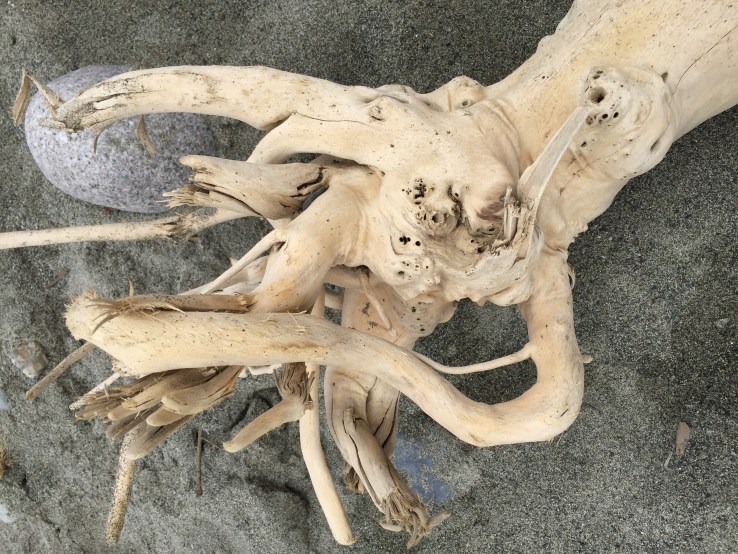
Nature’s sculpture. Dungeness Spit is littered with driftwood.


IMG_3229.JPG
What you can make from a tree. This is in Sequim, Washington.

My Favorite Things


Tulips in Orange


Books, writing, creativity, cool media and other delights….

  • Walking book clubs. Did you know these existed? Here are a couple in the UK hosted by two book bloggers who write fabulous reviews: Emily’s Walking Book Club with Daunt Books – turns out the one and only time I’ve been in London we went to Daunt Books, where we browsed for over an hour. Wish I’d known about Emily then, I’d have tried to connect with her; and  The Northern Reader – see also her Flower Power if you love gardening, flowers and nature lit.
  • Book spine poetry. A few weeks back in honor of April being National Poetry Month, I wrote some book spine poetry and asked readers to share theirs. Here is what Naomi at Consumed by Ink came up with. I love her little poems. Try it yourself, and if you’ve created book spine poetry you like, please share in the comments.
  • A good book. My favorite book bloggers always give me titles to add to my to-read list. I love this review of Hill by the French writer Jean Giono that Melissa wrote at The Bookbinder’s Daughter.
  • Instagram flat lays. I’ve been messing around with photography lately, teaching myself to do still lifes of books, flowers, and whatnot, and posting some of it on Instagram. I adore Cristina Coli’s floral work on IG, and enjoyed her “A Day of Creative Connection” blog post recently.

Have a great week!

litricity: a potent form of energy generated by great literature – – from Powell’s Compendium of Readerly Terms

April Lit
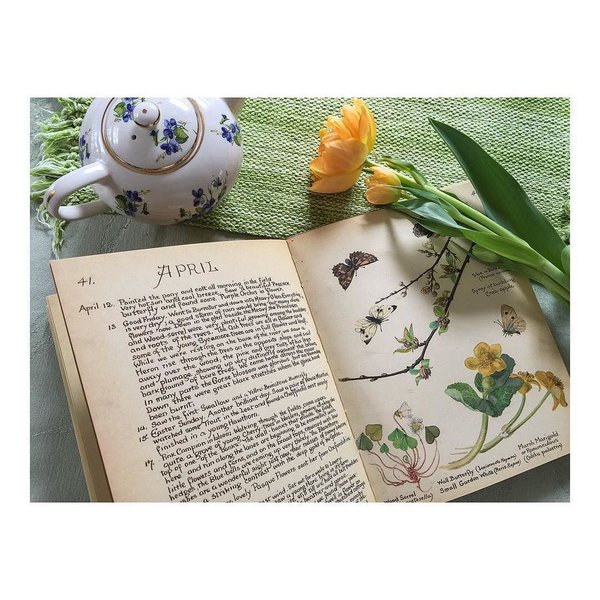
The Country Diary of an Edwardian Lady, by Edith Holden. First entry, January 1, 1906.


My Favorite Things

I’m trying something new.

Once or twice a month I’ll share newsy items, links to some of my favorite blogs about books, writing, and creativity, and whatever else strikes my fancy that I think you might like.

Here is what’s caught my eye lately:

  • A short, beautiful video, “Lessons from Flowers,” that is a narrative about death and loss. Larisa Minerva at Wildest Blue says we could stand to change our attitudes about death. My next post will feature a new memoir about death and dying.

67 Shots


Sonja Livingston’s Queen of the Fall

Livingston“The Italian word for gypsy, zingaro, is perhaps a better word. [The word] “heart” is merely a convenience, a sort of shorthand for what’s contained within the cautious body–the spark that thrives on wonder, that which is flung wide or ratcheted shut until it seems all but sealed but remains open, if only just a touch; the thing that moves and changes even as we seek to know it, that which stalks and stalks but cannot be satisfied. Not fully. Not permanently. The part of us that continues to yearn, to try, and to dream, despite the fact that there’s a certain space within us incapable of being filled, and that learning to live with this is a part of our humanity. But what does the heart know? Zingaro cuore. So great are some hungers, so unrelenting, that whatever even halfway fills them must be tried–miniature orange trees and birdhouses and homemade ukuleles. What can we do but feed, then feed again, the tender shoots within us?    Sonja Livingston, Queen of the Fall: A Memoir of Girls and Goddesses (University of Nebraska Press)
If you want to read something different and magical, try  Queen of the Fall: A Memoir of Girls and Goddesses by Sonja Livingston.

This collection of linked essays, the 2016 choice for If All of Rochester Reads the Same Book sponsored by Writers & Books, is a wonderful example of how powerful and poetic the essay can be and how inventive the form.

(Despite the subtitle, this is a collection of essays–memoir-ish, rather than a true memoir.)

Sonja writes about how the term “essay” conjures visions of tedious school assignments. But the essay is actually an elastic form of literary exploration that can be novel and beautiful. If done well, an essay tantalizes, catching the reader up in an unfolding.

The author has dedicated Queen of the Fall to the memory of Judith Kitchen, a teacher and mentor who passed away in 2014. I wrote last week about how Sonja, who grew up in the Rochester area, took Judith Kitchen’s essay writing class at SUNY Brockport twice. (I took Judith’s class also, several years ago.) While she was enrolled in Judith’s classes, Sonja was inspired to give up her career as a school counselor and become a writer.

Her essays share the themes of womanhood, fertility, and poverty, which have been central to her own life–hence the term “memoir” in the book’s subtitle. Each essay stands on its own, but I found myself so captured by their momentum that I read several in one sitting, as though I were reading a novel or memoir.

When I was in graduate school at Syracuse University many years ago, two classmates and I made a documentary about rural poverty in New York State. I’d just moved here from New York City, and I loved the landscape of glacier-made Finger Lakes, deep gorges, and waterfalls. I had no idea that, hidden in all this rural beauty, many families lived in poverty.

Growing up in the 1980s and 1990s, Sonja Livingston, her mother, and her six siblings were among them. Though there were five fathers among the seven children, no father was present in their lives. They moved from place to place: a rural town, a Native American reservation, an urban slum in inner city Rochester.

In Queen of the Fall, (which refers to the apples Sonja and her siblings picked during a stint as farm workers), Livingston explores the lives of various women and girls, including the great suffragette Susan B. Anthony who lived in Rochester (“The Lady With the Alligator Purse”), the troubled young girls (and a boy) Sonja met as a school counselor (“One for Sorrow”), and the television character Ally McBeal  (“The Lonely Hunters.”) They are some of my favorite essays, as well as “World Without End,” “What the Body Wants,” and “The Last American Virgin.”

Livingston casts the lives of women, especially disadvantaged and/or obscure women, in a new and dignifying light. Throughout, Sonja weaves in moments from her life as a teen taking risks yet hoping to avoid pregnancy, as a woman confronting infertility, and as the aunt of a young, unmarried niece who finds herself pregnant.

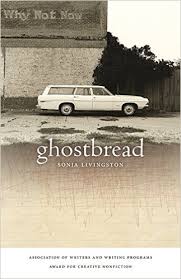
GhostbreadIf you’d like the full story of Sonja’s remarkable life as a backdrop to her essays in Queen of the Fall, you could read her remarkable 2009 memoir, Ghostbread, first. After devouring her essays, I found a copy of the memoir at my local library.
Sonja will have a newly published collection of essays this month that has been described as a hidden history of women’s lives: Ladies’ Night at the Dreamland. (I believe the Dreamland refers to Seabreeze, a Rochester amusement park.)

I’m looking forward to reading about little-known and obscure women from the area where I live–among them, a woman who crossed Niagara Falls on a tightrope, and the Fox sisters, who became well-known Spiritualists and mediums. Western and upstate New York has always been known for its progressive spirit and energetic spirituality, a hotbed of abolitionism, women’s rights, religiosity, spiritualism, and utopianism.

Declaration of SentimentsHere, for example, is a link to the Women’s Declaration of Sentiments, written and signed in 1848 in Seneca Falls, New York. It is inscribed on a wall there, and I remember being very moved on my visit several years ago.

From Livington’s upcoming book:

“Women understand how to overlook or wait until next time, can spend years holding their tongues in the face of the thing that most wants letting. No, I need no convincing of the strength of women, but it’s too often a matter of restraint. I do not often see us standing bold or brazen before a crowd. I do not mean to belittle cheerleaders and fashion models and television weather women—though theirs seems a case of the body going through a series of prescribed and pleasant motions. Where are our wild women? Those with open mouths and muscled legs, who flare and flame, whose actions shock, and whose bodies defy gravity, whose every step rivets the eye so that we can’t look away?”

Ladies Night

Reading Kazuo Ishiguro

IMG_2640 (1)

“Then he took the sword in both hands and raised it—and Gawain’s posture took on an unmistakable grandeur.” – The Buried Giant, by Kazuo Ishiguro

My son gave me a signed first edition of Kazuo Ishiguro’s latest novel, The Buried Giant, for Christmas. The book has been cast in some marketing circles as a fantasy, with allusions to King Arthur and Beowulf and the like, although the author has said he doesn’t set out to write in one particular genre or another and doesn’t like his books to be labeled as such.

Ishiguro is one of my favorite novelists, so I read every new book of his that comes out.

Never Let Me Go (dystopia/science fiction) and When We Were Orphans (in the tradition of the mystery/detective novel but with a literary twist) are my favorite Ishiguro novels. In fact, Never Let Me Go is one of the best novels I’ve ever read, one of Ishiguro’s more accessible stories. If you want to read Ishiguro, you might start with Never Let me Go, which was made into a movie starring Carey Mulligan. Ishiguro’s The Remains of the Day (pre World War II) was also brought to the screen with Anthony Hopkins and Emma Thompson.

As much as I enjoyed the screen versions of these books, there is something about Ishiguro’s writing that seems to be lost in a movie, at least for me. His novels are like dreams verging on nightmares from which you can’t awaken. Things don’t quite make sense in Ishiguro’s novels – you know this is not “reality” and that something is off, but what? The main character(s) are usually on a quest of one kind or another. They long for something that seems to be just out of reach.

You come to discern that Ishiguro’s characters are operating under some grand delusion. It’s unsettling, because you sense something familiar about the delusion; you begin to recognize that perhaps you operate under the very same delusion.

The Buried Giant by Kazuo IshiguroEspecially if you’re of a certain age and you have children who have left the nest as I do, you might find The Buried Giant particularly affecting. Axl and Beatrice are an elderly couple who leave their village and set off to find their son, whom they apparently haven’t seen in many years. They can’t remember the circumstances under which he left, or exactly where he lives, just as they can’t remember much of anything about their own pasts.

Axl and Beatrice aren’t unusual, though. No one in their village or anywhere else remembers much about their own past, nor do they seem to want to; a fine mist over the countryside, thought to be the breath of the dragon Querig, is said to be responsible for shrouding both personal and collective memory.

It is somewhere around the year 600 AD, and England is in ruin. Axl and Beatrice want to find their son, and they want to regain their memories. As they wander in search of their son, they meet others on their own quests. Clues and sightings suggest a terrible slaughter between the Saxons and Britons that no one remembers, just as no one recalls the dark secrets that lurk in their personal pasts. Perhaps the mist is in place so Britons and Saxons can live side by side without wanting to exact revenge.

As one reviewer pointed out, don’t we all operate under collective memory loss, or denial, that’s partly deliberate? Over climate change, for example, even though climate scientists have been warning us about it since the seventies? Or the atrocities of war?

Axl and Beatrice become caught up in a scheme to slay the dragon so memories can be recovered, but as Sir Gawain, the knight and nephew of the dead King Arthur, asks Beatrice, “Yet are you so certain, good mistress, you wish to be free of this mist? Is it not better some things remain hidden from our minds?”

Just as the Saxons and Britons fought a terrible war, you gradually learn there was upheaval in Axl and Beatrice’s relationship as well. What will happen when this couple, who seem to be so in love, recall their betrayals of each other? And what happened to their son?

Axl and Beatrice meet a boatman who they must rely on to help them cross a river in their journey. He says, “When travellers speak of their most cherished memories, it’s impossible for them to disguise the truth. A couple may claim to be bonded by love, but we boatmen may see instead resentment, anger, even hatred. Or a great barrenness. Sometimes a fear of loneliness and nothing more. Abiding love that has endured the years – that we see only rarely.”

Beatrice replies: “But God will know the slow tread of an old couple’s love for each other, and understand how black shadows make part of its whole.”

Ishiguro builds up to a powerful and haunting conclusion. Like all of Ishiguro’s novels, I can’t get this one out of my mind.

There has been some interest in making The Buried Giant into a movie, but there are no definite plans yet.

Here is an excellent 4-minute video of Ishiguro talking about his novels made into movies.

In this interview, Ishiguro talks about how a book can be the raw material for a movie, which becomes something new and powerful in and of itself; how literary genres are breaking down and overlapping in exciting ways; and how he embraces the Leonard Cohen model of artistry and aging in which the artist looks to aging as new material for his/her art.


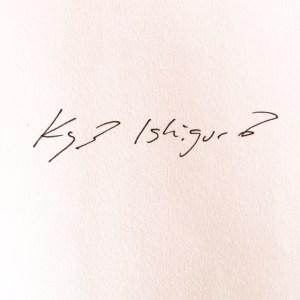
Kazuo Ishiguro authograph


Have you read The Buried Giant or other novels by Ishiguro? Do you have a favorite? Have you seen the movie versions of Remains of the Day or Never Let Me Go?