

I belong to an amazing book club of ten women, and we just finished reading and discussing The Handmaid’s Tale by Margaret Atwood. It was my first exposure to this iconic dystopian novel about the theocratic Republic of Gilead (formerly the United States), where fertile women have been enslaved for purposes of reproduction due to dramatically declining birth rates.
Atwood has said that every aspect of extreme female oppression depicted in the novel has actually happened. The ghosts of New England puritanism and witch hunts haunt The Handmaid’s Tale: the novel takes place in Cambridge near a university (Harvard) that has been shut down. There are also strains of American slavery, the Bible, and the Third Reich, among other periods.
NOW is the perfect time to read The Handmaid’s Tale if you haven’t already. It has been getting a lot of attention because of the new Hulu series starring Elizabeth Moss and, of course, because of the unsettling political era unfolding in the U.S. As Emily Nussbaum in The New Yorker put it, “Our President is a Playboy-brash predator; his Vice-President is pure Gilead.”
I decided to simultaneously watch the unfolding Hulu series, which added interesting contrasts and depths to my reading and viewing experiences.
I quote Emily Nussbaum below because I think our book club would agree that reading Handmaid inspired us to reflect on how it was for women in the Reagan era when the book was published. (We range in age from 40s to 60s.) I was thirty when The Handmaid’s Tale came out in 1985. I’d just moved out of New York City, where I’d watched the Trump Tower go up on Fifth Avenue directly across the street from my office. In fact, the book publisher I worked for moved to a humbler downtown neighborhood once Trump’s golden tower was in place and the rent became unaffordable.
“…for many readers of my generation, “The Handmaid’s Tale” is also a time machine back to the Reagan era, a mightily perverse period for sexual politics. Just a decade earlier, a woman could be denied a credit card without a man to co-sign, and yet, by 1985, when the novel was written, the media was declaring that feminism was over, dunzo, defunct—no longer necessary, now that women wore sneakers to jobs at law firms. At the same time, sexual danger was a national obsession, seen from two opposing angles, each claiming to protect women. On the right, there was the anti-abortion New Christian Right—led by figures like Phyllis Schlafly and the televangelist Tammy Faye Bakker—intent on restoring traditional marriage. On the left, there was the anti-porn movement….It was a peculiar era in which to be a teen-age girl, equally prudish and decadent: the era of Trump Tower and cocaine, AIDS and “Just Say No.” Emily Nussbaum, The New Yorker
While I read and watched The Handmaid’s Tale, I’d been working on a scene in my memoir that takes place in New York City in 1978. I’d been trying to remember how I’d seen myself in the context of the times at twenty-three, but my memories were delivering up a great deal of ambivalence and little clarity. I knew I’d felt grateful for the second-wave feminists and the 1960s cultural pioneers and that I’d thought that women’s liberation had done its work. Yet carving out a career wasn’t proving to be easy; mostly I’d blamed myself for that. Reading Nussbaum’s essay helped me flesh out my scene and my thoughts by reminding me that the late seventies already heralded a backlash: Phyllis Schafly and Ronald Reagan were just around the corner.
Atwood’s book, of course, shows us that history can move in cycles. Freedoms won can be lost.
Nussbaum points out in her essay that the Hulu show has to keep going season after season, while the novel is a self-contained work. Because of this, the spirit of the TV show eventually departs from the claustrophobic bleakness of the book. Offred’s quest on television becomes escape and reunification with her daughter and lover. (Offred is a handmaid forced to have sex with her married Commander; should she become pregnant, the baby will be turned over to the Commander and his barren wife.) The TV series becomes more like a thriller, while in the book there seem to be few ways the women can work toward liberation. The TV show is more hopeful, but be warned that it is graphic and violent. I think both the book and the series are excellent, but I don’t know how long I will watch the series. Season after season, a series can lose power and focus. It could eventually pale next to Atwood’s book, which reads like a bomb going off.
Have you read The Handmaid’s Tale or are you watching the Hulu series? What do you think?

(On the heels of The Handmaid’s Tale, I happened to find out about a new documentary series on Netflix, “The Keepers.” My husband and I watched all seven episodes in two nights.“The Keepers” depicts a real-life dystopia for young women who attended a Catholic school in Baltimore beginning in the 1960s, the life-long ramifications of untold secrets, and the confounding process of recovering memories. Well-crafted documentaries remind me how truth can be stranger than fiction. It’s got me thinking about how story and dramatization, no matter what the medium or genre, can so powerfully reveal truths about the human spirit. It’s not easy to depict such depth of character in documentary. I’m still thinking about the good women–and the handful of good men–in “The Keepers.”)
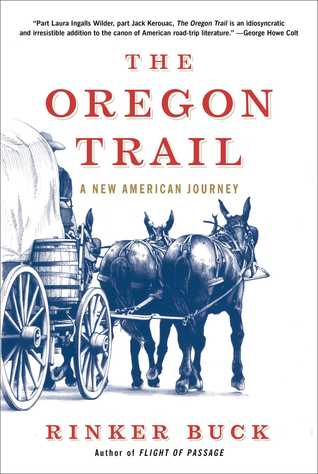 “I turned left after the bridge over the Snake and headed east along the trail country. The basalt cliffs along the river gleamed in the sunlight, and the austerity of landscape reminded me of the austerity of mission.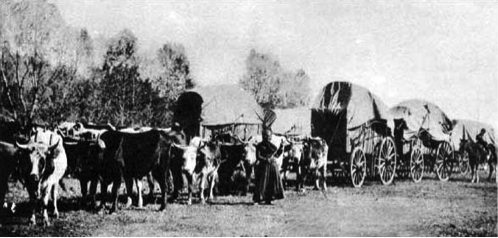
 “She never got Royal to tell her about the men and women who made the underground railroad. The ones who excavated a million tons of rock and dirt, toiled in the belly of the earth for the deliverance of slaves like her. Who stood with all those other souls who took runaways into their homes, fed them, carried them north on their backs, died for them. The station masters and conductors and sympathizers. Who are you after you finish something this magnificent – in constructing it you have also journeyed through it, to the other side. On one end there was who you were before you went underground, and on the other end a new person steps out into the light. The up-top world must be so ordinary compared to the miracle beneath, the miracle you made with your sweat and blood. The secret triumph you keep in your heart. – Colson Whitehead, The Underground Railroad
 “Maybe life is just carrying news. Surviving to carry the news. Maybe we have just one message, and it is delivered to us when we are born and we are never sure what it says; it may have nothing to do with us personally but it must be carried by hand through a life, all the way, and at the end handed over, sealed.” – Paulette Jiles, News of the World


 I’m fascinated by the sound of
  “…she listens to reports of war in Europe…people lean in to discuss FDR, the Lindbergh baby, Amelia Earhart’s final flight…Audrey stands in line, overhearing news of the McCarthy hearings, Eisenhower, and Nixon…she watches anchormen speak of Korea, Vietnam, and the Cold War, start to finish…Satellites, astronauts, and the moon landing. Martin Luther King and Kennedy, their eventual assassinations, until talk is replaced by Three Mile Island. Love Canal, the Exxon Valdez…She’s there for all of it: Iran-Contra and Monica Lewinsky. The invention of the automatic coffeemaker, the atomic bomb, personal computers. The years fall like spent leaves…Audrey remains at the Saint Lawrence State Hospital from 1931 to 1996.” —
 By the way, Ann just released her new novel,
  Read a collection of essays:
  Read a dystopian or post-apocalyptic novel:
  Read a book over 500 pages long:
  Read a book of historical fiction set before 1900:
  Read a book about politics, in your country or another (fiction or nonfiction):
 “Humans don’t mind hardship, in fact they thrive on it; what they mind is not feeling necessary. Modern society has perfected the art of making people not feel necessary.
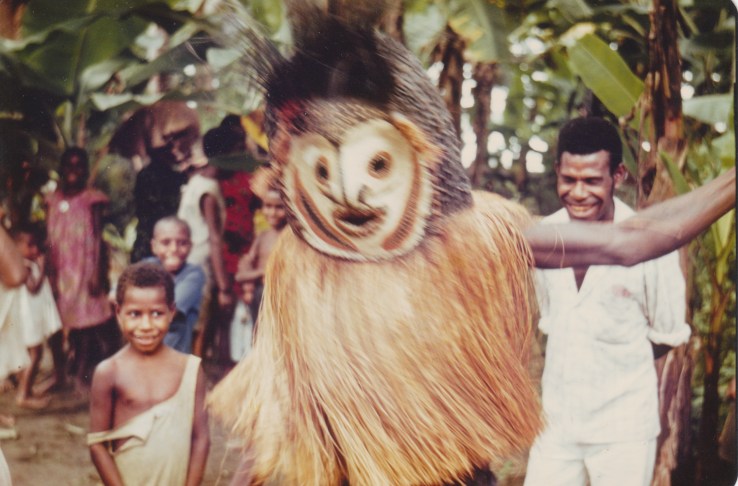
 “A Wood Mask, Kandrian Sub-District, Wosom Village, the oval white face with an hollowed mouth showing teeth and tongue, hollowed eyes, pierced ears, and the high forehead with three cylindrical shafts issuing feathers, strands of shells and pig teeth hanging from the ear lobes, painted with white, black and red pigments. Height 63 cm. (24 3/4 in.)



 Books Can Save A Life