Revisiting H Is for Hawk

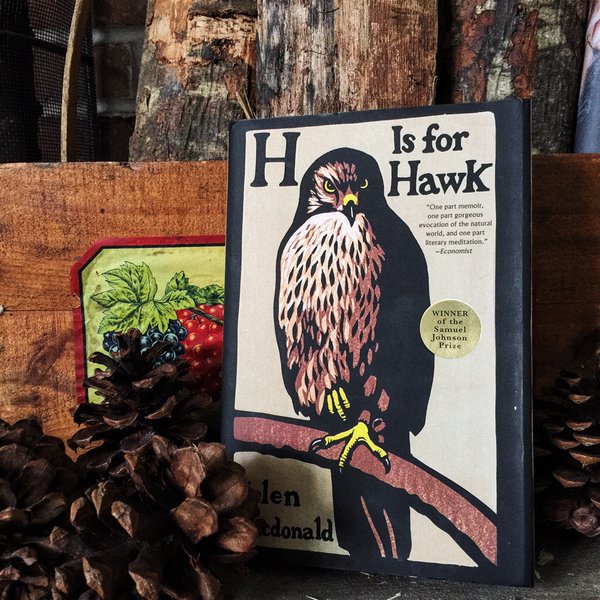
H is for Hawk

“….her feet were gnarled and dusty, her eyes a deep, fiery orange, and she was beautiful. Beautiful like a granite cliff or a thunder-cloud. She completely filled the room. She had a massive back of sun-bleached grey feathers, was as muscled as a pit bull, and intimidating as hell….”  H is for Hawk, by Helen Macdonald

Helen Macdonald’s father, Alisdair Macdonald, was an iconic British photojournalist, and his daughter’s biggest fan. “He was the only person who understood me,” Helen says in his eulogy.

This isn’t hard to believe. Helen is a brilliant entomologist, difficult and eccentric, as portrayed in the just-released movie based on the memoir.

The movie, H Is for Hawk, is good. The memoir is better. It is the story of Helen’s training of a goshawk, a fiendishly difficult undertaking, and a metaphor for her struggle with grief and depression. (A book blogging friend of mine suggested that H stands for Helen, too, and I think she is right.)

At the time of its publication, H Is for Hawk was something of a breakthrough for its unique way of combining memoir with nature writing.

H Is for Hawk is well worth your time if you are up for challenging, multi-layered nature writing that explores the mysteries of human and wildlife psychology. This memoir is a classic.

Here is my post from 2016:

Helen Macdonald’s reaction to her father dying suddenly was to embark on the extraordinarily difficult task of training a goshawk, one of nature’s fiercest and most ruthless predators.

Goshawks are cold-hearted, lifelong loners with no social instincts whatsoever. They bond with no one, not the goshawk they mate with, not other goshawks, not any human who wants to train them. You can’t look them in the eye, either, because if you do they might attack you.

Goshawks don’t respond to punishment. The only way to train a goshawk is to be submissive and patient, eyes cast down at all times. Tim Gallagher, in a review of H Is for Hawk, likens this to being a kind of monk. It is not a part-time thing. Training a goshawk is all-consuming. It takes over your life.

Helen writes about the hawk she is training, whom she names Mabel:

“Everything about the hawk is tuned and turned to hunt and kill. Yesterday I discovered that when I suck air through my teeth and make a squeaking noise like an injured rabbit, all the tendons in her toes instantaneously contract, driving her talons into the glove with terrible, crushing force. This killing grip is an old, deep pattern in her brain, an innate response that hasn’t yet found the stimulus meant to release it. Because other sounds provoke it: door hinges, squealing breaks, bicycles with unoiled wheels – and on the second afternoon, Joan Sutherland singing an aria on the radio. Ow. I laughed out loud at that. Stimulus: opera. Response: kill.”
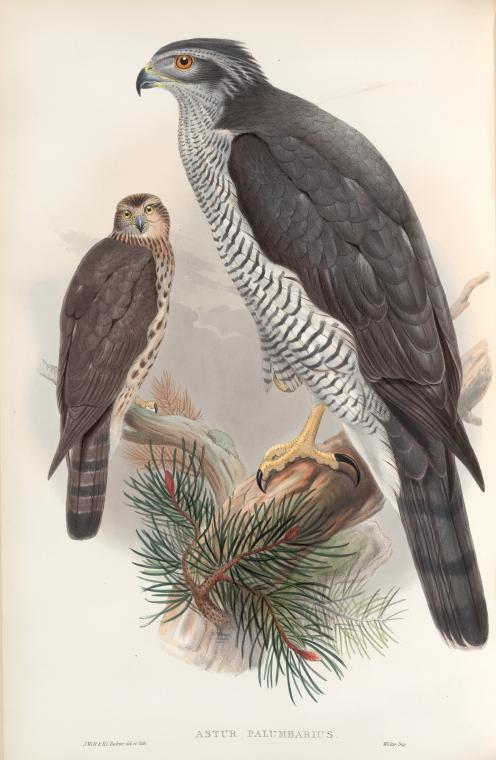
Two goshawks
Goshawk. Rare Book Division, New York Public Library

When Helen was a child, she and her father spent many days roaming the countryside as Alisdair indulged his passion for airplanes and Helen her growing passion for birds.

After Alisdair died, Helen wanted a distraction from her grief, something deeply immersive and challenging. In this respect, H Is for Hawk is unlike other memoirs. There isn’t a lot about Helen’s father or her relationship with him, or about Helen’s feelings of sadness and loss, per se. These are subsumed into an arresting narrative of Helen’s struggle to achieve what seems to be impossible as she grapples with her grief.

As Helen comes to understand, “Shocking loss isn’t to be shared, no matter how hard you try.”

Helen was, in fact, an experienced falconer, but she’d never taken on a goshawk before. She brought along a companion in her unusual undertaking: T. H. White’s, The Goshawk, White’s account of his own experience training a goshawk in the 1930s. (Remember T.H. White’s The Sword in the Stone, The Once and Future King, and other tales of Arthurian legend? Even if you didn’t read the books, you’ve probably seen the movie/musical Camelot and the Disney version of The Sword in the Stone.)

This weaving of T.H. White’s experiences into Helen’s narrative is fascinating; White, who was gay in a culture and time when this was unacceptable, was grappling with his own loss and inner darkness. Helen writes,

“It took me a long time to realise how many of our classic books on animals were by gay writers who wrote of their relationships with animals in lieu of human loves of which they could not speak.”

And this:

“….White wrote one of the saddest sentences I have ever read: ‘Falling in love is a desolating experience, but not when it is with a countryside.’ He could not imagine a human love returned. He had to displace his desires onto the landscape, that great, blank green field that cannot love you back, but cannot hurt you either.”

Helen’s immersion with Mabel, her goshawk, is harrowing. She holds nothing back in the struggle, and she holds nothing back from her reader.

Ultimately, Helen has to confront her obsession with the goshawk and her nearly complete withdrawal from friends and family. Where does obsession end and madness begin?

Before you read H Is for Hawk, I highly recommend that you read this fascinating review by Tim Gallagher at the Cornell Lab of Ornithology All About Birds site. Gallagher puts the human-training-a-goshawk challenge into context, and I think it will pique your interest. Not knowing a raptor from a falcon from a hawk myself, I wish I’d read this review first. And I’ve a soft spot in my heart for the Cornell Lab of Ornithology and the good work they do. We live not far from there, and I’ve seen at least one of their research sites in the Finger Lakes countryside.

Read H Is for Hawk if you want a different kind of memoir that demands to be read slowly, one word, one phrase, one sentence at a time. If you’re willing and want to slow down and immerse in another world entirely.

I expect I’ll read H Is for Hawk once or twice more down the road, as I simply couldn’t take it all in the first time through. If I’ve painted a rather dark picture of this unusual memoir, there is light and wisdom gained, too:

“There is a time in life when you expect the world to be always full of new things. And then comes a day when you realise that is not how it will be at all. You see that life will become a thing made of holes. Absences. Losses. Things that were there and are no longer. And you realise, too, that you have to grow around and between the gaps, […]”
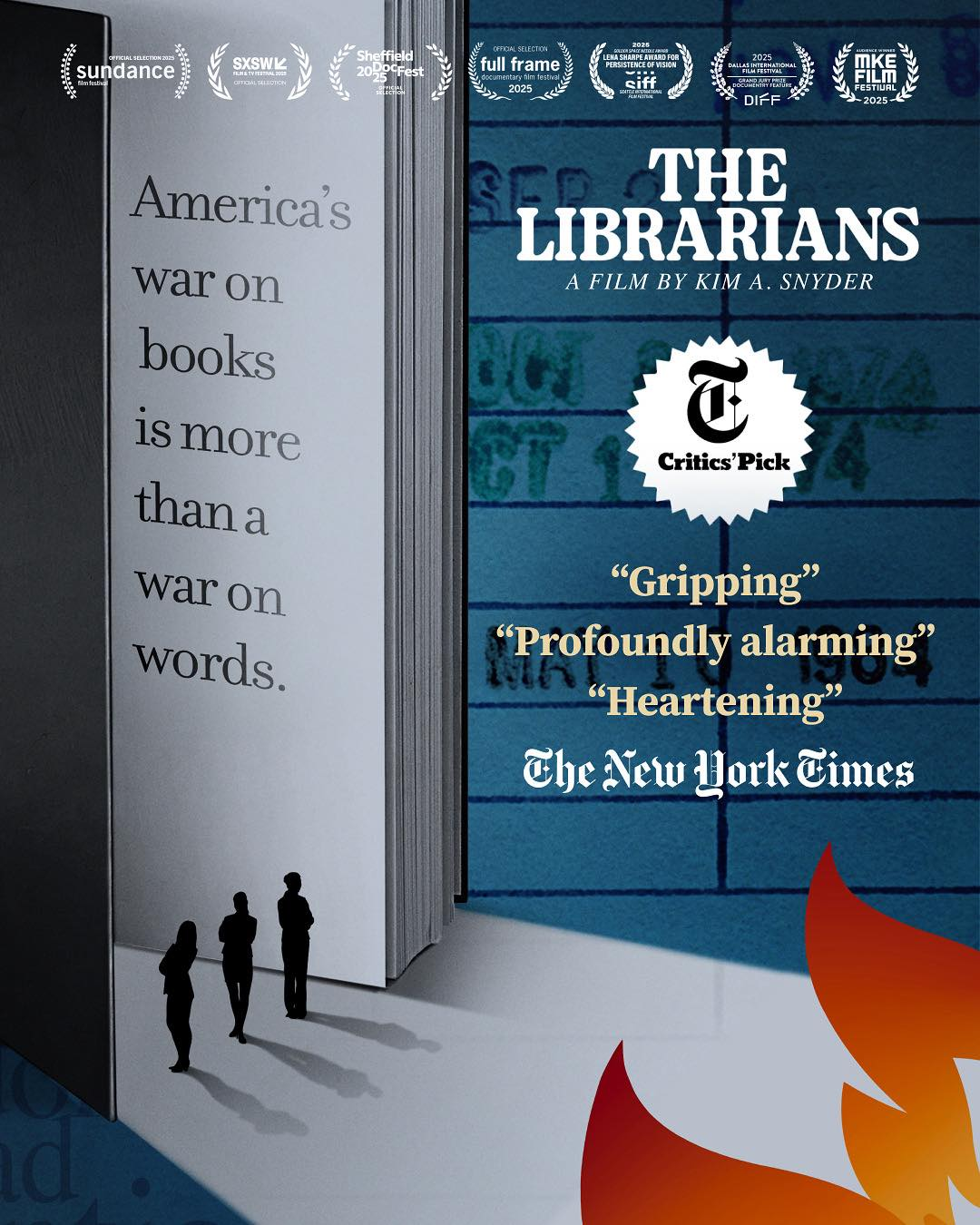

Coming for the librarians (and the books)

On Friday evenings, I like to have a glass of wine, make a nice meal, and maybe watch some mindless TV with my husband. But not on this particular Friday night last fall.

Our local public library was hosting a showing of the documentary The Librarians, about book banning in America and, obviously, I wasn’t going to miss it. (For those of you new to my blog, because I’m an avid, lifelong reader, an academic librarian by training, a former children’s book editor, and a writer. And because, of course, Books Can Save a Life!!!)

Every seat was filled. At least half a dozen librarians were in the audience, and I had the good fortune to sit next to one. So I had a kindred spirit nearby as we channeled our disbelief and outrage while, on the screen, one hard-to-believe book-banning drama after another played out in Texas, Florida, Louisiana, and New Jersey.

I could focus on any number of issues regarding the documentary, such as First Amendment rights, the definition of pornography, the removal of marginal voices from American libraries, or what, exactly, is deemed educationally unsuitable. But what most shocked me was how deeply divided communities have become and how harshly some book banners treat community members they may have known or worked alongside for years.

Our library featured a panel discussion, and at some point, someone used the term “religious psychosis,” which resonated with me. I found the story of Weston Brown and his mother a heartbreaking example of this, difficult to watch. Weston, who is gay, was disowned by his mother, Evangelical Christian Monica Brown, and is not allowed to be part of his siblings’ lives.

After she began publicly advocating for the removal of LGBTQ+ themed books from school libraries in their Texas town, Weston spoke out against book banning at a school board meeting that his mother attended. She then came to the podium and, ignoring her son, spoke passionately (and in crude, offensive language) about banning certain books that had been carefully vetted by librarians.

Another thread in the documentary featured the Reverend Jeffrey Dove in Clay City, Florida, who became concerned about the Llano County library director, who had been slandered by community members and removed from her job. What struck me was the sight of Reverend Dove, who is Black, patiently waiting for three hours to speak while the town council (all white) ignored him. When he was finally allowed to speak, Reverend Dove defended the library director and highlighted the value of the banned titles. His is truly one of the most eloquent voices in the documentary.

It seems to me that some have been blinded by a kind of irrational and dangerous religious and/or political fervor that overrides our common humanity.

On February 9, 2026, The Librarians will air widely across the country on the PBS program, Independent Lens. You can also check the listings on The Librarians website to see if it is coming to your city. Better yet, contact your local library and ask them to host a viewing.

School librarian and anti-censorship advocate Amanda Jones tells the story of her efforts to fight book banning in her hometown of Louisiana Parish, Louisiana. Her life was upended, and she felt compelled to tell her community’s story, which is playing out across the country. She says in the memoir that she doesn’t see herself as a writer, and I do wish that she’d had a better editor. Nonetheless, That Librarian is an important and revelatory testimony about book-banning efforts in America.

Train Dreams

Mount Index
Mount Index

I first published this post in May, 2012, when we were staying in a remote cabin near the town of Index in Washington State’s Cascade Mountains. I was also reading the novella, Train Dreams, by Denis Johnson. I’m reposting it now because the gorgeous movie adaptation has just been released. (It is currently in theaters and on Netflix.)

Train Dreams is a beautifully filmed, meditative story about an early 20th century Idaho logger who travels to Washington and environs to work on crews that take down the largest trees in the forest. I promise you, the movie will sweep you away, completely and utterly, to another time and place. New York Magazine calls Train Dreams a staggering work of art, and they are right. The translation from book to film is flawless, and those of us who are avid readers know how special it is when the essence of a beloved book comes to life on the screen.

Here is my original post:

Just steps from our front door, the peaks of Mount Index are illuminated in great detail by the last rays of sun.

It’s spring and we’re in Washington’s Cascade Mountains. This is wild, intimidating territory. Rivers and creeks rage as snow melts in the mountains. Along the highway, as we made our way here, we passed by dozens of cascades of snowmelt tumbling down steep walls of rock on either side.

Our vacation cabin is perched on the banks of the Skykomish River. It was raining our first night here, and the rain, together with the rushing river, created quite a din. The mountaintop had been hidden by fog.

We built a fire in the wood burning stove, which took the chill out of the air and made everything cozier. Later in the evening, a dull roll of thunder swelling to a roar overpowered the sounds of downpour and river flow outside our picture window. My first, nervous thought was “flash flood,” but when the high-pitched whine of metal-on-metal joined the mix, we realized the sound was a train.

Train in Skykomish
View from the Cascadia Hotel in Skykomish

We are in high train country. The legend of the Great Northern Railroad is very much alive here, though nowadays the trains that run are mostly on the Burlington Northern Santa Fe line. Twice now, while having lunch at the Cascadia Hotel Cafe in Skykomish, we’ve watched trains pass through, heading east from the port of Seattle with container cars from China, Germany, and Scandinavia.

Several times a day and into the night we hear the trains.

In a kind of parallel journey to my vacation, I’m reading Train Dreams, a novel by Denis Johnson about a logger and laborer who worked for the Pacific Northwest train companies of the early twentieth century.

The Pacific Northwest is surreal and dangerous in Train Dreams, as much a character as Johnson’s protagonist, Robert Grainier.

Photos of loggers
Loggers taking down 500-year-old cedar and fir

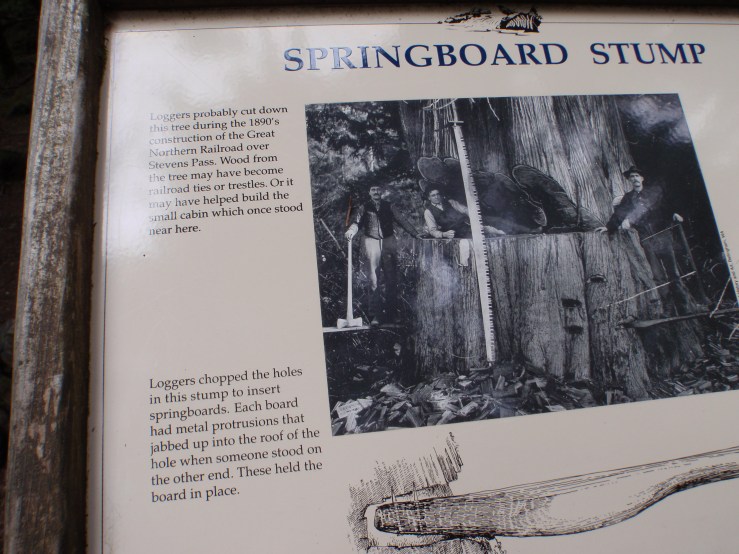
I thought about the life and times of Grainier when we hiked the Iron Goat Trail the other day, along the now abandoned Great Northern Railway bed. On plaques along the way, old photographs depicted loggers like Grainier taking down giant cedar and fir trees.

Grainier grew “hungry to be around….massive undertakings, where swarms of men did away with portions of the forest and assembled structures as big as anything going, knitting massive wooden trestles in the air of impassable chasms, always bigger, longer, deeper.”

Yet Grainier also saw the great mountains and forests defeat the ambitious plans of mere humans. The land defeated him, too, in a very personal way, but he learned acceptance and, finally, a kind of reverence for the terrible beauty of the place he called home.

The Iron Goat was the last spur of the Great Northern Railway, crossing the Cascades at the treacherous Stevens Pass. I found Stevens Pass stunning the first time we drove through, going east at sunny noon. But on the late afternoon return trip, when it was foggy with rain turning to sleet, I could hardly stand the vertigo as we tried to avoid skidding on the slick highway.

Disaster Viewpoint on the Iron Goat Trail marks the spot where, in 1910, an avalanche swept two snowbound passenger trains into the Tye River below, killing nearly 100 people.

Snowshed
Snowshed

To alleviate the dangers of avalanches, the railroad companies eventually built snowsheds, huge retaining walls to protect trains from tumbling snow. My husband and I walked alongside an old snowshed on our hike.

We knew our hike would be cut short because a sign at the trailhead indicated an avalanche had made the trail impassable a half mile in.

Sure enough, just a few feet from where the snowshed ended, we could go no further, thanks to a wall of hard-packed, dirt-encrusted snow.

“All his life Robert Grainier would remember vividly the burned valley at sundown, the most dreamlike business he’d ever witnessed waking—the brilliant pastels of the last light overhead, some clouds high and white, catching daylight from beyond the valley, others ribbed and gray and pink, the lowest of them rubbing the peaks of Bussard and Queen mountains; and beneath this wondrous sky the black valley, utterly still, the train moving through it making a great noise but unable to wake this dead world.” – Denis Johnson, Train Dreams


View from Spirit Lake trail
View from Spirit Lake Trail

Train Dreams, Denis Johnson, Farrar, Straus & Giroux, New York, 2011.

Read Harder 2016

Have you heard about Bookriot’s Read Harder Challenge?

I thought it would be interesting to see which books I’ve read in these categories, since Ann Patchett just wrote about her own progress in making her way through the list.

I’d love to hear what you’ve been reading, too, so let us know in the comments. Book suggestions are appreciated and welcome, especially for those categories I’ve left blank.

commonwealthBy the way, Ann just released her new novel, Commonwealth. Many of you know she’s one of my favorite novelists, so I’ll be sure to get my hands on it as soon as I can.

True story, when Ann was a girl, one morning she woke up to find kids she didn’t know in the kitchen. Turned out, her mother had gotten remarried, and these were her new half siblings.

Ann has translated some of that strange family experience into a novel that isn’t, literally, a true story, but that I imagine has plenty of emotional truth, as writers of fiction often say about their work.

If you’re looking for other suggestions, check out the New York Public Library’s Read Harder recommendations. See also the reader-generated lists on Goodreads.

If I’ve left the category blank, it means I haven’t read that category and don’t have any particular suggestions. If you do, please let us know.

BOOKRIOT’S READ HARDER CHALLENGE 2016

Read a horror book

Read a nonfiction book about science: Lab Girl, by Hope Jahren. (I’m reading it now). It has gotten excellent reviews, a memoir about a female scientist. It’s an eye opener, in part about what women in science are (still) up against, but there’s a lot more to this memoir about a woman passionate about plants.

I just borrowed Half-Earth: Our Planet’s Fight for Life, by Edward O. Wilson from the library. Nearing the end of his life, Wilson felt compelled to sound the alarm once more. He proposes that we devote half the surface of the earth to nature.

Queen of the Fall book coverRead a collection of essays: Queen of the Fall, by Sonja Livingston; and Why We Write About Ourselves, edited by Meredith Maran.

Read a book out loud to someone else: The Harry Potter series; The Giver; and Hatchet. Not this year, but when our sons were growing up, these were unforgettable read alouds. Harry Potter is especially captivating read deep in the woods at night when you’re camping.

Read a middle grade novel: see above, none this year for me.

Read a biography (not memoir or autobiography): Charlotte Bronté: A Fiery Heart, by Claire Harmon is on my to-read list. See the feminist category below.

The Buried Giant by Kazuo IshiguroRead a dystopian or post-apocalyptic novel: The Buried Giant by Kazuo Ishiguro, and Find Me, by Laura Van Den Berg. I read everything by Ishiguro. The latter novel by Van Den Berg was well reviewed and is excellent, though it didn’t really speak to me.

Read a book originally published in the decade you were born: I’ve been wanting to re-read Australian Neville Shute’s chilling dystopian novel, On the Beach. His  A Town Like Alice blew me away in 1981 as a 5-hour Masterpiece Theatre production, and I would love to watch it again. (It’s only available on VHS.) I don’t believe I ever read the book.

Listen to an audiobook that has won an Audie Award: 

The Bully Pulpit: Theodore Roosevelt, William Howard Taft, and the Golden Age of Journalism, by Dorothy Kearns Goodwin. OK, I haven’t read this book or even listened to it, but I gave it as a gift to a friend who loves Teddy Roosevelt. It won an Audie in 2015 for the best History/Biography category. This would qualify for the over 500 pages category, too, which is reason enough to listen to the audio version. I should read this or listen to it, considering that I believe journalism today is in a sorry state.

There is an Audie Classic Category, which I didn’t know about but just may entice me to finally start listening to audio books. Here’s a suggestion that sounds intriguing, also an Audie award winner: The New York Stories by John O’Hara.

I will try audio books soon, but I resist them. I don’t want to constantly fill my head with media, I need plenty of silence to think and to let my own writing germinate.

I’ve read and hear often that print books will disappear. Some people announce this with a great deal of glee, and I don’t understand why. Can we have both? Why does it seem to make some people happy that print books may disappear?

Those Who Leave and Those Who Stay book coverRead a book over 500 pages long: Elena Ferrante’s Neapolitan Novels. I’m counting this as a long read, even though there are four in the series. Had a great discussion about these books in a book club attended by many Italian-American women. One day I’ll read her other novels, which I’ve heard are rather devastating.

Read a book under 100 pages: Tribeby Sebastian Junger. (130 pages, close enough)

Read a book by or about a person that identifies as transgender: Middlesex, by Jeffrey Eugenides, one of my favorites. Read this a few years back, superb.

Read a book that is set in the Middle East

Read a book that is by an author from Southeast Asia

To the Bright EdgeRead a book of historical fiction set before 1900: To the Bright Edge of the World by Eown Ivey; De Potter’s Grand Tour, by Joanna Scott.

Read the first book in a series by a person of color: Not a series, but this year I read and loved Ta-Nehisi Coates’ Between the World and Me, and his memoir, The Beautiful Struggle. 

Read a non-superhero comic that debuted in the last three years: This book is older than three years–I picked up Fun Home: A Family Tragicomic, by Alison Bechdel, but didn’t finish it. I may get back to it someday. It’s becoming a classic.

Read a book that was adapted into a movie, then watch the movie. Debate which is better:

I did see the movie, Brooklyn, by Colm Toibin, but didn’t read the book, don’t plan to. The movie was pretty good, mostly because of the acting, otherwise predictable.

I also saw this year the movie Carol based on the novel, The Price of Salt, by Patricia Highsmith. I thought it was excellent, haven’t read the novel. I was flabbergasted when someone I know said the main character in the movie was a predator. That is not how I interpreted the character in this movie about a lesbian relationship in the 1950s. I saw her as sympathetic. If anyone else has seen the movie and can comment, I’d love to hear your thoughts. I felt the predator comment revealed perhaps unconscious LGTBQ bias; but then again, Highsmith’s novels have disturbing characters. Perhaps the actual novel was darker, and some of that came through in the movie?

Read a nonfiction book about feminism or dealing with feminist themes:

My Life on the Road, by Gloria Steinem is a big bio this year, though I haven’t read it. I HAVE read, this year, and in the case of Bronté’s novel, many years in the past:  Jane Eyre’s Sisters, by Jody Gentian Bower and Jane Eyre. These, because my memoir has a Jane Eyre theme. Last year I read Bad Feminist by Roxane Gay. Fabulous.

Read a book about religion (fiction or nonfiction): After Buddhism, by Stephen Batchelor. (On my to-read list)

67 ShotsRead a book about politics, in your country or another (fiction or nonfiction): 67 Shots: Kent State and the End of American Innocence, by Howard MeansThis one is personally meaningful.

Read a food memoir: On my to-read list is Blue Plate Special by Kate Christensen. Classics I love are Laurie Colwin’s food memoirs. Elizabeth David was a superb food writer, though her books aren’t really memoirs. Ruth Reichl has come out with a new food memoir this year that I haven’t read, My Kitchen Life: 136 Recipes that Changed My Life.

Read a play

Read a book with a main character that has a mental illness:  A Common Struggle, by Patrick J. Kennedy. This is a memoir. I also read the riveting memoir, A Mother’s Reckoning. The Eagle Tree by Ned Hayes is fiction, and it’s absolutely great.

Here’s a smidgen of The Masterpiece Theatre version of A Town Like Alice.

Have you read any books in these categories, or do you have any suggestions? Are you following the Read Harder challenge? Let us know in the comments.

Reading Kazuo Ishiguro

IMG_2640 (1)

“Then he took the sword in both hands and raised it—and Gawain’s posture took on an unmistakable grandeur.” – The Buried Giant, by Kazuo Ishiguro

My son gave me a signed first edition of Kazuo Ishiguro’s latest novel, The Buried Giant, for Christmas. The book has been cast in some marketing circles as a fantasy, with allusions to King Arthur and Beowulf and the like, although the author has said he doesn’t set out to write in one particular genre or another and doesn’t like his books to be labeled as such.

Ishiguro is one of my favorite novelists, so I read every new book of his that comes out.

Never Let Me Go (dystopia/science fiction) and When We Were Orphans (in the tradition of the mystery/detective novel but with a literary twist) are my favorite Ishiguro novels. In fact, Never Let Me Go is one of the best novels I’ve ever read, one of Ishiguro’s more accessible stories. If you want to read Ishiguro, you might start with Never Let me Go, which was made into a movie starring Carey Mulligan. Ishiguro’s The Remains of the Day (pre World War II) was also brought to the screen with Anthony Hopkins and Emma Thompson.

As much as I enjoyed the screen versions of these books, there is something about Ishiguro’s writing that seems to be lost in a movie, at least for me. His novels are like dreams verging on nightmares from which you can’t awaken. Things don’t quite make sense in Ishiguro’s novels – you know this is not “reality” and that something is off, but what? The main character(s) are usually on a quest of one kind or another. They long for something that seems to be just out of reach.

You come to discern that Ishiguro’s characters are operating under some grand delusion. It’s unsettling, because you sense something familiar about the delusion; you begin to recognize that perhaps you operate under the very same delusion.

The Buried Giant by Kazuo IshiguroEspecially if you’re of a certain age and you have children who have left the nest as I do, you might find The Buried Giant particularly affecting. Axl and Beatrice are an elderly couple who leave their village and set off to find their son, whom they apparently haven’t seen in many years. They can’t remember the circumstances under which he left, or exactly where he lives, just as they can’t remember much of anything about their own pasts.
Axl and Beatrice aren’t unusual, though. No one in their village or anywhere else remembers much about their own past, nor do they seem to want to; a fine mist over the countryside, thought to be the breath of the dragon Querig, is said to be responsible for shrouding both personal and collective memory.

It is somewhere around the year 600 AD, and England is in ruin. Axl and Beatrice want to find their son, and they want to regain their memories. As they wander in search of their son, they meet others on their own quests. Clues and sightings suggest a terrible slaughter between the Saxons and Britons that no one remembers, just as no one recalls the dark secrets that lurk in their personal pasts. Perhaps the mist is in place so Britons and Saxons can live side by side without wanting to exact revenge.

As one reviewer pointed out, don’t we all operate under collective memory loss, or denial, that’s partly deliberate? Over climate change, for example, even though climate scientists have been warning us about it since the seventies? Or the atrocities of war?

Axl and Beatrice become caught up in a scheme to slay the dragon so memories can be recovered, but as Sir Gawain, the knight and nephew of the dead King Arthur, asks Beatrice, “Yet are you so certain, good mistress, you wish to be free of this mist? Is it not better some things remain hidden from our minds?”

Just as the Saxons and Britons fought a terrible war, you gradually learn there was upheaval in Axl and Beatrice’s relationship as well. What will happen when this couple, who seem to be so in love, recall their betrayals of each other? And what happened to their son?

Axl and Beatrice meet a boatman who they must rely on to help them cross a river in their journey. He says, “When travellers speak of their most cherished memories, it’s impossible for them to disguise the truth. A couple may claim to be bonded by love, but we boatmen may see instead resentment, anger, even hatred. Or a great barrenness. Sometimes a fear of loneliness and nothing more. Abiding love that has endured the years – that we see only rarely.”

Beatrice replies: “But God will know the slow tread of an old couple’s love for each other, and understand how black shadows make part of its whole.”

Ishiguro builds up to a powerful and haunting conclusion. Like all of Ishiguro’s novels, I can’t get this one out of my mind.

There has been some interest in making The Buried Giant into a movie, but there are no definite plans yet.

Here is an excellent 4-minute video of Ishiguro talking about his novels made into movies.

In this interview, Ishiguro talks about how a book can be the raw material for a movie, which becomes something new and powerful in and of itself; how literary genres are breaking down and overlapping in exciting ways; and how he embraces the Leonard Cohen model of artistry and aging in which the artist looks to aging as new material for his/her art.


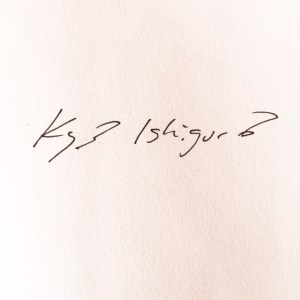
Kazuo Ishiguro authograph


Have you read The Buried Giant or other novels by Ishiguro? Do you have a favorite? Have you seen the movie versions of Remains of the Day or Never Let Me Go?


The Book Thief

“They say that war is death’s best friend, but I must offer you a different point of view on that one. To me, war is like the new boss who expects the impossible. He stands over your shoulder repeating one thing, incessantly: ‘Get it done, get it done.’ So you work harder. You get the job done. The boss, however, does not thank you. He asks for more.”       Death, in The Book Thief

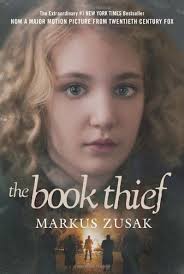
The Book Thief book cover

Death is the narrator in The Book Thief, a young adult book about a German family during World War II that has a huge adult readership as well. It is one book not to be missed. The writing is outstanding. Published in 2005, The Book Thief won countless awards and honors, and has become a classic in YA fiction.

I recently reread the book before I saw the movie. I think the screen adaptation is a good one, although some viewers found it tame, and subtleties of the text can’t be captured on the screen. For example, Max, who is Jewish and hiding out in the home of Liesel and her foster parents, paints over every page of a copy of Mein Kampf and creates his own book, with illustrations. Max’s book is embedded within the pages of The Book Thief, and on the pages of Max’s book you can see faint traces of Hitler’s words.  One of the pages in Max’s book is a drawing of a girl and a boy holding hands and standing on a pile of bodies. Inscribed on the sun that shines down on them is a swastika, and the girl is saying, “Isn’t it a lovely day?”

The author, Markus Zusack, uses the written word as a thematic motif. While the Germans burn books thought to be subversive, Liesel and Hans write words on the wall of their basement as Liesel learns to read, and Liesel steals a book whenever she has the chance, in defiance of the Nazis. Liesel then begins to write her own book in order to make sense of the world’s chaos and carnage.

I do think the movie captured the essence of the story, and it is well cast, especially Sophie Nélisse as Liesel Meminger and Geoffrey Rush as Hans, her foster father. Death is the narrator in the movie, as he is in the book, and in both he is an unsettling storyteller who confesses he is haunted by humans. Of course, in addition to being the narrator, Death has a starring role in the plot as well.

My father was wounded in the war, just inside the German border. Occasionally, my mother spoke of her family’s Victory Garden, the rationing of meat and gasoline, and the “man shortage.”  I was born ten years after the war ended. As an adult, I eventually began to understand how the world turned upside down by war cast long shadows over my parents’ generation.

Have you seen the movie or read The Book Thief? What did you think?

Catching Fire, the movie

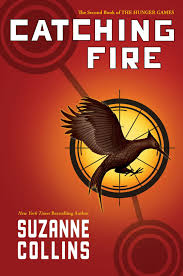
Catching Fire book coverI liked the movie version of the first book in the The Hunger Games trilogy, (unlike many viewers) and I liked Catching Fire, the movie version of book #2, even more.

When a book or movie is wildly popular, I’m curious to know the reasons. I want to know how the creator birthed a story that inspires passion in so many people. The Hunger Games is epic, powerful, and true to our times, and in capable artistic hands it speaks to us whether the medium is the page or the screen. The Hunger Games books and the movies have become fused in my memory, and it is difficult for me to separate the two – it’s the story itself that stays with me.

Suzanne Collins’ trilogy is based, in part, on the Greek myth of Theseus and the Minotaur, which she read when she was eight years old. According to Wikipedia, in one version of the myth, the king of Crete demanded that every nine years seven Athenian girls and seven Athenian boys be sacrificed to the half-man, half-bull Minotaur. Theseus volunteers to go in place of one of them and slays the Minotaur. (In The Hunger Games, Katniss volunteers to go in place of her younger sister, Prim, and Peeta volunteers to replace Haymitch.)

In interviews, Suzanne has said she was intrigued by reality TV shows that feature ordinary people viewers can relate to trying to prevail in impossible situations; she has also noticed our voyeuristic desire to watch others in their most private, vulnerable, and humiliating moments. Flipping through TV channels one evening, Suzanne was struck by news footage from the Iraq war on one channel and “Survivor” competitors on another channel. A former writer of children’s television programming, Collins has spoken in interviews about how viewers become desensitized to real-world violence if they are continuously exposed to the entertainment violence of modern media.

Probably most formative of Suzanne’s artistic vision was the fact that when she was six years old, her father served as a military advisor in Vietnam. News footage on TV of the death and destruction in Vietnam confused and frightened her. After the war, when her family was living in Europe, Suzanne’s father often took them on tours of famous World War I and World War II battlefields, where he taught them about military strategy and history.

Although she’s been criticized for depicting children killing children, Suzanne is not an advocate of violence or war. Katniss, Peeta, and many of the others in The Hunger Games clearly suffer the post-traumatic effects of war, oppression and deprivation. In my mind, they echo the child soldiers and the children who are victims of bombings and other atrocities we see often in the news.  Several stories about The Hunger Games in the media have highlighted the irony of the fact that Suzanne lives in Sandy Hook, Connecticut. I wonder if that experience will result in another powerful and timely story.

For me, iconic images from Catching Fire include the silhouettes at sunset of Katniss, Peeta, and a dying tribute who has just sacrificed her life for Peeta; the citizens of Rue’s District 11 giving the three-fingered salute; and, in one of the closing scenes, a riveting shot of Katniss that embodies the essence of sacrifice.

I’ve been especially moved by these characters: Cinna (Lenny Kravitz) and how he takes a stand with his art; Haymitch (Woody Harrelson) and his flawed strength; Eppie (Elizabeth Banks) and her transformation; the growing strength of Prim (Willow Shields); the fire and directness of Johanna Mason (Jena Malone); and the depth of feeling and loyalty of the deceptively shallow Finnick Odair (Sam Claflin).

Year of the Jungle book coverRecently, Suzanne Collins published Year of the Jungle, a picture book about a child whose father goes off to war.

Have you seen Catching Fire? What do you think of the movie and/or or the book? Please share your thoughts in the comments below.

One small fact

The Book Thief Book CoverHERE IS A SMALL FACT

You are going to die.

….the grave diggers were rubbing their hands together and whining about the snow and the current digging conditions. “So hard to get through all the ice,” and so forth. One of them couldn’t have been more than fourteen. An apprentice. When he walked away, after a dozen paces, a black book fell innocuously from his coat pocket without his knowledge.”   The Book Thief, by Markus Zusak

Catching Fire book cover

“If it were up to me, I would try to forget the Hunger Games entirely.”  Katniss Everdeen

Catching Fire, by Suzanne Collins

I’ll be at the movies this month watching two visions of apocalypse. One really happened. The other – well, take a world of haves and have-nots to the extreme, and maybe that’s where we’re headed.

I love watching my favorite books on the screen, as long as it’s done well. If you’ve read these young adult books that obsess grown-ups, too, and/or see the movies, stop by Books Can Save a Life and tell us your thoughts. Why do you think these end-of-the-world stories are so popular? I’ll revisit this soon, once I’ve seen the movies.

Joyce Maynard, Elizabeth Gilbert, George Saunders coming up

Been away for a bit while designer Nicole Bateman of The Pixel Boutique gives Books Can Save a Life a fresh, new look. (Thank you, Nicole!) But I’ve been reading, as always, and here’s what’s coming up:

After Her book coverAfter HerJoyce Maynard’s latest novel. Joyce has written several novels as well as the memoir, At Home in the World. After Her is loosely based on the true story of a serial killer who terrorized Northern California in the late 1970s.

Tenth of December – I don’t usually read short stories, but I’d heard so many wonderful things about George Saunders I had to pick up a copy of his latest collection when I saw it on our public library’s “Most Wanted” shelf. Besides, he teaches a stone’s throw away at Syracuse University – he’s someone I should know about.

Sons of MadnessI’ve written about Susan Nathiel’s excellent Daughters of Madness: Growing Up and Older With a Mentally Ill Mother, a collection of interviews with adult women. Sons of Madness: Growing Up and Older With a Mentally Ill Parent is a companion volume.

The Art of the Commonplace – I’ve always wanted to know what Wendell Berry is all about, so I’m reading his collection of agrarian essays.

Catching Fire, the second book in Suzanne Collins’ Hunger Games trilogy has been made into a movie and will be released November 22. I wrote about the first movie and book here, so I just have to check out the next installment.

The Signature of All Things book coverAnd last but not least, I can’t wait to dip into Elizabeth Gilbert’s latest novel, The Signature of All Things. Beautiful book jacket and end papers. The epigraph: “What life is, we know not. What life does, we know well.”  Lord Perceval

I’ll be back with a closer look at all of these.

“Where the blue of the sea meets the sky”

Water and skyThe art of diving is not to do anything new but simply to cease doing something. You have only to let yourself go….It is only necessary….to abandon all efforts at self-preservation.

C.S. Lewis, The Pilgrim’s Regress, as quoted in Standing at Water’s Edge: Moving Past Fear, Blocks, and Pitfalls to Discover the Power of Creative Immersion, by Anne Paris

Many thanks to Lynne Favreau, who recommended Standing at Water’s Edge by Anne Paris, a fabulous book about creative immersion. Now it sits on the top shelf of my writing bookcase.

Watching the movie Goodbye First Love, I encountered The Water, by Johnny Flynn, a beautiful companion song to this sentiment.   The water sustains me without even tryin’….

Blog post title quote from “The Water,” by Johnny Flynn.