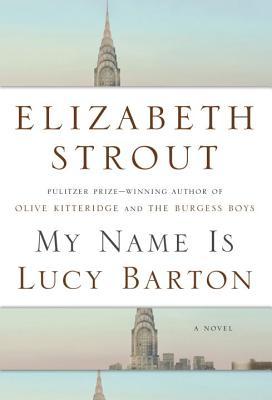
My Name Is Lucy Barton

LucyBarton2


This is one of my favorite scenes in My Name is Lucy Barton, by Elizabeth Strout:

The narrator is in a writing workshop led by a famous author she admires:

“…through the open window a cat suddenly jumped into the room, right onto the large table. The cat was huge, and long; in my memory he may as well have been a small tiger. I jumped up with terrible fear, and Sarah Payne [the author/instructor] jumped up as well; terribly she jumped, she had been that frightened. And then the cat ran out through the door of the classroom. The psychoanalyst woman from California, who usually said very little, said that day to Sarah Payne, in a voice that was–to my ears–almost snide, ‘How long have you suffered from post-traumatic stress?’

And what I remember is the look on Sarah’s face. She hated this woman for saying that. She hated her. There was a silence long enough that people saw this on Sarah’s face, this is how I think of it anyway. Then the man who had lost his wife said, ‘Well, hey, that was a really big cat.’

After that, Sarah talked a lot to the class about judging people, and about coming to the page without judgment.”

I highly recommend My Name is Lucy Barton, which has been lavishly praised by reviewers and other book bloggers and was nominated for the Man Booker Prize.

It has a deceptively simple plot about a young mother in a Manhattan hospital visited by her difficult mother, who she hasn’t seen in years.

The two women are now worlds apart, estranged by distance, education, class, their difficult past, and their own inability to express love and emotion and speak in a direct way about their lives. The writing is powerful yet understated, and unsentimental.

Lucy, raised in rural midwestern poverty and abuse, has reinvented herself in New York City. When her mother visits, Lucy reflects on the harsh childhood and upbringing she never talks about in her new life except occasionally with therapists.

The premise of the novel sounds like a cliché, but this is a page-turner. There is an urgency to Lucy Barton’s story. Strout has a strong sense of what to tell, when to tell it, and what not to tell at all.

I especially like this review in The New York Times by Claire Messud. This is a great choice for book club reading.

Now that I’ve finally discovered Elizabeth Strout long after the rest of the reading world, (she won the Pulitzer Prize for Olive Kitteridge, which was made into a TV miniseries), I look forward to reading her other novels.

“Sarah Payne, the day she told us to go to the page without judgment, reminded us that we never knew, and never would know, what it would be like to understand another person fully.”

My End-of Summer Reading

Currently on my nightstand are books by authors who were previously chosen for If All of Rochester Reads the Same Book:
To The Bright Edge of the World.jpegTo the Bright Edge of the World, by Eowyn Ivey (because I loved The Snow Child)

Ladies Night at the Dreamland, by Sonja Livingston (because I loved Ghostbread and Queen of the Fall, and because it’s about women, past and present, known and  unknown, in my neck of the woods)

I’m also reading:

The Art of X-Ray Reading: How the Secrets of 25 Great Works of Literature Will Improve Your Writing, by Ray Peter Clark

Clark mines great books, short stories, a poem or two, and a few movies for hidden treasures–the secret, powerful techniques of accomplished writers. Taking another look at some of these stories is fascinating: The Great Gatsby; Madame Bovary; A Visit from the Goon Squad; Lolita; A Farewell to Arms; The Bell Jar; Miss Lonelyhearts; “The Lottery”; “A Good Man Is Hard to Find”; “Notorious”; The Goldfinch; and Hiroshima, among others.
Ladies NightWhat have you read this summer that you love? Let us know by leaving a comment via the link in the left sidebar.


Off the Beaten Path: De Potter’s Grand Tour


De Potter's Grand Tour

“She is fascinated but not dismayed to discover that she has forgotten so much.

Is she really the same woman who celebrated Easter 1889 in Athens and walked up to the Acropolis with her husband?

Who spent a ‘most interesting day viewing the cisterns of Carthage’ with Victor and Armand in 1896?

Who once wrote on her anniversary in 1900, in an apartment on 97 rue de la Pompe in Paris, ‘In afternoon we went to Exp. and up the Trocadéro tower, then to Élysée Palace Hotel, saw King Leopold come in. In evening at dinner we ordered St. Honoré and champagne. M. Guerrier got up and improvised a poem and there was much gaiety and good humor. Armand gave me a gold watch charm’?”  De Potter’s Grand Tour,  Joanna Scott

This much, we know: In 1905, Joanna Scott’s great grandfather disappeared while on board a ship off the coast of Greece. A collector of ancient Egyptian art (some of it is at the Brooklyn Museum) and a world tour guide, he was at his wit’s end, hounded by creditors and litigators.

The question is: Did he commit suicide? Was he pushed overboard? Or, did he fake his own death and assume a new identity, leaving behind his beloved wife, Aimée, and his son?

How would you like to inherit that family mystery?

Joanna Scott did, in the form of Armand’s letters, postcards, photos, and documents, and the multi-volume journal of his wife, Aimée. This treasure trove had been sitting in a steamer trunk in Scott’s mother’s storage unit for years, until one day they unearthed it while searching for a diploma.

Intrigued, Scott threw herself into research and began writing a nonfiction account of Armand de Potter’s life. Ultimately, that proved too confining: Scott discovered that the mysterious and elusive Armand wasn’t who he said he was, and no one knew, not even his wife. So Scott switched to fiction, which gave her more freedom to suppose and imagine.

I read this novel ages ago and never got around to posting about it, but the book has stayed with me all this time. It’s not for everyone–Joanna Scott is a celebrated writer, but this particular novel didn’t garner the best of reviews.


To Travel.jpeg
A photo of Armand de Potter, the author’s great grandfather, walking away from the camera. He was, indeed, a mysterious figure.


I, on the other hand, loved it. I loved the larger-than-life way Armand and Aimée lived traveling all over the world leading their educational tours. Armand was an autodidact who pretended to be descended from Belgian royalty and more educated than he was. Nonetheless, as Scott portrays him, he was a scholar and a lover of the world with a passion for sharing that love with the people who signed up for his tours.

“To travel is to live,” Armand de Potter wrote in one of the documents Scott found in the steamer trunk.

His tour company went to these places: Algeria, Austria, Belgium, Czech Republic, Egypt, England, France, Germany, Gibralter, Greece, Hong Kong, Hungary, India, Italy, Japan, Malaysia, Monaco, Netherlands, Romania, Scotland, Singapore, Spain, Sri Lanka, Switzerland, Tunisia, Turkey, various locations in the US, and Yemen.

Some time in the late 1800s, Armand also wrote this prescient and hopeful passage: “The incalculable benefits of foreign travel can only be half told by our children….They will be appreciated by their sons and daughters, at a time when travel will have made the world very small and the human race what it is destined to be–one great fraternity.”

If you’re an armchair traveler, if you love history, and if you want an unusual story, I think you might like De Potter’s Grand Tour.

I enjoy Joanna Scott’s novels a great deal. One of my all-time favorites is Liberation, which takes place in Sicily, one of my favorite places in the world, during World War II. Scott is a much loved Professor of English here at the University of Rochester.

Speaking of family history, I’m off to a family reunion next week, where we’ll be reading a book loosely connected with a couple of the more colorful family members. I’ll tell you about it when I return.

I’ll leave you with what Armand de Potter had to say about good books (I would also add “women” of course):

“In the most beautiful books, great men speak with us, they give their most precious thoughts, and pour their soul into ours. Let us thank God for the creation of books. They are the voices of those that are far and of those that are dead; they make us heirs of the intellectual life of the past ages. Books furnish to all those who will use them with sincerity the society, the spiritual presences of the best and the greatest men.”


Going local: six Rochester storytellers

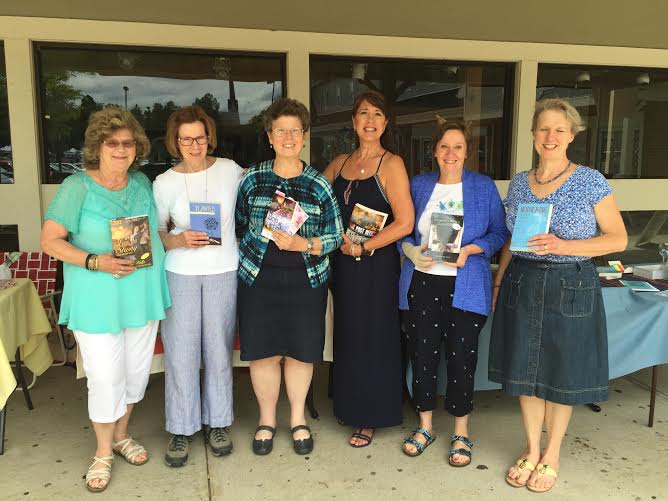
RochesterAuthorsLeft to right: Bev Lewis (writing as Beverly Wells); Kate Collier (writing as Katie O’Boyle & C.T. Collier); Ellen Hegarty (writing as Roz Murphy); Kim Cruise; Elizabeth Osta; Liz O’Toole

Historical romance & fiction, mystery & suspense, ghost stories & essays on motherhood

A couple of weeks ago I went to the Saturday farmer’s market, where quite unexpectedly I met six local authors. I’ve written before about the great small businesses in our town, and our pharmacy is one of them. Gift department manager Stefani Tadio supports and promotes the work of local artists and authors, and she organized this author/book event.

I enjoyed meeting and talking with Beverly, Kim, Roz, Katie, Elizabeth and Liz. I asked them about their writerly inspiration and research.

***

Historical Romance by Beverly Wells

Cowboy Kisses“I usually write long historical romance–mostly set in western America in the 1800’s, but I will also have a Medieval anthology coming out in the fall/winter and a civil war novel in the future, as well as a Canadian Mounted Police novel. I’ve also been included in anthologies and novellas.

As far as researching goes: first I investigate climate, terrain, foliage and fauna, foods, and items used at the time, types of lingo, and slang.

For example, in A COWBOY CELEBRATION, which is set in Wyoming in 1882, I had to make sure there were apples and what kinds, what the growing season would have been, and the ripeness and color of the apples hanging on the trees. Thank God for the internet, because it’s so much easier today than years ago doing research.

But my problem is, I get so wrapped up in research that I spend hours reading every tidbit and never use half of I read. I think that happens to a lot of us. But I love finding the answers!”

 ***

The Post Office by Kim Cruise

PO_Boxes_Kim_cruise“I started writing as a form of catharsis made necessary by having to watch my son suffer through drug addiction.  You see, books save lives in the writing, as well as in the reading of them. 
Shortly after I started writing The Post Office, my son was arrested on drug-related charges and ended up in a prison where he was not allowed to have books. He’s been an avid reader all his life; this was the very definition of cruel and unusual punishment.  So I started sending him my chapters, imbedded into letters, so he’d have something to read. He would edit them and make suggestions in the margins and mail them back. We had a flurry of mail going back and forth and I’ve not been as prolific since.   His one pencil became his most important possession while he suffered through his time there, and his proverbial fingerprints are all over my book.

My suspense novel features six characters, five of which are made up and one of whom is not –it’s me; putting my story and feelings into keystrokes, which turned into pages, then chapters, made it possible to function during some very dire times. I keep writing now that he is clean, to document his success and to let other mothers know that drug addiction can be survived. It’s my belief that it is very important to be talking about addiction; there are so many suffering from it, and even more people who suffer on the sidelines as I did and do; I hope that my efforts will help people to be comfortable with this conversation.”

 ***

Bob Book Ghost Stories by Roz Murphy

Bob at the LakeRoz Murphy’s Bob books [Bob at the Lake, Bob at the Plaza] narrate the screwball adventures of a crabby woman of a certain age, the kind grape grower who lives up the hill, and a martini-loving ghost.

“Since I’m the “crabby woman of a certain age” in this scenario, all I pretty much had to do was tell the story of Bob, my pain-in-the-butt martini-loving ghost, and our misadventures here in the Finger Lakes. I usually write early in the morning, while Bob is still nursing his hangover from the night before, since he’ll leave me alone for a couple of hours then.”

***

Lakeside Porches Romance Novels and Novellas by Katie O’Boyle

cover-steppinguptolove.jpg“In January 2012, my sister and brother-in-law invited me to celebrate the 90th birthday of a dear friend on the porch of Belhurst Castle for their famous Sunday Brunch. Watching the staff serve up incredible food and fuss over our friend made me wonder about their lives, their hopes and dreams. And wonder about the guests. And wonder about the visitors to the dining room and the spa. So many stories!

The idea for Lakeside Porches was born that sunny winter morning. That said, Tompkins Falls is not an actual city. Chestnut Lake is not Seneca or Canandaigua Lake or any of the Finger Lakes, although it has much in common with several of them. The Manse Inn and Spa is not Belhurst Castle, although the Belhurst may very well be one of the beautiful lakeside inns with a dining porch that serves lunch to the characters from my books.”

MysteryAnd just published: Planted: The Penningtons Investigate

It’s Monday of spring break when Professor Lyssa Pennington’s backyard garden project unearths a loaded revolver. With no record of violence at their address and no related cold case, the Tompkins Falls police have no interest. But the Penningtons and a friend with the State Police believe there’s a body somewhere. Whose? Where? And who pulled the trigger?

***


Jeremiah’s Hunger by Elizabeth Osta

jeremiahs-hunger-largeAt the height of the Irish famine of the 1840s, in a small town of Ahadallane, north of Cork City and south of Mallow, Jeremiah joins the rebels in the fight for Ireland’s freedom from British rule and learns firsthand the futility of violence. He and his best friend and brother-in-law, Father Michael Riordan disagree about the means to the end and ultimately take diverse paths when Michael is assigned to a parish in America.

Elizabeth took more than a dozen trips to Ireland to research Jeremiah’s Hunger, which is based on her own family history. Currently, she’s working on a memoir about her years in a convent with the Sisters of St. Joseph.

“My research has been chronologically driven.  For Jeremiah’s Hunger, I discovered genealogical records that led the way. For Saving Faith: A Convent Memoir, I am working with a distinct time period (1968-1977) so am able to explore those times historically, culturally, politically and cull the important and relevant facts.  Imagination for the historical fiction and memory for the memoir are key elements.”

 ***


Mothering: An Art of the Heart,  Elizabeth O’Toole (along with 8 more moms)

MotheringMothering: An Art of the Heart is a collection of short and engaging stories that celebrate family life, told by nine moms who want to share the wisdom and experience they gained in the process of raising their children. Each story highlights a specific idea or activity that may be used by the readers to enhance their families’ experience as their children grow.

This is not a text book or how-to manual, rather it is a forum where one set of mothers hopes to help another set of mothers by sharing “things that worked” in their families. There are 118 stories in all.

The Eagle Tree


IMG_2983
Browsers Bookshop in Olympia.

We spent part of our recent Pacific Northwest vacation in Olympia.

I know exactly one person who lives there, but she doesn’t know me – the artist Nikki McClure, whose work I admire.

We were exploring the center of town, when I spotted Browsers Bookshop, and of course we had to go in. About three minutes later, Nikki McClure walked in. She was there to sign copies of her most recent book, Waiting for High Tide.

But it gets weirder than that. After I finished browsing and had chosen a couple of books, I introduced myself to the bookstore owner, Andrea Y. Griffith. Turns out, Andrea knew my name. We are both former medical librarians, and apparently a few years back I edited an article she wrote for a Medical Library Association conference.

Waiting for High Tide
Nikki McClure’s latest book

I love Andrea’s bookstore, which has been in business since 1935. Andrea and her husband recently bought the shop and are reviving it. She’s doing a terrific job. I enjoyed browsing the store; I saw many new and intriguing titles I’m unfamiliar with, and she had an excellent selection of titles about the Pacific Northwest and nature, as well as other categories. I could tell immediately that the book selections are carefully curated – that’s of course what you can expect from a librarian.

I encourage you to read a bit about what Browers Bookshop is all about here.

IMG_2994I purchased the young adult book The Eagle Tree by Ned Hayes, who is from Olympia, as well as another book I’ll tell you about in my next post. The artwork on the cover of The Eagle Tree pulled me in, and since I’d been awed by the massive and venerable old trees we were seeing in Olympic National Park, I thought the book would be a good traveling companion.

It’s about a 14-year-old boy, March Wong, who is on the autism spectrum and obsessed with trees. Written in first person from the viewpoint of March, the novel often reads like encyclopedia entries because that is how March expresses himself, so you have to be fascinated by trees to bond with this book. I took to it immediately, as have many other readers, although there are some readers on Goodreads who disliked it for this reason.

I loved learning about the ecosystem of trees and watching March become willing and able to connect to other people as he tries to save the Eagle Tree, a monolithic Ponderosa Pine, from being cut down. Even though the tone can be factual and didactic, it’s really more expressive and lyrical than anything else, which is a tribute to Ned Hayes’ fine writing. I highly recommend this book to young adults, and their parents.

I was impressed when I saw that an author’s talk sponsored by Browsers Bookshop featured local actors performing scenes from The Eagle Tree. This is an independent bookstore that goes above and beyond to enrich the community and promote local authors.

Here is some of what March Wong has to say:

“I do not like this idea that we have begun to kill off—at great velocity and accelerating speed—all of the things that sustain us. I didn’t like it at all when I first thought of it, but most people around me do not seem that disturbed by it, even though the knowledge of this is obvious and readily available to anyone who looks up trees on the Internet. At least, no one seems bothered, because no one has taken action to amend it. So they must not care. That is the only explanation I can think of for the lack of reaction to this fact.”

IMG_3252
In Olympic National Forest

“Most of the trees are already dying. All across North America from Mexico to Alaska, forests are dying. Seventy thousand square miles of forest—that’s as much land as all of the state of Washington—that much forest has died since I was born. What if I am growing up in a world that will not have trees anymore by the time I am my grandfather’s age?”

IMG_2907
This is a nurse log. March Wong in The Eagle Tree will tell you what that is.

“There is an ocean of light around us. We are surrounded by it, we swim in it, we move through it every day.”

IMG_2912
Reminds me of the flowing creek nearby


IMG_3240
Nature’s sculpture. Dungeness Spit is littered with driftwood.


IMG_3229.JPG
What you can make from a tree. This is in Sequim, Washington.

My Favorite Things

I’m trying something new.

Once or twice a month I’ll share newsy items, links to some of my favorite blogs about books, writing, and creativity, and whatever else strikes my fancy that I think you might like.

Here is what’s caught my eye lately:

  • A short, beautiful video, “Lessons from Flowers,” that is a narrative about death and loss. Larisa Minerva at Wildest Blue says we could stand to change our attitudes about death. My next post will feature a new memoir about death and dying.

67 Shots


Reading Kazuo Ishiguro

IMG_2640 (1)

“Then he took the sword in both hands and raised it—and Gawain’s posture took on an unmistakable grandeur.” – The Buried Giant, by Kazuo Ishiguro

My son gave me a signed first edition of Kazuo Ishiguro’s latest novel, The Buried Giant, for Christmas. The book has been cast in some marketing circles as a fantasy, with allusions to King Arthur and Beowulf and the like, although the author has said he doesn’t set out to write in one particular genre or another and doesn’t like his books to be labeled as such.

Ishiguro is one of my favorite novelists, so I read every new book of his that comes out.

Never Let Me Go (dystopia/science fiction) and When We Were Orphans (in the tradition of the mystery/detective novel but with a literary twist) are my favorite Ishiguro novels. In fact, Never Let Me Go is one of the best novels I’ve ever read, one of Ishiguro’s more accessible stories. If you want to read Ishiguro, you might start with Never Let me Go, which was made into a movie starring Carey Mulligan. Ishiguro’s The Remains of the Day (pre World War II) was also brought to the screen with Anthony Hopkins and Emma Thompson.

As much as I enjoyed the screen versions of these books, there is something about Ishiguro’s writing that seems to be lost in a movie, at least for me. His novels are like dreams verging on nightmares from which you can’t awaken. Things don’t quite make sense in Ishiguro’s novels – you know this is not “reality” and that something is off, but what? The main character(s) are usually on a quest of one kind or another. They long for something that seems to be just out of reach.

You come to discern that Ishiguro’s characters are operating under some grand delusion. It’s unsettling, because you sense something familiar about the delusion; you begin to recognize that perhaps you operate under the very same delusion.

The Buried Giant by Kazuo IshiguroEspecially if you’re of a certain age and you have children who have left the nest as I do, you might find The Buried Giant particularly affecting. Axl and Beatrice are an elderly couple who leave their village and set off to find their son, whom they apparently haven’t seen in many years. They can’t remember the circumstances under which he left, or exactly where he lives, just as they can’t remember much of anything about their own pasts.

Axl and Beatrice aren’t unusual, though. No one in their village or anywhere else remembers much about their own past, nor do they seem to want to; a fine mist over the countryside, thought to be the breath of the dragon Querig, is said to be responsible for shrouding both personal and collective memory.

It is somewhere around the year 600 AD, and England is in ruin. Axl and Beatrice want to find their son, and they want to regain their memories. As they wander in search of their son, they meet others on their own quests. Clues and sightings suggest a terrible slaughter between the Saxons and Britons that no one remembers, just as no one recalls the dark secrets that lurk in their personal pasts. Perhaps the mist is in place so Britons and Saxons can live side by side without wanting to exact revenge.

As one reviewer pointed out, don’t we all operate under collective memory loss, or denial, that’s partly deliberate? Over climate change, for example, even though climate scientists have been warning us about it since the seventies? Or the atrocities of war?

Axl and Beatrice become caught up in a scheme to slay the dragon so memories can be recovered, but as Sir Gawain, the knight and nephew of the dead King Arthur, asks Beatrice, “Yet are you so certain, good mistress, you wish to be free of this mist? Is it not better some things remain hidden from our minds?”

Just as the Saxons and Britons fought a terrible war, you gradually learn there was upheaval in Axl and Beatrice’s relationship as well. What will happen when this couple, who seem to be so in love, recall their betrayals of each other? And what happened to their son?

Axl and Beatrice meet a boatman who they must rely on to help them cross a river in their journey. He says, “When travellers speak of their most cherished memories, it’s impossible for them to disguise the truth. A couple may claim to be bonded by love, but we boatmen may see instead resentment, anger, even hatred. Or a great barrenness. Sometimes a fear of loneliness and nothing more. Abiding love that has endured the years – that we see only rarely.”

Beatrice replies: “But God will know the slow tread of an old couple’s love for each other, and understand how black shadows make part of its whole.”

Ishiguro builds up to a powerful and haunting conclusion. Like all of Ishiguro’s novels, I can’t get this one out of my mind.

There has been some interest in making The Buried Giant into a movie, but there are no definite plans yet.

Here is an excellent 4-minute video of Ishiguro talking about his novels made into movies.

In this interview, Ishiguro talks about how a book can be the raw material for a movie, which becomes something new and powerful in and of itself; how literary genres are breaking down and overlapping in exciting ways; and how he embraces the Leonard Cohen model of artistry and aging in which the artist looks to aging as new material for his/her art.


Kazuo Ishiguro authograph


Have you read The Buried Giant or other novels by Ishiguro? Do you have a favorite? Have you seen the movie versions of Remains of the Day or Never Let Me Go?


Closing 2015 with The Story of the Lost Child

Little girl statue edited
Little girl at Casa Guidi


Opening 2016 with a poem

I ended 2015 reading Elena Ferrante’s fourth and final Neapolitan novel, The Story of the Lost Child, and this first week of 2016, a poem of mine, “At Casa Guidi,” was published in Loveliest Magazine.

Italy. Children. Creativity. I hadn’t planned this, but the poem and Ferrante’s novel have these in common. (The similarities end there – Elena Ferrante is a world-renowned author; I’m a novice poet.)

First, the poem. Some years ago I traveled to Florence with my sister-in-law, and we visited Casa Guidi, the home of Elizabeth Barrett Browning and Robert Browning in the Oltrarno quarter, where many artists and writers lived. Later, recalling our visit, I was inspired to write “At Casa Guidi.”

Loveliest Magazine, a new venue “for storytelling and togetherness,” caught my eye when I read the words “slow-lifestyle” and “literary” to describe its cross-genre purpose. That’s me, for sure, so I thought my poetry might be a good fit. Beautifully written and produced independent literary and lifestyle publications such as Loveliest often look for good fiction, poetry, and essays; if you’d like to see your work published consider submitting to these in addition to traditional literary journals.


Little boy statue edited
Little boy at Casa Guidi


If you are ever in Florence, be sure to visit this quieter part of the city, the Oltrarno, which literally means “beyond the Arno River.” In addition to the must-see attractions and many great works of art, Oltrarno streets are lined with stationery stores featuring the things writers love: Italian-made note papers and leather journals, ornate fountain pens, inks in every shade and color. When I was there, I bought a small, leather-bound copy of Sonnets from the Portuguese, and my sister-in-law bought a print of Leonardo Da Vinci’s Last Supper.

Closing 2015 with Elena Ferrante

I’ve written about Elena Ferrante’s Neapolitan novels in a previous post.  The Story of the Lost Child is Ferrante’s fourth and final novel in her Neapolitan series. The books are a probing look at the inner life of a writer; a family saga; a soap opera; a history of Italian feminism, culture and politics; and more.

So much has been said about these singular, internationally bestselling novels and their mysterious author, who publishes under a pseudonym, that I’ll simply add my thoughts here. (That we don’t know the identity of the author adds to the power of her work, in my opinion.)

If you look at the book covers you’ll see dreamy, idealized illustrations that are misleading: the story of the lifelong friendship between Lila and Elena, born in Naples just after World War II, can often be raw, brutally honest, and bleak. The book covers belie the content, but perhaps that was intentional, as if to say: think again if you expect a story filled with roses and happy endings….

I wouldn’t say I was always entertained by the books, because they can be relentless in their depiction of Napoli poverty and the battle between the sexes in an era when feminism blossomed. But, as many readers do, I became obsessed with Lila and Elena and had to keep on reading to see what became of them.

  • Ferrante’s work is especially meaningful to me because my father was Sicilian. Now I better understand the values, traditions, and struggles of my Italian ancestors and how these may have had an impact on my own childhood. The cultural history of Italy and its focus on family reminded me of one of my favorite Italian movies, The Best of Youth. Although I have not yet read My Struggle by Karl Ove Knausgard, it sounds as though Ferrante’s penetrating look at the psychology of growing up and growing older may have similarities with Knausgard’s autobiographical series.
  • As a writer, I was especially taken with Elena’s love/jealousy/hatred of her friend, Lila. Though Elena was the outwardly successful one, with several novels published and lauded as a scholar of literature and culture, she always believed Lila was the more talented of the two, the one with wildness, fire, and true originality.  It’s often a struggle when I write to break out of my safe, everyday self and give creativity free reign. The genius of the Neapolitan novels is that Elena and Lila’s story can be read as the author’s own creative struggle with a psyche split in two.


IMG_2446


Elena and her friend, Lila, are strong women, survivors. Here is Elena during the earthquake in Naples, 1980:

“I felt that fear in me could not put down roots, and even the lava, the fiery stream of melting matter settled in my mind in orderly sentences, a pavement of black stones like the streets of Naples, where I was always and no matter what at the center. Everything that struck me–my studies, books, Franco, Pietro, the children, Nino, the earthquake–would pass, and I, whatever I among those I was accumulating, I would remain firm.”  – The Story of the Lost Child by Elena Ferrante


My Brilliant Friend book coverThe Story of a New Name book coverThose Who Leave and Those Who Stay book cover

Our Souls at Night

Our Souls at Night book cover

“I wonder if you would consider coming to my house sometimes to sleep with me.”

“What? How do you mean?”

“I mean we’re both alone. We’ve been by ourselves for too long. For years. I’m lonely. I think you might be too. I wonder if you would come and sleep in the night with me. And talk.”

He stared at her, watching her, curious now, cautious….

….he stood at the door watching her, this medium-sized seventy-year-old woman with white hair walking away under the trees in the patches of light thrown out by the corner street lamp. What in the hell, he said. Now don’t get ahead of yourself.”

Our Souls at Night by Kent Haruf

There is no writer quite like Kent Haruf. He’s been a favorite of mine for a long time. I wrote about his other novels, Plainsong (my favorite), Eventide, and Benediction here.

Haruf passed away a year ago, and his final novel, Our Souls at Night, about the blossoming of an older couple’s relationship, was just published.

Like his other novels, Our Souls at Night takes place in the fictitious eastern Colorado town of Holt. I’m not going to say too much about this book because Haruf’s writing doesn’t lend itself to heavy analysis; I think that might ruin it for readers new to this author.

Instead, I’ll refer you to this review by Ursula Le Guin, who greatly admires Haruf’s writing and does a good job of summarizing Haruf’s themes, characters and style.

If you are new to Kent Haruf, you could start with Plainsong. I think you’ll be entranced by the characters in the lonely little desert town of Holt and you’ll want to read the other books.

Our Souls at Night would make a wonderful holiday gift.

“They stopped in one of the towns for hamburgers and then drove up the highway through the Arkansas River canyon, the beautiful fast water, steep red jagged cliffs on each side, there were Rocky Mountain sheep along the road, all ewes with short sharp horns, and went on and then turned off toward North Fork Campground on County Road 240 and entered the national forest…..They could hear it running and rushing. The clear icy water, with brook trout holed up in the hollows below the rocks. There were tall fir trees and big ponderosas and aspen along the creek and back in the hillside.”

Nine books that can (help) save the planet

Laudato Si books

It still amazes me that there has not been more discussion of climate change in the media in the United States, nor have the presidential candidates said much. But we seem, finally, to have turned a corner; more people are paying attention.

Recently, stories have been published about Exxon’s alleged campaign of climate change disinformation and denial, while another industry leader has pledged to be carbon neutral by 2030. This week’s Hurricane Patricia was the strongest hurricane ever recorded at sea, while climate scientists expect 2015 to be the hottest year on record. I’ve a son living temporarily in southern California, and I just read that mosquitos carrying dengue, chikungunya, and yellow fever have arrived. Scientists believe they are rapidly reproducing in part because of the drought.

Countries around the world are preparing for the 2015 UN Conference on Climate Change to be held in Paris November 30 – December 11. There will be climate marches in major cities around the world on November 28 and 29 and a Mass Mobilization and Civil Disobedience Action in Paris on December 12.

When Pope Francis visited the United States in September, he spoke to Congress, the United Nations, and other groups about the need for action on climate change, framing it as the greatest moral issue of our time. His climate change encyclical, Laudato Si’: On Care for Our Common Home, calls for the world to adopt an integrated ecology that combines eco-justice, which understands the earth has limits, with social justice, which recognizes that the poor are the hardest hit by the ravages of climate change.

The Pope calls for “a revolution of tenderness, a revolution of the heart” in regards to the earth and the earth’s poor.

The Huffington Post article at this link is a brief and excellent introduction to the concept of integral ecology. The author of the article, a former NASA researcher, says: “The fates of all peoples are linked, and they are linked ultimately to the fate of the earth. What befalls the earth befalls us all.”

Here is a link to the Buddhist perspective on climate change: A Buddhist Declaration on Climate Change

If you will be following the UN Conference on Climate Change and would like to do some reading beforehand, here are eight more of my favorite fiction and nonfiction titles that are relevant:

Arcadia book coverArcadia, by Lauren Goff

Flight Behavior, by Barbara Kingsolver

The Collapse of Western Civilization, by Naomi Oreskes and Eric M. Conway (See my next blog post about this fascinating fictitious “report,” written in 2393 from the Second People’s Republic of China, chronicling reasons for the collapse of western culture.)

This Changes Everything, by Naomi Klein

The Sixth Extinction, by Elizabeth Kolbert

The Great Disruption, by Paul Gilding

The End of Nature, by Bill McKibben

The Only Kayak, by Kim Heacox

And if you are an earth and nature lover, you absolutely must acquaint yourselves with these writers if you haven’t already:

Wendell Berry (essays and poetry); Mary Oliver (poetry); Barry Lopez (See “The Case for Going Uncivilized.”)

This Changes Everything book cover

Pope Francis spoke with great passion and love about families during his visit to the US. There are many parallels between our nuclear families and the family composed of all creatures on mother earth, aren’t there?

Are you planning to participate in any climate change events before or during the UN Climate Change Conference? Do you belong to a climate change group? If you’ve read other good books about the topic, please let us know in the comments.

If you believe we need to act to prevent disastrous climate change, please share this post on your favorite social media.


Circling the Sun

A life has to move or it stagnates. Even this life, I think. Every tomorrow ought not to resemble every yesterday.”  Beryl Markham

Circling the Sun book cover

If you want one last, lush, escapist summer read, consider Circling the Sun by Paula McLain, a fictionalized account of the life of Beryl Markham,  the first woman to fly across the Atlantic from east to west.

Born in England and raised in Kenya, Markham was a larger-than-life adventuress and socialite – a renowned horse trainer, an accomplished bush pilot, perpetually in the spotlight of gossip and scandal.

Especially if you’re a woman of a certain age, you might remember the romantic Out of Africa, a 1985 movie based on the memoir by Dutch writer Isak Dinesen (Karen Blixen), who for some years ran a coffee plantation near Nairobi. Karen, played by Meryl Streep, had a long-term affair with charismatic safari hunter Denys Finch Hatton (Robert Redford.) Denys had the power to make women of the day swoon, but was adamantly against commitment and marriage. Karen and Beryl became friends, and Beryl went on to have a secret, short-lived affair with Denys.

Though Beryl married three times and had other lovers – allegedly one of them Prince Henry, Duke of Gloucester –  many believe that Denys Hatton was the true love of her life. Author Paula McLain is adept at writing about affairs of the heart – she did a masterful job in depicting Ernest Hemingway’s first marriage in The Paris Wife – and she depicts Beryl’s affair with Denys in a sympathetic light, while plumbing the depths of the friendship between Beryl and Karen, who were in many respects kindred spirits even though they loved the same man.

I enjoy Cleveland-based author Paula McLain’s writing. She was drawn to Beryl Markham’s story when she learned that Beryl’s mother abandoned her at the age of four, only to reappear again when Beryl was twenty – which is exactly what happened to Paula McLain. She calls it a “shared emotional genealogy.” McLain writes with particular authenticity and empathy as she explores the lifelong effects, both good and bad, of maternal abandonment.

Despite Beryl’s remarkable feat of aviation, there isn’t a whole lot about flying in this novel. McLain instead focuses on the first half of Beryl’s life – her remarkable childhood in Kenya as she grew up next door to and on an intimate basis with the Kipsigis tribes, and her years spent learning and perfecting her horse training skills. McLain portrays Beryl’s love of Kenya in lyrical prose that will cast a spell over you if you love exotic lands and nature still relatively unspoiled by the ravages of civilization.

I think that one of Paula McLain’s strengths is her depiction of remarkable women who have not received the attention they deserve. As I read, I chafed at the difficult lot of women in Beryl Markham’s time. In the 1930s, many women still survived by making a good marriage. In both The Paris Wife and Circling the Sun there is a distinct feminist subtext.

West With the Night book coverI’m now inclined to read Beryl’s memoir, West With the Night, which didn’t initially receive the acclaim that Dinesen’s memoir, Out of Africa, did, though it sold well when it was later republished. Some believe that Beryl’s third husband, a journalist, wrote the memoir, though I almost hesitate to write about what could be a sexist rumor. Maybe it doesn’t matter – Beryl Markham lived a remarkable life that many a man and woman envy. Ernest Hemingway had this to say about West With the Night:

“Did you read Beryl Markham’s book, West with the Night? …She has written so well, and marvelously well, that I was completely ashamed of myself as a writer. I felt that I was simply a carpenter with words, picking up whatever was furnished on the job and nailing them together and sometimes making an okay pig pen. But this girl, who is to my knowledge very unpleasant and we might even say a high-grade bitch, can write rings around all of us who consider ourselves as writers … it really is a bloody wonderful book.”

In Circling the Sun, Beryl says this about her lover, Denys:

“More than anyone I’d known, Denys understood how nothing ever holds still for us, or should. The trick is learning to take things as they come and fully, too, with no resistance or fear, not trying to grip them too tightly or make them bend.”

The publisher kindly provided an Advanced Reader Copy (ARC) of Circling the Sun.